
Asset-Map vs. RightCapital:
The Conversation Layer Your Practice Needs
Asset-Map pioneered modern conversational financial planning. Every feature, every visual, every workflow exists to make the client conversation clearer, faster, and more productive.
2.5M+
Humans mapped
$3.4T
Financial instruments mapped
15 Mins
Average client onboarding time
20 Countries
Across USA CAN ZA UK

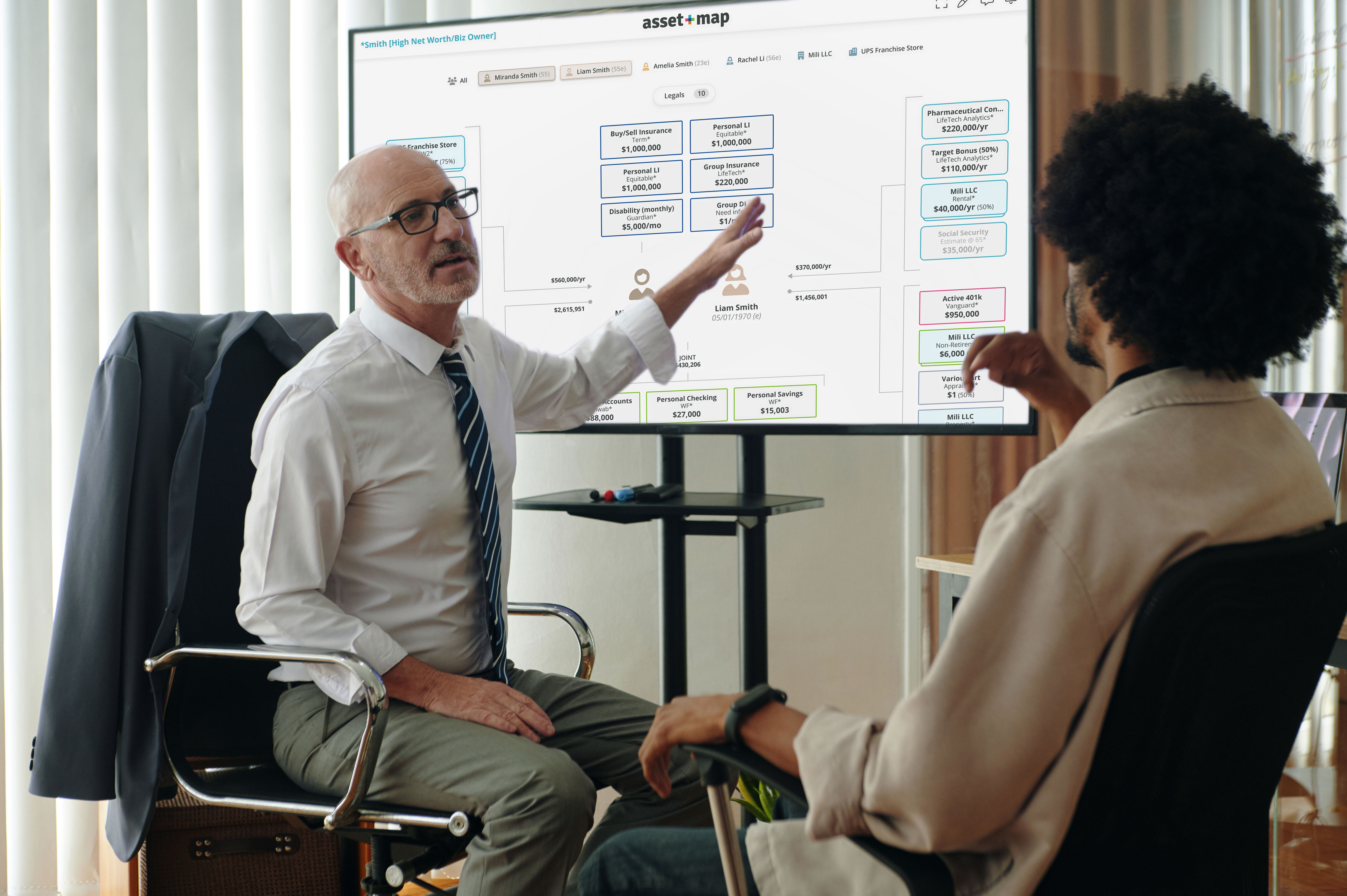
Asset-Map is the conversation layer for thoughtful financial advice. The platform starts with a rich visual of any household's financial inventory (members, entities, income, assets, liabilities, and insurance), so every client meeting starts from shared clarity. More than 2.5 million people across the USA, Canada, the UK, and South Africa are mapped in the platform, with over $3.4 trillion in financial instruments revealed. Advisors use Asset-Map because it reveals household financial decisions regardless of complexity, and enables productive conversations in minutes.

RightCapital is a capable cash-flow financial planning tool. Advisors who need deep tax modeling and projection precision have a good reason to use it. This page is not about whether RightCapital does its job. It is about where RightCapital lives in your practice.
The important question for professionals is simpler than feature checklists make it sound. As part of an advisor's tool chest, it’s critical to know when to use the appropriate tool. In an age of necessary differentiation there are tools for the advice conversation and tools for the analysis. AI is radically impacting the analysis functions of most advisors and financial planners necessitating the clear use for front-end and back-end tools. Asset-Map was designed for the front end, RightCapital was for the back office.

When AI handles the calculations, what is left for the advisor to deliver? The answer is the conversation. And the conversation is what Asset-Map was built for.
The Shift You Can Already See
Financial planning software was built for a world where the math was hard and the advisor's job was to do it. That world is changing. AI now runs Monte Carlo simulations, models Roth conversions, and projects cash flows in seconds. Clients can do this themselves with a few prompts.
What clients still cannot do is sit across a table with someone who understands their family, their priorities, and how every financial decision connects to the people they love. That is the work that compounds. That is what advisors get paid for now and in the future.
Michael Kitces named this category "advice engagement." Asset-Map's founder, H. Adam Holt, coined the term. The category exists because the industry recognized something important: the differentiation in wealth management is no longer computation. It is communication.
Asset-Map vs. RightCapital
Capabilities That Matter If You Lead With the Conversation
Two Different Starting Points

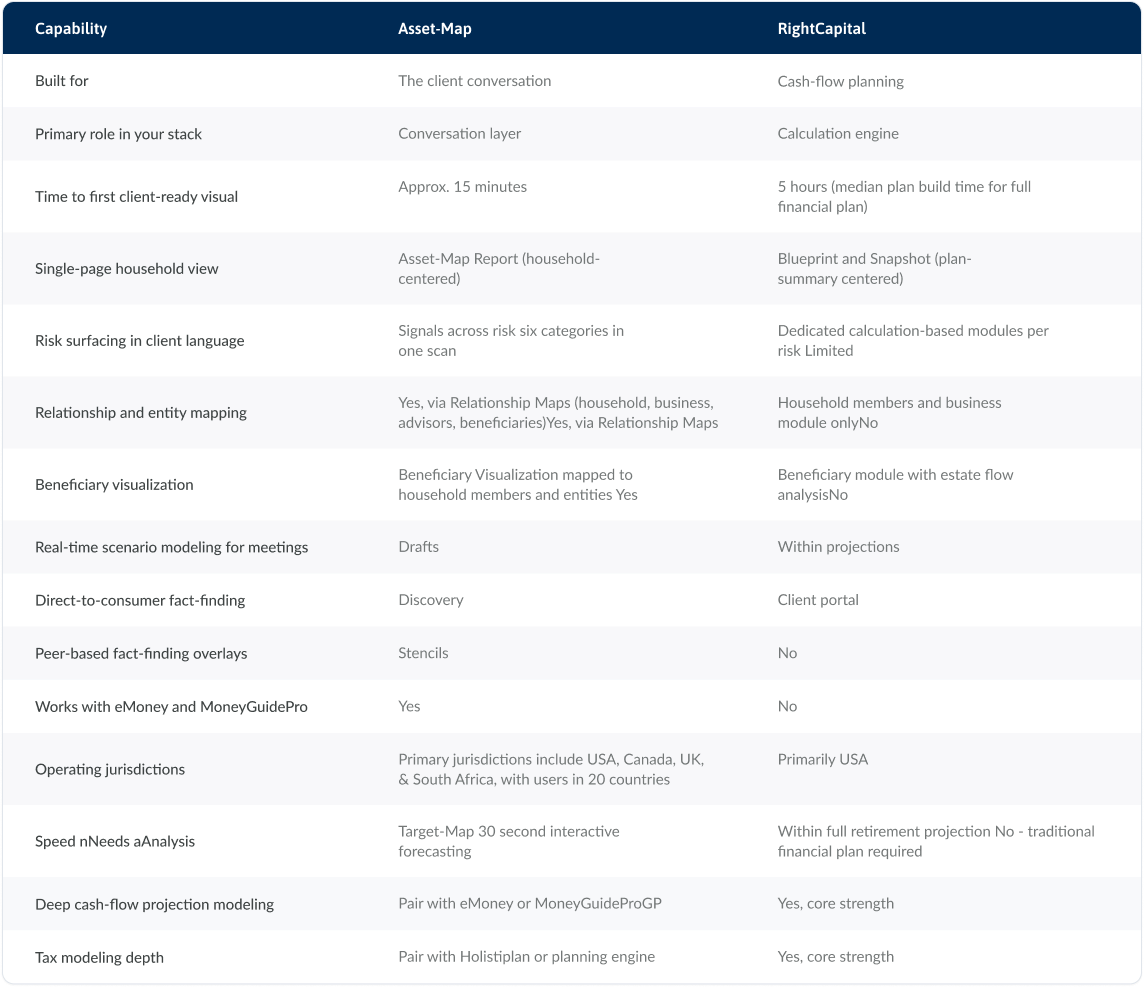
Asset-Map was built as a conversation layer. Everything in the platform, from Discovery, Signals, Target-Maps, Relationship Maps, Legal Documents, Beneficiary Visualization, Stencils, and Household Index, exists to drive client engagement and surface what matters in a meeting.

RightCapital was built as a cash-flow planning engine first and requires significantly more data to effect this analysis. Blueprint is a visualization feature inspired by Asset-Map and added as an accessory to keep clients engaged with the plan output. It is a rigid feature defending a calculation engine, not a native visualization designed for flexible conversations.
Client Service Model Segmentation
For thousands of professionals, Asset-Map is the starting point of the client service model. The first meeting opens with the Asset-Map Report to surface everything the household owns, owes, earns, and protects, along with the people and entities that matter to the decisions ahead. From there, eMoney, MoneyGuidePro, or another calculation engine takes over for the deep modeling and projections. That model works because the tools occupy important roles in the stack. Discovery comes before modeling. Conversation comes before calculation.
RightCapital's Blueprint feature diminishes that value proposition. Because Blueprint is RightCapital's simplistic attempt at a visual conversation layer, it misses the richness of conversations that require in-meeting pivots to talk about other members, views, shared interests including business, kids, trusts, that Asset-Map natively handles. The risk associated with using Blueprint as the conversation layer is that it leaves critical conversations off the agenda essential for holistic advice.
%20(1)%201.png)
Speed: Who Gets You to Clarity Faster
Asset-Map gets a household to a shared rich visual in fifteen minutes or less. The Asset-Map Report includes members, entities, income, assets, liabilities, and insurance policies on a single view. Designed for speed, Stencil templates let you surface what peer households typically own so the conversation can go deeper without any prep. Discovery sends a direct-to-consumer interview that pre-builds the Asset-Map Report before the first meeting.
RightCapital takes a different path. Building a financial plan in RightCapital takes a median of five hours, according to the Kitces Report. That investment pays off when projection precision is the deliverable. It does not pay off when the deliverable is a clear conversation.
Faster clarity means more effective meetings, quicker decisions, and more revenue earned per client. Speed is where the rest of the value chain starts.
Trust: Who Builds It Deeper
Trust is built when clients understand what they are dealing with. The 90-page report is essential diagnostic work for the professional. It is not what builds trust with the client. Trust is built when clients see their own financial picture clearly and understand the actions they can take today.
Asset-Map's Signals act as the check engine light of a household's ability to weather financial calamities. Signals instantly surface several categories of household financial risk (liquidity, long-term disability, loss of life, long-term care, longevity, asset location and liability) in language clients understand, so gaps are revealed in the meeting instead of after it.
Relationship Maps capture who actually matters to the decision: spouses, business partners, other advisors, and beneficiaries. The Beneficiary Visualization shows where assets will flow when a client is no longer here, which surfaces estate planning conversations that get skipped in projection-first tools. Drafts let you identify a modification in real time so clients see the before-and-after of a decision they are about to make.
Blueprint shows the two-party high-level inventory with no depth. Asset-Map shows the entire household and allows advisors to focus with intention. The household is what clients care about.
%201.png)
Growth: Who Drives Advisor Outcomes
The numbers tell the story. At a Fortune 250 wealth management firm, new advisors using Asset-Map earned 43% more revenue annually than non-users over a six year tracking period. In a separate study at a large broker-dealer, developing advisors using Asset-Map were twice as likely to retain at the firm after four years compared to those who did not. Where advisors have a choice of planning tools, Asset-Map is adopted voluntarily at a rate of 3:1 over traditional planning software.
These numbers exist because the platform was built to make the conversation work. Better conversations drive better client decisions. Better client decisions drive growth.

When Asset-Map Is the Front Office
Choose Asset-Map when missing data is an opportunity, not a problem. Traditional cash-flow planning stalls when something is missing. Asset-Map does the opposite. A gap on the visual draws the conversation forward and promotes attention, education and discussion. Clients see what is not there and tell you what they forgot, what they never thought to mention, or what they have been meaning to ask about. The visual identifies the critical discussions.
Choose Asset-Map when your practice is built on relationships and ongoing client conversations, not one-time projection deliverables. Choose Asset-Map when you want a tool that works the same way across prospect meetings, onboarding, annual reviews, and complex households. Choose Asset-Map when you push traditional financial planning to the back office domain of para-planners such as RightCapital, eMoney and MoneyGuidePro and need a true conversation layer to pair with your calculation engine. Choose Asset-Map when you serve modern households with relationship and financial complexity. Choose Asset-Map when you believe the advisor's value is the conversation that leads to decisions, not just the math.

When RightCapital is the Front Office
If projection precision is the primary deliverable in your practice, and your client meetings revolve around running cash-flow scenarios in detail, RightCapital is built for that work. The cash-flow engine is strong, the tax planning tools are well-developed, and the Sankey-style visualizations are useful for advisors who want to anchor conversations in projection output.

The AI Question
Advisors who build their value on calculations alone are building on ground that is shifting underneath them. AI is going to handle the math more effectively than any fixed calculator going forward. The question is what you are building on top of.
When calculations become the commodity, the advisors who differentiate are the ones who facilitate better conversations.
What Advisors Say
"The best way to measure the value of technology is to understand what your firm would be like without it. Asset-Map is like coffee for me and my clients. It is an essential part of every day."

Molly Ward, CFP®
"When I first saw Asset-Map, it was like a light bulb went off. Asset-Map gave us exactly what we needed to show our clients a simple and intuitive visual that explains their financial plan."

Marty Higgins, CFP®, ChFC
"My work is predicated on the ability to provide good advice. Asset-Map gives me one page to show a client's financial situation, and one more page to go through their goals with Target-Maps. Instead of printing stacks of paper, we can look at two pages and do it all virtually."

Mark Hannah
"Signals gives advisors and clients a measure of financial success through six key components. We look at those for every single household to scan financial health. It has allowed us to completely standardize that process."

Eric Negron, CEPA®
Frequently Asked Questions

Yes. Asset-Map is the conversation layer that begins every client relationship, and it works alongside back-office calculation engines including RightCapital, eMoney, and MoneyGuidePro. Not every client needs a full financial plan, which is why many advisors use both types of tools to serve the diversity of their client base: Asset-Map for ongoing meetings and client engagement across the entire book, and RightCapital, eMoney, or MoneyGuidePro for the episodic projection planning that specific households require. Lead with Asset-Map to open the conversation and uncover the full household, then bring in the calculation engine when deeper modeling is warranted.
No. Blueprint is a back-end visual summary generated after the plan is built. Asset-Map is the front-end discovery and conversation tool that opens the relationship, surfaces the full household, and drives every ongoing meeting. They are not the same job, and the order matters: Asset-Map starts the conversation, calculation engines do the modeling, and any output summary follows from there.
Blueprint is a visualization feature inside a cash-flow planning tool. Asset-Map is a full platform built from the ground up to layer client engagement over the lifecycle of a client, with Discovery, Signals, Target-Maps, Relationship Maps, Beneficiary Visualization, Stencils, and Drafts working together to drive the conversation.
Yes. Asset-Map integrates with eMoney, MoneyGuidePro, and other leading planning tools. Most Asset-Map users pair the platform with a calculation engine so each tool does what it is built for.
Conversational financial planning is the practice of actively organizing and discussing a household's financial life around the client conversation rather than strict analytical presentation. The goal is to surface priorities, identify gaps, and drive decisions through educational clarity rather than computation. Asset-Map pioneered this category, and Michael Kitces formally named it advice engagement on the Kitces AdvisorTech Map.
Asset-Map. The platform was designed for trust building conversations from day one, while RightCapital was designed for projection precision with Blueprint added later to check the box and compete with Asset-Map's visualization layer.