
Ep08 - Rethink: Paid vs. Organic Digital Marketing
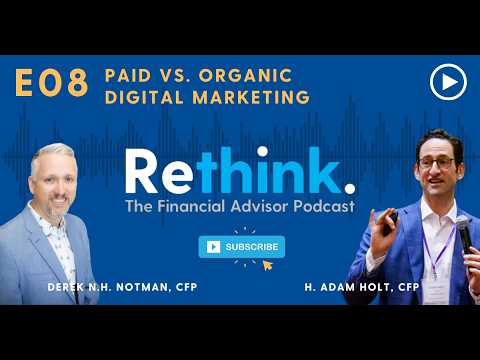
Watch and Listen
Episode Summary
Following up on their prospecting-versus-marketing debate, Adam and Derek turn to a practical question: what should a financial advisor actually pay for online, and what can be built for free? They define digital marketing for advisors who 'never really learned marketing 101,' then walk through SEO, SEM, social media, content marketing, and email/marketing automation one by one. Throughout, they stress that most advisors have never spent a cent on advertising and instead built businesses on referrals — so the episode is framed as a crash course for advisors starting from zero. The tone stays light while covering genuinely tactical ground on budget allocation.
What This Episode Covers
- Defining digital marketing for advisors new to the concept
- Search engine optimization (SEO) and long-tail keywords
- Search engine marketing (SEM) and paid search
- Social media as a form of online networking
- Content marketing, authenticity, and email/automation workflows
- Deciding what to pay for vs. what to build organically on a tight budget
Full Transcript
Full timestamped transcript.
[00:00:00] H. Adam Holt: Welcome to Rethink: The Financial Advisor Podcast. My name is Adam Holt.
[00:00:06] Derek Notman: And this is Derek Notman. We are your hosts, both veteran advisors and fintech CEOs who challenge the status quo, question everything, and have fun doing it. Hear honest commentary on the challenges facing advisors today. And be part of a community where we can all rethink the profession.
Now on to our episode. Adam in building your marketing brand what should you pay for and what should you not pay for?
[00:00:37] H. Adam Holt: Well, I, I don't know. I, I don't pay for anything. I don't wanna pay for anything, frankly. You, you know, it's funny because most of the advisors we talk to have never paid a cent for advertising.
We talked about this at the last... It's last month. Yeah. Yeah. But, but we thought that this... That's, this is not actually the question, and I'm, I'm glad you asked it this way because most of us in financial advice, as we've said before, learn prospecting.
[00:01:05] Derek Notman: Yeah.
[00:01:06] H. Adam Holt: We learned how to network, we learned how to call our family.
We learned how to ask our cousin for business, and our neighbors, and people we felt uncomfortable with. But we never really learned marketing 101 as well as what we now call digital marketing today. So I, I think we should talk about, we should really educate everybody because the marketplace has changed for marketing.
[00:01:30] Derek Notman: It certainly has. So it's... We're almost taking a step back. So advisors, like, take a step back and listen, we're gonna give you some really cool insights here into what actually digital marketing is. Let's define that.
[00:01:42] H. Adam Holt: Mm.
[00:01:42] Derek Notman: And then we can figure out, like, what the heck do we pay for and what don't? Because yeah, it is super overwhelming, um, to try to learn all this stuff, especially if we're newer and we're learning about, like, what products and services and planning techniques we're all focused on.
I mean, that's, that's our job. We're advisors, we're not digital marketers. Mm-hmm. But digital marketing's extremely important to tell your story and acquire new clients. Absolutely. So we're gonna drop in and just tell you how it is, man. Here we go.
[00:02:05] H. Adam Holt: Great stuff. Well, so one of the things that I learned at being a, a fintech CEO is that I knew nothing about marketing.
I, I thought that it was advertising. You buy some, you buy some advertising or you pay an agency, they do a bunch of stuff, and you got a cool logo, uh, and next thing you know, there's business in the door. That's not the way it works today.
[00:02:20] Derek Notman: Mm-mm.
[00:02:20] H. Adam Holt: Nope. And clearly for those people that are starting with a scrappier budget, right, they have no budget, uh, and they're willing to do some work on their own, there's some fantastic ways for you to generate what we would call organic interest.
That means it's happening naturally because you're doing the right kinds of things. But you really need to understand the space so you know what to pay for and what not to pay for. So this term of digital marketing, um, is actually, if you search it, is, effectively it's the promotion of brands to connect with potential customers using a different medium than normal, right?
The internet and other forms of digital communication, your phone, social, a whole bunch of other stuff. And what we found when we did this research to try to communicate this to you, how do you, how do you, how do we communicate this to you in 30 minutes? Well, there's a couple things you might wanna write down.
Um, the, the first four that come up for most, most organizations that define this is, number one, search engine optimization, right? SEO, you probably heard that term before. The second is so- uh, search engine marketing. Okay, number two. Probably these first two you're not gonna do too much. We'll explain that in a second.
The third is social media marketing. Now, we probably can understand that. And the last is content marketing. All right? So we're gonna explain these to you. But it does also include some other elements, including email- marketing automation- Mm-hmm ... and digital advertising. Now, okay, Adam, that was technical, more technical than we like to get, right, Derek?
One of the things that I, that I really took away from all that research that we did for this is that all of these include some form of call to action, a CTA. This term you will hear a lot, because CTA, or call to action, means you're asking someone who's engaging with whatever they're doing in the marketing effort to do something, to take some action.
And it's important, because a lot of us who learned how to ask for the business or ask for the appointment, that was the call to action, the moment when we ask somebody to take the next step, and it has to be present in marketing for it to be effective
[00:04:23] Derek Notman: I love how you broke that down, and don't worry, folks, we're not gonna get crazy technical on here.
You just, uh, need to understand how these things are, what they are, and how they work at a general level. That'll be enough for today. Um- Yeah,
[00:04:35] H. Adam Holt: that was it. Bye. Good
[00:04:36] Derek Notman: night. Um- So I hope you had a great day, and you know, I'll see you. Um-
[00:04:40] H. Adam Holt: Hopefully that was helpful. Yeah.
[00:04:41] Derek Notman: Yeah. That, that was helpful, right, guys?
Okay.
[00:04:43] H. Adam Holt: Yeah. Uh- Well, I want... Th- this is good. So Derek, would you take us through SEO? Because search engine optimization is, is something we've all heard before. What is, what does that mean?
[00:04:52] Derek Notman: Yeah, so, uh, uh, SEO is, is this, this technical thing where, so Google and other search engines have what are called bots and they're algorithms that are looking for types of content.
Now, the beautiful thing about Google and other search engines is they can be predictive and they know what people are looking for, okay?
[00:05:14] H. Adam Holt: Mm.
[00:05:14] Derek Notman: So then what they're gonna do is say, "Okay, well, everyone's looking for retirement planning, you know, for police officers." Let's just throw that out there as a whatever.
You know, it could be anything. All right. Well, now Google searches the ether, right, the internet, to find out, "Okay, well, who's written about, uh, retirement planning for police officers?" And lo and behold, Joe advisor in Nebraska has a, a blog article about it. They didn't pay a penny to, to get any type of results, but now they're showing up on page one of Google.
That is search engine optimization, because the g- Joe in Nebraska who wrote that blog post, if they did it correctly, either by themselves or with their team, knew that people were searching for that topic and then wrote their blog post in a way where Google would say, "Hey, this is exactly what people are looking for.
We're gonna serve it to them now." Um, it's all organic, but you do, it's still competition, right? 'Cause you're competing with other people who are trying to do the same thing. So it's, there are technical aspects here about that. Um, like, you know, retirement distribution plan is another thing that you could have for police officers.
You could get really, really, uh, in the weeds on this. But at the end of the day, that's what SEO is. It's for content on your website to get indexed by Google and ranked by Google as a, as a value add, as, as a, as a key source of information that people are looking for.
[00:06:42] H. Adam Holt: Mm-hmm.
[00:06:43] Derek Notman: Okay? And then they're gonna fi- find that, Google's gonna find it, and then it's gonna serve it to people searching for, for that information.
Um- Yeah ... and then eventually that starts them down that path, right? So it's, it's really interesting, but the thing about Google is, three, you can go figure out what people are searching for, and you can see how competitive that keyword is. A keyword, it would be like reti- so keywords are th- certain things.
Like, when you go into Google and say, "The best pizza shop near me," that's a keyword phrase, right? So Google knows that, so when you put that into your blog post as a title, Google's gonna index that and then serve that up to people that are looking for that thing. I don't want to go down the black hole here, Adam, but that's essentially what SEOs is
[00:07:25] H. Adam Holt: How does it work?
Explain how the algorithm... W- what, what is the code line on 423? Yeah. Yeah, so the interesting thing I learned about this, um, we did wind up hiring actually a firm to explain this whole thing to us, 'cause we, we're, we're... we realized we didn't know what we were doing, um, on this topic. Uh, but there's a couple things I learned.
Number one, as Derek already said, to, to summarize that, keywords matter. You can be intentional about the keywords you want your ideal customers to be searching, and actually embed it throughout the content that you create, whether it's your website, blogs, social, everything. 'Cause remember, when you go to Google, it looks for everything.
It's looking media articles, YouTube. Yep. It's looking for everything that could be relevant. And what it actually, the algorithm we understand, is looking for actual reference support. In other words, if you, if, if you just put a bunch of tag words like retirement planning in your content and you don't have any backlinks that have credibility- Yeah
in the space- That's spamming ... you're not gonna be on page one, okay? And the problem is, is that if you're not on page one, what, but who cares what page you're on? Because, right, page one would be of 100 million results. How do you own a keyword? In fact, it's really difficult to own a generic keyword like financial planning or like investment advice.
[00:08:38] Derek Notman: It is
[00:08:38] H. Adam Holt: very difficult. Because, right, because you're competing against the mega machines that are gonna put out an enormous amount of content to control or- that organic. So we're gonna get into paid in a second, but the, the, the key is you wanna be very specific if you're gonna try to do SEO. And, and, uh, my argument is if, if this is important to you, you should pay a firm to do this for you.
Don't try to learn this. There are organizations that have figured out little nuances on the algorithm to make it work for you. If you wanna be in the top search organically, uh, this... So we're gonna move on from this because many advisors, Brian, never gonna actually try to do this, but if you're gonna do it, we think this is one of those moments where you pay for somebody to do it
[00:09:17] Derek Notman: 100%.
[00:09:17] H. Adam Holt: Let's talk about the second, uh, which, uh, which is, all these, I love these acronyms. This is search engine marketing. Now, this is actually a little bit different because this is how you can pay these search engines to put yourself at the top. Do you have any experience with this one?
[00:09:34] Derek Notman: Uh, just briefly, 'cause honestly I don't have a budget that can compete-
[00:09:38] H. Adam Holt: Yeah
[00:09:39] Derek Notman: with, um, the big brands out there that can throw tens of thousands, millions of dollars at these things. So yeah, it's like when you do a Google search and you see the first four or five results, they say the little word ad right to the left of them.
[00:09:52] H. Adam Holt: Mm-hmm. I've seen that.
[00:09:53] Derek Notman: These are people that are paying, companies that are paying to get their visibility boosted on Google.
Google serves that up. It charges them, uh, you know, they can do like a click, like they get charged per clicks or per views. Um, and that way you can get further up there. But I don't know about you, but whenever I go to a Google search, I skip all of the ads- ... and I go straight down to organic. I don't click on any of the ads at all, and I go straight to organic.
Even, like let's say I was searching Asset-Map and you had a Google strategy in place.
[00:10:24] H. Adam Holt: Yeah,
[00:10:24] Derek Notman: we do. I wouldn't click the Google ad for Asset-Map. I'd go to the organic one.
[00:10:28] H. Adam Holt: Thank you. Save me like 10 cents.
[00:10:30] Derek Notman: Well s- it's, it, there's some altruism there, right? I'm trying to like help you out a little bit, brother, you know?
I mean what-
[00:10:36] H. Adam Holt: Thank you. It all adds up.
[00:10:37] Derek Notman: It all adds up. But so I mean, SEM can work. You can do okay by paying just to get like things up there, but I'm not a big fan of it, to be perfectly honest. If you've got a marketing budget that like a BlackRock or a Fidelity does, like that works. They know they get some ROI there.
But for- Mm-hmm ... a solo sh- advisor shop or a smaller shop, it's tough. Yeah. You know, as for example, I go back to the SEO thing, if you Google virtual certified financial planner-
[00:11:04] H. Adam Holt: Yeah ...
[00:11:04] Derek Notman: I am, my firm is the number one organic result. I own that.
[00:11:09] H. Adam Holt: Is that- But- ... that's because you're specific to those terms. Say that term again.
[00:11:12] Derek Notman: Virtual certified financial planner.
[00:11:15] H. Adam Holt: Okay. So somebody would have to search that specifically-
[00:11:18] Derek Notman: Yep ...
[00:11:18] H. Adam Holt: for you to come up number one. '
[00:11:19] Derek Notman: Cause if you do certified financial planner, everyone's got that out there, right? That's a tough one to compete with. Yeah. But part of my d- definit- part of my value add for my financial practice is that I'm virtual, right?
So I throw that in there- Yeah ... and boom. Now, I don't need tens of millions of people searching that. I need a couple. So it just shows that SEM, it would be tough to do
[00:11:37] H. Adam Holt: I agree with you and, and my conclusion on this one is that we, we did try this and we actually, our... the company that we hired to help us, now we've gone through three companies until we found the company we like.
So pay attention to that. Sometimes you don't always get the best relationship-
[00:11:50] Derek Notman: Yep ...
[00:11:50] H. Adam Holt: that's at least educating you and you know why you're spending all this money.
[00:11:53] Derek Notman: Yes.
[00:11:53] H. Adam Holt: Uh, 'cause you don't always see results until six to 12 months out, and you're wondering why you're burning this money on this stuff. It, it's interesting, if you have a name or a brand in your firm that is something generic like Incentive Financial or Ascension Financial, like we tend to put these very kind of, uh, strong, uh, adjectives in front of our brand names, but if someone were to search that, there's some, uh, other firm that would buy they bought the word financial planning, so they're gonna actually come up ahead of you, and that's one of the reasons why we actually bought our own name.
We buy Google Asset-Map so that any other company that tries to do, you know, use Asset-Map and beat us organically, we'll always still be at the top for the people who are actually seeking us. And I thought that was an interesting strategy. But again, here this is... You have to have a budget for it, and I don't know- Yeah
for most advisors that that's worth it. So I'm a big blah, I'm a meh on this one.
[00:12:47] Derek Notman: Eh.
[00:12:47] H. Adam Holt: Yeah. I'm not really like... I don't see it for most financial advisors. I, I, unless, you know, you're, you're big and you wanna be huge and you gotta, you know, money to burn, I don't see this one. I haven't seen it work. How about that?
Um, but look- I agree ... so let's talk about the one that we do like. Like this social media marketing has been something that both you and I have gotten into. Help us understand how do you f- how do you kind of contextualize social media marketing? It's big
[00:13:13] Derek Notman: It's a networking event that's online. If you just- I hadn't heard that
want to sum it up. Yeah, I mean, that, that's- All right,
[00:13:18] H. Adam Holt: great. Next
[00:13:19] Derek Notman: That's it. Yeah, next. Hope- Hopefully that works, guys.
[00:13:22] H. Adam Holt: I don't know what I'm doing at a networking event. Yeah. I'm
[00:13:24] Derek Notman: a
[00:13:24] H. Adam Holt: wallflower, yeah.
[00:13:25] Derek Notman: Yeah. I, I don't- That's true But it's true. You could be a
[00:13:28] H. Adam Holt: wallflower.
[00:13:28] Derek Notman: You could be a wallflower. You could be that creepy guy or girl by the fake plant in the corner watching everybody.
That doesn't work out. Isn't that the
[00:13:35] H. Adam Holt: wallflower?
[00:13:36] Derek Notman: Yeah, right. You know, they've got that drink they've been nursing for four hours. Um-
[00:13:41] H. Adam Holt: Right. Holding onto their business cards in their left hand like, "
[00:13:44] Derek Notman: Come on over." Please, come over here.
[00:13:45] H. Adam Holt: Come talk to me.
[00:13:46] Derek Notman: Oh. Now, social media marketing, um, it's, it's really cool.
It, it's, um, there's an art and a science to it, and it can be extremely powerful if you do it right, 'cause you can do this wrong. For all of us that learn how to prospect in our early days as advisors or who are being told to prospect now and cold call people, um, don't do that on social media. It doesn't work.
Um, s- it, it's really a beautiful place where you can grow a tribe of people that are like you, that wanna hear what you have to say and vice versa. And then you can create awareness around that. Education, awareness, calls to action, uh, to get people to come through your... I, I'm not, I'm not gonna call it a funnel anymore.
I'm gonna call it, like, a sales or process cycle now, okay?
[00:14:39] H. Adam Holt: Nice. I
[00:14:40] Derek Notman: like it. Um, we have to have someone on here that is gonna argue that the funnel is still there, 'cause I don't think it is. I think the funnel's dead. Um- Anyway, so I, it, you can, y- it's, it's really an amazing thing, but the, the social media companies have recognized this.
They're doubling down on content creation especially, but they've got these black box algorithms that we have- Mm-hmm ... to learn how to manipulate. Maybe manipulate's not the right word, but leverage, let's call it
[00:15:08] H. Adam Holt: that. Take advantage of? Yeah.
[00:15:08] Derek Notman: Take advantage of, um, to be able to tell our story more, because the challenge now with social media is that a lot of people are on it.
Um- Mm. Gary Vee just said last month in a podcast that LinkedIn is in the golden era, uh, between 2017 and 2023, and that people are gonna be crying if they don't get involved now and looking back at it.
[00:15:30] H. Adam Holt: Um-
[00:15:30] Derek Notman: Hm,
[00:15:31] H. Adam Holt: that's interesting.
[00:15:31] Derek Notman: Yeah, it is. But, like, LinkedIn is adding a new user every three seconds.
That's 28,800 new people on LinkedIn a day.
[00:15:38] H. Adam Holt: Wow.
[00:15:38] Derek Notman: Right? So people are going to these places, and-
That means we've got competition there, but that's also, that's like a double-edged sword because it also can work really well for you if you do it correctly. I could go on and on and on about this. Um-
[00:15:52] H. Adam Holt: Yeah, I have questions for you. I have questions for you. Jump
[00:15:54] Derek Notman: in. Give me some questions.
[00:15:55] H. Adam Holt: So, it's interesting you say that.
Why do you... Because there's been this big question about whether our ideal prospects, 'cause we're still talking about marketing for financial advisors.
[00:16:03] Derek Notman: Yes.
[00:16:03] H. Adam Holt: How... Are, are, are our prospects on LinkedIn? Are they Facebook? Are they on Twitter? Are they Instagram? What, where are my ideal customers?
[00:16:12] Derek Notman: All of the above.
How do I focus?
[00:16:13] H. Adam Holt: All of the above. They're on all the... Okay. So how do I know where my ideal customer is, or what message to give them? Like, when they're going to Facebook, what's the... How do I know what I should be creating content-wise for those people- Well- ... versus the LinkedIn people, Instagram?
[00:16:28] Derek Notman: You have to know who you're talking to.
[00:16:30] H. Adam Holt: Hm. Okay.
[00:16:31] Derek Notman: If you... We talked about this in a previous episode. If you don't know who your ideal client is, who your identity is, remember all, we've talked about this multiple angles already. If you don't know that, then how are you gonna know who you're gonna talk to or where to go? Yeah. If you know who your ideal client is, then you're, you're gonna be able to figure out pretty quickly where they hang out online, okay?
If your ideal client is 22-year-old, uh, influencers, they're probably on TikTok or Instagram. They're not hanging out on LinkedIn a whole lot.
[00:17:00] H. Adam Holt: Hm.
[00:17:01] Derek Notman: And vice versa. So you gotta know where your, your people, uh, your tribe is hanging out. And what do you say? Like what do you say to them, Adam? Well, you, you talk to them about like who you are.
You resonate with them. You show them you understand them. Like it's just, you don't, don't talk about whole life, please. All right?
[00:17:16] H. Adam Holt: You know? Um, that, that,
[00:17:18] Derek Notman: that can happen-
[00:17:19] H. Adam Holt: Yeah. Okay ... on
[00:17:19] Derek Notman: a one-off conversation after they wanna actually talk to you.
[00:17:23] H. Adam Holt: Yeah. So that's interesting. W- what we've learned over the years of, of using these different tools is how robust the data is that these companies have.
Oh my gosh. When you think about it, they know what you're looking for, what you're searching for, what you connect to, who you're connected to, who you like, who you, who you comment on, and what are their preferences. And you can imagine this massive web of an algorithm that can kind of direct, uh, the right message to the specific party and at scale.
That's, that's the power, the scary power of the social media network. And if you've seen recent, uh, documentaries on it, I think they kind of will freak you out. The question is how do you use this? 'Cause it's here to stay, and, and as Derek said, it's growing. For many years, the broker-dealer compliance in our space has b- really restricted, we'll call it authentic utilization of social media, right?
You had to use- Yeah ... pre-approved, canned, ghostwritten, uh, you know, articles out of some of the major companies out there that had been, you know, vetted 10 times from FINRA. Uh, which basically means it, it connected with nobody and educated everybody, but didn't necessarily get them to take action or associate any kind of real value to you other than the fact that you just served it up to them and they saw your name.
So it was really a top of mind awareness campaign, maybe I'm putting content in front of you that you care about. That being said, we- we're starting to see that change, um, as I think compliance teams are getting more supportive of authentic content. Podcasting by advisors is becoming more popular, um, especially in social media.
But I think the whole key to this thing is, number one, you gotta figure out a way to start gain- gaining a following, building that network. Um, one of the things that I think is amazing that you've been able to do is just expand the number of followers and connections that you have in such a short time.
How did you do that? How did you actually expand your network from the...
[00:19:12] Derek Notman: Yeah. Uh, yeah, I mean, it's, it's a couple things. It's being consistent, so I show up every day to this online networking party. Um, I create content instead of just creeping and watching whatever the people are doing.
[00:19:25] H. Adam Holt: Hmm.
[00:19:25] Derek Notman: Um, I found my voice in a way.
I just started talking. Um, I think one of the big challenges with the, the compliance side is advisors are scared, um- To do things because compliance won't let them. And I would go back to you and be like, "Okay, if you send an email to a client or you're in a meeting with a client and you're talking about a concept, uh, or an event that happened in your life or something that you learned or s- you're talking about something personal, are you asking compliance for approval for any of that stuff?"
[00:19:55] H. Adam Holt: Mm-mm.
[00:19:56] Derek Notman: No. You're not. You're not asking compliance. You're asking approval for, like, illustrations and products and marketing, like specific marketing pieces that are related. Investment
[00:20:04] H. Adam Holt: recommendation and that kind of stuff.
[00:20:05] Derek Notman: Yeah. That stuff, I mean, that should be. So if you're gonna, if you're gonna do social media stuff about that, then darn, you darn right your compliance is gonna have a say in it and, and view it.
And they have a mandate from FINRA that they archive all of it anyways. But if you're talking about just who you are as a person and your values and things you've learned and interesting topics and questions that are not product, service, investment related, then just go say those things as long as it's archived.
That's okay.
[00:20:31] H. Adam Holt: Mm.
[00:20:31] Derek Notman: Uh, 'cause a lot of the BDs have done a good job at least of bringing tech on where they can automatically archive all content- Mm-hmm ... which is what they're supposed to do, and then they can review it and see if there's any issues So I think that that's really, really important. Um, I'm kinda going down the black hole here now, but, um-
[00:20:47] H. Adam Holt: Yeah, well you, let me summarize that because y- so you're saying that, that your strategy has been to be authentic and be committed and to, to, to stick with it, right?
So that's how you've organically grown your following. You did it without necessarily paid components, right? You're, you're doing a lot of that work yourself.
[00:21:04] Derek Notman: Oh, 100%. Yeah, like, yeah, n- uh, we're, we're doing some paid now, but for quite some time it was all organic. I showed up, I did a post. Mm-hmm. Learned how the al- you know, how some best practices for LinkedIn es- uh, you know, especially, and, and leveraged those.
Um, and then just went from there, and the thing has just grown exponentially. It's amazing what can actually happen in a rather short amount of time, too.
[00:21:27] H. Adam Holt: I tend to agree with you. The, the authentic voice is really the best. The challenge most advisors have, besides the compliance one, is they just don't have the time to keep creating the amount of content that normally it takes to kinda keep up or be relevant.
Um, I, I would, I'd kinda give yourself a little bit of a, um, we'll call forgiveness here. It's not that you have to write every day. It's not that you have to create content. It's that you have to be involved at the party, right? Sometimes showing up to the party is 90% of it. That means- Yeah ... even if you show up, you comment on somebody, you repost it, you com- you say, "You know what?
I agree," or, "I disagree with this," and you start a conversation, and that actually creates, actually lifts your awareness, uh, in the piece here. Remember that in many ways, the social media, the number one usage of your social profile and the activity that you create is, it is your background check. That means when prospects are looking at you, they look at your website, then they immediately go to your social profile, typically LinkedIn 'cause it's the business side of it, and they start checking out who do you know together.
And then they start checking out what, where did you actually go to school and where did you work? And then they look at your activity, and they see what you post, and they see what you like, and now they get your political flavor, and they get your... right? So they're getting a feel for what you care about, too, the way that you would probably prospect them or at least, uh, figure out who- whether they're the right candidate they're looking at.
So sometimes it's also just about building the resume you want people to see, um, because it is public and it lives forever. So again, I, I don't, my, my, my conclusion to that, so we can move on, is that- There are some fantastic tools that you might wanna look up, like creating an engagement pod amongst your, your community of peers, something that we've played with.
Uh, just Google that. And what is an engagement pod? Something that you might wanna put together. Fantastic way for multiplying content. Um, there are also tools that allow you to write all your posts and then have them post throughout the week. So if you wanna spend the weekend writing your stuff 'cause you can't stop during the week, you don't have to do this just point in time.
There's many... There's some really great tools out there that'll let you automate a lot of the social posting, uh, and awareness and, and liking. But that's the key, just be engaged.
[00:23:31] Derek Notman: Yeah. Be- show up to the party. Let's start there and then go from there.
[00:23:34] H. Adam Holt: Yeah. Show up to the party and, and participate, right?
Yeah, participate. Like, cheers everybody. Say hi. Yeah. Uh, and then also say goodbye, right? Don't just disappear, right? Right, right. So they... So that they know to invite you the next time. That's another thing, right? Sometimes this, this gets very social in its, in its, kinda, roots. The, the fourth piece here, um, is, is really, uh, you know, it's content marketing.
How, how do you create all of this content? And I know that in many ways a lot of the content is around this idea of making you a subject matter expert, some authority, um, on the content that you're generating. And, and I l- I look at this, Derek, very much like magnets. These are magnets that are attracting your ideal customers who have these pain points to your content because you are an authority, they're curious, they're interested.
Um, whether it is a technical subject, like I wanna talk about estate planning and the taxes and how do you structure a life to reduce taxes, okay? Or it could also be interest-driven. How to have the most fun in retirement being a golfer in Florida, right? It can be that content that's gonna really align with your, with your prospects.
What have you seen in terms of the more effective content that's created out there?
[00:24:48] Derek Notman: Well, it's interesting. I th- I think before we even get to effectiveness, I think a lot of advisors have bought into, like, yeah, okay, this stuff makes sense, 'cause most of us have downloaded an e-book or read a, a, you know, a, a blog post and got some value out of it.
But reading one or downloading one is a lot different than creating one.
[00:25:05] H. Adam Holt: Hmm.
[00:25:06] Derek Notman: So o- you can have a lot of ROI here, but I'm not gonna, like... Take your rose-colored glasses off here because this is a lot of work. Social media posts... There we go, Adam, he took his glasses off. That's awesome. Guys, I
[00:25:20] H. Adam Holt: can see. Who are you?
[00:25:22] Derek Notman: Um- Social media posts is probably the easiest thing out of all of this, but blogs, e-books, books, white papers, infographics, podcasting, all of that stuff takes a lot of work. Um, I would say yes, you need to invest in this, and do not ex- first, do not expect results overnight. Um, and know it's gonna take some time.
And what I tend to guide advisors on this strategy is you should probably do some of this stuff yourself first and spend the time on it, because it's gonna help you find your voice, your persona, your style of writing and communicating. And then at some point, once you've figured that out, then you can go hire some people to help you do these things, you know, whether you're collaborating or just completely outsourcing it, 'cause it is a super big time suck to do these things.
[00:26:10] H. Adam Holt: Mm-hmm.
[00:26:10] Derek Notman: Um, they're s- they're extremely important. Uh, if you go back to search engine optimization, um, they look for stuff like this. They're looking for constant contact, uh, content being uploaded to your site and all these things. So it's there. Gotta feed the beast, but it takes a ton of work. So-
[00:26:26] H. Adam Holt: Mm-hmm ...
[00:26:26] Derek Notman: do it.
Do some of it yourself first, and then when you find a firm that you like, be like, "Hey, here's how I write a blog. Here's how my social media posts look. Here's how my e-books look so far. Go replicate this." Otherwise, if you go and you've not done none of it 'cause you just don't wanna be bothered, now, uh, any firm you hire is gonna white label it, and now it's not gonna be you anymore.
It's not gonna be your persona. And as you just said, Adam, people wanna work with sub- subject matter experts that they know and trust, that they can connect with on a human level.
[00:26:54] Announcer: Mm-hmm.
[00:26:55] Derek Notman: And if your, your content's just plain vanilla, they're gonna know that 18,000 other advisors have written the same blog post, and they're not gonna get any value out of it, which means no lead, no business.
[00:27:06] H. Adam Holt: Yeah, that, that's a great point, and I, I think the, the real big question in content is, is are you gonna create it or are you gonna have someone else create it? I, I happen to think that there's, that the requirement, the con- the need for creation of content is so high, you probably have to ... You can't make this one your day job.
There's some interesting scrappy tools that I've used. I, I tend to use, um ... I, I, I really like the audio model, right? So I come up with the ideas and I dictate them, and I either dictate them into my, my system that transcribes the whole thing, and then I send it to a copywriter and they write it, and then I get to edit.
Uh-huh. Uh-huh. 'Cause it's a lot easier to edit. Um, and they'll, they'll write it. You know, they'll think about the open, the close, the end, the call to action. The
[00:27:45] Derek Notman: SEO, the
[00:27:46] H. Adam Holt: keywords. The SEO, yes. They'll do all that, and I just have to show up and, you know, fix a couple language components or, you know- Exactly
whatever. And that's great, and then they'll get it out, right? I don't ... It doesn't make sense for Adam to do that. Um, although I did a lot of that. The other thing is that there's plenty of media outlets. There, there, there's such a demand for content today, original content. You can get many of the news media like NASDAQ, Forbes, um, ThinkAdvisor, Investor Perspectives, uh, Advisor Perspectives, these companies all want your content.
You can actually become a ghost writer for them, and they'll publish your articles if they're good enough and they're unique, and you now can create what seems like a t- you know, traditional media authority that's not, that you then- Yeah ... socialize by p- you know, posting in your social media. I, I would tend to say that the easiest thing to do early is clearly the social posts.
Um, the things that we're hearing are getting the most traction are lists still to this day. You know, David Letterman did it great. He's the top 10 lists, right? Top six reasons why people- People love it ... are here. S- top six things you gotta do when, you know, you pass away, or you're gonna take Social Security or These topics, people love that because, you know, if you can bubble something complicated down to three steps, you know, that's what we try to do here in a way to how can we take a complicated topic and make it 1,800 steps if we're to make it easy for you.
You know, um, but that's, that's the point is, is just think about what's easy early. Um, if you're gonna do stuff like books and you're gonna try to do infographics, y- you're gonna want professionalism here. Don't do scrappy there, um, because- Get some
[00:29:15] Derek Notman: help. Yeah. Yeah. Yeah, for sure. It's
[00:29:17] H. Adam Holt: a lot of work to do it right.
People have a high, you know, they have a high expectation for quality, and they want it to all look like McKinsey made it. Um-
[00:29:24] Derek Notman: Ain't gonna happen ... but
[00:29:25] H. Adam Holt: it's, and it's not har- it's not easy to do on your own. So pay for this one. You know, a,
[00:29:28] Derek Notman: a quick call to action on this one, just- Mm-hmm ... 'cause it is overwhelming.
[00:29:31] H. Adam Holt: Love
[00:29:32] Derek Notman: it. Create some social posts around different topics that you think are interesting and, and not just about products or investments, please. Whatever one does the best organically, has the most engagement, take that and further that by creating maybe an e-book or a graphic or a blog post around it where you can create even more value 'cause you know people already like it.
It's that simple. Yeah. Just go with that.
[00:29:54] H. Adam Holt: That's right. Anyways, okay. Multiplication of content's huge. So choo- It's huge ... if you're gonna do something, choose something you can turn into a, a meme and a post and a podcast and a... Right? That's, that's the key to, to leveraging this stuff. Let's kinda wrap this up with these last, these last pieces.
You know, email marketing is probably still the most effective, uh, you know, communication vehicle out there, and, and because not everybody has social media. Um, and at the same time, it's also the biggest junk mail bin we have because email is, quote-unquote, "free." Now, the, the key to this one we found is that when you're doing email to your warm market, make sure it's personalized and authentic, and you're really up- you're updating them to a s- the, the specific audience.
Like, "I thought this was relevant to you and the 50 other people I'm sending it to." Okay? Right? So in the cold market, though, you have to really think about how you w- how someone's gonna receive that 'cause junk mail is the predominance of what I get in my mail. I just commented I crossed 100,000 unopened emails, right?
Oh.
[00:30:52] Announcer: Oh.
[00:30:52] H. Adam Holt: I know. Isn't that, doesn't that scare a lot of people? Why? Because most of it's junk or at least looked like junk, so I already pre- f- I pre-decided, right? Um, if you're gonna do this cold marketing via email- The digital email, make sure you find a way to make it personalized and relevant. You cut the images.
Don't try to make it all fancy and look like a commercial, okay? Um, and try to capture attention on the mobile phone, where most of this email is being read first, right? So that means it's gotta, it's gotta have a clear call to action in the subject that's legible in the first four words, okay? 'Cause everything else gets cut off.
So there's some really interesting techniques I would think about. I wouldn't ignore this. Email, digital email marketing still works really well.
[00:31:32] Derek Notman: Oh, it, it's a great tool. I would add a, a few bits to that. One is make, try to do this inbound instead of outbound. Mm-hmm. What I, what I mean by that is have people opt into your email instead of trying to, you know...
Don't, don't, don't do it the other way around, because then now you have people that are wanting to hear what you have to say.
[00:31:49] H. Adam Holt: Hmm.
[00:31:50] Derek Notman: Also something to know about, so there's, I wouldn't, I wouldn't call it SEO, but the internet service providers Whether you're doing this through a CRM or manually, are tracking your open rates.
[00:32:00] H. Adam Holt: Yeah.
[00:32:01] Derek Notman: And if people are hitting spam, spam, spam, spam, spam, your email address, your, your service is actually gonna say, "Hey, this, this content's really spammy. It's not great. Um, we're not gonna serve this email as much as they think we are." So there's- Mm-hmm ... some really black box stuff going on there, but if you're doing totally spammy stuff and just whatever, the internet service providers know this.
Like I don't know about you, but like whenever I get a spam email in my like Gmail, I hit spam. Me too. That gets marked back somewhere, and- and then that, that provider or the, the sender gets dinged on that. So just keep that in mind.
[00:32:33] H. Adam Holt: It's true. We have had that happen, by the way. Someone, someone uploaded a list of 10,000 people and just blasted it out.
Enough people did that that literally every single email from that email account went nowhere, no open rate. Yep. Yep. They literally basically, they blacklisted it, and that's actually what happens. They can blacklist an email if too many people hit spam, and then it's, that's done. They can't use that one.
[00:32:52] Derek Notman: Years ago, that wasn't the case, but they got smart and they figured it out. Yeah. 'Cause people hate spam unless you're cooking it.
[00:32:58] H. Adam Holt: So that's the problem. I should be hitting spam more often, right? Um-
[00:33:01] Derek Notman: Totally ...
[00:33:02] H. Adam Holt: the, the other question I think we get a lot is this idea of marketing automation and where should you pay for this marketing automation.
You know, Derek said it great, that the CRMs have great functionality here for workflows. We run into advisors all the time, and they haven't even set up these workflows for marketing automation. In other words, a drip email that's going out on an ongoing basis, or even better, when a client is in a certain lifestyle stage or cycle of the advice journey, they get a, an automated email.
Like, oh, it's six months to my next review. They get an automatic email that says, "Hey, this is about time. You should be thinking about this. By the way, see our blog, follow our this-" Yeah ... "opt in for this content-" All those little things ... "download this video." Yep. Right? You're, you're giving... It's your opportunity when you connect on an automatic basis to, hey, say, "Hey, here's all this value we're providing.
Do you want it?" 'Cause sometimes our clients don't necessarily know what to ask for, right? So you have to serve it up in a way, say, "Hey, try this new mimosa cocktail I made." They weren't gonna ask for a mimosa, but they're like, "Wow, this is great," and then they refer their friend. And they're like, "I know someone who loves mimosas," and then they forward that on.
Yep. So every time we email them, we have to give more than the content of the email. The key here is that an automation system is really effective here. I know there's some fantastic campaign management tools that are in our space with fin- financial advisors. They'll do the calendars and the posting and the campaigns, and one of the things that I've learned over this time is that, that if you, if, if you, these modern platforms And there's several of them out there, I'm not gonna drop names, um, for campaign management in financial advice.
They have the ability to actually s- uh, follow the journey. So they, they serve up an ad on social, that person interacted with it. Now they know which next ad to give them via email, and then they interact with that, and then they go into a highly likely you should reach out to them. Yep. Or, no, let's keep actually, um, cultivating that by giving them other relevant ads.
Nurturing. So I think... Nurturing, thank you. That's the right word. Um, that's it. But I think we should close this topic with this idea of digital advertising and should anybody be paying, right? So should advisors, Derek, be paying, spending money on advertising, or should they be spending money in other ways?
[00:35:10] Derek Notman: Uh, yes and yes.
[00:35:12] H. Adam Holt: Okay.
[00:35:12] Derek Notman: And a little bit of no. Oh, oh, oh. Okay? Um, first invest in your digital infrastructure. Get all your accounts set up, then go pay either a, like a, a, a digital marketing team to create content for you, things of that nature, copywriters, help get some of that outsourced. Invest in automation tools where you can.
Those things are more important. I would say digital advertising should be last.
[00:35:39] H. Adam Holt: Hm.
[00:35:40] Derek Notman: Get everything else done first, and then, I mean, you know, as a fintech guy, I, I would argue maybe a little bit differently, but as an... If I put my advisor hat on and I have a limited budget and limited time- Mm-hmm ... d- do the other stuff first, and then, and then I would start paying for things at the very end after I've done everything else to a- further amplify my message.
[00:36:02] H. Adam Holt: Got it. And I've been told this, that y- if you, if you pay for something and you invest in advertising, and it gives you a rate of return, put a little bit more. See if you get the same rate of return. And you, you actually continue to do that until you start seeing diminishing marginal return, right? So- Uh,
[00:36:15] Derek Notman: exactly
[00:36:15] H. Adam Holt: that's the key. Uh- Track that ROI ...
[00:36:17] Derek Notman: but
[00:36:17] H. Adam Holt: this could, it could be, yeah, it could be... I think the key here is to, to do so. So let's kinda do our takeaways, and then we'll go to our question, and we'll, we'll-
[00:36:25] Derek Notman: Wrap this puppy up here ...
[00:36:26] H. Adam Holt: have fun. Yeah
[00:36:28] Derek Notman: So takeaways, we've t- covered a ton here. Uh, as I just said this already, advisors, um, if you haven't already, please just build your digital infrastructure first.
Get your social media profiles up and running. Get a, a, a clean website there. Uh, get some type of email marketing in hand. Just get those things done first. A lot of that stuff's free. It doesn't take a ton of time. You usually set it up once. Um, pay for automation before advertising, talked about that already.
You can automate some of these things, like email marketing for example is a great example.
[00:36:58] Announcer: Mm-hmm.
[00:36:58] Derek Notman: And for all of this stuff, know who you're talking to, 'cause you are marketing to them. So make sure your ideal client is defined, 'cause then your posts, your pictures, your videos, your e-books, all of the things that you eventually do, um, should be built around who you're actually marketing to.
So those are my three takeaways. Perfect.
[00:37:18] H. Adam Holt: Oh, that's great. What I took away from today, um, is number one, you gotta know where your ideal prospects are playing, right? That means you have to, again, define them. That means you have to also understand what they care about, down to the social interests and, uh, and things they follow and are passionate about.
Find people who are aligned with your own social interests, 'cause that'll be more attractive long term. Um, decide what you actually have time to invest in and what can you delegate, okay? 'Cause the, the reality is is the authenticity's important here, um, and it's really attractive that you stay authentic, but I, we all know that you're gonna run out of time.
So, so focus on something small. Don't focus on the whole thing. So after you get that infrastructure done relevant to where your prospects are, that's when you start just one of these things, not all 15 that we talked about, okay? Yeah.
[00:38:01] Derek Notman: Go for it.
[00:38:02] H. Adam Holt: Let's, um, let's jump to this, Derek. Um, so I... This came into, uh, LinkedIn, and it's a complete change of topic from Steve in Minneapolis.
Uh, and he said, um, "Derek, what's the deal with the best interest regulation? It seemed to be a big deal, and now all of a sudden it's off the media headlines. Would you guys rethink that topic for us as investors? Having thanks, having fun with the podcast." So what do you think about this? Where is
[00:38:29] Derek Notman: BIR? Yeah.
It, it, it was a major flash in the pan for a while there, and then it's k- It's hanging
[00:38:35] H. Adam Holt: out with DOL, by the way, I think.
[00:38:36] Derek Notman: Right? Yeah, right? With
[00:38:37] H. Adam Holt: DOL and BIR, right.
[00:38:38] Derek Notman: Yeah. And then all of a sudden it kinda just, it, it, it, it has, it has not really been top of mind for a lot of people, but it needs to be. And we're gonna jump into this on the next episode here.
I think this is a great conversation. But- If, if consumers... So just so you guys know, Steve from Minneapolis is not an advisor. So that's pretty cool, like we actually have someone who's not an advisor listening to this stuff. Uh, but if, if, if this is on a consumer's radar, then darn it all, it better be on the advisor's radar.
[00:39:08] H. Adam Holt: Mm.
[00:39:09] Derek Notman: And we're gonna dig into all of that, um, and what that probably means for our industry in our next episode. I don't know, what do you think, Adam?
[00:39:17] H. Adam Holt: I used to think that, uh, DOL plus BIR is really CYA. Um- And the interesting thing is that for most of us in the space, like I, I've always believed that I've acted in my client's best interest- Yeah
because I wanna have a job tomorrow, right? And, and I- no one's gonna stay with me if I'm not acting in their best interest. That comes across over the long haul, doesn't it?
[00:39:36] Derek Notman: Oh, they can
[00:39:36] H. Adam Holt: tell. So most of the people I know in their space, really, they do right by their clients and make sacrifices all the time.
Um, and of course the big question has been compensation. I think really we, we got... There's so many other topics in the news that are taking over, but I think there's an underlying theme here that's gonna pop out, and I'm glad we're gonna spend some time talking about it, um, because regulation and the unknown things lurking around the corner, good or bad, are gonna be things that we need to ta- uh, pay, uh, attention to.
It's probably gonna indicate that there's new pressures on those affiliated with FINRA. Um, the question is whether RIAs are going to be regulated in a whole new way a- after having, you know, we'll call it getting a little bit of the Wild West there. Um, I think there's some interesting things we need to rethink about this.
But more importantly, since a non-advisor's asking this question, the... You gotta wonder, the consumer is asking the profession, are these advisors acting in my best interest? And how would I actually know?
[00:40:35] Derek Notman: How do I know? Yeah.
[00:40:36] H. Adam Holt: Until 10 years from now, how am I gonna know? There's a trust factor here, and this is important 'cause we're still dealing with this as an industry because there's question about whether people are on my team, uh, same side.
So we have to, we have to do a better job in general as the industry to, to support this. So I look forward to talking about that one with you.
[00:40:54] Derek Notman: Likewise. That's a great, great, big conversation.
[00:40:57] H. Adam Holt: Cool. Thanks, Steve. Derek, always a pleasure. And thank you, Steve. We'll send you a T-shirt.
[00:41:02] Derek Notman: Yeah. Cool, cool. Well, all of you listening, send in questions.
Thanks for listening. Um, if you want mustache advice, you know, hit me up with a DM. Mustache advice. I can do that. I can do that for you.
[00:41:17] H. Adam Holt: You should see it right now. I'm seeing it in the video. Uh, yes. It is impressive, my friend. It's
[00:41:21] Derek Notman: impressive, yeah.
[00:41:22] H. Adam Holt: It is impressive. And we're almost in Movember, so- We are
you'll be ready in time. You're
[00:41:25] Derek Notman: gonna grow one, aren't you, Val?
[00:41:26] H. Adam Holt: I don't think so. Yeah, okay. You, I would look very, very scary.
[00:41:31] Derek Notman: It's
[00:41:31] H. Adam Holt: for a good- Scary enough for a podcast ... it's for a better
[00:41:32] Derek Notman: cause. Come on, Val.
[00:41:33] H. Adam Holt: You're right. Exactly. I'll send money. Thank you, Derek. Have a great one. Best to your family. And for all of us listening, thanks for being with us.
We'll see you at the next one.
[00:41:41] Derek Notman: Likewise. Cheers.
[00:41:44] Announcer: Thank you for listening to Rethink, the Financial Advisor podcast with Holt and Notman. Be sure to subscribe now and join the ongoing conversation. The information covered and posted represents the views and opinions of the guest and does not necessarily represent the views or opinions of Asset-Map or Connectr.
The content has been made available to you by Asset-Map for informational and educational purposes only.