
Ep73 - Rethink: Is the Tail Wagging the Dog? (Tech vs. Advisor) – Featuring Brian McLaughlin
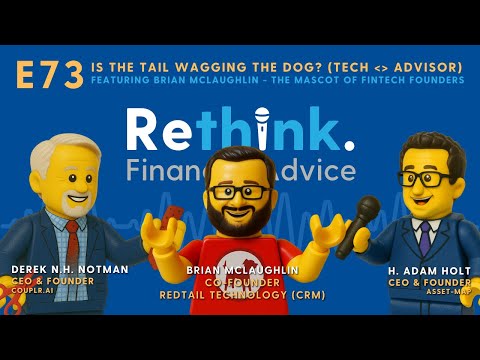
Watch and Listen
Episode Summary
Brian McLaughlin, former founder and CEO of Redtail CRM and an Orion Tech board member, joins Adam Holt and Derek Notman to ask a provocative question: is technology now wagging the advisor rather than the other way around? They discuss the hard questions firms should ask before adopting new integrations, the staff training that adoption actually requires, and why so much of the industry still struggles to serve the average American client profitably. McLaughlin also shares his read on the consolidation and AI shifts he thinks advisors are underestimating.
What This Episode Covers
- Questions advisors should ask before adopting new tech integrations
- Staff training requirements for successful technology adoption
- Educational selling versus product-first pitches
- Serving the average American client profitably
- Industry consolidation and underestimated AI developments
Full Transcript
Full timestamped transcript.
[00:00:30] Adam Holt: Derek is the tail wagging the dog in the advice business. All right. What do you mean by that? 'cause that
[00:00:38] Derek Notman: could have a lot of different.
[00:00:41] Adam Holt: Well, you've heard, have you heard of the phrase the tail is wagging the dog as opposed to the dog is wagging the tail?
[00:00:46] Derek Notman: Totally. I've used it a ton with clients like, don't let the tax tail wag the investment dog.
I've used that one for years. Oh, that, see,
[00:00:52] Adam Holt: that's a good one. So I'm asking you right now, with all this tech coming in, is the tech wagging the advisor?
[00:01:01] Derek Notman: You know, there's probably something to that. There's a, there's like a FOMO thing going on. There's drinking from a fire hose with all the tech that's coming in and having to learn it.
Yeah, I think it is to a certain extent. Uh, it's forcing change. Just like, you know, when we went from paper apps to digital apps mm-hmm. Or when we went from literally going around neighborhoods and knocking on doors to get new business to using a thing called the telephone.
Right. That used the
[00:01:34] Adam Holt: email like, amazing. That was back in your day, right? Yes, that's right. The, uh, stone chipping, just like your most recent posts trying to mine coal out of a, out of a cave. That's what I did first. That's how I got prospected. Well, you know what I really mean here is, is we are seeing so much tech, ai, you've heard this phrase, ai, you remember robo advice?
Oh yeah. All these things are catalysts that get advisors to just jump on board. They are, and we're seeing actually this big question of human advice now, getting questioned the relevance at least, and. A lot of the interviews we've been doing recently have been about how we gotta elevate the human experience.
But the question is, is that the, what's the shiny object in the room is, is the tech and I, we're seeing advisors literally with no training, just integrate a whole bunch of apps probably to their detriment.
[00:02:26] Derek Notman: Yeah. And then it doesn't work, so they're onto the next one.
[00:02:29] Adam Holt Tank: Yeah.
[00:02:30] Derek Notman: Did they spend the time to learn it or teach their team?
Yeah. Right. Do they all integrate together? I say to your question, yes, to a extent it is, but I think there's, there's a way that we can stop that too. And it ultimately, the advisor has to get hold of the tail. Right? Right. The advisor
[00:02:51] Adam Holt: has to wag the, the tech as opposed to. Well, we, we do joke, and we've said this plenty of times, that if advisors don't get on this new kind of trend of integration in AI and all the other fun stuff that's coming, that they will be beholden to, uh, I think, uh, those that are able to use these advantages.
And it was, it's a great intro actually to our, our good friend Brian. So, so help us get to know Brian McLaughlin. The teddy bear of our industry, the
[00:03:16] Derek Notman: teddy bear of our industry. So Brian McLaughlin, FinTech, C-T-O-C-E-O, board member extraordinaire and fellow Rebel Dad. Yeah, he is, uh, he started, Redtail technology.
The CRM that has, has been used by, its gotta be over 130,000 advisors at this point. Yeah. And created it into an amazing tool that was actually sold over to Orion. So I think the red tail, you know, I don't know if the tail wagged the dog on that one. Yeah, I think, I think he was in charge over there, but I.
Talk about perspective on integrations and experience and what we can do and is AI important or not, and so forth. He brings a really great perspective given his journey and how he's touched so many different parts of this industry too.
[00:04:04] Adam Holt: That's so true. And he's got, look, he's got plenty of years left in the industry
we're wondering what his next splash is gonna be, but we did have the opportunity to interview him at Fearless Investor Conference in 2024. And we're just getting now to actually publishing this episode. Um, but we want to introduce our, our good friend Brian, 'cause he's got some great perspectives and care for the industry.
[00:04:24] Brian: Who's Brian McLaughlin? I mean, I'm the founder of a CRM company, um, named after a dog. I'd like to tell that joke, you know, um, who, who else would have done that? You know? Um, sold the company a couple of years ago to Orion.
That was awesome. What a great win and a great win for me and for the whole team, actually, you know, and I've stayed working there for about two and a half years. Um, kind of helped transition the companies and we do a bunch of different projects and initiatives kicking off. And, uh, just recently now, decided to step down from day to day ops and, uh, still a board member of a Ryan happy board member over there and sharing them on and trying to push the mission and strategy and vision for them.
But, uh, yeah, now I'm nowhere day to day. I'm on, uh, week four, no day to day trying
[00:05:08] Derek Notman: to figure it out. I have no idea. The only one question I get
[00:05:10] Brian: now is, so what's the next thing? I'm like, the next thing is a break. I just got back from a cruise. That was nice, but I haven't been home to like, just decompress.
Yeah, right. After 25 years. I mean, you guys get as business owners. I mean, 25 years of learning so hard and so fast. Wow. Um, it's funny when people say, oh, you're hitting the next idea. We've been thinking about like, I have it. You know, I'm a guy who's like, if I'm in, I'm 1000 percent full throttle. Like, I don't think about what's next.
I, uh, I might tinker with stuff, but I didn't really formulate a plan like, Oh, I'm going to stop and do X. Right. It's I'm going to stop and like, and figure it out. Yeah. Yeah. Slow down. Yeah. Slow down. Yeah. So, I mean, everybody in the industry, I'm probably one of the biggest road warriors out there for so many years.
Oh yeah. And, uh, it's going to be a little weird, but it's going to be kind of fun to just like, take a breather.
[00:05:57] Derek Notman: Very cool. Very cool. It's cool. It's true, actually, when I'm thinking about, uh, the opportunity to interview you here at Fairland. You know, I think, I think most people know you as the nicest guy who's always present in the industry.
And they want, Oh yeah. So they're wondering, is Brian going to, you know, continue to come to events
[00:06:14] Brian: or come to events. I mean, I'm here. Like I opted to be here. I wanted to be here and hang out. I haven't missed a single fearless. These are amazing. And of course, supporting our friend Aaron and his whole crew and team, and now Dan.
Um, I mean, fantastic organization. So, um, people will see me at Schwab. They're going to send for a Ryan, of course. Um, so I'm excited to still be around. Not, not disappearing, you know. That's
[00:06:37] Derek Notman: honorary.
[00:06:38] Brian: Yeah, so it's kind of like floating. Well, it's your community, right? It's like floating attendee now. It is.
Yeah, yeah. I grew up here. You grew up, exactly. Yeah. I was 23 or 24 when I started Redtail. I mean, I, my first event actually was an insurance event. MDR. Oh, don't kid him. That's my first ever conference. I still have a name badge. I have a, a box of name badges, uh, on the back of my, like a small hoarder. Um, The Wall of Honor, right?
Yeah. Yeah, this is literally every badge, every event I've gone to since 20 something. You have all of them. All of them. I mean, the name tags are off, you know, whatever. Yeah, yeah. I have the badges. Oh, no kidding. And funny, MDRT back in the day used to give out little stickers, little pins.
[00:07:17] Derek Notman: Yeah, that's
[00:07:17] Brian: right.
It was really cool, like, you had a flair, right? Um, that was my first ever event. I mean, growing up in like 20 something year old kid. Like I have no idea what this industry is all about.
[00:07:25] Derek Notman: Yeah, yeah. Right. When you guys do it, I'm like, I'm making a CRM,
[00:07:28] Brian: uh, it's online. And like, online's a new thing. Like, what are you talking about?
They probably
[00:07:32] Derek Notman: ask like, what's online? What are you saying? Yeah, I know. What do you mean? You mean the internet? What? I don't trust the internet. Well, I do paper apps, right? Like, what? You mean like AOL for CRM? Yeah. What's wrong with the paper system? The one card system. Yes. Oh my, I have those. It's not broken.
The one card. The tickler cards, the box, I have all those. Yeah. It is true. Oh my gosh. This is my crew,
[00:07:51] Brian: right? This is the industry that's rewarded me with amazing things in life. So, I mean, if I can give back, that's going to be phenomenal. That's all been my goal is that we'll kind of get back to everybody.
Um, I'll tell you, I'm a good CRM. Seems like I did, but, uh, so
[00:08:04] Derek Notman: yeah, that's pretty awesome. Can't go very far without hearing about Reddale. The name is sticking, right? It's sticking. People love dogs, what can I say? The irony is now you are the mascot of the industry. I mean, I wish I had a red dog outfit.
Like, watercraft.
[00:08:19] Brian: Yeah, it was like, what's the Clifford hanging out over the corner?
[00:08:22] Derek Notman: That's too funny. Maybe it should do that. There should be a Reddale dog. That would be memorable. That would be really cool. I mean, there is a red tail
[00:08:30] Brian: dog. It's my dog, but
[00:08:31] Derek Notman: yes, where is he? You should come. Yeah, it should be your support.
That's a little nuts. So, so Brian, you, you've been in the industry a ton of years. You've served over a hundred thousand advisors through red tail. Tell us a little bit about your unique perspective, like from your vantage point, what's, just tell us something interesting about the industry or some insights that you have.
I think some of the basics, right? The, the industry is
[00:08:52] Brian: very small, very, uh, tight knit community. Um, I only really appreciate that, especially the startup coming in or something, how tight this crew is. Uh, whether you know somebody or don't, I mean, it's just, everybody seems to have like less than six degrees of separation, right?
Um, and people will jump around through the, through the industry, through different organizations. Uh, but all achieving a common goal, which is really awesome. Like, you know, how do we serve as advisors, better clients and, you know, humanity better, like that's the goal and everything we do is in that light of like, how can we make your business better so you can make their life better?
Um, I think that's the perspective I always take here. Like we can give so much to America and the world at large. Through all the things that we learn and do and teach, I mean, there's a community where we talk about like people's future, right? Where we talk about retirement, we talk about, uh, longevity, behavioral finance, all these different cool topics.
When you think about it though, you break it down, it's just about making people have great lives. Exactly. Like that's our topic. It's one of the coolest communities out there. I mean, there's people that, there's communities that are for cars, electronics, all this type of stuff, entertainment, but like we're solving real world problems.
And I don't think we take that into account a lot of times when we come to these events and just, you know, talk about the next annuity or talk about the next best way to do fee based planning or something like that. But I love that yesterday, um, Phil Simonette said, um, financial planning is supposed to be fun, right?
Financial advice is supposed to be fun. Where's the fun, people? Like, let's start having that again because we just get so much better when we have a good time.
[00:10:28] Derek Notman: It'd be cool for the clients, the general public to see how much fun we do have at these things, too. Like, wow, these guys are actually really cool.
Yeah, behind the scenes, you don't hide that. You don't, you don't, right? And you're right, it's a close knit family, but everyone's trying to improve people's lives.
[00:10:43] Brian: Yeah, I mean, even though there's a lot of competition in this industry, it's like friendly competition.
[00:10:49] Derek Notman: There's enough business for everyone.
Romance is everywhere. Yeah,
[00:10:52] Brian: totally. Or whatever they call that. Uh, but. Like, you know, hanging out, I mean, we're going out to like dinners and events after hours with, you know, my other CRM friends. Yeah, right. There's a couple CRMs in here that I was competing against, but at the end of the day, you're like, small world, let's just go hang out.
Oh, that's definitely
[00:11:07] Derek Notman: true. I felt that. And we talk about problems, we
[00:11:09] Brian: talk about, you know, issues in the world and, you know, you build these great bonds. And I think that can really push this industry even further at all, this great community.
[00:11:18] Derek Notman: I wonder if other industries are as welcoming. And you're right, that whole purpose of financial services, I remember coming in, but AssetMap, it was.
You specifically were incredibly welcoming and, and made, made it feel like there was this community. Yeah, and it's also something that we've been trying to perpetuate, keep welcoming new parties too. So that pay it forward thing I think has kept FinTech and financial services really pay forward. And
[00:11:39] Brian: I hope that continues really strong.
Obviously an advocate for that. I mean, when I started Red Tail, three companies took a chance on me. Mm-hmm . It was Money Guy Pro Laser App and it was statement one, all Bridge, um, at the time. Uh, these companies, they don't really get, you know, a kickstart going. You had to integrate, you had to tie in the things that were, these were just standard players.
Like, MoneyGuy was around for a lot longer. LaserApp was around a lot earlier, serving IBDs across the board. I mean, huge companies. Great point. And they were like, yeah, we'll integrate. And cool, like, I don't have any money. Like, okay. You know, we'll scratch each other's back. Okay, cool. It works. You know, you build those great connections.
And. But it's funny that you look at it later on, you go, man, it's a great advantage to all the advisors and the community at large that companies were talking to each other like that.
[00:12:24] Derek Notman: Other
[00:12:24] Brian: industries are like, I'm sure they are, I imagine.
[00:12:27] Derek Notman: Well, it's interesting because you have this, this very, you've been so present for 25 years in the financial services environment.
You know the language, you know the people and the players, but you're also on the technology side and have built more integrations, I think, than pretty much anyone. What do you think is the missing challenge that advisors don't see coming that you might be uniquely aware of?
[00:12:47] Brian: I mean, the big one, the obvious one is AI, right?
I mean, um, I think I've seen things come in different patterns, like cyclical patterns over the career. Mm hmm. We were talking last night about consolidation. We can get into that if we want. But, um, for here, AI is the next robo advisor. You know, I, I, you hear some fear about things taking out either, taking out companies, vendors here, like, won't survive.
Maybe I've heard that a little bit. It's kind of strange to me because I think that actually enhances them. Um, but Yeah, when robo advisor started, there's like massive fears industry is going to change everything. We're gonna be the next travel agents, you know, what actually happened when you look at retrospect of it is it actually advanced the technology.
Of the industry to make it easier. So we, we eliminated paper forms. We started opening accounts digitally. Everyone had to do it. It kind of made it a must do. And AI is doing the same thing. It's just still a wild west of it. So, I mean, what do they need to do? They got to lean in. You know, I think I've said it for millions of panels and podcasts and all that, but.
Go learn the tech, like stop like hiding in a shell, like go Google it, just take a quick YouTube course or something, just understand what it can and can't do. So you have at least a high level concept when you come into here, you can ask real questions. Um, I'm seeing the AI explosion happen. Um, I mentioned the consolidation because, you know, obviously my company I sold and part, so you can say that's part of consolidation.
And I think it's really cool that this consolidation curve as it. Um, goes on to this next, this next journey and we're seeing it happen right now, right? Everybody's buying everybody. So there's less and less players at the same time that opens up a flourishing of new startups. Yeah, a lot of new opportunity in this industry.
[00:14:25] Derek Notman: Yep.
[00:14:26] Brian: And that's the interesting thing I've realized over the last couple of years is like the cyclical event of like startups to spring up out of nowhere. Um, but I think robo advisors, like, I mean, I think they do survive. The wrestler assimilated. And they were
[00:14:39] Derek Notman: never really profitable either, . No, they weren't.
[00:14:43] Brian: Yeah. But they moved the tech forward that, well, that's it, right? They helped the whole industry
[00:14:46] Derek Notman: get forward in adoption of New tech and open the eyes a bit and whatnot. Yeah. I mean, open, I was a big one. Or open api. I, sorry.
[00:14:53] Brian: Yeah. Oh, huge. A huge one. I mean, I'm the one of the first to, uh. Publish an API publicly industry.
Um, I can remember the presentation. It was literally around that. I was like, okay, I'm literally opening up the doors to everything we do,
[00:15:06] Derek Notman: but you'll let everybody build to you. Yeah. Great. Enormous scale. I mean, bingo. That's yeah. So that's a two, a
[00:15:13] Brian: closed door system. You didn't integrate with like, um, I mean, pick a vendor, but you didn't just go and integrate with them.
I was like, it was a big monster of steel contracts. And you had to know the right person. You had to do all this handholding. And I'm like sitting there going like, Hey, here's the doc. Like, just go do it.
[00:15:29] Derek Notman: Well, we just finished integration with you guys. Right. And so it's huge because it brings us a ton of value, but.
Clearly, it brings Redtail and your whole organization that much more value too. CRM
[00:15:41] Brian: is the hub, right? CRM is the data set, that's everything. Everything in, everything out. It's the central repository for it all. So, yeah, it had to be integrated. And reducing that friction. Yes. Enabled opportunities. I mean, we would, and uh, pay a fuller model, right?
I mean, we opened it up to anybody. You can be a startup. Literally, I've never even heard of you. You can build to us and leverage our distribution day one if you want. Yeah. You know, so there were some really cool opportunities to startups, even if going into business and get distribution. I mean, I think Aaron brought it up the other day.
Or risk wise, like that was a big thing for them.
[00:16:17] Derek Notman: It's like one to many, right? One to many. You gotta build it, but then it'll happen. And
[00:16:21] Brian: what did I give my customers? I gave them more choice. More optionality. I gave them more opportunities to see an easier way to do something. I mean, they made the call.
They made the choice. It was not me.
[00:16:32] Derek Notman: Ultimately, it made probably things a lot more sticky, too, at the end of the day. Because it's really hard to change management and rip out infrastructure. Exactly. So we know it's the same reason why a lot of people are, you know, Well, it's stalled into their legacy now.
And so it's interesting because, you know, we can think about that also too. And we, we've been really happy at Redtail. Actually, right. So Ryan is actually our number one adopted integration since they merged. Oh, that's cool. Interesting. That risk alized was number one for many years. Merge happened then brought to Ryan and so forth.
[00:17:00] Brian: And I'm excited for what they're doing with Redtail and Orion right now, right? There's some really exciting projects going on. Um, one of the ones that they're doing is this global entity project, which basically unifies all the identifiers of all these acquisitions. It's like an investment. Orion bought a lot of different companies over the years and different tech stacks, different identifiers or clients and unification so that you'll have one platform, one identifier to like find where I might find anywhere in the system.
Like, how many proposals do they have? You know, what are there? What's their phone number? I mean, all of that intertwines and when they get to the next step with that, opening up through the API, you're going to have one point of contact. You're like, Hey, I want to know everything about private and law firms in the Orion system.
And it's going to be like a rental day, it's going to be a Orion day.
[00:17:40] Derek Notman: That's huge. So almost like it has like a blockchain to it. Yeah, they're talking about it. In a way,
[00:17:44] Brian: it looks like a blockchain, yeah. So
[00:17:47] Derek Notman: all this talk about tech, if I'm an advisor, listen, I'm probably feeling a little bit overwhelmed.
Like I'm drinking from a fire hose. I'm at the event. I'm seeing all of these vendors. What would be a, like an action step or some advice that you would give advisors trying to just figure out like, where do I go? What do I use?
[00:18:02] Brian: That's a great question. So, I mean, what we use, what we try and tell people for years and still do is, You pick your core tech stack.
Yep. So it's planning, or it's CRM, whatever. It's, and you're just ing around that, right? So you're learning your core tech and say, look, this is most essential technology to my business. I have to have like, and a normal small businesses like QuickBooks maybe or something, or Salesforce.
But, um, you go, Hey, this is my one text thing I have to have. What do they work best with? You're going to talk to the vendor. Hey, I'm looking to do X. Who do you integrate the best with? Oh, I work with Redtop really well. We can share data, blah, blah, blah. Hey, I need to do, um, a better job with marketing. Who now works with these two vendors the best?
So it's kind of asking the question, like, Hey, who actually can you show me what the integration looks like? It's like, there's a million, everybody says integration. A lot of them are single file, one click. Yeah. That doesn't really help you much. I'm going to leave two tabs open. Yeah, right. That's not the world.
But when you start getting into partnership companies that work really seamlessly. You know, where it's like, Hey, I updated the name here and it updated here. Seems like I didn't do anything or it notified me about an opportunity because of the data and another system. These are really cool, powerful integrations that can change the scale of your business real fast.
So,
[00:19:21] Derek Notman: so as an advisor doing a demo, it's overwhelming.
[00:19:23] Brian: You're right. You walk in that hall, oh, it's totally like, oh my gosh. If you're like, what do I, Hey, there's 50 vendors though. Oh, yeah. And 10 of 'em look the same.
[00:19:31] Derek Notman: Yeah.
[00:19:31] Brian: You know? That's true. But I like that. I feel like you need an anchor.
[00:19:34] Derek Notman: If you're a, yeah, you have the anchor.
Then when you're looking for the demos or. Like, ask those specific questions. How do you integrate? Show me, like, how does this help me instead of just looking at the demo and deciding if I have to buy or, you know, right then or there or not.
[00:19:46] Brian: Correct. And then a lot of people buy, like, in the moment here, you know, oh my God, he's not, like, go home and think about it first.
[00:19:52] Derek Notman: And see if it actually integrates. Does it do what you want it to do?
[00:19:54] Brian: Yeah. Talk to the staff about it. Like, hey, what do you think about this? Like, uh, that's the other thing, actually, I think about that is, like, staff buy in. It changed a lot of technology when I was there for a couple of years. Um, so a couple of different internal software stuff, um, like here or whatever, it's kind of get the staff adoption because they're the ones that actually use it.
So the advisor walking around here, they have 3 or 4 staff members. That person's not the one using it, or they're the buyer, but they're not the user. The one who got to actually be told is the staff.
[00:20:24] Derek Notman: Yep. Well, I see such tough things on adoption. Advisors are not spending the same amount of money on licensing as they would on training, right?
So Redtail always did amazing training. Yeah. And brought in thousands of people. In fact, power planners, assistants to come and learn the tools. So there was Redtail University
[00:20:40] Brian: a couple days ago. And, um, that's been going on for over a decade. And it's an education program. Yeah, too. You know, I told another vendor here, I, you know, one of our, I think our successes was.
Um, selling through education, you know, teaching, not pitching, right? And it's like, show me how this stuff works. Let me, um, show you what you could do. You may not, but you know, let me show you what the potentials are. And really kind of gets the brain going for them. Like, oh, well, if I can do this. Yeah, that's super cool.
[00:21:07] Derek Notman: Yeah.
[00:21:07] Brian: And people build businesses off of that. Yeah. Let me show you better ways of using the tool that you bought. Like, whoa, okay. I thought we knew everything about our own tool. And they're like, some of these cool, creative, like, you know, abstract ideas for how to do stuff. That's not enough.
[00:21:21] Derek Notman: This is certainly not the last time you'll be interviewed in fintech.
Of course, you know, despite your quote, unquote, retirement, I'm sure there's lots of going forward, but is there anything that you kind of see for the future or want to drop in there? Controversy? Welcome to anything. I know
[00:21:38] Brian: what you're going to say. Okay. Well, I'm going to say that I thought about this a little bit, uh, was, mm.
Um, and I spoke about this this summer, actually, at an event. Um, what I think this industry fails at is fails at serving the average American, the average person. Uh, I, I've told the story a hundred times, but, you know, I was raised by a single mom. We grew up, you know, very limited means in Los Angeles. And, um, you know, I think her top gross earnings was probably 60k a year, you know, when I was an adult at that time, you know.
Um, and she had no access to this environment. Like, no access to budgeting, planning, just basics. Yeah. Right. I mean, it's put us into a 60, 40 all the day. It's not making money. Yeah. It's like whatever the employer did is what she had access to. That was it. And I wish that we could get this industry into a position where it was profitable for their business to go and service the people literally outside of some town street.
Yeah. Yeah. The ballet like, yeah, right. These are people like, you know, I've talked to a friend over at BYU last week and he does wellness. coaching for players because, you know, you realize 95 percent of college players, athletes don't make it to the NFL or NBA or whatever. They need to have planning, education around how to be ready for life after this, and you're not going to make, you're not going to be a superstar making 30 million, you know, no chances are not, chances are low and good for you if you do.
How do we get this where I hear all the time I've heard for 20 plus years, it's 100, 000 liquid assets, a quarter million dollar liquid assets to work with you. Yeah, cool. I appreciate that. And you're running a business. But like, you know, I think that was more than the price of a home I lived in when I grew up, right?
And the assets for the house, right? Yeah, yeah, that's it. These people need help. These people seriously need, and if we're not careful, and we're seeing it already with M1, or Robinhood, or Acorns, name it, um, that, you know, our very vanguard was doing it through digital assets gathering, saying, hey, we're going to go and tap into the markets through a mobile app, and people are doing that, but we're the experts.
Right. Yeah, we're the ones that come up with all the software, all the education, all the training, like we are the experts on how to be financially successful in your life and have wellness. And then if we can scale that down into the system, one, it's going to feel great for everybody, but how do you make that a business model?
And I think this is something we can solve. That's true.
[00:24:06] Derek Notman: Well that was a really fun chat with Brian and we've been friends with him for years. Really cool to see his journey. We've spent time on Necker Island with him twice now for the Rebel Dads event. Yeah, this is super cool dude. And really neat to see and hear his perspective given, I mean, he's had a heck of a ride the last 25 years with Redtail.
[00:24:27] Adam Holt: Yeah. He did it in a very humble way too, by the way. He really did. He just solved, solved problems, spent time with people. Just did it. You know, he is a real quick start. I mean, we think about ourselves in the Kolby. Yeah, right. He just has an idea. He goes and does it. He is like, I built it last night. You know, he's not, you know, we think of the CEOs running major companies.
He's, you know, he was at CTO first. He was, he just solved the problem back when he was in his twenties. Uh, the CRM side. Look how big they got. 130,000 last count. I heard advisors using his technology, and of course, I think it's more now. I think it's actually I'm more, I'm sure. I'm sure it's way more.
[00:25:03] Derek Notman: It's so cool.
And he, and he bootstrapped the heck out of that thing. I mean, what a great, what a great story and great example of what's possible.
[00:25:11] Adam Holt: Couple hundred employees, I think at one point, and I, and multiple locations around the country. And I think, uh, if there was anything that was interesting about looking back at Redtail and its successes, especially as somebody in the FinTech world, as you know.
It was the people, you know, the people were just really great. He did a, I mean, I look, I model a lot after what Brian built because I want people to love working at the company and, and I know that they're passionate about it. That came, that came through as a, as a customer for sure.
[00:25:37] Derek Notman: No question about it.
You know, it's funny 'cause we talk about Rebel Dads and Necker and Richard Branson. Part of his success, he attributes is like, treat your employees well.
[00:25:47] Adam Holt Tank: Mm-hmm. And the
[00:25:47] Derek Notman: rest kind of takes care of itself. And Brian's just a great example of what, look, what, look what happens. You know, when you're building something like that and people want to be part of it.
That's, that's awesome.
[00:25:58] Adam Holt: Alright, so let's talk about what we took about, this was a very interesting, you know, interview because Brian has just left the industry to a degrEe. Right? He is taken a little hiatus after 25 years. What, what did he say here that advisors need to start thinking about?
Well, you
[00:26:14] Derek Notman: know, it, I, firstly, we'll preface it, he. He makes it very clear that advisors and FinTech, you know, our industry in general, we're a special group and that we really do have the opportunity to improve people's lives. We're not just selling a cell phone or a hamburger like we are.
We are helping people with decisions that will impact their legacy, like really deep, meaningful things. And so I, I, I really like that 'cause that shows at the core of like how he's thinking about. All of us and what we should be doing. I like how he said, our community, even behind the scenes, it's pretty welcoming.
It's small, it's a small community. It really is, but it's pretty welcoming. It's, um, and I like that there's a lot of friendly competition out there. I mean, I've even had competition approach me like, Hey, what are you doing? Maybe we should work together. I don't know. What do you think? You know, it's,
[00:27:09] Adam Holt: it's kind of fun.
It is. Maybe it's because the FinTech community or wealth tech community in the United States is so small. I mean, yeah. So there's something like 300,000 to a million advisors, depending upon how you want to count who you wanna include. Yeah. But, uh, you know, it just boils down to several broker dealers, a bunch of wirehouses and, and, uh, and some insurance companies.
Yeah, sure. There's plenty of names out there. But the bottom line is, is that that. We all basically do the same thing, right? We have the same kind of experience, we have the same needs. We need fact finding, we need CRM, we need portfolio management and a whole bunch of other stuff that supports the process of advice.
But it's really amazing how we all know each other. When I joined in the community, I guess back in 20 16, 17, I was so surprised how welcoming everybody was. And if you're willing to play out and be, be out loud a little bit and show up, uh, you can build great relationships. It's been really the hallmark of my excitement about being a FinTech CEO versus an advisor.
'cause gosh, oh, for sure. I have community unlike everywhere. That's how you and I met.
[00:28:06] Derek Notman: That's how we met. Yeah. Yeah, for sure. So clearly it, it, it works and it, it's really cool. And there's, I think lean into that. He mentioned that too. Lean into to the community and, and lean on it as much as you can. Um, I also liked how he was talking about a challenge, so there's all this talk about ai.
But he made, he is like, it's the next RoboAdvisor. Which is interesting 'cause Roboadvisors were a flash in the pan. They were gonna replace advisors. They, they didn't. But Roboadvisors are still around and have gained some market share. Yeah. And I think ai, I think he's right there, right? I think AI is a big flash in the pan now.
Probably bigger than Roboadvisors. 'cause it touches more parts of our lives., But it's not gonna replace humans.
[00:28:53] Adam Holt: Just can't. It's not, it's, no, it's not. But let me ask, let me challenge you on that because I, I think what I heard in this rethink discussion is. That robo advice was the catalyst for all of us to retool and retool fast.
So that robo didn't have a competitive advantage over humans. Right. So most of most of them were modern companies either bought the technology that Robo was providing or built it themselves and you know, renovated. Right. They went paperless, they went to uh, you know, dashboards and client portals.
Yeah. You know, so they basically obviated the technical advantage that Robo came out with at a low cost. Right. But didn't, right. Didn't have the context of a human. And then the robo started adding humans and it kind of fizzled out for the most part 'cause it's a relationship business all day long. But a AI is, I think it's interesting because you're right, it's forcing everybody to wake up.
Is it gonna force financial advisors to change much? I think it will mind up changing the back office. You and I have done a bunch of work in AI and we have gotten enormous leverage from it.
[00:29:58] Derek Notman: Oh my gosh. Tremendous leverage. But, and so what are we doing with that extra time?
[00:30:04] Adam Holt: Yeah, we getting time back. It's
[00:30:05] Derek Notman: more, it's more human interaction
[00:30:07] Adam Holt: if you choose to use that time for human engagement.
[00:30:10] Derek Notman: Right? Well, I suppose, and so if you're in an advisor and you're looking at this from a business perspective, yes, you can apply this to calling more clients, meeting with more clients, all of that, at the end of the day, that's what we're paid to do. I'm not paid to file your stuff.
I'm not paid to update Redtail, you know, as much as, I mean, I use Redtail, but I have, I have staff that helps me with that. You know, like as an advisor, this is where my time is spent. So if AI is helping me do that, you, but I you also, I think, right, you could play more golf.
[00:30:42] Adam Holt: You could deliver more value.
Maybe golf is your highest revenue. Producing work could be. I know for some advisor it, there certainly is, but
[00:30:52] Derek Notman: Well,
[00:30:52] Adam Holt: it
[00:30:52] Derek Notman: works. It works for some of 'em. Yeah. It, uh, we've talked about this before too though, is it's the advisors that are not gonna use ai, the firms, the broker dealers, the life insurance companies who are worried about it or putting their heads in the sand about it.
Yeah. That's how you go obsolete.
[00:31:15] Adam Holt: I had a friend come into, uh, one of the conferences I was doing Panos. He's pretty much known globally as a crazy person. I think we might actually have him on the podcast. We planned on having it. That'd be fun. He's two a DD to like, focus on anything. He literally runs around and he showed on stage as a handheld drone, followed him around the stage showing advisors what they could do from making AI avatars that literally had full responsiveness, trained with his voice and his face.
It was like him speaking on screen and he, he showed advisors what AI can do today and asked the question, what is it gonna look like in a year? And Brian's been a real student of this stuff, especially 'cause he has his extra time on his hands now. He showed us a bunch of stuff when we saw him in Necker that, uh.
It's gotten him all fired up. So I really don't even think that the mass population has any clue. 'cause they're busy doing their job and they're making money. Of course, what these AI tools are can do already and how that could cause a massive disintermediation, at least in status quo. It may not be taking business away from humans, but something in the value chain is going to get innovated.
The question, is it processing? Is it portfolio rebalancing? And either way it's probably gonna force margin compression. And if that's the case and we need to lower our prices, are we prepared to do that? I think that's gonna be the disruption.
[00:32:33] Derek Notman: I agree with you on that. I would say though, that it is taking business away from humans.
[00:32:45] Adam Holt: Okay.
[00:32:46] Derek Notman: It's a transfer of wealth from one group of advisors to another group of advisors. Hmm. From those using. To those who aren't using it to those who are, yeah.
So you have that going on and then you've got the fee compression. But I, I mean really, I mean even Kitsis I think came out with something this in the last couple months. There's all this talk of fee compression, but it doesn't seem to be happening.
[00:33:08] Adam Holt Tank: Hmm.
[00:33:10] Derek Notman: Right. But's, maybe it's not fee compression, maybe it's expansion of services to justify said fee.
[00:33:17] Adam Holt: Ah, that's probably where it plays out. I agree with you. Right. You know, can, can you expand this conversation from investment management to estate planning? Or can we start talking about tax structure or maybe working with your company? And I agree with you, I think we're gonna deliver more for less price.
Well, here's a good example. Or same price. Yeah. Here's
[00:33:36] Derek Notman: a good example. So wealth.com, they're doing really interesting estate planning solution, technology driven for advisors. Mm-hmm. Mm-hmm. And I just did a deep dive with them, like Tim was on Necker with us as well. Right. Yeah. They've really figured it out.
Now where I can now be a more comprehensive advisor, I can go offer all of my clients estate planning packages. Mm-hmm. I don't have to touch it. I'm not the attorney, and I can actually make that into another revenue line for my business. So now I've, the clients are stickier, they're getting more service.
I'm actually making more instead of less. It's a really interesting model, but it shows clearly how if you use the technology correctly, you can deepen relationships, make more money, you're gonna get that business versus,
I mean, like, if I'm a practicing attorney and I see this, I'm starting to freak out. You know? Or if I'm even just an advisor, oh, I'm looking at this, this RIAs website, and they offer estate planning services. It's all turnkey. Mm-hmm. I don't do that,
[00:34:36] Adam Holt: huh? Yeah. But you know what's interesting, even about that marketplace, like you think about the estate attorneys, they're really so few and far between.
Most large firms have one or two people in their entire partnership that's focused on t and e, right? That's trust and estates. And the reason is because despite the fact the market is massive, the actual demand for that work is so low. And really the reason it's so low is because it's expensive and it's complicated.
And this is a classic industry that's ripe for disruption. And advisors, you know, tend to not touch this one with a, you know, a long pole because. You can't ever solve it. You don't practice law. I think it's a really interesting way that, that fee-based advisors must, I'm not saying, should, must be able to provide an outlet like this.
And there's several companies that are doing it, not just wealth.com, but the, the, the key is you gotta provide an off ramp for people to do this work and do it cheaply. This should be a commodity. And the fact that nobody has it or, or something like 60% of the population doesn't even have a will is oh, it's crazy.
Easy opportunity.
[00:35:39] Derek Notman: And you might be saying, well, why do I have to do this? Who's telling me I have to do this? At the end of the day, the consumer is driving this now more than anybody else. That's true. The consumer has expectations. They want convenience, they want hyper-personalization. They want digitally enhanced.
[00:35:57] Adam Holt Tank: Mm-hmm.
[00:35:58] Derek Notman: They will go wherever they can get that. So if you don't have that, they will go find someone else that does.
[00:36:04] Adam Holt: Yeah. You know, there's another thing that Brian said that I wasn't thinking about or expecting to hear when he mentioned something about the unified id. This is something that I, I wasn't really thinking about because in the states we don't, we have a social security number.
A unified ID is for the eu or United Arab Emirates has, uh, basically everyone has a number, a distinct number that unifies your data across multiple platforms. And it obviously there's lots of, we'll call 'em, state systems within the EU that need to talk to each other, how they don't have the same social security number.
So they have a UID. So this is interesting that he's, that he's contemplating this. 'cause one of the bigger challenges that we have, certainly across. Households and different registrations and you know, my first name is not Adam. Right? It's, it's Heath, right? Yeah. Or it's, I'm by h Adam. And then in a CRM system as an example, there could be six records.
It just messed up.
[00:36:53] Adam Holt Tank: Yeah.
[00:36:54] Adam Holt: And, the data, , gets all messy. Now you gotta integrate that data, send it someplace, and, and, you know, everybody's complaining. Like Householding has been such a hard thing to do. We clearly do it in asset map, that's like what our thing is. But that's because we're asking the advisor, like, what's the, like, you know, we're, we're starting from scratch.
[00:37:10] Derek Notman: Maybe we should get an asset map, universal ID and roll it out nationally.
[00:37:15] Adam Holt: We do have this though. That's the thing. And it's not only numbers. If you integrate with Asset Map, you have to use RUID right? To integrate with us. And that's, that's a household and member level, registrant, kind of like a blockchain.
Like he said, that's pretty cool. Nobody knows that behind the scenes, except now I guess I just, I just, I share, I think
[00:37:33] Derek Notman: you need to sell that
[00:37:33] Adam Holt: separately. We just give it away. Well, certainly you wanna give it away because now you're embedded in the entire, but how ecosystem of that data forever. Right? So think about downstream data.
If, if we've seen a lot of kind of change here. A lot advisors don't even think about this. So let me kind of give you some insight. There's data protection agreements between a lot of these companies. What does that mean? It means that if I take data, let's say from Schwab, right? I pull in the data from Schwab 'cause the advisor says I want my data.
Okay. Let's say an asset map or some other tool. If now I take that data from Asset Map and send it to, let's say, precise fp 'cause you wanna move it to E-Money. Sure. I have to hold the downstream data recipient accountable to a data protection agreement on behalf of Schwab. Ah, because Schwab's data came to me.
I sent it off with authorization to precise because they wanted it and then they sent it to Emani. That chain has to be able to be turned off through a sieve today. That is really difficult to do. And things that Brian didn't have to deal with in the same way with Red, so is like, oh, you have an a login.
I give you the data. Here's my API. Today we're seeing that people wanna protect the data from leaving their vendor. Yeah, right. Can't take my data to my competitor. So, so it's interesting to see how these unified IDs are actually gonna become more prolific because we need to make sure where's this data coming from?
And most of us advisors are like, I just want to integrate the data. Can you just gimme the data center? Yeah. Just lemme integrate. These are problems that I think a lot of people don't even realize.
[00:39:07] Derek Notman: Well, speaking of integrations, I think Brian had some good comments about that as well. Um, if we want to kind of jump into like, what can you actually do, like if you're listening today, like, all right, I've heard enough of what Derek and Adam have to say, they can stop jaw jacking.
[00:39:21] Adam Holt: Is that what we do? Jaw jacking? Yeah.
[00:39:24] Derek Notman: Never
[00:39:24] Adam Holt: heard that
[00:39:24] Derek Notman: one. I want, I wanna know what to actually do now. So we'll, we'll go straight to the integration thing, but I like that is that Brian was saying like, what's your core tech? What do you use? Most of all it's probably CRM or maybe it's like a financial planning asset map type tool.
Alright. Now, what do you need to do in addition to that?
[00:39:43] Adam Holt Tank: Mm-hmm.
[00:39:43] Derek Notman: Okay. Alright. I want CRM. What do you want your CRM to do? Okay, well wait, who does that? And, and do they integrate really well with this other core tool I'm doing? Mm-hmm. Now you've built two. Now you go to the third one. All right. I have these two doing this.
I need this third thing. Who integrates really, really well with both of these?
[00:40:03] Adam Holt Tank: Yeah,
[00:40:03] Derek Notman: it's a bit of a process. I think this is why also your, your text stack should be less versus more. 'cause it, it can get very slippery, all kind of expensive once you add up all these different things. So I really liked that he was talking about that.
Make sure there's a seamless integration. It works well. You keep it simple.
[00:40:20] Adam Holt: Yeah, I, I, well, clearly I agree with that. I, I did find though, you know, I built a pretty successful practice with virtually no integration. So I, I have, I do feel in some way that people have gotten integration like giddy and they don't wanna re rekey any data, and I get that.
But there's a, there's an element also, and here's my, my pathetic excuse of why not to integrate is that we're, we're definitely seeing a bunch of bad data get in front of clients every once in a while because no one actually cares to inspect anymore. They just assume it's right. And so that's why I think over integrating in the current state of the world without a human saying, Hey, I double check that number, runs the risk of actually, you know, perpetuating a scaled problem, which is.
I walk in front of a meeting and, and I just assumed that the, you know, e-money aggregation was right and it turns out it wasn't updated for two years, and now the client's like, that's wrong. What are you talking about? Why do you think you're so, you know, what's going on? I'm like, well, downstream, I relied on that data for five different systems and it's wrong.
And I, I didn't check 'cause I rely on the thing to work so well
[00:41:27] Derek Notman: and it makes, it makes it look like a fool. You're in a client meeting, the client doesn't remember that the tech wasn't working. The client remembers like, man, Adam wasn't prepared.
[00:41:35] Adam Holt: That's right. That's right. But hey, look, I saved all this time by just hitting the easy button.
I so I understand the design and then you lose the client, right? I just, I lose face, I lose credibility. And that's, and in this world where tech is so fungible, I, I just don't think. We can be, we have to, I don't wanna say we have to be infallible, but we have to be thoughtful and we have to show that we're actually paying attention to the store.
Not just like, you know, Hey, yeah, the camera didn't show anything. So I guess we didn't lose any product this month, but somehow there's like, apple's missing our part. Uh, well, you're in charge, man. What, what's, what's the deal? So I think
[00:42:08] Derek Notman: that's, you know, that goes back to an old saying, I learned at my first job outta college.
What's that? Inspect what you expect.
[00:42:16] Adam Holt: That's right. That's right. , my mom says it this way. She said, people don't do what you expect. They do what you inspect. How about that? That's
[00:42:23] Derek Notman: good.
[00:42:24] Adam Holt: Yeah. She, she, she went to the same school as you. She sure did. Yeah. Yeah. She didn't, she went to high school. I got a
[00:42:31] Derek Notman: GED.
[00:42:33] Adam Holt: Hey,
[00:42:33] Derek Notman: nice
[00:42:33] Adam Holt: agree. Awesome. Awesome. No, that's great. Listen, I'm really proud of you. I, I knew there was something there that you weren't, right. You've left that out of every interview I've done with you. Amazing. You know what I thought was cool that Brian did a fantastic job at Redtail of really focusing on educational selling.
Yeah. I dunno if you noticed this, but he, he had like no marketing budget all those years. He focused on integration. Let me just, I'll, I'll work, I'll work with you and what you're doing. And, and then he focused on education. Let me educate the staff. 'cause he realized that was the key to adoption of CRM.
It wasn't the advisor, the staff is doing 90% of the work. Exactly. Yeah. And I, I run into this all the time, Derek, which is advisors just expect to spend their SaaS, fee to buy a, a tech and it's just gonna work like Facebook or it's gonna work like some, some consumer app and. This is a technical app trying to make your business look better.
An enterprise app is not designed like Facebook. It's designed to do something really technical and, and so they don't spend the money on training. It's such a waste. So enterprises typically spend two to three times the licensing fees on training alone and implementation. So they get the ROI and I think that's where advisors missed that boat, and Brian did it so naturally that, uh, it's,
[00:43:44] Derek Notman: it's almost like he was selling a subscription to university classes, right?
Like his, the first year you were with Redtail, you didn't pay for technology, you paid tuition. Yeah. He paid for education, you got your education. And then I switched over to tech eventually.
[00:44:00] Adam Holt: Well, if you're educated, you're empowered, and if you're empowered now you're actually dangerous. And that's bingo.
That's now you can actually add and contribute value to the business. If you're not really empowered, it's just that it's not a toy. Right? I use it once in a blue moon. I don't really know it. I use 10% of it. I mean, financial planning gets this wrap all the time. Derek. All the
[00:44:20] Derek Notman: time.
[00:44:20] Adam Holt: Well, I use it like for retirement burned.
Did you use it for the Roth conversion? No. Did you show the family? No. Wait, you can do that. Yes. Yes. You should have learned what you're paying for. So that I, okay,
[00:44:32] Derek Notman: here's an action item. If you're listening to this and you're considering getting rid of a piece of tech, mm, push, pause, go learn the tech.
You and your team go learn the tech. That's even what Brian was saying, like any tech, even like, like new ideas, ai. Mm-hmm. Go learn about it. Like just hit pause, skip the nine holes of golf today and spend an hour or two on learning the tech instead. It's a one one time investment. That's true. And then you'll actually know if it's worth it or not.
[00:45:00] Adam Holt: You know, with everything on YouTube today, like there's no excuse, right? There's no, you get on-demand learning. We even have an LMS system learning management system. You can like learn the whole thing at night, in the middle of the weekend. Like, no, you don't, you don't need a human anymore. You can go at your own pace.
So there's no excuse to learning. And granted, I, I happen to think any advisor who's got a business that's generating $250,000 or more, they should have a budget that that's reinvesting back in their own company and their knowledge. Otherwise, why are you managing my money? You're not growing yourself, you're not bringing more value.
Like come on point, be more efficient. I, I, it's, its ridiculous how, how many times advisors are like, yeah, just kind of like collecting a fees and it's good enough. And they'll have an accent obviously. 'cause that attitude must have Are they all from Philly? Are they all in Philly? Did I sound like a Philly guy?
What? They all got old phase. That's my southern accent. South. South Philly. That's right. My southern Philly. No, yeah, that's right. That sound like I'm from Philly. Anyway, that's great. Well, that's what, what's the wrap up here? I think this is really awesome to spend time with Brian. Uh, just a great, great guy.
And , I believe Derek, I've said this before, he is the mascot of the FinTech industry. He is the red tail, you know, and that's
[00:46:15] Derek Notman: his, that's his dog that doggy had when he started, right? So there's actual real meaning behind that.
[00:46:20] Adam Holt: That's true. We've been lucky to call him a friend. Very lucky of what we do.
Um, and it was ironic that we ran into him there at, at Fearless, um, and had the opportunity to interview him. So always appreciate what he's doing.
[00:46:33] Derek Notman: Well, thanks for to listen. Hopefully you got a couple takeaways or at least a, a laugh. Maybe you're laughing at us with us. I don't really care. As long as you're laughing.
That's good. Yeah. And uh, until next time, take it easy. Keep, uh, keep making progress and we'll see you later.
[00:46:48] Adam Holt: Absolutely. Thanks my friend. I'll see you in the next one.
The content has been made available to you by Asset-Map for informational and educational purposes only.