
Ep72 - Rethink: Why Advisors Are Failing at Organic Growth – Featuring Joe Duran
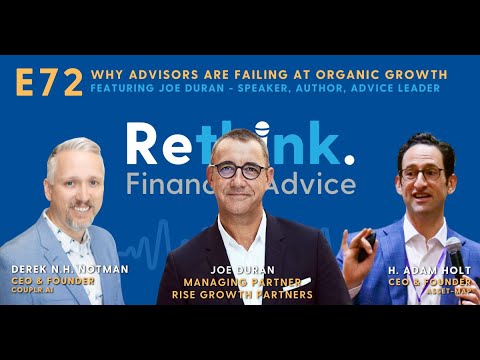
Watch and Listen
Episode Summary
Recorded live at Nitrogen's Fearless Investing summit, this episode features Joe Duran, founding partner of United Capital and former president of GE Private Asset Management, in conversation with Adam Holt and Derek Notman. Duran argues that advisors have simply forgotten how to sell, and that industry consolidation and private equity money have masked a deeper organic-growth problem. The group discusses why sales has become a stigmatized word in the profession and what it will take to train the next generation of advisors to prospect and close business.
What This Episode Covers
- Organic growth versus consolidation as a growth strategy
- Why advisors have forgotten how to sell
- The stigma around "sales" in financial advice
- Training the next generation of advisors to prospect
- Private equity's influence on industry growth trajectories
Full Transcript
Full timestamped transcript.
[00:00:30] Derek Notman: Adam, why are advisors failing at organic growth?
[00:00:37] Adam Holt: Wow. They're failing at organic growth, Derek, because they forgot how to sell.
[00:00:46] Derek Notman: Ooh, that's good. , Okay. Tell me more. What do you mean? Forgot how to
sell?
[00:00:52] Adam Holt: Well, let's, let's define organic growth because it's a term that you and I are seeing and hearing from a lot of our podcast guests.
Yeah. There's really three forms of growth in your practice that we're seeing, right? Organic growth means I'm bringing in new business, brand new assets under management, premium, whatever it is, fees, whatever you do to charge and grow your business, then there's the market growth. my existing assets under management just grew right.
And I'm charging a fee on them. And then there's the acquisition growth. I bought a practice. Yeah, I expanded very much like what you call PE, I bought a book business. Yeah, right. Yeah. So that's what I'm saying. I'm saying that, that our organic growth, when we started out in the business, started from an acquisition business.
Right. And we moved to a retention business. So I, I just don't think anybody knows how to sell anymore and nobody likes it.
[00:01:43] Derek Notman: Yeah. You know, it's funny. I don't have any data to back this up, but I, I'm wondering if most advisors become advisors, because obviously the business can be very profitable and you can have a nice lifestyle, but , they enjoy working with money and working one on one with clients.
did they really see themselves signing up to be advisor, but also to be a marketer? Be a salesperson. , there's almost like a negative connotation around that. I wonder if most advisors like, yeah, I became an advisor. I'm a CFP. I get to help people with retirement. I love that, but I have to do this cold calling and I have to do seminars.
And now they're telling me I got to write blog posts and , you can tell they're not really interested in that bit of the business, but that's the organic growth bit of the business.
[00:02:31] Adam Holt: You know what? I just had this great vision of. You know why people get married, they don't want to deal with dating anymore.
I think, look, naturally we don't want to go and sell ourselves constantly, right? We want to get into a comfortable relationship that ultimately, loves us for who we are and is willing us to compensate us for such. And I, and, and those relationships of going and trying to attract people all the time is tiring for most people.
Very, very tiring. And I think I would rather just cultivate existing relationships going and getting new ones every week. And, and that's a mindset. Some people are fantastic at it. It's few and far between, but it's the reason why most companies will pay salespeople exorbitantly because it's a hard job.
[00:03:18] Derek Notman: It's a really hard job to be a great salesperson or even a halfway decent one. Well, I think this, this is a good segue into our guest today because he knows all about organic growth and is doing just that helping other firms. So tell us a little bit more about , our great guest today, Joe Duran.
[00:03:36] Adam Holt: Well, , Joe Duran has been in our industry for some time, and he's got a very interesting background.
He actually is raised in Zimbabwe, as you know, well, right? South African, neighbor and a lot of familiar and similarity there. Grew up in the UK as well has got all kinds of background and great education and MBAs and so forth. But I think he's probably Most recently known , for growing the RIA United Capital, which really focused a lot on behavioral finance was really ahead of its times, creating scale and, and ultimately exiting, , and selling it to Goldman Sachs.
, and of course there's been some, , machinations since then. I think Goldman Sachs is actually, uh, disbanded of that and allowed it to go back to its roots in many ways, to go back into the RIA world. But he takes an enormous amount of knowledge and. Because he was at, if he was a thought leader for the past 10 years, he was writing an investment news.
I kind of grew up on a lot of his thinking and it was really exciting Derek to spend time with him at Nitrogen's Fearless conference, where we interviewed him in person, in between flights and speaking and running around the world. But I think it's really interesting because I learned something from him very early on.
And , he wrote something in 2014 that said. That a human is always going to be relevant in financial advice when , a decision has to be made that is a high cost of being wrong or is complex. And you think about it yourself, so it was really fun to hear his strategy, what he's doing with his all star team at Rise Growth.
[00:05:02] Derek Notman: Well, let's jump in and hear what he has to say. It was a really fun conversation. I think advisors are going to have a lot of great takeaways.
[00:05:08] Adam Holt Tank: So, Joe, it's great to actually meet you in person. I've been a big fan, obviously, since the early days of United Capital, and even to this day, I actually still quote you. An article you wrote in Investment News, it talks about the complexity and the cost of being wrong in financial decisions, still very relevant today.
So thanks for all the work that you do and are in that great watch. Yeah. Uh, as many of you know, Derek and I are here at the fearless Investing summit, the place where we met many years ago and the stage and created that podcast. So this is a special time for us.
So thanks for being our guests. Great.
[00:05:41] Joe Duran: Really, really happy to be here. Awesome.
[00:05:44] Adam Holt Tank: Uh, you know, given all the things that you've been working on of light, what's your unique perspective these days on financial services market
[00:05:50] Joe Duran: left to, uh, first of all, we're in the consolidation phase of the industry, everyone who wants to find a financial planner can find one.
And so we went from It being a disruptive idea because none of the wire houses are doing it and the independents could offer financial planning to really a growth area where everybody stepped into it and now the market is saturated with financial planners. And when that's true. I don't think most advisors have adjusted their view for the fact that organic growth will just be harder because the competition is greater.
So my first overwhelming idea is hey look, you cannot operate in a consolidating market the same way you did in a growth market. Because now it's about market share and what wins in market share great brands and advisors really are still operating the way they did when they were just really good advisors with friends and colleagues that they could bring in and we're now in an institutional world.
And so the first idea is that, hey, when you start having your biggest competition being mega RIAs who operate like wire houses, the rules of engagement are different. The large custodians are not going to want to work with small independent firms for referrals. They're going to want ever bigger partners.
And so, as I look and look at the centa billion dollar RIAs that are out there today, there's a consolidation race happening, and it's not going to be good for everyone, because a lot of the emerging high growth firms are going to be either forced to sell to a firm where the equity growth is not that high, because they don't have organic growth, and so one of the things we see is, hey, On this environment, you need to have capital and you either the consolidated or the consolidating and and if you don't have an organic strategy, you're going to have trouble.
So. So there are these two ideas that intersect, which is one, organic growth is harder, it requires having a great brand, building great brands requires expense and dollars, which middle market RAs at a billion, 3 billion, 4 billion, 5 billion don't have, because they're either distributing the capital or investing heavily in their own business, and they're limited, they don't know how to build a brand, they don't know how to build a great platform, and then the mega firms, Are basically operate like wire houses with a G2 who are taking over on not sales people because they didn't build the business.
Oh, it's you selling to be a dirty word through it. So to me, I think it's a very interesting intersect in the business. You notice for the last few years, the biggest, the fastest growing firms are the biggest firms. And why is that? They have resources they can spend on advertising. They can spend on brand.
They can spend on going to the custodial programs and being a part of them. And actually institutionalizing the sales process. And so what you're going to see is a haves and haves not. And we're very interested in what that means for our industry. And it's something that I'm always thinking about where we're going to be in five years, not where we are today.
And in five years, you're going to have even more really large RIAs. Many of them will be today at three or four billion, but in four, five, six years, we'll be at 20, 30, 40 billion. By the way, when you think about it. Those large 200, 300 billion RIAs. They're gonna have to acquire 20 and 30 and 40 billion firms because this industry is going to be consolidating for decades.
And so what you want to do is build high organic growth, great integrated brand with true abilities to serve clients in a unique way in a niche that everybody wants. And if you're there It's going to be an incredibly valuable firm to both private equity or one of the large strategic. So the reality is that most RIAs have never run anything as big as they've run.
And so they don't know how to put all the pieces together, which is why we exist, which is why we're doing what we're doing.
[00:09:39] Adam Holt Tank: Really interesting perspective of what's going on. So , it sounds like you covered this as a missing opportunity. But if we were to drill down a little bit more, if I'm a smaller firm, what is an opportunity or challenge that I am not aware of right now that I should be aware of
[00:09:54] Joe Duran: the first one's really easy.
What percentage of your day you spending focusing on new clients? Because I will tell you, I asked, we spoke to hundreds of our eyes between a billion and 10 billion. 10 billion. The average is probably, if I had to, uh, just non scientific, I'd guess it's 5 to 10 percent maybe. Now, the reason is the G1, the founder of the
[00:10:20] Derek Notman Tank: firm,
[00:10:21] Joe Duran: is semi retired.
G2 is all focused on serving existing clients. They're very uncomfortable with prospecting, doing seminars, finding new clients. They're even uncomfortable asking for referrals. They view themselves as professionals and professionals don't focus on organic growth. Uh, we had a conversation with a firm with, it had thousands of clients, 7 billion in assets, and their goal is to bring in 25 new clients this year.
Really? 25. Now, what size? No, the regular 5 million client. No kidding. And you're sitting there going, Okay, other than, of course, the great help we've had for the market? Eventually, you must have organic growth if you're going to get great valuations. And so there's a total lack of appreciation.
And the second thing I'd say is, what are you doing that makes you different? Because the great, the great advantage if you're individual, smaller firm is you can be original. And yet there's so little originality in the industry, nobody's using behavioral economics, even though United Capital was built on it, right?
And yet, still, it's just a sea of sameness, and it's very hard to win when you're competing and telling the same story as everyone else. And so I find it amazing, the total lack of originality when it comes to branding and Most everyone still serves everyone. They're not specializing in a niche. They tell no unique story that we've been around for X amount of years.
We love our clients and we're trustworthy. This is how we do things,
[00:11:55] Adam Holt Tank: right? The relationship, those are the table stakes, right? But yeah, so it sounds to me like they're really just taking advantage of the relationship currency. The prior founders had clients that have stayed and sticky and trust. That's not a growth model, but that's certainly not gonna retain yourself next gen.
So what are the action steps that you would recommend for the advisors that are listening to this that they need to take today? What are the next three things that you to do?
[00:12:18] Joe Duran: Well, look, first thing, Google wealth management in your neighborhood and see what you're doing that's any different than anyone else.
And the reality is they're gonna see that Well, I'm I'm not even findable. You know, it's amazing how few advisors even check to see what they look like. Then, in a neutral way, assess how you look or feel any different. Why would anyone feel compelled to come to you? Because again, we all fall in love with our own story.
We sure do. Good. Do a client survey. Find out why your clients love you. Like absolutely put that at the top of your list because if you find out why they love you, you'll be able to tell a story that's honest and true. That is different. Because there is a set of skills you bring to the table that people love most about you.
So tell that, find out what that, those words are. And then fourthly, spend real time on sales. Spend 30 percent of your management time. What are we doing to get new clients? How many new clients have we met with this week? How many prospects do we have this week? Because at law firms, And at doctor's offices, they are running things like a business.
They totally are. Yeah, right.
[00:13:25] Derek Notman Tank: Yeah.
[00:13:25] Joe Duran: And we are as an industry, as we become more professional, viewing it as a bad thing to concentrate on growth. If you really feel good about what you're doing for clients, you should be really focused on how we help more clients. So again, I, I noticed that that is the biggest gap that we have is training G2 on the sales aspects beyond the professional training.
So I think most firms, this would be my last tip. Take your G2 and teach them how to grow. Don't just teach them on how to serve clients.
[00:13:55] Adam Holt Tank: Or find someone, maybe G1 just doesn't know how, like what got them to where they are today may not get them to the next growth level, right? So now find another firm, someone like even yourselves, right?
Yeah. Here's how we grow.
[00:14:06] Joe Duran: This is how you grow. This is how you actually train people to expand. Yeah. And, and adjust your compensation model to reflect the fact that you're going to make more money when you bring in new clients. 100%. 100%.
[00:14:20] Adam Holt Tank: Uh, so I, we like to always try to add a little bit of friendly controversy.
And if we can't, so is there anything that you think the industry, I mean, you've already put a splash here in the pool. We did what we've been talking about. Is there anything that you think we should, the industry needs to hear?
[00:14:34] Joe Duran: I do this one. I think that the private equity taking control positions of all of these large firms.
Has come at a price that very few people acknowledge and that is that it is grow and acquire at all costs without actually building something great. I wrote an article, um, called the three little pigs. Okay, another story that the house of straw the house of wood the house of brick. What's being done right now and what we've seen with lots of 5 billion and 6 billion is that a consolidated firms.
Is they think because they buy a firm and change its name to the parent company that you've built a house of brick and that is not true if the underlying advisors are not getting any scale or not getting any advantage of the brand or not in fact, the clients are not better off and the advisors are not better off.
They're not growing quicker because they're part of your brand, right? And the reality is you have a house of straw and the underlying value, the businesses, if they're not any better because they've joined you, then they're not more valuable just because you're bigger for and you can't take advantage of scale.
You can't take advantage of consistency. You can't take advantage of brand, if everybody does something different. And what I'm seeing built right now. Which is frustrating to me because I thought United Capital was a great example of we are one firm, we are one platform, we are one brand, which is what made us successful, which got us an exit that no one else yet has managed to succeed.
What made it work was we were a house of brick. We were the same team, we were the Navy. What's being done now is, hey, change your name, you don't need to change anything else. You keep doing everything you're doing. And this looks like a big wire house. You, you go to these places and you go to one advisor, you get one set of services, go to another advisor.
They have a totally different investment portfolio. Yes, they have some planning. One uses money guide. One uses e money. Everyone's telling a different story. So what is the value of collecting a hundred of these people? If they're all doing their own thing. Under one umbrella seems to be worse. It's also just, well, there's more controls, but there's none of the advantages of size.
Yeah. Right. So what is happening? Well, a lot of private equity money is just go buy, go buy, go buy, buy cashflow. At the end of the day, those roll ups, that's why I hate the roll ups because roll ups don't, don't actually help the consumer or the advisor. They ended up being a house of cards that are only for financial advantage to somebody.
And why we are doing what we're doing is. We don't want the firms we're backing to sell their souls. We want them to do it the right way, build a great, beautiful firm that delights clients. So that is my controversial view of the world. Build a house of brick. It's harder work. It means being very careful about who you culturally align with, who you acquire, but it changes everything about the value of what you're doing for consumers.
And for me, The only reason I'm back in the business is I believe that the consumer deserves more than an amalgamation of advisors who are just doing things. You're
[00:17:32] Adam Holt Tank: right. You're right. 100%. Sounds like we're approaching the next big short. I'm a securitizing financial advice. That is what it feels like.
Yeah. Right. Seriously. Seriously. Yeah. Yeah. Seriously. Thanks for joining us. Yeah. It's a real pleasure. Good to see you. Thank you.
[00:17:46] Derek Notman: What a great conversation. huh, Adam.
[00:17:49] Adam Holt: Absolutely, Derek. I've been a big fan of Joe Duran for some time because he was really a bit of a rebel, a bit of renegade in this space and building United capital and RIA when it, you know, was relatively early and, and that very cool, and then having such a massive rollup and then exit to Goldman Sachs only to find out that the organization, you know, went through exactly what he's talking about.
And I think that was really kind of cool to hear directly from the horse's mouth. What did you, what'd you take away?
[00:18:20] Derek Notman: Really neat story too. And just to show like anything's possible, you know, a little backstory with him. He left Zimbabwe when he was 18
[00:18:30] Joe Duran: with 200.
[00:18:31] Derek Notman: So if he can do it, anyone can do it, you know what I mean?
Which is it's just pretty cool. So that perspective of his and what's possible to build because let's face it. Building an advisory practice is not easy building an RIA. or being a life insurance agent, whatever. It's not easy. So if he can do it from that backstory, I think that's pretty awesome and just should be inspired, but I thought it was a great conversation.
I love his perspective and where he's looking at it. I mean, obviously one of the big things that we heard from him and others at the nitrogen fearless event was organic growth. Very important topic.
[00:19:06] Adam Holt: Comes up again and again and again, and I couldn't help but thinking after how many times we talked about both investment capital, right?
So this PEVC world and also how is a person looking at their practice from an investment perspective? This is a business I'm running that needs to exit eventually. I need to monetize this business. Or in fact, I can, how about that? And the idea that organic growth It's such an important part of the valuation that a lot of advisors don't really understand.
What did you think about , his thoughts about organic growth in this market? It is
[00:19:41] Derek Notman: the sweet spot and it's almost this, this full circle thing where we've come back to fundamentals. , as you said, we're in a consolidation phase, you've got rollups going on and yeah, can you use that as a growth strategy?
Yes, you can. But those roll ups that you're buying, how well are those actually growing? And that's the organic growth , component, like what, what is that RIA doing to grow? Do they have a good marketing strategy? Do they have a niche? Do they have organic SEO? are they bringing in clients through different channels, whether it's referrals, marketing, paid advertising?
All of these things, because ultimately end of the day, that's what's driving your organic growth, not buying another practice. And other practice will help right off the bat, but what happens then. Right. Like that's a splash in the pond. Now,
[00:20:36] Adam Holt: it's so funny. I mean, these themes , they circle around and around, around.
So as a, as a person who is part of a practice, you know, that's gotten to a relative size, it's true. Gen two is now running our practice, right? The, our founders, myself and my mentors have effectively moved on to greener pastures and kind of different phase of life. We're not growing those practices.
Gen two is fantastic at servicing and supporting, but they don't have natural organic growth other than market appreciation or referrals that just come in, right? They really are fantastic at the service side. And they spend a lot of time on the planning over delivering to clients, right? Being really present.
But it just goes and show that the only way that those practices are going to grow is by buying smaller practices, just like these large roll ups that have 100, 200 billion eventually going to have to buy practices because getting organic growth growing by 20 percent means bringing in another 20 billion, right?
40 billion if you've got 200 billion under management. So the point of the story is, is that at any size, it's How are you actually achieving and showing that you're going to continue to grow? Cause that's the multiplier of your valuation. Not just how much recurring revenue you have, but how much is that recurring revenue growing by?
[00:21:48] Derek Notman: And that's what I think a lot of just through market appreciation, right? You know, actual net new assets coming in from organic activities. And I don't know, would you lump paid advertising as an organic activity? I guess, I guess you could, because I've always thought about it as paid as I'm putting fuel on a fire I already started.
[00:22:07] Adam Holt: That's a good question. they use that word organic and I, I mean, that means organic. I believe that means that it's not by acquisition, right? So you're either acquiring a practice and you're growing by acquisition or you're organically growing because your plant grows on its own, right? It, it, it brings in new business.
It finds new space. It finds new, you know, expands in the soil per se. And I think that's the reference that organic eat, how you go about it, whether it's advertising or referrals or whatever, you got to do something. It just, all of that marketing, the stuff, the digital marketing, you talk about so much advisors have never been trained up.
They don't even know where to start.
[00:22:45] Derek Notman: Now that, you know, that just, that makes me think about it. So when you and I started the organic growth strategies, we were taught were cold calling door knocking seminars, right? Great referral scripts. I just saw another article the other day that referrals are not what they used to be, but are firms teaching this next gen organic growth strategies of today.
I don't have any data on it, but
[00:23:15] Adam Holt: tell us what are, what are organic growth strategies today? Let's let's think about let's let's tell people.
[00:23:21] Derek Notman: Are you being taught how to write a blog post that's optimized for SEO? So let's say it's, someone's looking to buy a specific annuity product, for example, and they have questions and they Google that specific annuity product.
And we do this for my firm at Intrepid. We write reviews on all the top annuity products and we get organic growth in. And then we say, Hey, maybe if this doesn't do what you want it to do, contact us for a second opinion. That's an organic growth strategy, right? this is one of many, there's email marketing, social media campaigns, paid and organic, like, what's your niche?
What's your brand? You know, I always, it's, I was even just talking to a producer group, maybe two weeks ago, and one of them was like, I just want to spend 15 grand a month on paid ads. Like, well, like, Okay, great. But you haven't built the brand behind it or the persona you want to market to, or any of these other things.
So you're probably going to end up wasting all of that money. Spending more money doesn't solve the problem unless you've actually defined all these other organic components that are really important.
[00:24:29] Adam Holt: But I think you're right. I mean, the most advisors, When we saw this switch to asset retention versus asset acquisition, right?
We went from a sales culture to a retention culture, right? And lifetime value really determines how valuable the client is. That means I just got to keep them on longterm. And that means, you know, the monetization I create from this line of business is greater. Um, The, the lack of sales. I love how he said it, right?
People perceive themselves as professionals now, not salespeople and professionals just serve the problem at hand, right? I'm let me just be the competent person, but you're right. We did switch from an outbound marketing process. Right to an inbound one where people now search for someone who can help solve their problem and thought leadership is the single most important thing.
I think we can do because there's a couple things that you and I have seen in our space since the SEC allowed for testimonials and reviews. This changes the game because we should be a financial advisor should be creating a public image. We've talked about this digital profile that supports that other people think we're credible and that we can prove that we know the topic well enough to serve people who are seeking for a solution.
That is critical.
[00:25:43] Derek Notman: It's critical. You know, I think about it. You're looking for a new doctor, whether you just want to change the way that you're getting your, healthcare, or you have a specific medical need that you need the best doctor in the world for, you're going to go Google that you're going to find them.
You're going to look at their website and other resources and do a lot of vetting. And then if you feel good enough at that point, then maybe you schedule a call or you walk in. But if you're not there, they can't find you. If you're not ranking high for that specific area, then you don't exist, which means you don't have the organic growth.
That's a by product of it.
[00:26:17] Adam Holt: Totally. So when he said that he's not, he's surprised and maybe not surprised to see that advisors are spending as little as 5 percent of their total. Week on new business development. The question for most advisors is, well, well, what should I be doing for almost 30 percent of my time to actually be on high organic growth and a high valuation practice?
What specifically do I do? And the first thing they think is, oh, my gosh, I got to go and ask for referrals. Uncomfortable. Yup. Right. I gotta go. I gotta, I gotta run a seminar. Oh boy. I haven't done that in a while. I gotta go. I'm not going to cold call. So that's off the table. I'm not going to, you know, so, so the reality is I think, because there's such a, I'm speaking for a lot of advisors that I know as friends.
There is such a hesitancy to write it in the calendar that I'm actually going to spend 30 percent because I don't know what to do. And so the real question is, who do I need to talk to, to find out what to do? Right? And there's so much content on this that it can be overwhelming.
So one of the things that we found, there are groups like intentional.Ly, there are, there are certainly so many consultants out there that can help advisors start framing this and say, well, what are three things you could do? Maybe I can start writing a blog. Maybe I can start, uh, maybe creating some videos about credibility, right?
So podcasts, podcasts, there you go.
[00:27:38] Derek Notman: Yeah, I mean that, but remember they're all longer term plays and the advisor world, I would argue is still an eat what you kill mentality more so than the long term play and, um, that may ruffle some feathers, but I think overall that's still the culture is what have you sold lately?
[00:28:00] Adam Holt: Yeah, that's true. Well, because we're all using the same measure, right? Which is how much assets under management did you bring in? How much premium did you
[00:28:06] Derek Notman: write? How much AUM do you have? And I, I think that that's, is in contradiction to organic growth as, as an overall idea.
[00:28:17] Adam Holt: Well, that's a leading and a lagging indicator, right?
So the, the leading indicator is what did you do to invest in the brand. And in its attractiveness, uh, and obviously in the marketing side of it, the lagging indicator is the results we're talking about. And I think one of the things that advisors miss, uh, all too often is that if they can't create influence and brand leadership, let's say in the social space, like I'm not going to put a blog out.
I'm not going to do a podcast, Derek. I'm not, I'm not, I'm not going to buy Adam , maybe I'm going to buy leads. Okay. Or I'm going to use coupler as an example to kind of us. We can also spend time. Investing in other influential relationships because remember, not every business piece of business.
So perhaps I can talk to three attorneys about what I'm doing uniquely in my practice. That's different. And I can make them informed. So the next time they're talking to their clients, guess what they're going to remember. You remember Derek? Oh, gosh, I just had this conversation with Derek. He's got an R.
A. And And because that influencer is now empowered, we have to go back to that basic, which is who are the most influential people? If it's not Google, maybe it's, maybe it's my inner network.
[00:29:25] Derek Notman: Yeah. Most advisors don't want to be marketers. Um, I didn't for years and I finally kind of figured it out.
Although I still even still get sometimes that , like the cold call reluctance, picking up the phone for that first dial, you know, during the cold calling clinics, like there was some trepidation, man, like you just didn't really want to do it. It does get easier. Um, but yeah, if you're not going to do it yourself, you still need to do it.
I think that's the takeaway is organic growth is needs to happen, whether you are doing it or somebody else hire a firm, have, have someone that you bring into work within your firm, look at Joe's. You know, rise growth partners, something because that's where it's going to be. Like maybe you love doing financial plans and you hate doing blogs and LinkedIn posts.
Okay, fine. Lean into what you're good at, but that doesn't mean you can't like ignore the organic growth component.
[00:30:16] Adam Holt: But this is the point of, I think, teaming and ultimately scaling a brand. What he's making is basically, you don't have to be expert at everything. You have to find the team or delegate it.
support this if you're not willing to do it, but you have to start with recognizing that it's important in the first place. Talk to me about what you're seeing on the PE side. Cause this rollup argument was an interesting take from Joe.
[00:30:38] Derek Notman: Well, as a PE firm and I, I am not a PE firm and I don't really know anyone well at a PE firm, but if I'm looking at an RIA as a strategic investment, Well, I mean, let's face it.
Once an IRA is built and built, well, it's a great cash flowing situation and is from an investment perspective for my investors and to grow my own PE, man, that, that seems like a great idea. But that is Joe alluded to comes with strings attached, especially when they take a majority stake ownership in the RIAs.
And now we're focused more on, let's just keep buying more firms. And I think what's happening is the organic growth components are being overlooked. , what's this by RIA is based simply on EBITDA. Okay. Well, what are, what's the demographics of the firms? Do we have different types of clients we're serving?
Like what's going on here? And then I think that becomes a weird monster. And then now you have this PE influence where eventually they want to get out of the, out of the investment.
[00:31:39] Adam Holt: So
[00:31:39] Derek Notman: there's pressure on that as well. And I, I would argue that that's probably, uh, opposite at some level of what some of the advisors want to actually do.
[00:31:50] Adam Holt: Yeah. I think this is really interesting because as the nature of private equity companies is to raise a bunch of money, and then the managers of that private equity have to go employ it. And then, you know, they're constrained by what the market is and where the prices are and so forth. So I thought it was interesting to see how, and we've seen this a couple of times, we even talked to Abby Salameh about it and the importance of, of.
choosing the right partner in this because I think many advisors look at the PE roll up as an exit plan for themselves, not necessarily as a long term, what's in the best interest of their clients. I think they say it's good enough. My firm, my team is still here. They'll take care of it.
But it begs the question. What's the next stage? And Are there any additional synergies? I thought it was interesting how he said, if there's no benefit to the end client, the advisors, or, other real value creation, it's just a rollup to pre, repackage it and securitize it, and I'm saying PE firm is going to basically just sell it as a multiple because it's a big pool.
Uh, then, look at it for what it is. It's really just a liquidity play for an advisor to just, you know, take some cash off the table. But I think it does beg the question since, as you said, this is a relationship currency business. If the person with whom I have a relationship is no longer there, then do I really have brand loyalty?
Uh, I don't know if the PE firm is going to be able to just package and sell that thing off for a second exit if half the people are no longer there cause they retired. And I, and I think that this is going to be a problem in the industry. And it's going to. Bring down valuations. Actually,
[00:33:21] Derek Notman: well, Joe even talked about like at the end of the day, this is a relationship business.
Are we giving consumers what they want to be given them the experience, the attention, all of that? And PE has its place. But I would argue that the goals of the PE are different than the goals of the firm and working with clients and true. How much are they combating each other? I don't know. It's a tough one.
Like I I've even recently just had valuation done on my own RIA, and it's, it's an interesting experience. I think it is important because you do have to have an exit strategy, but I don't know if, if maybe there are better ways to do that, where you've got an organic exit strategy. I don't know what that is yet, but everything that's possible too.
Right. It's a
[00:34:01] Adam Holt: good question. It's a good question. , so for everyone listening, like, I mean, like there's
[00:34:05] Derek Notman: a lot of cool stuff here, but what are some nuggets you would say we should let our listeners walk away with? So hopefully they can make a change or think about something to help improve what they're doing.
Well, thankfully Joe was
[00:34:18] Adam Holt: really thoughtful about the question we asked him, which is what would you do, Joe, what would you tell advisors to do? And I thought his first comment was. Start with just Googling wealth management in your neighborhood, right? And what do you show up? How are you different? Do you look like everybody else?
How are they positioning? And we tend to not do competitive analysis because we don't think we actually compete. We, we love our own process. We believe in it. We think we're all right. We're passionate about it. We build it. You know, it's like your own kid. My kid's the best. Don't tell me otherwise.
Uh, but you know, let's look at some other kids and see what they're doing. Right. They could be, you know, doing Ivy league kind of stuff. And we don't even know. So the reality is our customers, our prospects are seeing that we got to assess ourselves, uh, and ask ourselves, why are people coming to us?
I thought that was really important. What did you pick up?
[00:35:03] Derek Notman: Definitely ask your clients. Why did you pick us? Get that. It's okay to ask them. You want that feedback. , it's only going to make you better. , it's the whole story because once you find out why, then you can actually package that story and attract other people,
[00:35:16] Adam Holt: which is
[00:35:16] Derek Notman: pretty cool.
And it can be as simple as a short video on your website or a bold statement or an article, or the about page is one of the most visited spots on an advisor's website. what's the story you're, you're, you're, you're sharing there. And the more you can share from actual clients, the better.
Um, no question about it. No, I think another big takeaway, spend more time on sales or find someone who's going to. You know, I remember my early days, like my time was best spent doing revenue producing activities, cold calling appointments, prepping for appointments, all of that stuff.
And I very early on, I hired a part time assistant to do all the stuff that needed to get done that I didn't want to do. And eventually you can hire marketing, again, I I'm not a big fan of marketing myself. I was uncomfortable doing it for years and I get, I guess a lot of advisors are, but that's okay.
If you're not comfortable doing it, just find someone that helped you do it. Cause it's, it's necessary. You might have the best cheeseburger in town, but if no one knows about you, it's more sales activities. Get out there. Stop, stop sitting in your cubicle running spreadsheets.
[00:36:25] Adam Holt: The thing I think that most people, most advisors don't realize there.
So what, what, I mean, okay. Yeah, sure. I've got good cashflow. What's in it for me to actually drive new sales other than. You know, obviously bringing in more cashflow, the difference between a practice being worth five times EBITDA versus 10 EBITDA is organic growth. That's what take, that's what doubles you from five to 10 in these marketplaces.
We've seen some practices go for as much as 17 times EBITDA being purchased. Why? Because not only do they have, great retention of assets. They're also growing at 30, 40 percent a year. Now that's a big difference, right? Bringing in that kind of new money, you know, you only have to do it a couple of years in a row to show a trend that becomes really, really compelling.
That's what's in it for you is that when you think about retiring, my practice is worth 5 million versus 10 million. With capital gains treatment. That's a really interesting difference. It's it's that's we're talking life changing money. And I, and I think that's, what's in it for you long term. So I think Derek is right.
We need to teach generation two or just whoever's running the firm, how to sell again. And maybe that means bringing in a sales consultant. Maybe it means bringing in a marketing team to say, Hey, here's some things you can do. Maybe it's watching YouTube all weekend and saying, here's some ideas, but put the intentional work behind revenue producing activity, because it will serve you.
Uh, in the long run,
[00:37:51] Derek Notman: well, no question. Let's not forget our clients, some leave and we have this thing called attrition. Some leave, some die. Right. I mean, transfer of wealth money is transferring to the next generation or the, the spouse, primarily female, uh, they may not like the advisor or know the advisor.
So what are you going to do to replace lost revenue?
[00:38:13] Adam Holt: Totally.
[00:38:14] Derek Notman: Organic growth. Is that, is the spot? Like, I think we, we. Interviewed four or five people at fearless and every single one said organic growth independent of the others. They didn't hear each other say it. So it is definitely top of mind.
[00:38:26] Adam Holt: Absolutely. Very cool. I think that's a great wrap up. I mean, we obviously learned a lot from Joe. He's made a huge contribution to our industry. We really appreciate everything he's doing in this newest venture is helping other advisors by applying his own experience and that of his unbelievable team, uh, to.
Uh, to I think where, where these, where this business can go. So I'm really excited that he's thinking five years down the line because a lot of advisors can learn from that with that. I think Derek, let's, uh, let's wrap it up and let's take us home.
[00:38:53] Derek Notman: Yeah. Thank you, Joe, for joining us. Really appreciate it.
check out the show notes for learn more about what he's up to and get in touch with him and, uh, make sure you leave us a five and a half star review, if you can figure out how to do that and send us questions or tell us who you want us to interview. We're always here. Open, open dialogue. So hit us up on LinkedIn and, it's good seeing your brother until next time,
[00:39:13] Adam Holt: my friend until the next time.
The content has been made available to you by Asset-Map for informational and educational purposes only.