
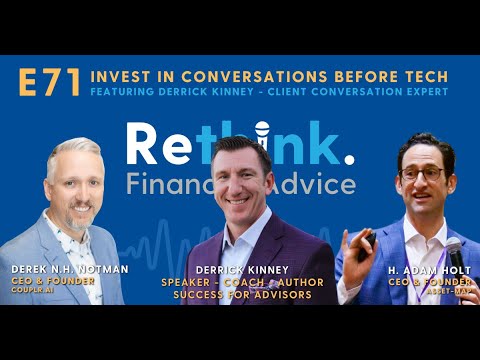
Ep71 - Rethink: Invest in Conversations Before Technology – Featuring Derrick Kinney
Watch and Listen
Episode Summary
Derrick Kinney, founder of Good Money Framework and host of the Good Money Podcast, joins Adam Holt and Derek Notman to explore the tension between chasing new technology and simply having better conversations with clients. Drawing on 25-plus years running his own planning firm, Kinney shares how to craft a distinctive elevator pitch, protect focus time from digital distraction, and identify the clients and problems a firm is best suited to serve. The conversation returns repeatedly to his central warning: an obsession with technology over humanity undermines the advisory relationship.
What This Episode Covers
- Crafting a distinctive advisor elevator pitch
- Balancing digital tools with focused, human conversation
- Identifying your ideal client and the problems you solve
- Lessons from 25+ years running an independent planning firm
- Why storytelling outperforms technology in client relationships
Full Transcript
Full timestamped transcript.
[00:00:27] Adam Holt: Derek, what should advisors. Be investing in
[00:00:31] Derek Notman: to help acquire new clients.
Love that question. I think it's top of mind for most advisors. Right. Yeah. Especially with all the technology that's out there. I mean, doesn't it feel like drinking from a fire hose most of the time? Oh yeah. And everybody wants organic growth, right?
That's the new thing. Organic growth is the new thing. That's the new black, I guess you call it or whatever. I don't know. I'm not a
[00:00:57] Adam Holt: What my revenue in the black? Yeah. Yeah, there you
[00:01:00] Derek Notman: go. Yeah. Yeah. , it is an interesting question. I I would say that obviously there's a number of things we can invest in, but I would ask advisors to maybe take pause and stand back a second and say, what type of conversations am I having?
What type of relationships do I want with the clients that I have or, or intend to bring on to my firm and getting more clear about that. What problems am I solving? What people do I like to work with? You know, I'm more of a human level. And then what tech can I go get invest in to help me? Amplify the conversations and relationships that I'm looking for.
So I think a lot of times what happens is tech comes first. Yeah. Like, oh, I need lead gen. Okay. Uh, why do I need lead gen? What kind of lead gen do I want? Oh, I don't know. I just want lead gen. And then they go buy lead gen. Right. Like, hold on a second here. I get it. It's important. You want more clients, but what kind of clients do you want?
Like you gotta go deeper than that because tech by itself, as we all know, is not the magic silver bullet. It could be actually detrimental if you don't do it right. So I would say like, if you're going to invest in something first, what type of relationships and conversations do you want to be having with what types of customers?
And then from there, use that to drive your technology investment.
[00:02:27] Adam Holt: You know, that's funny. I didn't really think about it until you came back with that response, but it's true. Everybody is jumping right to the idea that I need to go acquire all the tech. Again, I need to workflow, automate, animate, whatever, anything, but be human.
In other words, that the tech itself has got so much leverage in it that no matter what I do, if I just add it, I'm going to be great. But the reality is, is that what we're really saying is that the conversations I want to have with clients. And maybe the conversation I need to have with myself is all about intentionality.
It's all about meaning connectivity. And then you should use the tech. That's going to help you have more of those conversations. Cause I can tell you one thing after being in the business for 20, some years, I realized there are certain clients I really like to work with and certain clients I didn't really want to work with.
And I found myself being more choiceful as to who I would take on. But when my coach told me. Decide who you really want to work with, be with who you are, who you want to attract. Guess what? When I was more intentional, I started having better conversations and everything was a lot easier. Wasn't it? Did you have a lot easier?
[00:03:41] Derek Notman: Well, you want to be there. Like we're, we're human beings. We want to be with other humans like us that we like. Yeah, we have for millions of years. So don't try to replace that, lean into that and find tech that helps you do that. Yeah.
[00:03:58] Adam Holt: So this came up as a conversation we had with Derek Kinney, who's actually an also a recovering advisor, just like us because we kind of like figured it out.
And then we're like, Oh my gosh, there's something more. , so Derek, if you're not familiar with him, other Derek, uh, is Derek is a, is an ex advisor. He's, I would say he's almost a motivational speaker, but he's a speaker. He's an author. He's written the bestselling books. He's been on the news. He's been on media , and his kind of different take has been all about the conversation and the power of the language you use and the words that we use.
, and I encourage you guys to check out some of the work that he's doing and some real altruistic stuff for helping children, helping teens. , but Derek and I had a really interesting conversation, which we know you'll find something here, Derek.
[00:04:47] Derek Notman: Yeah, really great conversation. I think he's got like six kids or something like that, definite rebel dad.
So , let's jump in and see what he has to say.
[00:04:55] Adam Holt: Well, thank you, Derek Kinney, for joining us today. We're excited to have you on Rethink podcast. Do us a favor. Give us an idea. What's your unique perspective of the advice market today?
[00:05:05] Derrick Kinney: Yeah. Well, Adam, Derek, great to be with you today.
I know you're very selective on your guests. I kind of squeaked right in there. So I appreciate that. You know, one of the, the core beliefs I've got is that, especially in an age of technology, when you're attracted to that, you need to be even more attractive. to the prospects who have problems that you can solve.
And I'm a big believer in how do we convert conversations into clients. And part of that is knowing what part of my job is visible to the prospect and the client versus what's invisible. And I need to make sure that by adding the most value, I need to be the most visible. Present advisor. That's how I'm gonna stand out.
[00:05:47] Adam Holt: That's a really challenging thing to do, though. So how are you finding that the advisors that you interact with or coach or speak to? How are they sharing their challenges around that topic specifically?
[00:05:59] Derrick Kinney: Well, right now, the temptation is so great. I mean, like, for example, I have a challenge right now that when I get up in the morning, I can't look at my phone until 10 a.
m. Okay, and the purpose of that is because my most productive highest dollar use of my time is 8 to 10 in the morning But I find if I'm being candid here, I can get sucked into house my LinkedIn post doing What are people talk about on social media and literally within about? Five minutes of waking up determines how I'm feeling about the day and I've done myself a disservice and everybody else a disservice.
So my goal is to kind of do a little phone fast the month of February during those two hours. And it gives me a treat at 10 a. m. to say. Something to look forward to, but I realized if I'm thinking about that with my phone, how many advisors believe that I've got to have the best tech stack and I've got to have the fastest computer, the best day I prompts.
And if I don't have that, then I will not attract the ideal clients. I want, I would say to them. That is just not right. And if I could just tell a quick story, let, let's say that you were in a social setting and you were kind of mingling around the room and you met a gentleman and you asked him, what do you do for a living?
And he said, well, I'm a, I'm a personal trainer. And he said, I help people get in shape and any better so they can live a better life. And you kind of ask him some more questions and so forth and don't think much about it. Well, later on in the evening. Um, you meet a woman and you ask her the same question, Hey, what do you do for a living?
And she says, well, you know how busy executives want to eat better and look better, but they're so busy growing their business and they want to provide for their families. I create a customized game plan for busy people so they can be the cool grandparent that's fit enough to chase their grandkids across the floor and live the life they've always wanted.
You say, wow. So a week goes by. And you're talking to your wife and you say, you know what? I really feel like I need to get in shape. Which of those two trainers will typically immediately come to mind?
[00:08:03] Adam Holt: Good point. Second one, I'm guessing. I'm still stuck on the story of the second person. So what did the first person do?
[00:08:09] Derrick Kinney: Yeah, so exactly. And so what that means is that when we are in these social settings that we're we're in every single day, the moment someone drops on you what you do for a living, You've got a choice to make either you can cause their eyes to glaze over faster than Krispy Kreme donut and they literally go comatose in front of you when you say I'm a financial advisor.
Or you can introduce them and engage them in what I call a relatable problem. So for example, I might say, you know, Derek, you know how people worry about running out of money in retirement? And you're like, well, yeah, well, we have a three step plan that provides a way for them to not worry about money and have the confidence they want to have financial freedom.
We specialize in retirement income planning, then I might tell a story about a client that came in who felt nervous and worried and how we help them create confidence. Well, what that does is in that entire dialogue of maybe 20 to 30 words, did I mention at all that I was a financial advisor?
[00:09:14] No one: No,
[00:09:15] Derrick Kinney: and the whole point is all of us, whether we like it or not, and it's not fair, but it's reality.
People have a mental checklist of what they choose to burn their brain cells on. So for example, if I say I'm a financial advisor, automatically there's this mental checklist of you sell stuff. My friend lost money with a financial advisor. You buy stocks, you sell insurance. You're going to sell me a bunch of stuff I don't need.
And I didn't even say anything at all, but you're judging me based on your preconceived notion. And the way to fight that clearly is to connect with your prospects. In their financial pain with a relatable problem. So, for example, if you work with teachers, you know how teachers struggle with working hard for 20 years and they've got to make that one pension decision.
They don't want to screw it up. Yeah. Well, see, you say something that immediately connects with your target market where they think this person gets me and they understand me.
[00:10:17] Derek Notman: So, if I'm hearing you correctly, the missing opportunity, maybe like for our next question here is advisors that are not paying attention to and doing just what you said. . Are you seeing that a lot with the advisors that you're working with? , is this a challenge that they're having? , And why are they not addressing it or are they and just not doing it the correct way?
[00:10:42] Derrick Kinney: Well, I think , it's a couple of different things. First of all, think about all the pain that a financial advisor goes through to become a financial advisor. They study, they, they have to reach out to people. They're rejected a lot. They face a lot of no's. I mean, there's a lot of pieces, and I think as an advisor, it's the most noble profession available, but I don't think people are equipped to realize how other people are thinking.
People think They think how I think, and that's bad thinking. The reality is understanding this is how other people are thinking. For example, if I'm driving down the highway and I'm looking at billboards, I might see 20 billboards on the way from here to my office, but I'm mentally registering only the ones that I immediately have a connection with.
The rest of them are just wasted money. And so what I would tell people is right now, especially in the age of AI and high tech. Thinking that AI is going to be the magnet that attracts our ideal prospects to us, I think is foolish. But every day, our neighbors, the people we care about, the parents at our kids school, at our church, at Rotary, wherever they are, those people, figuratively, are all carrying this roller bag luggage behind them.
And inside that roller bag luggage are their painful financial problems. That they've accumulated their whole life. And you meet some people who can tell they've had a lot of problems in their life. And what they're looking for subconsciously, I believe, is someone who can give them a lighter set of luggage.
And that's what our job as financial advisors is. And I think we're doing people a disservice when we say, I'm a financial advisor, or we're causing prospects to try to figure out how we can help them. If we do that, it causes them to have to burn too many brain cells and they simply check out. But if we can say to them in a relatable way, you know how, and you connect with a problem you know that person has, it opens a doorway where you could help them solve that problem.
And I feel like that's what we owe more of the American public today.
[00:12:50] Adam Holt: This is a great point. I mean, gosh, it's, it feels like what we talk about all the time and that the challenges we're trying to address with that as a map is, can you just start the conversation? You have a conversation about that heavy luggage and the inventory that's typically overwhelming them or maybe even intimidating them.
They don't know how to start digging in and cleaning out. So that's a great point. So what kind of action steps would you recommend for our audience to start thinking about now or for us to start doing?
[00:13:14] Derrick Kinney: Well, let's take this now inside of the office. So let's say you've intrigued the person enough and they, they're meeting with you now.
And I like to call these visits and non meetings. Typically meetings are with your proctologist, visits are with someone you care about and you enjoy. So we're going to have a visit together. So now you're in the office having a visit. And so many advisors and we're wired this way to solve problems. You know, we talked about the relatable problem.
And once they're in the office, we want to get in there and impress people with our knowledge and solve stuff. And that could be probably the biggest mistake. I like to say, agitate, don't solve problems in the first visit. And that goal is finding out from them what is the greatest service. I could provide for you.
Number one question, because you want them to tell you how you can help me have a better life. And even asking 12 months from now, if we were having coffee together, what needs to happen for you to say, I'm sure glad I hired Derek today. And in their words, they're telling you what the win looks like. And so what I would often tell people in our visits is.
Is that something you'd like my help with? What would happen if you don't solve that problem? What is it that you want to happen with that problem? And so they're telling you, basically almost begging you, I want you to solve this. And I finally wrap up and say, is that something you'd like my help with?
Because what I believe is, and this may sound controversial, no fee, no me, no fee. No, me, I can't be the best advisor you need until you pay me to be that advisor. Once you put your money to me, I become very, very knowledgeable and smart and I become very much of a problem solver for you because I don't want to just solve your problem today.
I'm solving your problem the rest of your life and possibly your kids and the next generation. So if I solve too much now, I'm actually doing you a disservice and I can't allow that to happen.
[00:15:15] Derek Notman: No fee, no me. I like that. So it sounds a bit like the action. Some of the action steps you're suggesting to advisors is to take a step back and reevaluate what is the dialogue that you're having with the potential customer with the client, right?
What question are you listening more than talking? What questions are you asking? How are you explaining things? Um, it's, it's easy to get very technical without the prospectus for the 40 page illustration. Um, that's not going to solve the problem. So, if I'm hearing you correct, that's what it sounds like.
[00:15:49] Derrick Kinney: Yeah. And to your point, what I would say is our work as advisors, and I say this with a heart full of compassion and empathy. We are all commodities. We are all commoditized. In the eyes of the prospect, we appear to be and sound like everybody else.
[00:16:08] No one: The
[00:16:08] Derrick Kinney: reason we are that way is because of how we typically dialogue with prospects.
We typically say things like, you know, um, based on our product and services features and benefits, This investment, this annuity, this insurance, this fee based account, whatever it is, well suddenly now you place yourself in a comparison game with everybody else based on features and benefits and fees.
But instead, I like to call that renting your success. If you want to own your success, you want to own a problem that keeps your ideal prospects awake at night. And what I would tell people to do is simple exercises. Ask yourself of the five most recent clients that you brought on, what was the problem?
That they asked you to help them solve. And then I would ask you to look at your five favorite clients. The names on your calendar, that when you see their names, you get excited, like, oh my gosh, Derek's coming in, Adam's coming in. This is gonna be great. And they take every word of your advice as gold.
What problems did you help them solve? I call that your focus group. So there's no need to do advertising or big things. Just ask your clients and once you know what that pattern is of the problem you're solving, you have a question to ask. Do I like solving that problem? Because you've clearly shown people will pay you to solve that problem.
Or is there a different problem? But the key is you have to own a problem. If I believe you're going to achieve the success and really enjoy the life you want as a financial advisor.
[00:17:40] Derek Notman: It's like another way of saying figuring out your niche.
[00:17:45] Derrick Kinney: Yeah.
[00:17:45] Derek Notman: I've never heard it that
[00:17:46] Derrick Kinney: way before. Yeah. I like the word niche, but what I would distinguish that is, let's say someone listening likes to work with doctors.
Well, if I'm in a room of doctors, I might say, well, we specialize in working with doctors. Well, there is a certain level of attraction there that says, okay, this person works with doctors. But if I then say, we specialize in working with doctors who worry about spoiling their kids. Because they didn't work as hard as I did going to school.
Well, see that little extra piece there says, yes, that's exactly the pain point. It'd be, for example, if we were in a room full of parents, other dads, and another dad said to you, do you ever feel like when you talk to your daughter, it goes in one ear and out the other, and you're like, oh my gosh, yes, it's immediate.
And so the goal of all of this is how do you find a problem that is immediately relatable? People are like, oh my gosh, this person understands exactly what I'm talking about. That's really the golden key.
[00:18:45] Derek Notman: And you're saying that the best way to identify that problem, the thing that you help people fix is by looking at the clients you've already brought in, the ones that are your favorites, the one that you've done the best work with, and then go find more people
[00:18:57] Derrick Kinney: like that.
Yeah. And what I would say is too, is I'm a big believer in recent and relevant. So, for example, you want to look at my past five clients and ask, okay, what problems am I currently solving? Because sometimes we kind of get off track a little bit and we're not. In the same lane that we started off in, but what that does is it validates.
And so what I would ask people to do is find that problem, but also even more importantly, identify if you can, what emotion did they feel once you help them solve that problem? Did they feel confident? Did they feel at peace? Did they feel, uh, empowered? And those are words that people can relate to because what I believe is.
Words equal wealth and the right word spoken at the right time said to the right person describing the right problem can lead to great profits.
[00:19:55] Derek Notman: Boy, that was a really interesting conversation. Uh, and how often do we get two Derrick's at the same
[00:20:02] Adam Holt: time?
Huh? I was going to mention that just because we had two Derrick's, that was going to be the most amazing part of the whole thing.
[00:20:09] Derek Notman: Yeah. So anyone listening, you can go away now. Cause it's, you got the most out of it already.
Well, we did. I didn't even know who was speaking. I said, Derek, Derek, it was very confusing to me.
I hope you guys listened, understood what was going on. I need a nickname.
You got to come up with a nickname for me. Because I can't come up with my own nickname. You can't be that. Okay.
[00:20:27] Adam Holt: I tell you what, why don't we do a social poll? Everybody submit on LinkedIn what they think we should nickname Derek Notman.
[00:20:35] Derek Notman: I can only imagine.
[00:20:38] Adam Holt: Well, it's funny because if you know Craig Iskowitz, remember what he called us? What did he call us? He called us not Holtman. . Yeah, something like that. So stupid , I guess that makes sense. Yeah. Anyways, in the moment it was funnier. I think it was in the moment.
Yeah. Well, what did Derek with two Rs say, that resonated with you?
[00:21:01] Derek Notman: Well, right off the bat, I really liked his positioning around , Hey, don't obsess over technology. Yeah, it's important, but there's other stuff going on here that's deeper. Like we refer to as humanity. I think that really was interesting.
And even at a rebel dad's experience, like he talked about he doesn't have his phone on until 10 in the morning. So he can be more focused on being present and doing what's we talked about that digital detox when we were on Necker with the whole rebel group, and there's a lot of value to that.
I think that it's, there's been this slippery tech slope and we're overwhelmed now drinking from a fire hose with it. So I really liked that. Push back on that a little bit. And let's focus on the human side of what we do, which is, you know, when you, when you hear it like that, it's like, duh, we should, you know, I think that was well
[00:21:51] Adam Holt: said does the perfect non tech way to describe it or like, bro, bro.
That's true, bro. That's what I'm going to, I'm coming up with nicknames as we speak. you know, it's funny because I forgot that. He brought up the digital detox in the morning. I, I was thinking while he was saying that, could I actually do that? Could I actually not open my emails? Forget my social media.
I don't really go to social media in the morning. I go right to calendar. What time
[00:22:22] Derek Notman: from you, you waking up until turning on and looking how many minutes go by?
[00:22:27] Adam Holt: Oh, well, I wake up at six 30. I generally look at the calendar very first thing. I don't look at text, social, any of that stuff. You're still in bed?
I could be still in bed because the alarm clock is going off. It's on my phone. Ah, the alarm is on the phone for, and I got to wake up the whole family. So I get up, nobody else getting up. I get up with the alarm and I look at my calendar to figure out what I'm going to wear, where I'm going to eat. Okay.
I got to know what I'm, where I'm going to eat today. Am I going to get any lunch or is it back to back all day long? That's what I have to figure out. Okay.
[00:23:01] Derek Notman: So I, I get it. But so what, okay. I mean, I don't, we don't need to tell everyone you're day by day, minute by minute. Well, if it helps me, let's do it.
But what I'm, but I'm, so let me share what I do. 'cause I used to do exactly what you do. What do you do? I don't anymore now. So I, we get up and phone is off. And I have a cup of coffee and spend, you know, usually a half hour to an hour reading a book and then typically go on, , a walk to the beach with the dogs and then come back and turn everything on.
[00:23:35] Adam Holt: They're literally off on, you mean it's actually off.
[00:23:41] Derek Notman: Yeah. Like I actually turn everything off and it stays in my office. So it is. Yeah. So we don't use an alarm clock unless we got to get up early for a flight. And
[00:23:50] Adam Holt: if
[00:23:52] Derek Notman: we do need an alarm clock, it's with an actual alarm clock on my nightstand and it works, there was FOMO initially, but dude, I'm, I'm not an ER doc,
[00:24:01] No one: you know,
[00:24:02] Derek Notman: like most advisors aren't, so you don't need to be, you don't need to be that connected really.
[00:24:08] Adam Holt: That's amazing. I've taken for granted the fact that I have everyone on the phone. So. I do have Do Not Disturb time on my phone, so it won't ring or bing or make any noises during hours like 10 at night till 7 in the morning, unless it's a family member. This is a really interesting question because what's the real benefit for the person listening to this right now?
To contemplate a digital detox before let's say 10 like Derek Kinney said, or turn off the phone like Derek Notman said, or not do that like Adam Holt does. And, and is there a real benefit in it that we can experiment with individually?
[00:24:51] Derek Notman: I think so. I mean, as Kenny said, he finds that his most productive hours in the day are eight to 10.
So he doesn't want to be distracted. And I find that I have like this additional level of anxiety if I've got my phone on and it's just, it's a distraction. Cause it's really easy. Even if I'm on do not do not disturb how easy it is to like, Oh, I'm going to just check LinkedIn real quick.
Oh, I'm going to just check my email. And next thing, you know, like you're stuck in that instead of being present and being present could be with your kid. It could be working on a project for your business that you should be focused on. I think so. I mean, there's different ways in this cat, but, uh, right.
[00:25:27] Adam Holt: Okay. Got it. Well, let's talk about the second thing he brought up, which was this idea that everybody's getting commoditized and you have to kind of change over your elevator pitch has to change. Right. Remember what he talked about about this? Like I'm an advisor or I'm a, I'm a blank that does this for people just like you.
[00:25:47] Derek Notman: I had to laugh at that because how many times have you and myself both been in a situation earlier in our careers where we were asked, Oh, what do you do? Oh, I'm a financial advisor. And then you can literally see the person like eyes glass over there. Oh, I got to go get a drink or Oh, I, Oh, I really had to go talk to that person.
And then you're just by yourself. Right?
[00:26:07] Adam Holt: I don't know. That's what, maybe that's what happened to you, but I hate
[00:26:12] Derek Notman: it. I do not ask me what I do. Cause I don't want to have to tell you it. Cause I just feel like I'm schmuck.
[00:26:17] Adam Holt: Well, you weren't in the lead gen business back then. I mean, I, I, I gotta believe we were all trying to get business from wherever we could, but we were hoping that that one statement would inspire somebody to be like, I actually need.
Financial planner right now. Do you know any or you get the person wants to ask you about, should you buy Tesla or whatever, or Apple, right? You'd get that person, uh, pontificate.
[00:26:39] Derek Notman: I'd try to stay away from those people, but what, what I think he was driving at here is that we are commoditized. And so how do we differentiate?
We differentiate with. Our personal stories, our personalities, our shared commonalities, our shared experiences, similar problems we might've had. Like he talked about, like, does your daughter not listen to you when I talk, when you talk to her, you know, in one ear, that's something that we can resonate.
So how do you connect with, how do you connect a client and an advisor on those deeper levels? Um, instead of just saying, Hey, I'm a financial advisor and I sell life insurance. And so it really resonates with me. Cause that's what we're doing at coupler. We're using tech to actually, you know, do more humanity to find that human connection.
[00:27:24] Adam Holt: Yeah.
[00:27:26] Derek Notman: And that's what, that's what people want. So people are looking for, like he shared, you know, if you're at a cocktail party and you're having an experience or a conversation where you're talking about a problem and solving it and having the shared experience, Everything just like you've built rapport and trust more quickly.
You feel better. And so that totally resonates with me and it works. I mean, that's what we're seeing a couple or two. That's what people want.
[00:27:47] Adam Holt: Yeah. Well, that's true. People want to talk about the stories. I mean, if you have something that's a commonality, some interest, you have plenty to talk about.
There's nothing to do with finances. I mean, the, the real interesting thing of using that his phraseology as a lead gen opportunity. Uh, it's actually, I did something very similar in the old days. And of course, we always talk about this, like when you're at the networking event or at some dinner party, I haven't been to either one of those things in 20 years, it feels like they actually still exist.
There's not the format for having that kind of engagement. Maybe you go to like a super bowl party or you're going to, uh, your buddies, like, or your daughter's, um, recital and there's some thing afterwards, but you really don't. You don't really get the opportunity to just connect with strangers all the time, or maybe you do it through church or your religious organization.
For me, I used to say, when people didn't ask me what I do, Derek, you know what I would say? When something happened that could relate to a story, I would say, you know what, actually my client was just dealing with that. He was just telling me how he just wasted a whole bunch of money on this thing, and we had to unwind the whole thing, and blah blah blah blah.
And then people would say, well, wait, what do you do? And that would give me the entree to actually say, but of course I'm planting the seeds very strategically. People usually responded to a story that's relatable. And I think that's the takeaway of what Derek's saying is that going back to the humanity, as opposed to just the details is something I think we're all seeking.
It's the reason why reality television show is the most popular type of television series there is out there. And I think it's the reason why Instagram is way more popular than, you know, the news. Even I think, uh, people want to see it. It's
[00:29:28] Derek Notman: like an empathy thing, right? We are, are wired as human beings to seek out others like that, that understand how we're feeling about something.
Absolutely. Absolutely. It's, it's so true. So further down that, that vein though, I was like, what do people really want? I think there's gotta be this balance between tech and conversation, but Financial planning technology, like that is important. People do want it. And I think the best tech is probably going to be the one that helps facilitate both.
[00:30:00] Adam Holt: I think that really resonated with me big time, right? To feel like that's all I talk about. And in many ways, asset map has been trying to create a new category, which has existed forever called conversational financial planning. I mean, well, before we had all this great tech, we had, , a yellow pad.
We had a pen and a calculator and we talked, right. You drew it out. You actually draw it out. Right. Right. We educated people and, and. And then we would go back in office and we ran a bunch of analysis and then we would tell the client what the analysis said. Now we present the analysis as this, as if that is what the client is asking for, right?
Here's what the, you know, the Morningstar looked like. Here's what the financial plan looks like. You want a 40
[00:30:39] Derek Notman: page report? Here you go.
[00:30:40] Adam Holt: Yeah. Thank you. Thank you very much. Well, what people really want is they want to know that the work has been done, right? The analysis has been done. The credibility is there that the, that the recommendation you're making.
Actually is based on something. So I think for us at asset map, we've been really, really focusing on conversational planning and how do you just facilitate the conversation with this conversation piece called the asset map, which is just a picture of your very personal life. What makes sense and what doesn't and what's intentional.
What's haphazard. So I think really making it a storytelling experience is really the way that we keep humanity in our business today. And I think Derek's got it right. I mean, even to the point where you mentioned about his book, which we, which we recorded off air, uh, his book written about how the fact that.
The perception is that people with money are somehow evil or, you know, you can fit through the eye of the needle type of question. And that's not the truth at all, which I thought was another interesting topic to talk about if we had time. Um, but it's true. People really want to talk about the meaning of the money, not the money itself.
[00:31:40] Derek Notman: That's exactly right. And I like how he advocates a little bit for the true value of what advisors do with this whole comment. No fee, no me. Yeah. Do you want my help? Like we've established a relationship, we've had a conversation, you feel like you trust me now you want my help. Like you're gonna, you're gonna have to pay for it.
Like I, I am worth something. I mean, I can't tell you how many times as an advisor, I did so much stuff for free just to try to get the client, and just would give up opportunities. And I think a lot of advisors do that, unfortunately, and it, you are worth something. And you should get paid for your time as long as you're not just schlepping X, Y, Z to solve every problem.
[00:32:23] Adam Holt: I know. Yeah, I, I feel that this one too. I always gave way more than I ever charged. Even if I didn't charge, I just kept giving, giving, giving. And I, I did believe that my mindset is that it would come back. You know, and, and my experience is that it did come back a tenfold, but, but it's true. I think today's world, people are so used to getting everything for free on the internet or GPT or Google, uh, or I'll just watch a YouTube video at this point.
[00:32:48] Derek Notman: I always go back to your, you said this years ago, when price costs, , of being wrong is high, get a human involved. Yeah. Then, you know, it's worth paying that human because then you can blame someone else.
Sorry, it's not my fault. It was the advisor's fault, right? That's right.
[00:33:09] Adam Holt: And I have the receipts to prove it. Yeah, right. Yeah. See now, look how expensive that decision was. That's pretty funny. So what are the things that advisors can do, Derek? What's, what are the takeaways that people should put into motion right away?
[00:33:22] Derek Notman: Well, I don't know if I like the term elevator pitch, but I think that there's a better way that advisors can frame initial conversations with, , potential customers, potential clients and , share stories, share problems that you've solved, , things of that nature where it's relatable. Instead of, oh, I just sell life insurance to doctors.
That's really boring. Like I don't care how many other people do the same thing. Make it much more relatable to me. And those are just subtle little changes, things you can add into a conversation. And as Derek said, Listen more. You got to listen. You got to give them that open, forum to say what's on their mind.
Otherwise it's never going to really materialize into a great relationship.
[00:34:06] Adam Holt: Yeah, those are great points. I think something of the doctors, I kept thinking to myself, what was my, what would be a better doctor's pitch, uh, today. And I was thinking to myself, , you know, how doctors.
spend an enormous amount of time and energy and debt to get to a place and then make more money than they've ever made in their life and don't know where it is. I work with those types of doctors to help them find it. You're going to see a lightbulb go off and a whole
[00:34:30] Derek Notman: bunch
[00:34:30] Adam Holt: of doctors and they hear that, right?
Like, Oh shit. Right. Relatable rapport. And then give them a vision forward of how you're actually helping people. I think that, that was a, that's a great framework. If you take it apart, listen to it again, you can probably find your own phrase, maybe two or three for recency bias of who have you worked with recently?
So I think that makes a lot of sense. So go back,
[00:34:55] Derek Notman: definitely
[00:34:55] Adam Holt: look at the last five. Clients that came to you, if you assuming you still want more clients like that, uh, and then find out what that commonality was, what that story is. I don't think it begs a question. You can probably ask them, ask them why, what was the emotion that I met when I'm just going back and trying to figure out how to appreciate
[00:35:11] Derek Notman: that more because it shows you want to understand it.
It'll make you a better advisor for them moving forward and also help you crystallize who you actually want to help and do something with, you know, you
[00:35:21] Adam Holt: might be able to ask an introduction. Well, who else looks like that? Who else could relate to that challenge? Who else would appreciate being helped the way that I helped you?
I think that's, that's really good. I think for me also the, the takeaways I think are, that are really important as a reminder that in this tech. If evolution in this next wave of AI is that advisors really need to double down on relationship currency. The only way I can figure out that we're going to do that is either by giving them enormous performance value, which I think is becoming harder and harder, or just giving them fantastic trust communication.
Let. You know, you know, the client intimately, you know, I think you got to prove that. So you need a way to have conversations about all the stuff they're doing holistically. Uh, I encourage you obviously to look at asset map or anything that helps you frame a conversation, uh, because that's important. And certainly from the standpoint of lead generation and making sure you're getting like minded clients, right.
Exactly. Yeah. Who are you?
[00:36:23] Derek Notman: And does it match up a hundred percent? You're right.
[00:36:26] Adam Holt: Absolutely.
[00:36:28] Derek Notman: I
[00:36:29] Adam Holt: know. I'm right. And we know what works. We've seen it work. Just most people just don't know. And we're all overwhelmed. So change management, we understand is challenging. Focus on one thing and just put that into motion.
Then do the next thing, then do the next thing. One step in front of the other. With that, I thought that was really interesting. Derek Kinney. For joining our podcast. Uh, you can see all the notes and links to his book as well as some other resources to, to find out, uh, uh, if he can be impactful in your journey, Derek, I appreciate our time as always.
[00:36:58] Derek Notman: It was good seeing everybody and everyone listening. Thank you for your time. Give us a like, give us a recommendation or review or whatever. They do on podcasts these days. I don't know. I don't know. Those
[00:37:09] Adam Holt: youngins,
[00:37:10] Derek Notman: the people
[00:37:10] Adam Holt: who open their phone. Yeah.
[00:37:13] Derek Notman: For you, for you digital folks, you know, send me a snail mail.
I want someone to send me an actual letter. What is that? Yeah. What is that? How do you buy
[00:37:22] Adam Holt: stamps today? I
[00:37:23] Derek Notman: don't even know.
[00:37:25] Adam Holt: Very cool. All right, my friend, we'll see you at the next. See you later, buddy.
The content has been made available to you by Asset-Map for informational and educational purposes only.