
Ep66 - Rethink: Advice Mindset - Purpose and Principles – Featuring Breanna Blaney
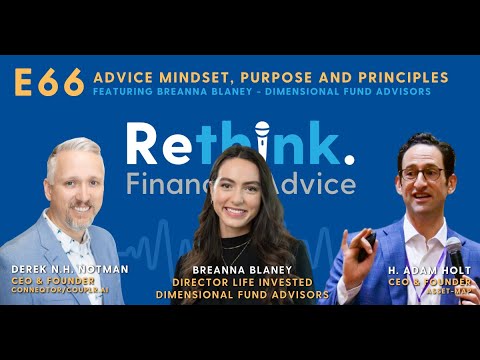
Watch and Listen
Episode Summary
Recorded in person at the SHIFT conference while Derek traveled in South Africa, Adam Holt sits down with Breanna Blaney, VP and Director of Life Invested at Dimensional Fund Advisors, to explore the intersection of financial advice, personal wellness, and human ingenuity. Breanna shares how principles drawn from yoga and mindfulness practice can reshape how advisors show up for clients, and why vulnerability and authenticity—not just technical expertise—build lasting trust.
What This Episode Covers
- The intersection of financial advice and personal wellness
- How mindfulness and yoga principles apply to client work
- Empathy and vulnerability as trust-building tools
- Understanding money-related stress and fear-driven behavior
- Connecting self-worth to financial attitudes
- Finding and sharing your own guiding principles as an advisor
Full Transcript
Full timestamped transcript.
[00:00:30] Adam Holt: Derek, can you share your guiding principles of financial advice with us? Derek, Derek. Oh yeah, that's right. Sorry. Derek's in South Africa. He's leaving me to do this podcast. On my own. Well, for those of you that know me, you know, I could probably talk for some time.
So I'm going to try this one out. Derek is in South Africa, proving that anybody could work from anywhere as he has fun and somehow runs meetings with his family in brand new places around the world. So if you haven't checked out that episode, Definitely make sure that you learn about work from anywhere.
This question actually is interesting because it came up in conversations around the shift conference that happened earlier in 2024, where I had the opportunity to be on the main stage, opening up the program with Brianna Blaney, the director of life invested at dimensional fund advisors. Now, this is really interesting because a new take. On an approach of financial advice, as we all search for meaning relating to what is the human role of an advisor, especially given all the technology innovation that's coming. That has a opportunity to disintermediate a good number of professional service advisors.
And that's what this conference was all about at shift this year is how do we elevate the human experience, both from the advisor perspective, as well as the empathy needed to deliver on a valuable experience worthy of paying for it from the customer's perspective, especially in this new age of experience economy and direct on demand technology available whenever you need it at no cost.
Now, the important thing about this takeaway is that when I had the opportunity to meet Brianna, she had a fantastic attitude and an energy that you will experience when I share our recording together, you'll understand what she's doing because it's a new and distinctly different approach to financial advice.
I think you'll appreciate one of the interesting things that Brianna is doing is she's actually at the intersection of both yoga and finance, thinking about the relatability of investments and aligning deeper sense of awareness and meaning that I think all of us can take some lessons from.
And I hope you listened here because there's going to be some really interesting nuances and challenges to you in your own practice and how you deal with clients. I hope you find this extremely rewarding.
[00:02:53] Adam Holt Tank: thank you Bre, for joining us today. It's really fun to be here at the shift conference where we're talking about human first advice, which is meaning a lot of different things to different people, but I'm really curious and.
You've been doing such some interesting work in the financial services business that I think a lot of people are finding surprising and unique and exciting. So tell us what's your unique financial perspective on what's going on in our marketplace.
[00:03:16] Breanna Blaney: Yeah. Well, thank you so much Adam for Having me on and it's just been so fun to get to know you over the past few days and spend time together So yeah, thanks again, and I would say two things.
I would say one I You know when I entered into the financial advisory industry it I thought of it in a very different way than maybe I do now and One of those pieces is that I think that I Financial advisors have always had this reputation of helping people with their finances, probably rightfully so.
Uh, but really I think that it is so much more than that and that really we've been optimizing for the wrong thing in some ways. Um, and not even maybe the wrong thing, but just that there's so much more to it than just money, right? A financial advisor's job is so much more than just managing someone's assets.
And, um, that that's really the opportunity that we have as an industry is to not only help people with their money and help them invest better, but also to live better. And then the second thing I would say is that people are actually much no more about investing than they often think that they do.
[00:04:25] Adam Holt Tank: So that's interesting.
I mean, when you think about your background and the industry, I would say this general trend for people's more awareness about both intention, uh, as well as mindfulness and financial wellness. These are all intersecting in a whole new way than I think many of us in the financial services base are almost not comfortable because it's not a technical approach to solving financial services problems.
Typically, right. The things that are solved by math, Excel, financial planning tools, asset allocation tools. It's interesting to see, especially as your organization has gotten into this space, how they've really elevated your position. So what do you think is the opportunity that advisors are missing right now that your mindset or approach might be applicable for?
[00:05:10] Breanna Blaney: Yeah, well, I think that what we're really trying to do at the end of the day is help change people's lives. , that's a big thing. Like how do you actually change someone's life? And the reason that financial advisors are in such a unique place to do that is because money is so pervasive in every single aspect of our lives.
And, people have such different perspectives on money. And I think particularly in modern day society, so much of our self worth often is tied up in money. From a really young age, you are exposed to the mega America and, uh, just having to be around not, not necessarily in a bad way at all, but you're just around what money can buy.
And I think the media is just constantly in your face of this is, this is the path, you know, more money is, is better. And I think that the opportunity is to really sit back and say, well, why do I actually want more money? And. I think most people would say that I want more money because I want to be able to actually do things in my life.
And so instead of choosing a career path solely based on money or solely, you know, focused on these financial goals, I think the opportunity here is to really help people. People reshape the way that they think about money and bring more awareness to it. Because often we aren't even aware of what our mindset is.
We are moving throughout life. I mean, this was in my own personal experience as well. And you're making these decisions without even having an awareness of what your mindset actually is. And so I think that that's the huge opportunity. And, um, you know, our industry has been this way for, for many years, but we aren't necessarily seeing better outcomes.
For clients. And so I think that that's really where, how do we actually change people's lives and see better outcomes for people, which in my me, my mind means that one, we're actually changing people's lives to focus on what really matters to them. And then we are also having people have better investment returns and having a better investment experience.
And I think that those two things combined that there's a, some good things that can come from that.
[00:07:18] Adam Holt Tank: That's interesting. So, but how do you. It's interesting because you can't really measure this, or maybe you have measured this. Perhaps there's been research done on how those better outcomes play out.
Is there, is there some form of guidance to advisors that are thinking about either going, let's say, holistic or thinking about mindset or talking about motivations and money and really getting them for their clients, understanding them, I think trying to connect why it's been so important. Is there measurement or insight that advisors can take and say, why I must do something about this now?
[00:07:50] Breanna Blaney: Yes, and maybe I'll answer your question thinking about those two components actually start with the latter one Which is around investment returns and there is a study that is done about by doll bar every year and it basically looks at was the average return of the S& P 500 and Then what was the average return that investors are actually getting and every year there's like a 3 percent difference there And so we know on average investors aren't even getting the return of the S& P 500, right?
And so that's not a good investment outcome. Well, what's driving that often either active management trying to predict what's gonna happen in markets or investor behavior. There's fear around money or what's gonna happen. And so there's more of this reactivity to markets. And so that's tangible data that has been pretty consistent over the years that shows us, well, Hey, there's more work to be done to actually ensure that investors are getting the returns that they deserve.
And then on the flip side of the coin, I mean, I think that this is an area I've been really interested on. How do we gather more data that can show advisors that this is not only the right thing to do for your clients, but it's actually also good for business. And I've, you know, had the pleasure at dimensional working with so many large firms and small firms, really firms of all size sizes, and, um, have started to see firms who are starting to do this, really integrating this into their practices.
And we actually held a little pre conference , in the fall of last year, where we started gathering some survey data around, well, what are you seeing, you know, from firms that are shifting to more of this holistic approach? What are the benefits of doing so?
And it was a small sample size, so I don't think we can bank on all of it. You know, as it says, it may be past the dimensional data test. Uh, but , it anecdotally stared all of the things that I think that we would think. Increasing client retention, uh, increasing net promoter scores. So clients are happier with their advisor and they're also more likely to refer.
And also helping actually bring more people in to advisors practices. So those aren't necessarily hard numbers in terms of the percentages there, but that is anecdotally what, , I personally have been hearing and I think it's something that I've been focused on is , how do we get some more, some more data to really back that up?
[00:10:20] Adam Holt Tank: So I'm curious. So for advisors listening to this and remembering, okay, this is sounds theoretically, okay, so I want to be more empathetic. I want to get into the meaning of money. I want to help our clients, their behavioral, , side get right. I mean, there's been a lot of conversation, especially here at shift about, , behavioral coaching.
And it's actually really interesting to see how many people here, I don't know if you notice are in the mental wellness space. Getting into financial services. So there definitely is a shift coming. That's I think palpable What are some action steps that advisors who are thinking about
introducing more Behavioral awareness mindset, uh, what can they do? What are a couple of things that they might think about right now?
[00:10:57] Breanna Blaney: Yeah, well, to me, it's so exciting to see that. And I think that it makes a lot of sense because we see so many studies out there that show that money is the number one source of stress and American psychological association runs those studies every year.
And it's fascinating to go through the data and just see, um, the impact that money really has on people's lives. So there is an absolutely a. They a mental wellness component of money and that goes back to the opportunity that we have to really actually change people's lives And so I think tangibly Like so many advisors are sitting in this place of well, where do I even start? How do I start about this? And um, there's honestly so many Different avenues to, to go into. But I think a really helpful, uh, place to start is simply taking a step back and really looking at your own business and asking yourself, , why am I doing what I am doing? I made it.
Why am I in this business? Like, why am I here? What am I doing? What are the outcomes that I'm looking to get for my clients? , what's that actual transformation that I'm looking to create? And once you're able to answer that question,
you
can then step back and say, okay, well, how does everything that I'm doing from my investment philosophy, all the way up throughout your entire client experience, ladder out to that.
Creating that transformation and ultimately that outcome. And I think that what you'll find in the industry, that the state of the industry as it is today, is that we may be going back to that, that initial, , perspective is that have we really been optimizing for the right thing or are all of the functions in my business really laddering up to that approach?
[00:12:35] Adam Holt Tank: It's interesting because of course this podcast is about rethinking financial What I heard you say is That we should be questioning our why for everything. I'm assuming you mean big and small, right? Totally. So we're, are we talking everything from onboarding to asset allocation proposition to financial planning tool we use?
That seems like a massive project, but is there an overarching theme or specific question that we can use that could be applied to all of these different things?
[00:13:07] Breanna Blaney: It's a big thing. So I do think it takes like, there's a lot that goes into this. And like, that's why, uh, there is, it's kind of like, okay, if I really want to do this, then I've got to maybe rethink how I'm doing this at every layer of my business.
But I do think that there are easy places to start, even asking, and I think we've heard this a lot, so it's not something brand new, but it's like, what's your earliest money memory? You know, how are we getting people starting to understand what their mindset has been. And so really step one, we talk about changing someone's mindset around money, around investing, and step one is, Coming at us from a place of awareness.
And so many of us are not even aware of what our mindset is. And it's not just about money, but it's about everything in your life. And so what lens are you looking at your life through? You know, I say you and I can both be looking at the same piece of art, seeing it completely different because of the experiences that we've been through.
And so that to me is step one. How do we get awareness of where our clients are coming from? And so what are your earliest memories? Great questions to ask in that kind of category. And then the second piece of the pie is then discerning, is this supportive for me or not?
[00:14:14] Adam Holt Tank: Yeah.
[00:14:14] Breanna Blaney: Right. So is this mindset that I have been taking to my life helpful or has it been hurtful? And, uh, do I want to change it?
And so I think that that honestly, being able to have this conversation live with. Your clients and actually allowing them to answer the questions for you. So , we're shifting from, I'm telling you that this is what's right for you to, I want to be on this journey with you.
And so, you know, you tell me your earliest memory, right? And Marie is X, Y, Z, and maybe you've had a big fear of money for a long time. And it's like, well, how is that serving you?
And you go through that and then you, and then the third piece is how do you then rebuild. So now we've determined what is supportive, what is not, and then how are we going to actually reshape and help you build a philosophy and a mindset that is going to be supportive for you across all aspects here of your life, investing money, relationships, the whole gamut.
[00:15:13] Adam Holt Tank: You share with me before that you're working on an additional degree, an advanced degree in. I'm going to call it mindfulness wellness, especially as it relates to ancient arts and so forth. How do you think those teachings could be applied? To the current state of financial advice.
[00:15:37] Breanna Blaney: So like you mentioned, I am a big advocate student of yoga and Ayurveda and Ayurveda is a sister science of yoga. It's the science of self healing and, uh, really the science of life. And it, uh, was born out of India over 5, 000 years ago. And same similar in terms of yoga, they both come from Vedic philosophy.
And so these are some of the oldest. world and, uh, yoga is the science of self realization. So yoga and Ayurveda, it's really this beautiful kind of combination of the science of self realization and the science of life. And, uh, it's amazing that as I've been studying those things, you see so much applicability.
In how people live your everyday life and also in finance, which I know it might sound, sound kind of crazy to think about that, but it, it really does. And I, you know, there's this focus. I'd say, you know, even post COVID I'd say we'd have a trend of this of personal development and I want to be more mindful with my life and I want to be more thoughtful and I talk about yoga and Ayurveda as like the OG forms of personal development, right?
How do you actually understand yourself? And I, , really focus on the clients that I work with on, how do you answer some of these big questions of like, who am I?
[00:16:58] Adam Holt Tank: Yeah.
[00:16:58] Breanna Blaney: Why am I here? How do I function? How do I optimize my life for the things that I want to actually do and accomplish and the tools that are embedded in that?
Are gold. They are so helpful in terms of providing the structure around. How do we start to understand ourselves? And so I'll give one more specific, tangible example of that, which is around. Why? Feels like we're always seeing, Sinek, really, for me, at least.
Opened the door and a modern day lens in terms of, starting with why and the whole golden circle , and all of that. And in a Vedic philosophy, your why or purpose is called Dharma and Dharma means natural law. And it means , how do you really get yourself in flow with the world around you?
And in Vedic philosophy, the sentiment is that each of us as unique individuals have a specific purpose. It's a specific reason that we are here and it's called your spadarma and it's your individual purpose. How do you plug yourself into the broader reality? And so that whole process of really helping someone uncover and understand, okay, well, what is my unique essence of why I am here?
That is so applicable to what we're doing. How do you make money in life? How do you get yourself into a place? That you're going to be, , an ultimate flow with the world around you. And that's Dharma.
[00:18:30] Adam Holt Tank: Very cool. As you were talking, I was thinking to myself, I've been a huge proponent of telling advisors, they need to apply what they've learned and what they espouse to their clients on themselves. They need to do their own financial plan. They need to go through the process. They need to take their family through that process.
Why? Why very often spouses and partners of financial advisors never get a financial plan is because the financial planners typically just doing it behind the scenes. Are they actually taking them through an iterative process? A process that gets vulnerable, that gets to talk about what are your real needs and are we meeting them as a family, unless you're actually working with a financial advisor.
So I try to get and inspire financial advisors to actually go through the process that they promote for their clients. And I think what you're really touching on is,
I doubt that many financial advisors have really asked themselves the same kind of Dharma inspired questions. Of what's my purpose? What am I really contributing?
Why am I here? We get lots of conversations. And in fact, they happened here at shift. People came up to me and said, when, when did you decide that you were going to give up the financial advice business and go into tech, how did that transition work for you? Because, you know, there's a lot of financial advisors out there that are thinking what's next in life.
What is this? The extent of it. I've achieved some level of success. I've got some AUM, I'm doing a good practice, whatever that might be. Um, and they're thinking what's next.
And I think there's an opportunity Bre that financial advisors can take a good number of these principles. Some that we've talked about, some that we've experienced here and start challenging themselves to question what the bigger purpose is.
And once you do that for yourself, it does actually affect everybody around you, right? It's kind of a, it's an energy thing in a sense. If you want to influence people in that way, let's just elevate our own game purposely. Absolutely. Talk about intent, talk about mindset. And share that with your clients in a very authentic way.
I think it's, it's really getting a lot more leverage today. So is there anything that you think that the advice community does need to think and challenge that, uh, you'd like to comment on? Sure.
[00:20:28] Breanna Blaney: Well, I just, I couldn't agree with you more like the whole sentiment of you have to be embodied in what you're sharing with your clients, regardless of what it is.
And if you're asking your clients to, uh, do anything, you know, whether it's not be reactive to, to markets or to, , think about their higher purpose of why they're here. Like you absolutely. Have better have done that work yourself first and that's what's authentic and that's what sells and that's what comes through and that.
And so, you know, for me, , that's always the first step. I've been studying yoga and Ayurveda for the past decade and I've only recently honestly started teaching that and sharing that in a more, uh, formal way with others. And that's because like I have to walk the walk. I mean, every morning I'm getting up and having, doing my morning practice and doing those things.
And that's. That's so important. People know that when you do that and when you don't. And so I think that that's incredibly important for financial advisors to really make sure they've been through their own process. Uh, and they're also like investing in the same way. I mean, I think about that for myself at dimensional, I'm invested in our portfolios at dimensional.
I sell that product because I believe in it. It's not. And again, dimensionals investment philosophy. It's a philosophy. It's not just products. It's a way to approach markets. And so I think that that's so important for advisors. If you are investing your client's money into whatever it is, do you actually believe that mindset?
Do you understand that fully? Can you articulate to your clients why you chose that? And again, that's a disconnect that I think we often see. And that's been so core to What we've tried to do a dimensional and is the reason that I have aligned myself with that is it's based on education. How do you educate people in a way that resonates with them across , all aspects from your investments to thinking about purpose.
So I really think it spans the spectrum.
[00:22:29] Adam Holt Tank: That's interesting. Cause you know, I agree with you completely. The, the idea of authenticity as an option anymore is not one. I mean, from a marketing standpoint, people can see right through bullshit. They're not really interested in being sold. Clearly. They want to be engaged.
They want to relate. They want to be connected to people that, affiliate with them, even they don't have to agree, but they have the same kind of value systems, uh, interest and so forth. And that's some of the project actually that Derek has been working on for some time, my podcast cohost.
And I think that there's something that's really important that advisors need to hear. And that is number one, if you don't know the answers to these questions yourself, you can't really ask other people. And I know that one of the disarming aspects of this is a lot of financial advisors that have approached from a technical side.
Let me, let me go into the math, right? It's protective to go to math because you think your clients are asking about that, right? Because that's what they think finance is about is optimize my money, right? Take away my pain points, if you will, from a technical perspective, right? That's why you'd go to a CPA on the most extreme side of, let's say, tax.
But at the same time, I think a lot of advisors have trouble with bringing these topics up. Because it's not a comfort zone for them. And maybe they're experimenting with themselves. One of the things I've always done is, is used vulnerability actually as a way to connect. So, whether I share my own challenges.
So if you're asking people about values, what are your values? Sometimes we need a little guidance on, well, what's an example of what you're talking about? Well, I, I value my family, right? I value, I don't know, I value religion, whatever But I think we're talking about stuff that's much deeper an example might be well personally I value security for my family and I value legacy and I want to make an impact on the world I know that that's important to me and it took me a while to figure that out and I might share that with a client You know in light of that, what are your what are your values?
Right if we're talking about Mindset one might say open up conversations with clients. How do you tend to approach money? What are the conversations that you've had early on in your life that have shaped your beliefs about money? You I'll tell you what mine are, right? So that you start to get people, I would say to drop their typical challenges or concerns with being open about some of those things that they might not have even thought about before coming to your meeting because they were thinking about whether we should roll over this IRA.
Totally. Okay. What does this have to do with money? It is true. One of the things we've seen certainly throughout our research and our experience in the business is that understanding people's attitudes, especially in times that are difficult, is going to be really important because it's. It's getting them to take the right action when they're not with you.
To choose to invest, to choose to save as opposed to spend to, to that are aligned with their values. And so that's why it's so critical that we know that and keep putting that in front of clients.
You know, it's interesting to hear how dimensional has been, has evolved. Trying to be on the forefront of this, you're an interesting role in a fund company, an asset management company.
And it was really unique to me when I first met you, I was kind of surprised trying to figure out what this puzzle is and what's on Dimensional's mind?. They're really bringing in this very evolved sense of awareness. Uh, and I'm really curious where you're going to take this. Cause I know you're working on a project, life invested.
Yeah. And how do advisors get to understand what that's all about? Where are you going to take this? What's the bigger vision?
[00:25:52] Breanna Blaney: Yeah. Well, I think it's funny. As, as you were talking, you started, you were using these questions, right? To draw people out even around their values. And that really is, at the heart of what Life Invested is about as well.
, Life Invested , Is really core to this idea of how do we explore this relationship between life and investing? And how do we empower advisors to really understand this connection between life and investing and to ultimately be able to educate their clients, to communicate to them in ways that resonate with them.
And so I really think with life invested, that's what I'm excited about is how do we get this message out to more people that there is a different way to think about money and to think about markets. And it is one that does not. Induced stress and all of this fear and greed and just all of these emotions, but that you actually have the opportunity to build a philosophy and a mindset around investing that empowers peace of mind, that allows you to ride the journey of life with more ease and more calm.
And so life invested is really all about how do we do that and the place that we're starting? And I think this is a journey that we're going to continue to work on with advisors, as we always have, is really empowering people to have the sense that you know more about investing than you think you do.
So instead of me pulling out all the graphs and charts, I might just ask you, what's a time in your life that you've dealt with uncertainty? You tell me a story, tell me a story about a time that you've dealt with uncertainty in your life.
[00:27:28] Adam Holt Tank: Let me tell you a story.
[00:27:29] Breanna Blaney: Let's do it.
[00:27:31] Adam Holt Tank: when I started the asset map products, I was a financial advisor for several years.
I'd been very blessed and I decided to start putting money into this technology and I built it for myself because it was a great investment in my business. I was making it back. So economically it made a lot of sense, but I was totally out of my league. I didn't know what I was doing. I was not a technology person.
I was, if anything, a financial advisor artist. And I was aspirational. I had visions of changing the whole industry and, but I didn't really know what I was doing. And so I actually had to learn a very important lesson. It cost me extraordinary amounts of money and Bre, um, that thankfully the business was making, but it's gone.
And that was my very expensive extra MBA that I did, which was that I didn't surround myself with the right people. And the uncertainty that I had in those years before I had a family, Was really starting to get big because I had started to see like, wow, it's the first time I'd ever made real money. And I put all this money into this tech and what if it doesn't work?
And, uh, I think that was probably, and I had the most uncertain money I made money, but now I was like, where is it all? It's in this box. I can never get the money out of it. And I wound up actually starting to hoard cash. And I think. Uncertainty looking back is as an a financial advisor. I now know what I did.
I, because I had so much uncertainty around money, both my practice. And the tech was basically funded by me. I basically put almost all my money in cash for 10 years, the 10 years between 2009 and 2000 and we'll call it 19 before I actually chose to get an advisor myself and I said, you know what? I'm not being a good financial advisor to myself.
I had to go out and get a financial plan. I mean, think about how much I know. Like. I wasn't doing so the uncertainty for me, I'm going full circle for you, but the story itself of that financial uncertainty cost me so much. I'm trying to bring a full store full circle for you. Totally.
[00:29:40] Breanna Blaney: Well, and it's, I mean, my question would be, why did you choose to do that in the first place?
[00:29:44] Adam Holt Tank: Why did it choose to which part?
[00:29:45] Breanna Blaney: Like in terms of you took this big risk, right? Why did you choose to take this big risk?
[00:29:52] Adam Holt Tank: It was an opportunity, I think, for me to, to do something that left a mark. I saw the vision of, at least for me, why, why, people responded to actually being engaged in a whole nother way as opposed to just being, here's your massive report, 80 pages in there.
If you read it all, it's going to be the technical argument for why you should just give me your money to me. Okay. I made my case, right? It was a sales tool almost. The financial planning, as we all know, is. Kind of bunch of math that tries to predict the future and I don't know if it works that way Does the future actually follow the plan?
Not really. Yeah, every plan I ever did was wrong But it justified me getting the business and earning the business I think and we know that was ultimately better for the client than not doing it, but yeah, like you just said But that was I felt like if I didn't do it, I would I would have missed an opportunity to make an impact on the world.
Not everybody believed me, by the way.
[00:30:47] Breanna Blaney: No, I mean, I think that's beautiful. And like you said it yourself right there, you did that. You took that uncertainty. You took that risk because you believe there is an opportunity.
[00:30:56] Adam Holt Tank: The upside was more important to me than the uncertainty.
[00:30:59] Breanna Blaney: And that's the same thing in markets.
Just that alone. The uncertainty in markets creates the opportunity. If there was no risk, there would be no reward. Why do we invest in markets? Why do we expect a return on that? It's because there's uncertainty, right? But that also dovetails into, you know, you talked about Many points in your story that you had to kind of solve challenges.
You're talking about how, like how you, the MBA and I have got a similar stories that really resonated with me in terms of the, the, spending your own money to do something and you're like, okay, yeah, that was, uh, that was my MBA there. But, uh, those are all kind of these pivotal moments in your own story that you had to solve a problem.
You had to, you know, solve this challenge. And, um, And that ultimately, at the end of the day, is why there's, there's even a return that we expect in the market, you know, when you invest in stocks, you are actually investing in human ingenuity. We are investing in people like you and me to, like, to create and innovate and respond to challenges.
So it's like, okay, well, why on average do we see, um, Over long periods of time, you know, the stock market return about 10%. Well, that's why, you know, when you're investing in the market, you're not just investing in these stocks. You're investing in people, humans to solve challenges. And how great does that feel?
That makes me sleep better at night.
[00:32:29] Adam Holt Tank: Yeah.
[00:32:29] Breanna Blaney: I'm saying, Hey, look, I know there's going to be uncertainty in this, but there's, I'm doing it because there's opportunity. Just like in my own life, you take risks.
[00:32:38] Adam Holt Tank: Yeah.
[00:32:38] Breanna Blaney: Two, because there's, there's a reward on the other side. And regardless if the market's down, you know, think about COVID and all the panic around that.
Well, what happened? We responded. Humans responded to that. And so if you believe in human ingenuity, you believe in markets.
[00:32:57] Adam Holt Tank: It's true. I haven't heard that perspective in quite a long time. I almost like forgot it, but you're right. You're investing in people. One of the things that came out of the last Necker trip that I did was, was It's about who not how, and I think here's another aspect of this human investment, isn't it?
Yeah. So I'm glad you brought that up because I haven't been thinking about that. We're investing in ingenuity. We're investing in innovation. We're investing in the belief that people are going to solve problems and find ways to monetize it and create value. That's a really great point.
[00:33:29] Breanna Blaney: Yeah, I mean and there's so many like this is just an example of that, right?
but it's like once you start having this conversation with your clients in this way, you can keep asking these questions and Pulling on these threads. I could continue this conversation with you. You talked about how you couldn't predict
[00:33:45] Adam Holt Tank: Right.
[00:33:45] Breanna Blaney: Predicting versus planning. You could get into a whole conversation around that, around why trying to predict the market is a rather futile effort and the mindset that we're really instilling, which is a much more scientific approach.
Or we could talk about controlling what you can control. And I could ask you, you know, how did you determine that and what was the things that you can control versus can't control? And, and all of these different things. Threads or even flexibility. You had to respond to these challenges. And so that is a completely different investment conversation than I think most people are having.
And that's really what we're trying to do with life invested is say, regardless of who you are, you actually know more than you think you do. How do we draw on your own experiences and use that as a way to instill some of these things? So the next time the market goes down. You're, you know, concerned because it will, right?
And we know that it will, uh, that's what you're thinking about. You're going back to your own narrative, your own story. You're not just saying, Oh, well, Brie told me not to worry. That's not going to help, right? We need to actually, maybe, you know, I think that it, but it's much more about, you know, doing what we're doing now is sitting in the , same side of your, the table as your client and really helping them unpack and really actually believe what you're trying to get across.
And that's a really different thing than someone just nodding their head and being like, okay, I kind of got it.
[00:35:17] Adam Holt Tank: Very cool. Thanks for being here.
[00:35:18] Breanna Blaney: Yeah. Thanks so much, Adam.
[00:35:20] Adam Holt: All right, hopefully your mind is spinning and you've come up with some really interesting takeaways, whether you wrote them down or they're in your mind, or you put them into your phone as things to think about or delegate, if that's going to help. Here's some of the takeaways that I came away with that I really encourage you to think about.
Number one, we got to remember that the three step process that Brianna talked about is really about number one, having an awareness. Of where your clients are coming from really understanding their deeper motivations by asking them clearly, what are their earliest memories about money that they probably have been shaped by and probably affect them.
Even today, most people haven't asked themselves this question and certainly haven't asked it of their peers. Or their partners, if they're in a relationship, and you can imagine how this affects your day to day decisions around money. And of course, with respect to investing and or insuring, it's going to have an impact.
So we need to understand this number two, we need to shift from financial planning, which tends to be more. Judging based upon the facts and then telling them what to do to really listening. And then of course, guiding them and finding a way that works for them, given their real wounds and anxieties around money, which they're going to have based upon those early memories, of course, how they've evolved over time.
So let's get into more of a coaching mentality and try to really show the clients that we're listening. We have empathy and we're understanding where they're coming from so that we can guide them on a path forward. That makes sense for them. Remember, it's going to be hard to pull somebody across this finish line, but it's certainly going to be easier to help guide them and say, Hey, let's walk this path together.
We'll figure it out with my expertise and your priorities. And then number three, let's help rebuild. Let's start with guiding principles that we can understand at the family level and as well as at the advisor level that are going to help us make decisions. And the 4th thing I can really took from this is that maybe we need to ask ourselves that opening question, which is what is our guiding principle that we're using to make decisions.
We all know that whether you're using an ancient text or whether you're using a modern framework for the meaning of life. Having that outlined for yourself written down. And of course, living by it is going to be a much easier way to, to navigate chaos when there's not a lot of clarity on which way to go.
So having a principled approach of how we approach not only investing, but also life is going to be really important. I really encourage you to follow that. Find that and explore for yourself what that's going to be because it's going to be an important aspect, again, of proving the relatability and the context and the context of how we deliver advice.
You can imagine how these guiding principles, whether they're spiritual or their faith based, or they're simply intellectual, are really going to give you confidence in times of uncertainty. And that's really what our clients are looking for when they're looking to a financial advisor.
So that brings up the fifth component, which is what are you willing to share? If you come up with your own principle and attitude of how you're going to approach life going forward. And as of course, financial advice, can you actually share that?
Can you actually have the authenticity and the vulnerability to share that with your clients so that when you ask them to build their own with you. That you actually leading by example, and showing that you've gone through this process as well. No different than the financial planning process that I hope you've gone through with your family and, and all of the difficulties and challenges of wrangling attitudes, perspectives, and levels of engagement and insight about what financial decision needs to be made.
You've done this. You've gone through the fire. You actually know how to help them best because you've done it yourself. And I think there's no difference here. I think Brie brings this up is find your find your principles, find your guiding light and of course, be able to share that with your clients in a vulnerable and authentic way.
And it'll be worth it in spades in the relationship as well as the trust that you create. With that, I hope you had a great experience. You've written down some things that are going to work out for you. Of course, you can reach Brianna in any many of ways from social media to directly through dimensional funds.
If you're interested in learning more, and of course, for all of us here at rethink Derek included, , we appreciate everything you're doing. Remember to like this program. Share it with your friends that need to hear it. And of course, we appreciate your reviews and your participation. That means reach out to us in the community, right?
To us, things you want to hear about you, social media, LinkedIn is best. Uh, and of course we appreciate you taking the time out of your day to listen to us banter about. Hopefully you've taken something away with that. Have a fantastic day.
The content has been made available to you by Asset-Map for informational and educational purposes only.