
Ep65 - Rethink: The Evolution of Financial Education – Featuring George Nichols III
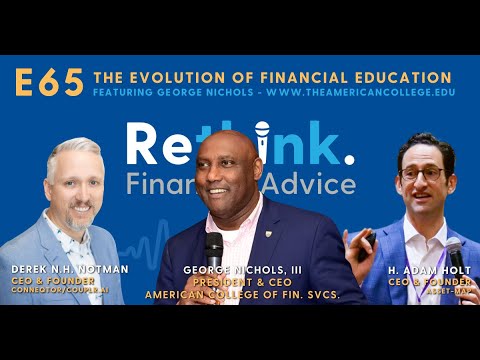
Watch and Listen
Episode Summary
George Nichols III, President and CEO of The American College of Financial Services, joins Adam Holt and Derek Notman to trace the evolution of financial education and what it takes to prepare the next generation of advisors. Adam reflects on his own roots at the College, and the conversation turns to how financial education must keep pace with a rapidly changing profession, from technical credentialing to the human skills that can't be automated.
What This Episode Covers
- The evolving role of financial education in the advice profession
- The American College's mission and history
- Preparing advisors with both technical and human skills
- Advanced credentials, including doctoral and master's programs
- Building a lasting professional legacy
- The future of financial services education
Full Transcript
Full timestamped transcript.
[00:00:30] Derek Notman: Adam, Why are you an alumni of the American College of Financial Services?
[00:00:36] Adam Holt: Because that's where I got my CFP, and that's where every mentor and peer I ever knew went to go get their financial education. Actually, they're right here in Philadelphia. That's right.
[00:00:46] Derek Notman: They're in your backyard. Aren't they?
[00:00:48] Adam Holt: Yeah. That was like, it was literally like hallowed ground where I remember going. My mentor brought me 25 years ago to an event at American college. It was amazing because Derek, there was every single company was, was represented. There wasn't just our company time. It was a melting pot. And it was high brow.
I mean, I remember going back to Bryn Mawr where it originally was, and it was like, wow, this is, this is serious. There's an actual financial services college that gives degrees, even a, they even have a doctoral degree and a master's degree in financial services. So why do you ask? Well,
[00:01:28] Derek Notman: So they have insights to our industry and professional, unlike probably any other organization, company, I mean, 95 percent of all insurance and wealth firms in our country. Yeah, again, as you are, I am also an alumni have been since a long time.
I got my LUTCF. That's how long I've been around. Um, and so they're doing some really cool things. You're right. It is hallowed ground for sure. But because of what they're seeing, they're starting to make some interesting changes and they've been around for almost 100 years, 1927. Wow. Um, but they're almost acting like a startup a little bit, which is cool when you think about like pivoting and being a little more nimble and this is why we're bringing on George Nichols, our special guest today is that is really interested to see where they're going and what they're seeing.
[00:02:22] Adam Holt: It's interesting. They moved. I had an opportunity to do some of their programming. I guess maybe six months ago, they were doing an educational program where they're providing CE to all of their constituents and go and listen to it. And I was lucky enough to get asked to do this. And I was so impressed with their operation, how modern it is.
And, and how much value they're still bringing, especially in this post pandemic world where you can't really go on site, they're educating tens of thousands of advisors every single year. And they've even started to dabble in consumer. And I think this is really interesting what George brought to the table.
So help those of us that don't know George, who, who is George Nichols?
[00:02:57] Derek Notman: So George Nichols, the third, by the way, really cool dude. Um, dad, you know, hopefully he's going to be one of our rebel dads here at one point, right? It's just a super great guy. Really fun to chat with, but he's currently the president and CEO of the American college of financial services, but interesting past, he was an executive VP at New York life for a long time, which is actually where I met him initially and saw him talk.
He's been very active. IFAPAC. It's, you know, the, the more of the political side and helping with our industry and being on Capitol Hill. And also some really cool things is that he was the first African American president of the National Association of Insurance Commissioners and also Kentucky's first African American insurance commissioner, which is really cool.
He's definitely been a trailblazer in the work that he's doing. And that's, what's so cool is just now he's at the helm of an amazing organization that's reached so many advisors and continues to do so. That's what we wanted to bring them on.
, what are they seeing? What are they doing?
[00:03:57] Adam Holt: Yeah. I thought this was really revealing and nothing else. I just, his energy is great and just great laughing. And so I hope you all enjoy this. Let's listen to hear George
[00:04:05] Dr. Nichols: , George. Thank you so much for taking the time to spend time with us in the community here. We're curious.
What's your unique perspective of the advice market today?
[00:04:16] Adam Holt Tank: It's disappointing that I say this, but I believe that there's still many advisors. Who are failing to really meet what the client needs and wants. promoting what they sell, they're promoting what they're incentivized to sell, where they get paid. And I fully get that. But, when I look at the stats, there's a research that was out by Herbers and Company.
That said, 90 percent of the people who have an advisor want tax advice. And only 74 percent of the firms provide it. Uh, when they say they want retirement advice, their retirement advice that most advisors give is very limited. And so I think that we've got to do a better job as advisors and actually.
Paying attention to what clients want and need, uh, you know, as I was talking to Derek about this, my view is that, you know, if you are affiliated or work for a particular firm, you're, you're usually promoting what they have to offer and I get that, but it isn't always what your client may need. And when you look at people that have 250, 000 or more in assets, you know, they're probably getting a little bit more.
In need of, of broader financial services needs. And I just don't think we, I don't think we do that well. So that's the first thing. The second thing is that I'm seeing a trend where the more successful advisors are those who have specialized. I don't, when someone says to me, I got a CFP or CHFC, here's what I say to them.
Great. You got the table stakes. Well, what's next? Do you specialize in something? Because everybody's worried about retirement. Do you specialize in that? Everybody's worried about, uh, estate planning. Uh, I think all of us are going to have to start thinking about disability, not disability insurance, but the fact that my father had Alzheimer's.
And I got to rethink my financial picture. Uh, if something happens to one of my kids, those things are going to change the way mental health is going to drive that. So when I start looking at this, it's like, can we really understand what our clients need? And then our advisors, I think are going to be more successful.
They specialize in something on top of being able to offer the comprehensive financial planning. And then the third would be. How good are you at participating or building a team? Because even whether you specialize or not, none of us know everything. And you serve your client better if you can bring people to the table that you trust, they can trust through you, and they can get all the other needs with the fact that my father did have Alzheimer's.
We then had to go get an attorney that specialized in that to come in. Was it the right person that fit my personality? And I spent more time on that because I had to worry about what happens if I died before my father. So you've got to be able to build a team or be a part of the team when you're really thinking about meeting what a client's needs are.
[00:07:16] Derek Notman Tank: Thank you, George. It's, it's really interesting given that, you know, you're, well, you've had a really interesting career and, you know, I've had a lot of experience and now, you know, in your role at the American college, I mean, I think you said you guys have relationships with about what maybe 95 percent of the advisor community nationally.
So knowing that in your perspective, what would you say is an upcoming challenge or maybe a missing opportunity that advisors simply aren't addressing? In addition to some of the things you just said, I mean, maybe there's one you just want to like elaborate on a little bit
[00:07:48] Adam Holt Tank: Yeah. Well, actually, there is a one that I think the advisor community is. First of all, I got to believe they know. So, you know, someone's going to hear this and say, duh, but I'm going to say it anyway, because when I talk to people, some of them start writing it down as if it's something new, which scares me.
Uh, I think it's, it's this transfer of wealth. here's the, here's the numbers. Um, there's going to be about 30. Trillion with a T dollars transferred to women by 2030, $30 trillion, which now is getting close to the US. GDP $30 trillion is going to be under the control of women. There's another stat that says most women. Change advisors, 80 percent of them change advisors in the first year because you've disregarded them in the relationship because you talked to the husband, or you disregarded them, or you wanted to help them and tell them what they didn't know. But now imagine that 30 trillion that is under your control today because you're dealing with George and you've been disrespectful to CJ. And that, that money's going to move. And for the firms that have figured that out and in saying, how do we not, Oh, how do you sell and take your women? But do we understand what women are need and how is it different than how we've served previously? That's a different question than I think they're going to be successful.
So I'm blown away. When I say that and they're like, well, I didn't know that number, but that's real and it's, it's a short period of time. We talk about way out in the future, but now let's talk about into the future. In the next 20 years, we're going to transfer another 20, 30 trillion to millennials, because I'm going to die.
So my three kids, my three adult kids are going to do well financially because of what we transfer as we die. Well, my kids have a different expectation than what I had at their age. They're also going to have a lot of money. At their age versus what I had. And, you know, everybody said, well, I got to go hire next gen advisors.
No, this is not about next gen advisors. This is about, have you really begun to understand? What, who your clients are, what is the nuances and uniqueness of those clients? And then how are you going to serve them? And, you know, so when I, so that's the first thing I struggle with that, that no one is paying attention to all this money movement that's getting ready to happen.
Everybody was excited about the money movement. It's going to go cause people are retiring, but there's a bigger one that's coming down the, down the path. And then. The last part of this that I think I struggle with is that, um, you know, and I'll get in this. I want to get us in a little bit later, but, uh, My kids grew up in a different environment.
Rich white kids grew up in a different environment. And so eventually this, whatever you want to call it, D E N I, wokeism, call it whatever the hell you want. Okay? These folks grew up differently. They're less segregated. They're more integrated with each other. They are willing to accept gays and lesbians that are around them.
They're willing to accept transgenders. And so the whole culture of what we're thinking about, which has been traditional in a male dominated environment of how money is, that is getting ready to change. And I just think companies have to change. And where I have companies that say, well, we, we do really good recruiting women.
Well, my next question is, well, how many of them in leadership? Then the number gets really small. I'm like, well, then don't really tell me you're ready. That would be my response. Well,
[00:11:58] Dr. Nichols: You know, so many of us who have been in practice for a good number of years. I'm 25 years myself and, you know, trying to rethink whether we're doing the right things. And of course, struggling because so much of the existing business and revenue associated with has been from what we did in the past.
And you can always do you keep doing what you always do. so much. To get what you always got. And that that is really I think we're finally faced with a question that actually might not be true coming down the pike and certainly as our as our boomer clients were who have a lot of capital moving. I'm curious what you're actually running a massive organization that has so many influences into the outlook of advisors and certainly educational programs you continue to develop at American College.
What are the action steps you think that we should recommend taking now or for us to rethink?
[00:12:45] Adam Holt Tank: uh, I think, so let's start with our ability to recruit and retain. Because, you know, when I look at most recent statistics, we're still saying that financial services advisor is a growing, growing field. That's a good thing. So, and when you look at the average age, which is probably 53, 54, somewhere in there, you're going to get people eventually over the next five to 10 years going to retire and transition out.
So there's all these openings and opportunities and that's great. But I think we're going to have to think about. The commission and incentive structure, because. You know, I think my kids would do great in sales and they're like, wait a minute, dad, uh, so how does this work and how am I going to get paid?
And, oh, dad, I just want you to, I can get this job down here, making 60 starting and 70 starting. And I don't have to do all that. I don't have to get used to no, I don't have to do any of that. And so I think that we're going to have to, you know, we've been saying it for years and we got to rethink the commission structure and the fee structure, but we really haven't.
And I think we're going to have to with the new groups coming through. So I think that's the probably the first thing that that I would say, and I think that in addition to the incentive structure. think we have to. It's almost like we have to lay out what. Your life is like, as a, as a certain type of advisor, you know, it's your life work.
Well, what is it if I'm just doing, I'm in the insurance space or I'm in the investment space, or I'm in a mutual fund space, or I really want to be broad and I'm doing wealth management. What does that advisor model look like? So that I can say, I want to be an advisor. Which one of those fits me? Which one fits my personality.
And then I know I got to start from the, from the bottom, but I know where I'm working toward. And then your mentors, the American college can put the right package around you to get you where you need to be at from a competency standpoint and a skill and knowledge standpoint. So I think that's, that's another one that I think is, is really important.
And if we don't do those two things, I think. You know, we're going to have actually a harder time recruiting and retaining right now, our hard part about recruiting and retaining is we find them and we can't keep them well. Okay. If we're able to find them now, we got to work on keeping them. Okay. That's a better deal.
Then they're not really understanding this and they don't even look our way. And I also believe that if we do that, well, uh, you know, Derek was sharing with me what he used to do and what he does now, I actually think what he does now, he's going to be better at because of what he went through when he was on the other side as an advisor.
Because it's still adjacency to what he's doing. That's exciting. And now we can really talk about career development and my life's work, which is sort of something that we try to promote at the American college.
[00:15:58] Derek Notman Tank: You know, George, all of that resonates so much. I'm starting to pull out a theme from what you're saying here in that. We have this situation, this transformation, I think you said, where we're going to more of a, really a client driven experience all the way around. And we have to really lean into that, but even deeper, like personalization, demographics, these are all things that are becoming so much more
[00:16:22] Adam Holt Tank: Yes,
[00:16:24] Derek Notman Tank: Both at a firm level and at an individual level, um, because we have this like, the whole process of advice, planning, investing, whatever you want to call it, is really shifting. So it's just cool to hear you say that, given your perspective, like, I mean, Adam and I have had many conversations around this and it's just, it's validation.
This is what's happening.
[00:16:41] Adam Holt Tank: it is. And, and, and I'll tell you that you all are having a conversation and I think there's a lot of other people are having a conversation, but it, you know, the financial services industry as a whole, whether you're looking at the advisor side or, or even on the manufacturing, the product side, we've all very slowly. So I think that's what's happening. But the thing that I'm seeing is we may be evolving slowly, but the marketplace is not, the marketplace is evolving quickly. Just, just think about, you know, everybody talks about, you know, whether there was appropriate oversight or not on Silicon Valley bank, you know, what was the most amazing thing to me? Is being able to move billions of dollars by on my phone. That was what was amazing to me. And that when I talk to my kids and they're saying like, you know, dad, I need this or that. And the first thing they say, and I'll Venmo you. And I'm like, well, your daddy don't take Venmo. Okay. I said, well, I can't pay you.
And I said, well, then I can't give you no money. because we're like in two different worlds. But they are, they are moving down that, that space that's totally different. So what's happening is we as an industry are going to have to speed up to do this, to meet what those customer needs are, because they are totally different.
I'll tell you a quick story. My, we were working on my, uh, my, my wife and I worked on our state plan. It was about 10 years ago. And, uh, we went in and we brought the kids in and I told the kids. How much money we were leaving. And my advisor said, are you sure you want to do that? And I said, yeah, I don't think you're going to kill us.
I said, but, but the point is. I don't want them dealing with our death and then finding the shock of how much money we're leaving, whether it's more than they thought or less than they thought. I don't want them to deal with it. I just want them to deal with us, the loss. And then everything is set up while they mourn, and then they can just step right into it.
And, and I want them involved in it now while we're alive. So really well, so we're leaving and we were down in Florida and we, we said, let's get some bikes and we went riding around on bikes around by the beaches and stuff. And one of my kids said, Hey dad, when y'all die, do we have to keep him? And I said, well, no, why?
He'd be a great granddaddy. But he's not going to be my advisor.
[00:19:02] Dr. Nichols: Oh, you're advising me.
[00:19:04] Derek Notman Tank: Wow.
[00:19:05] Adam Holt Tank: Think about it. That's why I'm thinking of this transfer. That's 10 years ago. That's not what we're, I'm sitting here telling you all this wealth transfer. I wasn't thinking about this 10 years ago. I was just thinking my kids didn't like this old man, but no, that's, it's just a different, and, and then I would tell you, so I told him and he hired a young person, but it's a young person that doesn't know much.
And you know, my kids do. live in a family where the father is head of a financial services college. So we talk about a lot. My kids know more than these new people coming into business just because you wanted a young person.
[00:19:47] Dr. Nichols: interesting. We've heard this theme a bunch of times, bunch of times, and I'm glad you're repeating it because it warrants being heard again and again from real experiences like the one you just talked about. Not just the stats that 90 percent will turn up. This guy, my kids are saying, hey, we ain't going to keep Joey, right?
[00:20:03] Adam Holt Tank: Not gonna happen, not gonna happen. And dad, and so, so just let me tell you the rest of the story. As I've tried to find an advisor that they're comfortable with, And I'm comfortable with at my level has been finding a needle in a haystack. And the thing is that, so we talked about team. Well, if, if I could find somebody that has 60 percent or 70 percent of what I'm looking for, and then they understood what I was saying to them and they say, now I, I got two people that I can bring in on the other parts. Okay. Then bring them to the table. We can meet them so you can close that deal with me quickly.
But they can't because they're not thinking that way.
[00:20:51] Dr. Nichols: Yeah, we saw we talk about this a lot, actually, just in recent podcasts that that that we're not just planning for the clients, the whole household have to be thought about that. That means that the next generation. In fact, the next generation we're seeing is taking over for the boomers early because the boomers are saying, I don't want to learn new technology.
You just take over your son, daughter, whatever, and they're bringing in their own advisor. And hopefully they're retrofitting on the tech side and the accessibility, the literacy and, of course, empowerment. That's really important. You know, I got to ask this question. Well, how do you think American college is going to change in the next 10 years?
And how are you setting them up for success to support this next evolution of it?
[00:21:26] Derek Notman Tank: I
[00:21:28] Adam Holt Tank: question for us. It's we are actually shifting more to focus on what we think the client wants. So I can teach you all day long, all the sophisticated. technical knowledge you need to know to be of an effective and compliant financial advisor. Uh, we have programs that, that are focused on special, you know, helping you in the specialization, one, getting you the table stakes of comprehensive financial planning, and then any specialization that you want.
And our goal is to add, as we go down the future, how to build and participate in teaming, how to truly address behavioral finance issues. Uh, how to address incorporating technology as a tool, which is all it is in your relationship with your clients. But because of this, I work for a firm and this is what they push for me to sell and market.
We've decided we'd rather go and now do more in the consumer space and understand what is the consumer. I want to understand what those women who are getting ready to receive 30 trillion dollars. What is it they're looking for? What do they say they want? Not just in how to address my financial transactions, but are there other things that they would want that are, that are important in the concept of this?
That's where I want us to go. That's where we're already going is we're trying to move into that return into the consumer space. You know, cause it used to be Derek and I worked at the same company. And, and, and so here was the, here was the view. If you wanted to know about the policyholder consumer, you had to ask the advisor. Okay, because they are the only ones that knew because it was their client. Okay. I remember it well. Well, now that same firm is saying like, no, I really need to go ask them just to make sure I'm getting it right. Now, but that's a slow process, and most of us do research on how do I sell what I sell? Well, I'm not trying to do that.
I'm agnostic on what, on what all that is. I want to know what is it they need. And when I think about, let's just take retirement. Most advisors never have a discussion with you about your health and wellness when they talk about your retirement strategy. They talk about aggregation of the money and then what we're going to do in the distribution phase.
My God, George got hurt on the job. George did a wheelchair. Well, I feel really good. I got a lot of money, but you know, why did you get hurt on the job? Well, I like playing on the job, like drinking on the job and like doing a whole bunch of other stuff. Okay. Well, you know, part of that is like a discussion about my work you're saying like, I'm going to do all this for you, but what is it you want to do? And then saying like, and how are you going about doing that? That goes beyond the financial. Now there may be some clients that say, I don't want to tell you all that. I get that. But in most cases, if you started in your relationship with me by saying, okay, George, tell me what it is you want to get to, and then let's talk about why you want to do it. Okay. This is, there are people out there that all they want is money. I got it. And they just figured out, how can you give me the next dollar? The majority of the people have a why in their life and you need to find that out because once you get there and you're helping them achieve that, you now have a client forever.
[00:24:56] Derek Notman: And that was a great conversation, Adam. And, and, you know, something that really resonated with me towards the end there is when George talked about how. Most people have a why in their life, a why behind their money and what they want to do with it, you know, now and in the future.
And, and that's so powerful. Not, not everybody. Some people just want an extra buck, like he talked about, but most people have the why. And I think advisors paying attention to that, to have deeper conversations, to understand that why. Man, that's going to be so successful, but man, this is part of a much greater conversation that we just, we just had with him.
[00:25:35] Adam Holt: It's a great point. And so many of us in the advice community haven't been taught to ask that question. We're seeing it more thematically come up in newer training programs or coaching programs or behavioral finance, as you know, has been kind of breaking out as a new theme, but it's true. I don't know that a lot of advisors have.
I've found good ways to ask about people's wives, because it's not necessarily a comfortable question, nor does it always get associated with, Oh, this is a technical advisor, or this is an investment advisor. Now they're asking me why I thought they should tell me whether I should buy. Like, what do you mean my, why I want to make money.
Right. Um, but I think this is really a theme that's, that's coming up more and more really, really great conversation from him. And of course, given the accolades of what he's achieved is it's pretty impressive. So it was, thanks George for the time. On that, what, what are the, what are the kind of takeaways?
What can we debate about what he talked about?
[00:26:27] Derek Notman: Well, he, he brings this up in a couple of different, um, ways, but basically he's talking about, can advisors actually differentiate,
[00:26:37] Adam Holt: you know, he
[00:26:37] Derek Notman: talked about, you know, that CFP, CHFC, CLU. I mean, there's, there's a ton of, of, of designations now available through the American college and even others.
And he talks about how they're all table stakes now. So one is, I guess, do you believe that? Are they table stakes? And two, if they are, how does an advisor differentiate?
[00:26:59] Adam Holt: It is funny. I was a CFP very early on and just like you and I used it in the early days, probably to bolster my credibility in the space 20 years ago.
And, you know, I wanted to be a financial planner. I want to look like a financial planner. I wanted to be able to answer that question. Then over time, I actually dropped it because I found I wasn't getting marketing value from it anymore, but then I actually went back and did all the CE and brought it back because again, it did actually lend itself to more credibility to my, , differentiation strategy. At least that was a perception that I had for myself. So I'd say I'm a CFP again. And I pay my bills and pay my dues into my CE and I, you know, I'm like, Oh, gosh, it's like a project as we all know, um, but I am seeing everybody, you know, have some kind of designation, as a marketing differentiation, whether I see people actually applying CFP.
We'll call them ethics and process. I don't know if I can say that that's true. So I think there's one thing to be said for the marketing and one thing to be said for the actual process. It's not always
[00:28:02] Derek Notman: interesting. Yeah. Are, are they, are advisors getting it for just the marketing aspect or are they.
Utilizing what it really means to be one. It's funny. I actually, I had my CHFC before my CFP. I remember I ordered from the American college, the beautiful little tri fold brochures of the CHFC, and I would discuss with my clients what it means. So it was definitely a marketing credibility thing.
[00:28:29] Adam Holt: But I think now it's business, right?
I mean, we're 100 percent so,
[00:28:33] Derek Notman: well, I mean, Adam, if, if you're going to go to a doctor or a tax professional or a psychologist or a lawyer, the bare minimum is they better have the MD, the CPA or, you know, whatever, right? Like, I'm not going to want you cutting me open if you don't have your MD at least.
Right. But then after that, like, Well, what's your specialty? You know, I need heart surgery, but you specialize in feet. Probably not a good, not a good mix, right? Still
[00:29:00] Adam Holt: says MD, man. Right. You know, what's the joke that you told me a while ago? It said, uh, what do you call the lowest GPA student from med school?
A doctor. So what do you call the guy who gets a 70 on his CFP exam? A
[00:29:20] Derek Notman: CFP, right?
[00:29:21] Adam Holt: So
[00:29:25] Derek Notman: I think George was onto something there. I, there has been a shift in, in more, and I'm glad that people are getting these credentials. It is important. You do learn something by going through this great curriculum. Yeah, but it's kind of like, yeah, you better have the MD give me more than that.
What do you specialize in as an advisor? Like, why should I pick you over the next CFP or CHFC or CLU? Right. Yeah. I
[00:29:50] Adam Holt: think that's a great point because, you know, it's true. When you think about a physician, you expect that they're a doctor, right? The health insurance might. So that that's, they've done their due diligence.
So we know that they're reasonably credible that the hospital chose to put them on the But you're right. I think you, when you need, when you need a specialist and it's funny, Kitson's talked about this a bunch of years ago. He said, when you need a specialist, you look for the best specialist that you can get access to.
Right. And you want, you want a plumber. You're like, yeah, you ask your neighbor, who's a, who's a local plumber. That's not going to take advantage of me. But when you have some strange cancer disease, you look for the best person you can get to, and you look for credibility everywhere. And I think that was his point really relating to client expectations and something that you brought up before, which is this idea of putting the problem before the product, and can you actually associate yourself as being the problem advocate?
Right. I basically help you understand and solve problems. I don't just, I just bring solution X, Y, Z.
[00:30:49] Derek Notman: Yeah, this goes into a deeper, bigger thing. That theme that George was talking about is that there's this massive shift of client expectations and you're right. I mean, if, if all you can sell is one product or a suite of products.
You know, you've got a bucket and a hammer pretty soon. Everything starts looking like a nail, right? You know, and that that may not be like, Hey, I need you to replace my window. I don't want you to hit it with a hammer, right?
[00:31:17] Adam Holt: Like a slow down a little bit, glue a bunch of nails.
[00:31:22] Derek Notman: That doesn't work. Um, so there is this shift and focusing on problem.
And he used a good example, a disability insurance. I think he mentioned how his dad had Alzheimer's don't focus on the insurance, focus on here's how we help people that have gone through this experience and have these problems,
[00:31:40] Adam Holt: which
[00:31:40] Derek Notman: is a great way to, I think, to differentiate, to go back to our first
[00:31:43] Adam Holt: point.
I mean, I think a lot of advisors. Tend to do that, right? They say, I don't just do investment management. I do retirement planning, or I do retirement distribution planning, or I don't do life insurance. I do estate planning, right? And life insurance may be the way that I monetize it, but I think there's a real keen eye to selling the problem as opposed to selling the solution, especially in your differentiation.
And then of course, be the best estate planner you can get to. Just like that analogy that I talked about, Michael Kitts is talking about How can you be the one who's sought after in the marketplace as the best in that category? I do estate planning for business owners who have family owned issues in the state of Delaware who like dogs and go skiing on the weekend, right?
Like the more specificity you can be the best at that end, it's going to really be a way to differentiate. No question
[00:32:36] Derek Notman: that as a consumer, I have expectations. I know what my problems are, at least generally. And I, all of a sudden I find this person that likes skiing and dogs and is in my state and helps people with small businesses.
I'm like, well, that's me. Instant credibility. You've differentiated. Now your, your CFP credential means a heck of a lot more to me than the next person.
[00:32:55] Adam Holt: Well, that niching that we've done several podcasts on before, but whether it's good to niche or not is an interesting one because he does also bring up the complaint that a lot of consumers want broader advice, not always just specific.
So I think getting specific advice for my specific problem is an attraction strategy for marketing, but also being able to deliver a broad swath of Uh, products and services, whether that's legal tax insurance and investments, maybe even banking, maybe even financial chain, you know, it's, it's going to be more important that we actually provide more services to the existing customers.
And we've heard that one before, haven't we?
[00:33:32] Derek Notman: Oh, a number of times we have, and he even talks about that's one of the success factors he sees is what's your ability as an advisor to build a great team that can do all of these different things. That's another differentiator. So
[00:33:43] Adam Holt: maybe bring together all the specialists that you can so that you build a, uh, you know, a Justice league or a an X-Men or x Love it.
I don't know, some kind of analogy here that, uh, you have, you can handle all the problems. Well, the old
[00:33:56] Derek Notman: A
[00:33:56] Adam Holt: team, remember the old A team? A team. There you go. more guys. That could solve every problem, actually. Well, that would then, that would ask the question, well, was, what is MacGyver then relative to a, oh man, MacGyver, would you choose?
[00:34:08] Derek Notman: Ooh, I don't, I would want to got MacGyver to ride along in the van with the A team. That's what I would want. He
[00:34:14] Adam Holt: should join the A team. He should join the A team. Just bring his duct tape and he can solve all the problems with that. All the problems. He's got duct tape. I, it's funny actually that, cause that throws back to our generation, right?
Because in the same, in the same vein, uh, I think a lot of advisors are trying to play MacGyver, right? And that, that's an interesting analogy. Are we a MacGyver? Are we, are we trying to build a team or whatever your favorite team was out there?
[00:34:41] Derek Notman: I love that. That actually makes a ton of sense. Um, and nothing wrong with MacGyver.
He did quite well. But if, but if the client's looking for the A team and you're only a MacGyver, and that, that's what George is saying is that the client expectations, what they're looking for, how they're looking for has changed. And he even talks about this with this whole wealth transfer thing going on.
[00:35:04] Adam Holt: You know what I just realized, actually, you know what a tech enabled advisor would be? What's that? Knight Rider.
[00:35:12] Derek Notman: Ah,
[00:35:13] Adam Holt: so maybe you want to be the advisor,
[00:35:15] Derek Notman: the Hoff, or is the advisor Kit?
[00:35:18] Adam Holt: No, the advisors, David Hasselhoff
[00:35:20] Derek Notman: and Kit
[00:35:20] Adam Holt: is basically his
[00:35:21] Derek Notman: whole tech stack. So you are saying that all advisors are the Hoff now.
Okay. That's right.
[00:35:26] Adam Holt: So
[00:35:27] Derek Notman: then you can go into Baywatch.
[00:35:29] Adam Holt: That's what their retirement job is. Okay. Okay. All right. Retirement job is they watch on the beach.
[00:35:35] Derek Notman: Do you think we could get a picture of George? We could put into like a, uh, like an A team or the Hoff or something. That would be pretty cool. Maybe get them on Baywatch.
[00:35:44] Adam Holt: Absolutely. I don't know if we have those kinds of connections anymore, but the shows are closed. I think those, they are canceled. Um, but that's an interesting thing. I mean, I can imagine if you're listening to this podcast, you're wondering, you know, which, which one am I, right? Am I any one of those things?
Or, uh, maybe I'm the Hulk. I don't even know. But I think the point is, is that there's, there's lots of fun analogies to, I think, relate to what George talks about because, , Clients want different things and not every client wants the same thing. And I think that's an important aspect to choose a direction and to start chiseling out a category.
I loved what he said about the wealth transfer opportunity and about not wanting your dad's advisor. What did you think about that?
[00:36:23] Derek Notman: Well, we can chuckle about it, but it is the hard truth. I mean, you and I both have kids that are almost the exact same age. And it's, it's interesting. I'm starting to see how, what they think is cool versus what I think is cool.
And they tend to be different.
He's right. And we do have this massive wealth transfer. And he was talking about this lack of, of engaging as part of this wealth transfer conversation and that. What do you say? 80 percent of females that inherit the wealth will change advisors within one year, because that existing advisor never gave two craps about them.
Right. And it's a real shame, but it's a real, it's a real opportunity to, I think, and just addressing that this is a bigger conversation that involves multiple parties. You should probably involve all of them,
[00:37:14] Adam Holt: right? It's true. We've mentioned it a couple of times that the, that the adult.
Children of many of our boomer clients that are getting older that will likely be left to us as, as the non CFO spouse who we didn't have the same level of relationship with are likely to be brought in. Those kids are going to likely be brought in and they bring their own attitudes, expectations of performance and fees and.
Delivery tech and all those things. And we need to start recognizing that, although I think everybody's been talking about the great wealth transfer for now, 10 years and saying, well, well, hasn't it happened? These boomers are living forever, right? They're all going to be in long term care. Uh, and maybe they're going to spend all their money, but, but we all know that for the most part, there's an enormous amount of wealth out there and transfer there.
And so the question is, can we get involved now? Uh, in bringing not only the under engaged spouse into the story, but maybe even their children. I think this is going to be an important aspect because I don't think that the successor client, that means usually the surviving partner is going to be choosing their advisor.
, I think their children are because they're likely going to be the executors, executrix, and they're going to probably have to make the decisions for, you know, mom and her and her older age or dad and his older age. And I think that that's going to be important for advisors to pay attention to this now.
[00:38:34] Derek Notman: Oh, yeah. I mean, think about that. Dad passes away. Kids are chatting with mom. Hey, mom, what did you think about your existing advisor? Oh, I don't even remember his name. He never talked to me. Kids are like, Oh, and he sends you all this paper and it's really hard to work with them. What's he doing,
[00:38:50] Adam Holt: by the way, Derek?
Yeah.
[00:38:50] Derek Notman: And what's he charging you? Oh, I don't know. He never told me. Oh, I'm gone. Like the kids are like, Hey mom, we got you. We're going to help you. We know what we can do. We're going to help you get some. I mean, that's the kind of conversation that's going to happen. Like,
[00:39:04] Adam Holt: It is. It is. And for those people that are buying practices, because we know there's a lot of ex gen advisors buying practices from, let's say, retiring advisors.
And guess who their clients are? The relationship currency is all with those older individuals that may not want to change in retirement, right? They're going to be deathly afraid of changing their advisor. So the argument is that that asset will be sticky unless now there's no relationship with mom and the client.
The kid is like, Hey, what do you, you haven't talked to that new guy that took over for Joe dad's best friend advisor. They went golfing with like, think about it. If you care at all about the succession value, this is time we need to start building those bridges right now to next gen and communicating with the under engaged spouse.
I think that's really big of George to pick up. Uh, and as we talking about table stakes, you got to do this just because it makes sense. Now, I was curious how American college is actually moving towards more client empowerment on financial literacy, taking their big machine that they've created on, on financial wellness and literacy and education, and actually redirecting it to helping consumers who want to get educated.
I thought that was really interesting.
[00:40:06] Derek Notman: It's really cool. They have so much experience and knowledge and reach. Why not go direct to consumer, you know, almost like a, like an , introductory financial literacy. I mean, it's, it's, it's brilliant. Everyone wins with something like this and they have the, the, the powerhouse of people and content to do it.
Well,
[00:40:26] Adam Holt: what happens if they, they install this in the colleges? What happens if they install this in the high schools? I mean, the reality is, is that certainly people who are interested in learning more about finance 1 or 1 or getting literacy. It seems to me that the market Tam or the total addressable market is massive, right?
But what they could do that socially, if they start getting and creating standardized education for. Next gen. I think it'll really accelerated what we talked about previously, which is an empowerment of of the adult Children. I think maybe even the millennial Children that are going to likely take the assets of the boomer generation.
So
[00:41:00] Derek Notman: well, what's really big? What's cool on this? Is that now? The consumer has a trusted resource that's educated them and empowered them. A lot of they're going to be, the next question will naturally be, well, now I need help to do this Roth IRA, or now I need help to get my life insurance. Hey, American college, who do you recommend?
Great point.
[00:41:21] Adam Holt: Okay. I
[00:41:22] Derek Notman: mean, I think what they have 200, 000 ish alumni now in their network. It's huge. I'm one of them just like, Oh yeah, I got my LUTCF with them. That's how long I've been with them. No, I didn't know you
[00:41:34] Adam Holt: had that now. You're
[00:41:35] Derek Notman: incredible.
[00:41:35] Adam Holt: How many designations do you have there? CFP, CHFC, CLU, LUT, CF.
No kidding. I think, uh, a B C D I do have my HLP, which is from Columbia and I've done other certificate programs, but I, I've, I stopped on the alphabet soup, uh, especially when they were getting smaller and smaller and obscure, but that's really cool. Um, see who knew that you were so much more educated than me.
I never would've known that one.
[00:42:07] Derek Notman: Never would've known. Definitely not by looking at me.
[00:42:12] Adam Holt: And I got age on you too. All this was really cool to hear from George and actually I'd had conversations with his team a couple of years ago, learning that they're really focusing on also HCPUs and how they can empower a whole bunch of generations that are generally disenfranchised with financial education.
And there's huge issues. Obviously that many of us are completely unaware in terms of social implications of wealth creation. And I think it's great that they're doing that. So really just hats off to George and the whole team there, you know, I'm really curious. We talked about so many different aspects of what the college is doing, Derek, and I know you have a huge project that you're working on to try to solve a lot of these problems.
How does that relate? What are you guys doing together?
[00:42:53] Derek Notman: Well, so we're really excited about this, uh, Adam is, you know, Couplr.ai is all about, , going upstream in the human relationship experience and connecting people for the right reasons at the right time and place and long story short. , We've built a really great relationship with the American college to the point now where we are launching this month, our partnership, or we will be powering what they call their, your advisor guide experience to help consumers get matched with the right financial advisor for them.
We're just so excited because I couldn't ask for a better partner. They're huge. Clearly we're aligned. I mean, look at everything we talked about today. So just really excited. Like that's launching as we speak and, , good things to come for sure.
[00:43:36] Adam Holt: What is that? That's interesting. So I don't, I actually don't know this.
So what does that mean for the advisor community or the customer? What, what,
[00:43:43] Derek Notman: what's that going to do? So, as you said, I mean, the American college does have a consumer facing experience already called your advisor guide. And, uh, clearly they're doing stuff with more financial literacy. They're going more direct to consumer and those people, we know a percentage of them are going to need help.
We'll look at the American college. They have tens of thousands, hundreds of thousands of advisors in their network, and now they're going to be able to use Couplr.ai to match those consumers with their network of advisors based upon these different client experience and expectations and, demographics and all of , these human elements, we call
[00:44:20] Adam Holt: them,
[00:44:20] Derek Notman: um, we're going to be powering that experience.
I mean, how cool is that?
[00:44:24] Adam Holt: So, so wait, so my analogy of, of, as a consumer, I can find the advisor who's credible from American college, who does work in the estate planning for small business owners who likes dogs and go skiing on the weekend.
[00:44:38] Derek Notman: Bingo. All you have to do as an advisor is opt in super easy to do as part of the, you know, your existing experience with them.
[00:44:48] Adam Holt: Yeah. If I wanna find the right advisor for me, based upon what I care about, shared interest is a huge one because we all know if I, if I don't love the advisor, I don't feel like they're, they really understand me or they, they don't understand. Let's say, uh, we love music. I guess you could say, I love music and I like this kind of personality.
I don't want to be bullied around and I don't wanna pay fee only. Right? That you saying that I'm gonna get that capacity.
[00:45:08] Derek Notman: Yeah, we get into the weeds quite a bit, really quick, simple, beautiful experience, but , it's a consumer driven one too. So we'll give the consumer the opportunity to get what they want.
And as George said, I mean, most people have a why that why is pretty personal.
[00:45:21] Adam Holt: That is
[00:45:22] Derek Notman: if I'm going to open up and tell an advisor, my why. And my financial skeletons and all of these things, darn it all. I better make sure I have rapport and trust with them based upon these different shared commonalities.
[00:45:36] Adam Holt: That was, that's pretty awesome. I look forward to seeing that myself. I'll sign up since I'm an alumni as well. All right. You get your first customer. Um, that's exciting. Cool. Well, thank you, George, for doing this. It was a really interesting, and of course we love what you've done and been able to achieve.
, certainly someone who's going to, I think, continue to do great things in our industry. So thank you for all your contributing George. , and of course, , for lifting so many of us in industry and outside of it. I think it's sort of a great Testament to your work. , Derek, as always appreciate your partnership on this project.
Anything you want to leave us with?
[00:46:05] Derek Notman: No, great conversation, George. Thank you as well. And if you're listening and hopefully you enjoyed this and got a few laughs in the process, make sure to follow us, send us a question if you want us to debate something and, um, just, uh, go keep being awesome.
[00:46:21] Adam Holt: There you go.
Keep awesome. Keep being awesome. Yeah. All right, my friend. See you later. See you later.
The content has been made available to you by Asset-Map for informational and educational purposes only.