
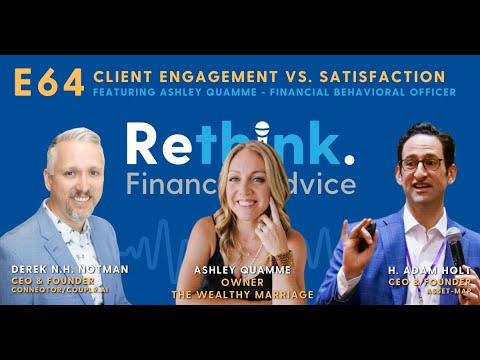
Ep64 - Rethink: Client Engagement vs. Satisfaction – Featuring Ashley Quamme
Watch and Listen
Episode Summary
Ashley Quamme, a Fractional Financial Behavior Officer with Experience Your Wealth, joins Adam Holt and Derek Notman to debate what matters more for lasting client relationships: satisfaction or engagement. The conversation explores the "knowing-doing gap" that keeps clients from acting on good advice, how advisors can better involve under-engaged spouses, and why genuinely engaged clients—not just satisfied ones—are the foundation of a resilient practice.
What This Episode Covers
- Client satisfaction versus client engagement
- Closing the "knowing-doing gap" in financial planning
- Engaging under-engaged spouses and partners
- Communication strategies that drive real behavior change
- Training gaps in advisor-client relationship skills
- Building a more human-centered advice process
Full Transcript
Full timestamped transcript.
[00:00:30] Adam Holt: Derek, what is more important? Client satisfaction or client engagement? Hmm.
[00:00:37] Derek Notman: My gut reaction is to say both.
[00:00:40] Adam Holt: No, you have to choose which one's more important. I have to
[00:00:42] Derek Notman: choose. It's like, it's an all or nothing thing, huh? It's a black or white thing. It's a black or white thing. Well, I'm going to choose gray. Fifty
[00:00:51] Adam Holt: shades of gray? Which one?
[00:00:53] Derek Notman: Fifty shades of gray. Which shade are you going to choose?
You know, that's interesting. Satisfaction definitely is important. Like, are your clients satisfied with the results? That you're getting, I mean, ultimately they want you to help them grow their money, protect them, they want that help. And are they satisfied with the results they're getting?
So, yes, that's important, but also. I would define engagement is also like, relationship building and do they feel engaged? Are they only getting numbers? From you and real like clinical, it's almost think about like a doctor that has no bedside manner, how engages , that doctor, , you did my,, my brain surgery, you got the bunion off my foot
[00:01:42] Adam Holt: in your
[00:01:42] Derek Notman: brain
[00:01:45] Adam Holt: surgeon, do the bunion surgery.
[00:01:47] Derek Notman: Well, I mean, yeah, whatever works, right? Important a storm. And you've got the doctor that can can technically do it. I'm satisfied you got it done, but do you have good bedside manner? Did you build a relationship with me? Like, would I go back to you again? Do I see you as a long term? , I guess that's where I'm going at.
So , it's a tough question. It's not a black or white question. I would say both are equally important and have some overlap and are tied to each other somewhat. But not entirely like the tech I use and the rate of return you have, they play a little role in my relationship with you, but me asking you how your kids are doing and what you did this weekend and what's keeping you up at night and me sharing with you those same things.
That's the relationship bit. And they both feed in together to this overarching, I guess we could call it human first engagement advice relationship thing. That's a mouthful.
[00:02:47] Adam Holt: You know, we, I realized we actually did touch on this in a prior podcast. We spend a bunch of time with J. D. Power talking about the depth of one's practice from transactional 1.
0 to deep planning, 3. 0 financial advice. Dictated whether a client was satisfied when the performance was down and that the more transactional, the relationship, the more you were dependent upon the performance, the underlying performance of why I hired you in the first place, right? The market is up. My, my portfolio is up.
The, the fees are low, whatever it might be that. If you had more process relationship and engagement overall, talking about legal tax insurance, investment, doing planning, goal based empathetic relationship. Even when markets were down, client satisfaction was actually higher. So I would argue that actually these things are combined.
Engagement is probably a good predictor of satisfaction in good and bad times. But when times are bad and there's no engagement, Satisfaction goes to the floor. And that is a great opportunity for turnover of the client relationship as well. While we're you're simply been invested. What you're saying, Adam, is
[00:04:09] Derek Notman: that we could coin a new term today.
Engagement alpha engagement, alpha. Bingo. Think about it. You just define it. When we have the data from JD power to back it up, it's engagement alpha.
[00:04:25] Adam Holt: So the alpha or the additional reward or value created as a result of the underlying engagement that isn't present in the relationship.
[00:04:35] Derek Notman: Bingo. And you know, Morningstar actually produced a report on this probably a decade ago.
I think they called it advisor alpha, but the importance of the advisor, the role of the advisor, but let's go deeper. What's the engagement level of that advisor?
[00:04:49] Adam Holt: It's true. We tend to think a lot about NPS in a scaled environment, right? In other words, providing the same service and process to everybody.
I need NPS, Net Promoter Score. But Net Promoter Score could fall apart if, in fact, things go awry that weren't planned for. And there's no engagement. There's no relationship currency. There's no process. There's no thoughtfulness as to why we're doing what we're doing. And therefore people just jettison the plan and say, there's clearly no plan.
Let me go. Let me, I must have a change and I'm going to change my advisor first, especially in, let's say death scenario, divorce scenarios, uh, where the market falls apart, I think that's really interesting,
this is actually a great intro to our guests today And Ashley Kwame, who I met at the shift conference, which is all about human first advice delivery was really interesting because I saw a breakout of hers and podcast. Our audience would love what she has to say. Cause there's some really good deep learnings here.
If you don't know Ashley and you can check her out on LinkedIn, she's a fractional financial behavior officer for firms. She's a speaker, she's a certified financial behavior specialist, and a marriage and family therapist, which is really her roots, given the fact that she's done a lot of education and training around relationship coaching and management.
The irony of course, Derek, is that she's married to a CFP who joined her on stage. I love it. Talked about the dichotomies of their awareness of relationship, uh, and so forth. So she's actually starting to consult advisors about this and how to really approach behavioral coaching relationship management.
And I hope you find this really interesting. So with that, Let's just jump into that interview. Sounds good, buddy.
[00:06:23] Adam Holt Tank: Well, thank you, Ashley, for joining us on the rethink tank. This is exciting to see you after watching your presentation at shift. Really, really great stuff. Thanks for being here.
[00:06:31] Ashley Quamme: Awesome. Thanks for having me guys.
[00:06:33] Adam Holt Tank: One of the things that you probably already noticed is we'd love to get your perspective on the advice market coming from your very unique background.
What do you see in the advice market today?
[00:06:44] Ashley Quamme: From my perspective, I'm looking at advisor, client relationships, and you know, there's a lot of studies out there around client satisfaction and satisfactions generally with advisors pretty high, right? From my perspective, satisfaction and engagement, though, are two different things.
And so when I have it, buyers that reach out to me, or when I'm reading just in the space, I'm hearing that satisfaction might be high, but engagement, there's a lot of questions around it. And You know, working with couples in the way that I do, I'm familiar with what, uh, unengaged and unengaged partner or, you know, disengagement might look like.
Uh, and so from just a perspective place, where I see the value, at least that I bring, but also where the industry, I would love to see starting to focus a little bit more on is how do we help clients engage better in the financial planning process.
[00:07:42] Derek Notman Tank: That's really interesting. And given your background, Ashley, what would you say is, is, uh, Unmissed opportunity that advisors really should be addressing.
I'm just curious, is there something that advisors should be paying attention to, to better engage as you say, with their clients?
[00:08:02] Ashley Quamme: Yeah, I think we know working with clients sometimes that there's a knowing doing gap. for clients. They might know better, but sometimes it's hard for them to do better. I actually think for advisors, They're missing the knowing part. And so knowing and understanding what are the behavioral cues that might indicate that a client is not engaged, what are the physical cues that might indicate that and, and relational ones as well.
I think if there can be some greater education, uh, from, you know, folks like myself and other, behavioral, , experts out there that can really educate advisors on what those cues are, it will help them to then be able to identify, Oh, this client doesn't say much. And they're also the type of client that when I ask them to fill out that 401k form or just give me any kind of data.
They consistently don't follow through with that. In fact, it's actually their partner that ends up sending me the information, those types of cues, that type of knowledge and understanding can really go a long way than in helping advisors know how to shift or be able to, , change their tactics around how to interact with that person.
[00:09:23] Derek Notman Tank: Yeah. It sounds like. If they had the knowing, as you say, they could change or improve sales process, service, marketing, all of it, right. I mean, it seems like it can be quite impactful.
[00:09:36] Ashley Quamme: Right. I look at things just from a relational side, but you're right, Derek. Like it could also then spill over into every aspect of their business as well, which, I'm not an expert, at least on the impact of lack of engagement across all areas, right.
Of the business, but I would imagine, and I could see where if you had a high degree of engagement from most, all of your clients. It would have to impact just that bottom line from a growth or scalability.
[00:10:07] Derek Notman Tank: Well, we're in a relationship business, right? That's what advisors are in.
[00:10:11] Ashley Quamme: Which is always interesting to him, which has been interesting to me.
So fun fact, I don't know if I shared with you guys, my husband is a CFP. And so he and I have talked about just this idea that we're both in the relationship business and I've kind of made a Joke or a dig. I'm not sure which one it is. You can ask him how, how he takes it. But you know, that I was taught in my background of going through school to be a therapist and mental health provider, I was taught how to do relationships, but he wasn't as an advisor.
And yet here we are both in the relationship business.
[00:10:48] Adam Holt Tank: That's a great point. You mentioned a couple of things during your presentation at shift. I thought was just really great because it got us to the action side of what are some techniques that advisors can use. And you gave actually real examples that I know all of us related to from the spouse that's under engaged or not.
You don't even meet them. Uh, or is, uh, overly protective. I mean, there's, there's lots of different nuances here. You, you see in a typical two person household where there's equality, but not necessarily the same levels of engagement. Can you walk us through some actual useful techniques that you've been using to help start that engagement process?
[00:11:29] Ashley Quamme: So one of those couples that we talk about, which is pretty common, uh, and you know, Clayton gave these brilliant names that I'm not going to do him justice and giving them. , if you have one partner, a female partner, Rhonda, I think was her name and Ed. Yeah. Engine in engineer Ed and relaxed Rhonda.
, are his two, are the two names, but in an instance like where you have a couple like that, and let's just say Rhonda, she really trusts Ed and Ed is the CFO, right? He's the spouse that takes over and does all manages everything. And Rhonda is the non CFO spouse, right? She's not very engaged, but she's highly trusting , in Ed.
You know, one of the things from an engagement standpoint to keep in mind here, and we were talking about this at the beginning, is that Ron is likely going to be the one that assumes that financial responsibility at some point, potentially she could be. And so even regardless of that, I think just from a respect standpoint, keeping Rhonda engaged and keeping that relationship alive Transcribed One of the things that, you know, we call it a successor role as the advisor, you are playing in that successor role.
And so one of the things from an engagement standpoint to do is make sure that Rhonda in this instance, or the non CFO partner, make sure that she's on email communication, you should be including her on email communication, show that she's up to date with what's going on. One of the things that I like to coach on is even saying things like, Hey, I know that you're interested in horses and I saw this really great article about, this horse and this race that was running and it made me think of you and I just wanted to send it to you and check in and see how you were from an engagement place that speaks volumes to Rhonda or somebody like Rhonda, it's going to communicate that you care, you know, about my interests.
Yes. And you took the time to proactively reach out and see how I'm doing. Rhonda may not show up to the meeting, but what she does know is that if she ever needs something, if she ever has a question around her financial situation, she knows that you're going to be there. So including her in on the conversation.
The other piece too is making sure that if you're relaying messages to another partner, you're not doing that through, we call it triangulation, but you're speaking directly to them. If you need to say something to Rhonda, speak to her, call her, shoot her an email. Don't go through Ed in order to make that happen.
I see a lot of advisors , that will do that. And I get it. It's out of maybe a place of convenience. But there's also an underlying meaning that gets spoken there when you do that is that you don't have maybe the time or care to reach out directly and communicate that , with them.
[00:14:20] Adam Holt Tank: It's a great point.
I can, I'm imagining even in my own historical practice who Ed and Rhonda were, and it might've been actually roles reversed. Uh, it's not a male running engineer, but typically there is somebody delegated or assumed the role. As you say, , I think. Reaching out and having relationships independently with them is a great idea.
Cause I think we do, we tend to get focused on meeting the needs of the loudest spouse as our customer. And we're just meeting their needs all the time, or we think we're meeting their needs. Uh, maybe ignoring the unspoken needs of the other party.
[00:14:54] Ashley Quamme: Yeah, the key here to keep in mind is, is being consistent.
And so whether that's a couple or client that, , is like Rhonda or Ed, making sure that your communication and rapport building is consistent. You can't start a relationship and then if they don't show up to meetings, wait three years and then check in and say, Hey, how are you doing and expect that client or that partner to trust you or to want to engage with you relationships just don't work that way.
So, in terms of engagement, no matter how involved one of the partners may be, it's important that your communication, , and that you're reaching out as consistent over time.
[00:15:40] Derek Notman Tank: You know, something comes to mind, like, my earlier days, you know, as a young advisor, it's like drinking from a fire hose, all the things that we have to learn and do.
And sometimes it's hard to identify who is Rhonda and who is Ed in the relationship. So I'm wondering, as part of the work you do with advisors, do you focus on things like that? , just identifying, whose role is who and how to engage with those people. I would assume the sooner you do that, the better equipped you're going to be and the better relationship you're going to have.
[00:16:09] Ashley Quamme: Yeah. One of the things we talk about is really knowing what your role is with, and I'm speaking more specifically to couples here, but what is your role in, in working with this couple? Is it to be that of what we call a successor? Is it to, , be more of what we call like a facilitator? So helping, direct and guide couples there, um, who may not be on the same page.
What is your role and if you can identify that early on and who also may or may not be engaged, it does make the work, the knowing part, it bridges that gap between the knowing and the doing piece. It's not oftentimes easy and people can change and evolve over time. That's the thing to be aware of.
Life circumstances happen, transitions happen. And so, making sure that you're monitoring that around engagement Can be really helpful and useful. Like you said,
[00:17:03] Derek Notman Tank: yeah. And if you're engaged, then you're going to be able to identify those transitions and deal with them much better than it.
Like, Hey, I saw you three years ago. How's it going? You know?
[00:17:13] Ashley Quamme: Right. Right. Some of the keys to look for though, when it comes to engagement, , really center, you know, from an obvious is, are they showing up to meetings? , that seems to be kind of an obvious, are they responsive to your, communication, email exchanges, what have you.
Uh, and maybe it's not a hundred percent of the time. They're the ones that are initiating it, but are they responsive at least enough? Or are they just radio silent? Do they also participate from a conversational place? Are they sharing their insights? Are they asking questions? Are they giving feedback?
Are they opening themselves up from a place of vulnerability, sharing their own hopes? Dreams angles. There's that mental emotional participation part. That's important to also, you know, be looking for. Sometimes , advisors think that a client or a couple, both partners are engaged if they just show up.
[00:18:08] Adam Holt Tank: And
[00:18:09] Ashley Quamme: Showing up to half the battle, uh, that may not always be the case. And so looking for the mental, emotional participation piece can really give a lot of cues as to whether or not they're engaged and to the extent that they are.
[00:18:26] Adam Holt Tank: I can't help but wondering if, is there a, is there a strategy that you've been teaching your advisors?
To catalog their entire book of business and approach this in a way that they can, of course, scale the being the big word these days, try to systematize an approach that gets them more planned empathy or engagement or retention. Given the fact that we're looking at such a massive amount of money moving over the next 10 years or so, is there, is there a process that you might, or a set of questions that you think that might be appropriate to start with?
[00:18:58] Ashley Quamme: Yeah, I really look at things as kind of from the initial get go. So during the onboarding process, this is where this is really impactful. Now, many advisors might be listening, thinking like, well, crap, like, you know, I've already got X number of clients already onboarded. So, um, and you know, I think some of, some of what You know, I'll share here.
It can also be done at any point in time. But really, the key is setting up the expectation. Initially, what is the relationship going to look like? What is it that you expect of both partners if you're working with couples? But what do you expect of your clients from an engagement standpoint? You know, we talked about, the shift conference is all about human first, right?
Kind of financial guidance. And one of that aspects is also learning about yourself too. And so how do you show up? Do you know yourself well enough? How do you come across, I guess? So one of the things from like a coaching standpoint is understanding the self. Uh, there's a self component here.
And so how do you come across, especially early on in, in these meetings? Are you, , just focused on getting all the data and getting all the numbers and, you know, hitting your certain questions? Or are you opening to loosening up maybe that conversation or structured just a little bit more to allow the client to go into greater depth around some of their hopes, maybe their fears or their vision for what they want and how they want you to be involved in that process.
So from an onboarding standpoint, you know, and there's a lot more just kind of nuance there, but that's at least some of the coaching that I'm doing, you know, from that side, if you're thinking, well crap, I've You know, already onboarded all these clients. What can I be doing right now? I think it's totally okay.
If you have like an agenda and most advisors, they come into a client meeting, like with an agenda, but sending out that agenda in advance and just asking, you know, Hey, these are some line items that I want to talk about, but what's on your mind. What is it that you want to come in and talk about? Uh, especially if you haven't seen them in six months or maybe even a year, who knows what's gone on, but asking like what's relevant to you, what's been relevant to you since our last meeting, what are you bringing in and what do you want to talk about really can speak a big message and also help get them engaged from a parenting standpoint.
And I don't know how you guys are, uh, you know, and your thoughts around this, um, or even maybe as kids, how you felt. But when I'm like divvying out. Chores responsibilities if I'm telling my kids like you need to do this and you need to do that and we're going to do this and we're going to do that their buy in is usually a lot less as opposed to if I approach it and saying, Hey, we have this list of 5 things that need to be done.
What do you want to do? That's on this list or even, , what do you think should be on this list of, , chores that we need to accomplish, , this weekend. So bonus parenting tip here, , that works with your kids, but, from an engagement standpoint. Kids are going to be a lot more engaged and invested in the process when you give them choice.
It's the same with clients from a meeting standpoint or just overall engagement. If you give clients choice, if you allow them to have some buy in and influence the process, they're a lot more likely to be engaged.
[00:22:25] Derek Notman Tank: No question about it. So one of the things we'd like to do here at Rethink is challenge the status quo a bit.
So, what is something that you think the financial advice industry , should be debated? What's something that you'd like more people to be thinking about and doing and challenge what's currently being done or not being done?
[00:22:47] Ashley Quamme: Going back to a little bit what I said earlier, uh, looking at the self, looking at and examining yourself.
So in the field of therapy and mental health, a lot of people say like, Oh, therapists, they have to go through therapy in order to be a therapist in some programs. That's true. I am in no way saying that every advisor needs to go through therapy, however, however, and maybe, maybe they should. I don't know.
However, One of the , valuable aspects of doing that is that you start to look at and examine who you are and why it is that you think, feel, and do the way that you do. That's my little tagline is think, feel, do. So one of the things that I would love to see in the advisory space is advisors really understanding themselves in a, in a better, deeper way.
Why is it that I think feel and do the way that I do? The value of this is that not only do you create a greater level of awareness for yourself, but in that place of awareness, it allows you to show up and be a better advisor from an engagement standpoint, from a relationship standpoint, from a business owner standpoint, from a growth, everything.
So, , one of the things that I, Speak out about is, , what I call self of the planner, but engaging in that self relationship and understanding yourself better. Understanding your own money story, perhaps, uh, understanding your own triggers. What are the relationship things that are kind of bug you and why is that?
And maybe being willing to explore that maybe with yourself, with a, with a friend, with a peer, maybe with a therapist if need be, but, uh, being able to do that and in promoting a lot of self growth. Thank you.
[00:24:35] Adam Holt: So that was different. What did you think about that, Derek?
[00:24:38] Derek Notman: My initial reaction is almost one of, uh,
[00:24:42] Adam Holt: duh. Watched a lot of Beavis and Butthead as a child?
[00:24:47] Derek Notman: Fire. Fire.
[00:24:48] Adam Holt: Dub
[00:24:48] Derek Notman: it, Beavis.
You know, I actually, I do want to go back and watch that show again. My son's not quite old enough for that yet. But anyways, it, I, I have , this feeling of why have we not talked about this openly before? We're focused on it. Um, I think the, the greats, the really good advisors, the ones that have found more success probably have been doing what Ashley's talking about for quite some time.
And maybe it's because we are in an industry we had this conversation before one of our other episodes, industry versus a profession. And an industry is all around, you know, product. Manufacturing distribution and emotion doesn't play a whole lot into that. Like what's the best way to help people with their money.
And there's some good things like we need good products. There's no question about it, but we also have to tap into the emotional side of things. I look back at one of the best things I ever learned as an advisor was from my mentor of mine, who it was what we called above the line below the line and the convergence of the two and the above the line was all of these things about hopes, dreams, goals, fears, what keeps me up at night.
And I have to know those things as an advisor and a, and a client, but then the bottom below the line is equally as important. How much money do you have? What's your risk tolerance time horizon? And the beautiful part is when we have the convergence of the 2 or we blend the 2 together, and that's where great planning and advice and execution happen.
I've got this really great, simple, uh, flow or diagram that he created years ago. And that that's what clicked for me, and I think I always kind of did it like I always wanted to build a relationship with my clients. And I think that's 1 of the things that led to more success, but just hearing Ashley talk about all these things.
I'm like, I kind of wish we had done this more earlier on as an industry and profession, but I'm really glad that it is more and more becoming like this human 1st conversation. It's so important. That's a long winded answer for you, but that's, that's my thought.
[00:27:07] Adam Holt: I kept thinking to myself during the interview, of course, listening back to it.
Why is this becoming so popular? Right. We came back from the shift conference, which as she said, was human first. We, uh, you know, obviously I played a role in it and got to talk about what we're doing at AssetMap and why we think that human first is the future. But I couldn't help, but think that there's really two motivations going on here.
Because you're right. This is a tenant of the relationship building that she mentioned her husband does as a CFP that we've been forced to do because we're dealing almost with financial therapy without being accredited to do so. You know, the duration of our Of our employment as an advisor, we're dealing with so many things.
You've mentioned it in many podcasts before, right? How about we're pretending to be the priest and the therapist and the divorce counselor
[00:27:57] Derek Notman: all at once. Right. Yeah. All at once. Right. Without
[00:28:00] Adam Holt: any training, without any training, we just, yeah, we just do it. Um, And at the same time, I said, why is this becoming such a big issue now?
Clearly with the technology coming into the space, it's, it's saying more people can scale, let's apply technology. Let's be less human. We can just make more modernization. It'll be efficiently op, you know, operational efficiency, all these kinds of business metrics. So that's driving this kind of like, wait, where's the humanity in all this, right?
We easily get too techified. But the second one is the one I think is really moving the money. And that is. This idea of the under engaged spouse and the big wealth transfer that's happening. I think most financial advisors and the companies that employ them realize that money's going to move big time in the next 10 years, and if they don't have the relationship security, They're not going to be managing that money, so they run the risk of losing a lot of the comfort of their, we'll call it client loyalty that comes in the form of a relationship with an advisor that may not be able to sustain the loss of one of the members of that household.
[00:29:09] Derek Notman: I think you're right on. Technology is table stakes. Technology does not in itself build a relationship. And if it is table stakes and I'm a consumer looking at all my options and I'm like, well, geez, my, my advisor quote unquote, always talked to my husband. I don't, I don't never really liked the guy. He never, he never put me on emails.
Never really asked me what I was thinking and I can get the same tech over here. And this person wants to listen to me.
[00:29:38] Adam Holt: Oh, I'm out. See ya. Absolutely. Well, yeah. And we know what's going to happen, right? The adult children of the surviving spouse. Who may or may not have a relationship with the advisor of late, right?
As you said, dad's old advisor, dad's friend, he went golfing with no relationship there. Those, those kids, they're not going to have the relationship either. To the cheap platform.
[00:30:00] Derek Notman: So it's just showing you how much the relationship. Matters. It really does. And I think for a while tech was the differentiator like, Oh wow, you can do this faster.
It looks cool. I can get the app on my phone. That's cool. I kind of like you as my advisor, but that's really cool tech. So , I'll stick around, but now this other advisor that I like more has the same tech.
[00:30:23] Adam Holt: Oh, and it's free.
[00:30:24] Derek Notman: Yeah.
[00:30:24] Adam Holt: Oh yeah. And I don't have to pay for it or? That's right. That's right.
Oh, that's good. Well, let's take it apart. So there was a couple of things I think that came up that are really good reminders to repeat let's talk about them, Derek. What's the first thing that hit you? That's a great takeaway.
[00:30:38] Derek Notman: Well, how she, defined the difference between satisfaction and engagement that a client could feel satisfied.
And apparently there's some pretty high satisfaction scores out there, but they may feel very under engaged. And that the 2 are not 100 percent related to each other, right? Which is super interesting. and that's true. You can be very under engaged with your clients and they can still be satisfied.
Like, yeah, my account keeps going up. I got my insurance don't really know what's going on, but
[00:31:06] Adam Holt: I'm doing okay. I'm satisfied. Satisfaction is let's say from net promoter score all the way to just, you're right. My performance is good enough and it's better than I could do on my own and whatever, right? So that doesn't mean that, that they're loyal or engaged or talking about their bigger fears until all of a sudden they rear their head.
Exactly, exactly. Uh, I don't know. What, what hit you? I, I, I related so much to the fact , that this under engaged spouse thing is, is a big, big issue. And I think , it's challenging because for most of us advice, one person does step up and said, Hey, I'm the customer communicate with me. I'm the one who's going to respond to you by the way.
My, my. My spouse could care less doesn't even know doesn't care. But if we're empathetic advisors to both of them, if they're both on the client list, they're both in the registration, they're both owners of the accounts. We have a duty to engage them, even though they don't know how to engage with us. I think challenges has been financial advice has been generally intimidating and we haven't had a lot of financial literacy.
So we can't expect that everybody's going to have the same level of interest or acumen on it. And as advisors, we need to be empathetic to it. And that means sometimes helping somebody who doesn't ask for help. Uh, that could be challenging. That could be aggravating. It could be difficult to scale that.
But if it's, if it's really about delivering value to both parties as they need to be communicated with, I think it merits taking time. I think she'd makes a great point, which is find out how they want to be communicated. But don't just communicate the way you communicate. And here's the boiler plate.
You're getting an email from me once a quarter and you're getting a newsletter and you're going to hopefully follow me on LinkedIn and that's good enough. But the reality is what they may need is they may need a handwritten note every once in a while. They may need, uh, different research, but you don't know, you don't ask.
You don't know.
[00:32:48] Derek Notman: Personalize it. I mean, that's one of the things she said. Another tip almost or a thing to do is early on when you're bringing on a new client, set the expectation. Here's what I expect of you. Here's how I intend to communicate with you. But how do you want to engage with me? And , let's define this now.
So I can actually follow through on that as an advisor and vice versa. And , one of the things I tell all my clients are used to new clients. I don't take new clients anymore was, , I will never care more about your money than you do. And it catches sometimes a little bit off guard, but at the end of the day, it's their money, it's not my money and I'll care, but I'll care just as much about their money as they do and be just as engaged.
And so I always made that very clear. Like, here's one of my expectations. I'm not going to do all this work if you don't give two craps about it. It's like, what's the, what's the point.
[00:33:40] Adam Holt: Yeah. I mean, it begs the question, right? So all of us have in some level, , top 10 clients, your top 20 clients, whatever that number is, you probably have a dotted line on them.
And it would be a really great exercise to just reach out unexpectedly to the under engaged party. Or the non CFO party spouse or otherwise, and just reach out to them just because call them and just check in and, and actually ask some of these questions that Ashley brings up, right? How can I help you?
How what's what's going on for you? How, what's your, what's your thought about this process? Are you okay with. Engineer Ed running everything. And is there something more I can do for you, Rhonda? Right. Is there something that would you like to come in and spend some time with me? Maybe you just want to have lunch with me and just, we'll talk about what's going on in the, in finance, or you'll tell me what's going on in the kids.
I love it. I think there's a real argument for us to invest in the relationship. And I think that's really what she brings up, uh, kind of consistently is that we're not systematically investing. Investing in relationships in order to cultivate them, uh, to create relationship currency, if you will, that's going to be useful in overall helping to make decisions , going forward.
[00:34:46] Derek Notman: It totally will. Cause remember there, it's not just you they're talking to, they're talking to their friends at church or synagogue, the water cooler, uh, sport events. And if they're not feeling engaged and having a good relationship or One spouse is like, yeah, we have a guy. He's all right. We're making money, but they only that the advisor only talks to engineer ed, I never really get to say anything.
Right. Right. Or, yeah, he just called me. We just had coffee or they're always engaging. They're asking us separate questions. That is all going to be determined on what the advisor intentionally goes out to. I think that's, what are you just saying? Intentional relationship or something. You said you may, you had, you said something like three minutes ago and it was perfect at some, I
[00:35:31] Adam Holt: said a couple of things.
I'm glad to know that
[00:35:34] Derek Notman: I listened to one of them. I tune you out half the time,
[00:35:36] Adam Holt: but that's fair. I don't, I don't blame you. This is like, uh, you know, who are you at or Rhonda? I don't know. We have our own relationship here. I said relationship currency, but I think that that's it. And that's something I think you bring up a great point, right?
When you think about what generally happens is usually surviving spouses, widows, widowers, they tend to talk to their peer group and they hear from their friends who's happy with their advisor. Who's not who's engaged. Who's. Right. And they want to avoid these situations again. So they tend to be reactive.
And I think there's a lot of survey that says that many people will be leaving their advisor and granted, look, not everything has to be about protecting the advisor and their business. And that's the only reason we take action. , this is just. Right by the client. It's in their best interest for you to engage multiple parties, because we, we have also seen situations where the under engaged partner or spouse is now not just dealing with the loss of the partner you were dealing with, but also their disability.
And now all of a sudden you're under POA and you're trying to explain basic stuff to someone you have no relationship with, and the person who did know everything is incapacitated, and now you're trying to make decisions and it gets messy. They want to make changes. I think there's a real argument here.
We need to be cognizant of the turns that are coming in the rocks that can fall on the road. And it just makes good sense for us to be proactive here. And I think it's great that Ashley brings it up. We're seeing more advisors actually engage coaches in this regard consultants who can bring this behavioral
guidance to the firm and awareness, whether large or small, uh, and they're really investing in their practice by becoming more empathetic and aware. I think that's really an interesting theme we're starting to see.
[00:37:20] Derek Notman: Oh, definitely. It's more and more and more. So tech is helping that at some level. There's more tech that has more consumer engagement relationship at.
I mean, heck, that's what we're doing at Couplr.ai. Like, that's core to what we do is building rapport and relationships and understanding each other. So I think that that's definitely and I, and I like, cause you're right. Ashley makes a great. Definition. She was trained on how to be a therapist, counselor, advisors weren't.
So having a resource in someone like Ashley is amazing to be able to learn what to do and what not to do.
[00:37:54] Adam Holt: Well, she's got some great resources. Let's talk about what advisors can do right now. So we've debated this. We know about the topic. Uh, hopefully every, everybody feels a little bit more empowered about it, thinking about how they can apply for themselves.
, what are the things that advisors can do right now and, and start taking action on?
[00:38:09] Derek Notman: I like what she said that and you wrote this, but basically look in the mirror and we joked about it. , maybe you don't need to go through therapy. You do. I don't know. But, however you want to define that, but, but really understand who you are.
As an advisor, like one of the things that you and I recently did is we took that Colby test,
[00:38:33] Adam Holt: which
[00:38:34] Derek Notman: was pretty cool. Like it was insightful. My wife took it and it's no wonder that she and I are a good match because we are totally opposite on our Colby scores, but just even simple things like that.
I mean, just. Think about if your intake included a Colby analysis of every client. And for those of you who don't know, it's K O L B E. com. Just go to Colby. You can check it out. It's really interesting. It's not really a personality thing, whereas like how you handle situations and do things and whatnot.
Um, I found that very interesting and better understanding yourself and your strengths and weaknesses and how you build relationships is going to make you better doing it with your clients.
[00:39:11] Adam Holt: Yeah, there's no question. I mean, whether it's Colby or crystal or strength finder, you know, getting a coach or a tutor, however, you want to look at it, a therapist, I think it's all the same, right?
It's how do you want to accelerate your own mindset and your improvement faster, right? You want to go fast. You get a, A professional coach. Uh, but I think that's, it's a really important aspect. And the reason it resonated with me is because I typically found myself in my later years of practice, let's say the last decade of it, really trying to tell my clients what I'm doing, what I'm going through.
Because it was much more relatable and authentic for them to say, wow, you know, Adam doesn't have it all figured out. I would tell them, here's my estate plan. Here's what I had to decide to do. And I had to fix it after years of it, just basically not looking what I wanted to. And I had to hire the right coaches to do it.
And here's what I did now. Let's apply that to you. Not all that's applicable, but clients tend to do to want to know. Well, what did you do? I'm wondering what are you doing? Cause you clearly no money. I'm going to just, I'll follow you, man. You just, it's not always right for everybody, but the same thing is true in this empathy side, right?
Recognizing and bringing up stories. Like for example, you know, I've made a plan so that my, my partner has the person she can go to. And it's not just, it's a person, a name on the, on the On the list said, okay, call this trustee when you need this. It's I've introduced it to them. We've talked about it.
We've had meetings of fire drills. What's the plan? How are you going to approach this? How are you going to handle this? That's what I want to take you through. So I think again, that empathy of, uh, planning forward on the relationship currency that we need to build and the comfort and the security that we need to provide, not just on the financial and the protection side, but also in the emotional side, you know, Because we know that they're going to deal with these challenging situations.
And what you don't want to deal with is , being in the, the, the gunfight and everybody's freaking out, right? Like Mike Tyson always says, everybody's got a plan until someone gets punched in the mouth. When you're dealing with hard, difficult financial decisions. It's not the time to basically be jettisoning your relationships or realizing you don't have any.
[00:41:08] Derek Notman: Or yeah, or trying to build one in a, you know, in a fire sale type of situation. It doesn't work. No, absolutely. You know, one thing to this, , I love how, you shared, , here's what I'm doing with my estate plan. Here's how I've invested my money. Another thing that I have recently started doing, or at least systematized it, is that the other advisor and I, in our, in my firm, We're doing a monthly newsletter called Intrepid Insights, where we have a little bit of business related stuff, but then we also are sharing personal stories about , here's what I'm doing in my personal life.
Here's what my kid and I just did or something like that. And already clients have come back and be like, wow, that is really cool. Thank you for sharing. And we end up having conversations about that stuff.
[00:41:50] Adam Holt: Yeah, that's
[00:41:51] Derek Notman: part of that relationship building. And so that was a really simple, quick thing that we did on at a firm level.
And it works.
[00:41:58] Adam Holt: Yeah, I think that's, uh, that's really kind of great stuff. So first of all, that was really fun and different. I appreciate Ashley's time. I know both of us, uh, always take something away from this. Hopefully you do too. And you're going to put it into motion. Uh, I think if you do want to reach out to Ashley, we'll put it in the show notes of how to get to her, you can certainly LinkedIn or Google her.
Uh, she is actually helping advisors start to think about this stuff. So I appreciate the, the work that she's doing. With that in mind, Derek, we need to wrap us up. So is there anything that, uh, you want to talk to me?
[00:42:26] Derek Notman: , thanks everybody for joining us. And, well, they should, they should have subscribed to our podcast.
[00:42:32] Adam Holt: They should probably subscribe. They should probably forward this. You
[00:42:38] Derek Notman: know what, forwarded to another advisor, but forwarded to a client, it'd be interesting to get some client feedback on this too. , Hey, we're this forward thinking we're listening to these two knuckleheads talking about this stuff.
[00:42:51] Adam Holt: That's right. Let me show you where we invest our time.
[00:42:54] Derek Notman: Yeah.
[00:42:54] Adam Holt: Right. When we're not with you, this is where we're investing your money. With our time. No. Well, look, hopefully they see that, but I think that's a really cool idea, right? Ask them whether they think that, that there's something that their advisor can do.
Exactly. That they, that is a missing opportunity, even if you're just saying, Hey, what you should do for other people. Right. Sometimes it's easier to be a Monday morning quarterback and say, here's what you should do for people in general, not just me. , but I think that's a, that's a great point. So certainly.
Give us some feedback. Tell us whether you like this topic, put some comments in however you work with your podcasts. Of course, , please do give us a review. And of course, make sure that you communicate with us in our community. Tell us, what do you, what do you want to hear about? What's what's bugging you?
What do you want to hear a rethink about in financial services?
[00:43:36] Derek Notman: Love it.
[00:43:37] Adam Holt: Well said, sir.
[00:43:38] Derek Notman: Thanks everybody for listening.
[00:43:39] Adam Holt: See you at the next one.
The content has been made available to you by Asset-Map for informational and educational purposes only.