
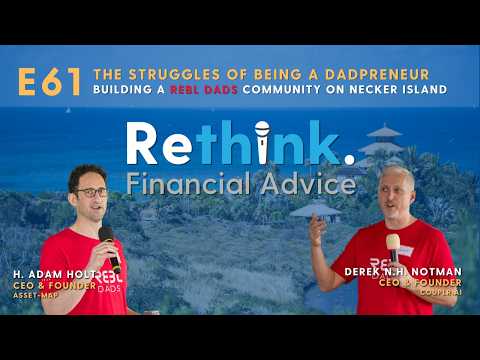
Ep61 - Rethink: The Struggles of Being a Dadpreneur
Watch and Listen
Episode Summary
In this special hosts-only episode, Adam Holt and Derek Notman revisit the origins and meaning of the REBL Dads community, the group Derek founded to support entrepreneurial fathers pursuing both business success and present, engaged parenting. They reflect on a memorable gathering on Necker Island with Sir Richard Branson and share what "dadpreneur" life has taught them about balance, purpose, and building something that outlasts its founders. It's a personal, unscripted look behind the podcast's usual guest format.
What This Episode Covers
- What it means to be a "REBL Dad" and a dadpreneur
- The Necker Island gathering with Richard Branson
- Balancing entrepreneurship and fatherhood
- Building community around shared values
- Reflections on the REBL Dads journey so far
Full Transcript
Full timestamped transcript.
Derek. What is a rebel dad,
[00:00:36] Derek Notman: a rebel dad? Well, it's, it's an idea. It's something that embodies a lot of different aspects of what it means to be a dad and an entrepreneur, or sometimes what I like to refer to as a
[00:00:52] Adam Holt: dadpreneur.
Dadpreneur. I've seen that a couple of times on social media recently. I think people might be hijacking your dadpreneur idea. That's fine. They
[00:01:01] Derek Notman: can take it. You know, that's, that's, uh, you know, that's more power to everyone else out there. And I don't think I'm the original dadpreneur user, although I did get , Sir Richard Branson to write an article about me and dadpreneurs, which was pretty
[00:01:14] Adam Holt: cool.
You got to tell that story. Cause I think a lot of people have been asking us , what happened on Necker Island in January of 2024. And , how did that all come together? Can you share that story?
[00:01:26] Derek Notman: Yeah, I mean, this is part of what Rebel Dads is, it's not just an idea, it's also a community, and a little bit of back story is that Like, like most dads, , we don't get a lot of training on how to be a good dad.
, but also like most entrepreneurs, we don't get a lot of training on how to do that either. , And it's really tough to do either one of those things. Well, I would say it's even harder to do both well at the same time. And what really spurred this on for me was that after. My son was born,
[00:02:03] Adam Holt: I was watching him grow up through
[00:02:05] Derek Notman: text messages because I wasn't home, working nights, traveling and so forth.
I'm like, man, this sucks. I'm missing special moments with my kid. I'll never get back. But I also have this entrepreneurial itch, if you will, that I just have to scratch. Otherwise, I'll go crazy. And so life happens. I was, I was really getting tired of that. And I'm. Ask the question, is there a resource that understands what a dadpreneur is and that can help, help me be a better dad, but also a better entrepreneur and long story short, I couldn't find one that actually focused on both.
So I put my entrepreneur visionary hat on and I created Rebel Dad. So what is a Rebel Dad? Well, rebel actually stands for remote entrepreneurship, balanced leadership. And it's a fun play on words too, because most entrepreneurs tend to be rebels in one form or another.
Right. But I wanted to encapsulate an idea of , how can we be the best dad and entrepreneur possible while leaning into these four different pillars, if you will, of what a rebel dad actually is. And so I, I started putting , this thing together. I'm like, well, like, where would we want to do a gathering like this?
And what would be a good draw? I've always had a fascination and admiration for Sir Richard Branson with everything that he's done with his virgin companies around the world. Like, wouldn't it be really cool. , he started Virgin Atlantic, his airline, from a houseboat with his kids crawling around his feet while he was working.
Yeah, I heard that story. Right? So if there's ever like a great example of what a remote entrepreneur can do while balancing leadership and family. Bingo. And so looked into it and next thing I know, we've got this gathering on Necker Island, which is Richard's home and wanted to bring together visionary dads from wherever we could get them to share in this experience to, to have us collective mastermind, if you will.
And I was lucky enough for you to be one of those dads that was there. So there's a little bit of the backstory. , what's your impression, right? Cause you came in a few minutes after this idea was started.
[00:04:19] Adam Holt: You tell me. Well, you know, look, we spend a lot of time together in this podcast.
We build obviously a pretty good friendship. And when you shared this idea, it just made a whole bunch of sense because I generally tend to think there is an epidemic of community, given the fact that we are. All separated and some of us are working from home or working in an office by ourself and our, our community is just not present in the same way.
I think it was historically. So the, the argument for, having community around you to help co parent build relationship and so forth. Unless you had a really strong family upbringing is, is literally lacking. I mean, we think about so many people across the entire economic spectrum that literally just don't have any support on how to be a good father.
Right. Some of us who grew up without any father, so I don't have a mentor. And I think when you created this for me, it was, I know that it's important to create work life balance, right? Like I tell our clients and the financial services side, you know, it's not about the money. It's about the values and how the money supports your values.
And pretty much most of us value our kids in a time. The fact that by the time they're 12, 85 percent of the time that we're ever going to spend with our kids is basically passed. So scary. So as we build these businesses, as you just explained, my story, just the same, I worked extremely hard to get here and try to create that certainty just to find out that I missed a lot of years and now making up for it.
So I really am so excited what you've created. And for those of you in the community that asked us what did we take away? What was that experience all about? We thought we would share in this. Podcast, some real important takeaways, not even close. It's not even going to scratch the surface, but we think there's some really important things that we wanted to share with you, our community, , that I think would be very valuable.
[00:06:05] Derek Notman: You know, what's interesting is cause , our community on this podcast is primarily advisors. And folks in the space, a lot of dads listen to this and a lot , I would argue advisors are entrepreneurs and business owners. And so what we will try to do as we go through these takeaways is tie some of them back to actually running your practice and being a great advisor as well.
So just keep that in mind as we're going here. , some really, really interesting insights. I mean. We brought together 25 visionary leaders, including, and then we also had some, some spouses and even my kid went. And the takeaways from this experience are priceless , and something I've never been able to get anywhere.
So I, I think like if, if we can learn anything by listening to this, I mean, there's gotta be some takeaway here, , based upon this experience.
[00:06:54] Adam Holt: Yeah, that's right. So hopefully everyone who's listening, just take out your pen, your pad, or whatever you write on these days. , I think there's going to be some really important, , things to think about.
Things to contemplate with maybe your teammates and or your partner in life, , and maybe even books to read. We'll make sure that we'll throw in some books here , that other, , peers thought were really, really impactful in their journeys. Not the least of which is we did have the opportunity to interview Sir Richard and that was a fantastic experience, a very, very unique And, and there's some things that we think are worthy of sharing with you, , that we want to pay it forward.
And I think Richard would really support that, um, because, uh, he's been very clear, Derek, that he really wants to impact and help and lift others. And, and that was a really great experience to spend the time with him. I think it was really, really cool to see just like us, a regular guy who wants to help others.
[00:07:44] Derek Notman: , no question about it. And I would argue that most great. Successful entrepreneur, dadpreneurs share those traits. He was very humble. But also a great business mind, a great father, a great husband. And , I think there's a lot of similarities there. It's interesting, but let's jump in, to these takeaways.
Is there anything that like hits you right off the bat? I mean, it was overwhelming. I I'm still digesting this as a month later now, what's something that just hits you right off the head there that is wow, like this is awesome.
[00:08:15] Adam Holt: Well, one of the things that I think was really interesting in creating a community for those of you that are part of a study group or a mastermind, or you have a group of, you know, close friends or partners that get together, I couldn't imagine now replacing what we just created in communities.
You know, we have a chat thread of 25 people that is still going strong today. We are sharing our successes. Both personal and professional. We are there to support each other. It's amazing how just spending four days together in this incredible experience has created friendships. I do believe will last well beyond this.
And I think for myself, just helping to create a community and getting people together and having common experiences that are novel shows that you can actually build relationships with people completely different than you and actually can create a support system very fast if you just make the effort.
I think there's a lot of people out there that want to get together. They're looking for a reason and excuse. So the most important thing I think I took from this entire gathering, Derek, is that you can create community very easily because there's a lot of people. That want to get together and whether it's the highest end of billionaires or people that are just starting out, we are all looking for this connectivity to learn from each other.
And I was a really, really great eye opener to say that it, it doesn't have to be complicated. You can create this today. And I want to really inspire everyone to say, if you're feeling this lack, you can be part of our community, of course, but you can also create this very fast. Derek.
[00:09:42] Derek Notman: I love that. That's, that's better than any individual takeaway.
We'll jump into here. That, that is exactly what happened too. And we brought people together from coast to coast and two different countries, most of whom had never met before, and we all walked away. Best friends had deep, meaningful conversations. , it's amazing what can actually happen.
[00:10:03] Adam Holt: Well, maybe you can share that.
Yeah, sure. No, let's, let's start with this cause I, you gotta know when we interviewed Richard, he brought up some really great stuff. So why don't you share some of the bigger takeaways that you took , from our interview with him? So what
[00:10:16] Derek Notman: I really love, and I've actually read this before somewhere, , but Richard said this during our conversation, what he calls his circles.
And it's, it's a really great concept or philosophy, if you will, where it starts with build a circle around yourself. 1st, be healthy mentally and physically and focus on that and focus on doing something good. But then expand that circle to your family, then expand it to your local community. Perhaps how can you do something to positively impact the community you live in?
And that could be as simple as your neighborhood, right? Neighbors. And then continuing to expand those circles out to be doing bigger and better things that help everybody all but always staying true to yourself and making sure those inner circles are taken care of. I really loved that philosophy idea and reminds me of like you drop a pebble in a clear lake and look at those ripple effects that are possible and something so small can have such a massive impact.
And so I just, it just really resonated with me that sometimes we forget the, that the small picture is related to the big picture and we got to start with ourselves first. And, you know, although this event, we did talk about work life balance, I'm a believer now, which is something that has shifted over time for me, that work life balance is actually not possible when we strive to get close to it.
Yeah. And I think his circles philosophy or idea that I'm starting on yourself and then expanding out really helps get to get us a little bit closer
[00:11:47] Adam Holt: if that makes sense. No, it makes total sense. I mean, look, leadership basically means that you're, you're taking the first step, right? Whether it's a military and family and businesses, right?
You have to lead from the top and to a degree, or if your triangle is upside down, maybe you'll lead from the bottom. But the point is, is either way you're in the front. And, and people are following the leader and there's no question if you can't get yourself straight, it's, it's hard to authentically lead, especially when things get challenging.
I thought it was really interesting how he talked about his own challenges, both business failures and also personal trials. I mean, a very human aspect of this, right? But I think what he demonstrate was really the importance of resilience. And the, and the ability to move forward after setbacks.
I mean, that, that is clearly what his books are a lot about, but I think it's, you know, he was able to share some moments with us that were private. I think it cemented the fact that even the people who seem the most successful they're just dealing with stuff that it would set them back a hundred ways.
So the question is, can we remember to be resilient even in the face of challenges? I think that's really important as a leadership reminder.
[00:12:51] Derek Notman: It is to that point. He also commented about give something you're all and when you've tried and it's still not working, then no one to cut the cord and move on.
Very true. Very true. Like virgin cola. For example, I loved his story about that and all the things that, I mean, look it up and you can look what he did in, you know, times square when they debuted it in the States and everything. It's pretty funny.
[00:13:13] Adam Holt: No, it's true. I look, I mean, you can't go very far without, you know, if you Google Richard and you see how adventurous he's been, he has not been afraid to embarrass himself.
I think it shows extraordinary authenticity before it was even cool. In some ways, now you see everybody embarrassing themselves on social media, right? I, that's what I think TikTok is a running embarrassments. Look at me. I'm so funny. Um, but I, I think, , that's really important. I think a leadership to show that humility and that's a reminder.
I know I tend to be goofy, probably even on this podcast. It's, it's kind of my personality. , people are looking for, . Real leadership, not just protected or, guarded. And I think that's really important to see, , not only the risks he took to go to space and to create new things, even not knowing how it was going to work, , what really resonated with me was in the leadership side, how much he really talked about.
The equivalent of the book, who not helped by Dan Sullivan, right? It's putting the right people in place where he could come up with ideas and visions. And he knew literally his team to call and they executed and built it and, and knowing when to get out of the way, especially in areas where you don't have skill or, or interest.
[00:14:21] Derek Notman: Well, so this is, this is how we can tie it back a little bit, Adam, about advisors helping their clients is that visionaries tend to get started quickly and have this idea for the future of what they want to accomplish, but then they need somebody else to actually execute. They need an operator.
And that's what Richard has done masterfully is that he's had wonderful ideas. From himself and from his team, but then he, he gets a role in, but then he gets someone else to do it. And as advisors, I think we have the same responsibility to our clients is that most of the time our clients do not want to be operators with their money.
They, they have hopes, dreams, and goals for the future. They have things that keep them up at night. And they want to just almost have , this total, like verbal unloading weight lift off the shoulders. Like, let me tell you everything that's bothering me and everything that I'm excited about now go get it done for me.
And that's where an advisor's value is so crucial is that the advisor is the operator for clients, money and their hopes, dreams and goals. Oh, that's a great point. Then I just like, anyways, I just, I connect that back to what Richard's philosophies have been. It makes total sense. Even all the other dads, pretty much the same thing.
Visionaries operators.
[00:15:33] Adam Holt: You know, it's funny how many times we run into, uh, the conversation of how you're operating your firm, especially if you're growing an advisory firm, whatever business you have out there, right. , it's going to take a team. It's going to take different skills and certainly different hourly rates, right?
We know that there's good efforts. There's productive things. We should be spending our time on. And there's underproductive things that we should not be spending our time on. And that's kind of the whole measure of scale and growth and all this other fun stuff we talk about.
But just like. Parenthood, just like, , filing your taxes. No one gives you any lessons on this one. No one teaches you how to run a business. And one of the things that came up from so many of our fellow peers on this program , was the effectiveness of an entrepreneurial operating system. And you can't go too far without running into traction by Gina Wickman.
Which basically creates a framework of how to organize and run the day to day of an entrepreneurial company. And as you just said, it requires typically the most successful have a visionary and an integrator. And that visionary is typically the CEO and the integrators, typically the COO, and they both play a complimentary role.
And doesn't this show up also in families? I think even in my own family, I'm, I'm that visionary role, big surprise. And I'm. Partnered with an operator person who's getting it done and they don't want to play the front role. They don't want to be the fun, crazy. They just want to execute and they want to do it efficiently.
And partnering up with someone like that is I think really interesting because it just shows how as you say, we're really doing that for families with respect to their money. And it's true. Nobody tells us how to run a financial advisory practice. Can we actually run meetings more effectively by using some of these principles?
Oh, I'm sure we
[00:17:17] Derek Notman: can. And if you even just having that mindset of like, I'm going in as the operator for my clients and explaining it to them in that way, that would be hugely valuable, you know, like I'm going to be the COO, right.
Tell me your vision. I'm going to go fire or hire all the money managers, insurance folks, whatever, to get this stuff done. And I'll report back to you on what's happening. No, it's very true. It just makes so much sense. So, uh, long story short, the value of an advisor is, well, it's invaluable.
If they're doing a good job and they truly are using that operator
[00:17:54] Adam Holt: mentality. You know, though, I don't know that how many advisors actually communicate that though, because we've never been given a real frame to explain that to the client. I mean, you're right. You hit it on the head, for whether it's the protections or whether it's the filing.
When you think about when you run a business, you've got to put some money into protecting the operations. You've got legal, you've got contracts, you've got insurance policies for your, , infrastructure, and then you're putting money to work in the form of employees and, , giving them the tools that they need that that costs as an operating expenditure.
Right. The same thing is true with clients that are making decisions to protect their family through the typical insurances and so forth, we've got to allocate some of the money they're bringing in there, the capital they're bringing into this business. And then we've got to, of course, deploy it in the form of assets that managers were hiring or.
Or we're doing it ourselves or, and, so it's really true. We ha we could, we have an opportunity to rethink. The way that we actually deliver an experience for our clients actually, and running it as a business. And that's something that just came up for us so many times over that week is, are we being intentional of how we actually manage and scale as opposed to just winging it or doing it the way we've always done it and may not actually be as efficient as it could be.
[00:19:03] Derek Notman: It probably isn't. I think that's really important to understand that about yourself. And one thing that helped me understand more about who I am and how I operate. Is, , something that I'd never heard of before, but it's called the Kolbe index. And I guess it's been around 40 plus years.
, super interesting. It's not a personality test. It's really more of a. What are your strengths and weaknesses in getting stuff done? It's a simple quiz. It takes maybe 20 minutes. We'll put a link in there, but it really was interesting. It's like you and I have very similar scores.
We're both high on what's called a quick start. We're visionaries, but our follow through is not as good. Uh, and that's where you need an operator and it would be interesting, even as a, as a parent, both spouses can take this thing and understand how you guys balance each other out. Have your kids take it super interesting to see how they are.
You can actually probably learn a lot about business and being a parent by just understanding the output of this. And no, we are not sponsors of the Kolbe index. It's not at a really interesting output that helped put my entire like psyche of how I operate into like just a couple numbers.
It was really interesting.
[00:20:15] Adam Holt: I did it too. As you just said, and when reading about this, the Kolbe and that's K O L B E really was interesting because it actually talked about you have a preference. Of how you approach problems and life and really where you live in your flow state. And for those of you that don't know what flow state is basically, you know, your ideal environment where you're in the moment, , you're just like at your highest productivity and you're happy and you're fulfilled and you're doing the work that you want to do , and getting to that point.
And, and what it really expressed for me, because I also had some other people do including my team. Is it validated the fact that what do I really want to be doing? Where am I the most effective? And it's not in the operational aspects of it. Big surprise, right? It's in the vision, creation, communication, you know, like I love that stuff.
And that's why we do a podcast big surprise, but you know, when it comes down to, making sure that certain operational things are there, like that's not the job I want to do. And I've had to do it because we're all entrepreneurs. You have to do every job at one point. But the recognition, I think here's the takeaway, the recognition of knowing what serves you the most will keep you energized and basically what you should be delegating.
Even if it's a critical task, you've got to find the who, not the how, , but it's important to recognize and be honest about maybe I want to live in my flow state as much as possible. And that line that with the personality and things I'm really good at.
[00:21:37] Derek Notman: Think about that. If you're excited to get up every day and be in that flow state as a parent, as a spouse, as a business owner, you are going to be so much more productive and happy and fulfilled by doing that.
And just knowing that, but a lot of us, I was never taught this stuff. You know, I'm pushing 20 years in business, one shape form or another, and I'm finally, , learning some of these things. It's pretty
[00:21:59] Adam Holt: wild. Well, the shape and form is actually a dad bod. Just so you know, that's the shape. Dad bods all day long, man.
Well, let's talk about that because, you know, when you're around a whole bunch of other successful, , business people, you start to pick up the theme of health and wellness and awareness. And of course, as we're all getting older, we're kind of thinking about, gosh, I don't, I don't remember seeing that wrinkle or, right.
Or, uh, gosh, these pants fit differently. You know, we all go through this, right. And, and there was a real awareness, I think towards health and, , not only from Richard, but what did Richard tell you about his own commitment to health?
[00:22:36] Derek Notman: I struggled with this. I actually went back to him the next day and had our conversation.
He was telling us about how you should set aside three hours a day for your health between exercise and all the things. And boy, like in a vacuum, that sounds amazing. I love that three hours a day of exercise and healthy living or whatever that is. But I struggled with it because I put on my dad hat, I put on my entrepreneur hat, and I'm like, I don't have three hours to go exercise or whatever.
And so I asked the next day, I asked him, I said, can you elaborate on this for me, Richard? Because I'm really struggling with this. I don't have the time. And I asked him, I'm like, when you were 30, when you were 40 and you were growing, you're these huge companies, were you spending three hours a day?
And he's like, no. You know, I was giving it 30, 30 minutes a day. So he's at a stage now where he can do the three hours a day,
but this goes back to visionary. He has operators do all the other stuff now where he has the time to do it. But regardless of the time setting aside the time, because I think it's really easy as a parent or as an entrepreneur advisor, I have to make 10 more cold calls.
I have to go drive to this client of people and I have to prep, I have to do this, this, this, or this. And you end up working yourself to the bone. And if you're not healthy, I always go back to the, the airplane announcement, put on your own mask before assisting those around you.
Oh, interesting. If you don't take care of yourself, how are you going to take care of anyone that you care about? You aren't.
[00:24:12] Adam Holt: Yeah, that's true. Well, I will speak for myself. I, I've put , my health behind everything else that I think is important. But I think one of the, one of the interesting takeaways, , some of you might've heard me say this on stage before, but I tend to, I love the statement in finance and hopefully you use it with your clients, which is don't tell me what you care about.
Show me your budget or your balance sheet, and I'll tell you what you care about. And the reason is because you're intentionally putting your capital behind the things that you really think are important. Now, by the way, that might not serve you, right? It might actually serve anxiety. You know how many times we see clients that put all their money in cash?
And they tell us they value legacy or they value their family. And then you're like, well, I don't understand. Maybe you really actually value security. Um, and they don't realize it or recognize that they're making that choice with their actual resources. But when you have somebody who has enormous financial resources, what does he care about?
He cares about his time in his mid seventies. He's literally telling you, don't tell me what you care about. Show me your calendar and I will show you what you care about. Because it's interesting. I mean, most of us. You could argue, yeah, I need to set aside time for the calls on it. Yeah. You need to run your business.
Are we setting aside time for our families? Are we setting aside time for our health? Are we prioritizing it as much as that standing meeting that we have with all our teammates. Are we prioritizing it more or less than that?
And the whole joke about it is here. We are trying to create wealth in different forms for our clients or for ourselves, some, some form of quote unquote, whatever wealth means for you. And we're basically squandering time on things that actually won't matter to us in the end. So how do we actually allocate our time, our limited time when we're awake towards the things that we really value?
And I think that was a real theme of balance. And what you've done with rebel is to try to put that in the forefront of our big, why, why are we doing this? Are we doing this so we can have another, you know, a couple of Benjamins? Are we doing this so we can have values and impacts on our kids? And I think if that's what you value, by the way, so I think that was a really interesting thing.
I don't think that the 3 hour comment from Richard was about anything other than he values being here and being present for his family. And he knows as he gets older, he has to do more investment in his health, and he's created a way to do it because it's important to him. It's important. It's a
[00:26:35] Derek Notman: priority.
Yeah. Yeah. I. It reminds me back. Oh, it's about the time my son was born. I was grossly overweight, high blood pressure, medication, , working like a dog. And I look back and , I'm not serving myself. Like if you go to the circles thing, I'm not serving my spouse, but my clients. Am I living the example of
what is important? I don't know if I'd want to work with somebody like that. And that might be 1 of the reasons that, for example, Richard and virgin are , so successful is that they embody the things you were just talking about in a way where people are naturally attracted to it. And , that's really, really important.
[00:27:14] Adam Holt: I think we should talk a little bit about some of the shares that we had about kids and family. Because I think for those of us that. Yeah. That are really intrigued about learning from others on this one. There are some fun games that I thought other Successful peers really have used with their younger kids over the years to instill values, which as we kind of move away, I think as societally from the religious infrastructure and we're all distributed and family members are not nearby.
So we're not getting the kind of historical traditional values in, in the kids faces, like maybe you're not doing Sunday recurring family dinners, or you're not getting together on an So , we're not getting this kind of Collective effect of raising our kids. And so it makes it more important because this is like a lack of values.
Being espoused by families unless you have great intentionality about it. So how do we support at a small level? What's, what are small things that we can do that you took away from , this event? There were a
[00:28:12] Derek Notman: lot of them. Well, one that comes to mind right off the bat is something that you can use for business and for family is turn off your phone, tablet, whatever, and put it away when you are in a meeting and let me define meeting that could be with a client.
It could be something for your business. Maybe you're raising money or you're trying to close a deal, turn it off and be present. But it also could be as a parent don't have your phone on while you're together, having your family meal, be present in that meal.
Like we have that rule, no screens, phones, or anything. And we sit down to dinner seven nights a week together. And so little things like that, where you are actually present, because I've noticed this, I have anxiety when my phone is out and it's on and I can see it, even if I'm not using it, I have anxiety that I need to check it, which means now I'm not present for the moment.
Yeah. So turning it off, turning off those distractions and being present with those you love or those you're trying to work with is extremely
[00:29:15] Adam Holt: important. You know, it's funny you say that because sometimes I think we're so used to having access to the phone, we use it for looking up stuff we're thinking about something, we go look it up, we don't wait and say, well, I'll do it later.
Cause I might forget. I mean, we all learned ADD in a sense, right? I, I'm going to be distracted in five seconds. So even when you see family get togethers or watching television and three of the people are on the phone. Phone. What are they doing?
Like they're, they're not present. They're disconnected. They're, they're saying that something else is way more entertaining than this experience. And so you're not actually sharing an experience. You're just basically in the same room and okay, I guess that's convenient, but mentally they're checked out.
They might as well be on a VR headset. And I think it was something interesting. Uh, you know, that. That somebody mentioned about even the fact that we all have cell phones, right? You go to a meeting with clients, if you're in person and you drop your phone on the table, or if you're having a lunch meeting with people, people drop their phone, literally screen up so they can see any emergency text messages that are going to happen.
By the way, what is not an emergency? If somebody texts you, like, is it, how do I know? I got to look at it. So now I'm basically saying to you by putting my phone on the desk that you're not the most important person right now, there are 10 other people that can basically walk in this room. And take my attention away from you, they could be relevant or not.
And I think that that was a really interesting aspect because I tend to do the same thing. Like everyone else, I dropped my phone screen up or screen down on the table because, well, you never know. My kid could be like texting me in the middle of the night, you know, they need something like. And I think we have excused this behavior cause we're just so used to it, but it's, it's sending a message, especially to our older clients who don't do this generally.
They don't drop their phone on the table. Right? Most of us X and millennials, we're doing that all the time. And we just, we just take it for granted. And what happens inevitably you're distracted. So you're not present. I think that's an important awareness. Maybe you don't change that right away, but it's important because it affects both.
[00:31:09] Derek Notman: Well, what are you teaching your kids too? What if you're standing in the kitchen, your kid just got home and they're telling you about something that happened at school, but you're looking at your phone and trying to scroll through Instagram at the same time. Like, oh, well, oh, oh, that's cool kid. Um, yeah, , you have just shown your kid that whatever crap is it you're looking on your phone is more important than them.
Totally. And that, yeah. So just, yeah. So turn it off, I guess, is the thing, you know? And like right now, like when we're doing this, this podcast, my phone is in a drawer, I can't even see it.
[00:31:37] Adam Holt: Oh, really? Not me. Mine's right here. I've been watching. I know you've been so distracted. I even got the watch so I could just go like this and pretend I'm looking at the time, but I'm actually, yeah, I do have the watch now.
So I, I've actually put the phone away more because I have the watch. Believe it or not. I actually do less phone stuff because I can see if there's urgency right there. I can be equally distracted with your phone. Yes, that's right. It's more clandestine distracted. You don't know the difference, but I'm really checked out.
I thought there was some really interesting. Brandt shared a really interesting aspect, you know, as most of us have gone to remote or have been remote working for years. So our clients are all over the place. And so for our top clients, we tend to get on a plane and go visit them, but he actually made this really fun.
So he talked about this idea of bringing kids on your work journey. So let them see you in action and find ways to inspire them. What he does is a, a family summit. And what he does is he schedules time to do a meeting with his biggest clients. It's a two, three hour meeting. So it's obviously more intense because it's an annual type of thing.
He brings his children, he sets it up that they're going to go to the client's house. The children are going to come with him. He basically tasks his children with taking care of those other children or playing nice with the client's children, right? So they have to be on their behavior. And he also inspires them that when they arrive, he told us that he expects them to ask an intelligent question to become interested in the family.
Right. To share and also to be curious. And I thought this was really interesting because he of course rewards them at the end with, then they do an excursion afterwards. The next day they go to some amusement park or museum or whatever the kids wanted to do, experience a new city. So he, he figures out ways Derek to basically make it interesting.
But I, I love the fact he's teaching skills. And he's letting his kids see him in action and what he delivers for real families and build connections. Gosh. Can you imagine how much that relationship is, is valued that he just comes with his family. The,
[00:33:38] Derek Notman: the client is going to love it because they see what, what he truly values and what he prioritizes.
The kids and the spouse are going to. Value it because they, they see what they are priority. It's so meaningful. And, maybe you're raising around for your company, maybe you're trying to close a deal, maybe, you're trying to do some team building with your C suite.
What if you focused on conversations around hope streams and goals and vision and who are you and what are you going through in life instead of two seconds saying, Hey, how's it going? Oh, it's nice. Well, there's good. Oh, good. Here's my pitch deck. Like, Whoa, Whoa, Whoa. Like, hold on. Like, who are you? Let's, let's get to know each other a little bit here.
First, we, we tend to marginalize the human aspect of everything we do in life. And I think what Brandt's example shows is he's leaning into
[00:34:28] Adam Holt: the human side. There's a couple of games that came up that I thought were fun and, , I will let you know, Derek, that I've already had fun with my daughter on this one, which was Spencer brought up this idea of freeze game.
He'd been playing with his, with his kids for years when they were in the car, you know, he's like, they're off thinking about something else. Of course, today they're probably on the phone and they had this agreement that when somebody says the word freeze, uh, the person who's receiving that freeze basically has to stop and in one word, not only describe what they're doing.
What they're thinking and what they're feeling and he made it a game, but I think this is really important because it really promotes this idea of self awareness and our kids really learning this idea that not only do they have things that they're feeling that you might, that it might've been obscure.
I didn't really know you were nervous about that or that you were thinking about that, but also the kids can use the freeze back on him and they can stop him and ask him and it begins funny and awkward at first, but all of a sudden you start to realize it's a great way. And a fun, spontaneous way really get to know what other people are going through and it's really connecting. And I've used this with my own kid and, and learn things that I didn't know, uh, that I really wanted to, I wanted to be involved and help her with, I didn't know that she was anxious about something or that, uh, that she was feeling.
, kind of lost and she wouldn't have volunteered that, but that's some things that happened by the third or the fourth or the fifth time. And, and that was really cool. Have you, have you tried this before? I haven't,
[00:35:53] Derek Notman: I'm going to do it tonight. Okay, what you're helping me realize something right now, our kids, especially, you know, well, I mean, heck, even up into college struggle to articulate how they're feeling and if they can't help us understand it because they can't articulate it, then we can't be more present and helpful as a parent and supportive this freeze game is just the simplest little thing you can do.
But now you are going to have deeper understanding and be a better parent. Like, man, how cool is that? It almost gives me shivers, man. It's so simple, but so powerful.
[00:36:27] Adam Holt: Yeah. Help them. Well, , the other one that I love that I took away from this was Rod's word of the year game and basically explained how His family came up with a value that they wanted to promote for the year .
And now it's really driven by the parents when they're young. But one of the things that he said that he was trying to get was more positivity. One of his kids to be more positive and have positive attitude about doing things and, and not maybe, I don't know, complain, whatever it was going on at the time, but he basically, they decided that positivity was going to be the name.
And then they chose a mascot. So I think it was a potato. Positive potatoes. Okay. Let's make it. Let's assume that it was a positive potato. So they basically assigned points. And when anybody in the family noticed that somebody was acting with a positive potato attitude, they said positive potato and they got a point.
And these points accrued so that at the end of the year, they would. Take their points and basically use it to that child or the person who won the most points would get to choose some adventure that they would go on as a family. And, and then he told me that they made, they made a grateful, grateful grapefruits or grateful green beans one year.
And you know, in my own family, we talked about this and we said, you know what, we need to be more honest and we need to be more. , up front with each other, instead of talking around issues, right? We're all pretty good diplomats in my family. And so we chose to be the honest onions this year. So this year we're, we're trying to do this honest onions, or can we be more, , transparent and just say what we really think as opposed to, trying to protect everybody's feelings and just, hide the truth.
So that's something I'm going to put this into action. Right? So my kid and I have this like moment where like, Oh, that's an honest onion moment. Nice job. And we can celebrate those together. So I hope these fun games really connect with you, you know, share with us on social media, if you're going to use these stuff, well, what has it been effective because we can all grow from this in the community.
That's the whole point of it. That's the
[00:38:11] Derek Notman: whole point of it. You know, we could go on and on and on. We had so much takeaways from this, but I think. The way that you opened it is a nice way to kind of wrap this, this session up in that it's a community and that building a community is actually probably a little bit easier than you think, whether it's with your family, with your team, with your neighborhood, with other business leaders, whatever the case may be, is you got to have the vision and bring these like minded folks together because people, what we found and the people, the collective group has the amount of success that this group had is, is out of this world.
Absolutely. And, and yet we were all able to connect on these really deep, meaningful levels , and had needs. We all had needs and things that we were struggling with. And it's, it's interesting. Like money doesn't solve the problems. Um, sometimes it amplifies them. And so it was just such a great thing.
So I think if there's a main takeaway is like, look for your tribe, look for a community. And if you can't find it, create it. And that's what we've done. It's a little bit more
[00:39:17] Adam Holt: work to create it, but, uh, well, someone has to have the first party, right? The first party is messy and, , puts a lot of weight on the host.
Right. But then, people bring the mac and cheese and then they bring the hot dogs and the hamburgers and someone brings the napkins. And that was, you know, And it, and it grows beyond you. And I think , that's an important aspect to this. I know this kind of journey that we've started here and that you've really championed with rebel is, is we know that , there are a lot of us out there that want support, want help.
And so we're going to continue to invest in this project. And I encourage you guys all to stay involved , and see what you can do, what you can bring to the party as well. Uh, so that we can all celebrate this together, learn and grow from each other. I think that's a kind of great. , parlay into some of the things that , we said that we would share some of the books that I think were really instrumental before we wrap this up.
So for those of you that have been waiting patiently, , here's a list of a couple of the books that, that several of your peers have indicated really made a difference in their lives. And in no particular order, I haven't read all of them yet. Of course, they're on the list now, let's see, what are the first books that came up here?
Yeah. What
[00:40:20] Derek Notman: did you get? There was a couple by Richard Branson. Read any of his, you know, his autobiographies screw it. Let's do it, which is a business principle. He's had been very successful with some great insights there. Um, what did you write here? You have some interesting ones that I've actually not read yet.
[00:40:39] Adam Holt: The ones that came up in my breakout were principles by Ray Dalio. So I know that that one has been read by a lot of people and also who, not how by Dan Sullivan. There were a good number of strategic coach members that were at the event. And I think that one really resonated with me because he kept hearing this theme of putting the right people in place.
And I think that was, that was awesome. You know, traction came up enough times with the entrepreneurial operating system by Gino Wickman. It's a great read, even if you adopt parts of it, but I think it's a, it's an exceptional way. If you want to delegate and say, Hey, I want to run the company this way, read this book, that there's actually all of the meeting management forms are actually in the book.
You can download them. It's highly available. And there's also. Of course, consultants that help you with this stuff. Uh, again, no affiliation with us. , so many people said they're using this. How could we not share that? And I think the other ones that came up that were really around family is one called family board meeting by Jim Shiles.
That's S H E I L S have not read that yet, but it's, it's on the list. Uh, and I think for those of us that have run a business and maybe can learn how to actually be more operationally efficient at driving values and mission at home and being present for our. Teammates, I think it's a, that's a really good awareness.
I think we can all grow from.
[00:41:55] Derek Notman: I've got so many more, I don't even have the authors, but. Start there. We don't want to
[00:42:01] Adam Holt: overwhelm you. Start there. Yeah. We'll probably create a newsletter list for all members of Rebel Dads to participate and stay on top of that stuff because we're, we think we're just going to keep getting more and more, uh, information we can share,
[00:42:14] Derek Notman: uh, with those of you that are interested.
I think something also important to mention is that from day one, when I had this idea about Rebel Dads is that, I know that I would not be the rebel dad that I am and strive to be without having the rebel mom backing me up. And when I say rebel mom, I mean my wife because she's there helping do all the other things.
And so I think this thing is going to grow bigger. So rebel moms, rebel kids, how do we bring up the next generation of entrepreneurs and support them? I never had any of this. My dad was not present. I had no entrepreneurial, presence at all. I grew up in a broken household. So , how do , we help kids much earlier on become great business leaders, but also, , family, family oriented folks.
So I think there's that rebel grand dudes, like in Sir Richard, you know, like there's all kinds of cool things that I think will come out of this. So definitely pay attention. We'll drop some links in the notes where you guys can follow us on this journey here. But. It's something much bigger that I think is going to tap into a lot of people.
[00:43:17] Adam Holt: Well, with that, Derek, we have to sign off. I want to thank you for your vision in creating something that now has actually affected. A good number of people. And I think we'll continue to, , I think we'll look back on these moments and say, like, these were the original stories of, of a vision that actually, , made a difference in the lives of millions of people.
So I'm excited for you and for us and for all of you that are going to join us on this journey. Hopefully you got something out of today. You wrote something down. You're going to put into action, just like every time you listen to rethink, please tell your friends about this, share this podcast, of course, like it.
Post it, be part of this community and be present. , we hope that, uh, hope we were, we're adding value to your lives and your journey.
[00:43:58] Derek Notman: Thank you. Awesome. Adios, Adam. It was good seeing your brother. We'll talk to you all later.
You got it, buddy.
The content has been made available to you by Asset-Map for informational and educational purposes only.