
Ep59 - Rethink: Insights From the Former CEO of TurboTax, PayPal & Personal Capital – Featuring Bill Harris
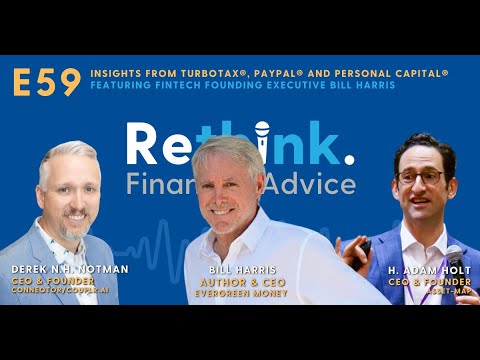
Watch and Listen
Episode Summary
Fintech pioneer Bill Harris — former CEO of TurboTax, PayPal, and Personal Capital — joins Adam Holt and Derek Notman to reflect on more than 25 years at the intersection of money, taxes, and digital technology. Harris makes the case for replacing outdated manual processes with automation so advisors can focus on the work only they can do, while using technology to deepen — not replace — client relationships. He also previews his new Investment Tax Guide, aimed at simplifying tax strategy for everyday investors.
What This Episode Covers
- Lessons from building TurboTax, PayPal, and Personal Capital
- Replacing manual processes with automation
- Using technology to strengthen, not replace, client relationships
- Modernizing outdated advisory business models
- A preview of Harris's new Investment Tax Guide
Full Transcript
Full timestamped transcript.
[00:00:30] Derek Notman: Adam, what can we learn from an inside outsider?
[00:00:37] Adam Holt: And is that like what I'm supposed to do when I fold the laundry and I'm turning the shirts inside out?
[00:00:44] Derek Notman: It is. I don't know. Have you checked your shirt today? Is it inside out?
[00:00:47] Adam Holt: Well tell me you can see me as a,
[00:00:50] Derek Notman: It looks like you might want to work on your wardrobe skills a little bit. Did you put it on in the dark?
[00:00:55] Adam Holt: I think that question is inside out actually. What do you mean by that?
[00:01:01] Derek Notman: Well, I think a lot of us within the financial advice. Industry profession, however you cut it,
[00:01:09] Adam Holt: No, we know it's a profession, it's a profession,
[00:01:12] Derek Notman: I think it's a profession. Some still call it an industry. So I'm, I'm being inclusive of everyone, Adam,
[00:01:18] Adam Holt: you're being empathetic.
[00:01:19] Derek Notman: being empathetic.
[00:01:21] Adam Holt: What a comprehensive advisor
[00:01:24] Derek Notman: I'm diversifying myself here. Now, come on. I think , what I'm driving at here is we have the blinders on and we hear.
Only certain sources of information. We only go to certain conferences. We only hear from certain people about best practices and so forth.
[00:01:42] Adam Holt: you are.
[00:01:42] Derek Notman: But can we learn something from someone , who was on the outside and now became an insider? Yeah, I guess that's more of a perspective. What can we learn from perspective?
[00:01:52] Adam Holt: Ah, that I love. And what's interesting about that is, , ever since we did that podcast, number 52 with LaCour and started talking about advice 0 and 3. 0, you and I have been doing CE credit courses for major companies about this exact topic. And we got a lot of data supporting it, which has been really fun. And the interesting thing about it is that this exact conversation came up with perspective. When somebody said, change the perspective of how you value advice from how the advisors think they're delivering it and how the consumers are actually receiving it and value it. A change of perspective is critical because all of us in financial advice think, Oh, you're going to deliver all these great services and have all this other stuff.
And it turns out to be a comprehensive viewed advisor. You actually just have to listen to your clients and show that you're on the same team has nothing to do with how deep. Planning you go or how large the booklet you generate is, or how big your planning team is, or whether you have a fantastic office with mahogany panels, that is not comprehensive financial planning, not from the client's perspective.
[00:03:04] Derek Notman: That's, that's like 1. 5, you know, financial advice, 1. 5, that's where I grew up, get the corner office or the office building, have the mahogany, all that stuff. Every client needs this great product that's on sale this month. And that was it.
[00:03:19] Adam Holt: That's true. But I, that, I mean, as my point is that the advisors are judging what is financial planning today. Well, what if we change the perspective from the outside, looking into financial advice said, what do you guys think? True financial planning or comprehensive financial advice is really about, I think we might find that outsiders have a different take of what advice delivery really looks like and what we're doing wrong.
[00:03:42] Derek Notman: Well, I, I would a hundred percent agree, but some might say, well, they're an outsider. They don't get it. Well, you could be right. What if you had an outsider that became an insider? Right? Like, what if you figured out how to put your shirt on correctly? Imagine that. Right?
[00:04:01] Adam Holt: how cool I'd look on our
[00:04:02] Derek Notman: you'd look...
[00:04:04] Adam Holt: I'd look the same to you.
[00:04:06] Derek Notman: It wouldn't matter, but I think that's where we can really get some valuable insight. And that's where our guest today is just that they are someone who was on the outside for a long time, an expert in their field, and then became an insider. So why don't you tell us a little bit more about, uh, our friend, Eric, who's joining us today,
[00:04:27] Adam Holt: Well, Eric McDermott, it's kind of interesting because, you know, he has over 25 years of experience in marketing. Actually, he's worked with clients of all sizes, mom and pops all the way to fortune five hundreds in a prior career. And he brought that creativity and thinking now to being a financial advisor and several years ago, I shared the stage with him.
So we became LinkedIn friends. Like all people, we should also be LinkedIn friends with all of you to us right now.
[00:04:53] Derek Notman: please.
[00:04:54] Adam Holt: Lo and behold, I see him post this video that links out to tick tock and I'd see he's got 500, 000 followers on tick tock. And I'm thinking, what is Eric doing? I mean,, he's running this 150 advisor team, , at Pacific advisors.
And he has the advanced financial strategies team. He says, he's got like six accreditations. He's really deep in our business yet. He came from marketing and lo and behold, they're seeing this thing blow up on Tik TOK and it's hilarious. And you got to check it out. If you go check him out on LinkedIn, you'll eventually find his kind of, side business of what he
[00:05:27] Derek Notman: Yeah. Right.
[00:05:28] Adam Holt: fun to try to help people.
But in his day job as a financial advisor, I think he really brings a different perspective. , so I think this will be fun for many of you . Who did either come from outside businesses and saw what was broken. And I think there'll be some interesting stuff. You ready for Eric?
[00:05:42] Derek Notman: Let's do it, man. Let's bring them on.
[00:05:44] Mcdermott Rethink Tank: Eric, thank you so much for joining us on the rethink tank. , I've been watching your own career for many years now, and I think it's really exemplary what you've been able to pull off, especially as a career changer, talk to us about your unique perspective of the financial advice market today.
Yeah, thanks. First of all, Adam, Derek, , it's fun to get to chat with you. I love what you're doing here on the podcast and what you're working to help advisors do. , yeah, I, I definitely did not grow up in the industry, you know? and so I think that does make my perspective a little bit unique. And that I was a business owner at a marketing services firm had other career opportunities for, more than 15 years of my career before entering into the financial services space.
So, , what that has effectively led to is this interesting. Way I see our industry and the way I see how advisors are approaching markets and and frankly, I see the systemic challenges as well as individual practitioner challenges differently than perhaps somebody who did grow up in the industry.
An example of that. Is probably best exemplified by a title. I gave to a presentation. I did as a keynote at 1 of our largest industry events. It's like 3500, financial advisors and leaders in the audience. And the title of that presentation was the inside outsider and it was just this recognition that I can't deny the fact that I am an insider.
Now, when it comes to being in the financial services world. . However, the difference I suppose is because I didn't grow up in that world professionally and I came in, you know, my late thirties to the financial services world, uh, what's happened is I'm clearly on the inside, like at this point, uh, you know, I've earned, uh, my credentials as an advisor.
I've got all the different licenses. I've got six advanced designations, including CFP, all that. , and so clearly I know this world. I'm part of this world. I've been a great beneficiary of being a financial advisor, a leader of financial advisors. So I'm an insider. For sure to the industry. And yet I've never let go of the fact that at the end of the day, what I noticed is that our industry is really obsessed with being what I'll call best in class at industry standards.
And I've always held that the standard to be after is the enterprise at large standard. What's happening across enterprises, across the globe, across the world, where people innovating in places. And that's a different standard than best in class in our industry. And so as a result, that sometimes makes me a little bit of a misfit.
Because I keep looking at the standard of what's happening in the marketplace as a whole and saying, wait, we are very constrained sometimes because of our own mindset other times because of very understandable systemic challenges. We we face as a regulated industry for the sake of public trust. So, given that unique perspective, given that you're an outsider turned insider.
And I, I believe you, you've got what, 160 so advisors you're seeing a lot of different things as I'm sure day to day, even within the own firm. It almost sounds like from your unique perspective, there is a missing opportunity there, but I'm wondering what that is. Yeah, for advisors, given where we're at today.
Thanks for asking Eric. I, I think my perspective is unique because I didn't come from inside the industry. So as a result, what happens is my sort of zoom out approach when I try to piece together what's going on in this industry that has it be the way that it's being right. Um, one of the things that was fascinating is I realized like, if you go back literally a hundred plus years, like we're talking industry that's been forming for over a hundred years, right?
What you have is you have this world in which, uh, effectively. From my point of view, what it appears to me is that if you go back to even the 1800s, you had certain parts of the financial services sector that grew up and evolved around investments. Then you had another part of the world that grew up over the decades, really over a century, on the insurance side.
And as we started to move into the 1900s and things started to become a lot more mainstream in those conversations, it was reaching more people. What I think we started to see is that in order to compete effectively, You couldn't just be one or just be the other. And so what you've got is you've got this, this sort of two camp system, right?
If somebody came into their career and they came through the world that evolved from the investment based products, oftentimes what's going to happen is a client's going to approach. That type of financial advisor and what they're going to hear is shockingly, everything looks like an investment solution.
And if they approach somebody that has come from that foundation that started in the insurance side, they're much more likely to hear. Products around protection and security and insurance. So you've got , these two camps. Now it doesn't mean that the investment wire houses haven't added an insurance desk.
It doesn't mean that the insurance companies haven't added investment desks. . Uh, however, I still think that as an industry, because that's the case and because those were around products and therefore all the regulations came around the products, post. Great depression, right? And all the laws that got put in place around the investment advisories and broker dealers and insurance companies, um, really for the sake of public trust, for all the right reasons, , they were around how to move products that people wanted to sell.
And the industry has really evolved on, , how to train people around products. That an industry wants to sell, which is very different than the world we're in today, which is really about how do you meet clients where they're at, which is what it is they want to produce as far as outcomes that the products are in service of.
And so this world we're in now, where we've been training and still continue to train more to what we want to sell and less to what people want to buy. And I think that's where there's a huge miss in that perspective. That's really insightful. We've talked about this in a couple of different episodes.
Adam, we're beating around the bush on it, at least, but that. That's really interesting and that so that is definitely missing opportunity. It sounds like that's not only just for advisors or the enterprises, but. Industry wide. It's not, not just our industry enterprise wide, right? Like a global marketplace.
Most folks have figured out in the last 20 years that we're no longer in a society. I don't know that we ever were in a society that, that loved this, but we're not in a society that, that appreciates being sold. And 25 years ago, people didn't have much of a choice. Like you wanted to transact, you had to be sold.
Right. Somebody was a salesperson. They had , to sell you today, though, all you have to do is turn around over to a keyboard connected to the internet and you know, or your smartphone, don't even need a keyboard, right? And you can literally attach yourself to information that's widely available everywhere.
You don't need, , it's not required to go through a salesperson to access certain information. So. That has caused this shift and I don't know that our industry has kept up with it as well as they could have, which is look, we are doing sales training. We are kind of strategies for what we want to sell, but the enterprise markets at large have figured out how to create an environment that clients want to buy in, not the ones we want to sell in.
And there's a great way to meet those up together to get everybody what it is they need, but it does cause a paradigm shift. I've talked about this also on stage about how people do not want to be convinced and be sold. They want to be engaged and then purchase or they want to buy. And I think that's right.
I think you're, you're seeing it exactly right. Of course, our industry has been hard to move off of that. What we call the financial advice 1. 0, which has really been a, , full facilitation of a sales process through the auspices of an advice conversation. That effectively the same products were sold, but it sort of felt like advice.
And we think there's a big advice engagement argument is really the whole thing. How do you engage people and deliver advice? First solutions are ancillary, despite the fact that many of us still monetize this way. , you know, we're curious here, what action steps do you think that an advisor can put into action right now, or should start rethinking in their own practice?
Yeah, it's a great question. And so a few things occur to me. And when I came into the financial services world in 2009, one of the things that I noticed, and this, remember I've got over 25 years of enterprise marketing background coming into this, right? So, um, so in my background, I'm sitting here listening to the conversations that are going on.
And what I'm listening to is all the prior teaching, coaching, and marketing advice that's being given to advisors for how to reach the market is all around. Expressing to end clients, how great they are, how great the advisor is. And so everything I walked into was bios of here's how great I am. Here's my designations.
Here's the people I help. Here's what I do. Here's how awesome I am. So the first thing that took years, the first thing I did was to, to really pervasively try to change our culture from let's stop telling people how amazing we are and start telling people how, what we do can be amazing for them. And start telling them how amazing they could be with our help, not how great we are and how amazing we are.
And so the bios changed, right? The, the, the approach changed from look at how awesome I am with my six advanced financial designations and five licenses and this many years. And by the way, I made this club level in production. No client cares about your club level in production. Like, no one cares. That's an internal thing, right?
Generally speaking, that does not find a true meaning in today's client centric world. So now, What those kinds of bios read is, you know, listen in more than a decade, right? As a firm, we have more than 60, 000 clients, and it's allowed me to have a certain bird's eye view what's working and not working in the lives of clients.
And so what I and my team do is, is we work to sit down with you, hear the objectives you're trying to achieve, make sure you don't fall into those. Pitfalls that we see so many people falling into that. You don't get a purview to see and help you come up with a plan for how to get financially organized, how to take control, how to reach those objectives, right?
Not just from financial growth, but also for financial security and find a balanced way to do that for you and, and produce these outcomes that everybody wants. Right? So I don't know the last time someone ever woke up going, gosh, I just got to get me gobs of more financial products. I just want to slather some, some whole life insurance on me, right?
Nobody, nobody gets up and says that in the world. So let's stop talking about , and this makes me very unpopular when I say this in my circle. So I will, I will say it, but please hear me the way I mean it, which is for the most part, and this is true of other industries, not just ours for the most part, we all sell stuff nobody wants to get to outcomes everybody wants.
So for example, we know that on the investment side. The idea would be to create some sort of, , way that somebody could invest over whatever horizon of time made sense for their objectives to produce the outcomes that they want. That's an outcome they're trying to achieve. But it's not about the instrument.
It's not about the sale of the product or the investments. On the insurance side, we know that if somebody has, for example, certain products, like a whole life product, it's got certain characteristics to it. Certainly it's got a protection set of characteristics to make sure that your family's okay in the event that your income stops because you're not there anymore.
It certainly has financial instrument asset class like characteristics. You know, because there's certain promise based elements to the cash value. There's also that just in time liquidity for business owners and estate planning. So there's all these things that it can do. But nobody wakes up saying, I want the life insurance.
What they do is they say, I want that liquidity just in time for my family. I want that income to be there if I'm not there to provide it. Right. So let's stop selling first the products nobody wants. And let's start instead offering the outcomes everybody wants. And the products will fit to serve them in that context.
Makes sense to me. I almost equate it to, um, I don't want to drill bit. I want to hold up the drills. That's right. And that's exactly it. So, so now you're moving from what I'd say transactional thinking to leadership. Definitely. Definitely. And, and that's right. Nobody wants the drill. They want the hole.
But if you go, you can go even farther than that though, because really, does anybody really want the hole or do they just want the playground in the backyard for their kids so that they can swing? Hmm. I love it. It makes total, total sense. I mean, you've answered my last question about what needs to be debated, but I think that's exactly what needs to be debated.
And I think that's a challenge though. And Adam, mentioned this earlier, just in this conversation about how we're comped in this industry and how it we've talked about this on a previous podcast with, , our friend Cobus in South Africa, the difference between industry and profession, industry, manufacturers, products that should be sold.
Profession is exactly what you're talking about, Eric. So how do you blend that stuff together? Do you have to fundamentally change the comp structure or is there another work around? I don't know. I, first of all, these are big questions and I don't claim to have singular answers for them because they're complex.
What my take on it though, , is that, you know, man, it is amazing how many problems get solved with diversification. I mean in life in general, I don't just mean from an investment perspective. So for example, , we understand from an investment perspective that diversification, and investments has a certain benefit, right?
So you avoid that concentration, that volatility, et cetera. , diversification of thinking, the fact that we're coming together in a podcast , and y'all have interviewed hundreds of people on these kinds of topics, but now you start to create more thinking, more dimensions, that diversity of thinking comes up with new ideas.
The same is true with diversifying our incomes. So one of the things that was also true when I came into our firm, and I'm not taking credit for this in any single handed way, it's really been an incredible effort of many, many people and amazing leaders that I get to work with on our teams. When I came into our industry, our firm, like just our agency, with our 150 plus Advisors and representatives, that firm, if you looked at a pie chart of our company revenues, you would have seen 80 percent of revenues from insurance, 20 percent from investments.
Well, where do you think the skew is going? Remember that historical, right? Okay. So now guess where it is today. 50 percent reverse. No, it's the opposite. 51, 49, Like I don't, it changes a little bit each year, but for the most part, we are exceedingly balanced. That's really cool. And what that means is we don't have to have a dog in the hunt for which instrument gets the client to the best place for them and find that diversification of not having to have.
So for example. What I try to encourage is make sure you've got the designations and credentials to do financial consulting fee based planning, right? That's one form of revenue where you're trading what it is You know and have learned as a financial professional or financial advisor and you're earning money that way also I think it's totally appropriate that if the Insights and the strategy and the recommendation that ends up making the most sense for the client involves some sort of investment Or market based product and some sort of financial security product like great, but you don't have to have a dog in the hut because I represent insurance products.
I represent investment products. I represent financial advising as a product. I don't care which way we go. In fact, when I'm working as a financial advisor for the most part, overwhelmingly, I started every relationship with a fiduciary financial consulting agreement. If I produce the best thinking for the client and the client really appreciates the strategy and recommendations, the product will show up as fitting. And my suggestions to advisors is to diversify, diversify your product knowledge, diversify your credentials, diversify your licensing so that you don't have to care that you can only get compensated on one product or two products or one class of products or another class of products.
Right. And you don't have to embody that all by yourself. In fact, , we're entering a world where the solopreneur is a endangered species. Okay, we're not quite extinct, but we are definitely an endangered species. And if you watch the golden age of, and this is, these are all ericism, so I'm not basing this on historic fact.
This is more of my observations, right? I just want to put it in context because I, I don't have a whole heap of data to back this up. However, I think if folks look, uh, they'll probably notice something similar to what I'm saying, which is if you look from the 1960s, when college degrees were exceedingly difficult to get just even four year degrees, the professional.
Was this really high honor and difficult to achieve outcome and that what you had is you had doctors and you had dentists and you had attorneys and CPAs and you have financial advisors and there were rare people to find because it took such a difficult threshold to get to that capability level.
Well, not only is it not as difficult because it's so much easier to find folks who can do it. That golden age though of those folks obtaining that really high value. Of compensation has been pressured away to the point where it's starting to feel a little more commoditized. It will be able to go online and find certain products and services exchange just right there online.
The ability to, find dozens of choices in the marketplace for people and to avoid being commoditized. , we have to compete with the enterprise marketplace at large, not just our industry. So being the best in the financial services world, but being compressed by commoditization compared to an enterprise world, that's figuring out how to compete at a much more sophisticated level.
It just means, you know, great. I can beat 5 year olds at football. That's not the standard we want, right? We want to be able to play to the standard that the marketplace and the client experience has to match up to, right? Across consumer bases. And so, um, that being said, I think that solopreneurs are an endangered species and everything I just said about how to diversify.
Can be diversified one by you having the ability internally, like you embody it. You have the license, you have the designations, you have the knowledge and you are a practitioner of it, but it can also just simply be by configuring, configuring with a team of other folks at our firm. We make sure we have a community of folks and teams that are available.
So I may not be licensed this way, but guess what? I'm part of a team and between all of us, we do embody this capability.
[00:24:13] Derek Notman: So, Adam, , what do you think about that? It is an inside out perspective helpful
[00:24:19] Adam Holt: I think he expresses
[00:24:20] Derek Notman: or outside in.
[00:24:24] Adam Holt: I never quite get that right, by the
[00:24:26] Derek Notman: Yeah.
[00:24:27] Adam Holt: I think in all the Eric isms, as he called it, Eric isms,
[00:24:31] Derek Notman: Eric isms.
[00:24:32] Adam Holt: were some really interesting nuggets that I hope everybody heard. And I think it was unique to an outsider looking in. And I think there's a couple of things that people could take away.
Hopefully you got them. And we're going to repeat them here so that you can really just codify them in your brain and decide what you want to rethink about in your own practice. Where would you start?
[00:24:53] Derek Notman: Well, this aligns really well with this conversation. We've been having about 0. Is this what he called it? Two camps, , you had this insurance world and products. Yes. Focused group of agents and advisors and, , wire house investment folks. And they were both growing up in the industry and their silos and focus around like, all right, here are the products that we offer.
And we're going to go get as many clients as possible to go get those products. And then now it's started to, to meld together and it's changing. And I think a , big piece of this is around the question he asked is. How do we stop pushing products a certain way and how do we start meeting clients where they're at and giving them what they want? In other words, he also said, like we're in a society now, probably more than ever, we've probably always felt this way. I'm guessing, but we probably feel it more now , than ages past is that we really don't appreciate being sold,
[00:25:52] Adam Holt: Mm hmm.
[00:25:53] Derek Notman: but we love to buy. We'll buy all day long. That was a big one for me and just hearing that and even talking about, it made me chuckle about what level of, , we call it council where I was at or club or whatever, based on all your production, what you achieved and telling everybody else your clients don't care, but I haven't, I haven't put that on my business card for a while, I'm chairman's council and blah, blah, blah.
And.
[00:26:21] Adam Holt: Yeah.
[00:26:22] Derek Notman: Like, wait a minute here. I'm, I'm looking at this all backwards.
[00:26:25] Adam Holt: But we, you know, but we were quote unquote selling our services to a community of people usually older than us that appreciated and came from that themselves. They had achieved those circles. They had gotten those gold watches. They had gotten their pensions. I think , the mindset of 1800s. Was really mired in a traditional approach to achievement was tied to your sales productivity and, and clearly that has changed, but you know what the real difference is?
It's all literacy. When you have a literate consumer or have someone who has access and is empowered, like the internet has given them. You don't need to be convinced. You don't need to be educated about the products. And we had to spend all our time as salespeople, educating people with confidence about how the products worked and all the details and the nuances.
And so we're , now these customers can, they know they need these things, right? So
[00:27:21] Derek Notman: Dude,
[00:27:21] Adam Holt: very fun.
[00:27:23] Derek Notman: So what you're saying is we as advisors used to be the internet.
[00:27:29] Adam Holt: Oh, totally. We were the subject matter
[00:27:32] Derek Notman: Yeah. We had all the information cause you couldn't Google it. Whereas my son says, search it up and we had to provide it. And I, I'm not even saying that it's bad that you have production and you make a ton of money and all that. That is a, barometer of how successful you are, but I think the point is that it's not important to the consumer as much as we thought it was.
[00:27:56] Adam Holt: not anymore. And that, that's the comment about being sold versus being engaged. And, and, you know, are we on the same team or are we across the table? Right. Many years ago, we used to talk about this, that the high net worth client expected you to be on the same table, same side of the table as them.
You're helping them buy, make decisions. You're acting as their advocate. And for yet for many years, it was always across the table, even if it was a kitchen table trying to convince somebody that they should sign here, and here's the pen, you carried a pen. Do you remember that when you
[00:28:28] Derek Notman: So I only had a nice panel like, um, was it Mont Blanc or
[00:28:32] Adam Holt: Why not? It showed how sophisticated you were with you had a, , a quill pen or a Mont Blanc or something like that. So they stopped allowing it had to be a rollerball pen. I mean, that's crazy that we remember that that was not that long
[00:28:44] Derek Notman: wasn't that long ago or we're just really old.
[00:28:46] Adam Holt: No, you are. But anyway, so the, the had to do that to you, my
[00:28:50] Derek Notman: Thanks. I appreciate
[00:28:51] Adam Holt: the diversify your income products and designations was a new one. And I totally related to it, but the way he framed it from his outside in view was really strong. What did you think about that?
[00:29:03] Derek Notman: That one really resonated with me because we've talked many times with a number of our guests about this, , for lack of a better term, our compensation problem and how that fits in with best interest and conflicts of interest and so forth. And It's true. If all of your revenue is coming from virtually one product or type of, , insurance based thing, or, , a um, or planning, then of course, you're going to protect that and double down on it.
I get it, being an advisor is tough, especially when you don't get the same paycheck every month, right? So, of course, you want, you need to protect your income stream. I haven't had the same paychecks since the very first day I started as an advisor.
[00:29:42] Adam Holt: Yeah.
[00:29:43] Derek Notman: So, of course, you want to protect that,
he's so smart. How do you reduce your risk? Well, we talked to clients about it all the time, you know, this about the strategy called diversification. Why don't you do the same with your income streams and selling different, , types of products and services based upon the need of the client. So that means getting licenses, but it's not just having to get licenses or credentials.
Maybe you don't want to do that. But having being part of a team that can do that. So as a united front. And by offering those different options, I would argue you're probably further cementing the work you're already doing and that income stream.
[00:30:20] Adam Holt: Yeah. I, yeah, I tend to agree with that. You know, one of the things that kind of hit me is when he said the sole entrepreneur is an endangered species, but that was kind of thought provoking. And this idea of playing at the enterprise level as opposed to beating a five year old at football, I thought was kind of fun, but it made me think the best in class at industry standards.
And competing at an enterprise level, in other words, , how is, , a large organization like Apple or Disney setting the standard for client expectations of, of delivering services? Whereas we're just trying to be the best in our, little fiefdom of financial advice. Can we actually be relevant in, as an experience for consumers at the enterprise level?
And that requires different thinking and requires really stepping outside yourself. And I hope advisors can start to do that.
[00:31:09] Derek Notman: Yeah, no question about it. I almost equate solopreneur to advisor 1. 0, but 1. 0 or solopreneur, if they tag on to a 2. 0, 3. 0 relationship can be just fine, but that's enterprise thinking. That's not solo thinking.
[00:31:28] Adam Holt: It's also about advice delivery, how you actually deliver that, what's that experience and what does that look like from the outside, right? , does that seem professional grade? Or does it just seem like it's been done for the last 20 years? You just haven't really retooled it. You just added an app.
Or something, I don't know. So I think just going from paper to digital and, , doing fillable PDFs does not mean that you're really thinking at enterprise level. Yeah, maybe you're innovating, but I think , there's a new level of competition and commoditization as a result coming on.
What did you think about? I mean, look, he talked about compensation, diversification. , I think , this is an ongoing conversation, but I'm curious. What do you think advisors can actually do? What's the takeaway that everyone here should be thinking about for themselves?
[00:32:09] Derek Notman: Well, definitely take a step back and look at your practice from the outside. Try to be that outsider. That's tough for a lot of us. I had only a couple of like what, I mean, one or two years of professional experience outside of college before I came into this profession. So I didn't have a lot of outside experience.
So a lot of the folks listening might be in a similar boat, but you can go ask your customers, ask your clients, ask friends, ask family, and give me an honest opinion , of the outside and give me that feedback. And there are even really cool tools. I don't know if , you've messed with it, but Julie over at absolute engagement. , I've been messing around with that really cool tech and it's a really great way to gauge a variety of different things at, at scale, actually with your current book of business or even prospects. So I would say get some feedback, be open to that. Look at it from the outside. What's missing, what's not working, what are clients want to have done differently?
I think would be a great way to do that. , and then implement, you can't just listen and not do anything like, Hey, if they don't like you're doing X, then maybe you should fix X.
[00:33:19] Adam Holt: That is a great, great recommendation here. I think the marketing message, , which I think is prolific. I have seen this before the bios that are deep with all kinds of accolades that talk about you, as opposed to talk about how you've helped people achieve outcomes , is a different level of marketing, right?
One is a, is obviously a very egocentric one. The other is an impact. A lifting others. And it's a great case study to show how, if you work with me, then perhaps you will have this similar experience as well. You probably have similar problems. Let me talk to you about the problems I saw. So I thought that was a good nuance, especially from a marketer himself to say, so,
[00:33:59] Derek Notman: I like that. And another one you heard us talk about, do I want the drill bit, the drill, the hole that it drills or something more. And at the end of the day, I think we have to stop focusing so much on the drill bit, a. k. a. product or service, and focus more on the actual outcome. And we don't even want, as Eric's pointing out, we don't even really want the hole.
, we don't want the nail or the screw or whatever that goes into that hole. We want to be able to hang the picture. Or whatever it is, and why we want to hang the picture because it reminds us of how much we love our family or a great trip that we had or whatever. So why not frame your process with clients around that type of outcome based understanding, like really deep understanding, because let's face it, dude, like, as he says, no one asks to be slathered with whole life.
[00:34:51] Adam Holt: Really? That's not how it works.
[00:34:53] Derek Notman: No one wants that. No one wants the stuff we sell and I get it, but they want what it does. They want what it does.
[00:35:00] Adam Holt: Very true. Very true. Awesome. That's great. Well, thank you, Eric McDermott. That was a lot of fun. Some great insight from the outside insider or the inside outsider. I can't remember, man, but one of those two,
[00:35:13] Derek Notman: Check your shirt, man. What side is the label on your shirt? That's a
[00:35:16] Adam Holt: And right. It might look better actually inside out, uh, just so you know. It's a reversible, but I think , there was some great stuff in there. So definitely check out what Eric is doing and find that video. I was talking about what fun he's having. He's having a lot of
[00:35:28] Derek Notman: He's awesome.
[00:35:30] Adam Holt: And, uh, so we appreciate everything he's doing. Well, let's go to our community question and wrap us up.
[00:35:35] Derek Notman: Interesting question from Mitch on what we're now calling X.
[00:35:40] Adam Holt: That's right. The artist previously known as Twitter,
[00:35:44] Derek Notman: Do you know that my mom used to live down the street from Prince?
[00:35:48] Adam Holt: you mean the symbol or prints.
[00:35:50] Derek Notman: Well, well, both,
[00:35:52] Adam Holt: But what point of his career was he at which branding level? I didn't know that. No,
[00:35:56] Derek Notman: yeah, yeah. I mean, I mean that that's, what did he call it? Where his recording studio was only five miles from my mom's house and like they even live closer than that. Yeah, it was totally random, but yeah, anyways,
[00:36:07] Adam Holt: thank you. Well, what did Mitch have to say on X?
[00:36:09] Derek Notman: so Mitch was wondering, you and I talk a lot about this digital experience engagement and the world shifting digital and, et cetera.
He wants to know what data is out there to support it. , why should I move from a human belly to belly? I guess I would put it,
[00:36:31] Adam Holt: It's very weird. You mean while you're slathering somebody with whole life, you're belly to
[00:36:36] Derek Notman: I guess you got to be belly to belly to slather that whole life.
[00:36:40] Adam Holt: Should work remote so you don't have to work belly to belly and slather people.
[00:36:45] Derek Notman: belly to belly. I mean, dude, like we're starting to paint a pretty weird picture here. Just
[00:36:51] Adam Holt: words, man.
[00:36:52] Derek Notman: Just saying. No, those are Eric's words. Just saying. Just saying. Anyways, he's asking, they're all serious, , what data is out there to actually help support this transition? How do we know what people want and expect and so forth and are looking for?
It's a great question. What do you think?
[00:37:10] Adam Holt: Well, it's interesting because this huge dichotomy of the human versus digital as established originally in the robo advice is really going to disintermediate the human. Now we're all talking about, no, the human's going to be around forever. And this. Argument of, decision making and we need someone to basically vouch for our decisions that, , there's a lot of behavioral conversations that we tend to have, but there's not a lot of data out there that says what the customers really want.
And , we actually got an opportunity to recently work with. Uh, J. D. Power and Craig Martin, we actually have him coming up on our podcast. So that's a great lead in
[00:37:44] Derek Notman: Yes.
[00:37:44] Adam Holt: because it turns out we discovered that Craig has the data on how much preferences there are from investors to go digital based upon generation.
And this is something we're going to share with everybody. When we saw it, we were super excited and Craig is just a wealth of knowledge. So I think we're going to actually answer this on our next, we're going to escalate this and put this next because of Mitch's questions.
[00:38:06] Derek Notman: So, so for all the data nerds out there, get ready. You're going to be able to nerd out big time on the
[00:38:12] Adam Holt: no doubt.
[00:38:14] Derek Notman: I love it. I'd like to nerd out. It's great, man. Data is awesome.
[00:38:17] Adam Holt: It's true. Well, very cool. So anyway, thanks everybody for being on , this podcast, Derek, what does everybody need to do to make sure they stay connected to us?
[00:38:26] Derek Notman: Well, firstly, I make sure their shirts inside out on inside
[00:38:30] Adam Holt: Right side
[00:38:31] Derek Notman: right side in first check that. Otherwise, yeah, man, follow us on LinkedIn. That's where we're at. That's where we're having great conversations. We're sharing really cool things. So follow us there, follow the podcast, share the podcast with others, please.
And as always, if you guys have a question you want us to try to answer, we'll do it. Just send it to us
[00:38:54] Adam Holt: Very cool. Well, my friend is always fun talking to you. I will talk to you at the next podcast.
[00:39:00] Derek Notman: See your brother. Have a good one.
The content has been made available to you by Asset-Map for informational and educational purposes only.