
Ep58 - Rethink: Client Engagement Is the New Alpha – Featuring Craig Martin
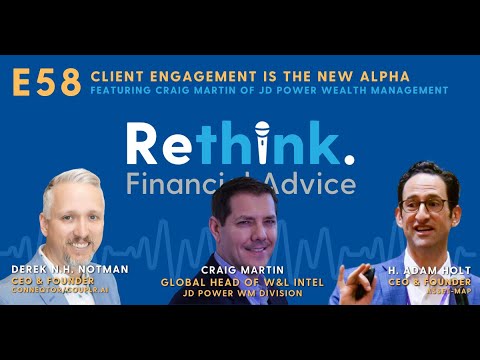
Watch and Listen
Episode Summary
J.D. Power's Craig Martin joins Adam Holt and Derek Notman to unpack whether advisors' real competitive edge comes from data, technology, and branding — or simply from improving the client engagement experience. Drawing on J.D. Power's research, Martin walks through how client preferences for digital and human service are evolving and what that means for demonstrating value. The conversation offers practical, data-backed ideas for advisors looking to strengthen client relationships.
What This Episode Covers
- Why client engagement may be the new source of alpha
- J.D. Power research on client service preferences
- Balancing digital tools with human interaction
- Demonstrating advisor value to clients
- Data-driven approaches to strengthening relationships
Full Transcript
Full timestamped transcript.
[00:00:30] Derek Notman: adam, do you use data to support your investments.
[00:00:37] Adam Holt: You mean my investment recommendations to clients?
[00:00:40] Derek Notman: Yes,
it could be something else. It could be what about investments in your practice? Do you use data?
[00:00:47] Adam Holt: I definitely use data to make better, more informed investment recommendations for both buy and sell side strategy. But I don't know if I use data for your second question. What do you mean?
[00:01:01] Derek Notman: Well, most people listening to this podcast, you're right. We do use historical performance. We read a prospectus. We look at , different data sheets provided by a vendor. , star ratings, the list goes on when we're trying to make a recommendation on a product investment, whatever. So shouldn't we be doing the same type of thing when we are trying to build, scale, grow our practices?
I tell you, I didn't. When I started, I didn't have any data like, I got to make so many dials a week to get so many people in. That's about all the data I knew. So I got to get these conversion ratios here. We have so much more data available to us these days. Shouldn't we be using that data to help decide how we want to build and grow our practice?
[00:01:52] Adam Holt: Well, it's a really interesting question because I think so many have built our practices based upon what I think we personally wanted to experience. If we were a customer of ourselves, for those of us that have gone independent or branded ourselves, we, we certainly have an opinion about what a good. And valued customer experience of advice delivery would look like, and we just designed it and built it. It's funny how similar it is to each other. Ironically, it's a very similar advice journey, uh, and therefore business practice or value proposition. But it's an interesting question around data. I'm wondering how we can frame this for everybody.
[00:02:30] Derek Notman: Well, what's the term that all advisors or most advisors know? Alpha.
[00:02:35] Adam Holt: Hmm.
[00:02:36] Derek Notman: We, we talk about, alpha beta. We talk about how to add that to an investment portfolio. Well, how do you add alpha to your practice, to a client experience? That might make sense. You know, what is the future of advice look like and how do we capitalize on that?
I think it's really important to consider as well. And then what is the role of technology in all this?
[00:02:58] Adam Holt: Very, very true. it's a great segue into our guest today because the topics of our intentional practice development, and also using the principles that we all know from an investment strategy. Is to use terms that we already understand. And what's interesting about it. We all picked up an article that was written in Barron's by Craig Martin, who wrote why extreme client engagement is the new alpha came out in August of 2023. And what really caught our eyes here and why we reached out to Craig to find out what is he talking about, we discovered some enormous amount of data. So what, this is gonna be really fun because we're going to share with you today, a bunch of the data that he has on practice management, which should indicate to you. Why you need to be thoughtful of the investments you're making in the client experience. Now, if you're not familiar with Craig, Craig is currently the executive managing director, global head of wealth and lending intelligence at JD power,
their
wealth
[00:03:56] Derek Notman: cool is that? Like, I thought they did
cars.
[00:03:59] Adam Holt: That's what I thought they did, right? Everybody's got these great ratings on cars. I want one of those circle plaques that I can
[00:04:04] Derek Notman: Oh, we got to get them to get us one of those.
[00:04:06] Adam Holt: Yeah. Can you just get us one? You don't, do you have to do anything for that?
[00:04:09] Derek Notman: I don't know. We'll figure that out later.
[00:04:11] Adam Holt: a car. Well, all joking aside, Greg has actually been at JD for 11 and a half years doing research in this space.
And there's an interesting insight that we got into it because for the last 20 years, JD Power has been doing research on the retail investor segment. And this is really different than what data we typically see, which is always about from the advisor experience, right? Advisors do this, advisors do that.
Manage your practice. Use a CRM. Use this tech bundle. What about the investor experience who's working with a financial advisor? So this was really interesting. And I hope you guys listen to what he has to say, because there's some great insights here. And of course, we'll do our traditional wrap up of what you can do in your practice today.
You ready to hear from Craig?
[00:04:55] Derek Notman: Let's do it. I want to hear what this guy has to say.
[00:04:59] Derek Notman Tank: Craig. Thanks again for being on the podcast. We really appreciate it. What is your unique perspective of the financial advice, financial services, wealth management, , market?
[00:05:09] Craig Martin: Yeah. We did a piece recently and we talked about extreme client engagement as being the new alpha. And, I think that this idea of traditionally, , financial advisors really focused on financial performance. And if you think about the traditional definition of alpha, it's, it's differentiation from a benchmark, , and beating a benchmark.
And what we're seeing is more and more again, what a financial advisor do for their client is really evolving. It's not just about picking stocks, it's not about constructing a portfolio. So, you've got to have this evolution that that next level of differentiation in the marketplace is going to come from client experience and how you engage in that kind of a broad term.
But, the challenge right now, I think, underneath that is, the old model is getting commoditized. It's not that it's bad service, but it again, there's a lack of differentiation. And that's kind of the whole point was as we look at, , the market performance tracks as goes up, goes down.
Generally, that drives customer satisfaction. So if I look at my portfolio and I look at my holdings and they're going up and I have more money, I'm happier, but if I'm going down, I'm less happy and then I start to look at you as my advisor and go, Hey, what's wrong with you? What'd you do wrong? And so this, the decoupling of that, or how do you control for that is really that critical differentiation in the future for the market.
[00:06:31] Derek Notman Tank: I find that fascinating and without getting into the weeds too much, Craig, , how many people did you survey, I, you said, extreme client engagement is the new alpha. I think that, I mean, that's a mic drop in itself, but can you allude a little bit at all to like the sample size of what you guys did to back this up?
Cause I, it sounds really compelling.
[00:06:53] Craig Martin: Yeah, so we, in a given year, , we are going to talk to, we, we start off at the front line. I kind of described, we have this broader kind of wealth platform and we break apart those with an advisor or say they work with an advisor and those that don't, uh, each year we're collecting somewhere in the range of 4, responses from people who have an advisor.
, and now we're we've actually moved into a continuous fielding. So, uh, in aggregate, we're talking probably 20, 000 folks. Now it just for the last couple of years that we've talked to that where we've done this analysis from 21 to 20, but now 24 were are partway into this year's building. , yeah, so about 20, 000 people that we're talking to who have advisors, and that's kind of coming out of that research.
[00:07:38] Derek Notman Tank: Amazing. Thanks for sharing that. I appreciate that. I
[00:07:41] Adam Holt Tank: you know, given the fact that you've talked to so many advisors and institutions, what do you think the missing opportunity is that they're just not addressing?
[00:07:49] Craig Martin: Yeah, I think The, the missing opportunity, what they're not addressing is this kind of evolving advisor situation and relationship situation. I think that the challenge is people are used to delivering what they know and they're incentivized to deliver that core piece of the puzzle. I mean, you gotta make money.
I mean, business is there. And part of that is, is how we're . Engage in the client. But I think the problem is, increasingly consumers starting to question, what am I getting out of this? And especially in down markets, , I use an example of my father. He recently, after the last kind of downturn was talking to me about his advisor and he said, no, he's okay.
He's a nice guy. You know, we met once a year and he tells me that portfolio. But during that conversation, he told me he's going to have to charge me more money. Cause we weren't paying enough and my dad's going, so let me get this straight. My portfolio went down and I lost, 20 percent of my net worth.
And now you want to charge me more money and I just paid you all this money for this past year to do badly. explain to me why I should continue to have this relationship. And, you know, frankly, my dad's probably not going to change. But when my dad tells me this, that changes my behavior in the future.
So what, what's going to happen when, , eventually there is that transfer of assets, when I become that next level potential customer. I'm going to reconsider what's the value and that's being able to demonstrate and clearly communicate the value is a challenge. I think for advisors, when are you providing your customer?
And I think we are seeing this more and more, and I won't go into all the different variations on it, but you guys have Spoken about a lot, which is you got a regulatory environment. You have fee models. You've got the role of technology and how asset managers distribute funds and how they charge and all these things that come into play that really the customer doesn't understand.
And they don't necessarily want to understand, but at some point you have to be able to explain something to the customer, what's the value exchange. And I think that's the real core challenges. What is your value to the customer? What true services are you providing them? And then how do you deliver on that?
Because I think that's the both. What is the promise? I mean, our, our studies at the heart of perception studies. And what we're finding is a lot of customers don't perceive. The value there. They're not getting these kind of critical outcomes in their minds that are really important because if you're lacking in that, that's where the failure really comes in.
[00:10:19] Derek Notman Tank: mean, there's a number of, , missed opportunities or challenges that I think are headwinds for advisors, clearly from what you just said. So for advisors or, or even, a larger organization listening right now, what would be one or two things you could say, Hey, listen, here's something you can do in the next 24 hours or next month to help combat some of this and show your value, you know, or whatever it may be.
[00:10:44] Craig Martin: Yeah, I mean, I think one is take a hard look at how you're communicating with customers. I mean, one of the most vital pieces of the puzzle that I think is missing. It's not that. The advisor is not doing a good job. They're not working hard. They're not trying to deliver value, but their communication with the customer really is challenged.
I looked at kind of a special kind of subset of metrics, uh, kind of in prep of this. There's three that stood out to me. One is, do you have a good understanding of my financial goals and needs? So do they believe that their advisor understands what they want and what they're really trying to get out of it?
Um, when they make recommendations, are they my best interest? And do they explain things in terms I understand? And I think too often advisors, you probably are wrong. Doing things in the best interest. I mean, that's kind of a regulatory requirement, but how do you communicate things in a way that the customer gets so you show I'm listening.
I heard what you're trying to accomplish and here's a solution that meets those needs so that you're really closing that loop because I think too often it's. Here's a product. And my mom was a nurse for years and years and years. And to this day, she talks to me in medical terms. And I'm like, I love you, mom, but I have no idea what you just told me.
And it's just same thing. I think any professional who's an expert wants to demonstrate expertise. And they do that in many ways. They think they're doing it by saying big words and, and communicating things at very advanced levels, the consumer doesn't. No, or care in many cases. So changing your communication style, being aware, even just starting by going, what am I telling them and why am I telling them this?
Not , who's getting the benefit? Is it the consumer or is it for the advisor to feel like they're. Showing value by saying I'm really smart. See the fancy words and technical terms I use.
[00:12:37] Adam Holt Tank: Yeah, , we can relate to that one. It's interesting. My coach for many years used to share with me. I said, the consultative process comes down to proving to the customer that you number one, know me. Okay. No, my client number two, you know, their situation and number three, that you know, their options based upon number one and number two.
And if you can't prove those three, you really actually don't have a consultative experience. , and I think what you're really just saying is you're supporting that idea. We're curious, you know, is there anything else you think that the community really needs to start debating or needs to hear about?
[00:13:14] Craig Martin: So I think the one other thing that is really important for everyone is to understand that technology is your friend. And I know everyone gets technology is important, but one of the things that we've looked at, uh, is a key question around does the advisor. Educate and inform the customer about technology's role and how it can be used as part of the relationship.
And when they do that effectively, that customer is much more likely to be an advocate and loyal. And I think for a while people have feared technology as a replacement. And, and all the data that we see clearly demonstrates that the customer, especially in situations where the stakes are high, they are looking for more advice, not less, more human interaction, but it's got to be the right kind and see to be able to effectively kind of evolve your model so that you can deliver that true value add so they see the value and benefit.
You're going to have to incorporate more technology. And I think that's the key piece is we're seeing a lot of customers aren't getting that education. And again, see the, if I need to see their role, not just as the financial advice piece, but showing them, , how do we work together? And part of that's using technology and the tools and capabilities you have available to you.
[00:14:31] Derek Notman Tank:
[00:14:31] Adam Holt: well, there you have it, Derek. What do you think about what Craig had to say?
[00:14:36] Derek Notman: It's thought provoking, no doubt, but part of it is just awesome validation for what you and I have been already talking about with a lot of our guests over the last year, it's, it's one thing for us to speculate , as we talk about our own experiences, but. , he's backing it all up with data, real data that he and his team and J.
D. Power have been doing for 20 years. What's funny is I keep almost every conversation I have now, whether it's like an advisor or like a FinTech or something like that, I'm like, Hey, do you know that J. D. Power has? And they're like, no, what are you talking about? I'm like, here, you got to go check them out.
[00:15:13] Adam Holt: they have that car research, right? They
[00:15:15] Derek Notman: Yeah. They're like, what do you mean? I don't want to know about cars. Like, no, dude, it's not cars at all.
[00:15:22] Adam Holt: that's right. Not only cars. How about that?
[00:15:24] Derek Notman: Not only cars. Yeah.
[00:15:25] Adam Holt: It's funny you say that because, you know, he did a great job of summarizing the data he has privy to in the wealth management space, right? Over the last 11 years, as he told us that, that he's been working with J. D. power and the wealth management division. I was also surprised at how much data they have, and they've been surveying customers, especially the wire houses for many years.
So they got a lot of stock data and stock broker data, if you will, uh, investment advisor analysis. And there was some interesting stuff that he shared with us personally based upon work that he had done in 2023, that I thought. Probably our community of listeners wanted to hear about, and it goes back to something that you and I and Craig did at Advice Tech Live this year, which talked about advice, experience and the net promoter score, or basically the satisfaction of the kind of advice that you receive. Why don't you share with everybody this idea that kind of touches on our 1, advice?
[00:16:17] Derek Notman: Yeah. This, this has been a , fun idea. That's evolved. Uh, I think it initially started for us with Michael Coors when we had him on, , it was one of the early 50 episodes. And, we've had this, this whole transition from 1. 0 to 2. 0, 3. 0 financial advice. And what's happening is that 1.
0 was, yeah. Your traditional transactional type of relationship and a lot of advisors were doing it, but the satisfaction or net promoter score is pretty low. From the consumer side. And what's interesting is that the, the NPS, the net promoter score almost doubles when an advisor starts using 2. 0 and then almost triples when you get the 3.
0, but I think what we've learned here is that making it from 2. is difficult because now you're going so deep, but the main takeaway is like the client feels better and, and likes what's happening when the advisor is more and more. Comprehensive with the type of advice that they're giving.
[00:17:20] Adam Holt: Very true. Well, it's interesting because , the data that Craig shared with us from that research of the one, two, and 3. 0 as a moving, as you've already said, more towards a comprehensive approach. So can, can we go past 2. 0, which is the typical financial planning as a sales enablement process to true comprehensive holistic advice, which I know terms that get thrown around a lot. The interesting challenge is that the data showed that nine out of 10 people are consumers who have advisors are saying they're getting transactional. Or financial planning only advice or goal based advice. They're not getting comprehensive. Only one out of 10 people are actually claiming to get this high net promoter score style advice. Uh, and, and that's not a surprise, I think, to us because typically only high net worth clients are expecting and are willing to pay for a real deep customer experience. But we are seeing new technology that continues to just infiltrate our financial advice marketplace that is enabling. More financial planning advisors to go deep and holistic and even collaborative with multidisciplinary professionals like tax and legal,
like banking and PNC or insurance and investment. So we are seeing this definite move or interest in using tech to scale out what we call comprehensive or 3. 0 advice. And I think that's really going to be important. What were some of the other things That you heard from , the data he shared with us privately that this community wants to know about.
[00:18:42] Derek Notman: Well, you and I have talked about this for a while. Heck, we were really early to this party when we started going much more virtual and digital a long time ago, man, when I had less gray hair. That's for darn sure.
[00:18:53] Adam Holt: You've always had gray hair. What are you talking about?
[00:18:55] Derek Notman: I was born, I was born with a gray beard.
[00:18:58] Adam Holt: Are you serious? A gray beard.
[00:19:02] Derek Notman: I don't know, man.
[00:19:03] Adam Holt: an old soul.
[00:19:04] Derek Notman: old soul, man. Yeah. I'm 182 right now. Anyways.
[00:19:09] Adam Holt: In dog years.
[00:19:13] Derek Notman: Uh, well, all kidding aside, though, it's really been interesting. That's one of things he shared with us is that as you move from the boomer to the Gen X to the Gen Y Z generations, you're seeing this massive shift of preference from human to digital interactions.
And there's still a lot of human preference when it comes to certain things like. Advice and planning, but the digital experience is augmenting that because now you can get a human experience via a digital medium, which is super interesting. And one of the things I mean, things was like the money we've been talking about this for what, 5, 10 years, these trillions of dollars that are moving from generation to generation, the younger generations, just like the example he gave with his dad, right, they're expecting a different experience.
A different way to interact and, um, it's happening. So we have to listen to that. I mean, his data, we're looking at it right now. Shows us where the puck is headed
[00:20:17] Adam Holt: That's true. And we'll make this data available through some of the show notes that we have in this session. Uh, but one of the things I thought was really kind of interesting is, is how all three generations boomers, X and YZ, if you will, we bundled them or he did for the data did, as you said, prefer human advice for the most. Part,
[00:20:36] Derek Notman: for the most part.
[00:20:38] Adam Holt: right. But there's definitely a mashup here. And you got to think of, well, what's the next generation beyond that going to think about? The trend says that they're going to want more digital than human experience. But what's important is that the human is not completely absence in any of these things, right?
There is a human component. If you get the chance to look at the data, even for the Gen YZ that are still looking for a human to give them guidance, because we're wired for that. And it's like, we're wired for sound. We're wired for human
engagement. Let's jump into some of the points that he made. I thought there was some really interesting, you called it a mic drop early on.
He said extreme client engagement is the new alpha, which is actually how we met him through the article in Barron's that I think started this. What do you think about that statement?
[00:21:18] Derek Notman: I love it. if you were to try to sum up, how does an advisor differentiate themselves when we all have essentially access to the same tech stacks these days. It's engagement. It's extreme client engagement. It's going deep in the conversations with their clients and understanding the meaning behind their money and what they're trying to accomplish.
And showing them that. Showing them that we understand that and that we're going deep and that we're engaging and making it a, a conversation where we're on the same side of the table instead of trying to pitch something. So I, I love that and what's so cool about it is Each advisor will do things a little bit different because we're all different human beings.
So you can lean into this new advisor alpha all day long and never have to worry about the competition.
[00:22:05] Adam Holt: That's interesting. You know, you really can't measure or give a benchmark to advise experience, right? When you think about benchmarking beta and alpha, it's typically around something we all agree around. Now, what would be the beta? What is the marketplace of financial advice? That would be, uh, I did some fact finding. I did some analysis. I gave you a big financial plan. I told you what to buy. You bought it. See you in a year. Crickets.
That would, that's got to be beta.
[00:22:32] Derek Notman: Next,
[00:22:32] Adam Holt: Well, that's beta for a 2. 0 experience, which is, you know, 50 percent of the marketplace is getting that experience, but that's the beta. So really for a customer experience, you don't have to add that much alpha in order to stand out.
And that's the interesting thing here is that I think what you're, you're right. That, that the level of customer experience. From the simple things like when they walk in, I have their drink or beverage available to, I actually thought about the fact that their kids can now get insight into mom and dad's portfolio episodically.
When we want to have a family meeting, like, wow, blow your mind. There's some really interesting, I think, technologies that are coming out and also experiences that advisors can adopt here.
[00:23:13] Derek Notman: I think so. And we can when we leverage tech to do the mundane things that allows our brains to focus more on the human side of what we do. And I'll give you an example. I was just meeting with a client recently for a review, and she was asking about one particular investment account that she inherited from her husband who passed away, recently, unfortunately, and Because I knew them and had gone deep with the conversations, I was able to ask, , what companies was your husband interested in investing in?
Where is that list? Cause he loved researching and all of that kind of stuff. Let's find that and think about it. And you could just see her eyes light up. , Hey, Derek knows me, knows what's important to me. That's advice engagement, right? It's not just, you know, showing you here as you're ready to return for the last six months.
[00:23:59] Adam Holt: That's a great point, right? So I guess the client feels engaged. It feels genuine. It feels authentic. It feels honest. You listened to her and to him from years ago and you're bringing it back to the
table. It just builds relationship currency. And that makes a lot of sense. I love that. You know, we've heard a lot about this commoditization of traditional financial services.
I think it goes hand in hand because
The old investment model of, uh, you know, of adding value through portfolio management, I think is getting, we'll call it diminished perhaps. , it's interesting that he has data that's supporting this. What do you think?
[00:24:34] Derek Notman: It is. It is really interesting. I'm a little not surprised though. You and I are both still advisors and when you have, we talk with clients and , the whole, uh, how much money have you made me ROI rate of return, blah, blah, blah stuff. , isn't as much of a conversation centerpieces, maybe as at once used to be.
It's about what's this money for? How are you feeling around the economy , and your financial situation? Are you doing okay? Is your portfolio invested in a way to help you do the things that you need to do? And we know that clients feel better when the market goes up as you're showing right here, which is a great piece.
But what happens when the markets aren't going up and their rate of return isn't great? How are they feeling? And what are you talking to them about? , well, you should share more about this. You're showing something else between one, two and 3. 0 advice.
What are you looking at here right now?
[00:25:26] Adam Holt: Well, I think the data that he shared with us was interesting because what it showed is a historical trend of the S and P 500. So in your mind's eye, you can probably imagine since 2004 to 2020 or so that the stock market obviously has grown with a couple of blips in there in 2008. And what they did is they overlaid overall satisfaction scores of the advisor experience with the SMP.
And you can see it basically follows it, right? So as the market is up, overall satisfaction is up when the market's down. Can we imagine what happens? Satisfaction is down. In fact, what's interesting is that we've never been at a higher overall satisfaction score than we were in 2020, kind of the high of this market. But what's interesting about it is the data that he shared with Derek and I, which was that comprehensive experiences as defined by the client saying, I receive a comprehensive 3. 0 experience actually had the highest satisfaction scores of all the experiences, even when market performance was down. So what's, what is really endemic there is that a client who feels heard, who feels like they have multidisciplinary holistic experiences where the client's advisors Roles are intertwined as clearly best interest relationship is that even when the performance is down, they have even higher scores and that's a real eye opener because it should be pushing all of us to help our clients understand that we're really with them, even though the markets are down, , and that comes down to communication.
I don't know if there's any other way to say it,
[00:26:56] Derek Notman: You know, you remind me of back of 2008, I remember hearing about this advisor who in the markets were crashing. He was joking about how he just wouldn't return emails or phone calls for six months. Oh my gosh, that's like the opposite. So don't do that. But that's the opposite of what you should be doing.
[00:27:16] Adam Holt: You know what, I guess it really probably worked for a lot of advisors, right? Put the head in the sand and just the markets will come back eventually. And so will the clients, I guess, uh,
[00:27:25] Derek Notman: , dude, if that happens now, I don't think it's going to be the same thing. I think the clients are going to be like, wait a minute, you weren't around when things really sucked. You don't really ever listen to me. Why am I giving you my business?
[00:27:37] Adam Holt: but doesn't, that's what happens, right? Didn't he say that about his dad, right? His dad is questioning why I'm paying 1 percent when you're down 20%. Right. And you're saying I got to pay more now to keep up. What do you, cause you want to raise planning fees. So we, we take it for granted that we're so busy and we're doing all this work.
And we had this great value and he brought it up in two different ways. He said that advisors tend to, I think, their own porridge, like. Oh, I got the greatest stuff. I'm doing all this great work for you. Let me explain it and complicate it. And I'm adding all this value. And then we were surprised when the client, number one, didn't understand what the heck we talked about. And number two is focused on the fact that all I hear is that I paid you 1 percent on my million. That means I'm paying you 10 grand and you underperformed. Oh, and by the way, I'm still don't understand the jargon. Cause yeah, you think you're so smart. But I've lost money and I don't understand why you don't feel that pain with me. And when we take it down to the true consumerism, the clients don't know how to value what you're valuing in your head. And when they just see the loss, you have to communicate.
[00:28:41] Derek Notman: you really do. And I, I think this is where as, as long as kind of combines two points that he made in that the role of technology, the way I look at it and, I'm really having a lot of fun as I'm digging into this , with AI for, for Couplr.ai in that we can use AI for so many mundane tasks and things that need to get done behind the scenes.
And when we do that. And we explained to the customer, okay, we're using these different technology solutions to do X, Y, and Z, which means I can get to know you better and help you do the things we need to do and help understand you and help walk you through things. Now we're meeting these changing consumer expectations and dynamics that have definitely evolved , as things have changed in the last 10, 15 years.
[00:29:23] Adam Holt: No question about it. Well, let's talk about what advisors can actually do, right? Because now we've got to turn this into real actions here. What's, what's the first thing you think that advisors Can take action on.
[00:29:34] Derek Notman: Take a step back. What is the true value? Of what you do, and how you do it and then how are you delivering on that to your clients, because I think when we don't know how to articulate our value slash services, as he puts it, this is where failure happens. a good barometer is , hey, is the next generation want to work with me.
So my client introduced me to her kids. Or are they kind of keeping that all closed off because, you know, they don't really trust me completely. Right.
[00:30:08] Adam Holt: that's a good test. So you're saying let's, let's just do a proverbial financial plan here and literally knock you off the client. Now, are those clients, kids staying with me
[00:30:21] Derek Notman: Think about it,
[00:30:21] Adam Holt: now? Just let's, let's just go run through the fire drill right now.
Are those kids saying with you, I guarantee you a very large percentage are not staying with you
[00:30:32] Derek Notman: I would tend to agree. I mean, look at the data from Craig. if you're doing this analysis on your, yourself, what's your tech stack look like? Do the kids want to look at your metal filing cabinets as you get your yellow pad out?
[00:30:46] Adam Holt: on your mahogany desk.
[00:30:47] Derek Notman: Yeah, right. I don't know. I was that guy. All right. I used to do that. So I get it. Um, I think
[00:30:55] Adam Holt: know if I want to work with grandpa's advisor. Well, I mean, I'm not going to be able to see anything online. I don't even know, I got no aggregation. I got no, right. So it's a really interesting, it's not just about tech though. You're right. I mean, it's about customer experience and you have to prove as Craig said, that you're doing the communication.
One of the things I really liked in this kind of second takeaway and actually you take is show clients. That you listened, he said that show clients. Of course, I'm thinking to myself, yeah, that's what we do. That's what an asset map is. It's I'm showing you, here's your stuff. I'll give it back to you in a digestible form. But if you don't do that, you can't confirm their, their proof need to know that you are on their team because you know, what. There's concerns and their issues are, , and what they're dealing with. So that's, that's an important aspect. , I think every advisor is listening right now needs to prove to the client that they listened to the client and they have now given back their life to them in some consumable form.
Big, big
[00:31:52] Derek Notman: you know, I would almost call it like advisor context. Like here's this beautiful asset map. We know where everything is. We know why it's there. But now is that the advisor, you know, I'm looking at this retirement account or this life insurance policy. And I can go deeper and be like, we know this is here to do X for little Johnny when he turns 18.
Because, and we know this is important to you because of this, so now that, that, that document, whatever you use becomes more of a living document almost because you've added that human context and value that they need. Cause if they don't get that from you, they don't feel like you're listening to them.
I mean, how are you really showing them?
[00:32:30] Adam Holt: I think you just really touched on something really important. We need to add. A statement of intentionality around every single financial instrument that's in that financial closet. We need to know and be clear why this exists and nothing stops us from actually adding those notes. But I think that's really clear. I don't think clients always understand , what the intention is and why it deserves to be on our balance
[00:32:53] Derek Notman: One of the things I always love to do to your point here, Adam, with my financial plans is I would have, I would add two separate pages. I customized each plan. One was a hope streams and goals page. Here are the things I heard you tell me that are extremely important. Bullet point, very specific next page.
Here are the action steps and the things we are going to help you do to achieve the things on the page before we really connect those dots for them. Just it worked. It worked. People like, Oh, Sweet, this guy isn't talking about some crazy lingo. Like, I understand what's actually happening here now. I'm buying life insurance for this goal over here.
I'm saving money up every month for this goal over here, right? Connected.
[00:33:33] Adam Holt: love it. That's great. What else did you take away? What are, what can advisors put in action right away?
[00:33:38] Derek Notman: so there's lots of great tech engagement solutions out there. We can use a long list to really do all the things we're talking about. But what I really liked is that whether you have tech or you're bringing on new tech, or you're going to change tech, tell your clients, why tell your clients, the role of that technology in your client advisor relationship, Mr.
And Mrs. Smith, I am using asset map because of this. Right? So it really helped them understand that. So they're like, Oh, so Derek is not only an advisor that understands us and what we need and helping us do all this stuff, but he's using these really cool tech solutions to help articulate and solve and get jobs done.
Now I understand how all this fits. So when I get Derek, I get all of this stuff. That's cool.
[00:34:25] Adam Holt: Wow. You know what I just realized when you said that used to do that in the early days when a new person of our relationship would walk into our office, we would walk them around the office and we would introduce them to the people
who they don't even know. There's no reason why they need to meet our, our underwriter and are this.
But there was a very strategic reason. We did it. Number one, we humanize the org, right. By showing them that it's not just me in a little cubby hole. And number two, well, maybe it might've been, but number two. It also showed our depth of capability and investment in their experience for when they had those needs, we had the team.
What stops us today from literally showing an org chart of the technology that we're using to deliver on a client experience, I guarantee you, it would be like 15 to 20 names of softwares and people connected to it to actually deliver it at scale.
[00:35:23] Derek Notman: Make it part of your onboarding process,
[00:35:25] Adam Holt: Wow. This looks complicated and thoughtful. Yeah.
Look at what this people are investing in all this stuff.
I don't have to buy and they're buying institutional grade software and technology and connecting it all together. That's an interesting, value add, because one of the things we're all struggling here is how do you increase that overall advisor experience to get off beta one, right? The banal block experience. Let me show you what I'm investing in. That is all just, you know, it's behind the scenes and I'm paying for it. That's why I need to charge you. Cause I got to pay for this huge tech stack.
[00:35:57] Derek Notman: Yeah. This stuff doesn't come for free, right? Show
[00:36:00] Adam Holt: right. But other than that, what are the client things that they're paying for? What, you know, like an asset allocation and an index fund, like,
[00:36:07] Derek Notman: them the stuff you're doing behind the scenes. Show them how it adds value.
[00:36:11] Adam Holt: Love it.
[00:36:12] Derek Notman: There you go. That's a great, I think we almost need to leave it like that's, that's it. If you're listening, go do that right now.
[00:36:18] Adam Holt: That's awesome. Well, I think with that, we have to wrap up. I mean, first of all, thank you, Craig, and all the work you're doing and your team there at JD power. We know that some really. Exciting because we found a new source of data that's got a lot of competence on it.
So we, we really appreciate this. And of course we want to remind everybody, whatever you just heard right now, figure out how you're going to put it in motion in your own practice or tell a friend by sharing this episode with them and hopefully giving them value. What else do our friends need to do, Derek?
[00:36:44] Derek Notman: Well, if they're listening to this on their phone, they need to text this episode to one of their friends right now on their phone, get to it. Uh, subscribe to the podcast, obviously follow us on LinkedIn. That's where we talk about all sorts of great stuff, including dad jokes. And of course, we'll always take the nice kind review.
If you want to give us one, um, and submit questions, we love getting feedback and questions from our advisor audience. So if there's something you want us to talk about, tell us we're here.
[00:37:12] Adam Holt: Absolutely. We look forward to having a conversation with you. And of course, please remember to contribute. Find a ways to actually ask us questions. We appreciate that. Derek, my friend, always good to see you.
[00:37:22] Derek Notman: Good senior brother till next time. Let's go
The content has been made available to you by Asset-Map for informational and educational purposes only.