
Ep57 - Rethink: The Age of Digital Intimacy – Featuring Jason Pereira
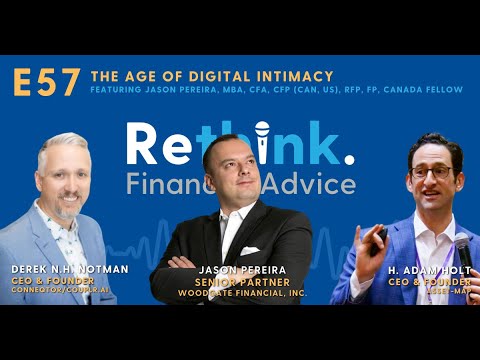
Watch and Listen
Episode Summary
Financial planner Jason Pereira joins Adam Holt and Derek Notman to explore what it means to build a genuinely intimate, trusted client relationship through digital channels. The conversation examines the shift from expertise-led advice toward meeting clients on their own terms with transparent, efficient digital experiences, along with the role artificial intelligence and documented workflows play in building that trust. Pereira also touches on diversification strategies advisors can use to manage business and conflict-of-interest risk as the profession keeps evolving.
What This Episode Covers
- What "digital intimacy" means for client relationships
- Shifting from expertise-led to client-led advice experiences
- Using AI and documented workflows to build trust
- Diversifying advisor revenue to manage risk
- Where collaboration fits into the future of advice
Full Transcript
Full timestamped transcript.
[00:00:29] Adam Holt: Derek, what is your digital intimacy strategy?
[00:00:34] Derek Notman: Ooh, what kind of question is that? That's a little personal, isn't it?
[00:00:40] Adam Holt: Well, what are you wearing digitally?
[00:00:44] Derek Notman: Dude, my camera's off. I'm sorry.
[00:00:47] Adam Holt: This is a podcast. You can wear whatever you want.
[00:00:50] Derek Notman: That's a really interesting question. So I mean, what is intimacy? It's connecting with other people on a more intimate level, a better human connection, . But we have this whole thing called the digital world. So I guess , if I think about it, my digital intimacy strategy is.
How am I conveying my human element, myself, over a digital medium to connect with people better?
[00:01:17] Adam Holt: tHat's a really good explanation. I tend to think of the word intimacy as excitement, but also vulnerability. And
[00:01:28] Derek Notman: Yes.
[00:01:29] Adam Holt: And privacy, right?
[00:01:32] Derek Notman: Yes.
[00:01:32] Adam Holt: but also connection and, um, maybe also unique, right? Not public, this is an interesting word and.
[00:01:43] Derek Notman: it fits so well the more you say all those different words that you're better articulating it.
[00:01:49] Adam Holt: Well, I'm just thinking out loud about this word that Jason Pereira dropped in an interview that we did with him and it really struck home because we hear these conversations around human empathy, digital experiences, and he mashes this up and says digital intimacy and it does, in a way, Bring together this concepts of financial advice tends to be intimate.
Right.
[00:02:19] Derek Notman: Oh, no question. Uh, you know, I, I've joked before, advisors tend to know more about their client's situation than the, the priest, the doctor, and the attorney, right? You know,
[00:02:29] Adam Holt: Even the spouse,
[00:02:30] Derek Notman: Yeah. And the spouse even times. So true, man. Sometimes they become the spouse.
[00:02:35] Adam Holt: spouse, that is true. My, my financial partner, my financial spouse, that is true. I think it's interesting because when we had this conversation with Jason and many of you know, Jason, we joke that he's the Kitsis of Canada, which I don't know if he likes that one or not, but.
[00:02:53] Derek Notman: Or is Kitsis the Pereira of the States?
[00:02:56] Adam Holt: there you have it.
You got to play both sides. I love that. , if you don't know, Jason, he's actually an award winning financial planner, portfolio manager, entrepreneur, lecturer, fintech expert. And of course he's a podcaster too. And besides all of his degrees and all of his thousands of accreditations, right?
He's also got the alphabet soup behind him. He's produced hundreds of articles and interviews, and he's a financial advisor, very much like us. , at a company called Woodgate, uh, in Canada and also advises US clients and also advisors up there. So he's really well known and an industry advocate.
And we actually had Jason, if you remember on our podcast, at the Weldstack
and he literally in his two and a half minutes, he probably did six minutes of content. So when you listen to Jason, notice how he frames his ideas around advice delivery today. And I think it's going to really interesting. Anything else you want to add, Derek?
[00:03:50] Derek Notman: No, I think let's jump into it. He is, He's really well spoken, really insightful. And, let's hear what he has to say.
[00:03:57] Derek Notman Tank: /All right, cool. Jason, thanks a ton for joining us today. We really appreciate it. What is your unique perspective on what we call the financial advice market?
[00:04:07] Jason P: , my perspective, interesting term. I think the way I look at it is that I got in either world right now.
I spend a lot of time. I'm a practicing financial planner, but I also spend a lot of time in the advisor technology space. So to me, it's always about how do I bridge the gap and make these tools effective within my practice. And I think, you know, everybody uses technology because of necessity, but I think the, the big miss in all of this in the application of technology across the board has largely been that we've been solving our own administrative problems.
We have not been solving for better digital experience and engagement with clients to basically make their experience, not just more pretty and interesting, but compelling and bring them into the conversation and use technologies as a means of getting them deeper engaged with us, as opposed to just showing them, you know, here's a, here's a PDF on a screen.
Like, that's, that's unfortunately what was happening. We've gone from the world of paper where we sat down next to him with paper to PDFs on screens. It doesn't make sense.
[00:05:02] Adam Holt Tank: Yeah, no, we certainly can relate to that. And there's been an interesting reticence to evolve to the consumer mindset, isn't it? I mean, it's interesting how advisors really tend to think of this is what financial planning delivery should be.
Let me deliver it to you. Not what the customer prefers or what they want to side of catch up with that. They don't even ask. What do you think about that?
[00:05:23] Jason P: I think here's the thing. All the world is theater, right? Like, to some degree, it is right. The most think about the most memorable experiences you've had in your life.
They've typically been something that's been thought out in terms of how you would engage with that environment. Right now, didn't make it insincere. And I think the problem is, is that everybody's in the mindset. You know, they're coming to me for this expertise. So I'm going to dump expertise on them, right?
This is where the 200 page financial plan comes from. I'm going to hit you over the head with how smart I am. This is where the use of terms like alpha and beta come in. I'm going to hit you with how much I understand. Look, the true expert doesn't need make things complicated. There's an old Mark Twain saying I love.
I wanted to write you a short letter, but didn't have the time. So I wrote you a long one. Effective communication means that you have to think through how to be effective with as little use of resources as possible because here's the thing. People don't want to be overwhelmed.
They want to be talked to on their level. So I think that that and all the negative things that we are, the less effective things we were doing offline have translated into the online space, right? And the reality is, is that a lot of technology we're using is not used, not built to be put in front of clients.
More and more, a lot of it is, I mean, Adam, to your credit asset map , was one of the first. It's like, Hey, this is a great tool to use within meetings for engagement and the thing. And while we use those tools in our own, we don't stop and necessarily think about, Hey, okay, this is great. I'm having a great consumer level experience.
Myself would be really good. I can actually use this as a, in a dynamic way to actually engage in my, my clients. And I'll give you one like awesome example. There's this software.
That I used in Canada was originally
developed for lawyers
to come up with wills and estate plans. And it's a visual drag and drop
tool that basically helps me build up the estate plan by moving assets and people around all this other stuff.
And I found
this thing. I'm like, okay, that's it. You need an advisor version of this. I need to be the first customer on it. Right. And sure enough, basically I started implementing
it without failure. It has a 100
percent rate of clients saying at some point, Oh my God, this is so cool. Or, wow, this is really neat.
And I want you to think about that. I am being complimented about an
experience talking about their death. We're talking about what happens when they die and they are complimenting and engaged by the experience. So if I can make that compelling, I can make anything compelling. So the reality is what we should be doing is saying to ourselves, what are the steps?
What are the reasons for meeting with clients, right? How do I use the tools that I currently have, or maybe some of what's out there to not only just. Basically explain what's going on in very
simple terms that short letter instead of a long letter, not the 200 page plan, but the one page plan. How do I do that effectively without overwhelming them, but also as a means of having an interactive conversation to arrive at the solutions with them.
And build that relationship. And that's what's been missing. Now, luckily, there are a lot of vendors in the space now that are very much, you know, we've taken care of the needs, right? We've taken care of, you know, the base needs there's lots of tools out there for every
basic need you have, but there's now more and more tools about
how do we create deeper engagement?
And I think it's, it definitely behooves a lot of advisors to start thinking through their practice about how they can basically utilize those tools in a live setting to basically to, to just have better outcomes. I
[00:08:31] Derek Notman Tank: mean, that's
digital engagement 2. 0.
I mean, to me, it's just basically not just worrying about using technology to make our lives easier. It's using technology to make our relationships better. Right. And that is, that is something that's been missing, right? And it's not about questionnaires. It's about every engagement we have that when you stop and think about it, right?
Like major areas, financial planning, investment, insurance, tax, estate planning. If you look at the entire Kitsis map that exists, I can guarantee you can find at least one software out there where if you actually open it up in front of the client, you can have a compelling experience. You can have a conversation where you guide them through and they can even lead some of it.
So an example of one of the things I use with that, one of the technologies I use, my portfolio management and reporting system, which is actually very nice, very clean and very dynamic. And I will bring it up when I don't do statements anymore. During meetings, I bring it up during a meeting and I open it up and I show them what's happened in their portfolio.
I take them through about four or five , different charts. And then I turn around and you know what, if at any point they need to drive the conversation somewhere, Jason, what's in this account or did I fund this or whatever, click, click,
right?
There is no, I'll get back to you later, or, oh, let me look that up or call my assistant.
It's instant, instant, instant, instant engagement. Instant engagement, right? And this is the kind of experience that they want from a consumer standpoint, when they are out there in the world, consuming anything else, right?
Meanwhile, too often, I mean, just
like, just like advisor websites, look at how badly most advisors websites work.
And my name's an overhaul because I'll say this. My thinking has evolved since I did this. Most advisor websites are designed , to get clients or prospects to
just be interested just enough. So that they reach out to you for
more information. Okay. You don't have full details of , your service offering examples of your service offering, your fee schedules, all the performance traffic is all this stuff that the clients are going to ask about.
They're going to ask about this, but it's, you know, it's never on the advisor website in most cases, because we're just trying to get the phone call. Let me ask you something. What other purchase decision do you make in your life? That you basically have to make a phone call to find out the information you need more often than not, every other business, like think about Amazon, every purchase decision I make is basically made without talking to someone in most cases, or if I had to talk to someone who already made the decision that I want to buy that thing yet, we want to play this game of keep away with information.
Right? So this is in a lot of ways par for the course. We're not used to having these big open conversations in a digital realm, right? I mean, thank God we have zoom and all these chat protocols now to do things virtually, but we're also under utilizing them, right? So a lot of people like, oh, this is me using technology to relate to my clients.
Well, it is. But if I'm bringing up the PDF. Or if I'm just jabbering on about a topic when I can bring up a tool to visually illustrate this and we know that people are far more compelled and engaged with visual dynamic illustrations and presentations. You know, we could bring up reports, we could bring up slide decks, that's kind of an old school way of doing things.
The new school way they were doing things is that experience is baked into the software itself.
It almost sounds like you're saying that some action steps advisors could be thinking or should be thinking about is 1. What's your digital engagement experience?
, for a consumer,
are you able to provide that instant engagement? Can they see in real time? What you're both talking about, whether it's in person or zoom or whatever, but then also give away your secret sauce. Be transparent,
[00:12:02] Jason P: but, but what, what secret sauce is there in this business reality, like there is nothing that can't be copied. Right. You know, I think back to advisors back when I was a young advisor who would go up in conferences and give away all their best, strategies.
And people would ask, like, why are you doing this? It goes simple, you know, maybe 5 percent of you or listen, if all you listen, I couldn't do it. But 5 percent of you will listen, right? I'm making those guys better. The rest of you, you know, keep doing what you're doing.
Knock yourself out.
[00:12:23] Adam Holt Tank: It's true. And 1 percent will actually call you up and say, Hey, can we do this together? Because I don't want to do my first to get on my own, right? If you have more confidence and experiences, I now know, and , it's actually exposure for you to share these ideas
[00:12:35] Jason P: and I'll go one step further to say, it's not just looking at it from a consumer standpoint, but imagine that consumer is your grandmother.
Right. It should be something that gets across the point simply and effectively, but allows you to, at the same time, and where a lot of these softwares are very good at now, progressive disclosure, right? What's in front of you should be simple, you need to know more information. Click. I should be able to drill down.
I should be able to expand and I should be able to go down the rabbit hole in whatever direction the client wants to go, not what direction I want to go, whatever direction the client wants to go along the way. Right? So, so think of it again, the tip of the iceberg is enough ?For most of these people.
Some of them want to see below the waterline, how far below the waterline? Let them drive that part of the engagement.
[00:13:16] Adam Holt Tank: Well, Derek brought up some really good questions about actions. What actions do you think that advisors need to start rethinking
[00:13:21] Jason P: about? Well, first and foremost, you can't digitize or modernize a process that doesn't exist, right?
So the question becomes is 'what is your process?' That needs to be written down and mapped out? Okay. So do you have one meeting where you go over everything? Frankly, I hate that because it's just too much to take in. You know, in my own practice, we break up the financial planning cycle into separate meetings for each topic so that we can just focus on one thing.
And the second piece is we know attention spans drop off like a rock after 10 minutes and usually gone by 20. So , can you effectively get through what you need to do in 10 to 20 minutes, right? Then it becomes , what is it you're trying to get across and what is the simplest yet still value demonstrating version of what it is you're trying to do.
Or what else are you trying to get across? Sometimes it's just giving them information. Like this is what your portfolio has done in terms of return. Other times it's a collaborative process, like working on some of the plans, planning softwares now allow you to collaborate on planning initiatives or whatever it might be.
Others like, like the estate planning one. So where are the points where maybe instead of coming to them with a completed, with a completed process, maybe I finalize it in front of them because their input matters.
And that makes for a, a far more involved in engaged conversation, but also one where they are brought into the process, right? And they feel that engagement.
So, you know, back to your point on advice, what are your steps? What is it you're trying to get across? What are your tools that you're currently using?
Do they actually help you in this process? Right? And it's okay. You don't have to have every step of your process fully digitally engaged. It'd be nice. Maybe there's not a software that kind of meets your needs for that. Great. Putting together a PowerPoint presentation, do something to add a visual to it.
But. If there's something there that isn't doing it, take a look at the marketplace, man, you guys are spoiled in the States. Like the amount of tech options you have is nuts compared to everywhere else in the world.
[00:15:05] Adam Holt Tank: It's a great point. I did. It's funny
because you mentioned this.
I've been really on this, this stick of talking about participation over presentation and the relationship or the ratio of those two things has to dynamically change. We have been in a presentation mode for too long and now people want to participate in and working on building the cake together and telling you, Oh, you know what, by the way, I'm allergic to nuts.
Don't put, Oh, there you go. Now I know this cake. Can be edible to you and your kids. And that's an important aspect of really just being part of the process that the retirement planning, the survivorship or protection planning, estate planning, et cetera, should have a participatory element.
[00:15:41] Jason P: And I'll tell you, one of the things that's going to push us towards this is the trend in other technologies around artificial intelligence, right?
So, you know, there's, it's still early in the game with artificial intelligence. There's not a bunch of players I can point to and say, Hey, this is the thing that's going to revolutionize financial advice and whatnot, but , there's. AI being applied almost everywhere.
In fact, most vendors are going to have some form of light version of AI within the next, , two years for sure. But there will be technologies that just basically make things faster and more effective right now. Nothing's going to save you 20 hours a week in terms of your time right now.
But the reality is, is that all this stuff will compound and save you a bunch of time,
which will lead to an abundance of time, which is going to happen, what's going to happen with that? One of a couple of things. A people are going to consume it and just not work as much. B they're going to try to expand their client books, which if you do that, you still have the limitation of how many hours there are in a year and how much, how many relationships you can keep straight.
So frankly, you do that. Your service office is probably going to drop, not increase despite the extra, the extra hours, or you're going to get deeper. Right and frankly, the advent of our artificial intelligence can make all the heavy lifting hard work that we did on the technical side, not push button, but pretty close to it in a lot of cases.
Right? So the future of this industry is 1 that moves more towards the human side, which is basically around. The behavioral finance, behavioral therapy, the life coaching, the, the helping them self actualize the best version of their lives. That's the future of this. So, you know, we've been talking, we've been talking about this a long time.
A lot of the, the BFI experts have been talking about this for a long time. Well, the tech has caught up to the point where, guess what? The differentiator for people is going to be how deeply intimate you are with your clients and how much you truly understand them, it already is, but now we're going to be able to take that to 11 and frankly.
The technology, the digital engagement piece is one of those tools that you use to build that level of , digital intimacy in this case.
[00:17:26] Derek Notman: You know, Adam, that was really fascinating to hear what Jason had to say. And I love how we ended their digital intimacy. It's a great term,
[00:17:37] Adam Holt: It really is,
[00:17:38] Derek Notman: what we're, we're moving towards. And it's, I don't know, you could have a lot of fun with that, but what were some of your main takeaways? How did that all hit you?
[00:17:48] Adam Holt: you know, it's interesting because Jason is so highly aligned with the space that you and I spend our days in, especially as fintech CEOs and recovering advisors and trying to build the next generation of tech before it's here, right? Try to be empathetic as to what's going to happen in the future and what our consumers and advisors are really going to deal with.
Thank you. Takes a lot of forecasting, but I think he's right, right? You know, the early comments that he made about digitization that firms have said, okay, let me take my paper process and make it now digital, which basically means fillable PDF is, is just, it's so short of where we need to be. And, he's clearly evolved in his thinking and he's on stages as you and I know, beating the drum about engagement, uh, and next generation of advice.
So I, it's. It's pretty impressive how he codifies it all together,
[00:18:42] Derek Notman: Yeah, it's, you know, it's funny. , Wayne Gretzky was always about, skate to where the puck is headed and I don't know if Gretzky and, , Pereira are in this, we're from the same province, but they're both Canadians. So I, well, we'll give them, we'll give them some love there, but it
[00:18:57] Adam Holt: right? In the same hemisphere.
[00:19:01] Derek Notman: the things though, that really resonated with me just now is that. You, you can't digitize or modernize a process that isn't documented. And this is so true. I Was guilty of this for years myself as a brick and mortar advisor, cutting my teeth at insurance broker dealer. I didn't have really well defined processes other than like, here's my cold calling script and let's go.
And that was it. And I, so I think that's true is that a lot of us fly by the seat of our pants initially, because we're just drinking from a fire hose. So maybe taking a step back and actually writing some things down could be really, really helpful as you're starting to approach those whole digital intimacy thing that he's talking about with your practice, your clients, and so forth.
[00:19:48] Adam Holt: You know, you just made me think of something, you know, I have a doctor who I've had a primary care physician. I've had him for, let's say 20 years. He's probably 67, almost pushing 70 concierge practice. I went to one a bunch of years ago because I figured, I'm willing to pay a little bit more to get immediate demand.
I see him once a year, like any. Any physician, you walk into his office and his office literally looks like it's from the 1980s, right? It has not seen a bit of renovation. And I think it's because people are going because of the relationship and the history and the trust that we have with the doctor, even though we're paying him all this extra money, he's not investing a moment into your experience whatsoever.
And I think a lot of advisors are living off the same laurels, right? They really haven't changed their process in years. People are accepting it. They're willing to pay their bills. You're a critical part in their life, or at least that's how they see you. And so they don't ask for more.
They don't request more and you're like, fine, why do I have to invest in an experience? Because they're happy. They pay their bills and we're doing great. And I think that's about to change the kind of disruption that's happening. Not just that the clients are going to change. And, but remember what Eric McDermott said, right?
We are tending to compete against our industry standard, which is really low in terms of client experience, but that is changing institutional experiences, right? The digital argument when he said something about how you don't know a product today where you have to like, Oh, I want to go buy.
And then I have to call somebody and I have to schedule some time, right? I want to learn about it. I might want to buy it right now without you even talking to me. So I think there's a change in buyer behavior.
[00:21:23] Derek Notman: No question about it. It's a really interesting example about your doctor. But I would agree, I bet you there's a lot of advisors that have , that old, like they've had the conference table there that's been there for 30 years, the same filing cabinets, the experience hasn't changed, which they've got great relationships, but the experience isn't changing.
And to even just go back to our episode with Craig Martin and J. D. Power, you can clearly see that there is a changing shift the tide is changing on what the consumer wants from an experience standpoint, more so than ever before. So we have to be there. Some of the things that I found interesting for what Jason was saying today, it was that, yeah, they want this digital and engagement experience.
And they want it to be really well thought out. So, so it feels just amazing, but they also don't want to be overwhelmed. Talk to them on their level. And think about what tech you're using. You know, he mentions about how visual tools are so helpful. They really get the client engaged so much more.
And don't show a 400 page financial plan. Show a one page plan, , and then let them drive the conversation. Whether it's portfolio or plan or whatever, like, okay, cool. I see. I've got this IRA. Well, what, what am I invested in? All right, let's drill down a little more. Okay, well, what's that investment?
Let's drill down a little bit more, but let them drive that instead of hitting our clients over the head with these massive reports or really complex jargon filled outputs that they don't actually even want.
[00:22:53] Adam Holt: Oh, that is true. Well, he said that, right? He said that the historical part is we used to have to dump our intelligence or experience on top of their head in the form of 80 page reports. And, and that was how we built our credibility to say, this is so complicated. You need me, right? I know it's complicated.
Let me show you how complicated it is. And , we would show them what the recipe looked like. We were like bringing out the measuring cups and we're, you know, I mean, who wants that? But I was thinking when he was talking about this idea of. Advice engagement, which we've been talking about for some time, you actually called a digital engagement 2.
0. I thought that's a really interesting thing. We could probably fit that into our advisor 0 framework somehow, but I think the real interesting thing for me, and I've been obsessed about it for. Good at over 10 years is this idea of presentation relative to participation and the key to what he was saying.
And the first image I had in my head is when you go to, let's say, a sushi restaurant and you sit at the sushi bar, you get to actually watch them making it right. You're because you're participating in that. They're usually engaging with you. Or maybe even if you haven't done that, the hibachi is another good example, where the chef is exposed and you see the chef cooking, you actually are, you're getting the smells. You're seeing how they prep. You're seeing their cleanliness. You're, you're seeing it come together. And then you have this experience in the form of tasting it. And because you've seen it that come together, you, you can participate and say, wait, hold, I see, uh, do me a favor.
Can you hold that sauce? I don't like that sauce. Like you can interject and basically create a customer experience. And I think what's happening is he said this. Can we put the technology actually in the front with the client and start building this stuff with the client? And I think that's a really important thing because now clients are seeing the value that you're bringing.
You're guiding them through the maze, not just telling them, Hey, make a left, break it right, like a left, left, right, right, left, left, right. And 80 page report and tell, and they're like, I need you to be with me.
[00:24:54] Derek Notman: it makes me think of it's almost like going from the MapQuest. Remember when you used to print off your MapQuest directions?
[00:25:01] Adam Holt: The turn by turn directions.
[00:25:03] Derek Notman: that was it. Like, There's no deviation here. You have to do what this thing says, right? Otherwise you're going to be lost. And now , it's more like GPS where you can have alternate routes.
You can choose if I want toll roads or not. It's more engaging. It's more visually appealing.
[00:25:19] Adam Holt: When recalculates, by the way, if you missed the turn where you decided to, Hey, let's, I like this road, right? That's a really great point. , and those are the institutional experiences that were brought up in our last podcast is we are actually being trained by tools and experiences we use every single day.
And so are our customers. To start expecting this empathy of my next experience. I'm going to walk into, have you already prethought of what my experience is going to be? So therefore I know you're like an awesome advocate. I, I tend to think of this just like a tour guide. If you've ever gone to another country and hired a tour guide.
You know, you're driving along this road and eventually going to get hungry. But if the tour guide doesn't think, Oh, I've already got lunch planned. I've already got it. We're going to this great restaurant. I'm like, fantastic. Now I you're, you're actually proving your worth because that's going to be the biggest debate we have in the family is like, where should we go eat?
[00:26:07] Derek Notman: It always
[00:26:08] Adam Holt: not how I want to remember our vacation. Cause we all know how stressful just figuring that out.
[00:26:13] Derek Notman: Oh boy., that's fun. That's another great example. Well, there's definitely a shift going on here. I love all of his points. Another thing that he mentions, before we get onto like some tactical things advisors could do, I guess this might be a little tactical is don't try to hide what's going on.
You know, he talks about it, , advisors, websites, assuming certain things . And we're just trying to push everyone. We're going to give you a little information, but. We're not going to tell you everything until you actually come and call us, email us, walk in the door. I'm like, like, why do that?
Don't do that. , just let it all out there and open and let the consumer drive it. We don't buy something on Amazon if all of the reviews are hidden or whatever.
[00:26:56] Adam Holt: Skip next.
[00:26:58] Derek Notman: Not doing that one. So we, I
[00:27:00] Adam Holt: interesting. No, but Derek, go there because I'm really curious what you think, because. You have a project that is actually trying to create this digital intimacy in Couplr.ai. Now I'm I'm thinking about this and most consumers today, when , they know they want something like they want financial advice or , they're anxious about, let's say, retirement planning or education funding, or , the things that tend to be the catalyst for talking to a professional, my investment portfolio is a mess, or I've got too many accounts, They're searching, , they're being digital sleuths. Their detectives are going out and they're trying to find a good fit for themselves. And what's the first thing they do? They just start going the same way they would shop for a microwave oven, right? Or some new shoes. They start looking for reviews.
They start looking for validation. So how does an advisor actually take that knowledge and put that into function?
[00:27:51] Derek Notman: Well, you have to know about it first, but then you have to embed in those places where people are already doing that , and lean into it actually don't compete with it. Because we know that only about 20 percent of people that are searching for things at any given time are actually buyers.
They're actually looking to make a decision at that point. So we have to be careful to nurture and coddle people and , cultivate that potential relationship instead of just saying, Oh, you're on my website looking at retirement rollovers. We have to call me and we're going to do the rollover tomorrow.
Whoa, whoa, whoa, whoa, hold on a second here. There's a relationship we have to build first. And we have to really be thoughtful about that and letting the consumer drive that process. We are in a consumer driven world. And as soon as we give up control, the whole thing breaks down. Like think of the car buying experience.
especially the used car lots. Like, and for any of you listening to have that background, I'm sorry, but it's a terrible experience for the most part, because you go in and the second your foot's on the lot, you're swarmed with these salespeople. And they're taking the control away from you.
And then as a buyer, you just feel terrible. The whole thing doesn't feel good. So you have to actually lean the other direction and let the consumer drive the relationship process. Let them do their due diligence. Give them as much information as possible. I can go on and on and on. I'm very passionate about this, but that's what we're trying to do a coupler. Couplr.ai.
[00:29:12] Adam Holt: Hmm. Okay. But so that's interesting though. I think you just touched on something curious. We all know that the buying the used car experience is, is such a thing to avoid that you probably, if you're a car buyer, you probably go to the same dealer you've always gone to, you re up on the same car you've gotten, or you've come up with a good buying process that allows you to be in control.
As you've said, look at companies like Carvana or. Uh, these, these, I don't know, eBay cars, or you can literally make this a true transaction where it doesn't get into that intimidated, uncomfortable environment, people hate, and it gets you what you want today, right? That was an industry ripe for disruption.
The financial industry is not that far behind, except for the fact that people fear that if I make the wrong decision without a human, I'm going to basically be skunked for the rest of my life. At least a car I can unwind, right? I can get out of the car,
[00:30:03] Derek Notman: Yeah. Yeah. Well, you've said this before, the cost of being wrong when it comes to my money is usually so great
[00:30:08] Adam Holt: yeah,
[00:30:09] Derek Notman: that I want to, I want a human filter. I want a human advisor to guide me on this thing.
[00:30:14] Adam Holt: well, you almost overtrust the human's role because you're delegating almost a decision to someone else who has supposedly more credibility, which is why I think that we have such a, we'll call it community trust obligation to act in the best interests of consumers because the industry in general is overtrusted relative to the client's literacy, competency, knowledge.
[00:30:38] Derek Notman: good point. They're overwhelmed and they just, but, but so the key word there in his trust, how do I find the right advisor that I can trust that I know it understands me so I can. Almost have a sigh of relief and give you this burden that's been on my shoulders and just hand it over knowing it's going to be taken care of.
[00:30:56] Adam Holt: yeah. And I think you're right with the Couplr.ai, you know, mantra and where you're going with it is, is help to get that alignment on multiple levels of interest, values, passions, geography, whatever it is that really is important to you will help deliver the trust experience, which will facilitate the whole business as a by product.
And I think that's a real interesting take that you've made because you're really doing digital intimacy at a whole nother level at the prospecting stage.
[00:31:23] Derek Notman: We totally are. I joked to wrap this up, but if eHarmony and Bumble got married and had a kid, they would Couplr.ai.
[00:31:32] Adam Holt: And there was finance involved,
[00:31:34] Derek Notman: Well, there's always money
[00:31:35] Adam Holt: just the other
[00:31:36] Derek Notman: relationships, so it's perfect.
[00:31:38] Adam Holt: I don't know what kind of relationships you get from bumble, but I've heard that I guess it's productive. I don't know. Very
[00:31:44] Derek Notman: It's while we love Bumble's, we stole a page out of their book. You'd have to check out our website to learn more, but yeah, they're, they've actually got a really interesting model. Um, yeah, , one of the people, the founders of Tinder didn't like how Tinder works, so left and started Bumble.
[00:31:57] Adam Holt: Oh, is that what that is? No swiping. Okay. Well, I think the last thing that he said that was really intriguing to me was this idea that there is no secret sauce and that's, that is becoming, I think, a big eye opener for a lot of advisors, right? They think their process is awesome. Bulletproof, right?
I think. We need a wake up call, uh, look in the mirror. , and of course, some people we know advisors, they're absolutely passionate about it. They're looking for Starbucks and Disney like experiences. They're thinking, how do I contemplate what my advisors or my, my client needs are at all points of the entire journey.
And they're obsessed about it. And I think they're obviously going to , set the standards. But it's all getting commoditized, man. I mean, all the, even the technology, everything, everything and asset map, right? There's thousands of advisors using asset map, but still there's so many people underserved the reality of it is that it's all about the advisor's application on top of these tech experiences, what we keep calling these human experiences that advisors need to pay attention to.
[00:32:55] Derek Notman: totally the human experience, the engagement, and then leaning into who the actual advisor is so they can have those human connection points. We're now the tech facilitates all the great things that have to happen.
[00:33:06] Adam Holt: Awesome. All right. So let's talk about what you can actually do. Let's think about mentorship. Advisors listening out there. What are the four or five things that Jason said that we can go put into action?
[00:33:16] Derek Notman: I like , this first one. It's, I think I might have mentioned earlier, but , it's so simple. It's so powerful. You can't digitize or modernize a process that does not exist., if you don't have a marketing process or a sales process or a service process or whatever process you want to talk, if you don't have one.
You're not going to modernize it. You can't just go buy a tech off the shelf and assume it's going to solve it. So write down what your processes are. If you have them, if you don't define them, I mean, heck throw it on a yellow pad and then be like, okay, here's my process for this financial planning, data gathering, whatever.
Now, what tech can I use to help modernize that experience?
[00:33:58] Adam Holt: Fantastic. All right. So my second one was , rethink your process in the actual advice delivery of getting the ideal focus down to 10 to 20 minutes. He said that attention span drops after 20 minutes Especially if you go technical,
[00:34:15] Derek Notman: I usually tune you out after about a minute. So that's pretty good.
[00:34:19] Adam Holt: wait, I, I didn't know you were still on the podcast.
When did you get here? A squirrel ran by the window. I just, yeah, I think that's very true, right? So even our own audience here, if we don't keep it interesting, you're out mentally. So 10 to 20 minutes of real focus. How can you get your real meaningful to 10 to 20 minutes of., hardcore content that the client is involved in, the more they're involved, the longer that attention span will expand, especially it's interesting to them. It's about them. So I think that's a real key. Look at your current strategy, right? If you have an hour long meeting, how much of that time is really just the critical content that needs to, deliver experience, advice, education, and then of course action.
And that's what I would say is you have to be very intentional about where you're putting that in the meeting.
[00:35:08] Derek Notman: You know, I, I'm just thinking about how I apply this in my own life with my practice currently is that most of my meetings are half hour blocks on purpose. We, we force it to a half hour block. Now I'll always buffer a half hour afterwards in case it goes over, but we can get to the meat of what we need to do in that 10 to 20 minutes that he's talking about.
And then we have time to, if we want to talk about, what they're doing and what their kids are up to, the grandkids or hobbies like, great, we can get into all that. But the real focus. We're on there and it actually works , really well where in the past we would meetings would be, two hours,
[00:35:42] Adam Holt: Totally. Oh, well, yeah, if they're unbound, they're going to be unbound. That's today. That's really hard to do unless
[00:35:48] Derek Notman: really hard
[00:35:49] Adam Holt: leave a schedule opening. I think that's a challenge. But I would tell you, we even have agendas, even if they're not spoken out loud. I usually tell people I open every meeting with.
How much time do you have for this discussion? It doesn't matter what it's scheduled for. Cause I, I want to know what their real attention span is. If they've got another big meeting coming or they got to pick up the kids and get in the car. I know I really only have 10 or 20 and that means we need to jump right into it.
And, and I, I kind of setting that like a boss is really important to really drive the tour bus. Not just like, Hey guys, where do you guys want to go? We're in a country that we don't know anything. You drive the bus. And I think that's an important part. Of our role is to be a leader in that regard.
It also builds confidence and trust and so forth. I think that's what else
[00:36:31] Derek Notman: know, real quick to wrap that up just comes to mind is that sometimes we're so busy and overwhelmed with everything that's going on in our life that we view the advisor, the doctor, the tax professional, the tour guide, whatever. As almost a pressure relief valve. Like I am relying on you to think about the things I just don't want to think about or have the time to think about.
So make it easy for me to understand. And now where are we getting lunch? Right. You know, and then, and just go from there. I, there's like , this whole sense of calm that comes when you do that for your clients, and that's going to be important to do,
[00:37:03] Adam Holt: That's a really, really awesome point. I'm glad you made it because it's true. We're in charge almost all the time of our environment or we try to be, whether it's our kids, our businesses, whatever it is, but this is a great opportunity for me to, to not be driving and I'm hiring somebody to drive the car.
Get
[00:37:21] Derek Notman: let me enjoy the tour. Let me enjoy it. I don't want to think about anything that's, you know, it's chill
[00:37:26] Adam Holt: Totally. I, that's a great point. And that's really what we're paying for. Isn't it?
[00:37:30] Derek Notman: and that people will pay all day long for.
[00:37:33] Adam Holt: There you go. Very cool. So what else you got? What was another takeaway in action we can take?
[00:37:38] Derek Notman: I mentioned this before briefly, but just be transparent. Don't get your website content or, or whatever it is that you're marketing. We're like, you're alluding to certain things or you're tempting people in, it almost feels like clickbait tell them everything. On our advisory website, we have our entire fee schedule out there.
We have a video, excuse me, asset map. We have a video of asset map. We're actually adding an asset map PDF. People can download to see a sample and , just give everything away. Here are all the ingredients and the outputs, but you still need the advisor to make it. You still need the cook. So come to us when you're ready.
And so I think that we need to be very open with the ingredients. It's like ingredients on when you buy anything at the grocery store, tell me everything that's in there. I'm all about analogies today, man. I got all the analogies today.
[00:38:27] Adam Holt: I'm a super fan of analogies. Connect what you don't know to what you do know. And can you imagine a brand new box of cereal or whatever you're buying? And it says, yeah, call this in to find out what the ingredients are.
[00:38:37] Derek Notman: Nope. I'm not
[00:38:38] Adam Holt: the box down.
You're going to go to the next box. You're not even going to call. Right. Cause I'm trying to do my exploration. You're making it hard. Why are you doing that? You're not, exotic item that we don't have to show our
[00:38:49] Derek Notman: Yeah, right. Come
[00:38:49] Adam Holt: have to ask, you can't afford it.
That is no longer the mantra of people. They feel like , you're hiding something now. And , that's not necessary. Why, why hide? Why hide behind it? , buyers will come to you. I think the last thing for me was this AI comment he dropped in the end. And. You know, we've of course been fans of this.
There's been a lot of talk about behavioral coaching. What is BFI or behavioral finance? Why is that relevant ? Is it too intellectual, a concept for our typical financial advisor? Who's, trying to help people make good decisions for retirement. And then I'm going to manage their money or do their insurance, whatever.
What is this behavioral stuff come into? And I think it's really forward thinking a lot of advisors don't understand it, but it really is the future. And here's why. The artificial intelligence is very clear that it's going to free up a lot of time to that busy work is taken up. It's going to allow us to go either really wide.
That means serve more clients or really deep, which means that's what I'm going to do with the extra time. It's going to free up technology and AI and all this kind of stuff together, but really what matters. Is the behaviors that our clients have, right? When do they save? When do they budget? What decisions are they making day to day?
That's going to affect this whole outcome that none of our projections are going to matter, right? If, if we give you a GPS from here to, to drive from the East coast to the West
[00:40:08] Derek Notman: a map quest?
[00:40:09] Adam Holt: Oh, sorry, MapQuest. You're right. If we give them that and MapQuest. We tell them to drive 55 miles an hour and they're driving 30 when we're not there with
[00:40:18] Derek Notman: right? Yep.
[00:40:19] Adam Holt: right.
They're pulling over every stop to, you know, go to the bathroom. Like we haven't accounted for it. Like, so the problem is, is that we need to help people when they're not with us. When they're off the tour bus, what are they doing?
[00:40:29] Derek Notman: That's good.
[00:40:31] Adam Holt: We're, we're always going to be late on this tour bus if I can't get them back on the bus.
So, so the key is, can we help clients make better behavioral decisions when we're not there, because that actually will impact the outcome more than anything we do. And that's, I think where we're going.
[00:40:45] Derek Notman: I agree. And again, it's not replacing us. Skynet's not taking over. It's going to assist us and help us do more or, or go deeper, as you said. So I would lead into that. And chances are at this point, there's probably something you're using that already has some AI in it that you don't even realize.
[00:41:02] Adam Holt: Yeah. And if it doesn't have artificial intelligence, apply your advisor intelligence, right? Just that's the whole point. Empathy is really just about advisor intelligence. It's, it's, can I actually predict what's going to happen and give you contextual guidance on what to do now based upon that information?
And that's really all we're talking about. We're going to free up the time to apply more of it. The question is, what are you doing with the time? Are you golfing more? Okay. You need life balance. Fine. Are you spending time with kids? Okay. What are you doing relative to the business? Because I'm telling you other companies and technologies are thinking about how they're going to take that business from you right now.
And I, that's the real key is, don't rush, but definitely hurry. As Jim Rohn said,
[00:41:40] Derek Notman: You know, just to wrap it up on A. I. We've got an artificial intelligence advisor intelligence. What about advisor intimacy?
[00:41:49] Adam Holt: Ooh, AI
[00:41:50] Derek Notman: I don't know. Maybe there might be something that might be a little too risky, but, uh,
[00:41:55] Adam Holt: know. I like it. You got digital intimacy. Now you got advisor intimacy. I don't know what we're going to name this podcast.
[00:42:01] Derek Notman: know. Yeah, this is, this has been great chatting with Jason and just getting all this. We've really been able to have some fun here.
[00:42:07] Adam Holt: Yeah, absolutely. Awesome. All right, my friend. Well, this was a great conversation. I hope everybody's going to think of one thing they can do from this podcast. They can put into motion today or tomorrow, if you're so inclined with that, Derek, thank you as always.
[00:42:19] Derek Notman: yeah, thank you. Thanks Jason. Make sure you go follow him and check out his own podcast as well. He's got some great content and, , I like his sense of humor. He kind right up there with us
[00:42:30] Adam Holt: I
[00:42:30] Derek Notman: anyways. All right, dude. It was good seeing you, man.
[00:42:32] Adam Holt: You too, brother.
The content has been made available to you by Asset-Map for informational and educational purposes only.