
Ep55 - Rethink: Is Goldman Sachs Supporting Independent Advisors? – Featuring Richard Lofgren
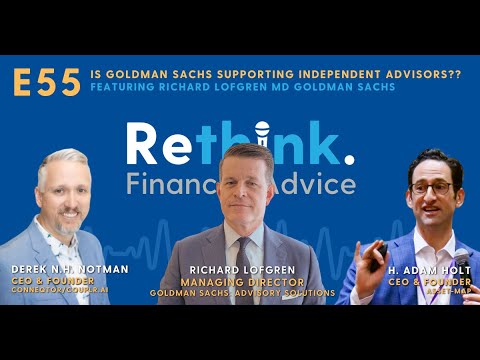
Watch and Listen
Episode Summary
Goldman Sachs' Richard Lofgren, a Managing Director and U.S. Navy Captain, joins Adam Holt and Derek Notman to debate whether independent advisors or large established firms are better equipped to serve clients today. The conversation covers Goldman Sachs' strategic push to support independent advisors through its Goldman Sachs Advisor Solutions offering following the United Capital acquisition, and draws surprising parallels between military planning discipline and financial planning rigor. Lofgren shares his take on what it takes for advisors to stay relevant and drive sustainable growth.
What This Episode Covers
- Independent advisors vs. large institutions
- Goldman Sachs Advisor Solutions and the United Capital acquisition
- Parallels between military planning and financial planning
- Using automation to compete on speed
- What it takes for advisors to stay relevant and grow
Full Transcript
Full timestamped transcript.
[00:00:30] Adam Holt: Derek? Who is better equipped to serve clients, the independent financial advisor or the large established companies?
[00:00:41] Derek Notman: Man, that's an interesting question. Partly because I've actually worn both hats. , , I've seen it from both sides. It's interesting and somewhat controversial. I would say I have my opinions on it though. There's this huge push, at least what it appears to be a push of independence there.
Obviously, there are those that want to promote independence because they can monetize that. , there's consumers that believe that independent advisors are better, but I'll tell you, man, a lot of these large established companies have been around for a really long time, and they've done a really good job of staying around for a long time, right?
You don't do that by accident. And I'll tell you, I've met a lot of great advisors who are not independent. I wonder if there's maybe like a happy medium between the two where you bring them together. Maybe
[00:01:36] Adam Holt: Oh, that's interesting. It's funny because as you and I talked to so many financial advisors, literally around the world. There has been a desire for the financial advisor who typically owns the relationship to get more, we'll call it intimacy and recognition that this is my relationship. I'm the reason you're working with our firm, small or large.
You see this in the migration of AUM from large to small companies and then back from independents to wire houses and then insurance BDs to other, I mean, everybody seems to be contemplating the move of their AUM or their book, recognizing that their clients are going to move. So I think this really comes down to if the relationship resides majority with the advisor. If, because we do know that's not always true. Some people are loyal to institutions, large wire houses, right? They want the succession and the security and the certainty of a large institution that goes beyond the individual advisor. It really winds up coming down to capabilities. What are the capabilities of an individual independent, uh, investment bank?
Mm hmm. Mm hmm.
[00:02:57] Derek Notman: that's interesting so I was just talking with an advisor yesterday who's looking at leaving and going independent. and it's the relationship most of the time. Your clients don't really care about the back office stuff.
[00:03:12] Adam Holt: Until they do
[00:03:12] Derek Notman: about the relationship, but not all of the time.
So the capabilities thing is interesting. I think you're onto something there. .
[00:03:21] Adam Holt: well, it may not be us. That's onto something. It might be the guest that we actually interviewed to learn more about what's happening. So why don't we take a minute to talk about our guests before we hear him speak? . Because I think there's some really interesting aspects, both you and I, Derek, we're curious about what's really going on in this move towards one side or the other.
Is there a go between? And we actually found Richard Lofgren, who's actually known pretty well in this space, who's lived in both spaces. So why don't you help us get to know Richard? Because he's got a great story.
[00:03:57] Derek Notman: Great story. Really interesting guy. Nice guy. , 30 years. , in this industry, but also he, is in the U S Navy, he's a captain. And I think with a little bit of luck, he's going to get rear admiral here pretty quickly to fingers crossed for him, we really appreciate his service , to our country, but Just such an interesting, background.
So he's now over , at Goldman Sachs. And he's managing director of something called the advisory solutions. And it really is interesting because Goldman Sachs has been around what,
[00:04:34] Adam Holt: 50 years. Yeah.
[00:04:35] Derek Notman: give or take, well known around the world. , so what are they doing? , why are they doing some things here to support advisors, which I found really interesting.
And, some of you may know, there's this whole thing going on with United capital that went in and went out and it's been in the news, but. What's Goldman up to? And I mean, Richard's he's in the trenches. Actually, they don't do that in the Navy. They don't get in the trenches, do they?
[00:04:59] Adam Holt: , no. , he's deep in the boat.
[00:05:01] Derek Notman: He's deep in the boat, right?
[00:05:03] Adam Holt: Uh, yeah, that's right. Well, I guess depending on which unit you're with. So I have a personal affinity for this because I have Navy history with my family. , and it was special to talk to him because he spent some time in the wire houses and also went into Bendant.
With an RIA he's been , in the investment world for years and even spend time in private banking. So when he went to Goldman Sachs, , earlier this year to run that advisory services, it was a really curious move, especially given what's happening in their RIA channel, as you just mentioned, what is Goldman Sachs doing?
To capture market share and use the preeminence that they've already created clearly, uh, as you said, they've got name brand recognition globally, but they also have some really unique skills that a lot of advisors don't have. And so episodically you got to think of from securitization to lending to, , illiquid markets and different types of trading desks.
They have a lot of really high end resources that I think many RIAs don't have. And this, came up in our conversation. So let's hear what he had to say.
[00:06:05] Richard Lofgren Rethink Tank: I continue to passionately believe that the driving force and the driving tenant behind independence is choice. And it's always going to come down to that, and it's going to be for advisors to make the decision of what types of clients they want to work with, how many clients they want to work with, what wealth bands.
It totally supports exactly that whole hypothesis behind the independent advisor. And, and for us, where we fit, I think is very important as well too, because we sit within global banking and markets. So you sit within the piece of the firm that it's really about the trade. And when I say the trade, you've got prime brokerage, you've got the investment bank, all those pieces that are there.
There's nothing within that group that's delivering that advice and guidance about providing solutions and strategy. And, and that's specific and by design.
[00:06:51] Adam Holt Tank: That is interesting. Richard, what is your unique perspective of the advice market today?
[00:06:57] Richard Lofgren Rethink Tank: Yeah. So Adam, number one, thanks for letting me join today.
It's, it's great to be with you. And Derek, when you take a look right now, Pew Research talked about, we've got 10, 000 baby boomers that are retiring every single day, they're hitting that age 65 and obviously retirement's a different terminology now, but if we use that term of 65. You've got 10, 000 a day.
So if you think about by 2030, , you're going to have about 20 percent of the population or 73 million Americans that are quote 65 or older. And what's really, I would say, interesting about that fact is that baby boomers now are needing more and more financial advice for really a couple of different reasons.
They really want to make sure that these retirement assets, they last throughout their lifetime. I mean, you could contend that you could spend as many years quote in retirement as you actually did working. You know, they've got to figure out these complexities around social security and Medicare and any other type of government type of offerings or programs that they're leveraging.
They need help with the state tax and planning and anything else that kind of surrounds that. And then the fourth thing is they got to think about the risks that are associated with aging. So for what my unique proposition, what I think right now is that for those reasons, we're really in this, I would say, continuing to expand environment with regards to advice and guidance and that there's going to continue to be probably a greater and greater demand over the course of, at least through the age 65 for the, you know, the tail end of the boomer.
So I think there's not any brighter time to think about becoming an advisor than right now.
[00:08:25] Derek Notman Tank: We would tend to agree with you. It seems like a pretty exciting time. And there's a ton of opportunity out there given what you're just talking about. So flip side of the coin though, what would you say is a massive challenge or missing opportunity that advisors just aren't addressing or maybe don't even see coming
[00:08:44] Richard Lofgren Rethink Tank: Yeah, I mean, part of it's technology, just, uh, even reflecting back on my career, I, you kept talking about, Hey, we're gonna have online trading back in the, in the late nineties and that's going to be the death knell for the financial advisor.
Then it was robo. That's going to be the death of the advisor. I think the greatest opportunity right now is for financial advisors to think about how can I embrace technology to do things more transparently. What can I automate that perhaps some inefficiencies or pain points in my practice? And how can I get that speed to market?
I can either stay speed and deliver advice and guidance to my client or speed to actually employ an investment. So I think the advisors that either choose not to embrace technology or say, not for me, never going to happen, or those advisors that, that are unaware of that technology, I think that they're going to be behind their other peers out there.
And perhaps they might miss an opportunity to either grow their practice or perhaps do a better job in delivering advice and guidance for, for that end client.
[00:09:41] Derek Notman Tank: It almost sounds like the death of it, the advisor would be self inflicted.
[00:09:46] Richard Lofgren Rethink Tank: Derek, I think that's true. Those that choose not to embrace progress or at least be better educated around that.
I think they probably are, uh, that could be
[00:09:55] Adam Holt Tank: signaling the, their career, career warning lights blinking on the dashboard, so to speak.
We've had a lot of people talking about how tech is the great frontier and how they're going to techify and robify and their own practices. I've heard plenty of comments back that. Those that choose to compete with technology are basically destined to be replaced by the same technology that they installed. Right? This classic question of what is GPT going to mean for the next phase of advice, but those that use it to accelerate or elevate the human aspect of advice are really going to double down on what really matters.
Given that, what action steps do you think we should, and other advisors listening, should start thinking about today?
[00:10:35] Richard Lofgren Rethink Tank: I think about some of the pain points that you've got. I'll take just the example of, of account opening. For those of us that have been around a while, we were very adept at using sign here, stickers, and a yellow highlighters to, to open up accounts.
And for us specifically, as we think about bringing advisor onto our platform, the ability for us to use what you could consider a bulk onboarding tool to happen. The ability to transfer accounts on without spending a lot of time with the yellow highlighters and digitize that to reduce your, you're not in good order.
For those of us that remember NIGO, to be able to reduce that, that creates efficiency for the marketplace. And it really allows an advisor to focus on having those rich and fruitful discussions with the client, as opposed to saying, Mrs.. Smith, I need you to sign here and here and flip that over and sign here and here.
That to me, I think it allows. The advisor to spend the time doing what they, perhaps they really got in the business to do, which was to really sit with those clients and, and help them solve problems.
[00:11:32] Derek Notman Tank: You bring back some bad memories with the NIGOs.
[00:11:35] Richard Lofgren Rethink Tank: I, I, yeah, I do. I think I'm going to leave out the, the tube system as well, too.
For those of us that remember the pneumatic tubes and shooting tickets back to the wire rooms, but technology certainly changed.
[00:11:45] Derek Notman Tank: Well, just a little bit, obviously the things are the rate of change has increased and you've been doing this for some time now. So you've seen things happen faster and faster.
Given your perspective though, do you think that there's anything that really should be more debated or at least heard by our community that maybe isn't being talked about?
[00:12:07] Richard Lofgren Rethink Tank: Yeah. Again, I'm going to come back to my technology piece. It's the, again, the robo and technology is going to be the death nail. For advisors, and as I continue to think about it thing, that technology, at least today I could be wrong, and maybe it gets there.
It, it can't empathize, it doesn't have emotion. And when we think about what's going on right now, particularly, you know, times where people will hire an, an advisor, it, it's really around a, a number of functions. They've either got a distribution, they've got a death, there's some type of disability, there's some type of, of catalyst that's perhaps emotional.
That's created this need for advice and for guidance and so while technology might be able to provide the analytics behind portfolio construction. Or maybe stock selection or some other type of, uh, discussion with regards to that vehicle. It's not going to be able to empathize and sit with that client and understand and talk through, why do you feel that way?
Why is this important to you? How do you feel about money? Cause I, again, I, I think we could ask a chat GPT or Siri. How do I feel or how are you feeling today? And they're going to say, I don't understand the question.
[00:13:19] Derek Notman Tank: I tried that with Alexa and she just gives you weird responses.
[00:13:23] Adam Holt Tank: She turned on Taylor Swift for you.
That's right. And she ordered you some tissues. That's great. From the Amazon. It's interesting that the empathy conversation keeps coming up and we're excited to hear that because we recognize the last frontier of humanity truly is in our ability to connect. To communicate and to help people make decisions along this journey.
Cause at the end of the day, financial advice is all about helping people make better decisions. Not perfect decisions, just decisions. Cause that's a big step for many people in the first place, right? Getting out of the procrastination or just we'll call it the ignorance mode. I'm curious because a lot of people don't know that you have a decorated history in the U S Navy.
And we're really excited to hear after 30 years, you've been nominated for rear Admiral. So we wish you the best of luck. And we were pulling for Congress to make that right decision. So thank you for your service from all of us at Rethink, but I'm really curious coming from a military family, myself, what can you take from your service and leadership there and apply to the financial advice marketplace today?
I'm just curious.
[00:14:27] Richard Lofgren Rethink Tank: Yeah, no. And, and I know you've got a Navy background as well, too. So thanks for thanks to your family, years of service as well. When you look at, you can really draw some parallels with any type of military operation that it really comes down to planning, planning such an important component of whatever activity that happened.
And the decisioning process around creating a plan really comes down to doctrine. And then it comes down to the reps and sets and the experience. And that's how you make a decision. And one of the things that I've learned throughout my military career, and I put it over and over again from regardless of what branch of the military, which way folks that are flying airplanes or driving ships or submarines or tanks or whatever, the fact that as good as your plan is, the enemy always gets a vote.
And so it's an understanding that you're not a perfect plan. That even as good as you are and as much time that you spend doing it, the enemy always gets the vote. I think that's very analogous to anybody within the financial services arena. And you think about perhaps catalysts that we've had or incidents that have happened, none of us forecasted 9 11 happening.
None of us could specifically put a marker on you. Hey, when Orange County was going to have the municipal bond crisis that that happened in the late nineties, we didn't know exactly what date that was going to happen. Or even that the housing crisis in 2008 and the Great Recession, so to speak, none of that was able to be forecasted with any degree of true precision.
The advisors that did the best job were the ones that said, Hey, we need to have a little bit of slack in the portfolio. We need to have a little bit of a hedge here. We need to make this plan here. And really, when I think about it, there's a lot of similarities there in the planning process. And that all of us from a day to day basis, we don't know what's going to happen day to day in the markets. And that's the enemy, so to speak. They always get a vote.
[00:16:16] Derek Notman: So, Adam, how do you feel about , what he just had to say there, a really great conversation.
[00:16:23] Adam Holt: There was a lot packed in there, Derek, and it was interesting to hear someone at Goldman Sachs. I would not have always thought this talk about empathy and advice delivery and technology. When I think in my own ignorance, I tend to think of Goldman Sachs is kind of floating in the clouds, this massive investment bank.
And I was really encouraged to hear that.
[00:16:51] Derek Notman: You're exactly right. They're lucky to have him. They're running that division and just being part of that community. No question about it. And I love his angle, , coming from his military background as well. It's spot on for what he's saying there. We'll dig into some of these points here in a second.
What was funny though, is that his point about the enemy always gets a vote , in planning. Made me think a lot about my kid's football team that he's on and all the stuff that they do. And a lot of analogies there, which , you could push that to almost any sport now, I guess. Any competitive sport.
[00:17:23] Adam Holt: Did you hear that part that he said, though, it comes down to the planning, the doctrine, the reps and sets. I don't know if anybody caught that. He said the reps and sets almost like it's about the practice to make muscle memory, to practice your plan, to execute it again, again, again, again, why?
Because when the enemy gets a vote, you don't have time to think you're either prepared or you can react. And I think the case that he's making here is that those that plan and then plan to succeed and then keep practicing their trade and doing the habits and the behaviors that support the plan, right?
You see the military guys out there practicing all the time. They're, they're running through scenarios, , just for that event, that event may never happen, but they're practiced and ready so that it's not a total. Uh, Oh my gosh, it's the first time we've ever practiced this.
Like they're doing fire drills constantly. And I think that's a really interesting aspect to financial planning. Cause I've been a big fan of asking clients, you know, what's your plan to deal with this? And you find that most people don't. In fact, many advisors don't have a lot of calamity planning already in their back pocket.
What are you going to do when this happens? Cause it's inevitable, isn't it?
[00:18:29] Derek Notman: Life happens.
[00:18:31] Adam Holt: The prepared party is more likely to survive. Frankly, that's the key.
[00:18:35] Derek Notman: Definitely more. Yeah. So practice makes perfect. , there's a ton of different ways you can say it. And I, I'm really glad that he mentioned it because it, it holds true for the work that advisors do and even the companies that support advisors. All day long,
[00:18:48] Adam Holt: Very true. What did you take away?
[00:18:50] Derek Notman: you know, I really liked his saying about technology and he talked a couple different things about it. He made 1 comment about how tech ignorance. Is a career warning light and some advisors may not want to acknowledge this to be honest, you know, you're cruising, you're doing all right, , oh, that check engine light just came on.
But you know what? Nothing feels off. So I'm going to keep driving for a while. It should be okay. You know, and I think that's exactly spot on. What about that ignorance? Because this will happen. Technology is taking over what the consumer wants is taking over and you can't be afraid of it. You have to embrace it.
But this is why you should embrace it because at the end of the day, it's never going to replace us because tech has no empathy. I love that comment from him and it makes total, total sense. I don't know. What did you pull away?
[00:19:47] Adam Holt: You know, I'm just listening to you talk about it and I'm wondering how do you combine the two if there are advisors out there and there's enough of them, they may not be listening to this podcast, but I'm sure we all know who they are. Those that have been, uh, we'll call it conveniently happy and satisfied with their firms.
Operating the way they always have money's coming in. The markets are doing okay. Clients aren't leaving. You still have plenty of golf time. Okay, great. You create a lifestyle business. Congratulations. That's great. Is that complacency, which several other guests have talked about? It's okay. It's fine. It's not broken yet.
What is the enemy of that complacency? That's going to have a vote. And when you least expect it, and are you going to have. The desire to fight and retool if a next technology disruption comes in or marginalization or God forbid a health situation for a lead advisor comes in and there's no succession plan.
It's not broken. What are those enemies of the success of that status quo that maybe a lot of advisors are not maybe thinking about or running through scenario analysis on
[00:20:54] Derek Notman: I think you said one of them already is succession planning. We know there's a massive gap there. And think about it. If you're an advisor who's been around, maybe that check engine lights on, but things are still running smooth. is your successor advisor going to be interested in buying a practice that has warning lights
[00:21:13] Adam Holt: and no technology.
[00:21:14] Derek Notman: and no technology?
Right? Eh, you
[00:21:17] Adam Holt: efficiency.
[00:21:18] Derek Notman: that's going to be a push or if they're going to buy it, they're going to pay a lot less for it.
[00:21:22] Adam Holt: Oh yeah.
[00:21:23] Derek Notman: So, I, I think , that's a big one. Then the other one, the other enemy, which we really shouldn't call them an enemy, but it's the consumer.
[00:21:30] Adam Holt: Hmm.
[00:21:31] Derek Notman: What do they want? You know, like, if you're starting to slow down, or you can't provide that digital experience or digital 1st experience that they're looking for, these guys with the check engine lights they're still renting movies at blockbuster. The consumer wants Netflix. How much longer are you going to force like, and maybe Blockbuster is going to try to get into some of that, but it's not really working. . So how long is that going to last? If the consumer says, forget it, we're done with Blockbuster. We're going to this other one now.
[00:21:59] Adam Holt: Well, I mean, just like me, I don't have a VHS anymore. So we might be getting by. I think a lot of advisors are getting by in relationship currency. They've been with me forever. I got loyalty. I listen, I'm empathetic. I don't use technology. I'm still yellow padding, or I basically have, I have some technology and it's good enough clients are not complaining, but I have to say, I just went through, , with actually a future guest.
, from J. D. Power shared some really interesting data that , the next generation is really asking for human role, but more digital service, more digital planning. , and the reality is that I think that the X gen, we've mentioned this before, the Y gen and Z are going to start helping their parents.
The baby boomers start managing their money and they're not going to want to manage it the way their grandparents manage it, or their parents manage it. , they're going to want to have access because they're going to want to be efficient. And so this real kind of push towards efficiency portals, transparency is going to be obvious.
And I think it's going to disrupt a lot of advisors who have been happy with their X millions of AUM and a bunch of loyal customers that always buy from them. , because they're not going to wind up being the decision makers anymore. It's going to wind up being the spouses in many cases that kind of retain the interest in the long term decisions.
Am I going to be with you for the next 20 years? So I think succession just keeps coming up again and again, technology assigned with it now. We started this program actually talking about whether the independent can actually go toe to toe with the big firm. In the beginning, we expected to learn more about what Goldman Sachs specifically was delivering to this marketplace.
But then of course, as we rolled this out, they announced that they were letting go to creative planning, their large unit that you mentioned in the beginning. That was an RIA unit, what was interesting to learn was that Richard told us that his entire unit is all about delivering the services typically garnered for the highest net worth in investors to the independent advisor.
Let's talk about that for a second.
[00:23:56] Derek Notman: I found that really fascinating, especially in light of the departure from United Capital. And I, I don't know how Richard exactly worded it, but basically you can remain an independent and he believes in the independent space clearly, he's been in it himself, but now Goldman is saying, listen, , instead of only serving every, the highest of the highest net worth.
You can plug into our environment, , our resources, our brand. So if you have a customer, you're an independent shop, you're a 50 million RIA, and all of a sudden you have a 50 million client walk in the door. And you're like, oh, crap, how do I deal with concentrated stock positions or whatever, I can't do this on my own, but I have a partnership with Goldman Sachs and I can go in here and we can solve this problem for you. That's huge. I think that's really, really cool to be able to do that, but maintain your independence.
[00:24:49] Adam Holt: Bringing the cache of the Goldman Sachs armory to bear when you need it, but That that's.
[00:24:59] Derek Notman: Huge.
[00:25:01] Adam Holt: I mean, maybe this is the bad analogy, but , that's like literally Zelinsky coming to the United States and say, Hey, I need some weapons. , can I bring you in? I'm trying to make it military. Right.
[00:25:09] Derek Notman: Oh, I gotcha. We're a small independent nation. We're having some issues with one of these other countries that isn't playing so nice and we need help to solve this problem. You know what? Our friend over in the United States, let's go get some help from them.
[00:25:24] Adam Holt: that's Right.
[00:25:25] Derek Notman: That, that I, that I can totally see. It's a good analogy. I like how you tied that all into the military
[00:25:30] Adam Holt: that's what I do.
[00:25:30] Derek Notman: I think this is the 1st time anyone has ever connected financial planning advice, independence and NATO together. You heard it here first, folks.
[00:25:39] Adam Holt: That's right. And why not? Well, look, we need to make, we need to make it something people understand. I think as an independent, we really cherish. Our independence and our brand and the fact that we can do or write our own ticket. And , that's an important entrepreneurial aspect of what I think you and I have been comfortable in a lot of the listeners here have done, whether we have affiliation with larger companies or not.
What's interesting to , here though, and it was a bit of irony to me because when I heard Richard say this, the way I thought about it was, wait a minute. The kings of securitization Goldman Sachs have actually figured out a way to securitize their own special sauce, right? The special sauce that they typically have for the ultra high net worth is these concentrated positions.
I need a trading desk that can liquidate, you know, a hundred million dollars worth of this family owned business, but it's going to destroy the market if we don't do it right. I need caps and collars with an option strategy for that's way outside of my broker dealer's league. Right. To be able to bring in securitization as well as lending around a position.
That's things that I don't say only Goldman Sachs can do, but that's what they're known for. And so being able to tell my client who is exiting a large business, I could bring this team in and still retain the relationship and the control is really interesting. Is Goldman Sachs becomming a SaaS?, Goldman Sachs as a Service service, , is a funny, , analogy here, which I think is, it's endemic of where I think a lot of companies are going. Do something great. Make it accessible
to
[00:27:14] Derek Notman: it accessible. Yep, 100%. So, to the question at the beginning of the episode, which one's better, it's actually both. It's blending the two together.
[00:27:23] Adam Holt: Well, the fact that that's available today, marketplace of services is really unbelievable. And I think you're going to see more and more of this. , so really cool, cool aspect. So what are the things that advisors can do? Let's make it actionable. What do you think they can do?
[00:27:35] Derek Notman: Well, let's see here. Um, I'm going to start with my last one first, because this is a really simple one. And , I've doubled down on this a lot of times, but find tech that actually helps you do more of the advising stuff that you want to do, as you reference the JD power, , guests that we're going to have on, , clients want more human elements, but they want it digitally enhanced.
Maybe that's the right way to put it. So find tech that helps you do that. What else do you think, uh,
[00:28:04] Adam Holt: Got it. So
[00:28:05] Derek Notman: walk away with?
[00:28:06] Adam Holt: so yours is the tech advice, engagement
[00:28:08] Derek Notman: That's, yep, 100%.
[00:28:10] Adam Holt: Okay. Mine was, uh, you have a plan for your clients. You're their advocate. What I took away from this is wondering who is the enemy of your plan that you've put together for the client? And because remember they have a vote, but is it markets?
Is it inflation? Is it taxes? Is it family? Is it health for both the advisor as well as the client? So thinking about second order consequences of the plan that we've made, , where are the reasons it'll fail and try to. Defend against that, right? Get the bunkers ready. For those scenarios, not that they're going to happen, but if they do, you're going to be happy.
You're prepared.
[00:28:42] Derek Notman: You know, this makes me think of this, and this isn't a plug for you, but I'm gonna give you kudos anyways, is that you guys built that, what do you call it, signals? In asset map and that that is one of those things where you can actually plan for things that haven't happened yet and be aware of them, which is that's exactly what it sounds like you're saying
[00:29:02] Adam Holt: That is.
[00:29:02] Derek Notman: figure out how many enemies there are if you can and try to address as much of those as possible.
[00:29:07] Adam Holt: Yeah, that's right. That's being a true advocate, being thoughtful. And by the way, isn't that what empathy is? Taking yourself out of your perspective and putting yourselves in someone else's. If that means future pacing their plan and saying, gosh, if we had a long term care event right here, this would just disrupt the whole thing.
So let's make sure we have a decision around it. Yes or no, not maybe, or not nothing. We're just, we're making decisions around what we're going to protect because we can't do everything. Anything else that you have to share?
[00:29:33] Derek Notman: No, I think we kind of talked about this a bit already, but you can leverage resources that are out there, including Goldman Sachs, to help put you on a pedestal, make sure your clients are happy with you and maybe your independent shop, but still having the resources of , some larger established brands to help you when you need it.
I think that's pretty cool.
[00:29:53] Adam Holt: Awesome. All right. Well, thank you, Richard. We really appreciate you and your service again. We have our fingers crossed from Congress
[00:29:59] Derek Notman: Yeah. Promotion to rear admiral. mean, he deserves it.
[00:30:02] Adam Holt: that's pretty awesome. , all right, well, let's take it to our community question. You want to give us this, this one that came in on LinkedIn.
[00:30:09] Derek Notman: Yeah, this is, uh, it's interesting question. I almost was in a little bit of a debate with the guy initially. Um, so this is Ivan. Up in Ontario,
[00:30:18] Adam Holt: Ooh,
[00:30:20] Derek Notman: we were having some dialogue and here's what he said. Coming from an institution, most of us are just given the tools to use and we adjust. I know how that feels.
I think a lot of us have been there. Um, and he says, you probably know best with the, like a little laughy emoji thing of a jigger anyways, but it could also be the same,
[00:30:41] Adam Holt: That's your technical description of an emoji with a smiley face. Okay.
[00:30:47] Derek Notman: could also be the same situation where some people prefer an iPhone versus an Android.
Um, by the way, iPhones are apples, so apples are for eating, so you know, you know where I, I stand, what
[00:30:58] Adam Holt: Yeah, but apples keep the doctor away.
[00:31:00] Derek Notman: Yeah, right. Um, this is turning out to be the longest answered community question we've
[00:31:07] Adam Holt: not even
answered
[00:31:08] Derek Notman: I'm going to continue on. We're going to get through this.
[00:31:10] Adam Holt: Okay, good.
[00:31:11] Derek Notman: All right, so some people prefer the iPhone versus Android, um, if enough tools can be bundled into one solution.
So, Ivan is a newer advisor, he's got a tech background, he says, out of my ignorance looking at the advisor tech stack, I'm wondering if we can ever have an all in one app for advisors.
[00:31:30] Adam Holt: What do you think?
[00:31:32] Derek Notman: I said no, almost instantly. And I said, because we have something called the human element advisors are different.
The way we like to plan is different. The way we like to communicate and engage with our clients is different. The way our clients like to engage with us is different. So if you force everybody into one app, , you've got a million and one different shapes of people, but you're making them all turn into one shape.
It's just never going to work. So that, that was my answer. Now, can we get closer by having integrations and better integrations? Yeah.
[00:32:08] Adam Holt: Mm hmm.
[00:32:08] Derek Notman: But that, that was my initial response. What do you think?
[00:32:12] Adam Holt: Well, I'm just wondering why don't we only have just one restaurant one restaurant
[00:32:16] Derek Notman: Bingo. Yep. There you go.
[00:32:18] Adam Holt: can I let's just choose one of them. What do you want Chick fil a or McDonald's? You can choose one of the other two one. They're gonna be the
[00:32:24] Derek Notman: want McDonald's.
[00:32:25] Adam Holt: Okay All right, that's it. You can only do that.
And it's the same thing right now. The interesting thing is in the industry, as you and I know in tech, there are several companies attempting to do this because there's so much aggravation around the integration. And can't I just have one tool that does everything? I put the data in once and every.
Thing is updated and invariably what happens as builders of tech that we have learned is no one perspective team company can meet the needs of everybody
[00:32:56] Derek Notman: Impossible.
[00:32:58] Adam Holt: in one specific solution. So, inevitably, what happens is that a new innovation or disruption comes out? It's not in the core tool. Everybody starts saying, hey, can that integrate?
, and everybody who's on the single platform is now dealing with a legacy platform. That's not up to date. And then they frustrated and they go and they buy all the newest stuff and then it's all disconnected again. So there's this cycle of going out and getting all the best stuff independently, and then trying to cobble it together.
And then there's a reaction to that. No, that's not good. Let's just go create one platform. And then that doesn't work. And this is like silly cycle. So I think I agree with you a hundred percent. There are arguments for a single core, let's say CRM that has core execution function built into it. I'd really like to see it.
There's a couple of companies that are doing that. Orion's examples, Envestnet net is one. Uh, I think Advyzon on is another, there's several out there that are trying to create most of the all in one, not all of it, but most of it. And then you just tack on the satellites that you really need that serve your practice, uh, and that are fully, ideally integrated.
They don't have to be integrated, so I just, as much as it's a panacea, Derek and Ivan, I just don't see it happening like that.
[00:34:13] Derek Notman: Yeah. in a vacuum, I get it from like a convenience and simplicity standpoint, but it just won't happen.
I
[00:34:22] Adam Holt: you know what I just realized? Ivan actually asked something really important. He did say the iPhone or the Android. The question is, can there be a single operating system with all of the unique apps that a client or an advisor can then choose to put in, but it all talks on the same platform that that would be interesting, but we would all have to agree to that common platform, right?
That climate experience. and that is B I would be really surprised if anybody would pull that off.
[00:34:54] Derek Notman: boy, that would be interesting. I mean, yeah, how do you build the Apple or Android version of FinTech financial services that
[00:35:03] Adam Holt: With a thousand apps on it.
[00:35:06] Derek Notman: at least
[00:35:07] Adam Holt: Well, at least, yeah, because everybody's got a different way of doing it,
[00:35:10] Derek Notman: yeah. Um,
[00:35:11] Adam Holt: if it all talked to each other, how, how insane would
[00:35:13] Derek Notman: and throw compliance and data privacy in there on top of all of it.
[00:35:18] Adam Holt: Mm hmm.
[00:35:20] Derek Notman: Um, so super interesting question. So, okay, maybe, uh, I guess a far chance that someday something like that can happen, but otherwise, no, I think it's always going to be up to the individuals and creating experiences that they like.
I mean, like when I went independent, I had full carte blanche. I can do whatever I want. Right. my text acts different than the next one.
Doesn't
[00:35:40] Adam Holt: But you still have to cobble it together. I mean, the reality is that we're, we're all still trying to make sure we can communicate with each other. APIs, I think, are the big universal, equalizer on this whole discussion. , but I, I do think unless there's a regulatory push to say everybody needs to be on the same platform and it's a requirement of doing business for compliance or regulatory.
I just, I think there's a lot of aspirational vision, which will be interesting if anybody can pull it off.
[00:36:09] Derek Notman: Great question. Thank
[00:36:11] Adam Holt: you, Ivan.
All right. With that, why don't we let our subscribers know what to do? That's right. You're a subscriber, aren't you?
[00:36:18] Derek Notman: Do I subscribe to this
[00:36:20] Adam Holt: Not you. I'm not talking to you.
[00:36:25] Derek Notman: My wife does. She just told me that she listened to like two or three episodes all at once recently. So I know we're getting a couple downloads at least.
[00:36:32] Adam Holt: She missed you, huh?
[00:36:34] Derek Notman: Yeah, she's gone right now. She's not even here. So she's just listening to us.
[00:36:39] Adam Holt: She's traveling and listening to you while she travels. I'm, you know what? She's very kind. I'm glad that she's very nice to you. I'm sure she's not listening to you. She's catching up on the Netflix that you don't like to watch.
[00:36:53] Derek Notman: totally is, right? Yeah. Getting a break from the husband. Yep.
[00:36:56] Adam Holt: true. Well, listen, thank you so much. Of course, to our guests, Richard Lofgren from Goldman Sachs.
And thank you, Ivan, for taking the time to write that out on LinkedIn. We always appreciate that. You know, look, we challenge everyone here to put something in motion that you just heard, right? This is a mentorship podcast, Derek. We, we hope that there was something in here today that. Just forced you to either rethink your current practice or imagine what could be and what's possible.
, we hope that you share this episode with someone who would appreciate it. It's also very much like you and wants to grow.
[00:37:26] Derek Notman: And leave us a review, a great review, a
[00:37:29] Adam Holt: Great review.
[00:37:30] Derek Notman: really great in multiple places. Like we'd like you to each spend an hour leaving reviews today. So just make sure you get out there.
[00:37:38] Adam Holt: hour of your time.
[00:37:39] Derek Notman: You know, that's something that you can put in motion. You just heard it here. Now go do it.
[00:37:45] Adam Holt: That's not selfish at all.
[00:37:47] Derek Notman: Not at all.
[00:37:48] Adam Holt: Well, only do it if
[00:37:49] Derek Notman: everyone.
Great chatting with you today, Adam. Thanks, man.
[00:37:52] Adam Holt: you got it. Thanks. See you on the next one.
[00:37:55] Derek Notman: See you, buddy.
The content has been made available to you by Asset-Map for informational and educational purposes only.