
Ep53 - Rethink: Stop Forcing Advisors to Be Technologists – Featuring Marc Butler
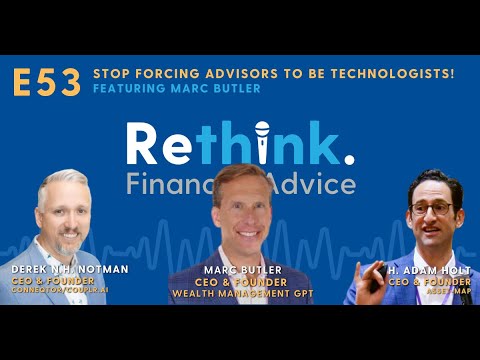
Watch and Listen
Episode Summary
Fintech industry veteran Marc Butler joins Adam Holt and Derek Notman to ask whether technology is really helping societal financial wellbeing — or just helping advisors. Citing data showing the average 401(k) balance sits just over $100,000 for tens of millions of Americans, the three explore the scale of the underserved retirement market and why advisors shouldn't be expected to become technologists to serve it. The conversation turns to AI's growing role in advice, the regulatory questions it raises, and practical ways tools like GPT can support — rather than replace — the advisor.
What This Episode Covers
- Whether technology is truly closing the advice gap
- The scale of the underserved retirement savings market
- Why advisors shouldn't have to become technologists
- AI's emerging role in financial advice
- Regulatory questions around AI-generated advice
- Practical uses of GPT-style tools for advisors
Full Transcript
Full timestamped transcript.
[00:00:30] Derek Notman: /Adam is tech actually helping societal wellbeing?
[00:00:38] Adam Holt: Wow. don't have small questions, do you?
[00:00:42] Derek Notman: No, I spent three weeks thinking of that one.
[00:00:44] Adam Holt: You did.
[00:00:46] Derek Notman: So I did
[00:00:47] Adam Holt: Is tech actually helping society in the financial well being, I'm assuming? , I like to believe that you and I as technologists and recovering financial advisors. See so much tech that's being created for the benefit of advisors. But I think you're touching on something important. It's aspirational in terms of how much it can affect people.
It hasn't even scratched the surface.
[00:01:15] Derek Notman: that. I agree with it. It has scratched the surface. It's. I don't know why. Like you, you've got all this new tech wealth chat, G P T, you've got you've got all of this stuff coming out to enable advice, engagement and marketing and portfolio management and income planning. The list goes on, right?
Brilliant ideas. But is it actually helping people and I well, you'll hear from the guests in a moment here, but there's like a real world story here, which started to get us to ask some questions. Like, why are people not getting the help that they need
[00:02:01] Adam Holt: we have something like 80 million households in the United States, maybe pushing even 90 million at this point. Every time you listen to the news, you hear in some aspect that the average American barely has a couple hundred bucks to cover emergency reserves. You know, costs are going up.
, I just saw as I walked down the street the other day in the city, , someone had graffitied on a wall and said, if, if minimum wage followed the consumer price index, I'd be making 54 an hour. Thank you. And I think that there is a huge disconnect between the worlds that we tend to run in, which is advisors working with individuals and families that have means, okay, and delivering technology to them, but the general population is still woefully.
under banked. It's still woefully undereducated. The literacy rate is really horrible
[00:02:53] Derek Notman: It's terrible.
[00:02:54] Adam Holt: and it creates not only a societally, because who's going to pay for all these individuals that are not going to be able to, , retire, let alone they're going to run out of money.
Is how do we help you or how do we use technology to start scaling advice? Cause it's a huge opportunity because there are a lot of individuals that are not getting help that probably deserve and need it.
[00:03:14] Derek Notman: Yeah, I hope that , it'll help us , crack the code, solve the problem. Why are the masses not getting the help they need? Is it their fault? Is it the Fintech's fault? Is it the advisor's fault? I don't know, and I don't even know if we're going to answer that question today, but maybe we can get a little closer.
Maybe we can start scratching the surface, as you say.
[00:03:36] Adam Holt: I don't know if it's going to matter whose fault it is. Ultimately, I think it's going to matter who's going to solve the problem. Right. And, and is technology going to solve the problem for the consumers or our advisors going to solve the problem? It seems to me that the people in the best position to solve the problem are advisors.
And there's actually a financial opportunity for those advisors that decide to go out and help. And so , let's introduce our guests because this came up in a total turn of how we expected Mark Butler, our guest this week. To talk about what's happening in technology. And he brought this up from a real world experience that tended to motivate his answer to this question.
So how do we get to know Mark
[00:04:11] Derek Notman: , . Mark's a really cool guy. He's got a heck of a resume when it comes to our industry. He was doing FinTech wealth tech before they even called it that. Now, , don't get me wrong. He's not that old.
I still got more gray hair than he does, but , he's been doing it for a while. And we actually originally wanted to talk to him about. Wealth management, GPT, which he's working on. And the conversation took a total left turn, which is really interesting, but he's been doing all sorts of cool stuff. He's a consultant now for different FinTechs and advisors.
He was previously the president and CEO of Skyence. I'm sure people have heard of that. He had a long tenure as the COO and managing director over at Bank of New York, Mellon, Aldridge and Pershing. So he's been in the space a long time, really well versed and just what an awesome conversation that came out of nowhere for us today.
[00:05:04] Adam Holt: Fantastic. Let's hear from Mark.
so Mark, , what is your unique perspective of the financial advice market today?
[00:05:11] Marc Butler: I think the financial advice market , is making progress on getting to, or meeting the unmet needs of advisors and investors, but I still think we have a long to go. I sat in with an advisor the other day , who's managing a 401k plan at a nursing home and just hearing from people as they came in the room, the questions they were asking and people that hadn't even signed up for the plan yet.
It just really struck me and not that I didn't know this already, but it was right in my face that people still need help. They need help more than ever. There were people I met that day that are near what we would consider traditional retirement age that weren't even participating in the plan. And so, you know, I know we, we talk a lot about serving high net worth.
Clients and people that have money. And if you're an advisor, that's what you aspire to do is to serve people with lots of money. But there's a lot of people in this country that need help, , with whether it's their 401k or just general finances and budgeting, , and many of those people, frankly, are never going to retire.
They're going to work their entire lives, , or they're going to retire and end up running out of money at some point. So I think. For as many advances, and the technology is great, and there's so many great solutions out there, as you both know, , we still have a long way to go in serving the American public.
[00:06:58] Derek Notman: You know, Mark, that's really interesting, literally being in a room and seeing those interactions happen and it makes you wonder, , why is there this major disconnect? We've got pretty great tech out there. Now, I mean, maybe our industry is not as fast to adopt it as others, but we've got some pretty cool tech and there's a lot of advisors.
So why are people not connecting? . I, It almost sounds like you're telling us what the missing opportunity is, but maybe unpack that a little bit more for us. You're seeing what's going on with this disconnect. Is it a challenge? Is it an opportunity? What's going on?
[00:07:35] Marc Butler: I think it's a challenge and an opportunity. I think it's an opportunity for our industry To do what's right and, , and help people that need help. And certainly there's technology solutions that can get people there. You know, I use 1 example in the case of a 401k plan. Um, and there's tools that help people do that. Help people allocate their 401k. People can get advice on, , on their 401k. And so I think there's solutions out there. , I think some of it's connecting the dots. I think often in that instance, participants don't know what they don't know. And if you're delivering advice in this country, I think that that's a great opportunity.
And some of those clients may not be a perfect fit for many advisors, but in some cases they're, some of those people that have saved, I've also met some people recently that have put away money in a 401k for 30, 40 years. And they're 401k millionaires and who wouldn't want to have. A 401k millionaire as a client. , and so I think those opportunities Are are out there I think the point is people need help and even I would go one step further and say even the people that You think are going to be okay? They have enough money to retire But when they reach retirement if they're not working with an advisor, do they really know what they're doing? And are they prepared to live? The next 30, 35, 40 years without income and live off the money they have. And nobody's going to wake up when they're 90 and say, I'm going to go back to work. So I think as a society, I think , it really isn't just a. Advice delivery problem.
It's really a societal problem. I mean, the three of us are around the same age. I mean, are we going to be waking up 40 years from now and there's tens of millions of people that have run out of money in retirement, and they're going to be alive for five to 10 more years. And what are we going to do about that? , so those are some things that I think about, which have, you know, don't necessarily have a lot to do with FinTech or WealthTech, but, , I do think that. Despite the advances we've made and we've brought a lot of people, , into the advice market over the years, lots of different ways to do that.
There's lots of companies that can serve the needs of really just about any investor out there. , but there's still a lot of folks that need help, whatever stage of life or stage of being an investor they're at.
[00:10:19] Adam Holt: That's really interesting. And I'm sure a great debate because it seems to me like. High net worth tends to dominate the space of actually getting more advanced help. How do we actually scale that? And it's a conversation that's gone around a lot. Scaling advice also means helping those that are underserved.
You know, thinking about that, what action steps would you recommend for most advisors out there to rethink? What can they actually challenge themselves to do to contemplate or to rethink in their own practice?
[00:10:47] Marc Butler: , I think there's a great opportunity. I use the example of 401k plans. I do think 401k participants, maybe not managing a plan per se, but putting yourself out there as somebody that can help someone manage. , their 401k. I think that's something again, you might stumble upon a 401k millionaire who's preparing to roll over in the next couple of years.
, I think those opportunities exist. There's some number that Fidelity publishes of the number of 401k millionaires that they see across their plans. And it's a huge number, and I just wonder to myself when I read that number, , have advisors stayed away from those investors, , because they've generally stayed away from 401k plans, but , are there great potential clients that advisors can help and whether you're a seasoned advisor or younger advisor, is there an opportunity there?
, same with retirement income planning, I think there's great opportunities to help people not run out of money. , I've said in some other meetings recently where people point blank, ask advisors, am I going to be okay? , and it's a, it's an emotional conversation. It's one thing to talk about it. Talk about it on a LinkedIn post.
It's another thing to be in the meeting and it's emotional and people get emotional about it. I mean, you guys know this. So you've been in this. Advice, delivery business is long, if not longer than I have. And these things, these are important conversations. I think the ability for the industry to help people and the tech helps.
With doing some of that, like I mentioned, the tools that can help participants manage 401ks more effectively. The tools that can help with retirement income planning, Adam, you do some of that stuff today with asset map. , those things are critical. Do advisors know how to use those solutions well enough to make a difference?
I don't think they do. I just don't, I've never thought that with any of the solutions I've ever been involved with that advisor really know how to use them well, or how to use them effectively. And I. I don't put the onus on the advisor as much as I put the onus on the firm, the broker dealer, the custodian, whoever it may be, or the fintech, to get the users up to a level where they can be effective.
[00:13:24] Derek Notman: You know, this almost makes me think of 2 questions. So 1, which is what spurred this having you on as a guest mark was. We had an advisor ask, should advisors even be using, , chat GPT within wealth management and it almost sounds like they should, but it's, they shouldn't be relying on the tech so much.
The tech owner should be empowering the other way around if it's used correctly. So I guess I'm curious, cause you're totally in the space. You founded a company on this. I'm curious on that. And then the bigger, it almost sounds like you're putting more responsibility on the broker dealers and the insurance companies.
So I, I'd like you to unpack that controversy a little bit there. , cause we tend to put all this on the advisor. I think almost everyone does well, it's the advisor's responsibility to do this, to do everything. So flip that for us.
[00:14:15] Marc Butler: Yeah, well I'll take the second one first. , I'll stand by what I've always said is that advisors were not designed nor do they want to be in the technology business. I know there's exceptions to that. The two of you are exceptions to that, but most of them don't want to be.
And so if we're leaving it up to advisors to get smart about FinTech solutions, , that hasn't worked. I've been around this space for a long time. And it hasn't worked. And so I think if we want to have advisors leverage technology to enable better advice delivery, we're going to have to help them become better using these technology solutions.
And I'm not going to speak for every FinTech and WealthTech out there, but I might give us a C or a C minus on that in this space because I just don't, , I don't think we're there yet. And , on the first question, , my answer is yes, because, , for a couple of reasons, number one, and some of this gets back to why I started Wealth Management GPT was really about how do advisors effectively communicate With their clients and with their prospects, and are they viewed as being a thought leader?
Are they putting thoughts out there? Can they communicate effectively? And, you know, one of the things that I picked up on, and you guys did as well early on with ChatGPT was For The opportunity to help you be a better communicator. Um, and I use this simple example over and over again, which is, , an advisor who doesn't even know where to start in creating a blog and a lot of advisors, you guys are an exception to this, but a lot of advisors , couldn't write a 500 word blog.
They would really struggle to do that and do it with. , some level of, of accuracy or, , having it be in a position to be published. And chat GPT, what we've created with wealth management GPT, I think gives an opportunity for advisors to communicate more effectively. And I read something the other day and I couldn't tell if it was a couple of years old, or if it was relatively new, but the statistic was at half.
Of the investors in this survey said that they would like to hear more and get more communications from their advisors and solutions like Wealth Management GPT provide an opportunity and a really easy step by step way for advisors and those supporting them to do that.
[00:17:10] Derek Notman: you know, that goes back just to our previous episode. It sounds like if it's used correctly with the way you've designed it, for example. You're just enabling scalable advice delivery. Right. That's what you're doing. You're able to speed that up. And that's one of the challenges advisors are trying to overcome is how do I do this at scale?
Because the thought of writing the blog post and then sending out 100 emails manually, like, forget it. I'm not going to do that. That's just way too much work. Even though half my clients want it. I'm just not going to bother.
[00:17:42] Marc Butler: That's right.
[00:17:43] Derek Notman: But if we can use tech to scale that and make it faster, less painful, then why not?
[00:17:47] Marc Butler: Exactly right. And that's kind of been my, my premise , for most of my career in the space is the tech. It's not about the tech. It's about what the tech can enable an advisor, an investor firm to do. And this is a great example of that.
[00:18:08] Adam Holt: I got to ask the question though, Mark, which is how are regulators going to look at GPT and are they going to perceive this as written advice and, or how do you deal with the data that you're putting into these platforms? We haven't really had much guidance on this one yet. Do you have any thoughts? I
[00:18:26] Marc Butler: yeah, I mean, the data aspect of it, we've purposely stayed away from anything that requires input or requires any client related data. Wealth management, GPT, just, we're not going to deal with that at all. , and then from a regulatory standpoint, I guess just a couple things.
One, , firms have approval processes, as you know, for written communications. And so that we're not looking to change that. So if you've created a blog, for instance, in Wealth Management GPT, we would expect That you would go through the same process that you go through and have gone through in order to get that approved , within your firm.
, one thing that we did do a couple of weeks ago, , was we took a list of, , these forbidden words. These are words that FINRA and the SEC don't like to see in communications and we've prevented those words from coming back in the results.
[00:19:28] Derek Notman: That's cool.
[00:19:29] Adam Holt: , you can't guarantee anything.
[00:19:31] Marc Butler: no guarantees. No guarantees.
So , that was one step. I mean, we would love to automate the delivery of the content into an approval system that a firm may have in place. , but in the meantime, we, like I said, we've taken out these forbidden words. They're not going to come in the results. We've also made it really easy for Advisors and other users to export the content out of Wealth Management GPT and put it into these approval systems.
[00:20:01] Derek Notman: I did some research while we were talking 60 million Americans have a 401k. That's a lot. And only it's crazy. The most recent data, 299, 000 have a million bucks or more. That's it. It's not a lot.
[00:20:16] Adam Holt: No, that is not a lot.
[00:20:18] Derek Notman: But still what if there's 10 million that have half a million in there?
[00:20:21] Marc Butler: Yeah. That's a good, that's a good amount. But the, the staggering stats is that Northwestern mutual study that I don't remember, which I think it was Gen Xers have like an average of 60, 000 bucks. In their 401k. And then, people think they need a million in order to retire. Like it's a long way from 60 to a million,
[00:20:44] Derek Notman: Oh, it's so it's so disconnected.
[00:20:46] Marc Butler: I just don't know where it goes. , but this woman that I met last week, she's 65 years old. She's got a full time job and a part time job, and she's just signing up for the 401k plan.
And she leaves the room and the advisor and I look at each other. And we both said at the same time, she's not going to make it. And she's going to work the rest of her life.
[00:21:10] Derek Notman: you know, Mark, what do you think is the barrier for all of these people? Not Wanting to, get advice, get help, or just even sign up for the 401k or log in and look at what's going at their, bank account.
, are they scared of money? Are they nervous? Are they, do they just not give a crap? , what's driving this? Because I think the advisor population is pretty eager to help as many people as possible. , and there's more than enough clients to go around. So why is there a disconnect? I don't understand.
[00:21:44] Marc Butler: , I don't know. It could be all of those reasons, Derrick. I think that sometimes people aren't, , they don't know what they don't know. Why did this woman all of a sudden at 65 decide, hey, today's the day I'm going to go find out more about this 401k thing. Like, why didn't she do that 30 years ago? I don't know. In some of it, , if you don't. You know, I talked about my father investing in stocks. Like I learned, like I kind of knew what was going on. And so I've been speaking this language for 40 years. I know something about it. Few don't grow up with that or don't grow up with conversations about money.
, or budgeting, , buying a house, getting insurance. If you don't have any exposure to that stuff, you might not know any better. ,
[00:22:33] Derek Notman: It's so true. Like my family money was not talked about. You brought that topic up and you got the look and or even worse, it was, you did not talk. So I never got any education on it.
[00:22:46] Adam Holt: Well, that was interesting. Derek, what do you think about Mark's interview ?
[00:22:50] Derek Notman: Refreshing. Interesting. Wasn't expecting it. Just, just a really cool conversation. And I value the real world experience that he shared. I think a lot of us have had those and we have them every week. But we don't talk about them, or if you do, it's one thing to do a LinkedIn post about it, but that's not being in the room, seeing it happen and seeing the emotion and what that actually means.
But then to extrapolate it out, he mentions about the 401k market, for example, and how many Americans we can serve there. Over 60 million Americans have 401k accounts.
[00:23:27] Adam Holt: My goodness.
[00:23:28] Derek Notman: It's crazy. It's a massive opportunity. But again, as we were talking about before, there's some disconnect going on here. Like, why is a 65 year old only coming in at 65 to start talking about getting their 401k sorted?
[00:23:40] Adam Holt: Well, probably because they have no outlets. I mean, when you think about the average American, they're not really taught finance, certainly not in educational institutions. They're not given any guidance on this. , all their information comes from media and Dow Jones or Bloomberg or CNBC, right?
They think it's all about stocks. They have no concept of legal, tax insurance or investment protections which is we woefully undereducated on the side of literacy has been so important. And when you think about how technology has the capacity to potentially scale out advice, I think everybody's overwhelmed.
There's just too many options. So they do nothing. And then all of a sudden it's become so urgent that they need to talk to somebody, but it's almost too late because we lose the compound effect. We lose the insurable effect. We, you know, we're kind of just so late to the game at 65 that we're almost destined to fail.
[00:24:28] Derek Notman: So how do we engage them earlier on? Right? There's, I mean, there's probably more than one solution here. And how do we get part of it? I think goes back to what you said earlier. I think there needs to be more open dialogue about money. Like I shared with you previously, my family didn't talk about money at all.
I had to figure it all out on my own. It was just, it was a taboo subject. I think that happens to a lot of people, or what if you don't have money? What if you're worried about making rent at the end of the week, right? You're probably not thinking about what stock portfolio you're going to get into. It's not priority number one, let alone seeking out advice from an actual advisor.
It's just probably not on your radar.
[00:25:06] Adam Holt: Well, finance is intimidating from the start. If you don't know anything about it, I mean, think about it. Do you, if I said that geometry was required for your retirement, you might try to kick that off as long as possible and be like, okay, I guess I better learn geometry, but you're rolling your eyes. It's not exciting.
, I think the outcome might be, , to make sure you could retire. But I think that a problem is, is advice is intimidating and we've made it that way and we've made it exclusive to those who actually have resources. Look, most of my clients were high net worth and that's because they were willing to pay for advice.
They knew the value of it. They knew how to delegate and they knew the leverage that they got by having experts on their team because they also ran a company. Or they also ran a shop or they were also highly educated. And so they already valued having an educated, competent person. They were overpaying theoretically to deliver an exceptional outcome that they couldn't do on their own.
This needs to become more accessible. And the question I'm wondering is whether. Technology, I think Mark is really questioning this at fundamentally given his background is how do we use technology to create opportunities to help more people, which in a sense, as a business owner is going to help me get more scale into the system.
Right. And in other words, it lifts all boats when an advisor actually helps consumers get financially better
[00:26:21] Derek Notman: Oh, everyone wins. Yeah. You know, you said a word a couple times just now you said opportunity. maybe one of the problems, is that for the non high net worth folks, which is the bulk of people, they are not able to visualize the opportunity granted them by tackling their money, getting the education, going through that geology, geometry course.
Yeah,
[00:26:51] Adam Holt: financial geometry. Sign me up Calculus. Great.
[00:26:58] Derek Notman: But it may, and if we're talking about advice engagement, maybe tech needs to figure out a way to help more visualization. This is not a pitch for asset map. You guys already do this, but
[00:27:09] Adam Holt: I agree.
[00:27:09] Derek Notman: Help me as a consumer visualize the opportunity, the plus side versus making me feel overwhelmed and scared and nervous.
[00:27:18] Adam Holt: Well, you know, you know, I believe in that. I mean, that's, that is, that's what I think is the key. I mean, , we're trying to figure it out ourselves at AssetMap. How do we help an advisor engage everybody regardless of net worth? And granted that might not be appealing to everybody. That's fine. That's a business decision, but that doesn't mean it's not coming because remember.
Generation X and millennials are the ones that are going to inherit the boomers money. Cause the boomers are not going to spend it all, which means these people are going to be highly motivated to make better financial decisions. And we keep talking about this major wealth transfer that's coming. And everyone's like, when is it coming?
When is it coming? These boomers are living forever. It's going to happen all of a sudden. Over a long period of time, but when it happens, it's going to happen and the people who are in the advisors who are ready are going to be ready. The question is, how do they scale their tech? How do they help people become?
Not so intimidated in this process. And I think it's interesting because Mark said that advisors didn't sign up to be technologist, right? And unfortunately, we've been really forcing a lot of advisors to take the mantle of installing their whole technology stack, despite the fact that , they're larger supporting firms, broker dealers, RIAs are slow to execute this stuff and adopt the newest stuff.
So you really only have the avant garde advisors who are really buying the newest technology and trying to scale advice, but there's no way they can keep up with the level of demand out there. And they're probably focusing on the. Biggest money market, which is really high net worth. So this great technology is not really even getting to the mass market in many ways.
And it's funny that he gave advisors a C minus on their support and implementation because the reality is they need to be heavily supported. And I think the real change has to happen at the larger company level, right? Because , the major wire houses, investment.
Insurance companies and banks are really the ones that are affecting the majority of the population. They need to find ways to support their advisors reaching down into the market.
[00:29:13] Derek Notman: You know, that. That's a really good point. We do put a lot of pressure on advisors and most advisors don't want to be technologists. Most advisors become an advisor because they want to sit across the table or cross the zoom meeting and talk about paying for the kids to go to college, buying the 2nd house retirement.
And if they can have a couple tools to , show the clients, like, Hey, this is what it works. This is how it looks cool. This is exciting. Like, that's awesome. , but the larger, let's face it. Most advisors are tied to some type of larger organization
[00:29:45] Adam Holt: And they only have the
[00:29:46] Derek Notman: serve who serve. For example, , I'm just looking this up right now.
How many clients does fidelity have. Fidelity serves over 43 million people, and I'm not saying Fidelity is good or bad at tech or empowering their advisors or not, but that's just an example. Think about if you lump all of the larger shops together, you're serving or probably touching almost every single consumer in the country.
[00:30:13] Adam Holt: In some way, probably true. Well, there's probably a whole bunch of people that are not served at all. But if you add the banks into that, true. They're touching something financially, right? , if they pay any bill.
[00:30:24] Derek Notman: Yeah,
[00:30:24] Adam Holt: So the point is that it's really incumbent, I think, on the large companies to support a technology initiative that allows scaled advice delivery and accessibility of professionals that can work with individuals at all levels.
That's really what the promise of technology was going to be for industry. But it's still so much in its infancy, despite the fact that we talk about tech all the time, it's real impact for the financial well being. Of society is at its infancy, and that's why there's so much opportunity. Now, it's interesting that we switched to this AI conversation because so many of us have been curious about, well, is AI going to solve all this?
Can we just actually enable chat GPT, upload the CFP handbook? Upload the tax code and just say, forget all you financial advisors. Just type in your question. Anyone in the planet and chat, GPT finance will answer your questions. That's not what Mark built, but it begs the question is, is the technology on the verge of solving major societal problems?
[00:31:25] Derek Notman: I think so, but I don't think it's going to be AI by itself.
[00:31:28] Adam Holt: Hmm. What is it going to be?
[00:31:31] Derek Notman: Well, , you've actually, I don't know if you coined this, but I'm going to say you coined it. AI as an advisor intelligence. If we're giving advisors better tech, that's simpler, that enables more engagement and visualization of outcomes for the consumer. Now we can scale, now we can serve more people, make them feel good about their money.
[00:31:57] Adam Holt: Interesting. So you're saying AI as a supportive tool to the advice delivery process,
[00:32:03] Derek Notman: I think so. I think that's where it could fit in. Although honestly, with my tech company, my CTO a number of times and he even talks about how like AI is a little scary because no one knows exactly what's going on inside.
[00:32:16] Adam Holt: That is true.
[00:32:18] Derek Notman: No one knows. No one in the world knows. So it's a little freaky.
[00:32:21] Adam Holt: someone who knows like the open AI guys, no, they built it.
[00:32:26] Derek Notman: No, there, there is AI that they don't know exactly what's going on all the time. Like there's literally like a magic wand going, there's some weird stuff. Like
[00:32:34] Adam Holt: way.
[00:32:34] Derek Notman: you'd have to talk to my CTO about this, but it makes you laugh. It makes you a little scared. You're like, what the heck's going on here?
[00:32:41] Adam Holt: Man, nobody knows what's going on in the federal government, okay? So there's some magic wand in there, too. Somehow it operates. I don't know. Look, somehow we have roads, and we have a military, and I pay my taxes. Somehow it works. It's a magic beanstalk,
[00:32:54] Derek Notman: That is funny. You just compared AI to the federal government.
[00:32:59] Adam Holt: Ha ha ha ha! Maybe every government. So how does it not all fall apart?
[00:33:04] Derek Notman: That's hilarious.
[00:33:05] Adam Holt: knows how it works, but somehow it works. That's pretty funny, it's interesting how well, you know, GPT, there's been a lot of advisors that have reached out to me personally that have asked about how to use chat GPT.
I happen to be a huge fan of it. Cause I use it every day for something. I like to ask it some dumb question. Perfect example, I said, can you, give me a list of all the episodes on rethinking, can you categorize? And it said, well, I can't look at the, at your website. But give me all the text of everything from every episode and I'll make you this beautiful bulleted list.
Well, that's great. So now we can post that in a blog, right? That's saved us a lot of time. I would never have created that on my own. I actually had it rewrite something. And I think what Mark's doing with wealth management, GPT, is he's creating an outlet for advisors who really want to create more content, have someone read it, and
[00:33:52] Derek Notman: scalable, right? Yeah.
[00:33:53] Adam Holt: And it's scalable delivery of communication.
[00:33:55] Derek Notman: So they can be better advisors and I've actually used it. I've piloted , his tech. It's pretty awesome.
[00:34:00] Adam Holt: That's great.
[00:34:01] Derek Notman: We'll leave a link for folks that want to check it out in the notes, but yeah, it's
[00:34:05] Adam Holt: Very cool. I do think that there are some big concerns though, Derek, , about what regulation is going to come down and basically slam the door , on a bunch of other tech that does go across that barrier that he talked about. , don't cross the seal. If you remember , the
[00:34:19] Derek Notman: Indiana Jones and the last crusade.
[00:34:21] Adam Holt: don't cross the seal with the grail.
Because I think there are a lot of advisors that are putting in personal identifying information into GPT because they're just ignorant. They don't know. And they're asking for summarize this guy's financial plan in a one page summary. And you're literally putting that person's information into this, who knows what, right?
A system that you just talked about, who knows what's really going on on the data side. And, and it causes some really big risks. I think we could see huge penalties and fines for inappropriate use, but no, one's got a guideline on it yet. So people are going to get caught. And I think we need to . Be more protective here than just excited.
I think
[00:34:55] Derek Notman: Well, I like what he said, too, , it's more marketing driven to write a blog, and then it should still be part of your compliance process. You've sped up, like, I don't know if we're even listening. If you haven't written a blog, it can take hours and then you have to optimize for SEO and then you have to upload it and then you got to get graphics.
It's a major pain where you could do the same thing. And what. A minute,
[00:35:18] Adam Holt: Good question.
[00:35:19] Derek Notman: but put it through your compliance process. Anyways, I think it was really awesome chatting with Mark, the guys will just a wealth pun intended
[00:35:27] Adam Holt: Yeah.
[00:35:28] Derek Notman: of knowledge and experience.
[00:35:30] Adam Holt: He's a wealth G P T.
[00:35:32] Derek Notman: Yeah, just, and we actually did this whole episode using his tech.
[00:35:36] Adam Holt: There you go. . We didn't, this is not us
[00:35:39] Derek Notman: This is not us speaking
[00:35:40] Adam Holt: ai. Just kidding. Well, let's go to our community question, 'cause I know Matt really wants to get some voice here.
[00:35:47] Derek Notman: yet. So Matt in Utah, I woke up to this note from him this morning of all things, actually. So he starts off, , Hey, Derek. Over an 18 hour road trip, which I guess he just took, I don't know where he was going. He didn't tell me that he's
[00:36:00] Adam Holt: To the supermarket in Utah.
[00:36:02] Derek Notman: Well, yeah, yeah. He probably still in Utah. Um, he's been binging the rethink podcast.
So I mean, personally, awesome. Thanks, Matt. Appreciate that. But he had a question, which I thought was pretty interesting. , that's near and dear to both of us actually from our advisor days is as a remote office, how do you recreate that calming waiting room that you would have in a physical office? And a little bit more context, he goes on to say, many people walk into a waiting room for the dentist with high anxieties from the drive over the pain or even the fear of going to the dentist.
We all know how that goes. And the waiting room experience can help calm those. Although I've been in waiting rooms that don't help calm me. Here's someone screaming in the background. That's not calming. Um, so in remote offices, you are technically skipping the waiting room.
[00:36:51] Adam Holt: Mm-hmm.
[00:36:52] Derek Notman: So how do you create , that calming effect, that calming room?
Um, what are your thoughts?
[00:36:57] Adam Holt: You want me to tell you my thoughts? Well, first of all, , don't ever let people wait in the waiting room remotely or virtually that would just drive me crazy. Like, are they joining the meeting? What's going on? Do I have the right link? Like that's anxious. Uh, but I think the answer here is actually by being prepared.
Right. I think being empathetic is really the key to it. I'd be curious your answer because I've never really thought about this until this question comes in is my gut tells me, you prepare in such a way that those people feel like they're in good hands. Right. They're not going into an intimidation zone.
[00:37:28] Derek Notman: exactly. It's a safe spot from day one. And I, I referred to this, , previously a number of times over the years as a, what I would call robust digital footprint. Where if a consumer is coming in to meet with you, whether they're a brand new client or an existing one, give them the opportunity to figure out who you are.
Have a great website. Have a video. Social media posts. Who are you? What do you do? Not just , Oh, I'm a CFP. I do retirement planning. No, who are you? You got kids? You know, you like dogs, who are you? So they have all that context, but then also what's your process? What are we doing in meeting one?
Are you going to ask me to sign something to send all my money to you today? Cause that's what they're worried about. That's the anxiety bit, or are we just getting to know each other? What's your process? Outline it for me, send it to me ahead of time. So I know what to expect. So now I've got all this context.
I've got a lot of the questions that I have answered before I ever even talked to you, and then you just jump in like this and just make it natural. And , why I'm a big fan of not having fake backgrounds, let people see into your life a little bit, who are you?
[00:38:38] Adam Holt: point. You know, I, I'm so glad you said that because you're right. We have talked about that in prior episodes about your digital footprint preeminence is always being built or, you know, people do, they look you up. They try to see on Facebook. Do you have a family?
Are you normal or weirdo? Can they get a sense of you as a human? In the early stages when they haven't necessarily built rapport yet, but I think that's true. , what technically can you do? You can really be empathetic to their experience. And one of the things that drives me crazy is I joined a meeting.
The person didn't put the link in the meeting. I go to join, join, I'm scrambling. I'm getting annoyed. I'm running late. I feel like I'm an idiot. And , I don't know what the agenda is. There was no agenda in the meeting invite. So now I can't like, what are we talking about? So being really thorough is a great way to calm anxiety because it looks like you're in charge and you've been thoughtful to their needs experiences.
And it's not, I got to go search for it. There's like 15 ways for me to reach you because I'm running late. I'm in the car and I can't find the email you sent me four weeks ago. And I don't know where your number is and you don't put it on anything like, Oh my God. Just be thoughtful just put a fire extinguisher on every floor.
Make sure that , you're creating a way, I think, to reach out and get my needs met in the moment when I'm in anxious mode and I'm in fire mode and I can't think straight. That's ways to do it, Matt.
[00:39:56] Derek Notman: And I'm just wrapping up by even saying , don't make people look up your nose. Don't have bad lighting. Don't be on your couch with a pile of laundry next to you. You know, come on. Like,
[00:40:07] Adam Holt: don't be on your phone during the middle of the meeting and they can
[00:40:09] Derek Notman: yeah, you're looking away. You're not really. Yeah. , I'll joke with people. I'll say , listen, I am going to be typing and looking away.
Trust me. I'm not on LinkedIn. I'm taking notes. Okay.
[00:40:19] Adam Holt: exactly. It's major league baseball week. And I was just kidding. The draft is now I just let you know,
[00:40:25] Derek Notman: Yeah, yeah, I'll just hold on. Hold that thought. Hold that thought on retirement for just five more minutes.
[00:40:29] Adam Holt: Hold on. Hold on. I got this player. Anyway, that
[00:40:32] Derek Notman: Great question, man. It was a great
[00:40:34] Adam Holt: is great. Thank you, Matt. We do appreciate that. And certainly thank you to Mark Butler, who just delivering so much to our industry.
Thanks so much for what you've done, Derek. With that, yeah. Let's let everybody go back to the next episode, which hopefully they're binging right now.
[00:40:45] Derek Notman: Hopefully they're binging. Good seeing your brother. We'll talk to you later.
[00:40:48] Adam Holt: Take care.
The content has been made available to you by Asset-Map for informational and educational purposes only.