
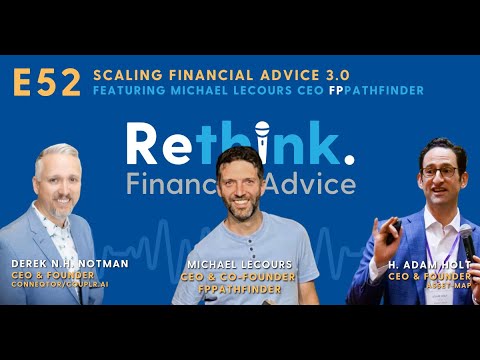
Ep52 - Rethink: Scaling Financial Advice 3.0 – Featuring Michael Lecours
Watch and Listen
Episode Summary
fpPathfinder co-founder Michael Lecours joins Adam Holt and Derek Notman to unpack what “Financial Advice 3.0” actually looks like, drawing parallels to how modern medicine scaled expertise through checklists, protocols, and shared best practices. The conversation digs into whether advisors are unknowingly leaving gaps in their process, and how standardizing decision-making can raise the floor of advice quality without sacrificing the human relationship. Lecours makes the case that the next era of scale comes from better systems, not just more technology.
What This Episode Covers
- What "Financial Advice 3.0" means for the profession
- Parallels between medical checklists and advisor workflows
- Reducing unintentional gaps in the planning process
- Standardizing best practices without losing the human touch
- Where technology fits into scaling advice quality
Full Transcript
Full timestamped transcript.
[00:00:30] Derek Notman: Adam. Are financial advisors. Unknowingly committing malpractice?
[00:00:37] Adam Holt: I don't know if I'm the right person to tell people that, but maybe. Why? That's a good question.
[00:00:43] Derek Notman: Well, think about it. We're human beings. Human beings make mistakes, right?
[00:00:50] Adam Holt: Mm
[00:00:52] Derek Notman: And I know, for example, a good friend of mine, his name is Adam has a lot of to do lists in his brain. Okay.
[00:01:01] Adam Holt: you mean someone who's looks and sounds like me
[00:01:04] Derek Notman: Yeah, it's, it's remarkable. Like you guys could be the same person,
[00:01:08] Adam Holt: Okay. Okay. Okay. Okay.
[00:01:11] Derek Notman: but think about it. So we, as advisors have, we serve what hundred, 200, hundreds of clients or households, depending on what type of advisor you are. And how do you remember to do everything you're supposed to tell your clients to do? How do you remember to ask every question? How do you remember to tell them to do every single planning thing you're supposed to do? Humans are naturally bad at remembering everything. are we committing malpractice? Maybe not with intent. I sure as hell hope not. But are we committing malpractice by simply forgetting to do things?
[00:01:51] Adam Holt: Wow. I just had an epiphany
[00:01:54] Derek Notman: Okay,
[00:01:55] Adam Holt: and the epiphany was rooted in your question, which is there is no true standard of care for financial professionals.
[00:02:12] Derek Notman: that's good. That's good. There isn't.
[00:02:14] Adam Holt: And it's not like medicine that has a code. . We have best interest advice. Nobody can figure out what that really means. Department of labor, fiduciary responsibility. Everybody's just doing business. Like they always have. Maybe they've got an extra form. There's a form. There's an ADV. I'm still doing what I was at. I'm looking out for my clients. I believe that I'm acting in the best interest, but malpractice is a completely different question.
It's asking, are we actually practicing in a way that is detrimental to our clients and in the absence of actually doing certain things, are we actually hurting them?
[00:02:58] Derek Notman: Yeah. Yeah. Even if we're not intending to, we still could be hurting our clients.
[00:03:03] Adam Holt: from a negligence standpoint.
[00:03:05] Derek Notman: Yeah, for sure. I
Mental bandwidth. Can you remember all the stuff from the secure act? I mean, that's just the tip of the iceberg of all the things, right? I mean,
[00:03:14] Adam Holt: look it up.
[00:03:15] Derek Notman: you look it up, right?
But then how do you know when to look it up for which client and when?
[00:03:21] Adam Holt: What a good question. I keep an enormous amount in my head. I actually do have lots of tools that I keep my to do list, but they're almost running to dues, right? This has to get done, or this is a new project or that's a high priority or, and you're constantly just managing projects.
But I think we're talking about something deeper when you're meeting with those a hundred clients. And you're replicating and scaling the process and the experience that somebody is going to have for which they're paying you some money, right? Either AUM or fee or whatever it is, are you delivering a consistent process to everybody? That's a great question because I think most of us think we are, but that might actually be in our head.
[00:04:05] Derek Notman: I think so. Yeah. And unfortunately, our clients probably don't know that something is missing until a life event happens where it's now too late to do something about it.
[00:04:16] Adam Holt: Oh, you know where this happens a lot. This happens in long term care planning where advisors don't want to talk about it. And then all of a sudden, it's the next generation that goes to the advisor and says, you've been managing parents money. For the last 20 years. How come you never brought up long term care?
Cause we just spent all that money you manage and now there's no inheritance. So guess who I'm suing for malpractice. Wait, what now practice? I didn't do anything wrong. I manage your money.
[00:04:40] Derek Notman: Keywords. I didn't do anything.
Right?
[00:04:45] Adam Holt: wow. That's a great pickup.
[00:04:47] Derek Notman: There you go.
[00:04:48] Adam Holt: do anything wrong. You didn't do anything. You're right. Great point. That's interesting. Interesting line of thinking. So this came up actually partially in a conversation with Michael LaCour. I think his profile is going higher and higher because he's FP Pathfinder, and that's a tool that I've had exposure to for the past bunch of years, and this kind of came up in our conversation, Derek, with him, and I think you brought some really great accolades to this.
Now, if you don't know, , FPPathfinder, they're a tool that's used by over 4, 000 advisors. Who recognize that checklists flow charts and advice engagement tools really help them deliver a scalable practice experience with value. As we've all been trying to struggle with in this commoditized world, how are we adding more value?
So, , I think we'll appreciate Derek, , how he started in the practice. He's obviously a professional, but he also started this project with Michael Kitsis and it's really kind of taken off.
[00:05:45] Derek Notman: It's a great story. Great origin story. Let's hear what he has to say.
/
[00:05:48] Michael Lecours: I'm a financial advisor and co founder of FPPathfinder. And FPPathfinder really got born based out of my own personal frustrations, just like you, Adam.
[00:06:00] Adam Holt: And Derek,
[00:06:01] Michael Lecours: Well, yeah, Derek too. The problem I had was that clients would call me up and they'd ask a question.
Can I make a deductible IRA contribution? Like real basic question. And I kept screwing it up. The rules kept changing. They were like five questions you had to ask. I always seem to mix up one and then I'd have to call the client back, apologize, clarify, and then provide the accurate advice. And it got so frustrating that I actually just sketched out a little flow chart for myself just to keep it straight.
Other advisors saw it. I turned it around. I sent it out to others. They liked it. I didn't send it to bloggers and it led to Kitsis. So Kitsis. , emailed me and goes, I've been thinking about another business along the lines of checklists, similar to the flowchart aspect, where we're helping to guide conversations, uncover planning issues.
You want to talk about this? You want to see if there's like a way we could partner together? And I'm like, it's Kitsis, like, of course, like , sign me up. , and so we, we started FP Pathfinder. It was really just. An experiment to see what happened and it actually did really well. We've got over 4000 advisors now using FP Pathfinder and it's morphed in like three different ways.
So some use us internally and some are putting us in front of their clients directly like they're putting the checklist in front of the clients. And then others are using some more interactive features where they're trying to create sort of like a repeatable system of working with their clients.
[00:07:34] Adam Holt: Michael, what is your unique perspective of the financial advice market
[00:07:38] Michael Lecours: Yeah. , I am a, I'm an advisor. I've got FP Pathfinder that I helped to start that several years ago. And really the genesis of all of this. comes to something and I didn't know it at the time, but it's providing advice at scale. And five years ago, that would have been silly to be thinking about and talking about it because we were actively saying as an industry wasn't really a thing.
But I struggled with certain things about how to have conversations with clients in a way that was repeatable because a lot of the conversations all had similar themes, but I would go over and I had to like reinvent the wheel every time, or I'd have to go like double check all the rules. And I needed something to help me.
Save some time. And so you marry that up with a book that was written by Atul Gawande of Checklist Manifesto, and like those two concepts come together to where we are now, where there are these simple frameworks, checklists and flowcharts that can help provide that outline to help advisors. Have those kinds of conversations with clients in a systematized way.
[00:08:54] Derek Notman: It's really cool. And you're bringing outside influences in and then applying them to the financial advice space, which is great. We see that actually quite a bit, . Now, given your experience, you're still an advisor, you get your finger on the pulse. What is the missing opportunity that advisors don't see coming, or maybe are, or maybe not addressing?
[00:09:16] Michael Lecours: So as I look out, like across the industries, different industries, because we, we try to get different perspectives. We do come back to healthcare, uh, numerous times there, that profession, the doctor profession is just several decades ahead of where we are in many aspects. , and one of the things that really inspired us, especially with that, the book Atul Gawande wrote, Was his experience of seeing what was going on in the medical field.
And so basically the World Health Organization called him up and said, we've got this problem. There are all these people dying and all these complications happening that are creating a lot of really big problems. And it's, it's just forgetting to do something. That's it. Doctors across the world were forgetting to do simple things.
Check the patient's name, this surgery for this patient, left leg, right leg. Make sure we clean this, like we laugh because it's kind of silly. That's literally the problem that doctors are running into. They go, I do this surgery all day long. I don't need a checklist. I can do this thing in my sleep.
That's the problem. They get in a routine and then all of a sudden , they forget. And the research came back like one, 1% of the time, there would be a mistake that would be made in somebody's level of care. Yeah. And, and okay, 1%, not a big deal, but there's so many people and there's so many steps and so many things happen that that compounded to create a problem that the World Health Organization had to step in and fix.
So you can take that and extrapolate that out and take that to what we're doing. We have a similar issue. There's all these planning issues out there. As advisors, we can't keep track of it all. It keeps changing. I can't keep track of how the rules change from Secure Act. Three years ago, let alone the ones that are in effect now and the ones that are going to happen next year.
So we need these guides, this is really important for us. just to , keep our clients from making a big mistake.
[00:11:28] Adam Holt: See, that's really amazing. Cause I can relate to that on so many levels, not the least of which is the healthcare side, right? That 1% might've been that, and that they left the tweezers inside of you. Right. That, that was the, that's a big outcome. I can , make a life changing difference. , but also as a financial professional, like the two of you, there's no way that I'm, if I were to be really honest and get the hubris out of the room, that I can remember every single thing that could affect , this client.
So I'm really curious, what action steps do you recommend that advisors need to take now, or what do they need to rethink about in their own
[00:12:02] Michael Lecours: . Okay. So here's what we're like. We, we study a lot of our advisors. We're asking them our advisor members all the time. , , how do you see this shifting? And the theme that I'm really picking up on right now is that advisors are breaking apart the annual client review meeting. All right, that's like you meet with the patient, you're a doctor, patient comes in, you do the physical and then I'll see you next year unless there's a problem, right?
I would think you can't cover everything then. , now take it to being, you're a financial advisor, you have a client come in, you try to cover all there is to do with them, can't do it. So what, what we're seeing is they're breaking it up into more bite sized nuggets and they're spreading it out throughout the year. one, let's just look at your taxes. Quarter two, let's look at investments. Quarter three, we'll do insurance. One year, we'll do estate planning another year. And then quarter four, let's just look at end of year planning opportunities. And , so one aspect is that it's just let's break that annual client review meeting up.
Another one is saying. We do a lot of work behind the scenes for our clients all the time. We don't get credit for it. That's our shadow work. Let's bring them into the fold a bit more. Let's not just go through and double check that, Hey, this client, they satisfied their RMD. Let's move on. No, let's stop.
There's a planning opportunity that happens right there. Do they actually have to take this RMD and put it in their bank account or should it go somewhere else? Or should it be tied up to doing like a qualified charitable distribution? All right, let's, let's fold them in on some of that shadow work that we've done or at least show them that we've done it because it might raise and elevate the conversation about something like an RMD.
And then I think it's just about creating these processes. Don't try to keep everything up in your head. Actually have it like listed out and being able to say like, this is what we do to our clients. We do this in quarter one, we do this in quarter four. , breaking it out in that way.
[00:14:04] Derek Notman: I really like how you break down those action steps. They're tactical. And as I, if I put my advisor head on, those are things I could easily incorporate into my annual review process. They're not overwhelming. If you've got those checklists or flow charts to be able to do those things, it becomes pretty systematized.
And I think you're spot on, there's a lot of shadow work as you put it, that is, there's no credit given due. And if we're trying to. Show the value that they're paying for. What a great way to do that without actually creating a whole bunch of extra work in the process. So I, Mike, what controversy, what debate, do you think our community should be talking about or hearing that isn't being talked about?
[00:14:47] Michael Lecours: Well, I think that this is really part of it. It's this idea of uncovering these planning issues. How do we keep doing this? And how do we make this like a system ties a repeatable process across the board for all advisors? Were fortunate. We've grown more than we really expected.
We ever could 4000 advisors or so. There's still a ton of advisors out there that aren't doing that. They're not thinking like that. And they're doing a disservice to their clients in a lot of aspects. , we need to be waking up as an industry and just realizing that there is so much going on in , our clients lives, how can we help them?
And how can we do that in a way that's scalable?
[00:15:27] Derek Notman: Yeah. Adam has mentioned this before. Other many conversations is that the costs or price of doing something wrong with our clients. When it's a very big potential problem, we don't want to make a mistake there. That's why they come work with us in the first place.
But if as an advisor, we're already super busy, and we've only got the mental checklist. So we're I mean, it's human to forget things, right? There's a huge opportunity here, but but they have to actually systematize through what you're talking about . And it's just it makes total sense. And Especially for a fiduciary, we don't want to have the malpractice situation like a doctor does.
[00:16:05] Michael Lecours: Right. And malpractice is one aspect of it. But, , the other aspect is that you have a client. Where you know, everything is fine with them, but how do you keep showing that value to them client? They're retired. Everything is on track for great retirement for them. How do you keep showing value and providing value to that client?
It's like, okay, now we have to go look for some issues to go work on. Like there's other things out there that maybe we weren't thinking about. It's not going to blow up your financial plan. It's not a malpractice thing, but it's providing a bit more value. And that's the other aspect that these checklists can help.
We're going to keep improving your situation above and beyond just protecting you in case, so you don't make a mistake. Yeah.
[00:16:50] Adam Holt: You know, an interesting aspect to this that I'm thinking about listening to you, Michael, which is someone told me many years ago that medical malpractice. Was statistically lawsuits. Were higher when the patient claimed that they did not build a relationship with the physician before the surgery, for example, and that was evidenced by a couple things.
Number one, the physician didn't take time to educate. The physician treated me like a commodity or like not a person, but a surgery check it off their list and the reason why that was important is because when they had a bad outcome or an unexpected outcome, it didn't feel like I got the right kind of treatment when they had a relationship with the physician.
They didn't sue. They're like, ah, I can't sue Dr. John. But if they didn't have a relationship, they were 10 times more likely to sue. And so that malpractice actually relates to bedside manner. Now, the important aspect of that is that a physician or a financial professional, whether they're guided by best interests, DOL, or other regulatory suitability, or just being at best advocate that they can be really is well served by educating their client.
Being thorough and not treating the client like a commodity. And I think that that's really one of the things that you're actually empowering advisors to do and get that bench without having to build it themselves.
[00:18:23] Michael Lecours: Yeah. Wow.
[00:18:25] Adam Holt: bedside manner and
[00:18:26] Derek Notman: but it makes sense, right? You know, scalable bedside manner, you know,
[00:18:31] Michael Lecours: Yeah.
[00:18:32] Adam Holt: on the reverse, isn't it true that the financial advisors are really getting commoditized to so effectively what Michael you're saying is that we need to continue to prove what you do for me lately, right? So when we fixed 80 to 90% of the maladies of their financial well being. Now we have the time to work on that last 10%.
And that might take twice as much time as getting to the first 80 or 90%. Because the details it's like, how can I make a tax nuance or a legal protective shell around you? Or how can I deal with the state planning and think about legacy and charitable impact after I've covered the core needs through, let's say, typical financial planning.
And I think . It's those ancillary areas. Those will look less focused on areas that the highest net worth always expected us to deliver for them. And you've actually, scaled that
[00:19:20] Michael Lecours: yeah, that's , really well said. Right.
[00:19:23] Derek Notman: we got your blood pressure in check. You're all good. , you're healthy. You're stable. Now what?
[00:19:30] Michael Lecours: Do any of you listen to Peter Atiyah?
[00:19:32] Adam Holt: Who's Peter? It's yes,
[00:19:33] Michael Lecours: Oh man, this guy. . So he wrote a book. All about longevity planning. So he's a doctor and he's pushing this whole aspect that we live in a world of medicine 2. 0. We fix you when you're sick.
That's where malpractice comes in for our industry. Like, let's just make sure we don't make a mistake for you here. But what you're describing now is like the equivalent of medicine 3. 0. It's like before you're even pre diabetic is the doctor helping to coach you on aspects to avoid you even getting to pre diabetic.
Right now, they won't even talk to you until you're pre diabetic.
[00:20:11] Derek Notman: Oh, this is good. This financial advice 3. 0
[00:20:15] Michael Lecours: Yeah. And so,
[00:20:17] Adam Holt: 1. 0 1.
[00:20:20] Derek Notman: I don't know, but I'm going to 3. 0 because it sounds good.
[00:20:22] Adam Holt: 0 was selling you insurance. 2. 0 is selling you investments, but doing financial plan 3. 0 is you do the plan. First, you don't sell any product unless it suits. I don't know. What is it?
[00:20:33] Derek Notman: but it's what's proactive, right? Just like he's saying, just like Mike is saying, it's proactive, like, hey, to not become diabetic, here are the things you should do. Right.
[00:20:42] Michael Lecours: 2. 0 is we're gonna get you retired, and you wanted those big goals, we'll get that covered for you. 3. 0 is what you're talking about. You've got more value each year and we're going to keep doing that and that's going to have these huge compounding benefits over time, that's on top of you already being able to retire .
Now all of a sudden you've got a much better, , estate planning, you can be more charitable than you ever imagined.
[00:21:11] Derek Notman: It almost feels like your financial health is better. Or, but.
You feel better about who you are and the choices you're making and in tune with everything. You just, you feel good.
[00:21:25] Adam Holt: Do you know what you guys just did? Just literally created a framework for the history of our industry, financial services. 1. 0 was you buy the product, regardless of your wellness,
[00:21:39] Derek Notman: Yep.
[00:21:39] Adam Holt: you bought, you're bought it, you're purchased, you purchase, or you're sold 2. 0 was you got financial planning and then you bought the products.
3. 0 is all about wellness. It's all about mindset and. Being preventative care, ongoing care, holistic care.
[00:21:56] Derek Notman: Preventative.
[00:21:58] Adam Holt: And that's arguably where we all think the market is going and why advice engagement has been so critical because we've got to get everybody who's operating in 2. 0 and still in 1. 0 to move to 3. 0 and they need a framework to get there and what you're doing at FPPathfinder is actually giving them the tools to walk in the room and be a 3. 0.
[00:22:16] Michael Lecours: Right. I got like goosebumps
that's everything.
[00:22:19] Derek Notman: Do that's money. that's awesome. That's going to get some attention.
Wow, Adam, that was really cool, man. Just seeing the, almost it happening in real time, we've mapped out financial advice, 1. And now this thing we're calling 3. 0, and we're going to claim that title for ourselves, by the way, that's ours now, so
[00:22:39] Adam Holt: we're gonna, that's it. We're gonna have to write it. We,
[00:22:41] Derek Notman: we're good.
[00:22:41] Adam Holt: we trademarked it as my daughter said. She said, I just copyrighted that dad. That's, that's now anything I say.
[00:22:47] Derek Notman: Love it.
[00:22:47] Adam Holt: I can't use it again without asking her permission. Like go to bed. Trademark. How about that one? Do your
[00:22:54] Derek Notman: see your kid doing that, dude,
[00:22:56] Adam Holt: She does.
She does that to me.
[00:22:59] Derek Notman: Just a really interesting conversation and he's right, , there is this malpractice. And I think the thing that he references that stood out to me initially was what about the 1% of things that the doctors are doing wrong? Right? And then, , we apply that to financial services and we actually end up having quite a scalable issue.
Even if just 1% of the time, we're all forgetting to do something. Yeah. So I really liked how we can try to overcome that and really having better bedside manner, if you will, how are we going to be helping our clients and not leaving the clamp in the body, so to speak, you know, cleaning the wound, being a little bit better about
[00:23:40] Adam Holt: Washing your hands, right, wearing a mask. Yeah, that's an interesting aspect to financial advice. I think because we opened up, there's not the same institutionalized rigor on inspecting your process. Of course, we all have audits, right? So there'll be an audit function. And pretty much most broker dealers historically and insurance companies and even RIA space has to do it at some level, but they're inspecting one out of every 10.
They're not necessarily inspecting process. And that's the difference is that. When you have a situation where there's mass attacks, like malpractice attorneys coming after you, you have to build a process that's so scalable that it's bulletproof, right? That you're going to have a 0.001% error, like as opposed to a 1%. And that means that everybody has to follow the same exact process. The challenge I found is that most financial practices I've talked to their process is very unintentional across the board. It's really, they provide a robust process for their top 10, 20 clients, really deep, really personal overbearing, like really involved.
Cause you can't lose them and everybody else doesn't get anything, but a statement and maybe a call once a blue moon from the junior. And I think , it's interesting because if there is a kind of change in the regulatory environment towards show me your process, that's defensible every single time, that's going to require a lot of workflows and a lot of intentionality on checklists.
Did you do this? Did you do this? Did you do this? Even if it's boring and like rolling your eyes.
[00:25:11] Derek Notman: Yeah. But you know what? I mean, using the medical analogy, if it saves lives, there's a cost. , and I, 1 of the things that, that Mike also mentioned is that we've had some fee compression, although it does feel like, that's starting to level off actually a little bit.
But there's, there's more transparency and I think , the customer has more expectations. So the challenge is, is how do we show our value? How are we scaling the value that we have? And it's not by selling them more accounts, that's not how we show the value that we have to go further than that.
And that's kind of what led to this progression of 1. 0, 2. 0 and now
[00:25:48] Adam Holt: yeah, you know, it's an interesting idea to, I think that his comments on ego tends to drive advisors from, let's say, accepting the fact that they need to create process right now for, I'll remember all the things I know what the stitches come next and then the antibiotic and then, and then, , next thing you know, they're talking about what their kid is doing after school and they forgot the clamp, like you said, it wasn't intentional,
right? But how much familiarity with doing the job, like driving on the phone, uh, somehow you get home. We don't know how you got home, but that process is really required at scale and has to supersede ego and familiarity with the job. And it's interesting that he mentioned this scaling that very often in order to scale, you need to delegate.
And that means I need to delegate to people. That may not have the same familiarity or experience that I have with executing, let's say a financial planning review or , an estate planning, uh, analysis. So that means you have to have processes that people can follow so that they get the opportunity to learn the job and deliver , at a level of preeminence that you'll be proud of.
And that represents the practice. .
[00:26:51] Derek Notman: That's exactly right, because if you're the lead advisor at that firm or group, whatever, what if the clamp got lost in you,
[00:26:59] Adam Holt: No,
[00:27:00] Derek Notman: You know, you're out for a while, you need everything else to be replicated where anybody, any doctor, quote unquote, can walk in and do the same thing and provide that client experience.
[00:27:10] Adam Holt: Boy, that is true. I guess that begs the question though, if we all take on the same exact process that we just commoditized ourselves, or is there really then going to be a differentiation of those who have process and those who don't,
those who
[00:27:21] Derek Notman: that for sure. I agree. Yeah, there's definitely a differentiation between those who have processed and I don't think we will ever outsource ourselves as advisors entirely. Money is a very personal thing. And when it's something as personal as it is, trust is an extremely important factor and human beings tend to trust.
Other human beings for a variety of reasons, human reasons, right? That you just can't outsource. That's what we're doing a Couplr.ai, right? It's that it's that whole foundational aspect where we're starting with that. So, no, I don't think I would ever be worried about that. I would be worried about process versus non process. You don't have it. You can't show it. You're not showing that value to your clients.
[00:28:05] Adam Holt: You know, that's a curious thing. I mean, , I haven't hired a financial advisor in many years, although I do have a financial professional works for me, because I know I can't manage my own money. I'm too emotionally connected. Like you said, so I have, I have a money manager. I know some people in the business,
[00:28:18] Derek Notman: do I.
[00:28:19] Adam Holt: , you know, but I think if a financial professional came to me and said, if I asked them, what's their process, And they can't really explain it or diagram it, or one might argue they don't actually have a process.
And one of the things I think that Michael is talking about with that P Pathfinder is he's actually able to show you a brandable because it's white label. Process for all these different events that you're going to have in your life. And here's a checklist when you lose somebody, when you got to make your filing, when you got an annual review.
So that process becomes instantly plug and playable into your practice that you can actually show you have a process.
[00:28:54] Derek Notman: Think about what a cool experience that is. If you're a client's interviewing you and other advisors and they ask you, what do you do if this happens, you know? Or they're asking you to show the process and you can say, well, look, check this stuff out. I can help you. If this happens, here's what we do.
If this happens, here's what we do. And all of a sudden you proved your worth, you know, very quickly and visually too, which is really important.
[00:29:15] Adam Holt: he talks about that actually in his. Annual review, the change up in terms of going from a once a year annual review to a 4 times as an example, and I know on FP Pathfinder, he has actually this outline. I've seen it. You can create your own format of what you're going to talk about. In the three or four times you meet brand it, put your logo on it, and then share with your clients say, okay, here's what we need to do.
And here's all the process we need to do and really shows that you've got an intention behind this thing that they are paying for. And I think in this kind of new transparent world, Derek, I think , these are going to be table stakes. And if you haven't thought about that, your client's 10, 000 a
[00:29:54] Derek Notman: Oh, for sure.
[00:29:55] Adam Holt: and what for money management?
[00:29:57] Derek Notman: yeah, no. Oh, what did he say? He called it , shadow work. Didn't he say something like that where there's so much work that advisors do behind the scenes that never gets shown. But even something as simple as chunking up your review meetings into three or four a year, and you simply give them a one pager here, the things we're covering and why we're covering them.
This is the checklist, Gary. And then now all of a sudden, like, oh, wow. My advisor is thinking about, social security, Medicare, Roth conversions, , require minimum distributions. My kid's going to college taxes now all of a sudden, , Whoa, there's a lot of value here. My advisor has the answer to each one of these things.
If they happen to me, huge,
[00:30:39] Adam Holt: Very smart. That's I mean, those are, these are things that are take us forever to create in our practice. A lot of thoughts. So very cool it would be remiss if we didn't talk about advisor 3. 0, our new trademark.
[00:30:49] Derek Notman: Oh, I love this. Yeah. And don't let your daughter buy the URL, man.
[00:30:53] Adam Holt: Why it's already, I purchased it. It's done. I copyrighted it. When you speak it and it's recorded,
[00:30:59] Derek Notman: It's done. Oh, man,
[00:31:01] Adam Holt: Okay. So we're good. We're good. No one else can use it ever.
[00:31:03] Derek Notman: ever. Well, they can, no, they could pay us a licensing fee.
[00:31:06] Adam Holt: That's right.
I mean, I thought about this and we obviously started riffing and you could hear the excitement behind it.
This is very aspirational, but I had to contextualize it. What is 1. And for the most part, as you and I both know, we started in 1. 0 as agents and reps that were solution based salespeople that used needs analysis in that advisory capacity to conclude. An action, right? Solve a problem, typically under insurance, asset management, education, retirement.
So we had the idea that we had to sell the problem, but our interest was really to sell the solution
[00:31:50] Derek Notman: Yeah, that's how we got comped.
[00:31:51] Adam Holt: And that was the way most of the market still to this day is actually organized. But 2. 0 came out strong when financial planning became big, both of us became CFPs and we used financial planning because it was.
A better alignment of our ethos. I think we were more advisors than salespeople. We liked helping people. We liked being knowledgeable in the room and being the smartest guy there and helping people and being a resource. And , those things rolled up into what we tend to call advice 2. 0, right? That's really the major theme of where a lot of RIAs fee based planners are investment advisors, but it's truly still a sales enablement process to earn the right to manage money or earn the right to place the insurance or charge a fee. And I think that , there's a new thing coming and I talk to me about what you think advice 3. 0 is going to be.
[00:32:43] Derek Notman: I agree with you. I think this has been a really nice way to frame the progression of financial advice in general, but 3. 0 to me is all about preventative. Proactive, how do we help clients get ready for things that are going to happen to them or might happen to them? How do we educate them and be proactive versus.
Oh, you just got divorced. Shoot. Sorry. I didn't know about that. , let's take care of it now. Oh, you just had a kid. Oh, okay. I didn't know about that, but let's get you some life insurance.
[00:33:17] Adam Holt: totally.
[00:33:18] Derek Notman: Not that that's bad because at the end of the day, if the client's getting the thing they need. The advisor is still providing some value, but the consumer has more transparency into what we do than they ever have.
They have higher expectations. They want more value. So being a proactive financial advice 3. 0 type of advisor. That's how you drive it. We're helping. Do all of those things. It's more collaborative. It's more coaching. It's we're talking about your feelings and your behavior a bit, which can feel a little weird, but let's face it.
Money is personal. , it's tied to emotion, so I, I do think it's going that way, but you mentioned something earlier where it's aspirational and I agree because I don't think anyone's always ever going to get to 3. 0.
[00:34:09] Adam Holt: hasn't happened at mass scale. Because consumers aren't demanding it because they don't even know that they want 2. 0, let alone 1. 0. Okay. I think they're starting to understand as they hit the retirement scene, mostly the baby boomers and kind of pre retirement, they're like, oh, I better do some holistic planning.
I need a financial planner. It's getting too complicated. So they, they argue that they need a specialist. They need a concierge doctor, not just a attending or a,
[00:34:34] Derek Notman: Primary Yeah. Yeah.
[00:34:36] Adam Holt: Yeah. So they want a concierge. They believe they're going to get more services from that. They're going to get more diagnostics, things they didn't know to ask about.
Like what, whether your jugular has some kind of, blockage in there, they're doing an EKG every year, whether you need it or not. So I think that preventative attitude is really going to force a lot of advisors to , rethink how they charge, because
you're looking for ongoing diagnosis to help be preventative, to see whether you're on track, kind of like the financial Fitbit, if you will.
[00:35:06] Derek Notman: Yeah. Well, we even mentioned it around financial wellness and health and , we're healthier. We feel better if we are more preventative and know these things and can preempt things that are coming. And I, I sure as heck know, I'd rather feel good going to my doctor and having a game plan of things I should do to stay healthy and stay feeling great versus, oh man, you got to lose 50 pounds, dude,
that doesn't feel so good.
[00:35:31] Adam Holt: You know, what's really funny. I tended to talk to clients about this retirement as a dominant factor of financial planning was broken down into the go go. The slow go and the no go years and how long your go go years are basically when you tend to be spending more traveling, seeing the grandkids running around the country, doing your world tours, doing the things you didn't do during your working years, Make it up for lost time. The go go years. The reality is, is that , we're actually advising people on how to manage their money through those years. How are we helping them expand? How long those years can be and that's why I think that you're starting to see mindset and wellness and coaching on longevity and how you can extend the useful quality time that you have.
Not just deal with the money and distributing it. I think we're starting to see this idea of true North mindset of why does it matter? Why are you working? What's that behavior that supports it? And I think you're going to see more advisors. Now this was, has been available to the high net worth community for years.
We used to call this family officing and that has been inaccessible because you needed to have either a hundred million dollars or the ability to spend a hundred thousand dollars a year. On having a team of experts really be there for you, but technology is allowing us to scale this. So you're starting to see, we think this emergence of advice 3.
0, a proactive, holistic, comprehensive, collaborative. Advocate who's acting in your best interest, even when you're not thinking about it. And that's what I think about being on retainer. Can I have someone like this? Who's literally on my family staff, who's looking out for my best interest and all the things that touch money.
And I don't know if that's going to be the dominant player in the space. I think, I think 1. 0 sales, just get something
[00:37:15] Derek Notman: It has its place.
[00:37:16] Adam Holt: But I think it has the possibility of taking over advisor 2. 0. I think it could take a lot of market share, and I think you're going to see advisors who are financial planners starting to move into the space or enabling that capacity.
So it's important for us all to rethink how this plays into our own practices.
[00:37:33] Derek Notman: I can't even add anything to that. Boom. Done. Well said.
[00:37:37] Adam Holt: All right, well, let's take that. Thank you, Michael LaCour, on being part of this program. And hopefully everyone goes out and checks that out and sees and ask themselves, what's your process and how can you scale it? Let's talk about our LinkedIn community question, Derek.
[00:37:52] Derek Notman: So this is from Genevieve.
[00:37:55] Adam Holt: It's actually Jean Pierre. Genevieve. How about
[00:38:00] Derek Notman: She's from Paris,
[00:38:02] Adam Holt: she's from Ohio.
[00:38:04] Derek Notman: Southern Ohio.
[00:38:06] Adam Holt: Okay. So that's the difference where they make wine. That says how ignorant we are.
[00:38:11] Derek Notman: She brings up an interesting question. So there's been a lot of chatter about AI and chat GPT specifically within wealth management. So she's asking, , what do we think about it? Can you guys riff on that a little bit? So we can riff for a minute now, but I think we need to bring an expert in to really talk about it.
Now, I know you, more so than myself, really dove into the AI pool, the deep end.
[00:38:39] Adam Holt: I'm a gadget guy, Derek.
[00:38:41] Derek Notman: I know you're a gadget guy, but even, but for creating content, for example,
[00:38:44] Adam Holt: I just got my 3d printed. Laptop holder so that I can, it'll hold it up on an angle on me. Cause I don't like it taking picture up. When I'm on a video. So I got this elevator thing and I had it 3d printed. So I'm a gadget guy.
So yes, you're right. The chat GBT thing is really interesting to me. I use it actually more than most people would realize to summarize a whole bunch of stuff, but there's a real big challenge here. And I have a bunch of fear around how the regulatory agencies are going to look at chat GBT not too far in this future, because it really begs the question.
What kind of data is, is in there? What were you putting client data in there? How am I using that? Uh, is that violating InfoSec rules for your
[00:39:25] Derek Notman: Oh, man. Yeah. Is it considered advice now? If I produce this and distribute it, even if it's just a blog post, you know,
[00:39:32] Adam Holt: yeah, that's a great point. Is that defensible in court? What is arbitration going to say? So I think there's an enormous amount of problems that are going to come out of this awesome innovation and nobody knows what it is, but. We can't ignore it. So we did bring in somebody.
So I'm excited for our next guest. You know, who it is. I'll let everybody stew on that one. , because he's a total industry leader. I'm looking forward to that one.
[00:39:55] Derek Notman: Cool brother. Well, Genevieve, thanks for the note. We appreciate it. , enjoy South Ohio.
[00:40:01] Adam Holt: Jean Viez,
[00:40:03] Derek Notman: Good job, and, uh, anyone else listening out there, you can send us a note, a question, kudos,
[00:40:09] Adam Holt: And how to pronounce your name
[00:40:10] Derek Notman: and how to pronounce. Yeah, we need the phonetics.
[00:40:13] Adam Holt: That's right. That's very important these days.
[00:40:15] Derek Notman: very important.
[00:40:16] Adam Holt: All right. Thanks, my friend. This was a blast as always.
[00:40:19] Derek Notman: Cheers, brother. Good seeing you.
[00:40:20] Adam Holt: All right. You too.
The content has been made available to you by Asset-Map for informational and educational purposes only.