
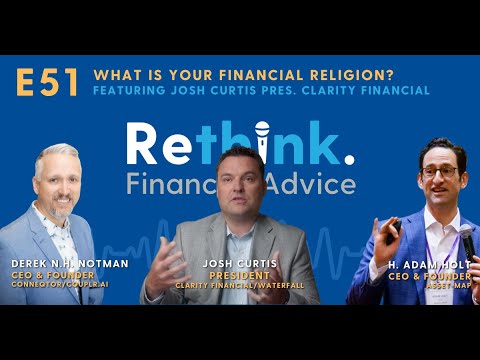
Ep51 - Rethink: What is Your Financial Religion? – Featuring Josh Curtis
Watch and Listen
Episode Summary
Independent advisor Josh Curtis joins Adam Holt and Derek Notman for a candid conversation about “financial religion” — the deeply held beliefs and philosophies that quietly shape how advisors build and run their practices. The three trade stories about the investment and planning dogmas they once followed, how their views evolved with experience, and why self-awareness about these underlying beliefs matters for serving clients well. The conversation is a reminder that every advisor operates from a personal worldview, whether they've named it or not.
What This Episode Covers
- How personal beliefs shape an advisor's investment philosophy
- Moving past inherited industry "dogma"
- Building a practice around authentic values
- Balancing conviction with client-first flexibility
- Lessons learned from years of evolving as an advisor
Full Transcript
Full timestamped transcript.
[00:00:30] Adam Holt: Derek, what is your financial religion? Uh,
[00:00:35] Derek Notman: That, that's, uh, that's a bit of a bold question.
[00:00:38] Adam Holt: Is it inappropriate for me to ask you
[00:00:40] Derek Notman: No, we're good friends, buddy. It's all right. You can ask me about religious stuff, politics, whatever. I'll answer
[00:00:45] Adam Holt: Good. I want, everybody wants to know what's your personal financial religion? Did, did you, you didn't get that memo?
[00:00:51] Derek Notman: No, I didn't, but I'll answer it. , It's an interesting question. If I look back on my, gee, like 17 plus years now doing this stuff, I think I've been a member of a couple different cults actually over the years.
[00:01:05] Adam Holt: Highly indoctrinated.
[00:01:07] Derek Notman: Highly indoctrinated. You know, I joined an agency distribution system, day one, and I didn't know any better. I mean, what, what was I 25? You know, I didn't know how to spell half the stuff they were teaching me, so I. I just drank the Kool-Aid, man. I was a sponge and I did it, and then I started questioning things , and I, I would say my religion has changed or evolved over time quite a bit.
Uh, and there's probably not just one. I don't know. How about you?
[00:01:39] Adam Holt: , I don't know that I know how to. Explain my financial religion, but really what we're talking about is what's your underlying belief system that gives you confidence that when you're helping people, you know which direction to help them take. Right? Not, not unlike a, a religious guide or , a Sherpa, or a a missionary, right there, there's different aspects.
I think about , this analogy. Of a true belief system, you must almost to the point of religious, almost to the point of cult, as you said, that is seemingly prolific in financial services that we really haven't touched on too much.
[00:02:20] Derek Notman: We haven't, but there are a couple that come to mind that , are definitely prolific. Almost to the point of you see , some pretty, , heated conversation and online chatter when it comes to people kind of sticking their stake in the ground for, well, no, this is the belief system that everyone should believe in.
[00:02:37] Adam Holt: right? I mean, God, you know, it's funny, this these days, polarization is so, I
[00:02:43] Derek Notman: Ugh. It's
[00:02:43] Adam Holt: Predominant, right? I mean, it's everywhere in the media from politics to, you know, to belief systems, right? Legal, it's almost overwhelming, frankly. We've talked about it in several other podcasts where, , have you ever heard this statement?
, client says, no, no, no, no, no. Index. Index is the only way I ever want to go. I have a belief system that's kind of core. We need, we know advisors who think the same thing or fee-based advisors is the only ones that , are really, serving the greater good , or people say, I don't believe in insurance.
Like, what do you mean you don't believe in, it's not a religion, , but to some people it truly is.
[00:03:15] Derek Notman: It is.
[00:03:17] Adam Holt: I think it's interesting because this came up in a conversation with Josh Curtis, and if you don't know Josh, he's the president of Clarity Financial. He's the founder of the Retirement Waterfall Method, which it's funny because Derek, he and I were talking about, um, his retirement distribution plan planning model, cuz , it's got a little bit of a buzz around it.
It, he actually has this defensible method that puts to shame Monte Carlo and 4% rule. And, and as we both know, retirement distribution is the big frontier right now for everybody. That's where the money is. And so he brought this up and then all of a sudden , he mentioned something about this bias in the conversation and he called it financial religion.
And, and it kind of went down a path. Of course, you know how we go and we thought we would bring him on to talk about this paper that he wrote that's getting distributed all about financial religion. So I thought it's a really interesting thing. I'm really curious what you think after listening to him. . We're gonna include this. His story is really interesting cuz you'll kinda understand how he came up with this concept.
[00:04:14] Derek Notman: Pay attention, you're gonna get hooked right in.
[00:04:17] Josh Curtis Tank: for all this to make sense, I have to start at the very beginning of how I grew up. I grew up inside of a religious cult. I wanted to play basketball. I wanted to play organized sports. , you can't do that. So I, I got a job, um, and I was telling my parents I was going to work, but I was actually going to basketball practice, and then I got caught. Basically came after , the decision was, I can either stay at home, stay in the cult, not play sports. If I want to play sports, I need to leave the house. So they gave me that choice and I was, , just about to be a junior in high school and I left and I never looked back.
And a lot of people think it's like, that's a really sad thing. It was probably one of the most exciting, funnest things I ever did. And I don't know how in the world I didn't end up in jail. It was awesome. It was like, you were compressed like a spring and all of a sudden that was lifted off like, oh my gosh, the world is amazing. They told me that this is all scary out here and it's not.
It's amazing. And, , so where that cult has their annual convention, , I was lucky enough to make the team went to play at the, , state championship. In the exact same arena that that Colt has their annual conference. And that was just , huge, there was no safety net. I had no one gonna catch me, nothing. I, it was all up to me to make it. And, , so made it through there, , it was really , survival mode. So I went from a cult really, almost like an agnostic atheist view. Like, I don't want, I don't want, I don't want anyone to tell me what I believe. I should believe. I, I wanna figure it out myself. Plus, I was a teenager, right? And there's also no one watching me financially. I was like, man, if I got a credit card application, I filled it out. And if they gave it to me, I took it causes like, wow, they think I can have this. So I, I get married when I'm 25 and I'm a financial mess. And it took me three years, got totally outta debt and I saw how that. Changed my marriage, how it changed my health, like physically I felt better. There wasn't this burden and at that moment I knew that was gonna be in the financial services industry at some point. , but the only connection I had was a general agent. I happened to be my step father-in-law and I was like, man, I don't know if I wanna work for family. I was like, well, I was kind of tapped out where I was at in my career. I. And I was like, oh, I'm gonna, I'm gonna do it. My daughter was 18 months old, my son was two. I had a six figure job and I quit it to go do this. And I thought I'm gonna help people with their cashflow. Cause you know, that's what really helped me.
So like the behavioral finance about cashflow and is a humbling moment where there's nothing worse as you're going broke, teaching people how not to go broke. That was a really bad thing. My wife is second guessing, why did I do this? Why am I jeopardizing our family? And I always had this plan B, it's like, Hey, I could always go to back plan B if this doesn't work out or do plan B.
And there was a point where it's like, no, I'm getting rid of plan B and I'm gonna do this. And the very next, that year I did M D R T, it was with Ohio National is where I started as a career agent. And then there was just a couple things that happened.
I was like, I gotta go independent. I can't operate this way and went independent. And luckily I had a couple of really good people around me, otherwise I would not have made it. Um, and then that's where the independent journey started. That's where Clarity Financial started. And then, um, that's also where the whole concept of the portfolio waterfall. Income strategy was the root. It started that that year, 2015, but didn't really realize that it had actually become a thing. And so I've seen life of a cult of an independent or non-denominational. My, you know, faith I have now. Then we have, , the atheist view then I got into the financial services industry. I was like, oh my gosh. There's the similarities between the two are so similar that it's almost scary and I think the more an advisor can just see it that way, not so you have to believe it all. But if you can see it through that lens, you can, I think, add more value to your client. You can, just see things more clearly cuz that this is actually how it is structured. I believe cuz I, I've lived it. So anyway,
[00:09:00] Adam Holt Tank: Josh, what is your unique perspective of the advice market today?
[00:09:05] Josh Curtis Tank: Well, , my view may be a little bit twisted but I think the similarities of. How religion is structured and how the financial services industry is structured are too similar to ignore. And you know, it's really that my upbringing inside that cult that once I was inside of the financial services industry, I start seeing all these similarities. And I shared the idea with a couple of advisors and , they totally did not see it at all. And then I started unpacking this idea of how religion and financial services is connected. And all of a sudden they can see the industry from a completely new perspective. So I think it's, uh, you know, my view because of my upbringing inside of a cult, I see it differently.
[00:09:53] Adam Holt Tank: walk us through that cuz that's, it's a really interesting article that you put together, kind of inspired this conversation. Help us understand, or for everybody listening, what is that similarity and how do we understand what camps we're in? Or recognize that.
[00:10:06] Josh Curtis Tank: Yeah, so the first thing. My goal is not to discredit religion or discredit the industry. I hope to not offend anyone, but I also want to hopefully bring up some ideas to make you, uh, see things differently and maybe rethink how what you believe in, I think when you're talking to advisors, I'm sure , you can realize this, like how many times does an advisor say, I believe, I believe, , there's all these religious verbiage that is very similar. , but I think , there's these three camps in religion, but also in the financial services world. There's the cults that say, we're the only ones right, and everyone else is wrong and we must save them. Right? When you have a newly recruited advisor that just went through their training, they have this missionary zeal that , you cannot deny it, and they are so they need to go save people. And from the sleazy salespeople that are out there, right? , that's their motivation. And then you have, the independent or non-denominational, right? So the, in the religious world, it's the non-denominational world. And then you have the independent, and then you go over to the other side of the spectrum is the atheist.
It's very short term thinking. There's, they don't really care about these, uh, consequences. The principles that they follow maybe are just not quite as deep in history. Um, those are maybe more of the transactional type, , people in the industry. And I think what clients want and where I think a large part of the growing part of the industry is this independent world that, hey, we just don't, we just want principle based things that aren't weird. And that we want to provide value that's meaningful to the client. We don't want to get to this point where we're the only ones, right? Everyone else is wrong and we must save people. I think that's dangerous. I've seen it on the cult side as I grew up. I consequences of that. What I see as a trend is, is a lot of people are maybe leaving the cult side.
Maybe call that the career side. I think the career side has a place, but they bring those cult beliefs back into the independent world, and that's super dangerous. If you think of where does someone get their business? Religion as an advisor, their initial training. A lot of times this initial training sticks with us. It's hard. It took me probably 15 years to get the cold mindset outta my mind. I think it's similar to you think someone that grew up, In the career side that was truly captive, right? You are captive. , it's hard to get those theories, those doctrines out of your mind and you can drag them into the independent world and I think having an advisor that's just aware of that is very, very helpful.
[00:12:58] Derek Notman Tank: This, this analogy , you're sharing with religion and cults , back to financial services, is fascinating and , I think you've just addressed this challenge that advisors are gonna face depending on what the client wants. And we probably have advisors from all three camps listening.
You're basically saying , maybe we should challenge ourselves here and rethink , this culture, this religion. We got initially easier said than done. So maybe what are some action steps for someone who's actually been through it on how , to break through this?
[00:13:27] Josh Curtis Tank: I think one of the first things is to be willing to test if your religion is right. Can you let the guard down? Is what you believe to be true as an advisor? Is it really true? I. That sounds simple, but it's very hard. And maybe cuz what if you find something that's not, are you willing to go back to all your clients and adjust it? That's, that's really tough. But I have gone through that painful process both in the religious side. I've had to rethink a lot of things and then I've had to also do that in the financial services world with my own practice and found that there was a handful of things that were not true that I was taught. So let your guard down. And try to find, is there any doctrines that you believe that are not a hundred percent true? Someone just told you that it was true, but is it actually true? And how do you find truth? That's the other big thing. So I love the concept of, I learned this from Elon Musk and Charlie Munger, this, way of thinking called reasoning from first principles, trying to boil it all down, like what is the purpose of financial planning? That's the very first question that we ask a client. What is the purpose? Because guess what, we don't wanna get hired for the wrong purpose. Are we gonna be their financial housekeeper? Are we gonna be their investment nanny? We want to be their leader, just like how they would maybe see their pastor in the financial world.
We want to be their leader, not just the financial housekeeper. So I think being willing to let your guard down. Is what you really believe. Is it really true? Test it? I think it's great to test it and maybe kick around that idea with some other people.
[00:15:14] Adam Holt Tank: One of the interesting things about , your kind of premise here of religion and finance or finding your financial belief system or religion is heavily predicated, I think, on how you're compensated. Talk to us of , how you're thinking about. How these belief systems play into the camps that you talked about.
[00:15:32] Josh Curtis Tank: I think that's the lure of, hey, if we're getting paid by a fee, then we obviously are doing a better job for the client. We have a higher standard and. In my own experience, I don't believe that to be true. I think it maybe can limit some of the options. , what you think of what we're trying to do as an advisor is to guard our clients from what I call financial pornography.
Looks good, sounds good. Has a, who blending well, getting paid by a fee kinda limits some of that stuff, but I don't believe that that makes me kind a better advisor just because I'm paid in a certain way. I think that's a false value proposition. I think that is something that you're hearing a lot of, like, Hey, if you're earning a commission, then you obviously didn't have the best interest potentially of the client. I don't think so, I don't think that is a part, the value proposition, it's just part of the formula the client needs to be aware of, and I don't think there's one that's better than another when it comes to quality of advice is my opinion.
[00:16:36] Derek Notman Tank: there's a lot of controversy around that, and I hope that there is some chatter on it. I tend to agree with you. I, I don't think sticking to one camp , and forcing that as , the ultimate religion makes a whole lot of sense. And how does, how I charge you ultimately determine if my advice is the best for you or not?
I, is it related? Yeah, but it's not the only determining factor.
[00:16:59] Josh Curtis Tank: I think it depends on which camp you're in. Are you in the cult side, the independence side, or on the atheist side?
Well, just cuz I'm, I'm a cult, but I also charge a fee. Then I'm right. Like, no. Well how about instead of following, cuz usually, , we wanna be principal based. I believe that's where, you know, Hey, am I doing the right thing?
Well, am I following the right doctrine? Do I have the right guiding principles that can stand the test of time? Those are the things that add value. How you get compensated is just a side piece, but it's more of your, is your religion right? Are you following the right doctrines? Are you having the right guiding principles? Is your methods and practices in alignment with your principles in your doctrine? Is all that in the right alignment? You could be earning a commission or a fee as long as you're in the right religion and everything's in alignment. That I think, is the key thing for advisors to rethink.
[00:17:52] Adam Holt Tank: So this really intriguing Josh, and interesting, I think, perspective to hopefully everybody's contemplating this, but is there anything else you think needs to be heard, debated, or that you're working on in community building? Um,
[00:18:03] Josh Curtis Tank: Yeah, I think we need to ha be open to hashing out these ideas. I think trying to do this all by yourself can be overwhelming and you have blind spots. So I think having a conversation in some groups is very beneficial. That's one of the reasons why we're right now in the midst of building a producer group to have these types of conversations and to really be the accountability of like, Hey, you said this.
Are you really following through with , your doctrine and your principles, , to try to build a community that is willing to , test our religion and then make sure that we're not drifting off into the cult side or on the atheist side. That we're staying true to our beliefs and to continually rethink things for the benefit of the industry, but also for our clients. , so I think that is a piece that we're currently working on, that we're trying to have an impact in the industry, but we have to do it together. This isn't something that you should do by yourself.
[00:19:04] Adam Holt Tank: I guess that's pretty much like most religious discourse, right? You need to have a community to help, have a healthy debate.
[00:19:10] Josh Curtis Tank: I think one of the things that I hear a lot, it's a buzzword in the industry, is we're here to educate. We're not salespeople. , we're here to educate. To me, that instantly says, I'm smart and you're dumb. I'm here to educate you. Instead, replace educate with the word serve. I'm here to serve you. That is totally different. Imagine if a pastor said, Hey, come to my church. I'm gonna educate you on Jesus. Right. No, I'm here to serve you and I hope to uncover some things that you may have not have seen. I'm not here to point out your financial sins and make you feel guilty about it. I want to serve you , and make sure that, when you go through rough times that you have people to help you financially. That's what our job is, the good times and the bad times. I think it's pretty amazing that when you typically call it pastor for help, the second call is usually a financial advisor. That's really interesting. So I hope the, this sparks some conversations through the audience , and to engage with people about this. Cause I think it is a win for all of us in the win for the industry if we can be aware of this.
[00:20:23] Adam Holt: So that was interesting. Derek, what do you think about that?
[00:20:27] Derek Notman: Man, like his comparison between different cults and religion and then he throws in atheism and then agnostic and comparing that , to financial services.
I do see a lot of similarities given just how I grew up in the industry myself. And the Kool-Aid that I, I've had a couple different flavors of Kool-Aid I've consumed over the years.
[00:20:50] Adam Holt: But do you know what's so weird about that? Because you and I both grew up in the agency system and had to be indoctrinated into , an environment where we had to very, very quickly be experts, especially amongst our family and friends. Remember that list the hundreds.
[00:21:05] Derek Notman: yes.
[00:21:06] Adam Holt: We had to look like we really had a strong, passionate, believable leadership role, which means we had to come into this missionary type of role that we knew what was best for people.
And ironically, a lot of those solutions all were things that our company sold. So in a sense, to distribute a product with a relatively young. But passionate advisor, you kinda have to buy into this belief system cult, right?
[00:21:39] Derek Notman: You
[00:21:39] Adam Holt: And you can't allow distractions of, well, what? Wait. There's other ways to do this because you know what happens when you're distracted?
Your salespeople don't sell.
[00:21:48] Derek Notman: Yep.
[00:21:48] Adam Holt: you're focused that this is the best set of knives on the planet, and you're passionate and you're going door to door, You start to become believable to a percentage of the population and they buy in and, and that's what we're referring to, I think, or what Josh is referring to as a coal, because it doesn't allow for outside influences or possible insights because you're gunning for a specific outcome.
[00:22:12] Derek Notman: You really are, and it almost makes , the hair in the back of my neck stand. End up a little bit talking about this, looking back and reflecting on the indoctrination we went through. But when you're getting into this business, man, is it overwhelming? And most of us don't do the due diligence to figure out all the different types of religion we could,
[00:22:32] Adam Holt: Mm.
[00:22:33] Derek Notman: Go assimilate with , go learn that belief system and really go with it.
So we just take , what kind of works because. We do have to get a paycheck. I gotta pay my bills. And if you're telling me this belief system over here is pretty solid and you're selling it to me hard and you're teaching me and I got my mortgage or my rent payment coming up next month, okay, , I'm gonna drink that Kool-Aid cause I gotta go make sure that, mama's happy.
Um, but , that's. a real challenge though. I almost, you're almost making me think, Adam, that what if there was a way for , advisors to be, maybe to be exposed to all the religions before they actually have to pick one.
[00:23:14] Adam Holt: Well, isn't that what the CFP board is trying to do? I mean, the funny part about it is that when you have to create. A standard or any, actually any of the accreditations, they're, you're trying to educate the advisor as best you can to be holistic or to be conscientious of different solutions.
Like here's the big travesty. My friends who grew up in the wirehouse side. And that's all they learned. They grew up almost like an athletic team, a bias against all the insurance players. They're like, oh, those insurance guys. Dunno what they're talking about. They just wanna sell you whole life.
And the whole life guys were like, oh my God, those wirehouses just wanna sell you a stock and make a commission and turn and trade your accounts and pay taxes. They don't care. Like, it's almost like culturally, and maybe the cult is in the culture. Culturally, these organizations have to. Polarize their people so that they can go out there and compete, because the reality is that they're competing for the consumer's attention.
So if you can win the customer over to your belief system, they'll be yours and they'll naturally defend against change or like, you know, don't bring that in my house. You know what I'm
[00:24:22] Derek Notman: We don't believe that
[00:24:23] Adam Holt: We don't believe in X, Y, Z, and interesting enough, because it's a business, it's like the business of financial missionaries. There's underlying a notal aligned best interest because you have to come with this passion of conviction of this is the right way to do it, because nobody has any certainty. We don't know what the heck, the f the truth is. We just have to have a belief system and then a behavior that supports it and do it like you need to save, you need to budget, you need to max, your 401k, you need to reduce taxes, right? So the behaviors are kind of driven from this principle base, but I don't know, I think it's all mushed up together in this very like, biased outcome, which I don't know how you get to a place where you actually aligned with the consumer's best interest without having a belief system that's believable.
[00:25:13] Derek Notman: Well, and that's a challenge. , and then if you are into the belief system of fee only, flat only commission, hybrid, whatever, how can you now go preach your belief system and say that that is the only belief system for all your clients? I think you and I talked about an example before about if a consumer or client comes in and all they need is the life insurance solution, that's it.
They don't need anything else. How is the fee only person gonna serve that client? They aren't most likely. And then now the client's left with nothing. So I don't think that you can just, you can't, it is too polarizing. I don't think there is a one all solution unless, is there like a financial God that knows?
Like is it all predetermined?
[00:25:59] Adam Holt: well, who's the, who is the financial Dalai Lama out there? Is it, is it Susie Orman? Uh, Is it Dave Ramsey?
[00:26:08] Derek Notman: Nope.
[00:26:09] Adam Holt: Is it right? Tony Roberts. I mean, who, who is it? Is it Michael Kitsis? mean, the interesting thing is that all of us in advice probably find a couple mentors, a couple, we'll call them, religious guides, right? That we probably adopt their thinking or.
[00:26:30] Derek Notman: pastors.
[00:26:31] Adam Holt: Financial pastors. Okay, great. Why can't it be rabbis? Gimme financial rabbi.
[00:26:34] Derek Notman: Okay, fine. For,
[00:26:35] Adam Holt: had to pull that on you just so we could make it more polarized.
[00:26:38] Derek Notman: I love it. We'll go with financial rabbis. That's better. Okay.
[00:26:41] Adam Holt: Imam. Okay. That's what you're going for, uh, our zen master, right?
[00:26:45] Derek Notman: Yes.
[00:26:46] Adam Holt: No, but isn't it true that , we probably espouse or seek it, or if we don't have one, we become one ourselves.
I mean, you and I have in a way created a bit of thought leadership around these topics. I'm sure there are people that. Tend to generally follow what we're talking maybe and take it for, you know, with a grain of salt, maybe we believe it really stringently. So that's kind of good enough. But I think people are really seeking people.
Financial advisors alone are also seeking leadership here and they're finding their own religion that serves them , and let's them sleep at night. And , that's an interesting thing.
So let's talk about their takeaways because I think there's some really important things that everyone else here can listen to and think about.
Challenge, rethink their own world.
[00:27:25] Derek Notman: Well do financial cults serve us? I think , that's a question that, that we need to think about as an advisor. And maybe we don't want to use the word cult, although I do like your culture. , I think that's a good, , a little play on words there.
[00:27:38] Adam Holt: Mm-hmm.
[00:27:39] Derek Notman: , but is . Our financial religion serving our clients, truly serving our clients the best that they need to be served.
And why does that, why does one religion exist versus another . I think that would be something I would really want to think about as an advisor, if I'm going to actually affiliate or believe in any system.
[00:28:00] Adam Holt: I wonder how advisors have to deal with this. So maybe the first question is, as a financial professional, Are you part, or could you be perceived to be part of a cult? How would you know?
[00:28:10] Derek Notman: Yeah.
[00:28:11] Adam Holt: How would you actually know? Derek? You probably would have to ask yourself the question, am I eliminating options or recommendations that are defined by my own biases or belief systems?
[00:28:29] Derek Notman: Or maybe not even your own biases, but the belief system that's been implanted,
[00:28:34] Adam Holt: Mm.
[00:28:35] Derek Notman: that you've been indoctrinated into. . So , what exclusions now exist because of that. Are you limited to market a certain way? Are you limited to certain products or services, certain types of clients and so forth?
[00:28:51] Adam Holt: It is an interesting question, but at the same time, you gotta ask, is that really enabling you to serve? Because I think there are plenty advisors that say, well, you know what, I actually I don't sell or cannot sell. Faults inside an s m a on a true fee, right?
I, I don't have that access. So am I biased because, uh, I don't have that, that style of pew in my, so no one can kneel, right? So you're not, so we eliminate kneeling cuz no one can kneel. I got like the, the question is sometimes our infrastructure dictates what our accessibility is to doing certain things.
So is that a product of my. Environment or is it a product of my choicefulness that I don't believe that those tools or strategies can work? Like I see a lot of fee-based advisors, who I would argue is becoming a colon of itself because they look down at everybody else. Anybody who's selling anything tied to commission or monetization, it's like , that's the devil, right?
Like those devil worshipers were like, really? I. So you don't actually place insurance for your families? No, no. That's the devil. I don't believe in that. Like, oh, so nobody believes in seat belts , and airbags. Like, really? That sounds like really best interest. So there's a, that's my fun debate that I have all the time. But I think , that's an important question is, is what's your capacity to inspect your own biases and restrictions. On what the experience of your customers can be in your, we'll call it financial church.
[00:30:16] Derek Notman: So further down that vein , and really almost like another takeaway here is what you believe in, is it actually true?
[00:30:24] Adam Holt: Mm.
[00:30:25] Derek Notman: And having , the awareness to be able to maybe step back , and ask those questions, well, is this really the best thing? , what are my clients seeking? Because, the more conviction I have around my belief system, the better I'm gonna be able to sell that to my clients.
Right?
[00:30:40] Adam Holt: Totally.
[00:30:41] Derek Notman: course, right? So I really have to believe in it, , but is it really truly what I need? , and I would argue that there probably isn't one. Belief system that trumps all of them when it comes to what clients actually deserve and need. Think about like ultimately, how do we serve our clients by connecting with them on a human level, by understanding who they are, by listening to them, by helping them visualize their financial situations, things that are missing, and through this process of almost empowerment.
And, and then helping them identify those gaps so they can solve those things and take action. So when we take action, the way that the advisor's compensated, or the solution that's implemented is almost an afterthought in a way , that, hey, like we did all this other amazing work and here's the solution.
You know, like we, we determine through all these tests, you're sick. You've got this issue. Here's a pill, the pill's, the easy part. And we don't really care who's getting paid to take the pill or how, how they got the pill. Just gimme the pill because now I know that you listen to me, you understand me, you're helping me.
But I don't know if there is a cult that subscribes to just that type of belief system. There's, it's multiple really.
[00:32:00] Adam Holt: Now that I'm thinking about it. I see this show up in. Technology as well. . You know, one of the most polarizing pieces of financial planning and obviously, uh, being in that space is do you believe in goal-based or cash flow-based financial planning? Do you believe in the 4% distribution rule or Monte Carlo, or do you believe in the confidence index or do you believe in cashflow buckets and set aside?
Right? There's all these distribution. Debates, which is I think ironically how Josh came up with this in a strange way when he realized there was such biases when he was designing his own distribution model. It was clearly coming up that everybody had a belief system of how it works, but the challenges of very few advisors have actually lived through a distribution.
Period themselves, they're still working. They haven't tried to turn their assets into income. And so whether you believe in annuities or whether you want to do some kind of, ladder bond strategy, right? There's so many different things here, but people have a fervent belief that that process is the best process.
Montecarlo is the best. I dunno if you've heard me on, I literally got bleeped out cuz I called it bullshit. I'm not even gonna bleep out myself here, but, the point is that people are overly confident in these belief systems, but they don't necessarily challenge. So when you ask, is this actually true or just what I've been told and I, I believed it too, so I'm just selling the belief down the line.
[00:33:24] Derek Notman: Mm-hmm. Oh, I remember that early on. I didn't ask if it was true. I just assumed it was.
[00:33:29] Adam Holt: Right? Your leader told you it was
[00:33:32] Derek Notman: And I, and I sold the hell out of whatever I was told was and then, so I guess what we're saying is take a step back, ask yourself if it's actually true. And, and, and if you have to ask for somebody else to have some dialogue on that, consider asking someone not in the same cult that you're in,
[00:33:49] Adam Holt: Yeah. By the way, if you can prove that it's true to yourself, it'll just make your belief system even more
[00:33:55] Derek Notman: Oh, yeah. Oh, for
[00:33:56] Adam Holt: It'll, but, but it'll, but it'll give you the conviction that you can defend it.
[00:34:02] Derek Notman: All day long. Yep. Till the cows come home, right?
[00:34:05] Adam Holt: Right. And that, that's truly followable by the way. If you can not only sell what you've been told, but I have had a personal come to Jesus moment on this one , and that really, really works.
In which case, I think defining your own personal religious and owning it and like saying, no, I wear it in on my sleeve, that is actually something that empowers people, I think. , and I think there was this kind of challenge like, wait, is being a cult bad? Yeah. It doesn't have to be a cult to be passion, right?
I don't do we call it Dalai Lama a cultist? I mean, probably not. For some reason, , we don't believe that's the same thing. So, but the point , is I think there's an interesting dichotomy here. , and it's really important that you bring it up, which is just challenge what you believe. Just challenge, right?
Rethink it. What's the third one? , what do we have as number three?
[00:34:52] Derek Notman: Well, initially when he said this, it almost rubbed me the wrong way, but I li I heard him out and he actually makes a really good point here. So a lot of us, not just the two of us, but a lot of us talk about financial education and the importance of financial education. And yes, education is important, but if we are there speaking the gospel, talking about our belief system in an education, Format.
We're basically saying, Hey dummy, come over here. I'm going to educate you on everything you've done wrong. Force you to come to terms with the mistakes you've made, and then we're gonna try to fix it. And I don't know if education would go that far all the time, but I can see , that perspective , and , he uses the analogy of, , a pastor doing this.
Well, a rabbi now in, in this situation, it's gotta be a rabbi now, but, but,
[00:35:44] Adam Holt: to be.
[00:35:45] Derek Notman: but, but instead serving, instead of educating, serving , and talking about , the overall values and beliefs of a system and helping you become aware of said values and beliefs and so forth. And in that process you start to become aware.
Of things that maybe you didn't know or didn't do correctly or can fix, but now you are being served in a way that is, is really, I'd say much more beneficial. You're gonna be more open to getting stuff done and you know what? You're also getting education in the process, but the way it's delivered
[00:36:19] Adam Holt: Yeah.
[00:36:20] Derek Notman: is different.
[00:36:21] Adam Holt: Serving is not presumptuous. Right. You're not presuming that somebody needs to be educated, right? Like that's a, that's a, that's a different frame. And I think language really matters here, and it's probably a nuance that most people don't even pick up because we believe that educating is what people really want, but really what they want is they want empowerment.
They want to be engaged. , and engaging doesn't mean, , we'll call it pejorative. It doesn't mean that you're putting people down, , actively or passively or unintentionally. It, it means that , you're supporting their needs where they are. And serving is really, how can I help you? You have to ask that question because I think a lot of people, , I know you know this, a lot of clients come to us , and they've got a good face.
Likely they're somewhat successful. They don't want to seem like they're idiots. They are probably intimidated about the whole thing, but they don't wanna look like they're their fusses. So , you have to run this fine line of asking them, how do I actually serve you? And not just you, the c f o of the family, right?
But also potentially if you have a two person household, the other party who's relatively underengaged or underserved even. And , that's, I think , the important part , is really is knowing the client, right? We call, talk about this all the time, just can, do you really know your client, what their needs are?
And can you find their North star together? That's a new aspect of financial planning, I think that's gonna become more and more prolific, is really understanding what people care about, why they're doing what they're doing. Because that way you can always go back to it. At the end of the day, financial planning , and financial wellness comes down to behaviors.
All this is just to get to diagnosis and figure out what path of action you should take. We're all gonna have a belief system about what things people should do based upon our experience, credibility, and education ourselves. But I think it's really important. So, uh, I think it was a great.
Mic drop moment for Josh to say, are we serving or are we educating? And educating probably should fall into serving category.
[00:38:11] Derek Notman: I think so. Yeah. We're helping them along this religious theme here. See the light,
[00:38:15] Adam Holt: Awesome.
[00:38:16] Derek Notman: Yeah. That's what it is. But anyways, I awesome conversation
[00:38:19] Adam Holt: Yeah, it was fun.
[00:38:20] Derek Notman: glad that , he was able to give us his perspective
[00:38:22] Adam Holt: Well, we'll put a link into his, , religious financial services industry, , Jerry Maguire writeup that he put out there. I thought that was cool. Look, I, I love the fact, Derek, that he, that he challenged the way we think he just put out, there's no, he has no agenda here.
Uh, he's not trying to convert anybody to use the analogy further. But rather force people to think. We appreciate that here at Rethink cuz we want to challenge what we're doing. So from one financial profit or cleric to another, I hope today , has forced people to really rethink it , and come up with some new ways.
Certainly if you have an idea about it, direct message us. Tell us what you think when these social posts come out. , bring up your own topics, challenge us there.
[00:39:02] Derek Notman: Love it. All right. , what are people supposed to do now? Do, do we just wanna tell dad jokes for 10 minutes or
[00:39:08] Adam Holt: No,
[00:39:08] Derek Notman: no? We'll let, we'll let 'em go. They've listened enough
[00:39:11] Adam Holt: send them a link to good dad jokes so they could listen to
[00:39:13] Derek Notman: That's it. We'll do that in the notes. That's a good idea.
[00:39:17] Adam Holt: Everybody needs those great stuff.
[00:39:20] Derek Notman: So everyone, thanks again , for listening. Make sure you follow us LinkedIn online, like in YouTube, Spotify.
[00:39:27] Adam Holt: Yeah, that's right. You too.
[00:39:28] Derek Notman: You have, , and just so you guys know, everyone who listens, you have to give us a five star review on every platform, not just one we, yeah. So I want you to dedicate the next eight hours to giving us reviews on all platforms.
That would be really helpful.
[00:39:39] Adam Holt: And if you do it, you will find financial. Spiritual Zen.
[00:39:47] Derek Notman: There
[00:39:48] Adam Holt: Welcome to our cult Rethink Cult. Actually, I think we do have a bunch of followers, so
[00:39:54] Derek Notman: I think we do have a couple. Yeah, I think so. That's good
[00:39:58] Adam Holt: Hopefully you're laughing with us because it's all in good fun.
[00:40:01] Derek Notman: Of course. So Adam, good senior brother was awesome. Chatting and getting into religion. Maybe we can weave in politics into one of
[00:40:07] Adam Holt: Oh, that's perfect. Let's do left and right side financial politics.
[00:40:12] Derek Notman: I love it.
[00:40:13] Adam Holt: right. All right, brother. Until the next time,
[00:40:16] Derek Notman: See you later, dude.
The content has been made available to you by Asset-Map for informational and educational purposes only.