
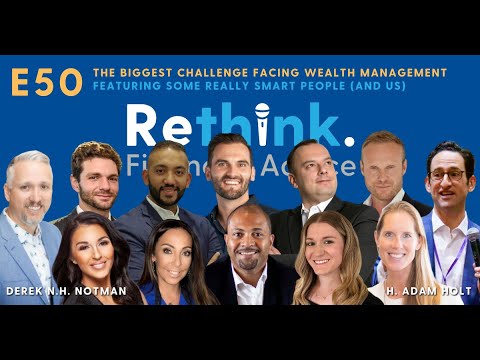
Ep50 - Rethink: The Biggest Challenge Facing Wealth Management – Featuring 10 Guests from WealthManagement Edge
Watch and Listen
Episode Summary
To mark the podcast's 50th episode, H. Adam Holt and Derek Notman turn the microphone over to the industry itself, sharing candid answers from ten advisors and fintech leaders they met at the WealthManagement.com Edge conference, including Jamie Hopkins, Jason Pereira, Mac Gardner, and Shanna Sissell. Sparked by a listener question about how the hosts keep finding fresh topics, the episode distills a wide range of perspectives into a clearer picture of wealth management's most pressing challenges today. It's a rapid-fire, guest-driven format built to surface patterns other episodes can't reach alone.
What This Episode Covers
- What industry leaders identified as wealth management's biggest challenge
- Perspectives gathered live at the WealthManagement.com Edge conference
- Common threads across ten different advisor and fintech viewpoints
- How the hosts source and validate topics for the show
- Where individual guest opinions converged and diverged
- Takeaways for advisors navigating a rapidly evolving industry
Full Transcript
Full timestamped transcript.
[00:00:30] Derek N. H. Notman: Adam, what is the biggest challenge in wealth management today?
[00:00:36] H. Adam Holt: Wow. You mean there's only one challenge in wealth management?
[00:00:40] Derek N. H. Notman: I'm, I'm asking you, is there one, is there none? Is there a ton?
[00:00:45] H. Adam Holt: I think there's probably four. Let me think about this. Five, six. Maybe about 23 challenges right now. I can think of off the top of my head
[00:00:57] Derek N. H. Notman: Ah,
keep adding to the list, man.
[00:01:00] H. Adam Holt: that might be more complaining than it is actually challenges, but it's a great question, Derek, why do you ask that question?
[00:01:08] Derek N. H. Notman: Well, , we had a great community question from Liz in Oregon about like, how do we decide what to talk about on the podcast? Do we worry about running out of topics? And she kinda alluded that everyone's talking about the same things and how are we keeping it relevant? How are we talking about challenges and solutions to help our listeners? , so it really is an interesting question. So I'm wondering one, can we distill it down to just one or the biggest challenge on wealth management, or is it more complex than that?
[00:01:40] H. Adam Holt: Well, I think you and I have a bias, right? We've been talking about this the last 49 episodes. We have found something to talk about that was challenging our industry, either obviously we thought of it ourselves or we asked somebody and they told us something new. But I, it was fun because as you know, we just got back from Wealth Stack Edge where we were on a panel and we figured we would just ask our peers and our friends what they thought.
The biggest challenge was to see if we could come up with something that was consistent and what did we learn.
[00:02:11] Derek N. H. Notman: We learned a ton and I, I think it's pretty awesome that this is episode 50 man, this is a milestone in itself, so I think it's pretty cool where we circle it back now and talk about all of the challenges that we're facing and getting it from these thought leaders out there. We met a ton of great people at Well Stack, and , well, they gave us 10 different answers.
And arguably 10 different challenges. So I don't know if 23 challenges is correct, but I, I would argue you probably are gonna get a different answer from anybody you asked. So it was really cool getting these 10 different perspectives from some really amazing people doing awesome things.
[00:02:50] H. Adam Holt: Well, it's true. You know, Derek, we did a marathon. We interviewed 10 people literally in an hour and had them focus. So we've compressed this down for everybody on the podcast to the most salient points that each person said. So this will be a fun listen. We encourage you to listen to each person's challenges.
What do you, , commiserate with? What can you agree with? What is new for you, you didn't think was a real big issue? And then find out how this applies to you in our great vision of hopefully, Mentoring you and rethinking our current industry and our profession and how we can do it better. So you ready to hear from our first one, Derek?
[00:03:23] Derek N. H. Notman: Let's do it man. Let's jump in.
[00:03:24] H. Adam Holt: Alright, so this is Jamie Hopkins, managing Partner of Wealth Solutions at Carson Group. Everybody knows him as Mr. Retirement. Let's hear what Jamie had to say.
[00:03:33] Jamie Hopkins: Right now, I think the biggest challenge is bringing talent into this profession and keeping them here. I think that's the biggest challenge out there right now. And part of the reason is we're not a sexy industry for young people to come into. Um, I think there are people that get interested, but then when they start looking at the first couple jobs that you can get in this world, they're not the tech world and other places, even though they've had their hardships, like they, they seem fun.
And you look at some of the first jobs here and it's, Hey, go sink or swim and sell insurance to your best friends. And even in the RIA world, like you look at all the job postings and it's, we want somebody with five years of experience in a book of business. We don't want people that haven't worked with clients for.
And that's a really big challenge. It concerns me a bit. I do think the good news is that I think technology is gonna allow us to serve more people in a better manner with fewer people in the industry. But we have a talent shortage in here right now, and that's hiring and the competition there of retaining people and training 'em up is super challenging.
[00:04:39] H. Adam Holt: So how is Carson Wealth specifically attacking that challenge?
[00:04:42] Jamie Hopkins: Yeah, and I'll, I'll point out at three things. So when I stepped in here, I actually sat down with Ron and said, this is super important and I want a program that gives people coming into this profession a path to equity in their firm within five years.
And the very first time I said that to Ron, he said, no chance at all. , he then he felled on it a little bit and we launched a program two years ago now that Dr. Julie Raggs heads up, and that's our strategies. We are bringing in people directly from college. Financial planning programs and giving them path to equity within five years that are firm.
And we think that's super important to retain talent. And then we also helped launch Finserv Foundation, which is a 5 0 1 C three nonprofit. BlackRock's a great sponsor, actually. Asset Map has brought us in and worked with us in the past too, so it's really exciting. We worked with about 28 different universities, about 130 students now across the country, which didn't exist two years ago.
Um, super, super amazing. Actually, two Finser students at this conference both came up to me and interacted with me too. So it's lovely to just see that impact occurring out there in the industry. Very cool.
[00:05:47] H. Adam Holt: So there you go. So the first one we have here is talent. What do you think?
[00:05:52] Derek N. H. Notman: I think he's spot on with that and I like how they're addressing that challenge cuz it's true. This is not a sexy industry. And if you're looking at your buddies who might be working over at one of the tech companies or working remotely, doing some cool stuff and , then you're told to go sell insurance to your friends or it's gonna take five years to even get some type of ownership in your business.
, you're starting to , second guess yourself before you even take the interview. So I, I love , his perspective on that. I love how they're fixing that and it is definitely a challenge. What's the average age of an advisor?
[00:06:28] H. Adam Holt: I think it's high now. It's gotta be like 60. Unless there's been some change that nobody told us about.
[00:06:33] Derek N. H. Notman: Yeah, I mean, it's high. So I, I like what they're doing about that and, and bringing the younger crew in, cuz we do need that. We need new ideas, we need new energy , in there , and , let's give 'em a, a clearer, more fun path, a sexier path, if you will, to, do what we do.
[00:06:49] H. Adam Holt: Absolutely. I mean, look, the, the real challenge for all of us who have created any level of established book of business, if we don't have next generation, that value is not there for us either, right? , if no one's gonna succeed, then we've gotta exit out to a non-human entity, a roll up or something.
Then that, you know, for those of us that have commitments, that actual humans that could leave those humans pretty disappointed in the later stage of their retirement plan, , that's not really so cool. So definitely think about that in your own firm. If you don't have a succession plan and how you're gonna bring in talent, what other techniques might you want to consider?
All right, you ready for number two?
[00:07:20] Derek N. H. Notman: Number two.
[00:07:21] H. Adam Holt: This is Shayna Orzick Sissell. She's the CEO of Bonrion Capital, and if you haven't seen her on television, you've probably seen her on social media. Really strong on the alt space. Listen to this.
[00:07:31] Shanna O. Sissell: I am the founder of Bon and Capital Management. Okay. I am the queen of alternatives. Queen of alternatives. Yes. That's mean I I did not give myself that nickname. I feel like I always have to caveat that cuz it's super obnoxious if you give yourself a nickname Right. Self crown. Yeah, that's totally, if you self crown yourself Yeah.
Then it has no credibility. It's a great coordination party. But, uh, Cynthia Murphy from title gave me the nickname Queen of Alternatives because I was telling her the origin story of how we came up with the name Bon Ran. Mm-hmm And Bon ran means Queen and Gaelic. And she said, oh no wonder why they call you the queen of alternatives.
And I said, I am immediately gonna trademark that and now I can use that for marketing cuz I didn't come up with it. So she is my Shaquille O'Neal to my Paul Pierce.
[00:08:16] H. Adam Holt: Very cool. That's really interesting. So from that unique perspective Sure. What's the biggest challenge you perceive in our
[00:08:22] Shanna O. Sissell: space today? I think for advisors it's becoming complacent.
And not finding ways to add value to your clients, to deepen your relationships. And I'm going to do a little bit of self-promotion here because why not? But I believe that as you look to differentiate yourself for your clients, that you need to find ways to not only provide them with good financial advice and good financial investment ideas, mm-hmm.
But make sure that those ideas align with your clients' values and passions. And really the only place you can do that is in the world of alternatives. So I spend a lot of time working with advisors, helping them gain comfort with alternatives, because let's be honest, it's a complex and scary and intimidating place, and there's lack of liquidity and there's a lot of things that can be intimidating.
And many advisors have jumped in, gotten burned, and then not wanted to go again. So I want to change that experience. I feel like the best way to help advisors such in increase their allocation to alternatives is by finding ways in which they can get excited about presenting ideas in the space for their clients.
And that means making sure that they align with your clients' values and passions. And if you do that, what you end up doing is deepening your relationship with your client, understanding who they are on a deeper level, and ultimately that leads to the retention of the relationship. So it's really about focusing on building the relationship.
I always say that when you're dealing with individual investors as an advisor, your client is emotionally attached to their money, right? So if you really want to change the game, why not find ways to help your client emotionally connect with their investments? In the alternative space. I think that's a great way to do it.
Deepen the relationship, bring something new to the table, have something exciting to talk about. And then from a competitive landscape, as an advisor grows their business and has clients that have larger average account size, they're gonna start to compete with private banks for that business. If you wanna develop a moat around your business, this is a great way to do it.
Private banks are offering this stuff to their clients. Mm-hmm. Let's think about ways that we can use it to our advantage to keep the client, retain the client, gather more assets, and deepen that relationship.
[00:10:58] H. Adam Holt: So there you have it. Derek, what do you think of from the queen of alls?
[00:11:01] Derek N. H. Notman: You know, she talks about basically selling the relationship as a differentiator, and she's exactly right. She also talks about how we are or our clients. All of us are emotionally connected to our. Our money. And sometimes we forget that when we're doing the financial plan or designing the portfolio or the risk analysis but we are very emotionally charged when it comes to our money.
At least most people are. So how do we differentiate and connect? And , she does bring up a , good point. And it's interesting how they're solving that with alts of all things and how they're coming at it from a different angle. So I, I like that perspective. She's definitely, , proving our point that we've even discussed in previous episodes about the relationship, emotional intelligence and understanding , what's really driving the client and so forth.
[00:11:49] H. Adam Holt: You know, it's true. I mean, most of my business owner clients , when they ask about business, they, they love to talk about their business and companies, if they've made private equity investments, they do dominate , the conversation, right? When you have a fund or an index, nobody talks about the underlying holdings, so you can't really geek out about, oh, I love what Apple's doing.
I'm so happy I have a position in them. But if you have a private equity deal, or , I took a stake in a nursing home locally because I really believe that market's gonna take off. Or I bought this technology company that's solving a major problem. I noticed in the market space, , it is exciting.
Hiding to talk about that stuff and frankly be given the fact that alts don't have ongoing performance requirements for reporting. It's a lot easier to talk about them cuz you don't know if they're actually winning or losing. But in a sense, , it's true. You do feel more connected to your investments when you know physically what it's invested in.
Or you can see the benefit of
[00:12:38] Derek N. H. Notman: It's real. It's real. It's more than just a paper statement with some index fund, right? It
[00:12:42] H. Adam Holt: Very true.
[00:12:43] Derek N. H. Notman: it real.
[00:12:44] H. Adam Holt: But I think it's important. She, she makes a comment that private banks are going after our larger clients because they can offer this stuff. Why don't we start thinking about it? So really important. Alright, let's hear from number three. Who is number three? Derek? Uh.
[00:12:56] Derek N. H. Notman: Mabel. So he is a dear friend. He is an awesome guy. He is in charge of , advisor growth, if you will, over at Trust and Will. , super cool dude. So let's hear what he has to say.
[00:13:06] Andres Mezabel: I hear the word holistic and comprehensive very often, but I see a lot of challenges in advisors really building a process that reflects what they really wanna do. So being very proactive about getting their clients to complete their estate plan as an example. For us, that's a big challenge that we face, right?
When we talk to advisors. There's a lot that they're thinking and have to do from a priority perspective, but it's really making sure that they built in that process to build in that peace of mind. And then two, I think it's always a matter of how do you really make sure that. The clients is getting the advice that they really need outside of just the investments and making sure that we're building and they're delivering a goals-based approach to what the challenges are that we have in life.
As life
[00:13:54] H. Adam Holt: kind of changes. Well, how is trust and will
specifically helping
advisors address these challenges?
[00:14:01] Andres Mezabel: Making it more accessible? So by having be better price points, being able to have a platform where an advisor can actually drive the conversation. Mm-hmm. Get their clients to take action, view their documents.
So now we're starting to see, advisors will now go back and say, I can view your documents. Come in, let's meet with your family, who's named in your estate plan. Right. Because this is something that clients are asking more help with regarding their estate plan. I always ask, why do most clients hire financial advisor?
It's peace of mind. Peace of mind. Can my kids go to college? Can I retire comfortably? But we forget. The biggest thing is not. If I pass, but when I pass, do I have the peace of mind to say, I know my kids are gonna be taken care of. We can avoid probate all that, so we forget. I think one of the biggest things, by focusing so much on certain tasks, if you will, it's really getting to know that family dynamic and understanding what that looks like.
And I'm sure we've heard of 57% of client's assets is going to be inherited by 2045. Only 13% of advisors connect with the client's children. So it's a huge opportunity
[00:15:10] H. Adam Holt: There you go. What do you think about that? Trust and wills different take than investments.
[00:15:15] Derek N. H. Notman: It's definitely a different take, but it's very, very important because if we don't do what he's talking about, it opens up a world of problems for the next generation. And even stress , for us, if you have a spouse, a parent that needs help, something like that. And what I like is that he's talking about essentially building a peace of mind process as part of a holistic approach to helping your clients.
And if we are talking about life insurance or beneficiaries on a retirement account and so forth, we are already, we already have one foot in the estate planning realm now. Cause we're talking about what happens when you're not around. So, as advisors, I mean, at least that's what I think he's saying is we should really , be thoughtful about talking about that a little bit more of other than just off the cuff, oh, do you have a will?
No. Hey, you should probably get one. And then you leave it at there. , that's not doing your clients any service.
[00:16:11] H. Adam Holt: That's
[00:16:12] Derek N. H. Notman: got, it's gotta go deeper than that.
[00:16:13] H. Adam Holt: no, that, that's a huge challenge. And I, last I heard there was something like, less than 20% of Americans actually have a will. So, , I think a hundred percent will die. I'm pretty certain of that one, maybe 99% if the medical goes well. But, you know, look, I think , the reality is if we're gonna say that we're holistic and , we're an advocate for people's financial wellbeing, we gotta get on this too, right?
, we can't then let them roll off the lot and say like, yeah, the seatbelts don't matter. This is, this is an important aspect. That, , or you don't need auto insurance. Eh, I forget what a waste, you need the documents in order. I think it's really important. So that's clearly a big challenge that I don't think people are talking about enough in this space.
Alright, who do we have next? Johnny Paulson.
[00:16:52] Derek N. H. Notman: Yeah, really cool dude. I met him for the first time at Wealth Stack, but he's the c e O over at Income Labs and, uh, well,, let's just see what he has to say.
[00:17:02] Johnny Poulsen: I think an interesting question is how does an industry that for so long and rightfully so, has been focused on accumulation and building wonderful tools and investment strategies to solve for that turnaround and provide quality distribution planning? Jamie Hopkins will tell you that we spend decades telling our clients to save more and spend less, and then one day we turn the switch and we tell them, it's time to live of your money.
It's time to spend your money. And that's not a minor tweak. It's not a minor adjustments. And I quite frankly, don't think simply building newer and better tools is the solution. I think that is important. Clearly the analytics, the math and distribution planning is fundamentally different than it is during accumulation, but I think we really need to completely change our mindset and at Income Lab we leave.
What effectively gets you. To retirement is not gonna be very helpful through
[00:18:04] Mac Gardner: retirement. Mm-hmm.
[00:18:05] H. Adam Holt: So that was interesting because Johnny Paulson, who comes from the income distribution world, spending years actually at Jackson National and got and teamed up with his, uh, partner, uh, Justin to create an a distribution mindful platform first. So financial planning from the distribution phase versus the accumulation phase.
And it's really interesting because I think this has come up a couple times, but so many advisors have focused on the accumulation planning, as does their planning tool. Very few have focused more than the 4% rule or the, uh, Monte Carlo approach, and that should be good enough. What do you think about that?
[00:18:45] Derek N. H. Notman: Yeah, it, it's true. It, it not only is it from a, like a technical per perspective of how do we plan around distribution planning. You know, mark Faff even mentioned this in, uh, our episode with him about how a lot of people retiring today, uh, Are retired more years than they worked.
[00:19:04] H. Adam Holt: Mm-hmm.
[00:19:04] Derek N. H. Notman: So you have to have different strategies.
But I think the other thing that Johnny alludes to is that we have to help our clients with that mindset. In our mind, it might be a light switch thing. Oh, we're gonna stop putting money in your retirement account. We're gonna start taking it out. But our clients, this is a huge deal.
They've spent decades putting money away, and all of a sudden you're telling 'em to stop that and take money out. They're probably gonna be scared. There's gonna be uncertainty. So how do we, we address that emotional aspect, uh, as well when we're making this transition.
[00:19:35] H. Adam Holt: Absolutely. All right. See, now we already have four different perspectives. Let's hear from the number five. Matt Gardner, the Chief Education Officer at Finlay Tech.
[00:19:46] Mac Gardner: Only because I've been in the industry for 20 plus years. I know what it's like to be an advisor. I think the biggest challenge that, that we have as an industry, Is a lack of education. Just, just, honestly, I, I ran across a fascinating stat, uh, and it that the financial services industry has a budget of about 30 billion is what they spend on marketing.
Less than 1% of that depends on financial education. So I, I just, wow. I believe as advisors, we serve a very unique role in that we're in people's financial lives, and I think, uh, a lot of people as different tools are becoming commoditized and free compression, and you can kind of go do a lot of things on your own.
Mm-hmm. As advisors, we gotta be able to bring something a little different to the table. I think financial education and perspective
[00:20:36] Jason Periera: is that thing.
[00:20:37] H. Adam Holt: Talk about the work that you've done though, about helping the next generation. Yeah. That's really intriguing. I think advisors have this interesting, we'll call it opportunity slash obligation as the
[00:20:48] Mac Gardner: no educated parties here.
, I'm trying not to, , Blow you up too much, Adam, because you've been a huge supporter of what we're doing in our mission, , for some time. , but yeah, we believe that an advisor has an obligation, not just to the people that they're sitting across from 'em and giving the advice to, but the generations that are coming behind them, which is why we wrote the Four Money Bears book.
Because if, if you as a child or if, if you as a parent aren't receiving this information, how can you teach your child? And so if you're an advisor and that you're playing the space all the time, why not develop tools to be able to pass that on? Heard a great line. Someone said, if you take care of a client, they're
[00:21:23] Jason Periera: thankful.
If you take care of their child, they're forever grateful.
[00:21:28] H. Adam Holt: What do you think?
[00:21:29] Derek N. H. Notman: Well, initially what really struck me is out of that, what do you say, 30 billion in annual marketing spend, only 1% is on financial education. That's crazy. So talk about a challenge and an opportunity and okay, so marketing, we spend money on marketing to drive revenue. I get it. But we've also talked to a number of people that if you increase financial literacy and education,
[00:21:53] H. Adam Holt: Mm.
[00:21:54] Derek N. H. Notman: you're empowering that client to do a better job with their money.
They're probably gonna be a longer term client with an advisor, which means , your lifetime revenue generated from that client's probably higher and their satisfaction and overall outcomes are also better. So it just seems like it's a no-brainer to have to lean into financial education.
Maybe I'm just naive, but that's what I'm, I'm taking from it.
[00:22:15] H. Adam Holt: Well, unless you're trying to basically, sell product to an uneducated party and you're afraid that if you educate them, they may not buy your product. I, I don't know that I'm trying to take the alternate side of it. I mean, there's a, there's a good question here about. Whether we are aligned in our interests, right?
The companies that are spending 30 billion on marketing are trying to sell something, right? That makes sense. That's a
[00:22:40] Derek N. H. Notman: Of course. Yep.
[00:22:42] H. Adam Holt: you know, so those that are, that are educating, and I think what he brings up is a really interesting point. It's incumbent upon the advocate of the household, the financial professional, to actually educate their client, leave them better than they found 'em, not just on the balance sheet, but also educate their next generation.
Not just because it's good business, but because it makes sense to help the next generation. Guess where loyalties will lie when they become the advocates of their own parents' assets?
[00:23:12] Derek N. H. Notman: Oh yeah, for sure.
[00:23:14] H. Adam Holt: Doesn't that, doesn't that pay itself forward a hundred fold? Isn't it just in the best interest of everybody just to educate people and get them more confident to make decisions?
I, I think that's a real big issue here, and I'm glad that he brought it up. Um, but big surprise that literacy was his, uh, his big challenge. Are you ready for Jason Perrera?
[00:23:32] Derek N. H. Notman: yeah, , he's cool. I consider him the Canadian FinTech guru. So cool to hear what's going on to the north. And let, let's see what he has to say.
[00:23:40] Jason Periera: So the, the biggest challenge I see is basically the fact that not enough attention is being paid to the actual experience of the client with technology. I have a friend whose name is Dennis Mosley Williams who speaks on on, yeah, exactly. Cause he talks about the experience economy.
He has this saying that efficiency is the enemy of experience and that, that bothered me cause I'm a tech and efficiency guy, but I also deeply value the experience with the clients. So basically, so when I pulled back and look at it, I said, you know what? 90% of the tech we have is for making our lives easier.
And 9% of what spits out a either printed document or a PDF that looks at the printed document, what a horrible experience that is and how would a failure to actually take advantage of the mediums that we're using today? Mm-hmm. So when you look at what exists though, a lot of technology that we do have can be either tweaked or used in a lot of ways to create compelling, interactive and meaningful purposeful conversations with clients live.
Where it's not just about let's go through what the PDF looked like on screen, let's actually have a collaborative, interactive conversation around this and actually engage. And I mean credit to Adam here, he is like the OG on this space because effectively like asset maps was built to be collaborative in That's true in that regard.
Yep. Yeah. Very cool.
[00:24:46] H. Adam Holt: Well that's interesting, so, and I appreciate that. What are you seeing differently because you have the opportunity to cross over the border Canada, us, you're probably even talking in the UK space now. Totally. What are you seeing that's bridging the gap or where's that opportunity for advisors to. Take advantage of some of this new technology?
[00:25:04] Jason Periera: Well, I think honestly, a lot of what you guys have down here is great robust, but a lot of it's legacy, quite honestly, right? Mm-hmm. Mm-hmm. And a lot of it's still built towards the advisor, basically, you know, making their lives easier. But the newer tech coming out, a lot of the stuff that's like, not the big full flow, the flow blown financial planning software, but the stuff that's more specific tends to be more paying attention to how does this actually look on a screen?
How does this look when I share it with someone? How does it look when I blow it up beyond me? And I think , what's really gonna happen is, is that with the, I mean, you guys have seen the kit, this map, and how big that thing is. Mm-hmm. The reality is there's a lot to choose from. If you're trying to just be a generalist, this could be hard to figure out what to do.
But as we know, and we've seen people who marketing to niches tend to grow at faster rates. So , if you figure out your value proposition to one group of clients, right, and you pick your software and the experience around that group of clients, you can truly create a unparalleled experience start to finish that speaks to that need start to finish.
Because there's so many specialized softwares now that exist that are lighter than the full blown planning softwares.
Talk to us about artificial intelligence and its entrance into financial advice. Where are we now? Where are we going?
[00:26:05] H. Adam Holt: We are at the infancy of it. So, um, the big news that came out this year was of course chat, G p t really capturing everyone's imagination.
And today everybody's just been playing around with it, and it's a novelty. Mm-hmm. But what you're gonna see in the next couple of years, and I've talked to these companies and I've seen it happening, is you're gonna see some form of chat, e p t guide or troubleshooter or just tool for working with the existing softwares that exist.
Everybody's looking at this. Okay. So that is gonna happen. I mean, windows just announced today that they've basically launched, uh, copilot within Windows. Mm-hmm. So now you can utilize chat gpt with it, whereas before it was in, it was in office. Now what's happening with, I know it's coming.
Well, conquest Planning has been mentioned many times in this, in this conference, and they are the first to throw artificial intelligence, pre-chat g p t, into financial planning software. I've been user, I've been advising these guys since the, since the Alpha. Frankly it is going to cause some real damage down here.
Uh, it's already in full production in Canada, and the amount of time it takes to produce better plans than any human being could do and amplify the plan that I was doing is substantial. It's incredible. So that gets down here, you're gonna see the old benchmark kits to study of 10 hours to do a financial plan.
Mm-hmm. That number's gonna start to shrink. Substantially. Freeing up time for what? Deeper engagement, more value. Absolutely. Now, when we start getting to the chat, g p t instances, we're now at the early innings of what's gonna happen with that. Besides the support mechanisms for different softwares, there's really, I just started working with a company at the UK called Cifa.
The name may change. We'll see. But one of the things we're talking about is, can this be a bridge across all the different silos that exist instead of trying to batch all the data in one place, which has proven impossible in the last 20 years. Mm-hmm. What if I just tie into these pieces and use the chat bot as the tool for how I extract data from these different things and combine it?
What does it mean for advisors though? What does it mean? It, it means that, frankly, like whether it be the ability to use chat G P T to reply to emails and draft emails, or to create blog posts or whatever else it is. Mm-hmm. The efficiencies that we're already, anyone who's on the early edge of this is already gaining from using these, I'm already replying to emails with this stuff.
I'm already creating content with this. The amount of time being spent is a lot faster. The best quote I heard about chat gpt is that it's effectively like the calculator for words, right? Mm-hmm. It's not gonna replace the ability of the human being to draft something truly, deeply meaningful, but it's a lot easier to create a first draft on it and then start editing.
[00:28:19] Derek N. H. Notman: The calculator for words.
[00:28:22] H. Adam Holt: I thought that was pretty cool.
[00:28:24] Derek N. H. Notman: That is pretty cool, and I can totally. See that, and I've, I've used it. You've used it and it does work.
[00:28:31] H. Adam Holt: Oh, yeah.
[00:28:32] Derek N. H. Notman: Uh, you know, something that kinda came to mind as he was talking about this AI stuff is that , I relate it back to medicine and our health. There's WebMD. I can go look at, , research, learn a ton, but ultimately, and you've mentioned this a number of times, when the pain of failure is high, I still want a human being who's an expert, help me execute.
, alright, check out what, what AI told me to do. Is it right? Should we make an adjustments and please help me execute it? It's the same thing with the doctor. If I like my doctor, I could do all the research in the world. They'll help be that filter for me and then say, well we should we try it this way instead of that way and so forth.
So I think there's, there's some similarities there. Um, fascinating perspective. , what were your thoughts? What he had to say?
[00:29:21] H. Adam Holt: no, I just realized what you just said. You know why that is, by the way?
[00:29:25] Derek N. H. Notman: What
[00:29:25] H. Adam Holt: Because trust, trust is a feeling of certainty and feelings are based on emotions, not logic. And the point is, is that when humans need to make a decision, they go with their common rubric of how they get to a trusted decision, and that's usually a feeling they get with confidence from credible people .
So it's interesting until we get to a place where people trust that the AI bots no more or can make a better decision than the humans. Given the massive amount of information they have, which is inevitable by the way. I think it's inevitable. The population will start trusting this technology greater.
We will start using this technology cuz it will just accelerate. No system is perfect. There's always gonna be some level of failures, but the time savings alone will be just so massive that we'll have time to fix the stuff that it messed up. And I think , the interesting thing about what he said too, it's fun to let Jason just riff because he's got so much information in his head and thinking about this stuff, is that he also brought up experience.
So in addition to ai, he brought up digital experience and how woefully lacking a lot of advisory firms are. They're not really using their technology to its greatest capability. I know we spend a lot of time, we actually talked to Dennis also. , he's spoken at several conferences I've been to and he just does a great job too.
Dennis . Mosley Williams. Um, and I think, uh, I think it's really important for us to all pay attention to what is the digital customer experience that we are creating.
[00:30:54] Derek N. H. Notman: as FinTech CEOs right now, we're both in the throes of designing our tech and. We have advisors and consumers that are our customers. How does that experience feel? It's really quite interesting when you get into the design aspects and he's spot on, you've gotta pay attention to that client experience.
It's arguably the most important.
[00:31:13] H. Adam Holt: No question. Alright, well let's jump to our number seven interview, kellen Brown, senior Vice President of Growth and Strategic Partnerships at Finance of America now Callan, if you don't know her, she is a force for good. If you ever get an opportunity to meet her, she's got such a great personality and we're excited to interview her on this podcast.
Let's hear from her.
[00:31:32] Kellan Brown: One of the things I've been trying to do since I got into the industry was talk to advisors and their firms about how you can implement strategic mentorship programs within their space. And the reason why this is so important to me is that we have a lack of women, people of color, L B G T Q, and it's not just about getting into the space, but it's actually about getting to the executive level once they get into the firm.
That's great. Yeah. How are you doing that? Okay, so there's two ways to do it problem. What's your solution? When I joined Finance of America Reverse, and we're a reverse lending company. We are the leader in the space and have been for the last 15 years. We just acquired our largest competitor. So that includes wholesale and retail.
But what's beautiful about our company is that our culture is so driven behind bringing up the next generation. And so when I came into the company, I said, let's create a strategic intentional mentorship program. So we went out and found a tech company. We used Mentor Click, which gives us the opportunity to match mentees and mentors and then measure the success of that relationship.
And the reason why this was so important to me was that it gives us the return on investment. And what I mean by that, it shows when we actually have people that stick around longer, get promotions faster, hit goals, and ultimately impact the bottom line. So how we typically land this is. Last year, finance of America saved over $2 million because of their mentorship program.
[00:33:07] H. Adam Holt: So what's the biggest challenge that you see in the whole space? I mean, there's a lot of people here at Wealth Stack, they're all here to get some best practices and learn. What do you think? Is that the thing that's standing out?
[00:33:17] Kellan Brown: So I just came out of the d e, I think tank with Suzanne Syracuse. Mm-hmm.
Uh, I've been in that three years in a row now. It's been fantastic because we're actually seeing the change that's coming out. So the advisors that are sitting in that space, we're all creating something new to make a difference. Mm-hmm. So, for example, the Finr Foundation. Mm-hmm. So I sit on the advisory board there and what we do is bring in the next generation of financial planning students from the university on how to get into the program.
Now, today I learned that Hannah Moore has created an externship for those students. Mm-hmm. So we're gonna team up. Finster Foundation will help support the networking, the introductions. , we'll do obviously the mentorship program and then if they want to, we'll provide the funding to send them off to the externship so that they'll prepare, be prepared to move into that next
[00:34:08] H. Adam Holt: w why is it critical that advisors not just watch this happen from the audience, but actually get involved and do something about it?
Why is it critical?
[00:34:18] Kellan Brown: So, we're seeing a huge gap when it comes to women, people of color, L G B T Q. We want a more diverse group, and why do we want that? Because it opens it up to the rest of the world. You know, we're not growing in this industry right now. So when you talk about like a Dana Wilson or a, , Jack Campbell, someone that's building a women only financial advisory firm in Detroit.
She's trying to find education and teach people how to plan financially successfully. I think that's the difference, right? We're not raising awareness about what we're doing at an early of enough age. And then once you get into the industry, the problem here is that either you don't make it to the next level or, and I hate to put it like this, but that white male syndrome where you're just bringing up the same person, that's a problem.
[00:35:11] H. Adam Holt: There you go. Yet another great perspective. What do you think Derek?
[00:35:15] Derek N. H. Notman: Yeah, it just adds to the whole diverse group that we have about so many different angles and challenges to look at what I heard her say is, If you have , this mentorship mindset, and you do it correctly, , and you're really thoughtful about it, you have now this path to, to success regardless of that person's background all the way up into the executive level.
So it's more fulfilling, there's more opportunity. And she even gave an example. It's leading to a better bottom line. So it sounds like a pretty cool way to deal with the challenge that she sees. And obviously they're making it work. And it even goes back a little bit to what, , Jamie was doing over at Carson with their college internship type of thing over.
They're recruiting them, so very cool,, on how sh how they're tackling it. What about you?
[00:36:00] H. Adam Holt: Well, it's funny, you know, I noticed that as well, and I didn't realize this when we scheduled it, that they're both part of Finser Foundation that we had. Also, , made a benefactor of the Advice Tech Live 2022 program where we were giving charitable contributions to support NextGen. So it was cool to see them all kind of come together and realize the connections there.
Also, the Hannah Moore comment about creating an externship program for all those students that are leaving the industry or education, , financial planning and don't have a place to land. So I know that Asset Map has participated in, in that program as well. I didn't realize that Kellen was part of it.
So that was, , really cool. And I, I think the real key here is that there are things that. We as advisors can do here, we can bring in the next generation. Now we tend to bring into our own internships. I, I hired my client's kids. That was one thing that I did cuz why I, I would tell my clients I'm hiring or they would call me up and say, Hey Adam, do you have any internships for my kid?
And guess what we would do? That's how we filled the spot. It all happened in network. It never got published. But I think it's an interesting opportunity for us to actually expand our horizons and, and offer to bring in people that are not in our normal community. Because the reality is the future of our business probably won't look like the present of it.
And that means we need to be mindful of how it's evolving and, and how do we actually create different opportunities to grow, , make people feel welcome. So that's an important aspect here. I think she brought up.
[00:37:19] Derek N. H. Notman: Boom. All right. Awesome. Awesome.
[00:37:21] H. Adam Holt: Alright, you ready for Marwa? Who's Marwa? Ria.
[00:37:24] Derek N. H. Notman: So she is the c e o of asset book, not asset map.
[00:37:29] H. Adam Holt: Oh, thank you.
[00:37:31] Derek N. H. Notman: That's you. I think
[00:37:32] H. Adam Holt: have that in common.
[00:37:33] Derek N. H. Notman: you're still doing that over at Asset
[00:37:34] H. Adam Holt: I think so once in a while I show
[00:37:36] Derek N. H. Notman: in a while, but, uh, yeah, let's jump in and she see what she has to say today.
[00:37:41] Marwa Z.: I would say the underlying challenge that we continue to hear is that they either don't know or don't have access to their data. It's one of the gleaming realities that they face when they're exploring changing portfolio management solutions or other, or kicking off the idea. Realizing, oh well I might have to pay X amount or I'm not gonna get it at all.
Or it's going to be very skewed data that is not, that isn't really useful to them or to another solution.
[00:38:14] Jason Periera: What are you guys doing about it? Do you have a solution
[00:38:16] Marwa Z.: in mind? The short term, we are proactively, we've been providing, this has been going on for a little over six months now. We provide backups of the entire dataset for our clients on either a monthly or quarterly basis.
It's their option to choose. Some don't want it on a monthly basis. It becomes cumbersome. Mm-hmm. But they have access to it. And we don't just say it as lip service, they actually have it on hand. And it's great for doing proactive audits and just having your data so you know what it looks like. And if anyone needs to go, they're gonna go anyway.
So I've had other solutions say, Well, you're just putting it on a silver platter. Yeah. That's what they pay us for. And if we're not the right solution any longer, then let them go. Don't hold
[00:39:03] Peyman Pardis: people hostage.
[00:39:03] H. Adam Holt: Now that's an interesting third rail statement because one of the reasons that a lot of advisors don't or cannot move from one provider to another is because they're so tied to the data at their broker dealer platform company and just unwinding that is just such a headache. You know what they do?
They just put up with the pain. So I think it was interesting. Asset book is a platform performance aggregator for advisors and does a bunch of other stuff that I'm probably ignorant to, but on its face. That's an interesting statement, Derek.
[00:39:45] Derek N. H. Notman: it resonates. I mean, I, went independent a year and a half ago now, and. When you start, you don't really think about it too much when you're in the middle of stuff, but then all of a sudden you're like, eh, maybe I go independent. Maybe I'm gonna switch firms. All of a sudden it becomes super important and you're like, oh, crap, I do not have the access I thought, or I don't know how to get it, or it's just, it doesn't fit into anything else that I'm trying to go over too.
And it's, it can actually get scary very quickly. Uh, so very cool that they're solving that problem and they're laser focused on it. No question about it. And I, I like their silver platter AP approach. Why not? You know, do it make it easy for 'em. It's, it ultimately helps the clients, so why is it a problem?
[00:40:24] H. Adam Holt: It's true. If you believe that the relationship is really the advisor and not the firm with the advisor, then, then the data has gotta be transportable and it's one of the things that I've been really hearkening on here at Asset Map is how do we create a way to really, truly empower the person whose data it is.
To contain, retain, and have possession of that without them feeling hostage. I mean, you know, years ago we used to sell mutual funds. Do you remember what it used to have a backend sales charge and you know what that would wind up doing? It basically kept people captive. Right? Okay, you're making a five, six year decision until they burned to ahas.
Let's be honest, , that's a retention strategy and why to earn back the compensation that was paid in the first year. And so what did we do as an industry? We said, oh, , we're gonna really be open architecture. You wanna leave us? You can take your assets with you.
There's no exit fee. We charge a 1% a u m fee. And that, that made sense, right? It was in the best interest of the client and it served us as advisors, right? Because we felt like we were aligned with the clients and they felt that, and that transparency built trust, remember that word? I. Why are we doing the same thing with data now?
, you can't leave your data's here. Sorry, you gotta use this antiquated tool. So I think it's really cool that they're actually leading with that and they're bringing up the challenge even though nobody else is talking about it.
[00:41:42] Derek N. H. Notman: Love it.
[00:41:43] H. Adam Holt: Alright. Introduce us to payment.
[00:41:47] Derek N. H. Notman: Hardis, he is our friend from, , Canada as well. Another, another guy from the north, eh, sorry,
[00:41:55] H. Adam Holt: Add, that
[00:41:56] Derek N. H. Notman: I used to almost live in, in Canada. So, , my cell phone would jump, my cell phone would literally jump to Canadian cell towers during the time of the day. I was that close to the border.
[00:42:06] H. Adam Holt: sounds expensive.
[00:42:07] Derek N. H. Notman: Uh, yes it was, talk about roaming. But, , he's the head of wealth management consulting at Deloitte in charge of North America. Really cool dude. , was an advisor first, so has that experience and, um, and now is looking at things from, you know, like a national, international perspective.
So, , let's jump in and see what he has to say.
[00:42:28] Peyman Pardis: So it's interesting, throughout the past few days, you would've heard about personalization. You would've heard about engagement, you would've heard about a, a whole bevy of different items, right? The platforms, the technology, all that stuff. I think the one thing that people don't really talk about, and excuse me, I'm gonna get a little bit consulting lingo on you, is real time wealth management.
And what I mean by real-time wealth management, and this is a little bit of consulting, but it is a lot of transformative forces. That are all converging, all within the same time horizon. So if I give you a few examples, whether it's open banking or realtime rails, which is like instantaneous wage disbursement, et cetera.
If I think about some of the regulatory changes like t plus one, there's all this, or even just the accelerated path towards digital. All of this is causing a realtime wealth management need. So it's not about the personalization. It's not about the engagement, it's actually how you're supporting your client on a realtime basis.
When now they're getting their biweekly paychecks are coming in instantaneously and they have inquiries to you. How are you supporting them? How are you supporting them as it pertains to market events that are happening? And how's your support team able to actually scale? It requires a whole different shift in the business model.
Whether you're a financial professional and a broker dealer, or you're an R I A, it's gonna cause a significant impact to your business. But I don't think people are really considering.
[00:43:51] H. Adam Holt: That's different.
[00:43:52] Derek N. H. Notman: Different thought provoking for sure, but he is right. I, I don't know if he coined it. Did he coin the term Real, real wealth man? Real
[00:44:01] H. Adam Holt: I have heard it from someone else. You know who else I heard it from?
[00:44:04] Derek N. H. Notman: Who?
[00:44:05] H. Adam Holt: Bill Harris.
[00:44:06] Derek N. H. Notman: Ah, okay.
[00:44:09] H. Adam Holt: I think there's a mindset that's coming.
[00:44:12] Derek N. H. Notman: it's true , whether it's our phones or computers or whatever, we are getting pretty much instant access to at least some parts of our financial lives.
[00:44:22] H. Adam Holt: Mm-hmm.
[00:44:23] Derek N. H. Notman: So why not be able to get that access to my retirement account, my investment account, my insurance, my taxes,
[00:44:32] H. Adam Holt: Mm-hmm.
[00:44:32] Derek N. H. Notman: That seems like it's pretty important. And if I can't get it from you, but I can get it over here. Huh? I wanted him the palm of my hand, right. As a consumer.
[00:44:42] H. Adam Holt: I was on a committee four or five years ago at a larger broker dealer, and , we surveyed what clients wanted and they said, can we actually manage our portfolio through a Venmo style immediacy? And I didn't really take it seriously because why do you need to have that immediacy? But I think what's happened is that the consumers are also so, like you said, indoctrinated with on demand speed,
[00:45:13] Derek N. H. Notman: Yep.
[00:45:13] H. Adam Holt: that people are gonna say, well, why not?
Why? Why do I have to wait three days when I, you know? So alternatives that provide speed is the same as providing me time and time is money. So theoretically, speed. Is gonna be really, really, really valuable to people who don't have attention span. Right. More patience maybe.
[00:45:38] Derek N. H. Notman: patient's attention. The thing about whether you're looking to make a change to your allocation or maybe you wanna buy a house and you have to make an offer on a house,
[00:45:46] H. Adam Holt: Yeah, that's
[00:45:46] Derek N. H. Notman: these are pressing real world situations sometimes, and you need access to your own information. You need real time wealth management.
And if you can't get it, you're gonna be frustrated. You may miss out on something that's gonna cause problems, friction, things you don't want, you'll go elsewhere to fix that problem.
[00:46:03] H. Adam Holt: Well, crypto as an example, does give you real time currency movement, right? You can move money incredibly fast. Wiring still takes 24 hours in most cases. Uh, yet Venmo's, instant and Ach H is two days and, oh, a check. Hey, you need a certified check to buy that house a week. Right? So it's an interesting aspect.
I think it's definitely the early stages of it, but I could see this becoming bigger down the line. Alright, are you ready for number 10?
[00:46:28] Derek N. H. Notman: Number 10, let's go
[00:46:29] H. Adam Holt: Now interesting. I don't know if you'd be surprised, but it's different than all the other prior ones. This is Megan Richter the President of Intentionally, that's intentional ly if you know her.
And she's a co-founder as well, along with Kelly, Walt Rich. , and I think that, , they're talking all about marketing for advisors. So guess what we're gonna hear about?
[00:46:51] Derek N. H. Notman: for advisors.
[00:46:52] H. Adam Holt: Probably one of the biggest challenges that, let's hear,
Megan Richter.
[00:46:57] Meghan Richter: So for what I'm seeing day and out, whether we're working with tech firms or financial advisors in this space, it comes down to differentiation, which is not probably something novel you might hear in some of your conversations, but I think it really is the root at a lot of the challenges firms are facing when it comes to growing their business.
And if you don't do it effectively, it has ripple effects into every single thing that you do. So when we work with advisors and FinTech firms alike, we like to really dig in and ask them a couple key questions. We want 'em to get really specific about who they're serving. So it can't just be people in my certain region or what it was going through divorce.
We need to get more specific about who you're really trying to get after and make a connection with. We really push them to make sure that they've understood the competitive landscape. Okay, you're gonna be in this space. What are others out there saying? And then we really push them to make sure that their story about why, why did they set out to do what they wanna do?
Why did they set out to create what they wanna create? Really drove their business. And they think between understanding really specifically about their audience needs, why they created their business or their model to begin with. And then how other people are speaking. We can pull together a formula that really works to help them come up with a very differentiated message.
[00:48:08] H. Adam Holt: Well, there you have it. Number 10, what do you think about Megan's
[00:48:11] Derek N. H. Notman: I think it's accurate. I think it is a challenge. I think a lot of advisors really struggle with differentiation. We've talked about this. Tech used to be a differentiator. Now it's table stakes. , we've had, uh, Angie Herbers on, , there was another one on there, but talking about referrals, Libby, GRE way, you know, talking about referrals and niching or not niching and differentiation at the end of the day , is a challenge when there are so many different advisors out there, all or arguably all using a very similar tech stack.
How are you different?
[00:48:44] H. Adam Holt: it's a good question. You know, I was literally talking to a firm this morning also about differentiation, and it was challenging to get them to say, yes, we fit in a specific niche. And because they, , they have business that's associated with multiple niches and they don't want to decide and they say, you know, can I be all things to all people?
And that's a really challenging one. I think especially with what's coming in the great indexing of all of our businesses, uh, and commoditization and what I think is gonna be marginalization of the compensation that we're paid. It's the reason why I think we're seeing a lot of advisors, although I didn't think it would honestly take, , I'll be honest about that.
I, I didn't think that fee-based financial planning was really gonna start taking any market share from assets under management. And I think I'm wrong that we are starting to see a real insurgence of advisors that are charging a flat fee.
[00:49:37] Derek N. H. Notman: Well, there's a demographic that it fits, right? It works. It it really. Really works. You know, I think if I'm listening to this as an advisor or a FinTech firm, this is a really big question on differentiation. I too, I was ha, I had a meeting this morning with the venture capital firm for Coupler, and they asked me, so who's your competition?
How are you different? And if you can't articulate that as an advisor or FinTech person or whatever, if you can't articulate that on your website, your conversations, your process, all of that type of stuff, you're gonna struggle.
[00:50:09] H. Adam Holt: That's right. You gotta stand out in a crowd. I, I said to this, to, uh, someone the other day, I said, memorable is better than better. Being memorable? Mean? Memorable means you gotta be different, right? Uh, like everybody's trying to be better than the other guy. I mean, so the question is, how are you gonna be memorable?
Cuz that's, that's what people will come to. Being top of mind is really the key when people need to make decisions. Do they call your firm, they call you as an advisor? Or do they, look it up on Google and get who they ever get? And I think that's the real, that's a key. I know you and I have talked a lot about digital presence and building preeminence around this, especially for what you're good at.
Are you a subject matter expert so that when people need help, they call you. So anyway, really, really strong here. Let's do the wrap up here , and see how many of the 10 were the same with respect to challenges in our space.
[00:50:54] Derek N. H. Notman: You know, I would argue there might be one or two that are, share some similarities, but they're probably all different.
[00:51:02] H. Adam Holt: I think they're all different. Two people said basically next gen, which is talent, maybe mentorship, that's 20% of the group.
[00:51:13] Derek N. H. Notman: Yeah, and they had different takes on it too. They had different takes on it, so it wasn't the same challenge or solution necessarily. But similarities for sure.
[00:51:22] H. Adam Holt: Now for all of you listening now we would like you to think about this. So we're gonna summarize all 10 of them. Okay? We're gonna read them off like the list of the 10 commandments here, right? So, or the 10 plagues or whatever you wanna follow in
[00:51:34] Derek N. H. Notman: 10 flags.
[00:51:35] H. Adam Holt: And 10 blanks. These are the, the 10 plagues of of wealth management by Derek and Adam.
[00:51:42] Derek N. H. Notman: but Derek and Adam. Okay.
[00:51:44] H. Adam Holt: right. Ready? One read, read me the first five there, Moses.
[00:51:49] Derek N. H. Notman: I've got enough white hair to look like. Moses, I'll tell you anyways.
Talent alternatives, holistic planning.
That includes estate planning, distribution planning versus accumulation, financial literacy and education. Those five right there, boom. I mean that's money. That's, that's how we fix money.
[00:52:10] H. Adam Holt: That is how you fix money. I know that's a big agenda for you.
[00:52:13] Derek N. H. Notman: It is, it is. And this is huge.
[00:52:16] H. Adam Holt: That's great. All right, and the following six are digital experience and artificial intelligence. What are you gonna do about it? Mentorship Next Gen and D E I. How are you gonna participate?
How are you gonna make a difference here? Data access. Is it portable? Do you own it? Real time Wealth management. That's on demand. Money and all things around it. And lastly, differentiation. How do you stand out in a crowd? Real interesting challenges. What's gonna be your strategy? Of course, we don't know the answer either, but we're happy to debate it.
If you listen to us on rethink. Derek, I want to congratulate you on getting to 50. You look great for 50. You look the same basically as two years
[00:53:01] Derek N. H. Notman: Is that, is that a, is that a backhanded compliment? I don't
[00:53:04] H. Adam Holt: is. Well, I'm the one closer to 50, so I guess I'm, it's happy to, I'm happy to say it. So anyway,
[00:53:10] Derek N. H. Notman: right, right on Brother. 50 episodes, man, that is pretty awesome. Let's go. Let's go for another 50 and see what happens. We'll see if I can make it to age 100.
[00:53:19] H. Adam Holt: You got it. Well, we're gonna shoot for a hundred. Well thank you to everybody who's participated and we know this was a longer podcast, but obviously we had a lot to cover and we hope you found it valuable. Again, we'd ask you to continue to support us by participating in the conversation on LinkedIn, by direct messaging us as so many other people have certainly like us.
Share this with their friends that, need to hear this story. And of course, make sure you subscribe and give us a rating. Hopefully a good one. Uh, if not, you can give it to somebody else.
[00:53:46] Derek N. H. Notman: Yeah, give us five and just go somewhere
[00:53:48] H. Adam Holt: Give the remainder to somebody else. Alright, my friend. Great to spend time with you again. What a great project this was.
[00:53:55] Derek N. H. Notman: Likewise, brother. Loving it. We'll see you on the next one.
[00:53:57] H. Adam Holt: All right. You got it.
The content has been made available to you by Asset-Map for informational and educational purposes only.