
Ep05 - Rethink: Financial Advice a Luxury or Necessity?
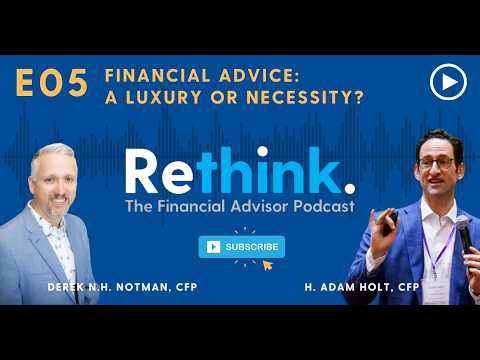
Watch and Listen
Episode Summary
Adam Holt and Derek Notman test a century-old idea against the advice business: that the luxuries of one generation become the necessities of the next. The line comes from economist Hazel Kyrk’s A Theory of Consumption, published in 1923, which listed bathtubs, toothbrushes, forks, matches, and window glass among former extravagances. The hosts apply the pattern to financial advice, arguing that what was once reserved for households wealthy enough to command a planner’s attention is being opened up by technology and access. The most useful stretch of the conversation is about simplicity as the actual luxury good. Clients with significant complexity pay for a one-page summary, while mass-market clients tend to receive page count instead. Holt argues clients want to know whether they are doing well and on track, not their position in a particular holding. Both hosts expect the next scarce luxury to be human attention.
What This Episode Covers
- Hazel Kyrk’s 1923 luxury-to-necessity framework, applied to financial advice
- Why access rather than cost is the variable that turns a luxury into a necessity
- Simplicity as the premium product, and why page count is a poor proxy for value
- The two questions clients actually ask, and what they imply for how results get reported
- Why the hosts expect human attention to become the scarce good as technology accelerates
Full Transcript
Full timestamped transcript.
[00:00:00] H. Adam Holt: Welcome to Rethink: The Financial Advisor Podcast. My name is Adam Holt.
[00:00:06] Derek Notman: And this is Derek Notman. We are your hosts, both veteran advisors and fintech CEOs who challenge the status quo, question everything, and have fun doing it. Hear honest commentary on the challenges facing advisors today. And be part of a community where we can all rethink the profession.
Now on to our episode.
Adam, is financial advice a luxury or a necessity for consumers?
[00:00:38] H. Adam Holt: That's such an interesting question. I wonder what our listeners are thinking about right now. What, why would you be asking that question? Huh.
[00:00:49] Derek Notman: Yeah, it, it's thought-provoking. Uh, I'm curious how you feel about this, um, 'cause there's been a shift.
We'll get to that, but there's been a shift over the last I don't know how many years now. I guess that's speculative, but there's certainly been a shift. So I mean, u- unpack this for me a little bit. What are you, what are you thinking?
[00:01:08] H. Adam Holt: Well, one of the things that brought up this topic recently was I was doing a, a thought leadership program for a larger company, talking about how the changes in fintech is affecting those in advice and sales and product delivery, and this comment kept coming up, which was that the luxuries of one generation become the necessities of the next generation.
And that's a phrase I know that you've heard before, but when we started discussing this before the podcast and did research around it, it was interesting to see how prolific this is. And, and I wanna share this quote for those of you that, that, uh, are really curious about this. And, and I want you to think about when was this written, okay?
And here's the quote, "It is now commonly said that the luxuries of one generation become the necessities of the next. What a list could be made of the essentials of today, which in the past were extravagances or selfish indulgences, fads or simply display, from bathtubs to toothbrushes, automobiles, forks, matches, window glass, houses with chimneys," et cetera, et cetera.
This was written... Can you guess how long ago this was written?
[00:02:24] Derek Notman: A while.
[00:02:26] H. Adam Holt: A while probably.
[00:02:26] Derek Notman: Be- be- before 2000. How's that sound?
[00:02:28] H. Adam Holt: Before... Oh, before the internet, before the interwebs.
[00:02:32] Derek Notman: The
[00:02:32] H. Adam Holt: interwebs. Probably. Uh, this comes from, uh, Dr. Hazel Kyrk, uh, Theory of Consumption in 1923. So 100 years ago-
[00:02:42] Derek Notman: Yeah,
[00:02:42] H. Adam Holt: wow ... he published this on, uh, research around obviously the fact that people were pretty much used to, were becoming used to bathtubs, right?
Those were now ne- a bathtub was a necessity. Previously, it was a luxury. Window glass was a luxury at one point. Now I think most of our windows have glass in it. I can't imagine a window without glass. Isn't that kind of oxymoron? I, I...
[00:03:09] Derek Notman: Well-
[00:03:09] H. Adam Holt: A house with a chimney ...
[00:03:10] Derek Notman: some cultures, like the Japanese culture, use paper, right?
[00:03:15] H. Adam Holt: That's true. That's true.
[00:03:17] Derek Notman: But that's a whole nother conversation.
[00:03:20] H. Adam Holt: Well, forks, I mean, there you go. Forks, I
[00:03:22] Derek Notman: mean,
[00:03:22] H. Adam Holt: all, all of it though. There's some areas that don't still use forks, right? My household doesn't really use forks. Um, but I guess the... They use their fingers, by the way, if you're wondering. They use their fingers
[00:03:33] Derek Notman: or they use chopsticks.
That's what they- It's just saving all the dishes that you have to do.
[00:03:35] H. Adam Holt: That's right, 'cause I'm always cleaning the kitchen. For- I had to bring that full circle again.
[00:03:40] Derek Notman: Sorry.
[00:03:41] H. Adam Holt: Thank you. Well, the reason we wanted to ask this question of everybody, and of course debate this live with each other- Is because financial advice itself can be asked the same exact question, right?
You know, when you think about this in our own generation What are the things that you think about, Derek, that were maybe luxuries for your parents that are now necessities? Give us some examples. I mean, I'm sure there's a hundred.
[00:04:07] Derek Notman: Yeah, yeah, to- totally. I, there, there's so many, but like it... Cordless phones.
You know, like- Cordless phones ... you r- you know, phones have been around for a while, but they were always corded, right? You had to have that like, you know, 30-foot cord so you could go around the corner and so you could have a private conversation. You know, so cordless phones. Just simple things like TV, being able to go to a bookstore.
Uh, you guys remember Blockbuster, right? I remember. Renting movies and bringing them home. Um-
[00:04:34] H. Adam Holt: You had to actually make sure you had returned your prior rental.
[00:04:37] Derek Notman: Right.
[00:04:38] H. Adam Holt: And if not, they wouldn't rent you anything. And then you'd go there, and the one movie you wanna rent was not there, so you had to wait till next week, and you had to rent- Oh, God
Rambo again. I mean, you know how many times- First Blood ...
[00:04:49] Derek Notman: I had to
[00:04:49] H. Adam Holt: rent Star Wars? I love Star Wars. I think it's because I rented it 40 times. What else did you rent? Um, that's funny, phones. I remember, I remember a phone, this might age me, where there was only one phone in the house. And- Oh, for sure ... you had to get off because Dad was expecting some, some one random person to call them, and it was g- they could get the beep, beep, beep, beep tone that said that someone was on the phone.
[00:05:11] Derek Notman: What about internet access? Dial-up modems. Remember AOL Online? Mm-hmm. I do. But, but if you didn't have a second line for a modem and someone called, you got kicked off and had to go through the whole process again.
[00:05:26] H. Adam Holt: But that- We used to mimic that scratchy noise. Remember that?
[00:05:28] Derek Notman: Yeah. Oh, my gosh. Remember that noise?
But that was still somewhat of a luxury, especially if you had a second line to have the internet.
[00:05:36] H. Adam Holt: Man, did you have call waiting growing up?
[00:05:39] Derek Notman: Not initially, no. Like, if you were- Call waiting. No. Like, no.
[00:05:43] H. Adam Holt: Caller ID?
[00:05:44] Derek Notman: No. No caller
[00:05:45] H. Adam Holt: ID?
[00:05:45] Derek Notman: You know, I really miss the days of no caller ID. As a kid, I was one of those guys that liked to do prank phone calls.
[00:05:53] H. Adam Holt: Outbound prank calls.
[00:05:54] Derek Notman: Outbound. And you can't do that anymore. It's just, you know, our kids, this whole generation is missing out on some real fun.
[00:06:02] H. Adam Holt: Those were luxuries. We, we used to val- When that was brand new, we were like, "Wow, that is so cool." I mean, I get to know who's calling. I could screen.
[00:06:12] Derek Notman: Yeah,
[00:06:12] H. Adam Holt: screen.
I can actually not pick up when someone who I don't wanna talk to is calling me. Everyone had to be quiet when you got on the phone because, you know, they couldn't hear anything over that receiver and the big cord- Right ... would get wrapped around and twisted in such a way where it was always jangled up.
You, you know, remember that crazy twisty wire- Oh ... that you're talking
[00:06:28] Derek Notman: about there? It never, it never went back the way it was supposed
[00:06:31] H. Adam Holt: to. It never did. You could hang the phone like this, hang the phone, and it would try to untwist until just the next time. Somehow someone's wrapping around, I don't know, a pole when you're not looking and destroying the cord.
I guess, I don't know. But it... Listen, if you're listening to this and you're thinking, "Yeah, I, I remember that moment," and maybe you saw your grandparents deal with this. I don't know. Why does that have any relevance to our podcast and financial, and financial advice? It has a lot to do with it
[00:06:58] Derek Notman: It has a ton to do with it.
It's just we're just gonna look at it through a different lens here. Yeah, for sure. Um-
[00:07:04] H. Adam Holt: So the luxuries for the last 200 years are now necessities, okay? Mm-hmm. Like window panes- Right ... okay? And no cords on your phone. Can we ask the same question about our industry? So one of the things that we thought about is we said, think about this on your own.
What do... What are the luxuries in financial advice and financial delivery, financial services? What are those luxuries today, and who right now has been... Who's setting the standard? We think, 'cause both Derek and I have worked with very high net worth clients, we'll call them ultra high net worth clients, they can actually, they demand and they expect the luxuries we're gonna share with you.
So we're gonna list a few that we, we thought of before this program, um, which I think are really important because if you recognize that these were the luxuries, by the way, for the past 20, 30 years of our own practices, they are becoming the necessities- Mm ... of the next wave of consumers of financial advice.
Let's talk about the first one
[00:08:04] Derek Notman: Financial advice, right? And, and not just, just silo, but all of the, the facts that a family has, business, personal, and everything. I, y- I think it... Forever it's been like, "Well, that was really reserved for the wealthy. We have family offices," all that stuff. For, for those that couldn't afford that luxury, they, they were buying financial products and they were getting siloed.
I don't even know if advice is the right word. We've unpacked that in another episode. Yeah. But, um, yeah, like, the, that was the luxury. Um, not anymore, and we're gonna get into why. Uh, uh, well, we talked about this before, but- Yeah ... go ahead and list some of these other ones here.
[00:08:43] H. Adam Holt: Well, I see... When I think about financial advice first, right?
Most, most of our ultra high net worth clients came to us for either two reasons. They either wanted someone to look over the entire big picture and give them legal, tax, insurance, investment, structural decisions, bring ideas, try to fix what someone had done to them, right, when they didn't have means, right?
Unwind the s- the products that they had bought that were just not serving them, or number two, they came with a very specific request. Like, for example, we want to set up a trust with $100 million. Execute that, right? At a high level, and we're willing to pay for that process, right? So they, they either came with very specific knowledge of what they wanted to execute, and the reason is because they have other professionals that are guiding them with their guidance- Mm-hmm
and now they want us to execute at a level of preeminence that we're used to given we work with their peers, okay? But if it wasn't a specific execution, like, "Here's X number of dollars. Invest in this strategy," they didn't know what they wanted. It was, it was always advice first. So in some measure, behind net worth individuals are getting, are starting with advice and context to what they're trying to do, create, influence, contribute, et cetera, et cetera.
So what's very clear about high net worth is that they're getting professional guidance first, and it starts with understanding the households. Now, this is of course really critical today. We know suitability best interest is driving this. We, we need to get the facts. We need to understand what's going first.
But it, it begs the question if, if advice first, product second was the luxury, it will also eventually become the necessity. Uh- And this is part and parcel to what we've talked about in the past, right?
[00:10:33] Derek Notman: It, it really is. Now, you and I talked about this previously offline, but I think it, it warrants being discussed here.
Why has it become, uh, a necessity now? Like, what, what has happened that's made it a necessity? And, and I would argue that it's access-
[00:10:55] H. Adam Holt: Hmm ...
[00:10:55] Derek Notman: to information.
[00:10:58] H. Adam Holt: Like
[00:10:58] Derek Notman: what? Right? Well, think about it, like before the internet, if I needed help with something, I had to go, like, get a book or I had to get a referral to some professional or try to research this stuff on my own.
And so it was, it was difficult. It was, it was disjointed. And all of a sudden we have this thing we have called Google.
[00:11:19] H. Adam Holt: Hmm.
[00:11:20] Derek Notman: And I have a question about a trust or a product or whatever, I can sit on my couch and now I can get access to this information. I may not be able to implement it, right? But at least I know I'm, I'm, I'm an informed consumer much more than I ever was in the past.
So now this information that was reserved for the high net worth, it was a luxury to have access to this information-
[00:11:43] H. Adam Holt: Mm-hmm ...
[00:11:43] Derek Notman: now all of a sudden has been democratized to everybody. Um, and if we have access for everybody, now it really does become a necessity, and I think it should be.
[00:11:55] H. Adam Holt: That's true. And at, and at what cost is that information?
[00:12:00] Derek Notman: Well, I think to the con- yeah, it's, it's an interesting question. To the consumer it's, I don't know if there's any cost. I think it's a benefit. But I think to the advisors that don't recognize this, this access, um, it could be a massive cost to them as a, you know, as a going concern for their business.
[00:12:17] H. Adam Holt: Oh, that's interesting.
That's, it's interesting how you heard that. 'Cause what, what I was, what I loved about what you said is you used the word access several times. And, and this is no different than any... Let's tie it back to our original theme, right? A luxury by definition means that it's exclusive. Yep. It's high cost or some barrier to getting it, and therefore only a certain number of people can get to it, either by invitation or by paying for it.
Um, right? You only know about certain things because you've been invited. You're in the loop, and that means that you can keep a luxury exclusive for some period of time as long as the cost point is high. But eventually if that luxury becomes, there's an awareness of it, people aspire for it. They want it.
They desire it. It becomes coveted. These fads that the, the prior, uh, quote that we used, uh, indicated, it starts with a fad, now all of a sudden people want it, now all of a sudden there's manufacturers that will provide it at a lower price point so that it makes it more accessible. When you think about information today, accessible is literally zero cost.
Yep. Um, so information is accessible. One might also argue it's, there's too much information now to weed through it. Maybe we need people to help, uh, actually just choose which information to read, uh, or listen to or read. But I think this is important. Wealthy individuals always had access to information, products, services, because they could meet the minimums.
They had exclusive professionals they could get to. That is becoming democratized, and I think you're probably right. The, the biggest influence that has just become access, uh, and availability. It's one of the things that's democratizing virtually everything. But how is that gonna affect advice, right? So if we're delivering financial advice and products that serve that advice, uh, access to information is becoming, you know, untethered, right?
There's, there's so much more information out there. Uh, we can't rely upon that as a differentiator that we have more information than somebody else. That's, that doesn't serve my purpose.
[00:14:10] Derek Notman: We can't, right? N- now someone, like whether it's like aligning my values with my investments or coordinating tax and legal and all these other things, things that used to be reserved for the, the luxury, the high net worth.
Now all of a sudden I can find that stuff out pretty quickly online by myself to a point at least where I can be somewhat educated when I'm having a conversation with- Mm-hmm ... potential advisor. So yeah, it, it, it's been this major shift. People still desire the simplicity that we're able to get, and I think that's one of the luxuries that also that these, these high net worth individuals really enjoyed.
But now it's, it's, um, it's there for everybody.
[00:14:49] H. Adam Holt: That's true. Well, that's, that, that's a great segue because we, we do know that a lot of our wealthier clients had a coordinated team of professionals, right? They have the attorney and the accountant. Maybe they have an entire firm. They have a family office.
You mentioned that. You know, talk about what, what, what has been the luxury That is now gonna be creating a, at least maybe influence a necessity, right? This is still an expensive proposition, but what did you see in your high net worth clients and what, how'd they put together their teams that supported their financial visions or their financial goals?
[00:15:22] Derek Notman: They wanted subject matter experts in a variety of ways. They wanted a coordinated effort, people all working at the s- on the same page at the same time. But they didn't want it to be... Like, there's a lot of work that we do as a coordinated effort as a team of advisors. There's a ton of moving parts and complicated things, but the client, they don't wanna know how the sausage is made.
[00:15:43] Announcer: Hmm.
[00:15:44] Derek Notman: Right? Like, tell me how, tell me this is what I want. Keep it simple for me. Don't give me hundreds of pages and stuff. I just wanna know that what I need is getting done. Um, and I would argue that regardless of net worth, people want that experience, and now just more people have access to it.
[00:16:02] H. Adam Holt: Yeah. Boy, you just said something that triggered for me.
I believe that high net worth clients, when they start working with a professional who's worked with their peers, they actually have less edict. In other words, they expect that the advisor already knows what's in their best interest. It's an unspoken thing. Like, I don't- Yep ... I'm not one, like, you are going to be empowered with a significant number of resources of mine, and I'm gonna pay you accordingly, to make, to act and make best interest decisions for me.
Literally delegating that, uh, that authority. I, the, it's funny, the, the wealthier the clients that we had, the more power they were willing to delegate to experts. Right. And I think it's because they said, "Well, I'm making a decision to work with you as a person and your process and my 10 checks and balances, so don't worry, you're not gonna mess up 'cause I've got three people looking over your shoulder."
Um- Yeah,
[00:17:01] Derek Notman: exactly ...
[00:17:02] H. Adam Holt: and you've already worked with my peers, so you already know the scrutiny I'm gonna give you. That level of care was actually easier than providing it to someone where you're managing the money they've saved over 40 years, and it's all they got, and they're not... Like, it's, it's, it's an interesting dichotomy, but it's proving out that the luxury of having a professional who works in your best interest is becoming the necessity for mass market.
Yeah. Right? Don't we have regulations now that are being imposed? I, we always act in their best interests. I guess there were some people that took advantage of people that didn't have the expertise and/or experience and literacy in order to take or make those decisions, and that's where we have to protect the consumer now.
But it is becoming a necessity. We have to lead with this concept that we're always acting in best interest. Um, and we're willing to have the transparency of a team of professionals, whether I build them or we're, I'm inheriting yours, that can look at our work and say, "Yes, it's- Mm-hmm ... it's good. It's bulletproof.
Um, and this is, uh, these are good decisions." So think about how that's gonna change going forward. That luxury is becoming pretty much uh, an expectation or it will in the future. How do, how about this? This has really big, been big these days. You know that, um, and I'm sure you've experienced this, wealthiest clients had an alignment early on that their investments supported their values, right?
I remember in the early days, we could put together programs that excluded certain pain stocks or-
[00:18:27] Derek Notman: Mm-hmm ...
[00:18:28] H. Adam Holt: uh, or stocks that had sins we associated them with, right?
[00:18:31] Derek Notman: Yeah.
[00:18:32] H. Adam Holt: And this is big. Well, how has this changed in the business today?
[00:18:35] Derek Notman: Well, we- we're still doing it, but I think there's been this upward, upward trend of more of it now because, again, access.
[00:18:42] H. Adam Holt: Hmm.
[00:18:42] Derek Notman: People are, uh, being educated about it, but they're also having more control. I- we- we've seen this massive not only democratization but also, um, it's part of fee compression, but also just, like, greater ch- choices in the market, where now if, if I've only got $5,000 in an IRA I just opened up, I can still direct how I want my money to perform in a, uh, in a line with my values, where before I had to have a million bucks or 10 million or whatever, you know, and it, it just wasn't possible.
Um, so that al- also has shifted and, but it- it- it's awareness now too. The, the masses have awareness of what only the high net worth individuals had awareness of 10, 20, 30 years ago.
[00:19:23] H. Adam Holt: Mm-hmm. But it's really ex- it's opened up obviously this market in what we typically call the ESG market, which I believe, if I get this right, this is, uh, this is either ethics or environments, social and governance.
Do you remember
[00:19:36] Derek Notman: it? Totally right. Yeah.
[00:19:37] H. Adam Holt: Yeah. I've heard it in both of those ways. So I, I, um, if I'm- Mm-hmm ... saying it wrong... Yeah. I remember 20 years ago when a client, there was one mutual fund that enabled a, you know, we'll call it an alignment of values, and now there's hundreds, right? So there's, there's micro managers, there's big managers that can, that can really focus on value-based investing.
This was, this was table stakes for wealthy individuals 'cause they had control over the companies they invested in directly, uh, either private or public. Um, but it's interesting to see how this has become a very quick necessity and how there's so much demand for values-based investing, even o- at the sacrifice of performance, um, because people want their, their capital, their social capital effectively to be invested and aligned.
So this is, if you're not ahead of this one, you, you ha- we have to be talking about this to consumers because that lu- that, the luxury is already becoming a necessity, uh, or on that path. It's more than a fad already, so we have to kind of be in front of this one. Um, I know for me, most of my clients that were high net worth, they focused less on performance and mostly on structure because it was the legal and the tax implications of their life that, uh, caused the biggest pain points, right?
Tax was their biggest expense. Uh, and of course protecting their assets from, uh, we call them creditors and predators- Oh ... inabilities and disabilities, right? These were their, these were their biggest weapons or, or, I'm sorry, um, enemies. Because when you've collected a certain amount of assets, now people wanna take it away from you.
Yep. Whether it's they perceive it's the government or they perceive it's some lawsuit, uh, or, uh, some, you know, they just structured their assets wrong and a divorce happened. I don't know. The point is, is that we tended to focus more on that aspect than we did the actual performance, and I think that this is one of those areas where financial professionals need to really be leading as opposed to following the customer guidance, uh, and, and do work on this.
Have you been, have you been exposed to the legal and the tax- Uh, as an important aspect of the financial advice?
[00:21:36] Derek Notman: Yeah, it, it, it's funny, in, in the conversations that I have with my high net worth clients Like they wanna know how their money's doing, but it's like, eh, you know, h- how is my, h- how's my 1099 gonna look this year, you know?
[00:21:53] H. Adam Holt: Yeah ...
[00:21:54] Derek Notman: what happens if that bus comes around the corner tomorrow? Um, you know, stuff like that. 'Cause like these folks, they made the money, right? So they don't need the returns that someone who's putting money in a 401away every month for 30 years needs. So it's a different mindset. So yeah, so there's this more coordinated attack or effort that ha- that has to happen.
But what's so cool, just over this whole theme of this podcast episode, is that now that that is not reserved just for the rich anymore.
[00:22:23] H. Adam Holt: Mm-hmm.
[00:22:23] Derek Notman: Anybody can do, can do this with the access to the information and, and advice that used to only be reserved for, for a few.
[00:22:32] H. Adam Holt: It's true. And I, I think to kinda round out this list, you know, the, the things that we came up with at our high net worth clients that were perceived luxuries because they could afford them included simplicity.
I mean, I, I know, uh, we have a couple clients that are on the Forbes list in our practice, right? You, you... It, it was always fun to see that their investment advisor showed up with three people in these beautiful suits with a fantastic gold bound book, uh, that nobody had time to look at, had down to the holdings and it was...
I say gold bound. It was a massive volume of text- Yeah, yeah, yeah ... to go through any statement they wanted from the 15 different trust accounts. Uh, and you know, for us, we showed up with our single page asset map and said, "Here's, here's all your stuff on one page." Love it. And they loved it, right? They were like, "Okay, move this box over here.
Draw this." They draw a little line. "Honey, here's where everything is." "Okay, great." Um, the, the point about that is that not, not to say whether Asset-Map is, is something that's just a requirement of wealthy people. It... What it really did kinda show is that the executive summary of just bubble this down to one or two pages, you, you can afford to pay for that when you have a significant amount of money.
Um, whereas I think the mass market had, that has been held back from them because we wanna deliver value in the number of pages we print. Um, and, and that's not necessarily helping them because a wealthy individual's got so much complexity, they're paying for simplicity. Uh, I think the market now is, is basically, has no attention, uh, left to read these massive reports.
They don't. And so simplicity is really forefront these days. It is going to be necessity for us to simplify our communication that com- that communicates how somebody's doing financially from a wellness perspective, okay? What clients wanna know is, am I doing okay? Am I on track?
[00:24:15] Derek Notman: Yes.
[00:24:15] H. Adam Holt: They're not asking, you know, what's their holding position in government bonds and, you know, what, you know...
I don't even, I can't even think about it, right? They're asking for, am I okay? Can you communicate that and what actions I should be taking or be thinking about?
[00:24:31] Derek Notman: 100%. And everyone's thinking that. And I, uh, to your point, like the high net worth, worth individuals have been thinking that and asking for that a long time.
The tools were in place to do it for them. Now the tools are in place for everybody.
[00:24:42] H. Adam Holt: It's true. It's true
[00:24:43] Derek Notman: So if you don't offer it, what happens, Adam?
[00:24:47] H. Adam Holt: Good question. Right? If you don't offer it, I'm sure there's 10 other people that are available, uh, that have done good marketing - Yeah, right ... or brand awareness technically that, that will solve this problem probably for cheaper.
Uh, and that's a really good point because, uh, you know, interestingly enough, wealthy individuals tended to pay, or the ultra high net worth tended to pay marginally less per dollar managed because they had volume. Um, and so I think w- we know we still see a significant amount of compression in, in, in revenue.
It was a luxury to be able to charge one, one and a quarter, 2% for assets management. The necessity going forward will be you need to be seriously cost competitive or, or list out what you're providing for your AUM charges if you're doing asset management or if you're doing insurance placement. What am I gonna get as a result of doing this business with you versus choosing the commodity next door that's doing the same index approach or active management or whatever, uh, process you believe is differentiating you yourself?
[00:25:46] Derek Notman: You know, that, that's an excellent point. You have to show that value 'cause of the, we've talked about this before, the products and services have somewhat been commoditized at this point, if not completely. But another piece that's so important is- Access to the right advisor. Yeah, at the end of the day, if, if I have 100 million or $100, um, and in point in fact, 'cause as you, as you listeners hopefully know, Adam and I are still actively practicing, uh, as advisors as well, um, is that I had a, a new client meeting yesterday.
Mm. Never met him before, and we didn't talk about money a whole lot. We talked about, like, life and do we like each other and do we have similar values and, like, does he like my style and vice versa. Um, because if we didn't connect on that level, well, I, doesn't matter what my offering is and my value add because we're never gonna get to it.
[00:26:41] H. Adam Holt: That's a great point, and I, I know that that's been true on our list is high net worth clients always expected significant access, human access. They want a relationship.
[00:26:52] Derek Notman: Yes.
[00:26:52] H. Adam Holt: They expect communication. They actually expect proactive communication. They... You're supposed to be calling them. They don't call you.
Yes. You call them to tell them what's up and what decisions you need to make, oh, and what you decided to do, right? Th- there's a difference between, I think, this mass technified audience of I've got 200 clients and I sent them out an email and that was good enough, or a newsletter, and they got their automated statement, and if they want, they can log onto their portal and, you know, that's, they want a self-service, that's fine.
That, that sounds kinda like a s- stop and shop. I, I, I don't know. Yeah. That, that doesn't speak to me in terms of we'll call it human value. The luxury there is... And that might actually wind up giving the fact that nobody has any time anymore. The luxury that maybe, uh, still costs money is having a human connection, so if you're planning on charging a significant amount or at least keeping your, your, your ex- your cost of doing business with you high, you best be providing some serious human value, not just tech.
Um, because tech is... And- Yeah ... although it is, as you said last time, it's table stakes, um, you know, the value that we can still charge is gonna be in the human, uh, experience.
[00:28:00] Derek Notman: No question. I mean, these people share all very, very personal parts of their lives that are not financial, right? And if, if we can't connect on those levels and empathize and build trust on those levels, then my tech and whatever else I have just doesn't matter.
[00:28:15] H. Adam Holt: Cool.
[00:28:16] Derek Notman: Anyways,
[00:28:16] H. Adam Holt: man, it's- Well, we should, yeah, we should talk about this, I mean, because br- 'cause briefly, you know, you're working on a project to try to address this kind of how do you connect a consumer to, to the right kinds of advisors. What's the preview on that and where you're taking it?
[00:28:30] Derek Notman: Yeah. This is a, this is a fun project.
Uh, there's a, a beta prototype out in the market space right now that we are, are offering, so if you're curious and you wanna learn more, uh, h- you know, send me a message. But, but really we're rethinking, all right? That's, that's what I love about this podcast. Right. We're re- we've completely rethought the whole connection process between consumer and advisor, uh, from both sides of that equation because the existing solutions at this point forgot one key element, the human element.
[00:29:03] H. Adam Holt: Mm.
[00:29:03] Derek Notman: And we, we just got finished talking about how important that is. So stay tuned for that. We'll get to that later. Um, you can always, you know, send me a message if you want more, but yeah, I mean, that, that's the missing piece and we're, we're trying to fix it.
[00:29:14] H. Adam Holt: Yeah. Well, that's great you're taking the initiative to, to address a problem.
That's... But that's what we do, right? We just- Exactly ... we don't just talk about it, we fix it.
[00:29:20] Derek Notman: We do it.
[00:29:20] H. Adam Holt: Um, that's great. So let's talk about some takeaways on this. Uh, you know, what can you as an advisor decide, research, delegate, or do, um, that we might offer you some, uh, some guidance or mentorship around these concepts of luxury and necessity?
Derek, you wanna take it away?
[00:29:37] Derek Notman: Yeah. I- I've got a couple thoughts on this. I, I think it- we have to bring more focus onto the relationship aspects. This is kind of a nice segue from the, the stuff we just unpacked, is that there's a humanity part of, of this relationship that, uh, uh... And when we have more access and now you're...
Like, like the, the, the value in that 200-page report is gone. So show me other value by being a human being that you understand me. And we have to be better about that as an advisor community doing that through our marketing channels, 'cause that's how we differentiate. That's how we show our extra value.
Uh, the tech stack's important, but, um, it isn't the end all be all like it used to be. But, but it is there to facilitate that human connection. That's really important. Yeah. Um, you gotta answer the why question. Like, why should a consumer work with you? And it's not just because you offer Asset-Map, you know?
Or, or some other great tool out there. There's more to it than that. Mm-hmm. Um, and then don't commoditize yourself with the tech. Um, you know, we have to be subject matter experts, uh, but also relationship managers, experts if you will, uh, to win at this game, in my opinion.
[00:30:48] H. Adam Holt: Yeah. No, those are all, those are great takeaways
[00:30:51] Derek Notman: What are your thoughts, Al?
I mean, I know that you're pretty passionate about this, this topic, so tell me a little more. Like, what, what do you think some advi- advisors could do, take away from this, so they could go do something?
[00:31:00] H. Adam Holt: Well, I mean, if you, if you, if you do believe that the luxuries of the high net worth clients are becoming the necessities of the mass market clients, which is where a significant amount of the opportunity is- Oh, yeah
right? That emerging wealth- It's huge ... the Boomer population- Huge ... that is gonna transfer billions, trillions of dollars from retirement accounts as well as business interests to the next generation over the next 20 years. Uh, my belief is that every financial engagement needs to lead with advice, right?
It just makes good sense that we do full holistic fact-finding as fast as we can for every prospect and every client. Um, and, and the reason is because it's, it's defensive as much as just good business process, right? In the next couple years, the number of planning and planning light and speed planning tools direct to consumer that are coming available is going to be overwhelming.
That's just the next couple years, which means clients are going to be able to run their own retirement plan. They're gonna be able- Mm-hmm ... to figure out whether they're under-insured. They're gonna be able to know whether they need to put away money for education funding. This kind of Excel-based run is a commodity.
Um, but it means that we need to, we need to add value by thinking holistically, and that means everyone needs advice, not just a product. Uh, product is gonna get commoditized even further, so it'll just be robo distribution as we talked about in a- Mm. Mm-hmm ... couple podcasts ago.
[00:32:22] Derek Notman: Yes.
[00:32:22] H. Adam Holt: Um, so I, my point is to you is, is if you're not leading with advice for every client, not just your As and Bs, um, that's a miss, and that's a missed opportunity.
Find a way to bring that into every single conversation, even if it's fast. Number two, I think everyone needs to decide that they're gonna provide guidance unsolicited. That means the rebirth of what I call a proactive advisor. We need to reach out to clients and say, "Hey, you know, I've been thinking about this.
What are we gonna do about long-term care? Is that a... Does it have a plan? Do we, do we have a plan of attack here? Let's, let's unpack that together and spend 15 minutes." People don't need full hours to get together, okay? They- No ... you can meet with somebody for 15, 20 minutes and start a conversation and research it in the back end, and then follow up via email today.
It doesn't... We can be doing a lot of things at the same time. Um, so I think we need to get into this habit of providing human, uh, advice unsolicited- And, and I, I think the way to do it is also to compete, make the luxuries standards for your customer, right? Decide that with technology and with that extra time savings, you can start to deliver more humanity.
You might choose to actually, you know, simplify your client base and cut your data- your, your client base. We've all talked about, and Derek and I personally have chosen to do this, right? We had a lot of clients that helped us get to where we were, and then realized that, wow, we can't, we can't handle it.
We can't deliver the level of service we want to for the lifestyle we wanna have. We need to make hard decisions. That means either growing your firm and bringing in the next generation and delegating, or choosing to say, "I- I'm gonna be very specific about my criteria." Um, but either way, um, this is gonna be, in many ways, both a land grab of opportunity for people that want advice and are willing to pay for it, as well as a hyper-competitive environment for the high net worth c- clients that can now demand the next level of luxury beyond what we're used to
[00:34:07] Derek Notman: today.
[00:34:07] H. Adam Holt: Yeah. That's what's... Think about it. What's the next luxury then? If all this has just become necessity, what? That's tough to know. It's gonna be more humanity. No, it's gonna be more humanity, 'cause the tech is gonna keep moving. Ah,
[00:34:17] Derek Notman: yes.
[00:34:19] H. Adam Holt: Tech is gonna keep accelerating faster than our humanity. So the, what will be the, the antique value of, of a human's relationship will be even more valuable than ever before, right?
I love how that- 'Cause 90% of my day is tech. I love that. But 10% is really intimate And I'll pay all day long for that So that will become the most valuable piece. In my opinion, now this is just my opinion. Of course I'm right, but that's, this is my
[00:34:45] Derek Notman: opinion. I'll second you're right there. Yay. Uh, I, I think that's good.
But I think this is probably the most powerful point there is, is, is... And, you know, it's, it's interesting, the advisors that, that standardize or, uh, necessitize, if that's a word- Hmm ... luxuries will be faster at, to growing at this party than the others.
[00:35:03] H. Adam Holt: That's it. You're right. Uh, see, we always save the best moment, like what we just realized, we have to talk it out.
Isn't that funny about this? Yeah, it's awesome, man. I hope you've stuck with us this long because if you just heard that moment, replay it, that was it.
[00:35:19] Derek Notman: That was it. It was organic, not scripted. Nope. And, uh, and Adam's awesome.
[00:35:25] H. Adam Holt: No, you're awesome for agreeing with me. That means you, we agree. See, brother, that's the way it works.
There we go. Let's jump to our, let's, uh, that was our series on, on, you know, your actions hopefully, so hopefully you wrote those down or remember them or are gonna delegate them. Let's talk about our community question, uh, in the last five minutes of our podcast here.
[00:35:41] Derek Notman: Yeah. I'm, I'm gonna ask this to you, Adam.
I think this came in to both of us from, from, uh, Bill in Colorado. Um, so I wanna, I want you to answer this- All right ... for us here, Adam. Um, "Dear Adam and Derek, I have been working with many clients who over the years share that they have a tax professional or other family member in the business that they work with already.
Sometimes they have years of a relationship already built up. I don't always agree with their other professional's advice or management. How do you communicate in a way that is not off-putting to other relationships, but helps show that you are looking out for them?"
[00:36:19] H. Adam Holt: Well, thanks Phil for, for doing that, uh, for taking the time to write that.
And remember, you can do that by just, uh, writing in LinkedIn to us or emailing us or, you know, we'll figure it out. Send us a smoke signal. Yeah.
[00:36:28] Derek Notman: Send us a note. Um, the
[00:36:30] H. Adam Holt: reason we chose this question, because it's, it's, it's interest- it was different first of all than than the other questions. Um, and we'll get to the other ones for those of you that did submit, thank you.
The, the interesting thing about this, and it relates to this luxury necessity question. If in fact we're moving towards a place where financial advisors in general or professionals are part of or responsible for managing a team of professionals, my belief about this and my practice has always been I take charge early.
The key, the key to this, uh, and here's why. Um, I believe that most clients of financial advice are asking for a confident leader, at least a more confident and competent leader than they are themselves with respect to making financial decisions. Mm-hmm. So they're not looking for someone who's wishy-washy and is gonna kind of like, "Yeah, okay," like, "I'll give you my advice when I think it's not gonna be- Yeah
make me feel bad or look..." They're looking for someone who's gonna tell them straight, be empathetic, and deliver and help them guide them towards a better place than they found, we found them, right? And the reason why that's relevant to this question is because we do know that lots of individuals have other maybe well-meaning or other professionals that they've adopted over the years, right?
I got my uncle's financial advisor 'cause I didn't know where else to go, but dude never calls me. I haven't talked to my other broker in 50 years , right? But, but I have a personal relationship, so I'm really... I'm... It's awkward. I, I don't know if I wanna fire them because I am gonna see them at Thanksgiving and then...
But can you give me advice in the context? And so unfortunately, as financial advisors, we're often put in a situation where we have to actually navigate this kind of emotional relationship with maybe disappointing somebody or giving them other guidance. And one of the ways that I've always done that, um, and I use my process to, to basically ask a question, which was If somebody had recommended informa- uh, you know, guidance on a product or a strategy that I didn't understand or I wa- I really seriously wanted to question, I, I would ask the client, "What is the strategy about this?
What, what is that strategy? What did that annuity intend to do? Why do we have it?" Um, and I would ask a significant number of times what is the purpose so I can work and coordinate with it, because I have to make other decisions if that is a legacy vehicle. Mm-hmm. A golden, uh, what did they call it? A sacred cow.
I can't, I can't- ... move that. And I would get enough clarity so that the client could tell me with legitimacy why it made sense. And oftentimes they recognize they can't tell you why- Yeah ... they have it. And therefore they a- have to either agree that they're making a decision that doesn't serve them and it's now out in the open.
They can't just keep it kind of private to their own ... mishegas, as my grandma would say. They had to now own it and then tell me that that's an okay situation. I have to work in their best interest. That means I have to point out when I think they're doing something that doesn't serve them. Uh, I'm curious if you've dealt with this before.
[00:39:33] Derek Notman: I have. But I think I, I like your style and way of doing it. You're helping lead, lead again, right? Love- Mm-hmm ... love the word, right? Uh, your client down that path, Phil, if you do this, where they can Come to their own conclusions like, "Hey, like maybe I shouldn't have this. Maybe I shouldn't have done it this way.
Maybe Uncle Bob didn't really know what he was doing." And i- it still might be an uncomfortable separation, but then even Adam and me who've done this before, it's like now you ask Uncle Bob to come in and start being- That's it ... part of these planning conversations, right? And then Uncle Bob feels, figures out pretty quickly, "Man, I, I'm kinda out of my league here.
Um, I'm still gonna come to Thanksgiving, but I think that, um, you know, Phil, you'll be better served over here with Adam," or whatever. Right. And if you have it happen organically like this, now you're not the bad guy anymore. You were just opening up communication channels and, and really at the end of the day, we work for our clients' best interests.
Mm-hmm. So let's figure that out, right?
[00:40:34] H. Adam Holt: I love that you brought this up because that, that was my... that, that's the next saving grace that, that I would have said, which is for Phil is y- invite, invite them. If they're really that important to this household, which is now your client, then invite them to be part of the discussion.
Now, you can seriously, you could clearly if, if it's on your turf, you can play the leading role, right? You, you set the agenda. You, you, you ask... But you create space for other people to create, to tell us why and to validate it with- in a place of respect so that you're clearly not making them look bad, 'cause that is gonna backfire on you, right?
The, the- Oh, yeah ... it's, there's a, there's a reason there's enough business, as you've always said, for us all to play. And, and, and it doesn't have to be an all or nothing unless that's your strategy. I don't know, maybe. Yeah. But, uh, but, but the, the point is, is that it's better to coordinate these professionals and it, and it really started us thinking, um, about what we wanna talk about next.
And, and this is a, it, this is an important time I think for all of us because there's so much changing drastically. In previous podcasts, we've recommended that you need to know who you are. You gotta know your identity- Yes ... going forward. What your firm's gonna be about. What are you gonna do? What are you not gonna do?
Uh, how are you gonna market that? How are people gonna... How are you gonna let people know what your why is and why you exist and what value you provide? How are you gonna do that, right? We've challenged many of you to ask this question. I think we're gonna spend the next program talking about this concept of who's in charge, rethinking whether we are CFOs for our clients or whether we are CEOs.
Think about that. I
[00:42:06] Derek Notman: li- yeah. I don't wanna, I wanna, I wanna jump in right now, but I'm gonna hold my tongue- Yeah, we can ... for the next one 'cause this is a great topic.
[00:42:14] H. Adam Holt: Well, I, I hope that, and for those of you that are gonna join us next time, and we hope that all of you do, uh, and are subscribed, um, to the podcast, there's lots of fun analogies already.
We've already started thinking it out, um, about this. It's really gonna be about leadership and the role that we need to have, uh, in being, uh, leading, leading with confidence and, of course, leading with advice. Um, so I, I think that this will be fun to talk about next time. It's a great parlay. Thank you, Phil.
We'll be sending you a f- uh, a t- a T-shirt with rethink on it. Um, and for those of you that are or that do wanna get, um, uh, get connected with us, please make the opportunity to LinkedIn connect with both Derek and myself and, of course, start the communication so we can make this about, uh, lifting the whole community.
Derek, any, uh, parting words, uh, for you?
[00:42:57] Derek Notman: No, I, I think you said it, said it really well. Um, I, I know we've gone over time here a little bit, and we don't wanna keep you from cleaning your kitchen, so, uh- Thank you.
[00:43:05] H. Adam Holt: It's time to clean the kitchen.
[00:43:06] Derek Notman: We'll get back to it. But no, this has been a great topic. I hope, I hope our listeners really, really got some things out of this.
And, and hope- I hope you're rethinking things, right? This is part of this is, like, we're, we wanna spur you on to, like, "Huh, never lo- never looked at it that way, but I like it." Um, yeah. So anyways, s- send us questions, connect with us, and just have an awesome day.
[00:43:26] H. Adam Holt: All right, brother. Have a good one. Good as always.
[00:43:29] Derek Notman: You too, buddy. Bye. See
[00:43:30] H. Adam Holt: you at the next one
[00:43:38] Announcer: Thank you for listening to Rethink, the Financial Advisor Podcast with Holt and Notman. Be sure to subscribe now and join the ongoing conversation. The information covered and posted represents the views and opinions of the guest and does not necessarily represent the views or opinions of Asset-Map or Connectir.
The content has been made available to you by Asset-Map for informational and educational purposes only.