
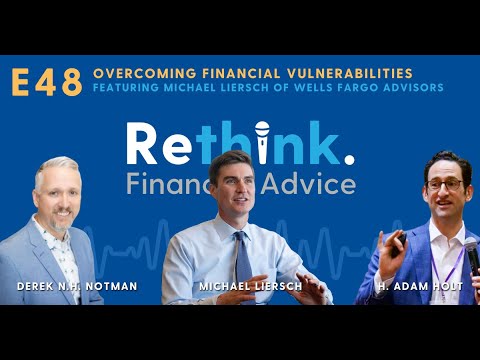
Ep48 - Rethink: Overcoming Financial Vulnerabilities – Featuring Michael Liersch
Watch and Listen
Episode Summary
Hosts H. Adam Holt and Derek Notman are joined by Michael Liersch, Head of Advice and Planning for Wealth and Investment Management at Wells Fargo Advisors, to discuss financial vulnerability in client relationships. Liersch, who holds a PhD in cognitive psychology and has applied behavioral finance at firms including JPMorgan and Merrill Lynch, explains how advisors can gently guide clients toward openness rather than pushing them to confront difficult financial truths too soon. The episode explores practical, empathetic approaches to uncovering what really drives client decisions.
What This Episode Covers
- What it means to address a client's financial vulnerabilities
- Behavioral finance techniques for building client trust
- How to ask better questions without overwhelming clients
- Michael Liersch's academic and professional background
- Empowering clients to exert agency over their finances
- What Wells Fargo Advisors is doing to support client wellbeing
Full Transcript
Full timestamped transcript.
[00:00:30] Derek N. H. Notman: Adam? Are you addressing your client's financial vulnerabilities?
[00:00:36] H. Adam Holt: Oh, that's an interesting one. I have to think twice about this one. What do you mean by that question?
[00:00:45] Derek N. H. Notman: Well, here's what I don't mean. I don't mean credit card identity theft. I don't mean, if they don't have enough savings or someone's gonna, , steal money from their safe in their house. All right? So , I'm not going down that road. What I'm talking about is, are you empowering your clients to be vulnerable, to open up
[00:01:07] H. Adam Holt: Hmm.
[00:01:08] Derek N. H. Notman: about their financial situation, so really good things can happen for them.
[00:01:14] H. Adam Holt: That's a great question. I think I am, Because I have a very clear process that I used in my practice to uncover the facts, and I used the facts. The people involved in their household, the assets, the liabilities, and all the different financial instruments, the policies they acquire over time.
I use that as a way to uncover their decisions or why do they have it, why do they have this without actually putting a finger on the vulnerability so that I didn't intimidate them. , I always found in the early stages of working with clients, Derek, , that if I went too deep early, I might touch , a difficult cord, and so I would review it by just not pointing out that, let's say there as a closet analogy that not that their clothes was ugly.
I would say, okay, let's take all your clothes and we'll dump 'em on the bed, and let's decide what serves us and what we like and do we understand it and does it fit and does it have holes in it? Right. So I think I approach it from much more of a mechanical standpoint, but I would elicit it by learning about why they made certain decisions.
, what have you done about this? Have you thought about this before?
[00:02:25] Derek N. H. Notman: I initially I didn't. I would ask questions, but I really wouldn't listen to the answers and would just push through. And then over time though, my process evolved where I was like, wait a minute, this stuff's pretty darn important. And if a client is actually gonna open up to me and tell me what's really on their mind, I have to ask better questions.
And when we do that, we allow them to be vulnerable. We allow them to open up and then things happen. But , I like your analogy is that you don't just throw the clothes out or the closet cuz they're ugly.
[00:02:58] H. Adam Holt: Yeah.
[00:02:58] Derek N. H. Notman: work with them through a process. You guide them, you gently nudge them, you encourage them. And that's a huge help because they probably deep down inside, no, they gotta do something. But they need to be helped there instead of just, pushed there.
[00:03:14] H. Adam Holt: I think it brings up though an important aspect, which is we all recognize that clients do have vulnerabilities around this, mostly because they're generally uneducated about finances in the way that we are. Obviously it's our profession, just very little literacy institutionally in our community.
And so there's going to be areas where we feel shame or intimidation around the process of getting financial help. And we don't always know the questions to ask and it, and there's a lot of emotion tied into this, but this really came out of a conversation that we had with Michael Lear.
So why don't you take a second and introduce everybody to Michael Lear, who's really well known in our industry.
[00:03:53] Derek N. H. Notman: He's a dad, loves his ski. He's a cool dude. And, , currently is the head of advice and planning, wealth and investment management at Wells Fargo Advisors. And not only does he have , a strong professional background where he's done similar things with behavioral finance at JP Morgan, Merrill Lynch, , Barclays, the list goes on, but he also has degrees in economics from Harvard has his PhD, , in cognitive psychology from uc, San Diego.
, so has really been in this space, from an academic but also from a professional standpoint for some time. So it was really fun having a conversation with him to get his perspective on financial vulnerabilities and what are we, what are they doing over at Wells Fargo Advisors to help customers.
[00:04:42] H. Adam Holt: Awesome. Let's hear from Michael.
[00:04:45] Michael Liersch: As I've, , traveled the journey of my career and met, , tens of thousands of financial advisors met, , just as many clients in my career. The first thing that all clients and advisors talk to me about is how difficult it is to ask meaningful questions about what money is supposed to be doing for the client.
And then how you connect that to a product solution or service that will get the client to where they want to go. And I just, Derek, I continually find that fascinating as to why that's such a challenge, why that's so difficult. Why clients don't necessarily wanna reveal that information because there's a big truth to that, Derek.
Mm-hmm. , multiple financial advisors, , wanna hold, , things close to the vest. Is there a trust issue? Mm-hmm. Is there a sense of embarrassment or fear in really doing the big reveal on here's my financial life because I've been a professional, or I've, , been a really important person within my own, , expertise and I don't wanna reveal that this isn't my area of expertise.
So there's a lot in that, right, Derek? And then on the financial advisor side. There's a sensitivity to not wanting to embarrass that client or make them have all those feelings or put them on the spot because they are an expert in their domain. , and the advisor doesn't wanna make them feel uncomfortable in the wrong type of way.
, and they wanna be disruptive in the right type of way, which is to reveal that they're to there to provide great financial advice and to connect that money and that meaning on an ongoing basis. So Derek, there's just, , a lot of, , challenges within that framework. Does that make any sense? Or, or not?
It makes complete sense
[00:06:23] Derek N. H. Notman: more than, more so than you may realize. Um, it's, it resonates quite a bit. We've actually talked about that a number of times at general area on the podcast. I even saw that you've got a background behavioral finance, so I know that you come at it from a, that perspective. Then I think that's where the industry and profession's headed anyways.
Michael, what is your
[00:06:43] H. Adam Holt: unique perspective given your
[00:06:45] Derek N. H. Notman: background of the financial advice, the market, profession,
[00:06:49] Michael Liersch: industry, whatever you want to call it? So I come from a background in what's called behavioral finance, and I know a lot of people talk about that, Derek, and describe behavioral finance in different ways.
My, one of my least favorite ways of describing behavioral finance, so I'll be a bit controversial here, is around what's called heuristics and biases. So it's this idea that human beings are not that smart when it comes to money, and so they make predictable errors and we all need to help them out because they don't take the right kind of risks.
They're afraid of losing money, so they don't put their money in the right places. , they follow the herd so they chase returns. You've heard it all before, and I really don't agree with that positioning at all. Really the behavioral science suggests that human beings are quite good at most things, uh, even when they do use heuristics, which are decision rules.
So using things like an emotion to make a judgment quick, very quick judgment call to make a decision typically works rather well. And using certain decision rules, , like losing money is not a great thing, is a pretty good decision rule as well. So the, these decision rules people use, work, , generally speaking around 90% of the time, it, it just creates reliable errors about 10% of the time.
And that's why we have big brains so we can override some of those decision rules and really bem more deliberative in thinking. And that's really where a financial advisor comes in, Derek. Which is where can you ask the client, , to press pause, really think more about the things that are driving those decision rules, which typically are your experiences both past.
Present and what you anticipate in the future. How much money you have or how much money you feel you have, what your spouse or your partner might think. So the people you're collaborating with, your children, you know your goals, there's so many different things that are gonna affect those decision rules.
And advisors can help lay it all out on the table so you can see, well, am I missing something? Am I using a deci decision rule that's more or less accurate based on what I really wanna accomplish with my money? So that's really the power of behavioral finance. It's not telling people that they don't know what they're doing, it's actually telling people that they have all the information in their heads.
And if they don't, the financial advisor can augment that, based on what they've seen work and what they've seen not work. And actually human beings are pretty, uh, adaptable and able to take in that information and make a better decision, collaboration with someone else. So they're not reluctant to make good decisions.
Derek, they're actually pretty good at
[00:09:27] H. Adam Holt: it. Gosh, it's so funny. , I think about that all the time. That's been the roots of my own practice and such is getting everything on the table so that we can actually inspect it and be intentional about it. So I'd love to hear that perspective on behavioral finance aid, because I know a lot of advisors have been really curious what this means, or is this above my head, or is this even relevant for me?
With that in mind though, what do you think is the missing opportunity that advisors are just not addressing today then?
[00:09:52] Michael Liersch: So , the key missing opportunity that advisors can address is, again, . It's really less about telling an investor that they're not able to invest on their own. What it is, is it's giving the investor the tools, the education, the ability to exert agency over their financial decision making, and use the advisor as a partner, a thought partner, a collaborator, someone who can bring Adam all that information together with them on an ongoing basis, because that can be highly complex, can be highly labor intensive.
It generally speaking, is something that human beings don't enjoy doing. So having someone else do that with you or for you, And then meeting episodically on it can be an actually very wonderful thing that many people appreciate, find a lot of value in, and are willing to pay for, and they get a lot of benefit from it, both financially and emotionally.
So the, the opportunity here is really to frame up yourself as an advisor, as a key collaborator that's really trying to keep you on track based on your goals, your intentions, your life specifically, and give you that information about, again, what works for others and what hasn't worked for others. So that at least there's a benchmark, cuz that's something people don't have.
Adam, 'em, they don't have a lot of insight because it's their one life. It's they're one situation. So having an advisor give them a perspective on what. Others like them have looked like, um, is it can be really, really powerful and valuable to give, uh, think of it as sort of a personal benchmark, you know, does that make sense?
And what should I be looking out for in terms of the trade offs in my own financial life? Does that make sense, Adam?
[00:11:39] H. Adam Holt: And it does, but do you think that that's not happening? I mean, do you think that advisors are not providing that or just not enough people have actually been served?
[00:11:46] Michael Liersch: I would say it's very difficult to provide that kind of information at scale, Adam.
So I, I think , in the industry, I would say 10 to 15 years ago, that was happening most of the time for the very best clients. For the clients. You could spend the very thing of it as maximum amount of time with you. You feel like they're very high value clients. , they value your advice.
So you spend a lot of time together. So as we've. Moved along that, , journey and financial advice in the way that we're describing, it has become more and more in demand from clients and more, think about it in this way, able to be facilitated through tools and technology, , through firms.
Mm-hmm. Uh, via a financial advisor. We've been able to scale it more and more. So I wouldn't say that it's not happening. I would just say it's happening more and more, and now we're getting to that crossover point where you can actually deliver it at scale. So advisors have to think about what is my process to do that at scale?
What's repeatable? And having a repeatable process doesn't make it. Think of it as a, it doesn't make it a negative thing like wash RINs, repeat. What you're actually doing is enabling a specific client to give you the information that's specific about them, but in a reliable way. And so I think it's really important for us to think about that, , a process doesn't make it, , think of it as, , something that a, a robot could do, a process actually makes it something that becomes more human.
Mm-hmm. Because you're able to gather that specific information about that individual to actually tailor the advice to them.
[00:13:32] Derek N. H. Notman: You know, Michael, when you opened up with your answer to this question, I think that's probably the best. Definition of what an advisor does and the value add of working with an advisor I've probably ever heard.
So advisors listening to this rewind and go back to that a few minutes ago, cuz that was brilliant. You summed it up. It's like it was a great elevator pitch in a sense, but I really liked how you summed it up, so thank you. Further down this road then, for advisors listening, we have this opportunity you've just identified, which I agree with completely.
What action steps, one or two things that an advisor or maybe even another person , in your type of shoes at some firm is listening. What is something that they can do? What's an action step that they can do to help rethink and make some changes?
[00:14:21] Michael Liersch: I think the, the big one, and I, I always like to think of the primary action step, Derek, that then leads into everything else that you do.
I think, I think the first one is just to ask yourself if you have a repeatable process that does at least five things. So I'm gonna name them Derek right now. Perfect. Do you have a process that understands your clients goals, needs, concerns, intentions, a, a repeatable process for a hundred percent of your clients and prospects, because you wanna set that expectation.
The second one is, can you link that to some sort of decision making process? Meaning, can you take those preferences, those goals, those needs, those concerns, and push that into some sort of decision making process? That could be on a yellow pad, it can be in a financial planning tool. I, I, in a sense, it, it can be in a calculator, it doesn't really matter.
You want to though, be able to consistently, for a particular goal, lead that into a consistent decision making process. So I'll give you a quick example. Client has an education goal for a newborn child. How do you push that reliably into this idea of asking them about age dollars, time horizons, and by time horizons, because a lot of people stop at, , let's call it college, but did you ask 'em if they're gonna go to private school leading up to college K through 12?
Did you ask them if , you're anticipating paying for their m MBA or PhD? I mean, all these things have huge impacts on the financial wellbeing of somebody. So do you have that consistent process to help them make those tradeoffs in those decisions? Then you want to propose. So understanding, The thing of it as planning, we'll call that decision making, process planning, then proposal.
So you have to propose some suggestions then. So based on what you heard, is it about funding a 5 29? Is it about funding A U T M A and UTMA to give you a bit more flexibility? You know what, what is that about? What's gonna give them that tax advantaged vehicle potentially in this case, to make the most of that money or that goal?
And did you help them think about, well, the alternative might be putting it in IRA or in a 401k or in a retirement vehicle. Did you make sure they knew that by doing this it could re risk based on their financial circumstances, their own retirement future? Have you touched on that? Then you wanna push that into implementation, right?
Derek, you wanna go to this idea of, well, what are this, the literal position level details at this time that will get to the client to where they want to go? And how often do you need to re revisit it? How flexible is that? You know, are you talking about the actual, think of it as. Tickers or are you talking about a fund?
You know, what exactly is it you're talking about? What's the risk level of it? What's your risk, budget? All those types of things. It can be very complex, but it's really important. And then you wanna push that into what we call a revisiting process. So how do you set the stage? We're gonna come back to this every quarter, every year.
And it's gonna depend depending on the goal, depending on the investment strategy that's in that, or think of it as the overarching strategy. Cuz certain things could include lending product, right? Like a priority credit line, or it could include a bank account. Now how are you gonna come back to that and say, is that product or that bundle of product still or services still?
Serving the goal as intended. So think of it as the, is this a way? Do you have a repeatable process to understand your client, help them make decisions through a planning process, however small or incremental, propose, implement, and then revisit it on an ongoing basis. That would be the one thing, Derek, that I think if an advisor ask themselves, if they had that fundamental foundation laid, it would really help them in general from a behavioral standpoint.
[00:18:07] H. Adam Holt: That's fantastic. And look, I think we all need to hear also the reminder of the full process or client journey through the advice process. Because I think you're right, advisors have cobbled these together with the yellow pads and processes.
Maybe they've integrated tech, maybe they haven't. , but I think it's gonna be really critical going forward to have this scalable process. The reality is that a lot of people need advice. There are a lot of underserved or under engaged clients, certainly. We're really curious, is there anything that you think needs to be heard or perhaps even debated by the community, especially given your role at Wells Fargo and the kind of, the impact that you have on the entire industry as it is?
[00:18:42] Michael Liersch: I think the, the primary thing we should all be debating, actually I'm gonna, can I come up with two Adam? Cuz there's two. You can do whatever you want and we can cut what you just said too. Yeah. All right. , so the, the two that would be on top of mind, the first one is, , there's a lot of talk about goals-based investing and goals this, and goals that.
And I, I would say I'm a big fan of goals. Anyone who knows Michael Lear knows I'm all about goals. But we have to really revisit that, and I'll get a little dorky here. That nomenclature, , that terminology, because goals for a lot of people feel is aspirational. It's like that, , age old research where you have wealthy clients who will say, well, I'm not wealthy, and, and we all want to, of push back on them.
But it's about them. It's about how they feel. So if, if people don't get what a goal is and you have to explain it and , tell them what you're really talking about, then we need to really ask ourselves, is there something wrong with that nomenclature? So I think we, we really are shifting that here at Wells Fargo.
To something that we call the jobs to be done. , what do you want to get done with your money? You just get a bit more plain language. And I, I will tell you, clients, customers, all the research we're doing, people are like, oh, I get that. Like , my money needs to work hard for me. It needs to get a job done, however tactical I can need to pay my rent.
Right? That, that's not really a goal, right? I have to do that. , but then it can translate into a big purchase. It can translate into vacations, it can translate into retirement. The money needs to get some jobs done. And when you think about that, people understand also that , it's. Less aspirational and it positions money as more of a finite resource, just like a real job.
You only have a certain amount of time and energy to allocate to things. And so it just sets the frame differently. So I think we need to challenge a lot of this nomenclature, cuz I think it's confusing people , and not necessarily getting us to where we need to be in this kind of goals-based domain.
The the second one, , that I wanted to mention is really around this idea of how we are positioning financial advice in general. And when we position financial advice many times I, I will say, I think it comes across as pejorative. It comes across as the financial services provider is the one who's going to give advice and then , the external party, the client or the set of clients is going to receive it.
, and that's just really not how things unfold for any advisor listening to this. They know that's not how it works. And so we really need to rethink again, that framework. So when you have a financial advice framework, it really needs to be about the conversation. It really needs to be about understanding one another, coming up with a common set of language, and think of it as, as motivations between the client and the advisors.
So they're sitting on the same side of the table rather than on opposite ends. And I think we haven't quite gotten that right, Adam, how we become a true partner, a collaborator, but set that framework because again, we, we can't be pejorative. We can't be judgmental. We've gotta open that dialogue. Mm-hmm.
, and what I tell advisors is the client's not confused as to why you're sitting together. . You, you're the advisor. They're the client, but both people have a huge say in what happens next. So how do you reposition it so you're in it together versus you providing advice and them deciding whether they accept it or not, and then lobbying it back to you.
Does that make any kind of sense, Adam or Derek?
[00:22:26] H. Adam Holt: Yeah. It's funny, we've been, I've been speaking a bunch about this, that we need to move to participation over presentation, right? Yeah. This needs to
[00:22:33] Michael Liersch: be a Oh, totally.
[00:22:34] Tank Liersh: Yeah.
[00:22:35] H. Adam Holt: Yeah. In fact, just for you, I actually, on the last presentation, I, I actually wrote it as a formula.
It's participation over presentation as a ratio. Now you gotta get this ratio reversed, right? So it's gotta be, it's gotta be heavyweight weighted on the numerator. Which people are like, how do you actually measure that? Well, you're just talking too much. You gotta listen. Right? Or you've gotta actually let them build the Lego toy.
Don't come with a pre-built Lego and be like, here's your Lego project. Right. So, no, I, they wanna participate.
[00:22:59] Michael Liersch: And, , and that's where the process is so important, right, Adam? Because I think a lot of people go to presentation because they feel like that's a process. Mm-hmm. But to your point, that's a, that's almost like a speech or that's a Yeah.
You know, sure. Formula to, to your comment. Right. Rather than saying, here are the different stages of a conversation that are gonna get us to our common set of understanding and decisions that we're gonna make together.
[00:23:24] H. Adam Holt: Recently, you've done a great job of bringing out lifes sync. We're curious, what does that mean to the advisor community?
[00:23:29] Michael Liersch: So when you think of Lifes Sync, so L I F E S Y N C and I make the joke Adam , and Derek, that it, it sounds like nsync, the band, but, , it's very popular.
It's, it's lifes sync. Uh, the, the fun part about Lifey is in all our research, no customers or clients who are confused about what it was. They're like, oh, that's gonna be a financial process or tool that's gonna help me make more of my money. And, and it was the first time I've ever done that kind of research where no one was confused without even seeing what it was.
So that was great. So the second part about Live Sync that , I'll mention is Live Sync is meant to really transform the financial services industry by creating a. Combined set of tools and technologies that require human interaction. So the tools and technologies are actually supposed to create a call to the advisor, supposed to create an interaction with the advisor.
So I'll give you an example. We just launched Live Sync and a mobile app in our mobile app at Wells Fargo. And what it does there is it enables the clients to articulate as many goals as they want. Label those goals, upload pictures of the goals they can connect family members, friends, the community, basically.
So think like you're alma mater to those goals. , you can create this whole ecosystem for yourself where the client owns it, they get to go online 24 7. The advisor can share a plan associated with those goals with them, and , they can keep on having this interaction, but those goals that the clients articulate go into the advisor's workstation.
The advisor gets an alert to then call the client and say, let's talk about this more. So, so in that way that's what we're trying to do is say, tools and technology aren't here to replace the advisor. They're actually here to motivate again, that partnership and that engagement. And that's why I'm so excited about live sync, Adam and Derek.
[00:25:18] Derek N. H. Notman: He's really, really, , passionate. There's , no doubt about it, about the work that he's doing there. And he's taken an angle. I think that really resonates with both of us and what we've been talking about for some time now.
[00:25:32] H. Adam Holt: Oh, absolutely. Well, , he has a really strong grasp. Of communicating it clearly. So , let's think about this for everybody listening. What are the real four or so big ideas that he shared? The first one I think we picked up was this idea of vulnerability and this emotional aspect.
, what are your takeaways from that, Derek?
[00:25:51] Derek N. H. Notman: Yeah, that was a really , interesting point that he made. Uh, and this even actually goes to the work we're doing at Coupler cuz we see the , same thing is that people don't want to just open up with any advisor in a conversation when it comes to their money , and what I refer to as sharing their financial skeletons.
Or maybe they made some mistakes, maybe they're embarrassed. Maybe , they've been feeling some shame about the things they're doing or they've been hiding stuff from themselves or a spouse, , or whatever. And so there's this discomfort and fear. That comes with it. I think, you know, what he was saying is that , we can't alleviate this vulnerability or at least embrace it
[00:26:33] H. Adam Holt: Mm.
[00:26:33] Derek N. H. Notman: when we get the right advisor to understand and connect with them.
And that's, that was my take on it.
[00:26:41] H. Adam Holt: , yeah, given his background on the behavioral finance and of course his own experience and awareness, I picked up so many words that he said like, shame and embarrassment and hiding discomfort, confidence, bias, fear. These were all very emotional words, and here we are talking about finance and there's been this question, I think, from a lot of our community.
Even just recently, we were at Wealths Stack just yesterday. That's why I have no voice left. , and how much came up about behavioral finance , and trying to modify people's emotions around money. And because they're really, ultimately what's motivating them to make their first line decision is their gut right?
Does it feel right? Um, but also there's that same aspect you just brought up, which is how do we get the advisor to get to a place where they feel like it's same team, right? , where the customer's not thinking about, can I be vulnerable and can I reveal myself? So I thought that was really interesting and it's a great, uh, great shout out.
We should always remember as financial professionals, how are we supporting our clients and their needs to get their emotional needs as well as their fears? And are we addressing them, , in a way that, , I think clients actually wanna reveal them to us? So that's an awareness, I think.
[00:27:50] Derek N. H. Notman: Awareness for sure. , money is emotional. , even a friend of mine, Christine Lukin, she wrote a book, money Is Emotional, all about It. So I mean, it, it is a true thing. There's no question about it. , the next big idea, I think that occurred, ad hearing just , what Michael had to say was around decisions about being deliberative.
The thinking , that we do with our clients and the important role that we have as advisors.
[00:28:18] H. Adam Holt: Mm-hmm.
[00:28:19] Derek N. H. Notman: , it's a , really important thing when we're talking about our emotions and all of these different things that come into play. I think Michael did a great job, so I'll say it again, go back and listen to his definition of advisors, but it really was a great definition of what advisors do and how valuable we really are, and
part of that is , this deliberative thinking and helping our clients through this emotional process
[00:28:43] H. Adam Holt: Mm-hmm.
[00:28:44] Derek N. H. Notman: to help them make good decisions.
[00:28:46] H. Adam Holt: Yeah. It's funny, the way he described it was different than I had heard anybody say it. He did it a little bit scientifically too when he talked about , the human decision process, whether it's emotional or we have decision rules covers. I think he said something like 90% of the, , decisions that are being made, but if you can add this other 10%, this professional deliberation where you're basically going from a sample of one to a sample of hundreds of experiences that the advisors bring to the table, it enables you to make better outcome decisions.
Right. So I thought that was an interesting way that , it's true. We, we do know a lot of. Consumers, they're, they got here somehow they made decisions somehow, right? So they've done some good things. They're not all of a sudden, , not capable of making good decisions just because they're not literate, let's say, on financial planning.
, but getting that extra 10% can mean the difference between through retirement and maybe not. Right? And
[00:29:44] Derek N. H. Notman: It's kind of an important thing.
[00:29:46] H. Adam Holt: kind of a, yeah, right? But that's, what's that last 10% is what's worthy is getting highly likely to get to the outcome, right? As opposed to having a high cost of being wrong.
And I think that's really what we talk about when we think about what's the role of a human, it's how do you help humans when the decisions are complex and there's a high cost of being wrong. It's that last 10% that makes the difference
[00:30:07] Derek N. H. Notman: That's why technology will never supplant advisors.
[00:30:11] H. Adam Holt: 100%.
[00:30:13] Derek N. H. Notman: we'll always be here. Yeah. I like all the percentages. Do we actually get up to a hundred percent? Does
[00:30:18] H. Adam Holt: I mean, are the robots gonna help each other? I mean, are they gonna advise each other? I mean, the humans have to have some role.
[00:30:25] Derek N. H. Notman: Yeah, that'd be interesting. , it'd be interesting to have Bard ask chat g p t a question and then go back and forth what
[00:30:31] H. Adam Holt: Ask them. Yeah. What's the best retirement strategy? Bard?
[00:30:35] Derek N. H. Notman: that's weird.
[00:30:37] H. Adam Holt: Well, they gotta retire too. They, they can't work like, like the dogs are
[00:30:40] Derek N. H. Notman: do they, they don't need to retire.
[00:30:42] H. Adam Holt: working like crazy. Millions of, of answers every single second. It's not easy. I'd be exhausted.
[00:30:50] Derek N. H. Notman: , they need to take a break, go kick their feet up on the beach. Oh my gosh. Alright, back to reality here. , what's, what's another big idea that you heard from Michael?
[00:31:03] H. Adam Holt: Well, I'd love to hear the fact that , he doubled down on process, right? Every advisor needs a repeatable process. I think everybody probably knows this, right? But I don't know that we've all been deliberative in terms of thinking about what that process really is, whether it's efficient, whether it's truly scalable.
I know there's a lot , of our advisors that are in the high net worth space that, , they do such a robust process that it's so complicated they could never imagine scaling, right? It's so bespoke. Uh, the question is, can you actually create some consistency and find best practices that you can share and scale out with the rest of your firm members, or maybe even grow?
[00:31:37] Derek N. H. Notman: You know, I think that's what he was talking a little bit about though, is that historically it's been a real challenge to scale advice, even if you had a great process.
[00:31:46] H. Adam Holt: Mm-hmm.
[00:31:47] Derek N. H. Notman: It was a time consuming process, and technology is definitely enabling us to speed up the process, which means we can serve more people and still be profitable as advisors and business owners.
, but there's no question about a repeatable process is , so important. And he kinda laid it out for us is understand the client, have a great decision making process, have an advice or financial planning engagement tool. Proposal. Show us solution. How are we going to get these goals that you stated to me accomplished, then implement, and then come back.
Step six is have a revisiting process. Go back, review, refresh, analyze. Are we on the right track? Are we actually doing the things we said we were going to do? I just, it, it was refreshing to hear that. , I think a lot of advisors, I know you and I both started this way.
I was taught how to sell a product through a needs analysis. And it was good. It was good. It worked. I sold a ton of life insurance because of it.
[00:32:48] H. Adam Holt: Mm-hmm.
[00:32:48] Derek N. H. Notman: But what I did is, is that as my education and my experience evolved and I started working with higher net worth clients, I forgot to evolve my process.
And it was this thing where like I was trying , to have this advanced process, but it was built off of a really cheap chassis that was, a little bit dated. And to go back and really be thoughtful about the process, take a day or two, it's not gonna take that long to do this. Iron out the process, even like how he says it, and then you go implement it yourself.
, it's almost the same thing. Just take look. Take a look in the mirror, right? Bring it back on yourself.
[00:33:24] H. Adam Holt: Yeah. You know what's really crazy? I, I, when listening to this, I talk about this advisor journey or , the advice journey and these different steps all the time. And he used very similar words to what I'm using. Cause that was fun to hear on the validation , that we're doing it the way Michael is doing it.
And I, you know, kind of as a thought leader, what is interesting about that I thought was very cool is he does talk about advice engagement, and I think this process is becoming more and more clear as people wonder what advice engagement is.
And it's really embedded in the process of how you deliver and how you connect and communicate. And that's really , I think the fourth mic drop that he places in here, which is this idea of jobs to be done. So what did you think about that whole commentary on language?
[00:34:07] Derek N. H. Notman: I love it. , so I've always been what I call a conceptual closer,
[00:34:11] H. Adam Holt: Mm-hmm.
[00:34:12] Derek N. H. Notman: With my clients. And so what do I mean by that? Well, It was my job to understand the complex technical things that we're supposed to know as advisors. How does the insurance policy work? How does the retirement plan work? What's the Monte Carlo, what's the alpha, the beta, all these things. But if I start talking and those terms to my client, and when we're saying cuz they're worried about paying rent, saving for a vacation for college, or whatever, and I start bringing up these terms, they literally will gloss over and be really annoyed that I'm talking at them.
It just doesn't work. So plain terms, plain, simple language. Where now we , are, are coming at them , as a partner on the same side of the table versus someone just spewing these big terms that they have no idea. What they mean or how to connect 'em to their actual goals. It's funny, he brings up the table thing.
When I used to have a brick and mortar office, I refused to have a conference table. Instead, I got a small round table where I could sit right next to them on the same side to really get connected with them. So I, I loved it. I think it made a lot of sense. What are your thoughts on it?
[00:35:21] H. Adam Holt: Well, I I don't think you can be on the same side of a round table.
[00:35:25] Derek N. H. Notman: The same quarter.
[00:35:27] H. Adam Holt: There's no corners
[00:35:29] Derek N. H. Notman: Quarter, it's the same slice of the pie. I don't
[00:35:32] H. Adam Holt: same pie chart, they see you going back to the pie charts. I very much agree with both of you in this. , I clearly believe in collaboration. So much of what we've been doing and what we figured out with the high net worth space is that they wanted us to collaborate with all their professionals, or at least have them all on site.
Because they worked at our firm, but with that rarely happened, right? Cuz they had their own accountants, attorneys and so forth. And we needed to bring 'em to tables. That's one of the big values of what we did at Asset-Map, was literally just say, can you create a framework that everybody can communicate on?
So I very much like this, but I did pick up something interesting. He said, I think a lot of clients don't really understand what the word goals means. And when we think about what's happening in this shift from advice to almost life coaching goals, if you've had a coach before, is all about a specific measurable by a certain date objective, right?
So these have very clear definitions of what a goal is, but we tend to talk, oh, I just wanna retire, right?
[00:36:35] Derek N. H. Notman: What does that mean? . Okay, great.
[00:36:36] H. Adam Holt: well, we need to figure that out, right? And now we need to help them figure that out. But I, I also even think sometimes, you know, what are your goals? , most people haven't thought about them, so we really need to help them in this process.
And I think , that's really what's getting done. , and I think this job should be done as an interesting framework. I'm sure we'll see it again, , as a way to say, Hey, let's be plain language speaker and let's help. And I, and the comment, the comments on participation, , versus presentation, I think is really something to pay attention to.
If you're an advisor, think about that. What's that ratio for yourself? , are you participating in this conversation? Are they engaged? Are they part of this? Or is this just a one way, you know, I'm the advisor, you're the client. Listen to what I say, do what I tell you. , that's not gonna fly.
[00:37:17] Derek N. H. Notman: It doesn't worry. It it, I've said this before, but it reminds me of the life insurance agent who showed up with a 30 page illustration and relied on the illustration to sell the product. Like, come on, come on.
[00:37:31] H. Adam Holt: There you go. See, I'm overwhelming you. Therefore you should buy it must be right. It's
[00:37:35] Derek N. H. Notman: Yeah. And then there's buyer's remorse. They, they cancel the medical, they want their money back, and it's done. Yep. I ev
[00:37:42] H. Adam Holt: . Well, thank you Michael for participating in Rethink podcast. That was really fun to have
[00:37:46] Derek N. H. Notman: Great
[00:37:46] H. Adam Holt: and we appreciate, uh, all the stuff you're doing. Certainly with your live sync project, we can say that's gonna be , really be something. We'll look back a years from now and say, we remember when that that came out.
So very cool there. Um, Derek, why don't you talk about our community question. This one just came in recently,
[00:38:00] Derek N. H. Notman: Yeah. This one's pretty cool. , so I'll just read it. This is, , from Bob in Idaho. Okay.
[00:38:07] H. Adam Holt: Bob.
[00:38:07] Derek N. H. Notman: , yeah, and again, anyone that, that's listening now, feel free to shoot us , a DM on LinkedIn or an email with any kind of questions that you have, you might be able to get on here. So Bob from Idaho, thank you, , but he says, Hey Derek and Adam.
I just listened to your episode 47 about the future of agency. I'm a frustrated FinTech founder who used to be an advisor. That sounds familiar. ,
[00:38:31] H. Adam Holt: know Bob.
[00:38:32] Derek N. H. Notman: yeah, right. Yeah. He said he goes on to say, I have a great solution that I would love to implement with a variety of enterprise partners, but I'm finding out it is really hard landscape to navigate.
What advice do you have?
[00:38:47] H. Adam Holt: Run, run for the Hills. Good luck.
[00:38:52] Derek N. H. Notman: Um,
[00:38:54] H. Adam Holt: a lot of water and food with you
[00:38:55] Derek N. H. Notman: yeah, we can give a quick answer, but I, I think we should probably do a, a deeper dive on this because it, it would be helpful for advisors affiliated with any type of agency system to understand the process, cuz they may see a really cool new tech and then wonder why they can't get it tomorrow.
. It would be helpful for other fintechs trying to do stuff with enterprise partners. Simon, do you have any like quick tips you wanna throw out there before we
[00:39:22] H. Adam Holt: no, I mean, look, I th it used to be that RIAs were running circles in the last couple years around agency systems and large wirehouses because they just couldn't move fast enough. And so I think a lot of FinTech has been really going after the, we'll call it nimbler space that doesn't have the compliance and superstructure bureaucracy.
But we have learned a lot in this process, so I think it's probably a right Derek time to share for those that are out there wondering either why I'm not seeing innovation. Or obviously this is a great new tech and my buddy at the r i a has it and I don't have it, so I, I think it's fine.
Let's do one and we'll just do it between the two of us. I think we got enough knowledge there. We'll do that next time. , so thanks Bob, Robert, for your question.
[00:40:03] Derek N. H. Notman: Great community question again. If you guy, if anyone listening has something they'd like us to try to address, please drop 'em in for us and we always love that, be part of the community. Um, at this point we're gonna wrap it up for the day, so awesome for joining us.
Thank you. And remember, please, you have a to-do. Now here's your c t a go follow us on LinkedIn and make sure you subscribe on YouTube and all the other places that we are and share it with a friend. That would be awesome.
[00:40:32] H. Adam Holt: Very cool, Derek, my friend. Always a pleasure.
[00:40:35] Derek N. H. Notman: Great to seeing you, brother. We'll see you soon.
The content has been made available to you by Asset-Map for informational and educational purposes only.