
Ep47 - Rethink: The Future of Agency – Featuring Mark Pfaff
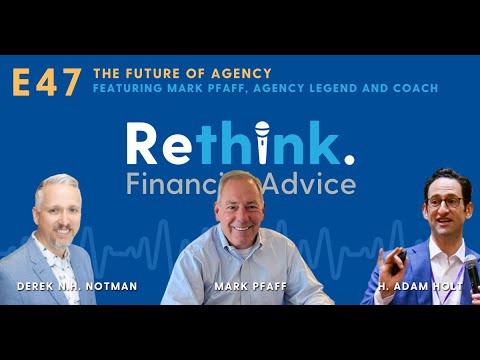
Watch and Listen
Episode Summary
In this episode, H. Adam Holt and Derek Notman talk with Mark Pfaff, a mentor to Derek and former Executive Vice President overseeing New York Life's roughly 12,000-agent field force, about the future of the agency distribution system. Pfaff, who rose from field agent to home-office executive over his career, shares his perspective on why an agency model built to distribute product now has to evolve toward advice-first thinking. The conversation covers recruiting, compensation, and what agencies must change to stay relevant.
What This Episode Covers
- The 150-plus year history of the agency distribution system
- Why the shift from product-first to advice-first sales matters
- How agency recruiting and compensation models need to evolve
- Mark Pfaff's journey from field agent to home-office executive
- Comparing agency, wirehouse, and independent advisor models
- What it takes for the agency system to thrive going forward
Full Transcript
Full timestamped transcript.
[00:00:30] H. Adam Holt: Derek, how is the agency system going to thrive in the future?
[00:00:36] Derek N. H. Notman: It's a really interesting question, Adam, given that we both grew up in the agency system, we were trained a certain way. We were recruited a certain way. We were taught about products and advice, quote unquote, and training and all that stuff a certain way. It makes one think because the agency system has been around a really long time. Like what? 150? 200 plus years. long
time. Like long time,
[00:01:08] H. Adam Holt: I mean, it was like guild or something before that, like it
was You were an apprentice's guild.
[00:01:13] Derek N. H. Notman: So we know it works. You're not around that long by doing something wrong,
but. As we've talked about many times, we're in a different environment now, especially with this mega trend we've experienced over the last 20 years with the rate of changes faster, the way we interact is different and so forth. , so I think moving forward, we probably can't rest on our laurels as far as how we're gonna be able to thrive. What do you think?
[00:01:41] H. Adam Holt: It's interesting to see given the fact, as you said, we both started there, how much we evolved. Some of that evolution happened. Inside agency. Some of it happened outside of agency. We both experienced different levels of, we'll call it growth and change management over the last 20, 25 years. And I think it's an interesting challenge for the current agency system because most of the people that come into our business come in this way, or they come in from wirehouses, which is a different form of agency,
[00:02:13] Derek N. H. Notman: That's similar. Yeah. Yep.
[00:02:15] H. Adam Holt: Right structure, client ownership at the corporate level processes, we'll call it the same for everybody. Individual brand is not as celebrated, let's say, as corporate brand, but I think the shifts that you mentioned in product versus advice first. And the adoption of financial planning pretty much everywhere is really forcing the agency to look like every other independent broker dealer and r I a.
I think they're all starting to look very similar today.
[00:02:47] Derek N. H. Notman: I'm just having almost an epiphany in you saying that agency distribution, the
agency system was essentially built to do one thing, distribute product, and we did that through field forces of agents and advisors and so forth, and it worked really, really well. But now that we have this shift from product to advice first. The agency system probably is gonna have to adjust, adapt, evolve because of that. Cuz if you're trying to, push product instead of advice, but the market is saying, give me advice, don't give me product first. Now you have a problem.
[00:03:31] H. Adam Holt: But every agency I know today, Mostly, let's say in the mutuals or in the corporate life led agencies, even property and casualty, they're all offering financial planning first. They've all led with needs-based sales, right? So they did, whether it was an Excel spreadsheet, a yellow pad,
rudimentary planning, we, it's just evolved.
I mean, now I see every insurance advisor using E-money. Right. Or Money Guide Pro. This is a sales enablement process
[00:04:01] Derek N. H. Notman: What about asset Map?
[00:04:03] H. Adam Holt: I They're using ASAP too.
[00:04:04] Derek N. H. Notman: I know you won't plug yourself, so I'll plug you for
[00:04:07] H. Adam Holt: okay. Well, I think that's the point,
right.
So needs needs based analysis, I think is driving pretty much all sales today.
In fact, without it, I, I don't think you're getting very far on the sales side, but I'm wondering what that means for the infrastructure of agency, right? You've got a recruiting engine that really focused compensation on a very, kind of kill what you eat and sorry, eat what you kill
[00:04:28] Derek N. H. Notman: We all get what you're saying. It's
[00:04:29] H. Adam Holt: don't kill what you eat.
[00:04:31] Derek N. H. Notman: Well, you should kill what you eat, shouldn't you first? I mean, you want to
kill it.
[00:04:34] H. Adam Holt: a great point. That's right. I roast all my vegetables. I kill them before I eat them. So this is great. This is an awesome opportunity. So let's hear about our guest today, who is a mentor to you. A long time back.
[00:04:50] Derek N. H. Notman: Yeah, so Mark Faff is a friend, uh, and also a mentor that I have known since before even signing my contract at New York Life. I still remember, , I was invited to , the general office had an annual kind of awards dinner to recognize people, and I was invited before even signing my contract or anything.
I remember going to this thing and meeting him. I'm like, wow, this guy's pretty awesome. And shortly thereafter, I signed my contract, joined the agency system and. It was really cool because Mark was an agent first. He started like a lot of us and was out there in the field, cold calling and door knocking.
Then went into management and then ultimately went to home office where he ended up as executive vice president in charge of agency. In other words, he oversaw about the 12,000 agents that New York Life has
across the country. Pretty awesome. So really interesting perspective. He's also a Packers fan, which I love.
So go pack, go. You can't, can't forget
[00:05:54] H. Adam Holt: Knew that
was gonna make it in there.
[00:05:56] Derek N. H. Notman: It has to. And for anyone who's not a Packers fan, I'm sorry, it's, it's too bad. We'll get to that another time. But he is just got a really interesting perspective and what's cool is that Mark has always been accessible. Even when he was working at a home office, he was still able, I was still able to get ahold of him, have a conversation with him, see him in person, which was really, really awesome.
And so I, I think if there's anyone that we should be getting a perspective on, like what should agency do in the future, Mark's probably the guy to ask.
[00:06:26] H. Adam Holt: Very cool. All right, well let's hear from more
[00:06:29] Derek N. H. Notman: mark, given your perspective, your experience in the financial advice space, the financial professional space, what is your opinion of where things are at today?
[00:06:42] Mark Pfaff: Well, obviously, great question, and I would say a couple things there. One, one of the things that I have always felt, and I feel this way more now, and I think this is exciting, right, is that the marketplace is sensational.
I just, it's insatiable. When you step back and you look at. , you know how the population is growing. When you look at life expectancy, when you look at what people's goals are to not only are they living longer, but now people seem to be more focusing on a quality of life, retiring early, whatever their goals are.
That's exciting demographic except that their world has changed in how do you fund that? Okay. And of course I'll use my parents as an example. You've probably heard me say this before. They've been dead a couple number of years now, but they were a middle class family. Dad retired at 65 retirement with nine years, okay?
And they lived on pensions from the factories that he worked on, social security. And what people's biggest asset was, the equity in their homes. Well now you fast forward to today people are living longer, they're retiring early. Okay? I don't know that equity's gonna grow as much in our homes and who has a pension anymore?
I'm let you work in the public sector. So that means the need for planning is greater than it has ever, ever been. We have never experienced this before. You can live more years in retirement. Than you really did in terms of work. If you think about that, well, how the hell are you from that?
Right? And so I think the marketplace has insatiable and that's exciting. On the other hand, and we're also seeing this, I think the last years it is ever changing. And that is challenging both for advisors and for companies. But, but I think I just, I think the need is gonna go on and on and on and on.
[00:08:44] H. Adam Holt: That's great. Mark, I really appreciate you saying that because we've continue to hear this question of how are you gonna actually do it, especially in this complete new precedent. I think that's being said by the demographics. It's interesting. What do you think is the missing opportunity that advisors
just don't see coming?
[00:09:03] Mark Pfaff: What I think the, for me, there's three answers to that, right? One is for advisors, one is. When I put on my corporate hat, one is for companies and then I think the other is for both, right? I think the thing for advisors is where are people's heads and goals going to?
You started out probably, or most producers did with the middle market, right? The word CERs, savings, insurance, real estate equity products. And so you sat down with people and it was about protecting their family, kids, education, retirement planning. Maybe you, you, and they gravitated into wealth planning and if they were fortunate, you went to a paid planning charitable plan, charitable getting right?
Like that would, that would be old motto. But what have we seen and learned from the pandemic? It seems like people's goals are changing. I live up in Vermont and I'm hearing this from people in the Carolinas and people hearing it from people in Florida. Yeah, I hear it from people out in the Midwest. We went through a period of time in the pandemic and are still going through some of it though, starting to tail off a little bit where people were buying housed un feet site unseat and just flood the marketplace here.
Why? Because they realized they could work remotely. They realize they wanted a different quality of life. So you roll that forward into planning. People didn't just experience I'd like a little more family life, they lived it. Right? And so when people now say, I wanna live a better life, what does that mean, moving it forward?
Is it going to be retirement planning? Is it gonna be charitable getting estate planning, or. What does living not life look like? And I think, and as an advisor, we have to understand that and work with that. And it may change some of the products and some of the goals and some of the way we work with them.
So that for me is on the advisor side, on the company side, what I'm starting to hear and starting to see , is what's happening to that middle market, right? Interest rates are growing up. There's pressure on home prices, immigration policy, perhaps inflation, that seems to be putting a downward pressure on the middle market.
And so when you now bring new producers into the marketplace, where do they start? It's a little difficult to walk into the marketplace and work in the high end, right? And so how you gonna bring advisors in and. That may change some of the rules in terms of how we compensate new people, how we train new people.
I mean, the three of us all started and it was, you gotta kill something if you want to eat right? Like that's how you Absolutely like, yeah. But in an environment where people are saying, no, no, no, I wanna work remotely and I want quality of life. I don't know where people are. We still gonna find numbers who are still driven that way.
And can you walk out into the marketplace and work with the middle market? I'm not really sure. Right. And so I think that's something that that companies are gonna have to deal with. And then the third item for me, which brings both of 'em together is, and this has always been an issue, how do we handle succession planning and transition planning, particularly when.
You think of some of the work you guys are doing in the tech world with technology and the people who are retiring or passing away weren't in that world, right? Mm-hmm. So I think that just layers on top of it and makes it a little more difficult.
[00:12:29] Derek N. H. Notman: Really insightful. So given that our audience, just as you even framed, your last response, is advisors, but also home office executives and a peppering of actual consumers.
Are there any specific action steps that you would recommend for advisors, home, office, staff, or all together to take, if they're listening to this today, what's one thing that they can walk with today that, that they can do to, take advantage of this opportunity or what's changing around them?
[00:13:02] Mark Pfaff: I don't know if I had the answer of what they have to do, but I do think it's certainly some things we have to look at, right.
Like I would say on the advisor side,
Where are you in your career? And if we are in a changing world, how are you gonna adjust to that? And you might be at a point where you might say, you know what? I'm older, I'm experienced, I can ride it out, I can transition into retirement that of my business and, and that's fine.
But if you're not, the M D R T always said in the formula or six first six stack, right? What was the triangle? Your goals, your activities, and your skills, goals, activities, skills. Right. And so I look at that and I say goals and activities may or may not change, but as an advisor, updating your skills, right?
I think there's more of a need for updating skills than there's ever been. And the challenge for a lot of advisors that I, I talked to is where do they get that from? Right. Where do they get that from and is their company allowing them to use some of those resources? You and I have had this conversation, right?
Sure. So, so I'll give you, I'll give you an example, right? I talk to, I get invited to talk to a lot of groups in a study group. Well, what's a study group? A study group is a group of like-minded producers who think and probably actually are in the same market and do the same practices. But when they talk about a, a problem, cause they've been in some of these groups.
They're looking at each other a problem, but they're all going through the same damn problem, so they don't know how to come. Right. So if we are actually moving into an environment where people are relying more on technology, where their goals are moving away from retirement planning to defining a better quality of life, what's the skillset set for the advisor to be able to navigate that?
Right. And where are they getting that from? I think that's, If you're gonna be in the business 10, 15, 20 more years, I think you gotta address that, right? I would think on the company side, to me there's two things. If in fact there is downward pressure on the middle market, and if in fact people's goals are, maybe the shame is yours and I were when we came into the business.
Sure, I'll work on commission then. How you gonna bring people in in the numbers that we need to bring them in? And comp them and train them properly so that we have a future generation of advisory. I, I think that's a big challenge right now for the industry moving forward. And then the other challenge, Derek, and you and I have run into this, and we've talked about this a little bit, with the myriad of tools that are out there, how does a company navigate that, figure out what are the best tools?
And then go competently to the field and say, this is what you have to do. And are the people making those decisions have any experience in that? I look at myself, I've been retired a couple years, would I be the person who could really do a good job understanding how to run a virtual practice? I'm not sure, but those people are in those places and I think that's a challenge for everybody moving forward if we're gonna do it properly.
Yes,
[00:16:19] H. Adam Holt: boy, that's a great point. We hear. We have a lot of opinions about that one mark. So thanks for
[00:16:23] Mark Pfaff: bringing that up.
I'm sure you do. It's right. It's the people who are deciding, I'm gonna tell you what tool to use. Mm-hmm. But I don't have the knowledge of the skill set, dear. Yeah, that's tough. That's tough.
[00:16:39] Derek N. H. Notman: We actually just talked about this and I think our last episode, Adam, about is there a disconnect between the field and home
[00:16:46] H. Adam Holt: office?
Mm-hmm. Well, it's the same reason why the home offices were putting out go use Citrix to go do or go do the, they used the corporate meeting sharing tools to try to work with clients as opposed to using what's adopted by the clients.
Join me, zoom the easy stuff, great example. And then they'd say, Liz, we're gonna go virtual and we'll give everybody the complicated product. And we can't even get our clients to join the meeting because it's just, they gotta download something. They're lost, they're angry. So it's true we've seen this time and time again.
Mark, I'm curious, is there anything that you think needs to be heard by
the community?
[00:17:21] Mark Pfaff: Yeah. We are in a changing world and as producers, if we're for advisors in the field, and I've been on both sides of it, right? We trust the people that we've worked for. We are looking to them for direction and the right tools. I just think that there's got to be a great synergy in working to find what those tools are . And I guess if I office heading right now, what I might say is maybe it's not finding the specific tool, but , we've gotta give people options and we might make some mistakes along the way, but it's real easy for five years to go by and had not made progress on a goal towards Zach.
Right. Derek, I think you've seen some of them. Oh boy. It's so easy for five years to go by and like here we any further along on this goal. So, and listen, I'm not coming on this broadcast and saying that's the problem, and I have an answer. I you say, you were asking what do you see as a problem moving forward?
That's what I'm kind of seeing and hearing from people and, and we gotta get this right while we are also trying to figure out what's the best way to bring new traditions in and, and keep funding , the tap and funnel. How many people. Are being charged today with moving their field towards a virtual S spelling environment.
And if I was sitting in a meeting, I'd be like, I don't wanna raise my hand, but I have no idea what the hell Citrix is. Mm-hmm. That's right point. I don't know the answer to that. Yeah, they own go no office fight. Say, oh, come on, we all know what that is. Okay. Maybe y'all do. Okay. Then it happened in the last few years, cuz I've never heard of
[00:19:00] H. Adam Holt: it.
No that, but that was the reason I used that example. Cause they own Go-to webinar, go-to meeting and I think that's what they, so it's a big company that basically bought up the screen sharing and delivered it to corporate America. But the consumers were like, how do I start a meeting? It's terrible. And we still see people using it and we're like, who gave you this?
Oh, corporate mandated that we have to use this. We're virtual. They check the box. See we have a virtual tool and people are like, I can't use this . So it's like, here, I gave you a basketball but it's square, but you got a basketball, check it
[00:19:29] Mark Pfaff: off.
Well, I'll tell you, I'll tell you a funny story.
This is a perfect example to me, okay. In my little world. All right. So , I retired. We were asked from New York Life if myself and two other guys, if we would do consulting work within insurance company over in India. Mm-hmm. Okay. Yeah. We did for two years just prior to the pandemic. Mm-hmm. When I was running agency, we did a ton of conference call.
Okay. You guys laugh at this. It probably seems antiquated, but they were a conference call, right? Like with the feel no stay, just write conference call. Very effective. I was on vacation talking to the people from India and I had to get home, but I didn't wanna move the meeting. So what I did was I was driving to Newark Airport and I was on a Zoom call.
It was my first experience with Zoom. Mm-hmm. And I'm on the Jersey Turnpike. On Zoom at nine o'clock in the morning with somebody in India and they could have been in New York City, and I'm like this amazing technology. I immediately after that, later that day, called up my guys I used to work with in New York Life, I'm like, guys, come explore Zoom.
Okay. No idea what June was. Okay. A year later, the pandemic hits. Now Zoom becomes like the way of doing business. Yeah. But yet I'll talk to study groups and I've had this experience of talking to study groups and when the pandemic hit, I'd go, I'd say, Jack has your business, all my business. Great, mark, I'm doing work from home, blah, blah, blah, blah.
Go back. I remember I was on the study group and one guy was real silent and he the guy from Philadelphia, and I said, Steve, how about your business? And he goes, mark, my clients don't like Zoom. And I'm like, Steven ain't your clients. It's your skillset, but we've gotta help agents. Agents get there.
Totally. I appreciate the work that you guys are doing and Adam, Derek will know there's a level of frustration when I see what Derek went through and what I know you guys are going through to try and help producers and help clients at the end of the day. Totally.
[00:21:32] H. Adam Holt: Pretty interesting. Huh?
[00:21:34] Derek N. H. Notman: Interesting and refreshing.
[00:21:38] H. Adam Holt: Why?
[00:21:39] Derek N. H. Notman: Well, mark is not only a smart man, but he was an advocate for the field. He was an advocate for innovation. And I think that's in part why under his tenure and leadership things went so well. And clearly he is open-minded and , he's like, Hey, when I don't know something, I don't know something.
But, but boy, we should look into it at least, and , maybe that essence. Is what we're trying to get at here is that why don't more companies have that mindset that Mark has?
[00:22:17] H. Adam Holt: Mm. It's an interesting question because it's a bit loaded and I'm thinking about this. You know, he makes this comment on the story about how we experienced Zoom well before the pandemic and mentioned it to his guys, Hey, we should look at Zoom. Uh, and I, what I keep seeing in my. My storybook is, here's the guy who's saying Iceberg ahead.
Iceberg ahead. the boat's like, we're going straight. We're going straight. Stop. You know, and, and turning that ocean liner, as you know, is really, really tough and takes a lot of people and a lot of budget re rework and a lot of infrastructure, super amounts of training and skills. But I fear that large companies, and I'm sure people work for them, Have experienced this takes a while to get things done, that generally the attitude is protect the status quo, protect the machine because it generates the revenue that our shareholders or our mutual owners want.
And after all, I'm just one person's voice. So I, I generally think that there's, I've, I've experienced it before, home offices have already accepted the fact that it's hard to turn, don't even try. Until there's some major, major calamity that's gonna force everybody to change, or there's a huge leadership change and that, and that's why I have to throw mad respect to Mark because he said with his own awareness that maybe he wasn't the guy to take the organization to the next level.
And he knew to step aside and say, okay, I'm gonna let the next generation solve this problem, because they have actual experience solving it.
[00:23:57] Derek N. H. Notman: Or do they
[00:23:57] H. Adam Holt: a big well, It's a, it takes a big person to say that.
[00:24:01] Derek N. H. Notman: Takes a huge person and, and my mentor, who was also , in management in New York Life for a while, he said the same thing to me. He retired because there was this digital push and he's like, you know what? I know I'm not the guy for this. , and I need to get out of the way so the people that can do it will do
[00:24:21] H. Adam Holt: Mm-hmm.
[00:24:21] Derek N. H. Notman: But there's this status quo thing, and I, we, we talk about entrepreneurship, but there are definitely intrapreneurs, entrepreneurial minded folks within a corporate setting. And Mark was certainly one of those people. And maybe there's just not enough and , it's tough to climb that ladder , and try to get things done, but, And maybe you have experienced the same Adam, I have experienced with other large companies that they are faster moving, more willing to pivot and evolve and they, they've got the right drivers that want to actually get things done.
[00:24:56] H. Adam Holt: Mm-hmm.
[00:24:57] Derek N. H. Notman: So I wouldn't say every company struggles with this, but I, I'm sure a lot of 'em do.
[00:25:02] H. Adam Holt: Yeah, no. And we're, we're ma, we're throwing a blanket. I mean, the reality is there's no way I would've been able to take asset map. To the next level, unless I had that corporate support from leadership. No, granted, don't make it. They made me prove it. Maybe even prove it more because cuz they didn't want to be perceived as a nepotistic kind of environment where let's, you know, just take care of the, the good old boy crew.
I, I mean, , I had to prove it a lot over years and years and years that this was viable, relevant, safe, and not gonna make them look bad. Um, and thankfully maybe they probably pushed me to grow in different ways, but I, I know that that culture was not common. And, and I think. It's many ways.
We know so many people that have come to you and I over the years and before we even met each other saying, how did you do it? Or How would you do it? Going again. And there was really no substitute for just proof, proof, proof KPIs that this innovation is gonna change. The game for this large company anecdote did not work.
Uh, you needed to prove it. Um, and they need to see that proof before they're willing to make any big changes. And very often, large companies don't wanna be the first. It's not surprising that innovation happens in the early adopters where people can take risks. That's typically the independent, the r a a community, the entrepreneurs that say, Hey, I see a new tech, I'm gonna get it and buy it.
Um, but it's taken a long time to get to where the money really is, which is in the large banks and the broker dealers, um, and certainly the wirehouses. And so that's why that innovation, I think, has been a bit stalled. Although I, you know, Derek, I'm, we're seeing a resurgence of this, like I think people.
Everybody is recognizing, not only they need to use tech, but now they're like, oh wait, we gotta use ai. How'd they go from like, we just had our first mobile app to all of a sudden we're doing an implement ai. Like I , think the tide is changing.
[00:26:43] Derek N. H. Notman: I hope so. I really do, but maybe I've got some baited breath on this just because of the, the hoops and roadblocks that were put in front of me. It's, um, it's not easy and it's interesting having that perspective. So again, refreshing to hear what Mark had to say. And I think. If you're a home office person listening to this, really take the heart what he had to say.
I mean, he had some really great suggestions, and we can even dive in here at a couple
[00:27:09] H. Adam Holt: Hmm, let's do it.
[00:27:11] Derek N. H. Notman: you know, things that I, I walked away with that I think our listeners should really be paying attention to. You know, he, he had the whole bit about the, the middle market and there's , this shift going on and we have this sensational marketplace.
But the need for planning is also more than it's ever been. As he says, how the heck do you fund that? Um, I, I think that, that really needs to be paid attention to, but how we are engaging with those people has to change. They are not looking for people to knock on their door. You know, or, or do a steak seminar anymore.
And you know, from the advisor perspective, people's goals are changing fast. As Mark said me, I was one of those people that he talked about, I bought a house site unseen during the pandemic. Okay. So, I mean, it is happening. I can understand it completely. , but from the corporate side, how is corporate going to address the needs of the consumer?
While also bringing in new advisors. Recruitment was always the number one priority when I was in , my New York Life days. I'm guessing it is pretty much everywhere around. That's how it is.
[00:28:23] H. Adam Holt: Sure.
[00:28:24] Derek N. H. Notman: How do you recruit the next generation if you aren't innovative? If you don't have the tech, if you aren't open to suggestions, if you aren't open to changing the game from.
You know, project 200 things have changed. Um, you're gonna struggle to attract advisors to come in versus the firms that are doing that and are looking forward. , so I thought that
[00:28:46] H. Adam Holt: hard. Yeah, I was gonna say, recipes are hard to break, let's be honest. Right. The recipe that's worked for a hundred years, especially when you know you need to get certain results, go back to the recipe. Right. We don't have to rewrite the the cake recipe all the time.
Go make. The same recipe that worked for Nana 200 years ago. Uh, I think what was really different though, and I'm glad you brought it up, is actually how to bring him in and how to compensate the next generation is really interesting, especially with this squeezed middle market that doesn't care about the same product concerns that he mentioned.
I mean, even calling back to md r t language and
the SIRE acronym. And you know, I think it's gonna change. I mean, lifestyle is now seemingly more important than, than I wanna say, compensation with balance, as we all know. You know, Dr.
Travis has talked about many times. It's gonna be a really interesting, I don't know of any, I don't have an answer on that one.
[00:29:38] Derek N. H. Notman: Yeah, I, it is, but we have to be open to knowing that it is changing. And he even Mark said, you know, how does a, a company navigate finding the best tools and solutions for their field force so they can deal with these changing goals, changing ways of it, engagement with , our clients. And do the folks at home office, are they qualified?
Do they have experience to mandate tool X for the field, even though that's maybe not the best thing. I'd like his suggestion to say maybe we should just offer a couple solutions. We might make some mistakes along the way, but let's give our advisors some flexibility.
Home office politics. I mean, that's what the start of this whole conversation should probably be a little bit more aware of this and say, you know what, maybe we should push some of the politics aside because Nana's recipe for the last 200 years, yeah, it worked pretty well.
But you know what? All the ingredients have gone stale.
[00:30:35] H. Adam Holt: Hmm.
[00:30:35] Derek N. H. Notman: People don't want her her loaf of bread anymore. They, they want something else.
[00:30:40] H. Adam Holt: They're a vegan with no nuts cause their kids are allergic to
[00:30:43] Derek N. H. Notman: Yeah. Right.
[00:30:45] H. Adam Holt: Right. No, it's true.
[00:30:46] Derek N. H. Notman: It's changed
[00:30:47] H. Adam Holt: wheat, uh, whole wheat. You know, that's an interesting aspect to this. I, I really thought that his awareness that very often we get this commentary from home office, you quote, unquote, should use this tool.
By the way, I've never used it. I heard it was great from the guy who sold it to us or the industry consultant who blessed it so that if this goes south, I can keep my job. Because, you know, after all, does anybody have to apologize for Salesforce? Does anybody have to apologize for buying the the, the incumbent?
Not really. And so there's all this incentive to just go with. The big company that everybody is using. So innovation doesn't get put forefront. I, I would love to see this, I tried to champion this a bunch of years ago , at Gamma, which is a large organization now rolled up into FinTech and AAL U of creating literally the thing that we are always great at, which has been best practice sharing.
One of the things our industry has always been really, I think, transparent about is what's working for you. I mean, he mentioned the study groups. I said, let's. Let's create a safe space, a sandbox inside all of these companies and say, I know that your broker dealer doesn't love that you're doing this outside business.
I know that your insurance carrier doesn't really approve of this concept, and we'll never roll it out, but let's create a safe space where we can actually bring new ideas and innovations. And bring that entrepreneur into it cuz they clearly have known the problem. Right? They solved the problem for themselves, just like you and I did for what our bigger pains were.
We're like, we're gonna solve the problem, we're gonna scale it. But because we didn't always have the support of the larger companies, it just took us forever to roll this out and an enormous amount of pain and capital and, and effort and pushing, even though we're like, this is for your best interest.
And , they made it hard. And of course I think you and I have that, that a little bit, that that scar from it, uh, we'll call it a scar.
[00:32:36] Derek N. H. Notman: a, that's a good CI scar. It's a memory.
[00:32:38] H. Adam Holt: Yeah. We have an experience, we have a therapy moment.
[00:32:42] Derek N. H. Notman: Yeah.
[00:32:43] H. Adam Holt: Look, it shouldn't have been that hard to just bring good medicine to the, to the populace. Right. Uh, and I think, I
[00:32:49] Derek N. H. Notman: That's the takeaway. That's a mic drop moment right there. It shouldn't be that hard.
[00:32:53] H. Adam Holt: mm-hmm.
[00:32:54] Derek N. H. Notman: Uh, you're, you're, you're exactly right Adam. And I think having that safe space to do that and learn, cuz we know all the broker dealers in the wirehouses are competing, but we can learn, study groups do that. We're all technically competition. Heck, you know, fintechs are competition. We still talk to each other.
[00:33:12] H. Adam Holt: We do, we do well with that. I have to, we have to thank you to Mark for being open and honest and coming outta retirement and basketball to spend time with us, uh, peons. Looking to learn from your great experience. Um, really just an awesome career and still making a difference for many advisors today. So that's really cool.
Derek, you wanna bring us home?
[00:33:34] Derek N. H. Notman: I am already home.
[00:33:35] H. Adam Holt: Okay. That's right. You're in your home office. That's
[00:33:37] Derek N. H. Notman: my home
[00:33:38] H. Adam Holt: the best part of politics. You work from home. .
[00:33:41] Derek N. H. Notman: , great having Mark on today. He's, he's a great guy.
[00:33:44] H. Adam Holt: With that in mind, don't forget to subscribe. Tell all your friends, leave us an awesome review, only awesome reviews, please and make sure you stay tuned for the next episode with that, Derek. Always fun spending time with you.
[00:33:56] Derek N. H. Notman: Likewise dude. See you later.
The content has been made available to you by Asset-Map for informational and educational purposes only.