
Ep46 - Rethink: Communicating Your Higher Calling – Featuring Chuck Garcia
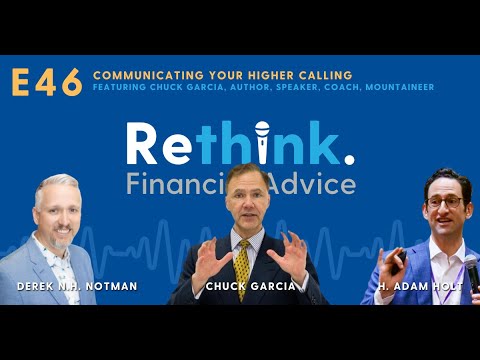
Watch and Listen
Episode Summary
Hosts H. Adam Holt and Derek Notman welcome Chuck Garcia, bestselling author of A Climb to the Top and a faculty member at Columbia University's engineering leadership program, to dig into the responsibilities of both speaker and listener in effective communication. Garcia shares the intentionality behind his own storytelling and delivery, offering financial advisors a framework for communicating their expertise and higher calling with clarity and impact. The conversation is a masterclass in tone, structure, and authentic connection.
What This Episode Covers
- Whose responsibility it is to ensure clear communication
- The intentionality behind effective public speaking and storytelling
- Lessons from Chuck Garcia's book A Climb to the Top
- Communicating a higher calling as a financial advisor
- Techniques for eliminating verbal filler and sharpening delivery
- Applying executive communication skills to client conversations
Full Transcript
Full timestamped transcript.
[00:00:28] Derek Notman: Adam, do you understand me if I yell at you?
[00:00:31] H. Adam Holt: Oh, my, my ears are destroyed, Derek. If I respond in a whisper, does that make it even more clear? The answer is no.
[00:00:43] Derek Notman: No, no. What, let,
[00:00:47] H. Adam Holt: are you talking about?
[00:00:48] Derek Notman: let me rephrase. Adam.
[00:00:50] H. Adam Holt: Okay.
[00:00:51] Derek Notman: Whose responsibility is it to ensure communication? The speaker, the listener? Both.
[00:01:01] H. Adam Holt: Ooh, now that's kind of fun.
[00:01:03] Derek Notman: honestly, I don't want to do the whole episode yelling
[00:01:07] H. Adam Holt: I don't, I don't wanna whisper in everybody's ear, you know, that might drive us crazy.
[00:01:11] Derek Notman: Yeah, it'll drive our listeners crazy.
[00:01:14] H. Adam Holt: You know, it's such a fun question because I can imagine this debate might go on for at least 35 minutes just on who's responsible or whose fault it was when it breaks down because, My gut tells me if somebody is trying to communicate something, it's predominantly the person who's trying to transfer that information to the recipient.
So I would say it's mostly the communicate versus the communicate.
[00:01:44] Derek Notman: Okay, so you're saying it's both, but really mainly the person communicating, the person speaking,
[00:01:52] H. Adam Holt: I'm, I'm assuming the communicate the recipient , didn't ask for the communication, right? Or, or maybe is expecting it, or, I don't really know the, the context of this conversation. So since you asked me the question, I think it's your responsibility to figure out what the heck you're talking about When you asked me the question.
[00:02:12] Derek Notman: I'm really starting to get confused here. start? Is it now? I don't know.
Well, I think we can have, we can answer this question a little bit better by having someone who actually knows what they're talking about.
[00:02:25] H. Adam Holt: Possibly
[00:02:26] Derek Notman: That would be helpful. , so we've got a pretty cool guest today, , in Chuck Garcia.
Great guy that I actually met. Online as a referral to a PR agency that I might end up using. So funny how this all works and he and I just hit it off. Great. , and it's funny, his PR agency didn't set this up by the way. . We, that we did this cause we had a relationship. But really cool guy. He's, , up in New York and has been a professional speaker many times over.
He's a bestselling author of a book called A Climb to the Top, which I have. He's on the faculty at Columbia University Grad School, , as part of their engineering professional development and leadership program. And he jokes about that a little bit. , you'll have to listen. , but he, he's also been on Wall Street.
And he's worked at BlackRock Citadel and even did a stint where he was working directly for Michael Bloomberg, which was I'm sure, just an really interesting experience. Also a world traveler and loves to climb mountains. So just a dynamic, really well spoken communicator.
[00:03:35] H. Adam Holt: Very well, and I, that was my, Experience too. I was very impressed with Chuck's ability to control his message. Now you probably know this cuz , you and I spend too much time. I tend to be very intentional about the words that I use, right? Everything from my tone, inflection, my family rolls their eyes.
They're like, oh, did you enunciate Adam? I'm like, yes, because . I take it personally that it's my job. To communicate with the recipient and for me to be as good as possible in communicating that idea. So that you can take that information and respond, grow, evolve from it. And , since we do podcasts, Derek, all the time, I tend to think about it more than ever.
And we both speak now on these stages, so we have to be good presenters. But the question from financial advisor is, We're actually presenting all the time and we're tending to present complicated information to someone who may or may not be interested in that detailed information. And so this all started to tie together.
And one of the things, Derek, I want everybody to really listen to here is listen to the intentionality of Chuck's tonality, his storytelling, his lack of unlikes, you know, his. He's a craftsperson here. And, and I, that's really what I was hoping that everybody has an opportunity to listen to and then question, can I do this better?
Can I communicate better? And he dropped so many nuggets here, so I'm excited for you all to hear this. Are you ready, Derek?
[00:05:04] Derek Notman: Let's do it.
[00:05:05] H. Adam Holt: All right. Let's hear from Chuck Garcia.
So Chuck, what's important about what you're doing that you want people to know?
[00:05:13] Chuck Garcia: I am grateful for the opportunity every day to go to work in the service of someone else's success. And I say that because for 30 years I thought about me. I had a family to raise. I needed to make money. I didn't come for money, but I was a finance major in college with a couple dreams.
First is to make my parents proud. Second was go to Wall Street. Third was to travel the world. I am grateful that I've done all of them, and now I get to give it all back.
[00:05:44] H. Adam Holt: So tell us what, what are you doing now to give back?
[00:05:47] Chuck Garcia: 10 years ago, I descended a mountain in Alaska called Mount Bonna, and I became a mountaineer because on nine 11 I was scheduled to speak on the hundred and seventh floor of the World Trade Center.
Three of my colleagues were in the building waiting for me because it was my speech to give and I never made it into the building and they never made it out. From that moment on, I started climbing. Because I knew I couldn't change what were the circumstances in front of me, but there was one thing I could change and that was myself.
I didn't know exactly what that meant, whether I was looking to find myself or to lose myself. But I knew I needed to do something different. And I grew up in a winter wonderland in upstate New York, surrounded by snow, and I've skied and skated all my life, but I used to see all these people climbing mountains, and I said, well, wonder what that is?
And then just before nine 11, I read a book called In Thin Air by a Gun on John Crackower. And I saw myself in that book. I said, oh my God, this is so cool. Well, he was talking about people on mountains dying, and I'm talking about getting out of mountain living. So I redefined, what am I gonna do with my life?
And exactly one year later, I stood on the summit of Mountain Rainier in the Cascade Mountains in Washington. It unleashed the beast. And I'll never look back, but I say that as a pretext because about 15 years later, I climbed a mountain in Alaska called Mountain Bona, and it's in that defines the middle of nowhere.
You take these little glacier planes, you fly to the middle of nowhere, you've dropped off at 10,000 feet with a bunch of gear, and two weeks later the plane comes back, God willing, and get back and we go home. But Adam, to answer your question, it was on that mount when I had these incredible inspirational guides.
Three people who are half my age were extraordinary and their kindness and generosity to get mere mortals like me up and down the mountain. And I started to look at them and I said, oh my goodness. What they do every day? They don't do it in an office. It doesn't matter where they do it, but it helped me to see, holy my goodness, could I see myself in that?
So to end this story, to make a short story even longer, I went home. And when I got home, I broke out my computer. I went into something called LegalZoom. I put on a credit card for $600. I quit my job at Citadel, one of the biggest, most baddest, prestigious edge funds in the world. And I resigned and I formed a company.
My company is called Climb Leadership. I'm an executive coach to many companies, mostly Wall Street companies. And then the other part of my life, I am on the faculty proudly of a place called Columbia University, where I teach in the graduates. And I teach engineers, teach 'EM engineering. I teach engineers how to wake up every day and how to do two things, how to communicate, which is the outside.
And I teach them emotional intelligence, the inside. So I teach first, help them, how do they stay calm under the weight of enormous expectations. And then when they're ready to communicate, what do I do that communicates you the brand?
[00:08:56] Derek Notman: Chuck, you were at Citadel, you've been on Wall Street. You spent a lot of time at Bloomberg. Given your experience, what is your perspective of the financial advice market as you see it today?
[00:09:09] Chuck Garcia: Yeah, and and for context, my experience from Bloomberg to BlackRock to Citadel allowed me to see the financial markets from a vantage point of a professional.
I want to answer from the vantage point on a more personal level, and I state that because when I told people I was on Wall Street, they'd ask, do you have any tips? And I said to them, you're asking the wrong question because the question that you're asking for me is to tell you something that could generate a transaction that for you, you want to get rich.
But I studied Warren Buffet for most of my life. Warren Buffet does not invest in glamor stocks. He doesn't like he invested. Very boring fact. If you look at Geico and insurance, these are dull businesses and no 20 year old wants to invest in adult business. They wanna invest in Snapchat, G P T, Google, anything like that.
So my point is, and I really like the question, but my statement is that the financial advice market is sadly misunderstood. The majority of people have no idea what you're talking about. If you ask any of your clients, tell me the difference between a value stock and a growth stock, they're gonna look at you crooked.
Like, what do you mean when you tell them what's the Dow Jones and the s and p? And then you even get onto the bond market. Now their head is spinning. So from my point of view, when I was inside at BlackRock and Citadel and my clients were very large arch companies, well-educated people, first in finance, that's one answer.
But the majority of people, Derek, walking around New York City, haven't the slightest clue what we're talking about, and I don't think anybody's speaking to them. I think most of your industry, I admire what you do. I have a wealth manager myself, but you're not talking to mommy. Even my wife. My wife is a very smart woman.
You're not talking to her, and you should be. You should. In fact, if I were you, and I love what you're doing here, you should educate your clients before you offer to give them advice. Teach them. What is the difference? Why does Warren Buffet advertise Geico a boring business every month, an annuity of paying insurance.
Not one of my Columbia students understands what he does. They just know he's worth a hundred billion dollars, but they think that to get rich, you gotta invest in the next Google. Warren Buffet is the complete opposite. He said, you guys got it all wrong. That's why he's a contrarian. And I think for you guys, you're talking about the trends.
You're talking about what's cool with say Buffet is the complete opposite. He's talking about the down trout and the down look for the stocks that are not that because historically, year over year they perform better. Yep. My drift.
[00:11:56] H. Adam Holt: . Yeah, we love, of course, that context and so many of the financial advisors definitely came from the stock world.
And then of course, wealth management has evolved so much. So some of the work that you're doing on emotional intelligence is obviously getting a little bit more attention these days, right? It's not taboo to talk about eq. And I'm curious for this space, what do you think the missing opportunity is that advisors just can't see?
[00:12:20] Chuck Garcia: I think advisors do a very good job with a bullhorn. All of them talking about, , the bulls, we should do this and we should do that, but they don't get to it at the individual level. They talk in very big terms. But when you're speaking to somebody rather than communicating and advertising in a billboard, oh, we really like Google.
We think we should buy that, I think you should gener, you find a way to help them understand. Why they're investing in what they do, why it's a great company, not just this great company. It has to be a great company to bargain price. That's the Warren Buffett mantra. Great companies are okay if you buy it a too high a price.
That's not a good investment. It's still a great company. So my my point is help people to understand that you invest in a great company. Does not mean it's a great investment. It's only a great investment when you invest in it at the right price. Nobody sees that. I don't wanna say nobody, that's not fair.
The market in general, you walk the 50 states and you meet people who don't have the education that you and Derek and I have, Adam. Most people do not. They don't understand. They think if I invest in a great company and they're disappointed, why it didn't return more because they didn't get the investment right.
They got the company, they got the investment wrong. And from my point of view, I think you should tell people that people don't understand that great companies at a bargain price, that's what makes a good investment. You ask most of the people, what's a bargaining price? So what's Google chain that, how do they know it's a bargain price only if Warren Buffet says so?
But I don't hear you guys talking that way.
[00:13:59] Derek Notman: I can almost say that , what you just shared could be used as an analogy for so many other things. I know we're talking about stock picking and investing, but when it comes to leadership, emotional intelligence with their money, family, business, whatever, , I'm sure even in the leadership things that you do, you see stuff like this where you could probably use that analogy to get a point across to one of your, one of the folks that you work with, I'm sure.
[00:14:23] Chuck Garcia: Um, yeah, and, and what I'm talking about, Derek, many of us who grew up in our generation, we read a book called The Seven Habits of Highly Affected. Everybody knows Stephen Covey, and when you read the Stephen Covey book, there's seven things to say, do this. I wasn't crazy about the book, but I loved the principles that he espoused, and one of them that he articulated, Derek, was Seek first to understand, pause for dramatic effect, and then to be understood.
I've added, when I start to teach this in that order, Think about this. Seek first to understand, then to be understood. Your state of Florida, what your politicians are doing. When you're all screaming over each other, New York City, what are our politicians? They're not talking to each other. They're screaming over each other.
I am not seeing politicians seeking first to understand. They say, you can have any opinion you want as long as it's mine and it's not. It's moral outrage and indignation, and I'm gonna put it on Twitter and say, what an idiot you are. When did we get to a world? And it's very sad. Where you and I can have bitter disagreements philosophically and politically, that makes for great dinner conversations and we're still gonna be friends and I'll still buy you dessert and coffee.
That's how it should be. But I've had friends that defriended other friends after 40 years of friendship because they didn't like their politics. They didn't stop first to understand why does he or she have that point of view? They only care that they do. The emotional intelligence factors into this cause.
This is where empathy comes into play. I don't necessarily agree with my own brother whose politics are completely different than mine, and I love my brother. He is the greatest Jude in the world, but our politics are different. When he and I are at the dinner table, I seek first to understand, not because I'm a great human being, I'm just trying to understand his point of view.
I'm not even gonna try to move him to my cause. Until I understand where he's coming from, what many people do in their defensive reactions when they don't get that connection of understanding, they raise the volume. People aren't deaf, but that's what we do If we just scream it louder. And I think you see that a lot when people are translating, if they're speaking to someone whose language is not yours and they're not understanding notice, go to the streets of Paris or Milan.
Notice what people do when they're ordering that coffee and not get it. I wanted a line, blah, blah, blah, blah, blah. The volume goes up. I saw that I love Lucy episode where Ricky was translating and he said to Lucy, Lucy, They don't speak your language, but they're not deaf. Stop raising the volume. I use that as a metaphor for what is happening.
As a guy who teaches communications, people ask me, what do you see? Stop raising the volume. In fact, if you whisper, that might be more effective. You're leaning in. This is the Cheryll Sandberg. Why would we lean in? Because it's interesting and compelling, not because the volume is high. And Derek. That's what I think.
I think it's just, you got, you know, I, I really admire what you guys do. You're managing other people's wealth. That is awesome. And it is a high calling, but it's misunderstood hope, and I love this thing, this episode here, to the extent that we can teach and help people to educate them on this. This is beautiful and this, I'd just love to see more of this.
[00:17:51] H. Adam Holt: Is there anything that you think we need to hear as a community or to be debated? Amongst us, that's just not being talked about.
[00:17:58] Chuck Garcia: Yeah. I, I think the first thing you should do with the other financial advisors. Let the people whose money you manage, let them feel your sense of enormous responsibility.
Stop using the word fiduciary. Don't be using complex words. Don't talk like that. Oh, you know, and I see these commercials. Oh, we're a fiduciary. Oh, okay. That makes it all better, man. Let them know it's a high calling and how privileged you are to manage their money, and what an enormous responsibility it is.
The fact that you have been entrusted with their lives. Well, we don't do that. We just start counting. How much money did he make? That's what the advertiser should say. They should say, Mr. And Mrs. Jones came here from Cuba. They work like dogs. They accumulated a half a million dollars and they worked so hard, they didn't wanna see it evaporated, so they came to us.
What a privilege, what an honor and a responsibility we have to ensure that we not just preserve the capital, now we have to grow it. That's what I want to hear on the advertisements, Adam and I don't see it that way.
[00:19:04] H. Adam Holt: So there you have it. What'd you think about that session?
[00:19:08] Derek Notman: So well spoken. Lots of good nuggets. Got into the weeds a little bit with the Warren Buffet stuff, which that's not this podcast, but everything else, it just really resonates his story. About nine 11, I mean, talk about.
It just makes you think that, , tomorrow's not guaranteed and look at what happened, and look how he took that moment to understand himself better and then go help others. It's, it's remarkable. It really is. I love his yelling versus whispering. and don't worry, I'm not gonna yell at you anymore.
It's okay.
[00:19:44] H. Adam Holt: Okay. I'm gonna whisper back at you cuz I want, I am committed to communicating my clearly accurate side of the story no matter what you think. Right? I, I thought that was really kind of interesting how it segued into the question of. And I've seen this a hundred times. Right? Right. People, people, anyone who speaks a different language than you, they say they slow down and they speak like this.
I'm asking for some tilapia, please. Like, I can, I can shaping it with my mouth, you know? Does that work? No. Like, uh, let's pay attention actually, here. But I, you know what's really interesting? I, I found that he's, even though he started with. A bit of an origin story. You could hear the storytelling nature.
I was really sucked in. Obviously I remember that event very well. Everyone knows somebody that was affected personally or indirectly from nine 11. Uh, and obviously I'm up here in the New York area. And so , it wasn't uncommon for us to hear how gratitude for a life experience, especially one around survival.
Caused him to push himself to another heights, and it really awoken this empathetic piece, which I'm sure he always had, but now his awareness to help people think about the recipient of the information, right? The speaker is constantly trying to communicate, we think people are frustrated. I'm trying to communicate this idea complicated, passionate.
Political, uh, polarizing or just basic stuff. And we tend to be very lazy about our communication. . We mumble it. We're not really clear. We assume people already understand what we're talking about, but we have no awareness in many cases about the recipient. And I think that's where our communication falls down.
I really, he brought that up in maybe four or five different areas. It seemed completely different. Even the buffet thing, it's like, what was he talking about? He was really talking about seeking to help people. Understand why it's important to understand why this is a good investment. Because when they understand why, now all of a sudden they can be part of the conversation.
[00:21:48] Derek Notman: Understanding is at the core, and I think you did a really well. Our job articulating what understanding means and listening to understand, but also understanding yourself so you can better understand those around you. And I think that's what makes him a really great communicator.
[00:22:09] H. Adam Holt: There's no doubt. What did you take away? I mean, what are the couple bullets that you think advisors can put into action in their own worlds?
[00:22:18] Derek Notman: Well, I, I liked his slow down to understand or to seek understanding, , comments. The financial advice space tends to be a faster moving. , whether that's from sales pressures or market pressures or we're just type A wired run, , I think it is really important to slow down seek that understanding so then you can be that much better of a communicator.
When you're meeting with our clients, his comments about the enormity of the importance of the work that we do.
[00:22:52] H. Adam Holt: Hmm.
[00:22:53] Derek Notman: Helping our clients with their money. That really resonates. And I think it's okay for advisors to share that. That would be something else is when you're having these meetings with clients, whether it's a first time or a review after 20 years, let them know how important it is to you, what the work that you do together is.
And I think that was, that was really, that resonated with me quite a bit. , and then his, his whole piece, we've talked about this Adam Mult on multiple episodes. Educate first, educate, educate, educate. Don't use big fancy terms. Once you understand the person and yourself, then seek to educate them. Then the advice and all the other stuff will flow.
So if those aren't concrete things, those are more smoke. It's up there, it's wispy, it's there,
[00:23:39] H. Adam Holt: comes together though. I, I just realized by listening to you, and I'm, I'm gonna wing it right here. What I just realized is I'm gonna make this up on the fly. Ready? I'm gonna apply Chuck Garcia to financial advice. Here it is. In the next meeting with your client, before you talk about anything about the performance allocation planning, any of that stuff, you're gonna ask them a question. What do you need to know or understand that I haven't done a great job already communicating? Then hopefully they're going to tell you and you're gonna take that time to educate them on that. Before you ha take any time outta your agenda, you're gonna make sure that you're on the same page. You're gonna educate them.
Okay? Then you're going to ask them. , was that clear? Is there anything else I can do to help you? This is, we're actually talking about how do we actually execute applying empathy, right? Emotional intelligence. And when they ask you, well, why are you asking this question differently? You're gonna say, because I take this very seriously.
I know how important it is for you to achieve success. You are very life savings. The trust you've given me and my team is all riding on the decisions that we make today. And I wanna make sure that you understand this journey at every point. That's the role I'm playing for you. That's a fiduciary, that's an advocate.
So I think what, what Chuck is really saying is we need to stop, you know, George Kinder mentioned this a bunch of times, right? He mentioned you gotta listen first. But I think many advisors need a playbook, right?
[00:25:22] Derek Notman: Okay. I'm listening. I'm understanding now what Right.
[00:25:25] H. Adam Holt: Like how specifically do I execute that other than just emotionally being aware of?
Yeah, I should probably ask 'em if they understand me, but I only have 25 minutes because the Zoom meeting's gonna end. Then I gotta go to the next meeting and we have to get through all this content. And you know what? I might as well just dump on them and talk louder, because if I talk louder, then they're really gonna understand it, and then they're gonna be like, what is going on here?
[00:25:43] Derek Notman: Then you're
[00:25:44] H. Adam Holt: at least I've done my job. I dumped it on them. I dumped all this information. Now pay me 1%. Like
[00:25:50] Derek Notman: well what's gonna happen is they're gonna get an email saying, Hey, thanks for everything, but we're we're changing advisors. That's what'll happen. So , you're on the spot. You just made that up is actually brilliant. Let's, you know, maybe we call that the Garcia method or something like that, right?
[00:26:05] H. Adam Holt: let's just upload it into chat, G b T,
[00:26:09] Derek Notman: Ah, but
[00:26:11] H. Adam Holt: my emails in the voice of Chuck Garcia.
[00:26:14] Derek Notman: but you're spot on and maybe you don't get through everything you wanted to in that meeting, but I, I would be willing to bet that the client is gonna feel a heck of a lot better. And you know what? If you have that understanding from them, after they tell you what they don't know, you might change your recommendations.
[00:26:35] H. Adam Holt: It's true.
[00:26:36] Derek Notman: So just stop, slow down, add that one question. Listen, pivot, do what you gotta do. I love that. I think some of us do it. It's just kind of there, but making it more part of your process, put it in the playbook. In your fact finder, whatever you do, add that question in there.
[00:26:56] H. Adam Holt: You know what's really funny because I, I tried to apply this to my own experience over the last, you know, couple decades in financial advice. I think I was actually doing this, you know, automatically. I, I think I was just kind of, it was wired in the system for me to do it. Au autonomically, autonomically. There's a word I know, and I apologize for my failure in communication to
[00:27:18] Derek Notman: Terrible
[00:27:19] H. Adam Holt: But there is a word that happens without thinking about it. Like your heart is beating a hundred thousand times a day that in my practice I did this. I think actually asset map was the culmination of this. It was, here's all the mess, here's all your stuff.
Do you understand this stuff? And if not, we're gonna educate the and. And it was, transparency started the conversation, I think for us, because the revelation of all the facts. Didn't allow them to get buried behind the big conversations like how should we invest your huge I R A, right? Even the small stuff that creates clutter and emotional uncertainty, like your policies are all messed up and someone sold you this annuity you don't understand.
But we're kind of not really talking about it cuz it's the pink elephant in the room and hey, by the way, the big account is more valuable. And so we just never address it. And yet those things become wounds that fester over
[00:28:07] Derek Notman: We totally do.
[00:28:08] H. Adam Holt: I think a great fact finding process where you could reveal somebody back to them like a mirror and say, okay, , here's where we need to work on the blemishes and here's where we need to do some sit-ups, and I'm there with you.
Let me help you understand why it's important, not just go do pushups, and they're like, why am I doing all this work? I mean, the budgeting and the saving, that's tough stuff for a lot of people that don't feel comfortable.
[00:28:29] Derek Notman: You know, , I think you've seen this many times in your career. I know I have. There is a moment when you do have the right understanding. You've asked the question, you've added the process, just like you explained. You will see the client there. I there either will be like a little smile or you'll see that their shoulders relax.
There's a little telltale sign where they get it. It all clicks and there's now clarity and understanding and really good things can happen. And that happens for the advisor too, when they truly understand. So not to get, I'll wish you washi, but I think that that does happen and I, that feeling, that feeling, when you see your client have that moment, it's priceless.
[00:29:12] H. Adam Holt: Well, if it accrues to you and maybe even your brand and people are like telling all their friends about it, it has real revenue opportunity, right? We turned , EQ into roi.
[00:29:22] Derek Notman: Oh, a hundred percent. You think about it. I'm going from one meeting to the next, or I'm going from a meeting to go do case prep for another meeting or check emails. Your client, whether it's a Zoom meeting or an in-person meeting, they are going on to something else in their life, hanging out with the kids, going back to work, thinking about what they're gonna do this weekend.
And if you leave them feeling really good and confident,
[00:29:47] H. Adam Holt: Yeah.
[00:29:48] Derek Notman: that's powerful. That's roi cuz of referrals. They're gonna go say, man, I just had the most amazing meeting. , that's value that, that's solid communication. And that's my dog in the background.
[00:29:59] H. Adam Holt: I don't even hear,
[00:30:00] Derek Notman: Oh good. That's good. I can hear him. He's barking.
[00:30:03] H. Adam Holt: Well, he agrees with you,
[00:30:05] Derek Notman: He agrees. Or there's a
[00:30:06] H. Adam Holt: at you. He's saying, I agree. I agree. I agree.
[00:30:09] Derek Notman: Or there's a bird.
[00:30:10] H. Adam Holt: And then he is gonna lick you. That's right. Or there's a bird. If only dogs could speak English or whatever
[00:30:17] Derek Notman: My dog doesn't speak English. My, my dog is Lebanese.
[00:30:20] H. Adam Holt: No kidding Does
[00:30:21] Derek Notman: Yeah, man,
[00:30:22] H. Adam Holt: yell louder to the dog because he doesn't understand.
Sit, walk, and run.
[00:30:25] Derek Notman: I have to yell louder. He doesn't get me otherwise.
[00:30:31] H. Adam Holt: Now that is a worthy of a meme, I have
[00:30:33] Derek Notman: Oh, totally. Right.
[00:30:35] H. Adam Holt: That's great. Derek, this has been really interesting and revealing. I think we just learned that our communication styles are completely a mess. Uh, but we have a lot of fun doing it.
[00:30:45] Derek Notman: I'm gonna stop yelling at you so much. I'm sorry.
[00:30:47] H. Adam Holt: Thank you. And I'll stop trying to speak so deliberately,
[00:30:51] Derek Notman: I love how you pronunciate your words.
[00:30:53] H. Adam Holt: don't you?
That's my enunciation. That's what
[00:30:55] Derek Notman: not a real word, by the way,
[00:30:57] H. Adam Holt: Pronunciation is a word
[00:30:59] Derek Notman: pronunciate. It's enunciate
[00:31:01] H. Adam Holt: that's enunciated, is what I'm doing.
[00:31:03] Derek Notman: pronunciate,
[00:31:04] H. Adam Holt: yeah. Exactly. It's one of those things. Okay, let's go back to using words like things and stuff, know, like the things that stuff, you know,
[00:31:12] Derek Notman: Um, like totally like, I like this thing.
[00:31:16] H. Adam Holt: I don't even understand how the next generation's gonna communicate. Are they literally just like, uh, they just saying like, you know, like, like, you know, I don't know. Like, I'm like, no, what? I don't know what you're talking about. Drives me crazy. Insane.
[00:31:29] Derek Notman: Well, I learned from you that I said like too much. So I have made a concerted effort to fix that and I like, I think getting better.
[00:31:36] H. Adam Holt: I think you are getting better. It's incredible improvement.
[00:31:40] Derek Notman: working on it.
[00:31:41] H. Adam Holt: It's amazing. I'm so proud of you, but actually I think Derek , of anybody, you actually think about what we talk about in this and you put into use, and we hope that the advisors. Are hearing something here and puts you put something into action because this is intended to be a mentorship podcast.
So hopefully this wasn't just some fun fodder that, you know, made you laugh while you're driving, but also give you an opportunity to inspire yourself. Think about itself, challenge yourself, maybe challenge your kids because they need the help too, and , and hopefully lift others. So with that, any closing comments on Chuck?
[00:32:14] Derek Notman: Just, Hey, thanks Aton, Mr. Chuck Garcia, you're awesome. We'll link to all his great stuff in the show notes. He was, , a great guest. So Chuck, thank you very much my man.
[00:32:23] H. Adam Holt: Absolutely, and please make sure that you also follow us on LinkedIn. Derek just opened up a brand new YouTube channel, so if you wanna listen to this podcast on YouTube, you can now do that search. Rethink financial advice on YouTube. You'll find it. You could binge watch 'em back to back to back.
It's really a fun way to do it. It's not video, so you could just put it on in the background. Of course. Make sure that you like re-share post, put any ratings on this thing if we deserve it, subscribe all that fun stuff. If you haven't ready, and of course, share this with your friends. That would also appreciate it.
With that, Derek, I look forward to seeing you on the next episode.
[00:32:59] Derek Notman: Sounds good, brother. Great chatting with you today.
The content has been made available to you by Asset-Map for informational and educational purposes only.