
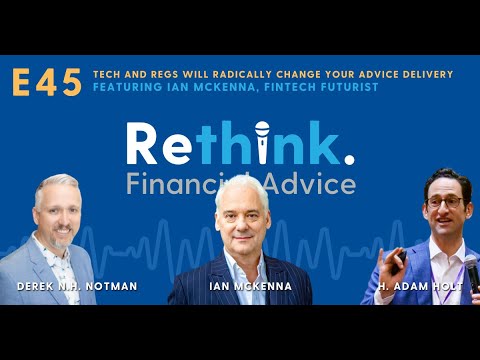
Ep45 - Rethink: Tech and Regulation Will Radically Change Your Advice Delivery – Featuring Ian McKenna
Watch and Listen
Episode Summary
In this episode, H. Adam Holt and Derek Notman speak with Ian McKenna, Director of the Financial Technology Research Centre, about the unprecedented pace of change facing financial advice. McKenna argues that despite decades of technology adoption, the core advice process has changed little, and that firms unwilling to update their commercial models risk being left behind within the decade. Drawing on his work advising fintech firms across the UK and US, McKenna outlines what advisors and enterprises need to prepare for next.
What This Episode Covers
- Why the financial advice process has barely changed in 40 years
- The commercial model shifts advice firms need to make to survive
- Regulatory pressure as a driver of technology adoption
- Lessons from the UK fintech market for US advisors
- Preparing advice businesses for the next decade of change
- Ian McKenna's perspective from advising global fintech firms
Full Transcript
Full timestamped transcript.
[00:00:30] H. Adam Holt: Derek, are advisors seeking modern best practices?
[00:00:36] Derek N. H. Notman: It's an interesting question, Adam. You know, I, I think that we are all exposed to a variety of best practices, but they are, I would argue, siloed and how often do we really seek them out? And I go back to my insurance BD days and we learned a lot of great things, but they were from other people in our office or in the community of that company.
And let's face it, we need to be on the cutting edge as things are transforming faster and faster and faster. And man, I mean, it's tough being an advisor, Adam. There's so many things to do. And now you're asking me to go seek out all the best practices on top of the 4,000 other things I'm doing today,
[00:01:20] H. Adam Holt: Of course, man, you know, you're, you're an entrepreneur, what'd you call it? In our last session, an advisor, entrepreneur,
[00:01:25] Derek N. H. Notman: advisor. No, no, you It was a entrepr, entre, provisor,
[00:01:30] H. Adam Holt: entre advisor.
[00:01:31] Derek N. H. Notman: whatever it was.
[00:01:32] H. Adam Holt: have to mash up everything and rethink.
[00:01:34] Derek N. H. Notman: We, yeah, we really do. That's a good thing. It, it's a good question. I, I think that advisors are, but I think we could do a lot better job of seeking out best practice.
[00:01:45] H. Adam Holt: I have really seen a lot of fellow advisors take this entrepreneurial spirit to heart reading books, following blogs, working on self-help. I think we have a fantastic industry that affords us a certain type of lifestyle that allows us the time to invest in ourselves, even if you are associated with a larger organization.
I think there's a mindset that comes with seeking modern best practices. But the funny thing is, I, I find most of the people probably not unlike myself or you we're getting a lot of insight from outside industry, not just let's be the number one, we'll call it advisor in our organization.
Let's just do what the other number ones do or what they did in the past. And I think it's, it's really an interesting question because it was inspired by this interview that we did. Ian McKenna from the UK who has some really interesting insights that got us thinking right, Derek?
[00:02:43] Derek N. H. Notman: It was really fun chatting with him. He's totally a futurist. He's been in our space for, gosh, it's gotta be 30 years. , but just the way he thinks about things and challenges things. I mean, it really resonated for us when, if, if you're talking about rethinking, he is rethinking all of it.
[00:03:02] H. Adam Holt: Well, and he didn't pull any punches too about what his thoughts were on the, you know, the perspective of the United States advisor and the industry, which I think is gonna be really fun to share with everybody here. Cuz we had to take what was a almost a 40 minute interview and chop it down into some really salient points, uh, for Ian, who, if you know him or have followed him in the past, he just really has some really great I insights.
So let's, uh, let's introduce Ian because I think for those people who don't know Ian McKenna, he's been involved in a significant number of FinTech startups. A consultant has a team, has programs in the uk and also travels to many of the events we go to here in the States as an. Evangelist as an interviewee, as a media personality, uh, columnist.
He's also, he's started several companies and I think, , when you hear what his perspective is from traveling the world, Derek, I think you'll also remember, and I think a lot of our audience will, will get some really interesting, chuckles and insights as to what's coming. And I, I'm, I look forward to debating what he talks about with you.
You.
[00:04:04] Derek N. H. Notman: Let's do it.
[00:04:05] H. Adam Holt: So Ian, obviously you've impacted so many of us. You've been writing about FinTech for so many years. You have a fantastic consulting firm in the uk We've even talked to, to you about, uh, participating in the many events that you're supporting. So thank you for taking the opportunity to be here. We'd love to know what's your unique perspective of the advice market today?
[00:04:26] Ian McKenna: I think we are right on the cusp of an unparalleled level of change in financial advice. If we actually look at how it worked, how different is the traditional advice process today from 40 years ago? Yes, we got bits of technology, but we're still kind of serving the same demographics. We haven't changed our industry in the way that so many others have.
And I think what we are seeing now with a plethora of ais emerging and certainly what I'm seeing has been coming up with predictions of how future financial advice systems might work for decades. And there's been quite a number of people who sort of listen to what I say and they're like, yeah, okay, Ian, you've lost the plot.
I mean my, , my vision of how we will give financial advice less than a decade from now, we'll include a scenario where we'll be inviting our clients to put on their augmented reality glasses, and based on their current level of savings, we will actually be taking them through a VR of their own future life.
It's almost like doing. The financial services equivalent of a Christmas Carol because what's one of the hardest things to do is to get people to save. But there were a series of adverts done over here about five years ago by Aviva, and what they did was they took customers and they got in a professional makeup artist and they were costumers and they dressed these people up in line with their future lifestyle and they made TV ads about, , what would they be experiencing as a lifestyle in retirement based on, on their current level of savings.
, cuz they were real clients they used in this and they gave them their real future lives and some of them were really, really quite shocked. You know, there was one guy, bit of a Jack the lad in his late thirties flash car, whatever he was getting on his bike to go to the library because he wouldn't have be able to afford internet at home, you know, um, there was another lady who was like, she was going off once her three holidays a year.
But if we think about how we interact with consumers today, one of the hardest things to do is to show them the lifestyle they're preparing for. You can actually do that really, really easy using virtual reality. You can then bring in things like, , biometric testing on people's conversation and also, , micro-expression testing to understand if they're actually telling the truth.
Are they telling you what. They really feel, or are they telling you what they think the advisor wants to hear? Mm-hmm. These, these technologies exist today. We just haven't put them into practice in financial advice yet. But the big thing that I'm seeing now is with the plethora of chat bots that are around there.
All of a sudden people are quite literally coming to me and saying some of those things you were talking about a few years ago, I thought you were mad. Now I see how it's gonna happen and let's look at para planners on as established in the US as they are over here. I remember being at a conference, I think it was three, three last year, and some people were getting excited about the, the idea of having power planners and what a good idea it was.
And I turned around and said, be very careful what you wish for, because the main thing that most advice firms now want to get rid of is all the power planners that they do a very good job, but they're very expensive and can think of, uh, it's one, one fervor media, which springs to mind they've got 600 power planners in the business at an average of about 70,000 pounds.
So, you know, not quite short of about hundred thousand dollars a year. The one thing I've been asked for by C-Suite in scale advice businesses over here for the last several years is, can you find us a robo power plant? And of course, some of these things are beginning to come to light. Um, if you look at what conquest are doing in , Canada and the uk and coming to the US very soon, they just.
Raised 24 million over in the week specifically to come into the us and that's a really, really smart piece of care. , the advisor can drive the conversation, take it through the different steps, or, um, you, you can have a guided conversation whether the, , if you like cruise control conversation where the system will just take the advisor through the various steps.
It'll be natural to raise. Or the third option is it just does full on self-driving car, the advisor slips, lets back and , watches the tech generate all the advice.
[00:10:22] Derek N. H. Notman: Christmas Carol analogy is brilliant. Yeah. Um, and I, I, I find that a bit scary on the way that that's coming, but I also do see that as a massive opportunity.
So along those lines then, Ian, if that is what the future truly holds, what action steps do you have for those in the financial advice space? We have a lot of, great advisors. We have some FinTech folks, we have C-suites at insurance companies. What is your message to them?
What's one thing that
[00:10:54] H. Adam Holt: they should do?
[00:10:55] Ian McKenna: I have a simple question. Do they intend to still be in business in five, uh, to push 10 years time? Because if they do, the overwhelming majority of financial advice businesses is in all the companies that support them. Are not adapting the commercial model in a way that will be fit for purpose in 10 years time.
The a uua model doesn't work if most of your climbers are relatively young and they're still growing their assets. It, I mean, it works quite well for the client in that EN environment. Cause don't pay very much. Doesn't deliver a sustainable amount of income now. Alright. The US does benefit, well, US advisors benefit from having nowhere near as tough regulations as most of the rest of the world.
So some of the operating costs are lower, but we need to completely reinvent the way that we are charging people so that the money that they're paying advice firms. Is adequate to sustain their businesses. And by the way, that's also gonna mean drastically cutting some of the services. That there are immense opportunities out there.
That's an enormous market that is untapped, but could be. But traditional financial advice firms, I don't see them creating, deploying, and I'm generalizing. There will be a handful that are, wait three, some over here. But most advice firms have a commercial model that will put them out of business in five to seven years time.
Probably doesn't come much more shocking than that really does it.
[00:13:00] H. Adam Holt: So the takeaways here is, Clearly the insurance industry is antiquated. Financial advisors, if they don't retool or refigure out how they're gonna address the growing market, that's not all wealth only are not gonna be here. There is, there's technology that's still not being utilized, that's available today that, that our antiquated industry is not even thinking about.
Like V R A I and even facial recognition like you talked about. Uh, and the bottom line is the reason that it hasn't changed in the United States in terms of catching up on regulation is because the compensation model's
[00:13:35] Ian McKenna: Yeah, well, where are we going next and what have we gotta, what do we prepare? What got to prepare so that we can meet the future needs of customers? One of, one of the reasons I spend as much time traveling around the world, and particularly the US, is, I think it's fair to say broadly on technology.
You were about three years ahead of the uk. I think that's down to a year and a half now. There are some areas where your life insurance industry is at the least a decade behind ours, but then the US life insurance industry is the least efficient insurance industry on the planet by an ax of absolute country mile.
There are practices that are going on, which it's incredibly clear that firms could support consumers vastly better. But then people that are being paid very large amounts of money for running factories in the way they used to in the 1970s. Your life insurance industry really hasn't moved forward since the 1970s.
And, and it's quite stunning when you look at it. There are one or two companies where, hey, they're up in the 21st century with everybody else, but the overwhelming majority of us life insurance policy providers rather, are truly stuck in a time warp. And you get some of the people quietly off the record and asked them not, is this really cuz like if you improved all these processes, a lot of people wouldn't ma make any way near as much money as, as they do.
And the answer is, well, Don ever ask me that publicly, but. I mean, your life insurance industry is in such a dire state, but then again, if you look at financial regulation, the the US is 40 years behind the uk. Tell us why though. That's
[00:15:41] H. Adam Holt: good exaggeration. Yeah. How do we understand that? Because I think most of our US based financial advisors are not up to speed on what anybody else is doing, just what's in their backyard.
Mm-hmm.
[00:15:51] Ian McKenna: What do we not know? The level of of consumer protection provided by Reg BI is less than was provided to consumers in the 1986 Financial Services Act in the uk. Yeah. I mean, basically you don't have any consumer protection worth mentioning yet. Everywhere else around the world. You know, Australia, Singapore, various Asian countries.
Various Arab countries, various African countries, and of course most of Europe have got Canada's not very far ahead of you. Jason Perrera organized a really good FinTech event in Canada and got Will along to talk about the future direction. What could Canada expect to learn from the us? And on the one hand, he was talking about a lot of attack, uh, from the us but again, I mean his statement was the UK was the most advanced nation in the world in terms of consumer protection regulation.
Yeah, I'll be quite clear. We overdo it sometimes, but it's better than having none. And it's actually really now beginning to damage American software companies very, very badly because half of your software companies. In all honesty, can't get over the fact that I know America's a wonderful school nation and it's 360 million people or so.
There's 7.8 billion on the rest of the planet, and what if only 3% of those are rich? You've got some, a amazing advice tech software companies in the us. How many of them actually take it out anywhere in the rest of the world? But they're now beginning to be at an enormous commercial advantage. Because the lack regulation in the US now means that there is a symbiotic relationship between regulation and technology.
You can only really achieve the highest levels of regulation with the latest technology. So new regulatory requirements drive the adoption of technology. Technology makes new regulatory requirements possible. We've got a huge thing, um, happening over here in, at the end of July called Consumer Duty. And so put this in context.
An advisor will no longer be allowed to recommend a life insurance policy after the end of July on just a price assessment. Any comparison service that only looks at price and does not consider value will fail regulatory standards. Mm. So, and what we are seeing, if you give people a price comparison list for life insurance, their eyes always go to the lowest price.
And then it's really hard to get them to come up. It's quite strange one really, because if you are buying life insurance to protect yourself and the people you care about the most, do you really wanna cheat one? Which one a good one? It's the,
[00:19:37] H. Adam Holt: that's the commodity effect, isn't it though? Yeah. I
[00:19:39] Ian McKenna: mean, totally is.
Well, well, yeah. But, but if you start giving people value assessments, so what we see through the, through the use of the system in various pilots that we've got going on now is if people the chance to buy a better policy rather than the cheapest one, and 72% of people will buy the better policy, which will lead to an uplifting premium of about 9%, but an uplift in quality.
Of 18%. Hmm. Oh. And conveniently, hey, premiums are 9% higher. So what does that do to the commission? Mm-hmm. I mean, yeah, we've just done an exercise, um, where we're working with an organization that currently, and based on the 55,000 policies that they sold last year, that alone will drive an extra 10 million in revenue and an extra two and a half million in retained income for the advice firm after they pay away to the advisors.
There's another thing that's happening in the UK that isn't yet happening in the States, I believe. Okay. Small company called, , Amazon now sell insurance in the uk.
[00:21:08] Derek N. H. Notman: Mm-hmm. It's coming here. It's it. Yep. They'll do
[00:21:10] Ian McKenna: it. So they've now got a house insurance comparison site where multi-product broker site, it's quite normal for Amazon to go and test things over here where they mm-hmm.
They don't mind getting things wrong in the UK for a bit. They don't like getting them wrong in the US Yeah. So we frequently get stuff and we get stuff for a while and then it goes away cuz they want to take it back to, you know, imagine Amazon, well they've not pulled it by all accounts doing quite
[00:21:44] H. Adam Holt: well.
Google had a direct to consumer property and casualty unit even seven years ago and they pulled it because they found that the humans really were needed. It's funny because in 2018 I actually spoke in, in New Orleans and I put this up on a huge screen on, in front of the main platform and I said, Amazon will sell live insurance.
Google will sell investments, uh, direct to consumer and they'll know how to, to, to position it right in front of you when you're thinking about it because they heard you. And that was five years ago. And I'm surprised it hasn't happened yet, but I agree with you that it's definitely coming. It's.
[00:22:16] Derek N. H. Notman: It's amazing. , it's definitely an eye-opener
[00:22:20] H. Adam Holt: Hmm.
[00:22:21] Derek N. H. Notman: because let's face it, you know, when we find out , where we're really at, then we can start to make improvements and think differently and rethink how we're doing things. And so now when we're hearing what's, what best practices are happening from a non-US perspective, like, oh wow, Adam, you and I were talking about this earlier today.
I've gone to the Morningstar Investment Conference in London. I've gone to the Johannesburg Stock Exchange in South Africa. You know, I've met with different advisors and financial services companies outside of the US and I've gone to non-financial conferences as well, cuz we can really learn some pretty cool best practices from outside of our normal sphere of living and working and so forth.
[00:23:07] H. Adam Holt: This came up, you know, a bunch of episodes ago with Becky Tumba from South Africa who was talking about is, you know, is the US really in the number one spot where we tend to be very ethnocentric. If you remember that word from high school and think about our world defined by America is number one.
And sorry, the United States is number one. Uh, and I, I thought it was interesting that he called out that the technology seems to be really on point here in the states, although that gap is lessening, but we are really far behind in consumer advocacy and protection, which I would tell you for all of my conversations internationally, Derek, most of those advisors told us it was really difficult to just provide financial advice to people, which I thought would've been a deterrent from more people getting advice cuz they're making the process more difficult.
Where in the states, it seemed like instantly everybody went from financial services salesperson to financial advisor. But that helped accessibility, didn't it?
[00:24:14] Derek N. H. Notman: I think so. You know, it's funny you, I hear you say that. I'm doing some work with some large companies in South Africa right now, and we were even talking about compensation models and they don't have half the stuff that we do here.
[00:24:29] H. Adam Holt: Hmm.
[00:24:30] Derek N. H. Notman: So that's interesting.
[00:24:32] H. Adam Holt: What do you mean? Like, what do you mean? What do they not
[00:24:34] Derek N. H. Notman: They can't, they can't charge hourly. They can't charge a planning fee
[00:24:38] H. Adam Holt: Hmm
[00:24:38] Derek N. H. Notman: at least. So there, there's, there's five large financial companies, if you will, in South Africa, you know, the equivalent to like the large wirehouses or insurance PDs here in the States.
[00:24:50] H. Adam Holt: Mm-hmm.
[00:24:50] Derek N. H. Notman: And, uh, they're one of the big five. And that's what they were saying.
Cause we were, we had, we were talking all about the different comp models and how advisors can charge for services and it really just boiled down primarily to commission.
[00:25:04] H. Adam Holt: But yet they have better consumer advocacy according to Ian.
[00:25:09] Derek N. H. Notman: that's what's so interesting about it. So, and, and you co you've commented before about how the compensation structures are all messed up anyways.
[00:25:16] H. Adam Holt: This, didn't this kind of come up in a couple of episodes ago with Sam Russell? I mean, we, we were talking about fee transparency and putting, you know, to be transparent for our marketing perspectives, putting your fees out front, whether it's your a D V or your hourly, or that you get paid on compensation that's derived from product sales, that it should be out front.
But it, it's interesting that he said that Reg BI was no better standard than their 1986 Financial Services Act, which conceivably gave the consumer more protections against, we'll call it poor sales practices in financial services. And I know that that specific. Regulation tended to push an enormous number of financial professionals out of the business, which I thought was not appreciated as certainly by the people that lost their jobs.
Um, because an entire industry was dis, was just eliminated. And, and so it's interesting to see this full turn. We're talking to a lot of people about how, you know, fiduciary best interests on the same team is very idealistic and awesome. And we, many of us have been acting this way towards our clients for years without somebody telling us that we had to.
Um, but that this is now becoming, on the verge of becoming the norm, whereas it was almost awkward a couple years ago.
[00:26:40] Derek N. H. Notman: It. Well, the shift has happened already. There's no question about it, and it's, it's interesting how even talks about how we're on the cusp of even bigger change. Sam said the same thing. We've had a lot of people say, we are on the cusp of something. So it's not just you and I saying it anymore, buddy.
It's,
[00:26:55] H. Adam Holt: No,
[00:26:57] Derek N. H. Notman: well,
[00:26:57] H. Adam Holt: these, he and would argue, he's been saying it for years. I mean, he's got his VR glasses. Last time I saw him, I was telling you at an event, he, uh, he came up to interview me. He had video glasses on and he said, okay, start talking. And his, his actual glasses had a video camera. And then he, he started like interviewing me
[00:27:15] Derek N. H. Notman: Are you sure his name isn't James
Bond?
[00:27:17] H. Adam Holt: don't know, I think he wants to be James
[00:27:18] Derek N. H. Notman: I, think so. I
[00:27:19] H. Adam Holt: much imagining him the entire time, driving around in his Aston Martin, you know,
[00:27:25] Derek N. H. Notman: totally. He is
totally
[00:27:26] H. Adam Holt: With a martini.
[00:27:27] Derek N. H. Notman: He is the insurance and financial services James Bond. That's who he is.
[00:27:31] H. Adam Holt: Maybe that's true. Or he's q He could be Q by the way,
[00:27:35] Derek N. H. Notman: He totally could be Q and Q branch. No question.
[00:27:37] H. Adam Holt: He is q Well let, so tell, tell us your takeaways cuz there's some really interesting things from best practices to, , where our position is and wake up calls. , what'd you pull away from?
[00:27:46] Derek N. H. Notman: Well, I, I think advisors listening to this really should take a moment to think about what Ian is saying. And we'll cover these bullet points real quick now, but Ian does travel over the world and he has a unique experience and exposure, , to things that we just don't have. That's why it's so cool to have him on just to hear , what he has seen , and doing.
I thought his, point on virtual reality fascinating. Then the next five or 10 years to be able to use vr. So like, think about it this way. I use a use case, we talk about retirement planning, quote unquote, for our clients, and it's just some idea that's like a wisp of error out there.
They can't really quantify it. What if we could, as advisors, have our client put on a VR set and actually look at themselves 30 years from now in retirement, visualizing the house on the beach or traveling or being with the grandkids? That's remarkable. And now it makes it real. And I think that consumers would act a lot more on the advice they're given if they saw things that way.
So I thought that was really fascinating.
[00:28:53] H. Adam Holt: Well, I haven't actually. That's an interesting, I just had this vision of having our clients in the room and showing them their Monte Carlo analysis and now in the vr , they're 82 years old, and all of a sudden they get evicted from their house and pulled out, and now they're homeless and they're walking around like, this is the choice because you decided to have no savings.
[00:29:15] Derek N. H. Notman: Make it real. You, you're making it real. Well, okay, here's another example. So my wife and I love this show. Um,, million Dollar Listing. they were selling 20, 30, 40 million homes in Las Vegas. But because the homes weren't built or even developed yet, and the land was barely even there, they were selling these things through VR and they were getting people to commit massive checks to buy these homes completely site unseen.
So VR can get people to act like that with their money. It can definitely work in the work that we do as advisors too.
[00:29:50] H. Adam Holt: Do you see why we need to do this now? Making it really emotional. I thought that was really interesting that they're testing this. And I know that when he mentioned the facial recognition, it's interesting. Gosh, in 2016 I saw from Invisio, actually Edmund Walters introduced me to it.
It. Basically biometric testing on risk profiling, so you could see whether they're lying when they say they wanna take a lot of risk, you could just like read their face. It said, Nope, they can't take risk. They're just telling you that for ego reasons. So it's true, it's a, there's a lot of technology that is just far off from really being implemented in our space.
[00:30:27] Derek N. H. Notman: But, and he didn't, he didn't bring this up. I'm gonna bring it up. Should we implement it?
[00:30:34] H. Adam Holt: Oh, well isn't that the big question today? Should we be implementing artificial intelligence chatbots? , you probably have already seen the, , what are they called?
[00:30:42] Derek N. H. Notman: Well they had that open letter to AI that they're calling for, for taking a break. And you know, I even did a post on LinkedIn about it cuz we are anticipating turning on our AI at coupler as part of the work we do. And I, what I don't want is Skynet to take over. I really don't. And if, if, if I put myself in the consumer shoe and you're asking me as an advisor Yeah, we're gonna do a , biometric, uh, scan of your face to see if you're lying
[00:31:08] H. Adam Holt: Mm
[00:31:09] Derek N. H. Notman: and all these other things, if I'm over 25, I don't know if I'm gonna do that.
So I don't, I don't know. But Ian did mention is that, you know, he talked, this is the other point is he talked about the compensation models all messed up and he made a really good point about are we gonna, are you gonna be in business in the next five to 10 years because of the younger generations and the comp models are not what they should be and so forth.
So when you combine that with AI and all that other stuff, I, I don't know, man, I, I can see the VR benefits because that's not too intrusive. Heck, you could record those videos and give it to them. Right? Send it, send them, the link to the video later, or put it on VHS for 'em.
[00:31:48] H. Adam Holt: Well, you know, it's so funny you say that because we even saw implementations in the late, you know, 2015 sixteens using financial planning in VR space. Basically meeting over VR and being like, okay, you got a virtual screen in front of you and there's your pie chart and there's your burn down chart.
And you know, did that make it more engaging? Now it's kind of more like chichi, you know, it's not like, okay, it was cool.
[00:32:11] Derek N. H. Notman: aren't there either.
[00:32:12] H. Adam Holt: It's not there. But neither was Zoom though. Think about it. Neither was Zoom. I mean, if everybody has an Oculus at home eventually, cuz their kids have it. , it's actually interesting because Panos Lala dais from Greece, he travels literally around the world.
He'd pretty see, he's like huge social presence. I met him at M D R T in Gamma years ago and we traveled, went to, uh, Taiwan together and , he's been wearing these goggles forever. He just hit, I think, 50 or 60 stages around the world in the last year talking about, and he shows up on the stage with the VR goggles and says, this is the future.
And I think a lot of people are catching on. They're saying, no way this is true. And they will accelerate that. , I mean, I don't know, I, it's, it's hard to really think, Derek, that we're gonna get a bunch of VR goggles and it's not gonna be taken sort of seriously. Well, we're gamifying your financial life, but gosh, that is how we take action, isn't it?
[00:33:05] Derek N. H. Notman: There will be some challenges there, but if we can sell that value , Sam talked about sell the value, right? What's your value prop? If you can sell that and say, listen, I can show you what happens, and let me tell you what, when I say show, you know, and really get into there, I would be, as a consumer, I think I'd be willing to go that far.
[00:33:24] H. Adam Holt: Mm-hmm.
[00:33:25] Derek N. H. Notman: Be like, what? What? So if I buy this boat today that I have to finance instead of funding retirement, this is what happens in 30 years, huh? I guess I don't need that boat so much anymore.
[00:33:40] H. Adam Holt: Yeah. That's interesting. You know what? I just remember it was a, it was a conversation you and I had two years ago. It was one of our first podcasts. We talked about the future of financial product distribution. We said it's gonna change radically. Here we have Ian talking about Amazon distribution, maybe the whole point of the VR and the next level of tech and social.
Is that the product to distribution or the solution Distribu. Will really be through these types of products too. Maybe you will be playing your VR goggles and playing golf and all of a sudden you'll see a billboard off in the background that says, buy your insurance or your mutual fund now, cuz we already know your portfolio's a mess.
And you literally just click on that and say, okay, what do you want? Here's the value. Is it boom, done? Like, is that possible? The interesting thing about what he said is that the reason that the US hasn't had the level of innovation that one would've expected given all this amazing technology is cuz the bottom line is that the margins are stopping innovation.
In other words, someone's getting paid an enormous amount of money relative to the value they're delivering, which causes a sty relationship in the innovation, right? When, when several people are making way too much money, they just use that to say, Hey, let's not make any changes. Okay? Because this is a good thing.
Don't, don't break it.
[00:35:01] Derek N. H. Notman: I like it. This is good. I I can go buy that boat.
[00:35:04] H. Adam Holt: But if the consumer base stops valuing what the guys make in the margin are really generating on arbitrage, they'll be forced to change. And maybe that's really what's happening is that the consumers, the next generation of much more value minded, conscious, not as relationship driven, that I've gotta have an advisor that I trust, that boomer mentality that controls a lot of the money right now, Derek, I think is that kind of loyalty and legacy is gonna wane on the a u a or a u m model because I, I don't know if, if I'm basically helping my parents who are now in their eighties, I don't know if I'm happy with them paying 1% or 10 or 20 grand a year to an advisor when they haven't built a relationship with me.
They're not using the newest tech, they're still, they're doing an asset allocation model. I, I think the value proposition is gonna be lost on next generation. So it's not just that you have to worry about. Well, when my, when my clients pass on, maybe that that model's done, I think that the kids are gonna get involved in the later years of the baby boomer
[00:36:07] Derek N. H. Notman: No question.
[00:36:08] H. Adam Holt: You're gonna be forced. That's, that's kind of my prediction today.
[00:36:11] Derek N. H. Notman: And if you show up with a VR headset, you're probably gonna win those kids over.
[00:36:15] H. Adam Holt: Maybe, maybe you'll be like, wow, this guy's modern.
[00:36:18] Derek N. H. Notman: Yeah. You got a better shot. Right? You know, you're gonna make an impression. We've referenced Sam's episode a lot, but there's a lot of similarities there, what she was talking about. Um, any other bullet points, things you want to just point out to advisors before we wrap this baby up?
[00:36:34] H. Adam Holt: I think the US comment about advice, tech not being designed to go global is very, I said before, the, you know, the US market is built for the us. It's like, it's the biggest market. Let's just stay here. Why go overseas? But I thought it was cool that he said, Hey, we're 360 million people. That's 3% of the global population, or 4%.
Uh, there's a huge market out there. You guys have the best tech. You're in the lead. Why are you not building for the global community? Ironically, asset map is, so that's my plug. I mean, we're, and so as couple, right? So you and I are built for this idea cuz we're a little, maybe we're more exposed than most, right?
We're not just operating in our single silo of, I sell this or I sell that and this is how I do it, and that's how I hang out with the same kind of people and we all look the same and we take best practices from each other. And that's good enough and.
[00:37:25] Derek N. H. Notman: And
that's
[00:37:26] H. Adam Holt: we're exposed, we're just exposed and we see it.
And so, you can't unsee it. Right. Um, so we're building Asset Map and already have like, you know, like, uh, South Africa, UK using Asset Map because we built it to be cross border agnostic. Um, you know, the ups and downs of that. But I think that's, that's a really important aspect of, of, you know, helping the entire ecosystem and saying , the addressable market is just massive.
[00:37:50] Derek N. H. Notman: It's huge. We can serve a lot of people that way. And again, to i's point, we can learn from these other countries and companies that are global and then we can take those learnings back, even all the way down to the granular level of what is , the solo advisors shop doing today that maybe they can do a little bit better.
[00:38:07] H. Adam Holt: Mm-hmm.
[00:38:08] Derek N. H. Notman: So yeah, we've, we've thrown a lot at people. And this one, this one definitely is more of a futurist brain bender, , doctor who, whatever you want to call it type of thing. But when you've got the James Bond from UK on your show, you gotta go with it.
[00:38:24] H. Adam Holt: That's right. Well, that, well, that's okay. I'm glad you wrapped it up because thank you, Ian, for what you're doing. Really, really exciting, interesting stuff. I'm glad that you pushed the envelope on the futurist stuff because that, uh, that really forces us to think and about. And as we all know in this podcast, we're trying to force a rethinking of our whole industry.
And good things will come out of it. It may not always be comfortable, but, , hopefully we'll get the, the reality of, of that honest dialogue to help figure out where we want to take it personally. So with that, thank you, Ian, for everything you're doing. Derek, why don't you, uh, why don't you bring us home?
[00:38:56] Derek N. H. Notman: I already am home.
[00:38:58] H. Adam Holt: Why don't you bring the rest of the people home?
[00:39:03] Derek N. H. Notman: Sorry, this is bad jokes. I'm really good at bad jokes, my wife says. Anyways, yeah, thanks everybody. Another awesome episode. We are closing in on 50 and we've got some pretty awesome guests in the pipelines to stay tuned. Um, in the meantime, you need to follow us on Linked. The links are right below in the show notes.
All you gotta do is go down there and click. So just click those things and do that. You wanna learn more about us, our companies, what we do on Saturdays. Just go, go do that.
[00:39:33] H. Adam Holt: Is that in there?
[00:39:35] Derek N. H. Notman: I don't know, it might, I don't know. Maybe
[00:39:40] H. Adam Holt: Awesome.
[00:39:41] Derek N. H. Notman: just ask Adam's mom what he does on Saturdays. He'll tell you.
[00:39:43] H. Adam Holt: I, she doesn't know. Awesome. Well, Derek, thank you as always.
[00:39:49] Derek N. H. Notman: man. Thanks. Good seeing ya. Everyone else, do something good today.
[00:39:54] H. Adam Holt: That's right. To Invest in yourself, in
[00:39:56] Derek N. H. Notman: Invest
[00:39:57] H. Adam Holt: and we'll look forward to, uh, to seeing it the next pod.
The content has been made available to you by Asset-Map for informational and educational purposes only.