
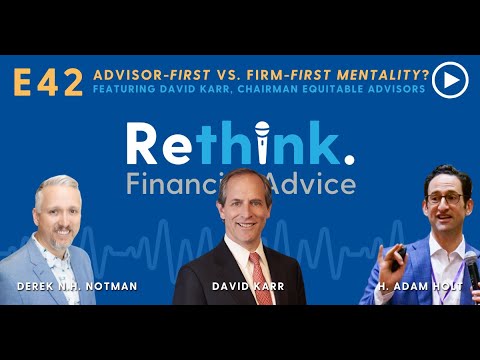
Ep42 - Rethink: Advisor-First vs. Firm-First Mentality – Featuring David Karr
Watch and Listen
Episode Summary
Hosts H. Adam Holt and Derek Notman welcome David Karr, Chairman of Equitable Advisors, to examine whether advisors or their firms hold the real power in today's financial advice business. Karr shares his view that rising demand for advice combined with a flat-to-declining supply of strong advisors has put capable advisors firmly in the driver's seat. The conversation digs into what that shift means for client expectations, firm infrastructure, and the support advisors need to keep delivering at a high level.
What This Episode Covers
- Why demand for financial advice keeps outpacing advisor supply
- How advisor leverage is reshaping firm-advisor relationships
- Rising client expectations and what it takes to meet them
- The infrastructure and support strong advisors require
- What advisors risk missing if they don't recognize their position
- Lessons from Equitable Advisors' approach to advisor support
Full Transcript
Full timestamped transcript.
[00:00:29] Derek N. H. Notman: Adam. Does the home office know what's happening in the field?
[00:00:36] H. Adam Holt: Huh? The home office. Do you mean the office back in some city that supposedly runs our companies.
[00:00:45] Derek N. H. Notman: Yeah. Yeah. I mean, most of us are affiliated with some type of insurance company, broker, dealer, wirehouse. Do they know what's going on in the field?
[00:00:57] H. Adam Holt: You know, I don't, I don't know. That's a good question because I think for years we've kept them typically at arm's length. Right? You do your role and we'll do our role in the, in the real we'll do the real work. You do the back office work, and
[00:01:11] Derek N. H. Notman: Be
[00:01:11] H. Adam Holt: as we get along
[00:01:12] Derek N. H. Notman: real work
[00:01:13] H. Adam Holt: Yeah, That's right. Don't, isn't that the work?
Always the guy in the field is the guy saying, I'm doing the real work. You're just counting all the being that I just pulled. Uh, but yeah, I think as long as we get paid and we get the execution, we care for and our reputation is strong. Uh, for the most part. I know a lot of advisors have treated the home office kind of like them and an us.
[00:01:35] Derek N. H. Notman: And is that the right way that we should be doing?
[00:01:39] H. Adam Holt: No, I don't think it is the right way we should be doing it. I think a lot of the financial advisors we've talked to throughout the years, gosh, for the past 5, 10, 20 years, Derek, they've been, recognizing that they play a role and we play a role and, and that's why I think there has been generally, I wouldn't call it a mistrust, but maybe a misalignment of perceptions. What we actually deliver in the field. I know that historically associations with financial services companies have been product manufacturers first. And the field force looked like a distribution outlet of agents and reps and salespeople that we all started as, and we still need to distribute those products and services that keep the mothership going. And there's been a shift, certainly. At highest net worth I think over the last 20 years, but now it's hit mass market. And it begs a great question that you ask, which is, do the leadership of these companies really know what's going on in the field?
[00:02:41] Derek N. H. Notman: It's really important I think, to feel like home office is connect.
[00:02:47] H. Adam Holt: Mm-hmm.
[00:02:48] Derek N. H. Notman: Uh, because I think the moment that they don't, you get some issues, there's pushback, there's complaining. It's, it's the whole, you know, the sailors on the ship. Don't think the captain's doing the right thing. Maybe that's a terrible analogy.
I don't know. But you
[00:03:04] H. Adam Holt: Well, you know,
[00:03:05] Derek N. H. Notman: always dissent in the ranks, right?
[00:03:07] H. Adam Holt: Well, what happens when that dissent starts to get bigger than dis?
[00:03:11] Derek N. H. Notman: Yeah, exactly. So, Further down that vein, then how do we fix that? Or is there, is there a different or better model that could be used? So there is no dissension in the ranks.
[00:03:25] H. Adam Holt: Yeah. Well, we've seen so many advisors migrating to the independence side when their current relationship doesn't offer them independence or doing business as. Or doesn't give them the technology platform they might have liked and they get inspired by another R A A. And we've seen certainly a L Mass movement from wirehouses into IBDs as well as RS and family offices.
We've seen a lot of this migration. I gotta believe at some point it's because there's a disconnect between the value proposition provided by the. And what the person in the field, the field producer who's talking to clients and delivering advice directly thinks that they could or should get for that association, right?
There's that, that's the disconnect where
the grass is greener.
[00:04:15] Derek N. H. Notman: I I think you hit that nail on the head and advisors then get really frustrated and maybe they try. I know I've tried to get home office to open up and listen and understand. But it sometimes they feel like it falls on deaf ears.
So then what's the alternative? How long do I want to bang my head against that wall before I just say, forget it, I'm off this other firm over here.
Or Independence, man, they're gonna make my life a whole lot easier.
If home office is more in tune, then you're gonna have less disen. You're gonna have less turnover. That's, I mean, let's face it, it's not cheap to bring on a new advisor and train 'em
[00:04:55] H. Adam Holt: it is not.
[00:04:56] Derek N. H. Notman: It's a hell of an investment for the company.
It's expensive, it's time consuming. Um, so maybe there's a better way, but we should probably talk to someone who knows a little bit more.
[00:05:07] H. Adam Holt: Well, it's true. You know, we bred our brains when this question came in months ago of whether there was this clear alignment between what serves the best interest of the client on the ground, the investor, the. Advisor who's trying to deliver the best they can with the resources they have. And of course the question is, is that supported all the way up through the entire chain.
[00:05:30] David Karr: And so we had to seek out who we knew who we could actually ask this question of to find out what the modern executive leader looks like. And we were lucky enough in our network to know David Carr and David, who's the chairman of
[00:05:43] H. Adam Holt: Equitable Advisors,
[00:05:45] David Karr: actually represents Derek for me. Someone who is. Much more aligned with US financial advisors in the field because he is A C L U C H F C C F P. He has been an advisor, he has been a manager. He has been a leader of an organization and eventually ascended to be the chairman. And I've been able to watch his career just as he's been able to watch mine, um, throughout all these years, know him pretty well when we asked him to be. Podcast, I was actually really impressed with what I learned because you can say you remember somebody when now you see how he's running an organization with thousands of employees, uh, and it's really exciting year. So I'm, I'm excited Derek, to share this with you and our community, on what David Carr is doing at Equitable.
[00:06:29] H. Adam Holt: Well, David, thank you so much for joining us. It's such a pleasure to see you, and obviously our, our long-term relationship is really great to see how, uh, you've blossomed and how. Of Equitable is Blossom has been, it's meant a lot to me, obviously in my history. We wanted to get an idea from you. What's your unique perspective these days on the financial advice market?
[00:06:47] David Karr: Well, Adam, I've been saying for years that I really believe that the demand for financial advice continues to increase, and yet the supply of advisors has remained flat to declining for at least a decade, if not longer. So from my perspective, Advisors, strong advisors, ones that are connected with their clients really hold all the cards.
They really sit in the catbird seat. There's never been a better time for a great advisor in this business.
[00:07:17] Derek N. H. Notman: That really begs the question, David then is if, if that's what's happening, if that's the environment you're seeing from your unique position, what's the missing opportunity? What are advisors missing?
What the ones that maybe don't hold all the clients, for example. What are they missing or what's the challenge that might be coming, or they just haven't realized yet?
[00:07:37] David Karr: Well, I think that what advisors need to be keenly aware of is that while the demand for great advisors just continues to increase and puts them in a great position, the expectations of clients in terms of what they expect from their advisors as also never been great. It's not enough just to manage an investment portfolio or just touch base with a client once a. Clients are expecting their advisor to provide a comprehensive plan. They want 'em to understand their current situation, including aspects of their life that aren't directly related to money, but are impacted by their finances. They want to be educated on alternatives as to how to move forward. Ultimately, they want to have clear recommendations from those advisors and they want their advisor to help monitor their situation and make. That they're moving in the right direction and keeping in touch on a regular and frequent basis.
And I think that's the change. Again, it's we're the days of being able to touch base with your client once a year and check in and that's enough are gone. And clients are gonna expect a lot more from us at as advisors than they've ever expected in the past. That we're gonna need to leverage digital platforms and so forth to make sure we're delivering on those expect.
[00:08:56] H. Adam Holt: So that's great and and I obviously we're very kindred in that both Derek and I have agreed that that being more present, being more available, being comprehensive. Even some of the interesting moves that I know Equitable has made recently on the holistic life planning, really moving more towards, I would say, even a life coach, right, to being available to clients at a whole nother level.
What action steps would you recommend now for us to rethink going forward?
[00:09:22] David Karr: I think the advisors really need. To think about this and think about what we just talked about in terms of what the client expectations are, because delivering on all those expectations that we talked about requires a great deal of support, and it requires infrastructure.
And advisors need to decide if this is a capability that they wanna develop on their own. Do they want to band together with other advisors to build it? Do they want to join a firm who can help support that process? but all of this expectation that clients have developed and what they're expecting from, it takes people, it takes process, takes technology, and every advisor has to figure out how they're gonna get that.
Are they gonna create it for themselves? Are they gonna do it together with the team, or are they gonna have a firm that's providing it for 'em? But they really need to think about that whole people process Te. and where that's coming from. Do they have the resources to build it themselves or not? Or are they affiliated with a firm that's delivering what they need to meet their client's expectations?
[00:10:31] Derek N. H. Notman: I, I think you hit the nail on the head, David, and. It almost sounds like what you're saying is that before an advisor to pick a tech stack or this or that, they should go back a little bit further in the process. What are they trying to build and where's the best place to build it? Is it by themselves?
Is it with a team? Is it at a place like Equitable, for example? Cause it seems like a lot of advisors don't actually think about that. They just jump in. I mean, from your vantage point, would you say that you've seen that probably happen a couple too many times?
[00:11:01] David Karr: Yeah. I think again, I think that's all part of our history where there's a little bit of a lone wolf mentality.
It's more about getting the new client, because at the beginning it's just about survival in the business, and you haven't thought of yourself yet as a business owner. And I do believe that in the old world, that could work for. A career perhaps, but I don't think that that is true any longer. I think, again, going back to the beginning of our conversation where the demands out there, but the expectations are high as well.
So advisors really need to be professional. They really need to think about their practice. They really need to think about how they're delivering on these promises to clients, how they're making. that they understand their situation, that they're making clear recommendations. They're keeping 'em up to date on how they're doing relative to their goals and objectives.
And they're in frequent communication. If they're not doing all of those things, they're not meeting their client's expectations and they have to solve for that. And it's not an easy equation. It's not something that's simple to just put all that in place, and you really have to determine. Again, do you have the capacity to build that yourself and think through all that? Or do I need to become part of a firm or organization that has already thought through that? Or do I need to join a company that's already kind of got these pieces in place that I can leverage it?
[00:12:21] Derek N. H. Notman: It resonates so much. Sorry, just You know, it brings me back to
some of those lone wolf early days and um, it would've been really refreshing to have someone like yourself to latch onto so well. So David, given your perspective, your experience as an advisor, but also an executive in our profession, is there anything that you think needs to be heard or debated that you would like to see the industry profession tackle or maybe rethink?
[00:12:51] David Karr: I think the industry has evolved tremendously as we, we have all seen during the course of our careers, and I think more than ever before, as we've talked about it, good advisors really hold the cards. They want optionality. They want flexibility, of course within regulatory constraints, but firms that are gonna win going forward. So thinking about it from a firm perspective, have an advisor first mentality, and really build their platforms to serve their advisors and their clients. Those who build with a firm first mentality, I believe will find themselves on the outside looking. And so I think that's, , to me , that's the big shift that has occurred in the last five to 10 years, and I believe that's gonna only accelerate golf.
[00:13:39] H. Adam Holt: It's interesting, David, knowing your history, you're one of the few executives that's in a space. With a massive organization behind you where you were actually in the field, right?
You were a financial advisor. You actually managed, you cultivated people,
Equitable Advisors
one of the few remaining firms that still has a commitment to developing Field Force. I'm curious why you think that's such an important aspect of your business today?
[00:14:06] David Karr: That's a great question, and I know a. Companies have exited, kind of bringing on training, hiring, developing new advisors, and it's a challenging, but also very rewarding opportunity when you think about the future of our industry. As I said, the demand's never been greater, but our supply is flat at best. And if we're not gonna do it, who will? Somebody's got to bring in new people, help train them, help develop them, help them understand what it takes to build a. Wealth management practice, and it's a long term investment, but it's an investment that is very worthwhile on the long term and the impact that you can have ultimately on the client's lives and in the process, you're having a big impact also on the advisor lives because they're building a great business.
They're impacting the lives of their clients. Adam, you've heard me say it a hundred times before. When you really think about what our advisors do for our clients, they're helping them save for their children's education. They're helping 'em retire more comfortably, and they're helping protect their families.
And very few things in the world are more important to our clients than those three things other than perhaps their health and their family's health. These are the most important things in our clients' lives, and it's great to be in a business, in an industry where we can impact our clients in such a way. And we need to develop new advisors to ultimately, in the long term, be able to deliver on that promise.
[00:15:33] H. Adam Holt: That's fantastic. I appreciate you giving us some context of this. A lot of the times it comes up in the podcast and of course in follow up through social telling us they can appreciate the challenges of starting out as a new advisor.
Where's the resources, where's the training, where's the mentorship? And so it's exciting to see that, uh, despite and sometimes controversy that really just leading the charge here. You know, I'm curious because we have had several guests on, the Rethink podcast from the RIA space, from insurance, from BDs, from custodians, as well as consultants.
And there's always been this ongoing debate around which organization really is positioned to serve the greater marketplace. And I could say from the outside, it looks like you've rethought what Equitable 150 year old company is and can be. And I'm really curious where you want to take the organization going forward.
[00:16:23] David Karr: As we've discussed, I think that taking a holistic approach for our clients, again, not just touching, just forget about just whether it's financial planning or not, and the products involved in financial planning, but really understanding what's important to our clients, understanding what's important in their lives and ultimately how that links back into their finances and how the finances are really just an enabler for them to accomplish what is personal and important to them. That requires a whole portfolio of products that's not just about selling an annuity product. It's not just about selling a life insurance product, and it's not just about managing an investment portfolio. It requires a holistic approach, and I firmly believe that that is how we best ultimately serve our clients and serve our advisors and help them build great practices that help their clients achieve their goals and objective. As an example, one of the programs that we've developed over the past year and a half is a partnership with Columbia, where it's a life coaching program. We've had, 150 plus advisors go through that program last year. We're gonna have another 150 or more go through it this year. The feedback from that program really has been unbelievable because what it's about is it's, it's this partnership with Columbia where they're helping our advisors understand how to connect with their clients on a much deeper and more meaningful level. That, again, taps into what's really personally important to them. Forget about the money piece for a moment. We know that money is an enabler to that, but still really connecting with the clients over what's personal and having that professional coaching, having that partnership with Columbia, the feedback has just been phenomenal.
[00:18:10] H. Adam Holt: So that was an interesting. Discussion with someone who's leading. As we just discussed, I'm hearing a lot of things I was not expecting, to be honest, Derek.
[00:18:21] Derek N. H. Notman: I walk away from. Feeling refreshed, if that makes sense. it just to hear someone with that perspective and experience talking about where we're going as a profession and to be that positive and that active about it, and , to say what you and I, and I think a lot of other people. And validate it from that, from the home office, right.
[00:18:45] H. Adam Holt: Yeah.
[00:18:46] Derek N. H. Notman: Um, it's really, it's really awesome. It's really, it's really great to know that that's where we're headed. And I, I, I've, I, were a younger advisor, listening, man, I would be really encouraged.
[00:18:58] H. Adam Holt: I heard institutionalized focus on advisor first versus firm first around process over product, around customer expectations and holistic awareness, and the enablement of getting the clients what they want through money and financial planning. That's, that's a very evolved perspective that has nothing to do with product.
[00:19:28] Derek N. H. Notman: Nothing and, and equitable, just like all of the large companies was a product manufacturer in its early days.
[00:19:35] H. Adam Holt: still is.
[00:19:36] Derek N. H. Notman: Yeah. And, and not that that's a bad thing, but product manufacturing shouldn't come first, I think, is what they're saying is what David's saying is that yeah, products are super important and we can do all that stuff.
Let's lead with that holistic approach and what's really important to our clients. You know, he mentions about the strong advisors are the ones that are really, really connected to their clients. Connected means knowing what's going on in their lives and helping them plan for it and, and things in the future.
[00:20:05] H. Adam Holt: That's very true. So what, what did you take away, Derek? What are, what are things that you think people should remember from that interview? With Carr?
[00:20:13] Derek N. H. Notman: Well, he made it very clear there is an increasing demand for great advisors, driven by the customer. That's what they want, but they have much higher expectations as well. And advisors are starting to realize this more and more. It seems like that flywheel is, is really firing up. , and . He made it pretty darn clear if any firms that want to succeed in the future.
And I think when he says firms, I think he says as big as equitable and all of the large companies out there, all the way down to small RIAs, you better be able to attract those strong advisors. And you're gonna have to be able to do that by giving them optionality. Let them customize how they want to build their practice, give them great tech, give them great tech support, , um, you know, things of that nature.
Cause if they don't get it there, they will find it somewhere else. Now the, the grass is greener on the other side of the fence in certain instances.
[00:21:09] H. Adam Holt: Mm-hmm. may be a different kind of grass though. Could be fescue, could be a grass,
[00:21:16] Derek N. H. Notman: And you still gotta cut it. You still have to mow the lawn.
[00:21:19] H. Adam Holt: Look that nice tall green grass that I can't hit my ball out of. Um, yeah, it's true. I always, I, I joke about that, right? The grass is always greener, um, until you get there and you realize
that, I thought, you know, it's kind of interesting to hear when you have somebody who's making decisions that affect thousands, if not millions of customers. Eventually, to hear that this trend is now hit the home office means that we all need to recognize that that is no longer a wave that's coming.
That wave is here because typically
institutions tend to follow the megatrend. And we're telling you that this executive is literally institutionalizing holistic life planning for the last year and a half and disseminating that to thousands potentially of field force reps, agents, advisors, financial planners, whatever you wanna call us today. That just begs the point if, if you're not talking about this, that party started.
[00:22:17] Derek N. H. Notman: I, I hope you're listening. Yeah. Especially for any of the other home. Folks that are listening to this pay attention.
This is a leader in the industry from a large, old, well respected, established company. They've turned the ship, they're going a different direction. It's already happening. They're not thinking about it.
They're doing it. And I don't know how many clients Equitable has as a whole, but it's gotta be in the millions. That's a massive impact. And obviously they see that it's the way that people want to be interacted with and it's the way, that way that things are going. I mean, he talks about people process, and.
That's, that's where it is. And that's what they're, they're doubling down.
[00:22:53] H. Adam Holt: It's funny, over the years I've always known David to ask that question, right? To challenge advisors saying, what's your process? Right? It may, it's your own process or our process, but what is it? Right? You, you need to be able to replicate it. And I thought it was funny to, to hear those nuances around early days of survival. And then if you can survive, then likely you're gonna thrive and have some success, and all of a sudden you turn around and realize. You actually an, an entrepreneur you, you've created now you almost have to retool and rethink how you actually created your practice to now. You know, handle what you've created.
Right? I always joke that, uh, the early days are planting a bunch of seeds. You don't know what's gonna grow, and then hopefully you just kept planting the whole time, and now all of a sudden you have this harvest and you're overwhelmed , by the yield, if you will. And now you need to bring on people to cultivate it, to bring it , to harvest.
So, Um, and that requires actually thinking like an entrepreneur in a business. So it's funny how we get here. It's not always, you don't always start out as a professional thinking about what you're gonna need infrastructure-wise. But today we can do that. We can actually join organizations large and small that have thought, uh, have been thoughtful around what is the process.
And I think it's important for us to scale today. The only way we're gonna deliver more humanity, more. We'll call it human advisor value is for us not to be doing the back office stuff, which means we're gonna need to automate and use tech and processes, and delegate. And that's really the key to being a successful business person is really delegating, isn't it?
[00:24:15] Derek N. H. Notman: Oh, delegating's a huge part of it. You said something else though, about just thinking more like a business owner in the early days of being an advisor, I mean, you're trying to figure out the acronyms, the products, the terms you're actually reading. Some of the prospectuses, you know, it's really, it's, it's really overwhelming.
and I, I think just being exposed to the fact that, hey, you know what, think about this as a business, not just as a product placement type of situation where you are planting those seeds, that mindset shift. Man, if I didn't have that in my first couple years, it was just sell, sell, sell, sell, sell. And I did all right. But it wasn't a business,
[00:24:54] H. Adam Holt: Hmm.
[00:24:54] Derek N. H. Notman: um, necessarily. It transactional. It was McDonald's versus a Michelin star restaurant.
[00:24:59] H. Adam Holt: Right. Well, it was a franchise really. It was
probably a franchise for somebody else. So that, that is an interesting thing because he did say that when you have a firm first mentality, you're a franchise. When you have an advisor, first, you're an entrepreneur. And it's interesting to hear that, uh, as an executive, to look at the field force representation, reps, registered reps, otherwise. As, as really advisor first culture. And that's, uh, that's really cool to see that,
and I'm very hopeful of how that, how that evolves and changes.
[00:25:29] Derek N. H. Notman: So important, and I would argue most advisors are entrepreneurs at some level, if not completely. So em embrace it, goad advisor first, help them be successful that way instead of forcing product.
[00:25:41] H. Adam Holt: Yeah. Well, thank you David for taking the time. I know you're incredibly busy. We appreciate it and hopefully all of you just found some message in there that you can take and apply in your own life. I had to ask you, Derek, because one of the things we've been thinking about, and you, you heard it here, even again,
[00:25:53] Derek N. H. Notman: Mm-hmm.
[00:25:54] H. Adam Holt: this topic of. Holistic wellness, mindfulness, you know, it starts to get a little bit soft and fuzzy around the edges because it's not how we were traditionally trained as almost financial technicians engineered. What is this new hot topic and is it really here to stay
[00:26:14] Derek N. H. Notman: You know, I, I have to share a quick story about this and I'll, I'll tie it back. Bear with me here. This is from one of my very first meetings as an advisor. I do believe we are going down this financial wellness path, and I think it's very, very important. And I do think it's the future of where it was.
And that means talking about emotional things, personal things that clients have on their mind they're trying to accomplish, or that scare them or make them, stressed out. So one of my very first meetings, my development manager was in the meeting with me and actually brought the wife.
This was a, a couple, we were friends. Personally outta work brought her to tears, not outta joy, but because of of, of basically scaring the hell out of her that if she didn't implement exactly what he was forcing that second that the world was going to come to an end. It was an awful experience. And the client said, don't ever do that again.
So that's not the type of financial wellness that we should be going down. The type of financial wellness should not be starting with an ulterior motive of , placing a product, but actually getting to the root of, well, what is financial wellness? How does that actually impact us? And so forth. So I apologize for the, the story, but I, I think it does give some context.
That's where it used to be in general, I would say. And, and it's totally shifted now where we really, truly are trying to do this and. Well, man, money's at the root of a lot of our lives. If we don't know how to use money or don't have the right access to money, I mean, we, we have bad things that happen.
Poverty, that's kind of a big deal around the world.
[00:27:54] H. Adam Holt: True.
[00:27:54] Derek N. H. Notman: a lot of divorces end because of financial issues.
You have mental stress, health stress and issues that come out from, from financial things. So all of this, Is a byproduct of bad money habits, bad money issues. So I, I believe that by talking about money from a more of a financial wellness perspective and being holistic and fixing it at its core,
[00:28:20] H. Adam Holt: Hmm.
[00:28:21] Derek N. H. Notman: now we solve some really big problems along the way.
And it's funny how it took us this long to get there, but I mean, think about it. Money's a tool that we have virtually everyone on the planet in some shape, way, or form has access. Yet there's no formal education and we're told not to talk about it or talk about our feelings together with it. It's kind of crazy.
[00:28:40] H. Adam Holt: Yeah. I love what you said there because you know, for years I felt like we were living in this space, but we were doing it for the high net. Right at the top of the pyramid, right? All your needs are met, all your wants are met. You're al you're already up there at self-actualization. The wealthy families that felt they had enough confidence and certainty and resources and right.
A lot of the fear from being financially, we'll call it destitute, is gone. They have the. Luxury of feeling and thinking like, what's the meaning here or what's the purpose? Or how do I contribute to the world? Right? Those things like very aspirational, but we are starting to see that now in the mass market, and I know you and I as just individuals, just like everybody listening. We have emotions, we have opinions, we have things we'd love to see happen in the world, as well as in our own households. And many of them can be influenced by finances and, and knowing our why has become a really big topic, especially as this robo question. Artificial intelligence intrusion into financial advice threatens the typical business model of giving somebody a projection like a G P S system, and this is what you need to buy and this is what I need to do to manage your money. Instead, we need to be able to go beyond that, and I think that's the trend we're starting to see as, as there's a lot of conversation that I know I'm having with. Real thought leaders just like yourself, that the big differentiator for financial advice delivery is gonna be delivering more humanity, which is tied up in what matters. And we have to find ways to get that out of our clients, even when it's difficult and doesn't seem like our traditional training or jobs, because we need to help them make behavioral change so that they can have the outcomes they really want.
[00:30:30] Derek N. H. Notman: A
[00:30:30] H. Adam Holt: that's gonna be the challenge, uh,
for, for us.
[00:30:33] Derek N. H. Notman: But opportunity. Also a massive opportunity. And actually to that point, we've got a great guest coming up on the next episode that's gonna jump right into all of this, has experience as an advisor, but also as a wellness coach and some pretty cool contacts and experiences that we'll share more about.
So definitely stay tuned for the next episode.
[00:30:53] H. Adam Holt: Fantastic. All right, well, thank you David Carr. Again, thank you Derek, for your continued patience and putting up with me as a
[00:31:00] Derek N. H. Notman: That's all right. I gotta have someone to make fun of
[00:31:03] H. Adam Holt: Oh, I thought I was the one making fun of you.
[00:31:05] Derek N. H. Notman: Yeah, that usually happens.
[00:31:06] H. Adam Holt: that's the irony. What? What? Well, thank you everybody for being on this podcast. Anything we need to do, Derek,
[00:31:14] Derek N. H. Notman: Yep. Go leave. , a review please. Pretty please. Subscribe, follow us, share the thing, the podcast, the thing, whatever is out. I'm calling it a thing now, but
go share it. Um, let us know if there's any type of topics that you want to uh hear or if you wanna be a guest, there's a link out there. You'll find it.
Follow us on LinkedIn. Connect with us on LinkedIn, and , I feel bad about the Eagles.
[00:31:39] H. Adam Holt: Oh, you had to bring that up.
[00:31:40] Derek N. H. Notman: Sorry man, I was rooting for.
[00:31:42] H. Adam Holt: We had a great season. , we respect and cherish that
from all, all
[00:31:46] Derek N. H. Notman: Didn't all of your pro sports teams in , Pennsylvania lose this year though?
[00:31:50] H. Adam Holt: No, they won up until the very last game.
[00:31:53] Derek N. H. Notman: so they lost
[00:31:55] H. Adam Holt: Ah, come on.
[00:31:56] Derek N. H. Notman: Uh, dude, I can't say. I mean, my packers did not even get that far. So I can't, I can't comment.
[00:32:01] H. Adam Holt: Okay. Well, we'll leave it there. Thanks everybody. And of course, don't forget to share this with your friends. We'll see you on the next pod.
The content has been made available to you by Asset-Map for informational and educational purposes only.