
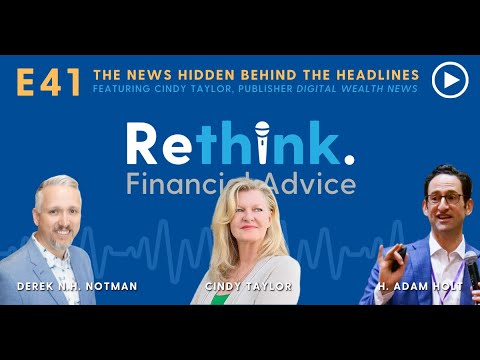
Ep41 - Rethink: The News Hidden Behind the Headlines – Featuring Cindy Taylor
Watch and Listen
Episode Summary
In this episode, hosts H. Adam Holt and Derek Notman sit down with Cindy Taylor, founder of Digital Wealth News, to explore the news and trends flying under the radar of mainstream financial media. Taylor draws on decades covering the wealthtech and wealth management space to unpack why so much real innovation goes uncovered, from disjointed advisor tech stacks to media training gaps. The conversation also touches on cryptocurrency literacy, fee transparency, and how advisors can turn recession pressures into opportunity.
What This Episode Covers
- Why mainstream financial media overlooks major industry trends
- The importance of a cohesive, understandable advisor tech stack
- Media training and communication skills for financial advisors
- Cryptocurrency knowledge gaps among advisors and clients
- Product fee transparency and its impact on trust
- Finding opportunity for advisors during recessionary pressure
Full Transcript
Full timestamped transcript.
[00:00:28] H. Adam Holt: Derek. Are advisors missing news that matters in lieu of what's hot today?
[00:00:35] Derek N. H. Notman: Adam, that's, that's a really interesting question. , and I'm guilty of sometimes paying attention to what's hot today because it's an easy way to get some of your content to go viral. But
[00:00:48] H. Adam Holt: Hmm.
[00:00:50] Derek N. H. Notman: there is or are. A lot of stories and a lot of things happening behind the scenes. I, I think of the movie Wizard of Oz?
You see one thing, but you've got this curtain thing going on, like what's going on really behind the scenes, and I suspect there is Adam. I mean, even you and I, we. Hear and see things based upon what we're doing with their businesses and the conversations that we're having with potential partners.
That's not public knowledge, and we see trends that maybe others aren't seeing. So I think they are missing news in, in lieu of what's actually just being promoted today because it's the next hot thing. What do you.
[00:01:33] H. Adam Holt: Well, this came from , my own personal frustration because I've been following the news very mindful of pay to play. I'm very mindful of public relations and our own efforts there of getting the story that we want to tell in front of the audience, that we want to hear it. And there's no question that the media outlet has been and is a significant business, and as a business needs to create revenue and opportunity.
And what I tend to get jaded about Derek is. Many of the media outlets that I tend to be reliant upon are all telling the same story. It's a top three headlines are the same in all different outlets. And it seems to me like it's somewhat curated and I'm not hearing what's behind the scenes.
[00:02:24] Derek N. H. Notman: I would agree with you. There's, um, shall we say, pay to play?
[00:02:27] H. Adam Holt: Yeah, absolutely.
[00:02:29] Derek N. H. Notman: on. And I, I don't know if that's necessarily bad, but I suppose those with bigger budgets, can push one thing versus another. , but ultimately, if we're trying to help the advisors and other folks in our profession grow, I think it's important that we make them aware of like, Hey, there are other things going on here that you really should be paying attention to.
There are undercurrents that are very important. , that should be on your radar. Well, and actually I think we, we have a guest today that's gonna talk about some of those and has a pretty cool perspective given , their past
[00:03:06] H. Adam Holt: Yeah, no, that's very true. You know, we were trying to think about how do we filter or get beyond the filter before the filter perhaps
[00:03:14] Derek N. H. Notman: a lot of filters.
[00:03:15] H. Adam Holt: right. Get before the coffee filter, get all the grinds and everything. Of what's happening in news as opposed to what makes actually the front page, or at least might be my news feed.
Right. So introduce us to Cindy because I think she's been willing to tell us what's really going on.
[00:03:39] Derek N. H. Notman: Yeah, she has, , an interesting story. So this is Cindy Taylor. She is the. Founder, of , digital Wealth News, but she's been in the, , media space within our profession and industry for 2 million years, as
[00:03:56] H. Adam Holt: 2 million.
[00:03:57] Derek N. H. Notman: I don't know how she figured that one out So , she's been doing media for a long time. She launched another company called FinTech News in 2016 that covered a whole spectrum of different FinTech, crypto hedge funds, wealth tech.
The list goes on. And she did so well. She actually sold that company, but then like any serial entrepreneur, she got bored and decided to do it again. . So , , she now has, , digital wealth news that she has launched and is pushing out and really brings an interesting perspective to what she hears, what she sees.
And you'll hear about this in a second versus what we actually hear in the media, which is pretty cool. So, yeah, I think we should have a listen to what she has to say and, and we'll tell you what we think.
[00:04:47] H. Adam Holt: Okay, let's hear from.
Cindy thank you so much for joining us what's your unique perspective of what's going on in the financial advice marketplace today
[00:04:57] Cindy Taylor: Well, it's, it's very interesting, you know, being in media, we get pitched constantly on new products, new offerings, and I think right now is just an incredibly exciting time in the wealth tech and wealth management space because there's so much innovation occurring and there's so many new products coming to market.
And they just keep getting better and better. I will say, you know, we can , like I said, so many media pitches and some of them are like, what the heck? , what is this thing and why did you just get 5 million for it, ? Because I can't see where this is a viable product. Um, so what I will say is that I think there's a lot of chaff being brought forward as well, so, It's just an interesting time.
It's really interesting, but there's a lot of entrepreneurs out there creating really interesting products and, and providing solutions for wealth managers and, uh, financial advisors, broker dealers that, that they need. I do read our competition. I consider Michael Kitces competition and you know, he does an annual directory of wealth tech firms and there's over 200 right now, so it's just phenomenal
[00:06:08] H. Adam Holt: yeah, it's interesting because it's so overwhelming actually, how many different companies are on that FinTech map? We just had this conversation with Craig Iscoe. It's Of Azure group that participated in that.
FinTech map. And we commented that it's been overwhelming and we're actually lost again, in the terms of how many different companies are on there. Almost like it's become a massive diner menu that you just can't figure out what you're looking at anymore. I'm curious, what's the missing opportunity that advisors just don't see coming, or that's really present from all the media work you're doing behind the scenes.
[00:06:44] Cindy Taylor: Well, I think there's three things. Number one, like you said, , if an advisor doesn't have a tech stack that's in place, that's cohesive and understandable, and that's where the value of consultants come in, ironically.
Where they can help you create just what that exact special stat. Is because you have to have a technology stack that makes sense. If you're not functioning with a cohesive stack, you're, you're behind the eight ball. You really are. We from the get-go, as I mentioned before, we started with FinTech news.
We were covering the crypto space in 2016. And a funny story, we, after we sold to f Fa Mag, they kind of hated our crypto content and they actually asked us to do less and so, We did. Now of course, everybody covers crypto because it's become mainstream, it's become institutionalized, et cetera. But that said, I still think, uh, there's so much space for advisors to really get better informed on how they can assist their clients and get paid for it.
With their digital asset holdings. And I think people still need to get their head around that they've been resistant. I, I know a lot of advisors are still resistant. I just think that's dumb. Like people are investing in it. Don't you wanna participate in it? Don't you wanna help guide them? So I think, you know, if you're resistant to that, I think that's just dumb.
I'm gonna just say it. It's just dumb. Done the same space. . Thank you. Thank you for that. Thumbs up. Web three. I was resistant to Web three because I perceive it as, you know, these headsets, well, that Web three is more than headsets. It's non fungible tokens. Those tokens can be used in all kinds of institutional investment products.
And again, people have to get in, you know, educated on what this is. And so I guess the third thing, so those are, I'm off my soapbox about crypto, but thank you for letting me go on about that because I think it's really important. I think. Two is that, you know, because we're doing Zoom interviews because there's so much social media, I think people just have to get really, really honed on their communication skills.
And that might require some, , media training. Ironically, even if they're a wealth manager, they might need some media training to just make sure that they're presenting in the right way. So that's what I think the opportunities are
[00:08:54] Derek N. H. Notman: that
That's great. Those are actually some good tips, things that I suspect most of them don't think about.
I, one tangent general question to that though. I agree. There's all this talk about crypto, it's going on, clients are investing in it, and there's all this other digital stuff going on and marketing and et cetera. Yeah. A lot of advisors, uh, and this was myself included until I finally kind of broke out of it, but a lot of advisors tend to be a little bit more old school.
right? Sure. You know, I, I would argue that our, our profession, our industry is a bit bit slower to evolve than others. Correct. Yeah. So when you're coming at it from an advisor who's maybe been around 20 years, 30 years, and they still have paper filing cabinets, so they have the traditional brick and mortar office, what's one tip you could give them to say, okay, let's, here's how you get more into what's going on in the digital world today, whether that's crypto or marketing or something else.
What's one thing that they can do to help them get a little bit more?
[00:09:51] Cindy Taylor: Okay, so last year we did an eight webinar series with SARS and funds, and that content is available on the Digital Wealth News site. It's no longer CE accredited, but you can do an eight hour educational series on Digital Wealth News, which was sponsored by Sara.
That will take you from A to Z in crypto. Oh, okay. And you know, if you take that time, I know it's hard to take that time. Listen, it's hard for me to take half an hour sometimes, but if advisors will just say, I've gotta learn this, set aside a day, log on, look at that content, get marginally, you know, educated, and then go from there.
Start by educating yourself so you can at least talk comfortably and knowledgeably and, and that information is,
[00:10:42] Derek N. H. Notman: Excellent. So I mean you already kind of, you know, through a, a good mic drop, controversial moment out there. I'm wondering, is there anything else you want to add to that, do you think, is there anything else that advisors need to hear?
Controversy is welcome, obviously, you know, polite and absolutely respectful. But you know, is there anything else that just bugs you that you think advisors need to hear and think about to rethink?
[00:11:05] Cindy Taylor: Yeah, there's a couple of things, and again, I, I don't mean to be purposely putting in plugs for our clients, but you know, we're in a recession and the re , I don't care.
You know, here we go. Maybe we're in a recession, maybe it's next year. We're in a, we're in a recession and. And the reason I say these things with conviction, I'm married to a guy who was in the financial markets for 40 years. He's an original member of the Chicago Board Options Exchange, held seats of the C B O T C M E, and we co-founded a hedge fund.
So I do know a bit about markets myself personally, and I'm not afraid to be controversial about that. People are gonna have to lay people off because we know, I'm seeing this with people in the wealth tech space where there's layoffs going on. And I don't mean to be Debbie Downer because I always think there's opportu.
In recessions. But I think, um, this is an opportunity where advisors are just gonna have to get more comfortable automating, automating certain processes, whether that's the input process, document, vaults, whatever. They're just gonna have to get past that file cabinet and get automated, because they're probably gonna have to lay a few people off.
So, you know, gotta get comfortable with that. If you're not, you're, you're screwed. I.
[00:12:16] Derek N. H. Notman: Thank you for that. I, well, we've talked about this a couple times on different episodes, Adam, there's this wave coming. Things are changing. Yeah. And uh, you're just reiterating, uh, that message, Cindy, so thank you.
[00:12:27] Cindy Taylor: For sure, for sure.
I will say too, there's such a plethora of investment products and so we, we talked about crypto. I get pitched a lot by investment platforms so that it gives us sort of a front row view. Of what is going on in the marketplace. And there's things you have to be careful of too. I, I got pitched yesterday on a new company that claims they're a platform and they claim that they offer tax savings for people if they invest with them through their platform.
And then they , keep those holdings until , men are 70 or women are 75, and that there are tax advantages, et cetera. , I saw three layers of fees in that, and I thought that's ridiculous because what they're investing in is, uh, the s and p 500 e TF Vanguard, those guys are already charging a fee. Then you're asking a financial advisor who's charging some fee structure to their clients to invest in that, and then they're getting an investment fee for passively managing a dam e tf.
Give me a break. So there's three layers of fees. Think about this, right? And they're pushing that out and I'm thinking, I have done spreadsheets and I understand how fees eat into. For clients. So I just think that people have to be really cognizant of the types of investment products they're putting out to their clients and aware, , of these fee structures that they don't eat into the client's returns.
So that one bugged me. I went and ran to my husband and I said, is, is this as dumb as I think it is? Because there's three layers of fees in here. So what you know, and again, what if the markets go down? I mean, now you're down and you're down three layers of fees. When a client. Buy a simple ETF themselves.
So if you're gonna as an advisor, you gotta have, you know, meaningful portfolios. I'm not, I'm telling this is to me self-evident, but maybe it's not.
[00:14:18] Derek N. H. Notman: Wow. That was a lot there, Adam.
[00:14:22] H. Adam Holt: Hmm.
[00:14:23] Derek N. H. Notman: I love her passion and I love, she just pulls the gloves off and, and says some things that maybe some of us were thinking, but not hearing. Uh, so brilliant. What are some takeaways from her thoughts there , that now you, that you've had some time to think on , that you'd like to share or comment on?
[00:14:41] H. Adam Holt: You know, it's funny, Derek, because when we did this interview, what I heard, the third time I listened to it was I had this vision in my head that the garbage person in our community probably knows more about the bigger trends that are happening in household utilization of, let's say, products than we have any insight into.
In other words, they see who's buying mac and cheese, basically. They know who's buying big stuff because there's boxes they. You know what I'm saying? When you're getting that much data across your screen, You started to see the trends. And the reason why I think that is relevant here is because in media, the media outlets are getting pitched obviously by a whole bunch of, Hey, put my media up front, put this story up front also.
Oh wait, newsjack on all the big stuff that's already popular because I want people to come to my side. So I think only like 2% of the real stuff that's going on in the world is actually getting into the media outlets that we all rely upon. And what she has the opportunity is she sees the bigger. Right.
She gets, , there's all this news and stuff going on that's probably news , worthy around crypto digital assets web three, but I don't think it's popular, so it doesn't necessarily get the attention of advisors, and I think that's the missed opportunity. . Unfortunately, media has become like an entertainment outlet.
It's, you know what I'm saying? I don't, I don't know if.
[00:16:05] Derek N. H. Notman: a good analogy. Well, to to your other analogy. That's a lot of analogies,
[00:16:11] H. Adam Holt: Yeah, I, I got more. I got
[00:16:13] Derek N. H. Notman: how often do you ask your garbage person
[00:16:16] H. Adam Holt: Hmm.
[00:16:17] Derek N. H. Notman: what trends they see? You don't.
[00:16:20] H. Adam Holt: You don't,
[00:16:21] Derek N. H. Notman: I, so I, I think you're right. I bet there are a lot of underlying currents and she mentioned some,
[00:16:26] H. Adam Holt: Yeah, I'm not saying that news is garbage. I'm just saying that here's a, here's an unfiltered environment where she's seeing. A whole bunch of different things promoted and not promoted, and has to, of course, as an editor and a publisher, make a decision as to , what does the audience actually want to hear?
And I, I tend to think that so much of news is fake news because we're subscribing to the channels that say the things that we believe in, right? Whether it's political, religious, uh, environmental, et cetera, right? We, we subscribe to these channels and then we consume more of it, and we become more and more fervent about it.
The question is, how do we as advisors become more. Of what's really going on, and you asked me what I took away from this. I, of course we can't help it being FinTech people saying, yes, the FinTech space is getting crowded. Everybody's bringing their newest idea to the table. Startup capital required is really low, and yet then, then you got VCs coming in behind it and putting huge evaluations behind these companies.
They're completely unvetted. So I think there's a little bit of. , there's a little bit of a freneticness that's coming into the, everybody can build an app and at enterprise grade security and roll it out and make millions of dollars. I think that's a joke, and I think she picks that up really well.
[00:17:36] Derek N. H. Notman: She totally does. You know, one thing that comes to mind is how can advisors sift through everything? The, I dunno if we call it fake news, but it's curated news for sure. follow more than one news source. Go to the, to the leaders in the space and try to find ones that are almost are conflicting. Hey, listen to us
[00:18:03] H. Adam Holt: Nah,
[00:18:03] Derek N. H. Notman: Yeah. But think if, if you have us and then you have some other, like digital wealth news, Kitsis, Craig Squiz, blah, blog and podcasts, you start adding all these in together. Cuz each of them are hearing all these underlying currents
[00:18:18] H. Adam Holt: Mm.
[00:18:19] Derek N. H. Notman: and they're only able to promote and or comment on so much.
So if you start trying to get tidbits from all of them as an advisor now you can hopefully see a little bit bigger picture of what's actually going on versus just listening to one station or podcast or source all the time. I mean, I guess if you're gonna listen to one podcast, it should be ours, , but.
[00:18:42] H. Adam Holt: Who has time for anything else? I mean, at this point.
[00:18:44] Derek N. H. Notman: Yeah,
[00:18:45] H. Adam Holt: But here's the thing. I think Derek right, and I'm thinking more about it as we're talking about it, thinking live, is that I believe the news is sharing with us what's popular. And promoting what's popular. So it's a self-fulfilling prophecy by talking to somebody behind the scenes and to talking to people in the field.
You tend to get a different story from what's being talked about in the main, we'll call it mainstream, and I thought it was really interesting. How much conversation there is going on at the consumer level around crypto still, but advisor outlets are really not talking about it.
Why is it, why is there such widespread ignorance around digital currencies? Why is there almost a scoffing at the Web 3.0 or the VR metaverse concepts and because nobody's quite figured out how to distribute financial services, experie. In that space. So it must be useless. But these are mega trends that are happening behind the scenes that are gonna affect our businesses.
And, it's funny how many people even look at virtual or remote advice as just, it's screen sharing. No, that's live streaming production, quality tv, and, and people are, Or looking at, oh, I've just got this zoom looking up my nose with the fan on the ceiling spinning around, and the the light is behind me.
And I'm not thinking about that experience.
[00:20:05] Derek N. H. Notman: Looking up my nose,
[00:20:06] H. Adam Holt: working from home. Like, oh, it's pandemic style. I'm like, no, dude. That is, that is literally how people are experiencing you. Are you intentional about it or not? I, I think the advisors are just, but the media's not talking about that, so it
[00:20:20] Derek N. H. Notman: they're.
[00:20:20] H. Adam Holt: be popular.
[00:20:21] Derek N. H. Notman: We actually interviewed someone just recently, , who's gonna be, you know, a future guest on the podcast. And they were talking about some of these things and how they see in the next five or 10 years what this virtual experience is actually gonna look like. So stay tuned for that. That's a really interesting conversation.
, with our, one of our friends across the pond. We'll
[00:20:41] H. Adam Holt: what did you, yeah, so what did you take from.
[00:20:44] Derek N. H. Notman: You know, one thing that, , I liked, which was an undercurrent, was she talked about hone your communication skills.
[00:20:51] H. Adam Holt: Mm-hmm.
[00:20:51] Derek N. H. Notman: And I know, Adam, you've actually paid, I don't know if it was for TV or radio or something, but you paid , for a coach to help you get better
and there was a ton of value to that. I, I remember back when I first started as an advisor, We were taught how to communicate one-on-one belly to belly and how to communicate through our sales process, if you will, and felt super weird. But there was some coaching there, but now we have this digital medium that we're doing this through, and I think it's really important to hone those communication skills, whether you're podcasting, posting, writing, video, whatever.
You have to get really good at communicating your. So that, that was one of the things I picked up on, which I thought was interesting also, and this is a current, you and I've been following for a while. We haven't taken the recession angle on it, and she is adamant that there is a recession and we could debate that one all day long.
, but I like her point about automating processes and getting away from the filing paper cabinet. We've been talking about that for a while because at some point, whether it's because. A staff member leaves, or you do have to unfortunately lay somebody off. How are you protecting your practice against these outside forces?
That can and will happen at some point. So I thought that was really, really important as well. Uh, those were , my main big takeaways. Uh, did you have anything else that you wanted to share other than, and maybe some more analogies,
[00:22:17] H. Adam Holt: Mike. Well, listen, you know me, I'm the analogy king, self-proclaimed. . There's plenty to talk about with respect to this recession. When a, when a person who's in the media and seeing a lot of the news, and you can only print snippets because our attention span is just squashed, and you gotta come up with new content every five seconds, that's gotta be attractive and, you know, is gonna get your readership to engage.
Um, I, I don't know that a lot of people want to hear that there's a recession and, and yet there's probably a lot of supporting. News worthy stuff out there that's saying people are laying off individuals. This whole entrance of AI and people making it real with chat, G P T and all these other things that are coming out from Google.
They're really starting to show how they're gonna be disruptive and more efficient than humans at doing tasks. So there's, I think there's gonna be a significant fallout from this idea of we're in a recession or really retooling of roles, uh, to do more, you know, even get more efficient, more productive.
And I don't know how that's gonna affect advisors down at the field level. Um, but it's certainly something we should be aware of. I mean, we think about trends in investments all the time, right? , what is the consumer. , desiring so I can invest in that, product or technology in my own portfolio.
We should be paying attention to these trends behind the scenes. And I think she makes some really interesting comments around, integrating tech stacks and the, and the digital stuff
[00:23:42] Derek N. H. Notman: So if I'm an advisor listening right now, what are things I should do? Well, I, I think get better at your communication skills digitally, what you just talked about. Have a great tech stack. Prepare for these bad events that can happen. Be more efficient, be more effective. , listen for the undercurrents and get educated,
those are things you can do as an advisor today. Don't rest on your laurels. You and I have talked about that many times.
[00:24:07] H. Adam Holt: That's the thing, right? This is this complacency risk that Aaron Klein talked about years ago. A year ago. A year ago. And, uh, and learn, right? So I think we all need to go back and learn and, and really understand at least the digital assets. And of course, what is the future of technology and this VR stuff.
We have a friend, Panos, who literally travels around the world doing literally. Presentations in front of financial advisors with a headset gear and what he's seeing behind them and showing them a new vision of how you could deliver advice. It's crazy, but it's possible. It's possible. So I think that's, that's great.
Thank you so much, Cindy, for your frank, , comments on, on what's going on behind the scenes. We really appreciate what you're doing, , at. Digital wealth news, , and FinTech news. Really great stuff. You know, Derek, it's time for our community question. We haven't had one in quite a while because we've been so inundated about our own agenda, uh, and great stuff.
So this one came in here from Sebastian, , in Seattle. You ready for this?
[00:25:01] Derek N. H. Notman: Do.
[00:25:01] H. Adam Holt: All right, so he writes, so many of us with boots on the ground advising clients are delivering the day-to-day advice and have been providing financial planning for years. I'm seeing most firms and executives just start talking about advice delivery before the products that they manufactured.
Do they finally get it? Won't this totally disrupt their business model? I mean, I think they mean leading with advice. Love to hear from an executive who's in the know. Thanks Seb. So thanks Sebastian for writing that. We always appreciate that. And he does that through LinkedIn. This is interesting, Derek, because we've been scouring for some executives that we feel are on top of their market or what, do you have a gut response to this?
[00:25:42] Derek N. H. Notman: I think they are. , but it's still early days and while we have a really interesting guest coming up that will be able to speak to this from the highest levels of a very large well-known. Company in the US here. We'll leave that one as a teaser for later. But I think Seb, in general, yes, it, it's finally happening.
In fact, I just got contacted by another very large financial services company, , that wants to know more about how all of this works. So it is on their agenda. They are thinking about it. But remember, these are large institutions that are very old and they move slow. Good, bad, or indifferent, it's just the way it is.
But I am encouraged to hear that the leaders of these companies are promoting a different tact now with this battleship, if you will, that takes forever to turn.
It's happening. It's never gonna happen as fast as us with boots on the ground want it to. , but from what we're hearing so far and what you're gonna hear in an upcoming episode,
[00:26:44] H. Adam Holt: That's great. And we do know when the big companies decide to, to get ahold of it. All of a sudden, just like the media, this thing becomes very real. So I know for a lot of the RA community and pushing to financial planning first, once the big institutions start. We'll call it process or institutionalizing advice first before product.
It, it's a game changer, right? So I think we're starting to see that wave hit if, if it's not happened already, actually.
[00:27:08] Derek N. H. Notman: no
[00:27:09] H. Adam Holt: forward to that conversation. With that, Derek, let's wrap us up today. Thank you. Of course, Cindy, for everything you're doing. Thank you my friend. Derek, any, uh, actions that are our listeners need to.
[00:27:19] Derek N. H. Notman: Well, , I don't wanna sound like a broken record here, Adam, but if you haven't given us a review yet, I think we would really appreciate one. But it's gotta be five or five and a half stars,
[00:27:29] H. Adam Holt: Can you get a five and a half stars now? Is that a
[00:27:31] Derek N. H. Notman: we're that special. Adam But Apple did that just for us. Uh, no, really. But please, you know, give us any questions or, or thoughts. We'd love feedback. We'd love for you to follow us on LinkedIn, both personally and , the rethink page. Leave us a review, yeah, be part of this community. We're all helping each other drive forward, and we do that by actually talking to each other.
So let us know what's on your mind. So am and I can debate it.
[00:27:59] H. Adam Holt: Fantastic. Thanks buddy. I look forward to talking to you at the next podcast.
The content has been made available to you by Asset-Map for informational and educational purposes only.