
Ep04 - Rethink: Brick and Mortar vs. Remote
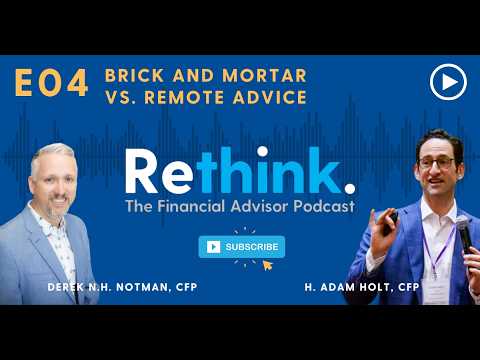
Watch and Listen
Episode Summary
Adam Holt and Derek Notman make the case that a virtual practice is not a compromise version of a physical one, and both moved before the pandemic forced the question. Holt describes keeping offices in Philadelphia that now run at roughly half capacity with almost nobody coming in, and traces his own shift back about fifteen years to a plain observation: his wealthiest clients were never available, did not want to visit an office, and lost the most from in-person scheduling. The organizing principle of the episode is that lifestyle should drive the design of a practice rather than the reverse. The hosts work through the commuting arithmetic, the staff-retention side of remote work, and the argument that a digital playing field removes geographic protection in both directions. They close with the production details that make remote meetings land and a meeting cadence that preserves some in-person contact.
What This Episode Covers
- Why wealthier clients often prefer remote meetings, and what that does to scheduling
- The commuting arithmetic, and designing a practice around lifestyle rather than the reverse
- What a level digital playing field means for competition and for geographic reach
- Lighting, framing, and setup treated as a client experience decision rather than a technical one
- A meeting cadence that mixes remote frequency with periodic in-person multigenerational planning
Full Transcript
Full timestamped transcript.
[00:00:00] H. Adam Holt: Welcome to Rethink, the Financial Advisor Podcast. My name is Adam Holt.
[00:00:06] Derek Notman: And this is Derek Notman. We are your hosts, both veteran advisors and fintech CEOs who challenge the status quo, question everything, and have fun doing it. Hear honest commentary on the challenges facing advisors
[00:00:19] H. Adam Holt: today. And be part of a community where we can all rethink the profession.
Now on to our episode. Derek, can you run a successful practice entirely virtually?
[00:00:35] Derek Notman: Hey, Adam. Love the question. This is right up my alley. Short answer, yes.
[00:00:41] H. Adam Holt: Okay.
[00:00:41] Derek Notman: Period.
[00:00:42] H. Adam Holt: That was the shortest podcast ever.
[00:00:44] Derek Notman: Done. All right, thanks g- thanks for listening, guys.
[00:00:45] H. Adam Holt: Everybody, thank you. We appreciate your attendance.
[00:00:47] Derek Notman: We'll see you next week.
[00:00:48] H. Adam Holt: There's gotta be more to that, right? Yes, I mean, we've had so many questions about the future of this, how we got into this, how you got into virtual and remote pre-pandemic. We have to unpack this for people
[00:01:04] Derek Notman: Yeah. Well, obviously it's top of mind given the last 18 months, and I think there's two key words here, six or two key phrases: successful practice and virtual.
[00:01:15] H. Adam Holt: Hmm. '
[00:01:15] Derek Notman: Cause there is a difference there. But I, I, I think let's, let's give the audience a little bit backstory of our journeys, and I believe actually you beat me to this party and you went virtual before I did. So I'd like to hear a little bit more about, like, what, what motivated you, inspired you, what was the, the defining moment or idea?
Mm. Or was it just a blur that said, "Okay, I have a pretty awesome office, brick-and-mortar office, but I, things are changing."
[00:01:43] H. Adam Holt: Yeah, so it's true. I mean, so my firm in Philadelphia w- still has its offices today. We have 100% of our offices. They are 50% to capacity, right? Nobody's coming into these offices. Yeah, right.
I'm not sure that that made sense anyway, uh, because both of my mentors and partners are golfing four or five days a week anyway. They're never in the office. I feel like they've been virtual for 20 years in a sense. But you know what was interesting for me? So I, I started at, like most people, m- moving after the high net worth, uh, clientele even 15 years ago, 'cause that's where the business was.
Those were the people that wanted advice, maybe even paid for it, appreciated it, and thought holistically, 'cause they were dealing with legal, tax, insurance questions, and investment. It wasn't just about, "Can you manage my money?" They were care- they cared about bigger planning things. So that was a, a sweet spot for me.
But what was consistent for them, those clients, is that they were never available. They did not want to come into my office. I did not want to go into their environment where I was a distraction. They were, like, literally trying to do 10 things. The... You travel up to New York City, if that's where we were going, and you had, they give you 15 minutes of attention.
Yeah. Half the time they're late. It was just impossible. So we noticed that a lot of executives were, were running meetings, especially the pharmaceutical side, they were running a lot of meetings using remote screen sharing for years, 'cause the, the pharmacists and the product managers, these people were all over the world, and they couldn't necessarily meet with them in a physical location.
So they were used to this. And once I got introduced to GoToMeeting probably 15 years ago, I was hooked. And I had... I, I think the real driver is something that you talk about a lot, which is lifestyle should drive your practice versus practice dictating your lifestyle.
[00:03:31] Derek Notman: Yes.
[00:03:32] H. Adam Holt: And I had decided, even in my mid-30s, one of my bigger goals, as we talked about vision boarding, my, my auditory goal was I wanted to be 35, make a certain amount of income, and work 20 hours a week.
The... I don't know why that goal, but that seemed like an appealing goal to me. And I worked towards that, and once I achieved it, I was, you know, bored. That's how I was. I don't know what am I gonna do with myself. I'm a worker, not a golfer. I started actually really tinkering with technology. That's kind of the roots of Asset-Map.
But, but I think the answer to your question was I just found such efficiency By telling people, 'cause I was always screen sharing. I, I don't know if you know this, but I invested in a SMART Board about 15 years ago. Mm-hmm. Mm-hmm. I got one off the back of a truck. One of my buddies said, "I'm taking these things to a school.
They have one more than they bought. Hey, I'll sell it to you." I'm like, "Okay, I'll buy it." Just like true Philly style, I'm gonna buy- I love it ... this thing off the back of the truck. It was a SMART Board. I didn't know how it worked. And it was six-foot touchscreen, basically, 15 years ago. Tech- technology-wise, it was like having the weather studio in my office.
[00:04:31] Derek Notman: Amazing.
[00:04:32] H. Adam Holt: And it was really cool, and it was... Actually, we would draw people's lives up on the line. So I knew that the screen interactivity really worked well, and I was comfortable with it, and it's something we're gonna address in this podcast, 'cause comfortable, being comfortable with the technology is really critical to delivering an awesome experience when you can't have the human face-to-face fallback.
So the reason, the, the, the short answer that made, that I made a long answer is I did it because it was efficient. My customers were just literally not interested in coming physically to my office. And I said, "Listen, let's just do screen sharing during your lunch meeting, but I need 30 minutes, 40 minutes."
So I had to compress everything, and it became a standard. That's just the way we did it. And it took- And we a- still have clients to this day that we've never physically met across the country.
[00:05:15] Derek Notman: That's brilliant. I, I love it. Th- and likewise, I, I have the same. So would you say if there was one, like, linchpin there, Adam, was that the consumer basically drove your decision?
Like, you were already... Like, you, you enjoyed tech, and y- of course, as a business owner, you wanna be efficient. But would you say, like, the, the main thing that pushed you was the consumer? Like, "Hey," like, "I just don't have the time, Adam. Make this easier for me. Otherwise, it just isn't gonna work"?
[00:05:41] H. Adam Holt: I think that was a big one.
Make it, making it easy, getting on the calendar, doing remote so nobody had to travel, it saved me an enormous amount of time, and I got addicted- Mm-hmm ... to that. I re- literally worked 9:00 to 5:00. I was... I left the office at 5:00. It don't matter, which means a lot of people who work all day, they can't meet you after hours if you're not available.
[00:05:59] Derek Notman: Exactly.
[00:06:00] H. Adam Holt: So a lot of financial advisors start doing the, the evening meetings, right? The, the 5:00 to 7:00 PM- Oh, yes ... meetings.
[00:06:06] Derek Notman: Remember those? Yeah. Oh my gosh, yes.
[00:06:08] H. Adam Holt: Remember, you go where the client is available, right? And so I, I was... I said, "Yeah, I can meet you 2:00, 3:00, 4:00, 5:00. You have to separate yourself, but you don't have to physically come here, so just set aside 30 minutes."
Yeah. You go to the dentist during the day. You don't go at night, do you? Do the, do the dentist meet you in the middle of the night? Exactly, right? No, it's like 2:00 on a Friday. Like, okay. That's when my ... That's what I did.
[00:06:28] Derek Notman: I love it. I love it.
[00:06:30] H. Adam Holt: How about yourself? I mean, you, you, you got this bug earlier than most.
[00:06:34] Derek Notman: Uh, I did. And it, m- so mine was not driven from a consumer demand, which is funny. Which is actually really cool is that you and I arrived at the same place, but for different reasons, which I think is actually something I hope our, our listeners really pay attention to, is that, like, it's, it's not just one or the other.
There's w- lots of ways we can take this journey. But for me, I had my, my office, my brick-and-mortar office in Vermont. Like, I literally bought a building on the main street in the city I lived in. We were there, staff, everybody, client meetings and whatnot. But then I had an opportunity to move to the, to Wisconsin for a business opportunity.
That's a whole nother story 'cause it miserably failed. But I was forced to... Initially, I was flying back and forth, so I could go see my brick-and-mortar clients. I had a one-year-old at home, and it was awful. I was gone a lot. It was really tiring flying these small tin can planes. Just, it really started to wear on me.
So for me, it was more of a life-work balance. Like, I'm like, "I gotta find a better way to run this business, otherwise it's gonna run me six feet under." And that's what started me on that journey. And it's a long journey, but, you know, long story short, I figured out how to do all this stuff virtually. And my biggest fear, which I think a lot of advisors have or had, is that the clients won't respond well to it, and that they'll disappear Boy, was I wrong.
I was mortified that, that they would just all leave and be like, just like I'd be out of business. I had one client leave when I went virtual in 2013. It's been that long. I had one client- Wow ... leave because of it. So it, it was all in my head. And as you said, I mean, it's, it's just efficiencies. People want more time.
They wanna be able to do things. And if we're talking about what it's in for, for the advisor or the client, it's like we get our time back, we get, we get to be more efficient, we can save money. Like there's all of these benefits. Mm-hmm. And it's kinda crazy that it's taken a pandemic on a global scale to kind of get us to rethink this as an industry.
Like, hey, maybe there's something to this thing that some of these people on the fringe have been doing for years.
[00:08:43] H. Adam Holt: Yeah. Well, it, it is true. I mean, we did see some major companies move to creating accessibility for their reps if they're part of affiliation with a broker dealer or otherwise. I would say within the last five years we saw Join.me pop up institutionally.
Zoom didn't really get a bigger hold until I think the past couple years- Yeah ... although it's so easy. I think it was pretty much, uh, poo-pooed because it was like too simple. It must have looked, didn't seem professional. But I think that's what the really consumer really said they needed. They needed to be able to just turn it on.
Simple, basic. One of the bigger challenges we had in the early phases is like, great, download this plugin. Tell Beatrice- ... the 82-year-old lady in Florida to go- Right ... and download the plugin so they could run the virtual meeting. You're wasting the first 30 minutes. And she's trying to
[00:09:26] Derek Notman: plug the computer in, right?
Yeah. She's like, "What do you mean plug my computer in? It's already plugged in."
[00:09:30] H. Adam Holt: What do you mean you can see me? Wait, you can see me? My hair's not ready. What? I'm not ready for that. You can- What is, is this on? Is this thing on, right? Forget whether, yeah, I'm on mute or not. This is like working. And what's interesting about this, uh, there definitely were some technology trends that, that took the fear out of that for a lot of people.
Remember, many people were already FaceTiming their grandkids or Skyping, right? So they were- Skyping ... over the last five to 10 years, the boomer population, I think we were really concerned about really adopting this stuff. They were getting acclimated to it, just, just a different way. So we had to find a platform.
I think it's really interesting to see how ubiquitous Zoom and some of these other platforms have become- Mm-hmm ... as literally a verb because they are easy to use. And it's basically, it sends a really important message to advisors, which is you ne- you need to make it easy. Now, I agree with you that there's a lot of benefits to the, to the advisor, right?
When you ask the question, well, what's in it for me, you said time. You said- Oh my gosh ... there's clearly costs you don't have, travel costs.
[00:10:32] Derek Notman: Nope.
[00:10:33] H. Adam Holt: You said life balance. Work-life balance- Yeah ... is much different, right? We having a lot of people... My employees, by the way, don't wanna come back to the office physically.
All the 25 people that are basically re- remote for the last 18 months, they're saying, "We figured out how to make it work. And by the way, when we check out at night, we walk into our living room and we're with our family."
[00:10:52] Derek Notman: Right. That said, that as much as we are, I mean, let's face it, America especially here, we're a capitalist society, right?
I mean, we're work, work, work, work, work But I think deep down, most of us have this yearning to have more time with our family, and pursuing our hobbies, and having this balance that we talk about. And I know that's a little hokey, right? We're ti- we're kinda getting into the touchy feely stuff here. I'm sorry, guys.
Pinch yourself. But it's true, and I think that's there, and I, I... This is a way we can tap into that, but still be efficient at work. And I, I love... I've used this analogy with other advisors. Think about it. Well, what if you're in the car only one hour a day, five days a week? Mm. 50 weeks a year. Let's say you take two weeks off, right?
That's what we do in America, we work the rest. Have you added those hours up, Adam, how many hours that is? And- No ... it's 250 hours a year that you're sitting in the car. And let's face it, most financial advisors drive a lot more than that. Well, think about it this way. If you, you know, l- use a standard 40-hour work week, that's 6.25 almost 40-hour work weeks a year you are in a car, maybe listening to our podcast, let's hope, right?
Yeah. But, but you're
[00:12:01] H. Adam Holt: not- Again, and again, and
[00:12:02] Derek Notman: again. Yeah, again and again, over and over. Just
[00:12:03] H. Adam Holt: repeating it, 'cause it's only 30 minutes.
[00:12:06] Derek Notman: Well, like, that's crazy. If, if, if someone were to say, "Hey, you need to spend six weeks a year in your car as part of this job," or eight weeks, or whatever, you'd be like, "No, that's crazy."
Mm-hmm. "That's time away from my family. I'm not making money driving. It's costing me and, and I'm getting stressed." Like-
[00:12:22] H. Adam Holt: Yeah ...
[00:12:22] Derek Notman: you put it in that light, you're like, "Oh, my gosh."
[00:12:25] H. Adam Holt: Well, by the way, you're also risking the parent of your children. I mean-
[00:12:29] Derek Notman: Yeah ...
[00:12:29] H. Adam Holt: think about it that way. Like, think about the risk that you take when traveling.
I mean, we're just so used to it, but you're on the road every day. I know people have gotten into car accidents. Of course. Like, don't you? Oh, yeah. Maybe even personally, right? Mm-hmm. Right? It is not our fault, by the way. But the, but- ... there's, there's a real... There's not only the hard cost you mentioned, but there's a lot of soft cost here.
It's interesting. For me, I moved myself and my family into the city so that I could walk to work, walk my kid to school- Mm ... and not waste any time in the commute. Now, the truth is, for me, I have a hard time working from home. I've always had to have an office, because I need to physically separate myself, otherwise I will live in the refrigerator every five minutes-
looking for something new to eat. I have, I have no control. Or cleaning
[00:13:13] Derek Notman: your kitchen. You like to clean.
[00:13:14] H. Adam Holt: Or cleaning... You're right, I love cleaning my kitchen. And somehow, someone is always messing up my kitchen. It's family members. They think they're on my team, and they're just making work for me. I think this is, like, their job.
I love cleaning the kitchen for some reason. No, I don't love the k- Excuse me.
[00:13:31] Derek Notman: No, but you do it.
[00:13:32] H. Adam Holt: I love a clean kitchen. So. Okay? Yeah. And therefore, I must solve the problem myself.
[00:13:38] Derek Notman: Maybe that's a future episode, rethinking what a clean kitchen is.
[00:13:41] H. Adam Holt: Yeah, maybe. It's true. Or not. How to remove neurosis from your life.
Yeah, that's my thing. Sorry. I like a clean kitchen, 'cause I like to start c- cooking. Anyway, but the, the funny thing about, about this is we also... It, it would be w- we'd be remiss if we didn't think also- Why we should support the brick side of it, right? What's the... We, we obviously clearly have a bias towards the virtual.
[00:14:01] Derek Notman: Mm-hmm.
[00:14:02] H. Adam Holt: But now why have the brick? What's, what's the ben- what's in it for the client for the brick side, having a physical location? Maybe what's in it for the staff? What's in it for us as advisors?
[00:14:12] Derek Notman: Yeah, I think there are some benefits there, a- and I think that it's gonna be per advisor. Like, this is a sliding scale.
It's not an all or nothing, right? And that, that's what's beautiful about it is is you can customize it based upon your personality and your wants. But at the end of the day, I think we're moving to this more hybrid model, and that's driven mainly, I would argue, by the consumer. Partially by about, like, who you are as an advisor and your staff as well, but there's credibility that comes with a, a physical footprint.
Hmm. But maybe that physical footprint's a, a fourth of what it used to be, 'cause you don't need- Right ... to have such a big space anymore, right? You have community amongst your team, if that's something that's important to you. If you wanna be, like, really, like, Main Street USA and, and be part of that community, there's some value there, too.
So I think there are some benefits there, but it, it's gonna have to be that, that k- that sweet spot combination. I mean, there's so much data coming out now about how people just would rather work- As you said, like, I can turn my computer off and walk into the next room and be with my family now.
[00:15:13] H. Adam Holt: Yeah.
[00:15:14] Derek Notman: I, I don't have to drive across Philly to go see you in your office today 'cause I just don't feel like it, but I still wanna meet with you, right?
Right. So there are all these benefits. I don't know, what do you think?
[00:15:23] H. Adam Holt: I, it's interesting because when I think about the going remote, I, I'll tell you that our client meetings, 95% of our client meetings in the last five years at the firm level, granted I'm no longer the managing partner of the firm, but that still happens today.
95% of them are virtual. They don't... That was before the pandemic. Wow.
[00:15:41] Derek Notman: That's awesome.
[00:15:42] H. Adam Holt: Um, in the last 10 years, we did this study, 70% in 10 years were remote. We ran them from our office, so we had our infrastructure and our cameras, and we had our setup so we could f- And we had found that physically for us as advisors, we really like the idea of putting on our suit or a dress shirt- Mm
going physically to work, and then leaving physically work, even if we were doing remote meetings the whole time. That was, that worked for us really well, and for the clients that wanted to actually feel like they were being hosted. Like, come to my place, sit down with me, have a coffee, and let's talk.
That, having that physical location wound up actually, I think, lifting our overall preeminence. It gave us the legitimacy that you mentioned as a legitimate organization, not just some person on the end of a phone. I could be in India. You don't even know nothing from what I'm doing, right? Like, I could be on the beach with a backdrop.
I mean, there is a, a, I think, a sense of professionalism that I think a certain generation expects, and that generation tends to have a lot of the money right now. And so if you're an asset manager or you're in the wealth management side, big surprise if your clients are gonna be boomers. I don't know that that...
I, I think the big question for most of you listening is at what phase are you in your, in your we'll call practice, and is the credibility there enough where you can disconnect from the physical location? We do know that clients have moved at record pace, right? Clients are either snowbirding or they're going to their dream worlds or they're downsizing.
Mm-hmm. They're going to cheaper environments for lifestyle or cost of living. So they're moving, okay? And they will be moving, just so you know. That's- So you need to be able to promote remote ...
[00:17:27] Derek Notman: that's a nice rhyme, as promote remote.
[00:17:30] H. Adam Holt: Promote remote. By the way, is, that's a good question, is you've, we've used this term interchangeably.
We say virtual meetings and remote meetings. What, which one is it? I got... What's the right one?
[00:17:40] Derek Notman: Interchangeable. Interchangeable I think it really is. They're interchangeable. I, uh, it's just, I don't know, tomato, tomato, right? You know?
[00:17:49] H. Adam Holt: It's- Can we rethink that word, please? I, really- Yeah ... it drives me crazy.
Virtual meeting, I'm like, it's, no, it's a real meeting. I'm here, you're there. We're just remote. Okay, that's what I... So I, I'm, I think the word is it's a remote interaction. It's a remote delivery.
[00:18:03] Derek Notman: Uh- It's, it's a remote deliver- it's a virtual delivery.
[00:18:05] H. Adam Holt: Yeah, that's right.
[00:18:06] Derek Notman: It's, it's,
[00:18:06] H. Adam Holt: it's- What do you mean it's virtual delivery?
It's not virtual delivery. It's like real delivery of advice. You can virtually pay me. I mean, I want you to reality pay me. You can remotely pay me by Venmo. Sorry, I get stuck on the words. It's part of my-
[00:18:19] Derek Notman: No,
[00:18:20] H. Adam Holt: no, it's- ... teaching clown habit ...
[00:18:21] Derek Notman: yeah, your, your neurosis. Um-
[00:18:24] H. Adam Holt: That's great. So let's, let's kind of talk about this.
Yeah. So this, thank- that was a good history. I think you guys understand, everybody understands where we're coming from. Let's rethink this for the next five minutes before we talk about actions and what you can actually do to invest in your practice, the, what you need to, what you need to ac- execute or decide upon, 'cause that's gonna be important.
Where is it going, right? You've done a lot, you've been speaking a lot about this. I've been following this and certainly have read, reading articles on this through Connector and your organizations there. What, where is this gonna go? Like, um, paint a future for us in the next three, four years. What is advice gonna look like?
[00:18:59] Derek Notman: It's, well, as you put it, it's remote. Okay? So-
[00:19:02] H. Adam Holt: Thank you ...
[00:19:03] Derek Notman: I like how you've coined this. You've kind of... Like, maybe you coined this term, I don't know, but the delivery of advice, and that, that's what it is. So I, I think we have this, this shift. Well, th- no, this shift has been going on for over 20 years. Mm.
We've been in a mega trend for over 20 years. If you don't know what a mega trend is, Google it. Okay? It's very interesting. But we've been in it for 20 years, and there's been this massive shift. The pandemic brought it to the forefront, and actually, it just really brought the financial advice, insurance, investment industry into or up to speed with where everyone else already was.
But it's a pendulum, think of it that way, and I think the pandemic pushed us all to this remote virtual environment almost entirely. But remember, we're human beings and we connect with other human beings, so I think there will be this swing back a little bit where it'll settle. In the next couple years, I really do think hybrid will be the sweet spot.
People wanna work with humans, but they don't wanna be stuck driving across town. They don't wanna have to cut their vacation short because they gotta meet with their insurance person or whatever. So it's this delivery, this new medium to conduct business is really the sweet spot. At least in my crystal ball, I think that's where it's gonna be.
And for those that are listening, like, you have a choice. Like, it's pretty clear what the consumer wants. The technology has evolved, like it's there. The expectation, the comfortability, whatever you wanna call it, is all there. So now either we meet clients where they want us to be, or they will find someone who is.
[00:20:35] H. Adam Holt: Hmm. There you have it. That's it. See, that's where I tend to think about it. I've already decided for myself, because we did it pre-pandemic- Yeah, exactly ... that this is the future. And, and every firm I've talked to or guided or spoken to, I have been pushing them to move this way forever. Okay, fine. It's not just me saying, it's not just you saying it.
Okay, we're here. Now what? What is this gonna mean for new things to defend against, opportunities to exploit? I would say game theory this out with me. If everyone moves remote, what does that mean for competition for advisors?
[00:21:13] Derek Notman: Well, one, I don't think we're, we're actually really in competition. I think there's, there's enough business for all of us out there.
I mean, just do this, this, the sheer math on the population of the, of the United States 18 and above that could be potential clients than how many advisors there are. There's enough business for all of us. So now it becomes not so much about competition. We are on a, a level playing field. We're on this digital playing field But are you playing the game?
Are you sitting on the sidelines, or are you still on the old brick and mortar playing field completely? And maybe you need to have a feet on both fields.
[00:21:47] H. Adam Holt: Hmm.
[00:21:47] Derek Notman: That's, that's how I see it, Adam. I, I, I think that that's... I mean, you and I made those decisions a long time ago, but either you embrace it and you run with it and just have people coming to you, or, or you don't.
"Oh, this, this whole internet thing, I don't- I'm not so sure about it. Maybe it's not gonna stick. I think we're going back to fax machines here."
[00:22:06] H. Adam Holt: Is that what you said to yourself back in 2000 when the internet dotcom bubble blew? Yeah, like- Or that's today's statement?
[00:22:12] Derek Notman: Uh, both, right? Yeah, like, "Oh, this internet thing's just a fad.
It's gonna go away."
[00:22:17] H. Adam Holt: Someone asked, actually, they, they, they, they called and they said, "What's your fax number?" I said, "Well, what, what time zone are you in?" They went, "What do you mean what time zone?" I went, "Well, what, what, are you in this decade or the last decade?" I know, yeah, right with you. Because I don't have a fax machine.
But I think, you know what's interesting? I, I, I wanna push everybody to even think further than that. So here's what I mean by that If everybody's remote and physical presence doesn't matter, well, two things happen. Mm-hmm. Number one, financial advisors can now actually expand their market. So the market does expand.
Mm-hmm. Number two, it creates a fantastic accessibility, as you said, for those who want advice to now get it because may there may not be the ideal advisor physically located next to them, which was a precursor in the past because you had to physically go to your advisor, right? If you didn't-
[00:23:05] Derek Notman: Uh-huh ...
[00:23:05] H. Adam Holt: feel comfortable with the people you knew in your network, like, "I can't talk to my dad's advisor," or, "Every advisor I know is a, this kind of salesperson," or, you know, if people have these preconceived notions, now all of a sudden they can actually go shop for advisors that could be located all over the planet, right?
Not, we're not talking about in my state and licensed. We're talking about advisors- Exactly ... that could serve you anywhere, which creates a very interesting competition for cost and service delivery and client experience. I think a lot of advisors have gotten by on physical proximity, relationship, and history.
They're gonna start competing with service delivery and price and accessibility. And if we're not thoughtful enough as advisors for how we make it easy to do business with us, with these technologies tools, it's not just enough for me to deliver my same old 80-page financial plan now over the internet.
This is not gonna cut it, guys. You, you must maximize the expectations that consumers are having now for speed, interactivity- Yes ... engagement. And I would say that the next skill that we need to work on, the soft skill that we need to work on as financial professionals, is production value. Think about that.
If every meeting is going to move, or a preponderance of meetings is moving either to a screen on my wall, because I'm actually still brick-and-mortar, or I'm sharing my screen and we got little- Uh-huh ... pictures of us, you and me on the corners there, and I've got a screen I'm sharing. It is literally like watching a reality television show that's got me as the story line, okay?
And my financial life is the story line, and you and I are character actors in this reality television show, and the production value of it better be good because if it's kinda garbagey, I'm judging it- Oh, man ... against all the other video I'm watching all day long on a subconscious level. Subconscious.
And now, m- people think like, "Th- th- Adam, you're crazy. You don't have to produce the way Netflix does." Really? If you're not really... If you're, if you're not maximizing audio quality, visual quality, ease of getting onto this meeting with you, you might as well basically have me say, "Okay, you know what? Listen, meet me in this back alley room.
I found a room that's available." Yes. "Let's have a meeting there." And there's like no lighting and, like, uh, junky walls. Like, well, you wouldn't do that in physical world. Why would you do that in digital world? So you have to think about the production value of this experience- Because who's setting the stage?
The people that are creating all the content people are watching. Netflix, Disney, Amazon Prime, right? Yeah. Their stuff is, is awesome. Clean, beautiful, thoughtful, has my name on it, got a picture that represents me. You have to think like this now. Can you imagine this? I'm telling you, in the next three years, we're gonna have to think like this, or sooner
[00:25:53] Derek Notman: You're, you, it's this massive personalization-
[00:25:56] H. Adam Holt: Yeah
[00:25:56] Derek Notman: that, that, that is happening. Why is it happening? 'Cause people love it. People want it. They
[00:26:05] H. Adam Holt: do.
[00:26:05] Derek Notman: Look at all the different streaming services. Like, I had some friends over this weekend. We were joking about how, like, our streaming bill every month is, like, $400,000, you know? Like, 'cause I've got 400 different- Wow
yeah, I've got all these different-
[00:26:16] H. Adam Holt: $400,000. You need an advisor, buddy.
[00:26:19] Derek Notman: 400,000.
[00:26:22] H. Adam Holt: No, you have too much time on your hand. Go back to driving to your meetings.
[00:26:25] Derek Notman: But think about, like, I have choices now, and if I don't like this streaming service, I'm just gonna stop it and I'm gonna go to one that I do like because it's personalized and I'm getting what I want, and I get it now, and-
[00:26:35] H. Adam Holt: Yeah.
Well, but that's a perfect example. We're seeing clients cheat on their advisors all the time. Yeah. Now, you might be thinking, "No, my clients don't cheat on me." Yeah, right. Your clients use you for the money and the legacy they've had with you forever, and you provide a service once a year, and then they're on Mint and Personal Capital with money that you don't even know about, basically because they wanted to get some technology deliverer accessibility when they wanted it and they didn't think you were available.
That is what's happening. I'm finding again and again when I talk to people, they're like, "Yeah, I have three or four advisors." Do they know about each other? No. No. Are they getting the best advice? Well, who knows? Because the client is basically hoarding 'cause they think they can get some other experience.
They have a Coinbase account, now they have a crypto account. Now they have, like, a currency account. Now they have, like, some bonds they bought direct from their cousin, and they, and they bought a private equity deal because their brother was involved. Mm-hmm. Like, I, this, all this stuff that's not getting to the financial advisor and it's because the advisor's not as engaging as all these great marketing tools and ease of doing business.
[00:27:35] Derek Notman: Well, it's been gamified, right? Yeah. People love the personalized, gamified nature of it, and they, they don't want that 80-page financial plan, whether that's
[00:27:43] H. Adam Holt: in-
Yeah,
[00:27:43] Derek Notman: it's
[00:27:43] H. Adam Holt: not gonna- ...
[00:27:43] Derek Notman: paper and paper anyway. It doesn't matter.
[00:27:45] H. Adam Holt: Yeah. So let's be good. So we, we promised you that we would give you some takeaways, everybody.
So, I, we have a couple here. So Derek, what's, what are, what are some takeaways that financial professionals, advisors can use to, let's say, either prepare themselves or to address this for themselves? All
[00:28:00] Derek Notman: right. So we, we mentioned about, uh, this digital playing field. Advisors must invest in their digital presence.
[00:28:06] H. Adam Holt: Mm.
[00:28:07] Derek Notman: What, what is that? Have an awesome website. Have great social media presence. Use automation for marketing, like an email and things of that nature. Even if you just do these couple things and do 'em really well, if you don't have a digital presence, it means you don't have a digital storefront, or maybe your digital storefront just looks terrible.
And then we don't go into it. Like, the only reason you bought that thing out of the guy's truck was because it was your friend, right? But, uh- Yeah ... you know, how many people wanna go to that truck down the alley and buy something? I, I don't.
[00:28:37] H. Adam Holt: You wouldn't even know about it, right?
[00:28:38] Derek Notman: Well, that's it. You wouldn't even know about it, right?
You know, I, I use this all the line, this line all the time, but you may have the best cheeseburger in town, but if the, if the front of your store looks awful or you don't have a store, then people aren't gonna know about it.
[00:28:50] H. Adam Holt: Or marketing, right? If nobody knows about it, there's-
[00:28:52] Derek Notman: That exactly-
[00:28:54] H. Adam Holt: It's just aware- marketing is just awareness, right?
[00:28:55] Derek Notman: Creating awareness. It's awareness. They have to have it out there. So invest in those things. Don't, don't just be doing five minutes and be done. Do them well. Define who your ideal client is. We've talked a little bit about this before, but your ideal client will help you drive a digital presence. Once you know who you're talking to, then you can create a brand and messaging and everything around that.
It really does drive all of it. I mean, take a step back and get super clear on who your ideal client is. Don't minimize this. This is not a five-minute back of the napkin conversation mind process thing here. You, you actually gotta spend some time on this. And then as you alluded to earlier, get comfortable with, well, we ha- we must call them remote meetings now.
My, my friend here is very particular.
[00:29:40] H. Adam Holt: You can say virtual for those disagreeers.
[00:29:43] Derek Notman: Well, for the... Yeah. Whatever. But it's again, it's... You, you mentioned, as a client experience, and if you're in virtual meeting, the audio is terrible, there's bad lighting, like you're looking at someone's couch behind them with like dirty laundry on it, you know, or whatever, that just feels awful.
And if that feels awful subconsciously even, like they're th- they're wondering like, "Is this person's advice actually gonna be any good? Like, do I really want to put my money with this person?"
[00:30:08] H. Adam Holt: Yeah, that's
[00:30:08] Derek Notman: true. So those are the three things that, that I would- That's great ... and part of that virtual meetings thing would be great infrastructure Right computer Yeah.
[00:30:15] H. Adam Holt: Got it ...
[00:30:16] Derek Notman: all that stuff.
[00:30:17] H. Adam Holt: All right, so I heard investing in digital presence, digital reputation, which we've talked about on prior podcasts too, right? So- Yeah ... making sure people find you. Number two, you said, who's your ideal client? And also I think that makes sense for thinking about maybe my ideal client wants to work virtually and doesn't wanna work physically, right?
So clearly if you're, it's gonna push you- Yes ... one way to invest. You might say, "Listen, I don't work with anybody physically, so sorry it's not a good fit." You know that upfront. Don't take the business and-
[00:30:40] Derek Notman: Exactly ...
[00:30:41] H. Adam Holt: then try to meet at Starbucks, okay? That's just not gonna work long term. And then you said infrastructure.
I actually agree with you. There's two things that came up for me when I thought about this. Customer journey is really important, and it makes sense to manage it down. If you're gonna do it in your office, we have a, an advisor who uses Asset-Map. He always tells me he has everybody's... He knows every one of his clients' preference for drink and food, and he has it there for their meeting whenever they show up so that they're coming almost to, like, his home and he's serving them- Yeah
hors d'oeuvres and the drink specifically that they like, even if it's alcoholic, by the way. Right. He, he literally, you go there for an experience. Well, I think that's, we need to do. That's what I meant by production value. I actually hired a coach when I went to virtual meetings to, a, a production person from, from television production.
I said, "Coach me on how I deliver vir- this video meeting," 'cause I want it to look like an anchor on NBC.
[00:31:29] Derek Notman: That's awesome.
[00:31:30] H. Adam Holt: Um, and get my, get my lighting right, get it, get the space right, get the angles. Like, I don't wanna have my head in... I re- I literally made my clean kitchen, okay? I made it very- Like, I knew that experience when I was walking in, and, and it's predictable, and it's deliverable, and it's top-notch.
Yeah. And I don't have to think about it 'cause I'd, I'd coached on it. I didn't know all the answers. I asked for help. The second thing I think is ask your clients and your staff what they prefer if you're really thinking about going virtual, right? Get the feedback from the clients. I think you'll find that there's a lot of support, but you won't know that for sure until you set forth a standard.
Here's the way that I do it. I tend to tell... My example is- I tend to meet my newest clients, when I did this more in person face-to-face, but then I told them in the very early phases, we have found it much more efficient for us to have remote meetings. We'll do them two, three, four times a year as opposed to once a year, this one huge meeting.
We'll use re- you know, remote, et cetera, et cetera. Every probably two years or three years we'll physically get back together, have a big family planning meeting. You're gonna bring your kids and your parents, and that's the time to really focus on relationship, right? It's when I'm thinking multi-generationally.
I save those in-person meetings for meetings where we really, like, we're gonna order lunch and we're gonna have a working meeting. Everybody's gonna get acclimated and get to know each other. Why? 'Cause I want that next generation's business and they're gonna remember, "Hey, you remember going to Adam's office?"
It's not just- Totally ... so I use that as a leverage point. A special moment is when you physically get together, but we're gonna include some serious people 'cause we're gonna put effort into it. It's like a party. So I, I think that those are, those are my two takeaways. I hopefully some of that stuff is really valuable to you.
You know, is as the theme of this program we've put together at Rethink is we've always asked our community to contribute, and we had some really a- awesome contributions recently where advisors and professionals reached out. Derek, this one, why, why don't you share what came to you over LinkedIn from Joe?
[00:33:24] Derek Notman: Yeah, this is an awesome question from Joe that I received recently, actually. I'll just read it verbatim for everybody here. "Hi. Usually I don't connect with people I haven't met, but I heard you on the Kitsis podcast so I feel we are pals." Smiley face. Nice. "My wife..." I love it. I love it. Yeah, that's, that's good.
That's character right there. By the way, that's actually a little tip, folks. Add personality into what you're writing. Anyways, "My wife and I are having many of those same late night conversations you were probably having in 2013. As I sit here today, I miss seeing my clients and coworkers. I can do the work remotely, and most of my clients know that I am out of the state and don't appear to care.
I find myself literally missing being with them since they were friends in addition to clients and coworkers. Did you find this to be a struggle for you in the early years? How did you get over this? I'm also not sure if this is a post-COVID hangover or just missing all the people, or if this is the same experience you went through at the time.
Perspective." Really heartfelt, wonderful question. It's probably top of mind for a lot of you, both from a, a virtual remote perspective, but also just missing people in general. So I would say it's probably more of a post-COVID hangover. Personally, that's how I feel about it. Adam, I'd, I'd be keen to get your, your feedback on this, but is it a struggle to not see all your clients in person?
I, I think maybe, but for me, my clients were always clients more than they were friends. Now, did some of my clients- Mm ... turn into friendships? Of course they did. I, I've been to client weddings and whatnot, but we always knew there was a business relationship there first And for me personally, my whole life I've always thrived on personal connections with my family and my friends, and that's where I want to spend my time away from work.
Mm. So when we're stuck in our houses for 18 months or whatever because of lockdown, like yeah, I think we're all gonna be just jonesing to get out and see people again and be with our friends and whatnot But I, I think the client piece, I, I don't know, I think this might be more of a post-COVID hangover as he puts it here.
How do I get over, like, just that struggle of, of making the transition? Well, it goes back to the infrastructure and your points about production value and just making sure that things are really good so I can still have really meaningful conversations with people that I haven't seen in a while. Mm. And for those of you listening, Adam and I have known each other for about a- only a year now.
[00:35:45] H. Adam Holt: Mm-hmm.
[00:35:46] Derek Notman: We've never met in person, Adam.
[00:35:48] H. Adam Holt: No.
[00:35:48] Derek Notman: But we are able to see each other, we've had wonderful conversations, we joke around, we mess around. Yeah. Like it's it's good stuff. So it's amazing what can happen if the- if it's facilitated correctly.
[00:35:59] H. Adam Holt: That's true. I think you probably like us, each other more virtually than in person.
You'd probably annoy each other in person. That
[00:36:04] Derek Notman: might be... Oh, who knows? We'll find out.
[00:36:05] H. Adam Holt: Like, why can't I mute you? Stop. Stop. It's da- that's interesting, actually. I didn't even think about that. It's true, we have built relationship virtually. It is possible. Derek and I, you know, text each other and call each other and have personal stuff the way friends do, right?
Yeah. So I consider you a friend now, despite the fact you called me- Aw ... a brother from another mother at a different, in a different podcast. I do remember that. So a lot of feedback on that. It was that other podcast. My, my take on this from Joe, and I appreciate it, Joe. We'll be sending you a shirt. Gotta- we gotta get your size.
Uh, a Rethink shirt. Everybody who submits a question, we choose it, we'll, we'll send you a shirt just for fun so you can walk around with a big Rethink on your chest. I, this is interesting. In my financial advice, I did build a lot of relationship with people. I f- I found that that was really satisfying to me as well.
I felt like I was part of their journey. I felt like I was helping them. Mm-hmm. I was like that tour guide on a guided tour in a city or a country you've never been to, and you build relationships and you become pen pals with these people that are on your- Yeah ... bus tour. You know, like that. Do you remember, like, if you've ever been on one of those tours?
That's the way I looked at it. I mean, we got talked about family, and my process, uh, if anybody knows about it, with this, was really driven by structural with Asset-Map. We talked about the family the entire time. We didn't talk about products performance. We talked about why are we doing what we're doing.
So-
[00:37:20] Derek Notman: Exactly ...
[00:37:20] H. Adam Holt: I really think it, it depends on how you run the meeting. You can get your connection out of it. By the way, all this technology doesn't stop you from being human. Mm. You still have to remember to do the human things, right? Maybe it's getting together with them physically, not talking about business if you have such a relationship with them.
Have a, have an event. Have a... Maybe you get everybody together at a golf or a sporting event or a wine tasting thing, and that's your physical connection. You save all the money on your infrastructure, put it into an unbelievable- Yeah ... physical experience, right? And that's how you actually get people together in a kind of camaraderie environment as opposed to say- Sometimes
[00:37:57] Derek Notman: it's simple things, Adam.
It is Like this Like I'm showing Adam my hat right now Hats, yeah ... it's, it's, it's Adam's Asset-Map hat that I have, and this is one physical, tangible thing that's connected back to Adam here.
[00:38:08] H. Adam Holt: Huh.
[00:38:08] Derek Notman: So it's little things like that. People thrive on these little things.
[00:38:11] H. Adam Holt: It's true. Yeah, we can do these things.
So, uh, yeah, Joe, I know a lot of people are kind of expressing this, got to deal with the emotional outlet of this. It's important. By the way, nothing stops you from communicating with your clients that you feel like you miss them too. Like- 100% ... we don't have to stop being human just because it's a technology format for us communicating.
We can express that, and maybe there's solutions there. Maybe we can say, "Listen, we're gonna get together once a year. We're not gonna just see each other remotely." You don't have to decide that. What you do need to decide is what are you gonna invest in infrastructure-wise and decide what, where you're gonna position your business to satisfy the needs over the next five to 10 years.
So that's something to think about. Any other thoughts before we wrap up here, Derek?
[00:38:48] Derek Notman: No, man, we, this is longer than we normally go- I know ... but there's a lot to unpack here, and I think it's... heck, you and I could probably go a lot longer. Yeah. I still, I really wanna dive down on your neurosis.
[00:38:58] H. Adam Holt: Thank you.
[00:39:00] Derek Notman: Great. We'll get... another day
[00:39:00] H. Adam Holt: Just mess up my kitchen. I will be sure to clean it. Ah, those clean dishes a little bit.
[00:39:06] Derek Notman: You
[00:39:06] H. Adam Holt: know what
[00:39:06] Derek Notman: is- Well, it's not just for our listeners, yeah.
[00:39:07] H. Adam Holt: Yeah, sure. So I agree with you. What's coming next? We've had a lot of questions that are coming to us, and please keep them up. So we're asking that you guys get involved, uh, in sending us questions through LinkedIn or otherwise, or emails, or figure out how to do it.
Send pony express or put a smoke signal up. Mm-hmm. Communicate with us and c- and expand this community so we can rethink all of this together. Please do that. Uh, in fact, offer your opinion as well on, on any of these threads, just start writing, uh, and we'll refer to it. But I think one of the things that's coming up in Derek's and my conversations is this idea of access to advice, and there's this real question about trust and advice and how do we couple this and how do we, how do we get the right fit, I think, between the advisor and the client.
So we'll be exploring that podcast. Uh, there's no question, I've been told for years is the 80/20 rule, use the 80/20 rule, or fire, uh, not ideal clients, or how does a client actually find us? We're gonna be discussing different techniques for this. So please stay tuned, definitely subscribe, and Derek, I look forward to rethinking the next topic with you.
[00:40:03] Derek Notman: Yeah, likewise, my man, Adam, my brother from another mother.
[00:40:07] H. Adam Holt: All right, see you, brother. All the way, all the best.
[00:40:09] Derek Notman: Have a good one. Thanks
[00:40:09] H. Adam Holt: everybody.
[00:40:10] Derek Notman: Cheers, guys. Bye-bye.
[00:40:12] Announcer: Thank you for listening to Rethink, the Financial Advisor Podcast with Holt and Notman. Be sure to subscribe now and join the ongoing conversation.
The content has been made available to you by Asset-Map for informational and educational purposes only.