
Ep38 - Rethink: Is Asking for Referrals Lame? – Featuring Libby Greiwe
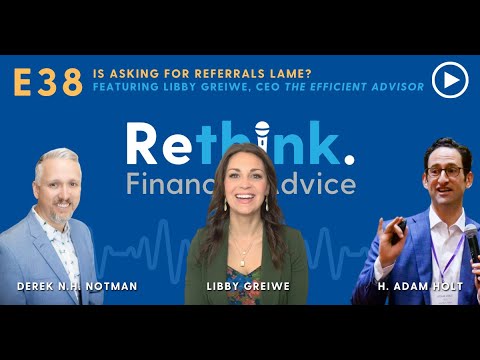
Watch and Listen
Episode Summary
Efficient Advisor founder Libby Greiwe joins H. Adam Holt and Derek Notman to challenge the standard referral-request playbook taught to nearly every new advisor. Greiwe explains how she built a seven-figure solo practice by focusing on authenticity and client experience rather than scripted referral asks. The conversation explores how advisors can create the conditions where referrals happen naturally, without ever feeling forced or lame.
What This Episode Covers
- Rethinking the traditional referral-ask script
- Building a practice that earns referrals without asking
- Identifying mentors and practices worth emulating
- Staying authentic instead of chasing industry trends
- Recognizing the limits of technology in advisor value
- Designing client experiences that generate organic word of mouth
Full Transcript
Full timestamped transcript.
[00:00:30] Derek N. H. Notman: Adam is asking for referrals. Lame.
[00:00:35] H. Adam Holt: Are you asking for a referral right now, Derek?
Well, it depends. Are you giving.
Is that your lead in for asking for referrals from your
[00:00:42] Derek N. H. Notman: clients? I'm that direct. I just ask 'em is this gonna be lame if I ask for a referral?
[00:00:48] H. Adam Holt: if I say yes, it makes me feel really awkward and uncomfortable for, me to give you a referral then. Is that your answer or are you looking as an innuendo to tell me? I you're expecting referrals from me.
Let's make this really uncomfortable. It's true. It is uncomfortable, isn't it?
[00:01:07] Derek N. H. Notman: It's so uncomfortable, man. I want to hear your answer, but I have some early days stories, man. I, oh, it was brutal. Tell me, tell me though, like, is it lame? Is asking for referrals from a prospect or client, is that lame?
[00:01:23] H. Adam Holt: I think it's challenging. At the least for most of us, because we feel uncomfortable asking. I think every financial advisor I've ever met went through some program in the early days of their experience, or even in late day coaching, that said they need to ask for referrals. They need a process, and then they need to explicitly ask, and I can't tell you, how many times I've had this conversation with financial advisors and they say, this year I'm gonna ask for referrals, and then they don't do it. What about you?
[00:02:03] Derek N. H. Notman: I was taught early on that that is just part of my sales process. Hmm. That I have to have 'em. So we were taught, , make, set two new appointments a day for some time in the future.
You know, go to your appointments, go through your stick, if you will. And part of that shtick, at least for me, was whether I got business or not, I was asking for referrals. And I let's face it, being a new advisor is really uncomfortable and going to someone's house, this, well, I don't do this anymore, but , going to some stranger's house at night, , and you're in your suit and tie and it's just weird.
And then now you're asking these strangers to introduce you to more strangers. , the whole thing felt really uncomfortable and weird for me, so I can only imagine how the people I was asking felt It must have been terrible.
[00:02:52] H. Adam Holt: It must be terrible. Although I, I have to say my own coach, when he asked me for referrals recently, I actually did it.
I followed through because I had great empathy for understanding what it was like to ever ask referrals. That when somebody asked me for referrals and I trusted them, I actually did go way , above and beyond, because the fact that they were willing enough to ask me showed such chutzpah, if we're gonna use Yiddish words here with schtick and chutzpah, I love it.
You're gonna throw them both in this podcast. I that I chutzpah basically means guts. And of course I trusted him and honored him, and I know how he was gonna be. So I, I was willing to do it. So, but I think it takes a mindset to accept that request when somebody actually asks for you to do something for me when it's clearly a one way service relationship, right?
If I'm your financial advisor, I'm the one delivering value for compensation, but now I'm asking for something back, and I think it does put people in a very strange. It does.
[00:03:57] Derek N. H. Notman: Well, we have a great guest today who shares, , a nice analogy for this and a couple other things that I think will really resonate with our audience.
I, and I'll tell you now as, as still as an advisor that has a practice, you do as well. Mm-hmm. , I don't ask for referrals. I don't, and I haven't in a long time. And it, it's nice, but I still get referrals. Strange. Right. , and , it's a high quality. And I remember, when I was early on, it was taught if you ask for referrals, you're tending to get the same type of people, , I don't know, what's an appropriate word for this, but maybe a financial level lower than the folks that you're talking to, if that makes sense.
Mm-hmm. . So it's really hard to go upmarket with referrals when you're asking, but it's really easy to go downmarket and then that has a whole bunch of other potential negative impact to your business. Anyway, I could go on and on,
[00:04:47] H. Adam Holt: but yeah. Well, we will, let's hear what Libby has to say because I think we'll, we'll get a chance to rethink this after we hear what she drops the mic
[00:04:54] Derek N. H. Notman: about.
[00:04:55] H. Adam Holt: . So Libby
[00:04:56] Derek N. H. Notman: Grawe is pretty cool. She has been in the industry for a while. She was at Thrivent, let's put it this way, for 16 years. Mm-hmm. , but she's been running this other business called the Efficient Advisor Coach, which is also a podcast, by the way.
You were actually just on it. So folks, make sure you check that out. So , she actually did something really interesting, is that as an advisor, she ended up building a seven figure single advisor practice working 25 hours a week. Amen. That's that's amazing right there.
So , if there's anything else you should, , that's gonna hook you in, you need to pay attention to that. I mean that, talk about an awesome lifestyle business. So accomplished, smart, dynamic, really fun to chat with, which you're gonna hear in a second here. She's got great thought leader. , married kids, has a bachelor's from Miami University, , has got a couple designations from the American College.
She's on a mission, I think, kind of like we are Adam to mm-hmm. push the industry forward. So , I'm excited to hear what she has to say today.
[00:06:00] H. Adam Holt: Absolutely. And she's really fun, so, so definitely listen to what she has to say. It's a lot of laughter in here and we hope you enjoy.
[00:06:07] Libbe Greiwe: I told you I grew up in the world where everybody was fat balled and 50, and this idea that if you wanted to make more money, you had to work more, you had to work harder.
And really stepping into that c e o role as opposed to just being an advisor that's running a business and really actually taking it and operating it like a business. And I'm really more of a coach for advisors. Not everybody wants to be a 10 million practice. Like some people just really wanna make a really good.
and not work like crazy. Um, so what I became known for was working 24 hours a week and grew a million dollar practice on just me as a solo advisor with a super small team. And I think if you can create solid systems and processes, you can scale a business without having to build this giant complex monstrosity.
[00:06:55] Derek N. H. Notman: That's really good, Derek. That's gonna, that's gonna hit home with you. Um, yeah, it totally resonates. That's right on my alley. I love, what was it, fat, bald, and 50 .
[00:07:04] Libbe Greiwe: I called him the fbs. Everybody around me was fat, bald, and 50 and white. Yeah. So when I got pregnant and it was like, okay, well where, who do I go to for, you know, advice on how to like really be a present mom, manage a maternity leave and still grow my practice?
It was like, Ooh, you should get a wife. Like that was. Oh, well I don't know where I'm gonna get one of those. Like I
[00:07:25] Derek N. H. Notman: am that crap. Oh my gosh,
[00:07:28] H. Adam Holt: that's perfect. I
[00:07:30] Derek N. H. Notman: love it. So, Libby, given your background, your experience, what you're doing today, what is your perspective on the financial advice market today?
[00:07:42] Libbe Greiwe: It's funny cuz it feels like the environment out there is everything is changing.
Well, everything was changing when I started in 2004 too. And I think the one constant that we tend to forget when there's fee compression, when there's robo advice, when there's all of this technology coming out that you really can't. Replace an advisor and I think now is just as good a time as any to be a financial planner because when it comes to, even with d I Y investing, when it comes to pulling the trigger for major life decisions, people are always gonna want to bounce that off of somebody.
With a certain level of expertise. So I think if advisors today can really switch from that idea of I am the sage that runs up to the mountaintop with all of your paperwork, and I come back down to bless you with some recommendations that I have been gifted with. To more of this idea of being a Sherpa and we're kind of being along for the journey together, and then I'm going to guide you, but you're also participating in this.
I think it's just as good a time as any, and I don't see that changing anytime in the near future. That's
[00:08:55] Derek N. H. Notman: it. An awesome analogy. I love the Sherpa analogy. My dad's actually been up in the Himalayas and had a Sherpa, and you have to participate. You have to be there. They're not there to do the work for you.
They're there to.
[00:09:07] Libbe Greiwe: Right. Right. Yeah. And I see so much fear, um, and the fears just change, right? Like it's funny cuz the market's down. Well that's happened before. Gas prices are high. Yep. That's happened to, Ooh, there's wars. Yeah. Yeah. We've been through that and advisors tend to see all of these things happening and it's like, oh my gosh, this is all new and different when it's really not.
And we overthink the advice world from a change perspective and we under think. The actual value that we bring to people, and that's not changing anytime soon.
[00:09:38] Derek N. H. Notman: That's really great. It's interesting
[00:09:39] H. Adam Holt: when you think about that perspective. We share a lot of that, Derek and I, and I know a lot of our audience does as well.
What do you think's missing? What? What's the missing opportunity that advisors are not paying attention, they can't see it coming? I
[00:09:50] Libbe Greiwe: think for me, I think the missing opportunity is. Everybody's wanting to streamline and go to fee only or be really kind of sucked into some of the nomenclature, so what I would call like the LinkedIn back and forth that's happening and that there's this idea that you have to be a fee only advisor or you have to be an a u M based advisor, or that there's one right way to do this business.
And I think that's incredibly shortsighted. There is and, and I tell this to advisors that I'm coaching all the time. There is literally somebody out there praying for you to do what you do in the exact way that you are doing it. and this idea that one size fits all and that there's a right way and a wrong way.
I think that's the opportunity that people are missing. So like I know for me, starting in a broker dealer world, that's how I got my feet wet. That's where I learned the, the skills. That's where I figured out who I was as an advisor and evolved from because I had a really firm foundation to start from.
And I see these advisors who have never delivered a piece of advice jumping into something that. I think is the appropriate thing for them because that's what they saw on LinkedIn. And I'm thinking like, oh my gosh, this approach that you're doing, we, we really need to, we need to modify it. And I go, but that's what so-and-so said.
And that's where the industry is going. And I think the opportunity is that you can do this in the way that feels authentic to you in a structure that works for you in a way that you're compensated and that works for you. And you can still be an extremely effective and efficient and enjoy your career, but you can be a great advisor.
without having to buy into this idea that there is a right way and a wrong way. Further down
[00:11:35] Derek N. H. Notman: that vein, Libby, our listeners can be anywhere from one month in at an insurance broker dealer to veterans living around decades, right? Mm-hmm. , what action steps would you say maybe to the younger generation trying to figure out, is this insurance bd right?
Or do I have to go fee only? Cuz that's what they said on LinkedIn? Or maybe for veteran advisors that's thinking maybe of transitioning it to independence. , are there any top two or three things that you would say, here's some action steps to think about before you jump in and just drink the Kool-Aid, so to speak,
[00:12:05] Libbe Greiwe: Yeah. I think for me, I'm a big believer in not keeping your blinders on where your head down, oh, the approach that I have is the one and only the right approach, but also not getting so sucked in that you're looking at 4,672 different options because you'll never actually do anything. So for me, the action step would be looking for advisors whose practice and lifestyle that I admire and I would want to grow into, and really determining the authenticity of it.
So I see all kinds of advisors online, right? And then you look at their, their A D V and you're like, , oh, this is, okay. So you're more of a like do as I say, not as I do kind of a guy or you know, or whatever. So for me it's asking for advice or interviewing or really researching from someone who is actually experiencing what you would aspire to experience with that a, that old adage of asking the guy in the cubicle next to you, what would he do with his 401k when he is schlepping away at the same job that you are?
Right. So looking. Those people who'd be willing to mentor you and really answer you authentically about, yeah, this works, this is really hard. Here's the things that I love. Here's the things that I don't love. And not necessarily just assuming there's a right way, a wrong way. And really I, so for action step, it would, for me, it would really boil down into identifying mentors that are doing what I'd wanna be doing and really, Understanding, interviewing, taking the time.
Go sponge, go observe. Go ask if you can. Just follow them around for a couple of days. Invest in it before you just make that call and see like, are they actually living out what I'd want to be living out now?
[00:13:52] Derek N. H. Notman: I wish I would've had that advice about 16, 17 years ago. It took me a while to
[00:13:58] Libbe Greiwe: figure that out,
Well, one of the things I did when I very first started my practice is I actually went and interviewed as a client at, I don't know, maybe 25 different financial advisors in town. Totally wasted their time and I do feel a little bit bad about that, but it was a great experience because I got to observe their start to finish prospecting experience and it was so incredibly helpful for me cuz it.
Not only did I understand like, oh wow, this, that actually, I loved the language. I love the way that that felt. I loved, you know, how they followed up. I loved, I learned a lot of what I absolutely despised and hated too, and Wow. That made me feel really icky. And that came across kind of salesy and like, Ooh, I'm never gonna wear polyester pants and slick my hair back.
You know? Or like just even experiencing the office and what was the client experience like? So putting. In that environment and really saying, okay, how would I wanna operate my business based on these experiences? So parlaying that to, to the question of going and actually experiencing what these advisors are doing.
And I'm not saying hide who you are and just go experience it, but you could totally do that. .
[00:15:02] Derek N. H. Notman: Love that. That was hilarious. Oh my gosh. So
[00:15:07] H. Adam Holt: come on. Doing your due diligence, huh? Yeah. I'm afraid to ask you this because I'm afraid of what you might tell me, . I just hope that it's awesome. So, What do you think needs to be heard by the community?
Everybody's got like something we think is an opportunity, but also something that needs to be heard. And sometimes we don't hear it enough. What do you think it is?
[00:15:26] Libbe Greiwe: Okay. And so I feel like I'm allowed to say this because I ran a referral only practice, but I think advisors should stop asking for referrals.
and the reason nobody asks for referrals or you know, the reason we always are like, oh, every advisor on their to-do list are goals for 2023. I'm gonna ask for referrals this year. No, you're not, because it sucks. Terrible. Nobody wants terrible to do it. Terrible. It's terrible. It feels awful because it is.
And if it feels weird. That means it is weird. If you think it feels bad for you, imagine what it feels like on the other end.
[00:15:58] Derek N. H. Notman: It's gotta be so uncomfortable. That's like a mic drop moment if you're listening. Elaborate a little bit, please. Here, Libby tell people why you think this.
[00:16:07] Libbe Greiwe: Sure. Well, I think we spend so much time as CEOs of our practice, building this client experience and putting the client at the center of what we're doing. And every advisor that you ask is, oh, I wanna serve. I wanna take care of my clients. And so we do what they've asked us to do. They pay us to create these plans like we're helping them, right? Every advisor, I wanna help people.
And then we get to the end of this process and then we're like, Hey, enough about you. Let's talk about what you can do for. and it just takes all of this energy that you and your team have put into building this client experience into building this killer financial planning process, and it turns it on its head and people immediately get that, that cringe.
Like, well, and, and I think about it like this. Like if I went to the dentist and I'll tell you what we should do instead. Right? Because obviously we ran a referral, we practice, we obviously had a referral. And it did not include asking for them, but imagine if like you went to the dentist and at the end of your cleaning you're sitting there with that cute little paper apron on and you've got your like little clean toothbrush that you're only gonna use when you travel.
And the little baby toothpaste and, and then the dentist starts saying, well, who else? Let's brainstorm for a moment about who else you might know that could use a good teeth clean. And just, you're just sitting there thinking, well, no, I came to you to clean my teeth and you did a fabulous job, right? I walked in the door.
The place was super clean. They got my insurance information while I was sitting in the waiting room, so that was efficient. The staff was super pleasant. They brought me back. The lady cleaning my teeth was wonderful. She chatted with me, but not too much since I can't move my mouth, they did this really beautiful process.
and that alone should be enough, right? The absolute best form of marketing is to do a killer job at being a financial planner, and then of course, creating an environment that is conducive to getting lots of referrals. But there's just something about, for me, that takes like, okay, we've worked so hard on creating this culture, this experience for.
and now we're gonna make it about us and about what you can do for us. And every advisor says, I wanna help people. I wanna serve people and to ask, then people to help us and serve us kind of starts to slowly chip away at all of that effort that we built into making a client-centered practice. And so, of course then the next question is, well, what do you do instead?
So for me, Building out a client experience that's so good that you become an indispensable advisor. And when you are an indispensable advisor, people will share that experience with others and having a referral mindset and culture. So we use the word referral a lot. But it's more in, so we tried to weave it into every appointment at least three times.
So if I'm referring to another client, I'd say, oh, we had this client that was referred to our office. He's really amazing. He restores classic cars on the side, blah, blah, blah, blah, blah. I'm sharing a story about that and. or you know, on our voicemail if it was a new prospect, you know, Hey, if you're new, please let us know who referred you so we can, thank you.
We just tried to use the word referral, but instead of asking for it, we created an opportunity. So we would do what we called white glove referral events. I, um, I'm not against appreciation events, but I have an idea that's way better. That really is just creating an environment that allow. Your clients to bring you ideal clients and in a way that's not sleazy, that's not salesy, it's an opportunity for them to introduce you to somebody versus this old.
Like who do you know the way I was raised right was we brainstorm at the end of the very first meeting where I have added zero value to your life and you're gonna tell me about who's in your book club. and then I'm gonna ask you to call the ladies in your book club to see if they'd like to meet with me.
And if they would, then you can call me and then I'll call them. And if they don't wanna meet with me, can you call me and let me, it, it just seems like a lot of work for your client when they're the ones who are supposed to be enjoying the fruits of your labor, not the other way around. So what if we create a better opportunity for them to introduce you because.
Immense value that you have created for them as clients. So we have to have a niche, we have to have a referral system. We have to be able to articulate to our clients who we work with, so we're not getting bad referrals, right? We've all had that experience where a client's like, oh my gosh, I wanna introduce you to somebody.
My daughter just graduated from college and she's gonna be a social worker, and I would love for her to get with you and just get started off on the right. Well, if you've asked for the referral and you haven't been really clear about what you do, who you work with and how you do it, and if you have any minimums or price points or whatever, you can't say no cuz now you're a jerk.
Mm-hmm. . So having a specific referral process or a referral system within your office and being very clear about who you work with so that you're only getting ideal referrals. And I obviously think doing that three introductions is gonna be the absolute best way.
[00:21:20] H. Adam Holt: So there you. What do you think about, what do you think about referrals now?
[00:21:25] Derek N. H. Notman: Well, after listening to that, I would say that referrals aren't lame. Asking for referrals is lame. Ooh. The way that she just lined out what they did and how they built their referral process, obviously she crushed it. I mean, building a seven figure practice, working part-time by herself with some support.
Hmm. Dang .
[00:21:49] H. Adam Holt: Yeah. I have a story. I realized when I was listening to that, oh God. I'm gonna share, I'm gonna share my own story when people ask me, what was your tipping point moment? I was about to fail out of the business. I was two or three years in, I think at the time I was in the business of financial advice.
I wanted to work with business owners cause I figured that's where the money was. I was young, I was a C F P, but I really didn't have any market and I , didn't have the network. And so I went to the last place I know where I could get some business. I called a family friend and I said, listen, we have lunch with me.
And I had lunch with them. And I remember we went to go to sushi restaurant, which I could barely afford. And I, and I literally asked for help. Instead of asking for referrals, I said, I need your, What do you need, Adam? I need to talk to business owners to talk about this great new idea I have, and I want to, you know, blah, blah, blah, blah.
And she thought highly enough of me, she took the napkin and a pen, and she wrote four names on there. Call these people. They're business owners. They know me. They'll take a meeting with you. Fantastic. Call them all. Wound up meeting with one. Long story short, I wound up not actually doing business with any of them, but one of them I really invested in.
I gave so much value like Libby's talking about. I gave them financial planning. I did so much guidance for them, even though in this case her own sister and her best friend were her financial advisors, two financial advisors. No one had ever done a financial plan for her, and I said, listen, you know what?
I'm happy to do a financial plan for you. You've been really kind. I'm happy to take the practice. I'm gonna do a financial plan for you for free. I did it, and I uncovered a major gap that her friend and sister missed, and I wound up getting that business. When it came time for me to ask her for referrals, Derek, I fell into this trap that Libby just brought up, which was.
I really figured if I could work with this super business owner who really loved me now and really appreciated me, I had great momentum. I would earn a significant number of referrals. She knew everybody. When I asked her for referrals, she gave me one. She gave me her masseuse, and she didn't give me the referral that I was expecting and hoping I would build my whole business on.
She gave me the referral of the masseuse. Of course, I took care of the masseuse as as best I could. I gave her the service of a business. And I thought my business was about to end except she gave me referrals unsolicited. She referred me to her father, and her father had a significant net worth, and I wound up actually building my entire year on those three people and all the referrals that I got naturally from them without asking again.
So the irony behind it is that I did ask for help and referrals in the very beginning. That got me this, that be got me, that, that be got me this and surprise. And I learned this lesson that Libby just said in that entire chain. But it was essential because that was the moment where I was recognized as one of the top producers in the year.
And it was how I got introduced to my mentors who wound up catapulting my business 10 years. How about that? I, uh,
[00:24:51] Derek N. H. Notman: I'm not even gonna say anything . That's amazing. That's a brilliant story. I, I appreciate you sharing. There's a lot of wisdom in there.
[00:25:00] H. Adam Holt: Well, it's only cuz Libby reminded me. I, I was, you know, I didn't really think about it from my own lens perspective, but I have personally run into this experience of knowing, I quote unquote, , should ask for referrals.
Right? It makes sense In my business, entrepreneurialship mindset, I, it makes more sense to grow via referrals. But number one, I'm worried who they're gonna give me. Number two, they're not prepared for this. Or if I prepare to list in advance, I look like a total salesperson. And I didn't wanna look that way.
Like I'm strategizing how they're gonna help me grow by business just because I gave them some investment or insurance advice. Right. So it was never clean. It was always awkward as like she said, it was kind of creepy.
[00:25:41] Derek N. H. Notman: Do you feel awkward asking for help from that first person with the cocktail napkin?
Did that feel awkward asking for help? It did,
[00:25:49] H. Adam Holt: but it was also a desperation. What? And it was a make or break moment. I had you, you know what you do when you're in the make or break moment? You do those hard stuff.
[00:25:56] Derek N. H. Notman: Yeah. Oh yeah. You, it reminds me of, uh, of being an entrepreneur. There's a saying out there if, if you need money for your company, like if you're trying to raise money, ask for.
Yeah. You know, and, and, uh, if you need help, ask for money.
[00:26:14] H. Adam Holt: you don't ask for referrals. You don't ask for referrals. So I, I, you know, somebody who could help me . Yeah. Right.
[00:26:19] Derek N. H. Notman: I, I could see some similarities there by what I'm hearing between what you just shared and what Libby has shared. Don't ask for referrals. , create an environment that will let those referrals flow through amazing service, experience and so forth.
But don't be afraid to ask for help. , and I, I've seen that , even myself. Like I, I have gone in the past back to my top clients who I had more of almost a friendly relationship with and just said, listen, this is what I'm trying to do. Just like you share, I don't have a great story to share, so I'm gonna try to hack through one, but it's the same idea.
That's what I'm hearing. Do you have any other like specific takeaways?
[00:27:04] H. Adam Holt: Well, I have a bunch, but I, I think just to tack on top of what you're saying, I heard create a referable experience, , create something that somebody would want to unsolicited, give you a referral around if feel good about it.
Just fan, fantastic experience, relationship. I built camaraderie. It's funny because I think back to episode 36. , rich Campy talked about creating an ideal. And only working with ideal clients that way. That way when you get referrals, like you said, that's only gonna, you're getting referrals to the same people like them, right?
You're not getting this potentially, oh, oh, my, my, my daughter's about to graduate college. Can you please help her? Of course we're gonna help her because she's part of your family and you're part of our family, and of course I'm gonna take care of them. That doesn't mean I'm looking forward to, to, to taking on that.
We'll call it the, the weight of that. I'm, I'm gonna roll it into your household as basically part of working with your household. Exactly. Yeah, that's fine. But if I'm actually looking for business development, I have to be specific. And of course I have to create, uh, the mindset of somebody who's an ideal client.
[00:28:04] Derek N. H. Notman: Well, why do people go back to their favorite restaurant? Why do people go to a certain dentist as Libby suggests over another? It's an experience.
[00:28:13] H. Adam Holt: Actually, actually it's more than that, right? It's actually an outstanding experience. Outstanding. Cause it's memorable. And
[00:28:20] Derek N. H. Notman: then you tell everybody, and we don't tell everybody, but you tell a couple people and those people tell people.
And if someone asks you, Hey, anniversary's coming up, where should I take, , my significant other to celebrate, oh well this restaurant here is. Let me tell you, you gotta get this, you gotta do that. You know, go get this specific table, you know, blah, blah, blah, blah, blah. Absolutely. Um, so go to loyalty.
Yeah. Yeah. Were there any other, uh, quick tidbits you wanna throw out there
[00:28:47] H. Adam Holt: Uh, yeah, I thought there were some really funny moments in there that are really good takeaways.
I think , the comment about. Being told that you need to get a wife, I think is really endemic of unfortunately, , a business that has stayed predominantly, , white male. , and that's , what she brought up. I think that was, that's interesting. We obviously are seeing a change to that. But I think it's, it's endemic of what all of us experienced in the early days of our business, and I think , it's really, it's an important aspect for all of us to recognize , and pay respects to because the industry is, has so much further to go.
So I, I did pick that up. I also liked the fact that she said become indispensable, which I think we did say, , is really important. How do you become more important than Google as. , AI and chat and the way to get answers to all your financial services questions, even contextually to you, is gonna really go digital.
How do you make sure that the clients are calling you, , and know that they're gonna refer you instead of saying, Hey, , just search this on Google. You'll find out, um, I thought it was funny. She said something about the cubicle next to you. And that's where most people get their advice, because we've always joked that probably the most important financial advisor for 401ks has been the person in the cubicle next to you, Hey, where'd you put your 401k?
What allocation? Don't forget, don't forget the water cooler. Come on now that. Hey, by the way, did you choose this fund or that fund? ?
[00:30:01] Derek N. H. Notman: Well, they fund you. Used it,
[00:30:03] H. Adam Holt: targets it, right? Uh, right. The same thing happens with all the insurances that people elect through work, and I think I, there was so many that she said about this, instead of actually asking for referrals, I realized that I do this too.
I dropped this innuendo bomb, by the way. So when I would go to networking events, Derek, I would never really talk about my practice. I would never really say what I do, but I would just say, you know, one of my clients, Does this. And I just had this conversation with one of my clients that had this similarity and they were like, oh, really?
What do you do? And that's how I would open up in network. So much better. So much better. Yeah. And if they didn't take the hook, they didn't take the hook. But it's it, I tried to make it as natural. What she said is, what you do in your voicemail is say, well, If you're a referral press number five, right?
If you're right. So you're already establishing the fact that you're looking for referrals without asking for it. So you give people a graceful exit without them feeling, you know, definitely stuck in a corner
[00:31:00] Derek N. H. Notman: for some real tactics on that. By the way, that could be in your website, it could be voicemail, as she said.
It could be in an email signature. Yeah, it could be an annual review type thing. There's all sorts of ways you can embed this into your processes.
[00:31:12] H. Adam Holt: Interesting. Interesting boy. What if you actually had a special site or tab only for referrals and you were a special category because technically your marketing cost is less, so you can afford to spend more money on that customer.
Can you actually treat a concierge client like you only take five concierge clients a year and. They only come in via referral. How do you become a concierge? Well, you gotta get referred to me,
[00:31:38] Derek N. H. Notman: so Totally. Well, that's what I put on my website, uh, for my r i a just a couple months ago, I said, I'm no longer taking hmm.
Clients unless you are a direct referral from an existing client.
[00:31:49] H. Adam Holt: There you go.
[00:31:50] Derek N. H. Notman: And I've even had clients comment on it. So it does work. Um, it's good. Anyways, what about you?
[00:31:56] H. Adam Holt: What do you got from this?
[00:31:58] Derek N. H. Notman: Well, I, I liked what she said about how advisors tend to undervalue the value that we bring our clients and we tend to overvalue things like technology.
Now, don't get me wrong, I love tech. I'm building a tech company for crying. I love tech, but I think she has a really good point there that we do , bring a tremendous amount of value. So don't undervalue that cuz then you will undervalue yourself and. that's counterintuitive to actually building a, an experience and environment where referrals will flow.
So value what you do. That's what I'm saying. , I like what you said, but just be, you don't jump into the hole, whether it's fee only or this or that type of thing. Cuz you saw a LinkedIn post or a tweet mm-hmm. that that's what they call 'em. They call 'em tweets, right? I think so. Or is it
[00:32:48] H. Adam Holt: a Twitter? I don't, I don't know if you're a tweet.
If you tweet. Are you a tweet ?
[00:32:52] Derek N. H. Notman: Well, I don't know. Sure. Fin
[00:32:56] H. Adam Holt: Twit, , maybe . I don't even know what that means anymore, but
[00:33:00] Derek N. H. Notman: it's alright. But she said just be you and, and that there are enough people out there and maybe you can't make this as a complete blanket statement. Pretty, pretty close. Is there enough people out there that will wanna work with your vibe?
Mm-hmm. . So just use your vibe and attract the tribe. That's all you gotta do. That's a cool. Yeah, I've heard that from someone else. I'm, I, I'm stealing it, so it's, I was gonna give you credit. No, don't gimme credit. Give somebody else credit. Okay. Somebody else. Good job. You can gimme a pat in the back.
That's fine. A virtual pat in the back. and I liked, so this was funny cuz she used this. So she went and interviewed what, five different advisors pretending to be a potential 25 , but 25 is, that's why I left . I mean that's amazing. That's like that talk about dedication and due diligence. This is remarkable.
But she learned a ton that way. Now I don't know if every advisor's gonna do that, but the takeaway I'm taking on that is go find the advisors that are working like you wanna work. , are they actually successful? Def Definitely fact. Check, check their A D V out, you know? Mm-hmm. , what are they actually doing?
Do some research, but I really like that. And go find them. I would say including us, Adam and most advisors in this space are pretty open. Mm-hmm. and wanna mentor. It's, you know, you know, as long as it's within capacity of course, but wanna mentor and help drive things forward. So I, that really resonated with me as well.
But tho those are my big.
[00:34:20] H. Adam Holt: Very cool. Very cool. Well, with that in mind, I am. I am. Very cool. I
[00:34:24] Derek N. H. Notman: know I am. You don't have to keep going. I've
[00:34:26] H. Adam Holt: heard that. I've heard that . Well, let's go to our thank you Libby, for doing that. That was fun for us. We laughed a lot on and off camera. That was really, uh, it was a great event's.
Great. It was great. So definitely check out, , Libby, what she's doing there for coaching advisors. Really some fun stuff. Stuff's just got great content out there. , let's go to our community question. Derek. What do we have come in from LinkedIn and. So
[00:34:46] Derek N. H. Notman: this is Mitch in Michigan. Mitch didn't specify where in Michigan, but that's okay.
Mitch, we'll, we'll take your question anyways. , I like it and I have a story to sh to try to answer this. Okay. So Mitch asks, , how do I justify my pricing? Okay. I think a lot of advisors and consumers are really price c. What fees am I paying? Blah, blah, blah. , am I really valuable enough to charge , 400 basis points I'm charging?
No, I'm just kidding. 400
[00:35:17] H. Adam Holt: basis don't charge. 400 basis. That'll be a
[00:35:20] Derek N. H. Notman: right on cash, right? That will, that's won't work. That's not gonna work. My friends. , but it, it is a good question. How are you gonna justify that? So here's an example. So , my brother-in-law and his family were just visiting. He's, he owns his own contracting company.
and we were talking to some local realtors and he is asking, well, what do you guys pay, handyman, contract, , to come in and get a house ready for sale? I'm like, oh, 30, 40 bucks an hour. And he just started laughing and just rolled his eyes. He's like, you're kidding, right? , no. And he is like, well, we charge at least a hundred bucks an hour.
And he's, he's got more business than he knows what to do with. And then the rest of the week he like, there kept to being examples. , Hey, Look at this trim work here. Hey Derek, look at this Sheetrock, look at this, how they did the electrical here, look at the flooring, et cetera, et cetera, et cetera.
And he's like, here's 30 or $40 hour at work. Here's a hundred dollars an hour work. Here's the difference. So Mitch, to your question is I think you justify your pricing by having a really awesome, outputs, really great value that you're actually bringing to your client. Cuz there is a difference. Let's.
Depending on the advisor administrating advice or products, their experience, their knowledge, and so forth, and just being able to articulate that.
[00:36:37] H. Adam Holt: Yeah, that's the problem.
[00:36:38] Derek N. H. Notman: That's it. My brother in, I say he is like, listen, I have a ton of experience. I'm extremely detail oriented. I have every tool known to man, I can do this job better and faster than you won't have someone else to come in and fix it after me.
You know, that kind of stuff. So when you can articulate in ways like that, I think that's how you justify a higher price. I know I'm willing to pay more to get a higher quality thing. I don't want someone coming back three times because they can't get the job done. Right. Well, so you That's how, that's how I answer that question.
Well,
[00:37:05] H. Adam Holt: okay. So then your answer was basically, find ways to articulate the value that differentiates you versus let's say, a lower price point. Because we do know that more than ever, especially with inflation rearing where we are. And we think, there's stuff looming on the horizon.
We don't know , what it's gonna be, that people are gonna become more price conscientious. And I think the challenge that Mitch is bringing up is how do you actually articulate that you're worth X rate or this hourly rate? And I think it's challenging because a lot of consumers don't know how to value advice in the, we'll call it the last decade that's really moved towards a u m fees because everybody was charging the same amount.
It almost felt like, well listen, that's the price of admission, right? Doctors cost this. You don't really see the fee cuz the insurance company pays it. You pay your copay and you're like, okay, it is what it is. I'm sick. Right? So I, for the most part, most professionals feel like they're the same cost.
So I think it's a, it's gonna be an interesting challenge, Derek, of helping to communicate what that real fee to value is. Because if there's no clear benefit, I think a lot of clients are gonna really balk. They
[00:38:16] Derek N. H. Notman: are, but I, I think there are ways, for example, rates of return. What's the net return? Okay.
Right. So maybe a client is saying like, listen, I can go to this robo-advisor and, and pay half or a quarter of what you're gonna charge me. Mm-hmm. . Okay. Yeah. Yes you can Mr. And Mrs. Client, no problem. You can do that. But are they gonna do all these other things? And what if the output of the work we do together, Earns you an extra one, two, 3% a year potentially.
And there's actually, the Vanguard did a study on this. We've had, Crosby has been on here and talked about this. So there's actual data around this to support the value of actual advice in working with an advisor. Net fees. So you could even use one of those reports. Yeah, and I, and a matter of fact, I just brought in a ton of a u m last month.
And he was challenging me and saying, well, maybe I'll just keep it over here. I'm gonna talk to this other advisor and said, listen, here are the reasons you should work with me. And I included a link to that Vanguard study. Really? Yep. And I ended up getting every single penny. We
[00:39:22] H. Adam Holt: should put that Vanguard study
[00:39:23] Derek N. H. Notman: in the show notes.
That's a good one. Yeah, it's a couple years old, but it's still relevant. Uh, it's only like two years old or
[00:39:28] H. Adam Holt: something like that. Well, but it indicated that there was actually alpha associated with having an advisor versus not.
[00:39:33] Derek N. H. Notman: No question. And Morningstar did one on this even longer ago. Same thing.
Mm-hmm. , I think they called it beta, but uh, or no, gamma. Gamma. They called it Gamma Gamma. They call
[00:39:41] H. Adam Holt: it gamma. If you call anything a strange Greek letter, it sounds professional. That's Oh, it,
[00:39:46] Derek N. H. Notman: yeah. It's, it's legit man. It's totally
[00:39:48] H. Adam Holt: legit. Yeah. . So if you have a gamma ray, that means you could just increase your value
That's why we were all trying to create the gamma gamma
[00:39:55] Derek N. H. Notman: ray investments. LL Steve.
[00:39:56] H. Adam Holt: That's right. gamma ray. Isn't that what, what didn't wait. That's right. The Hulk got hit with gamma rays. That's why he was so large. That's right. The, the green man, that's what you could, you could just change the topic, turn it into something, s heroish, and then you sound like you know what you're talking about.
Gamma Beta, alpha Sign here. Please sign here. That's right. Yep. That's right. 400 basis mornings, . Very good. Awesome. Well, that takes about us to the time we have for our podcast. Yeah. So thank you so much to Derek, to Libby for, and for of course you listening and participating. Derek, what do people have to do from here?
Well, thanks
[00:40:27] Derek N. H. Notman: everybody, obviously. Definitely. Please follow, , or subscribe to the podcast. We're on all the big ones, all the players. Follow us on LinkedIn. We're there, we're active. We want to hear from you.
Let us know what's going on. What is something you want to hear? Is there a burning question? Is there a topic you wanna know more about? Let us know. Tell us. I think that's it, right? Is that, is there anything else I'm supposed to ask? Like, no, I don't know. I wanna know like maybe favorite pizza joint.
I know my favorite
[00:40:54] H. Adam Holt: pizza joint. I want to hear what that is. Do it on LinkedIn. Well, I'm gonna
[00:40:58] Derek N. H. Notman: tell you right now, what is it? Delmar Pizza up in, , Delmar, , California, San Diego in
[00:41:05] H. Adam Holt: Delmar. No kidding. Best pizza I've ever had, man. Delmar Pizza. Okay, so, here's what we're doing. We're actually giving unsolicited referrals right now.
We sure are, but my favorite pizza place is Badilla in Philadelphia. And I've never been, I'm gonna have to go there so often. We literally buy coupons for the entire year in advance. That's how much we,
wow.
[00:41:24] Derek N. H. Notman: You know what, I think I actually talked to you on the phone one day while you were there picking up pizza.
[00:41:29] H. Adam Holt: I, that's probably likely at least once every two weeks. I'm only allowed to get it every two weeks.
[00:41:35] Derek N. H. Notman: I know. It tastes so, it's so bad. But it's so good. So
[00:41:37] H. Adam Holt: amazing. Anyway, Derek is always a pleasure spending time with you.
[00:41:42] Derek N. H. Notman: Cheers buddy. And all the best everyone out there. Go get some pizza.
[00:41:45] H. Adam Holt: Yes.
The content has been made available to you by Asset-Map for informational and educational purposes only.