
Ep34 - Rethink: The Secret to Financial Advisor and CPA Collaboration – Featuring Paul Saganey
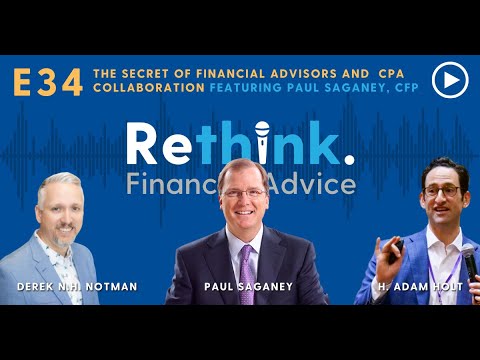
Watch and Listen
Episode Summary
H. Adam Holt and Derek Notman sit down with Integrated Partners founder and president Paul Saganey to demystify one of the industry's most sought-after but hardest-to-build relationships: the advisor-CPA alliance. Saganey shares what separates alliances that generate real client value from ones that never get off the ground. The episode offers a practical framework for advisors looking to build lasting collaborative partnerships with accounting professionals.
What This Episode Covers
- Why advisor-CPA alliances are so hard to build
- Establishing trust across two different professions
- Structuring fair, sustainable referral arrangements
- Expanding services for high-net-worth, shared clients
- Overcoming turf concerns between advisors and CPAs
- Keys to a long-lasting collaborative practice model
Full Transcript
Full timestamped transcript.
[00:00:29] Paul Saganey: Adam,
[00:00:31] Derek N. H. Notman: what is the secret for financial advisors to collaborate with CPAs?
[00:00:38] H. Adam Holt: You mean, you mean you don't know?
[00:00:41] Derek N. H. Notman: Well, I, no, I don't .
[00:00:43] H. Adam Holt: I don't know that most of us actually know.
It's something I was on the quest.
[00:00:47] Derek N. H. Notman: A quest. I was, I was on a quest for years to figure out. I, I never did. Um, is this
[00:00:52] H. Adam Holt: like a Dungeons and Dragons adventure or something, or like. Zelda, is that what you meant? You know what,
[00:00:57] Derek N. H. Notman: Zelda Oh my gosh. So I did
[00:00:59] H. Adam Holt: play Dungeons
[00:01:00] Derek N. H. Notman: and DM D. Right. I was, you know, I played that a little bit as, as a dorky kid, but Zelda, man, that's
[00:01:05] H. Adam Holt: my jam.
Um, Dungeons and Dragons, although not the topic of this podcast, , since you brought it up, something. Even my child is playing and I was able to Unc Earth the books of the Dungeon Dragons Guide and the, and the Dungeon Master Guide. How cool is that? Huh? Right. He was very, very happy.
[00:01:24] Derek N. H. Notman: It's um, man, those are some really nerdy days, but that's okay.
[00:01:29] H. Adam Holt: Boy, you know what? That could actually be an interesting segue for how a financial advisor, typically a strong relationship advisor, maybe an investment manager, maybe insurance, maybe planning, works with the Dungeon Master of the Client's adventure, . Or maybe financial advisors are like fighter class and CPAs are like magic users and they just speak different languages. But if they collaborate, they can actually build a pretty good adventure team together. Oh, they so
[00:02:02] Derek N. H. Notman: can, oh my gosh. This is bringing you back
[00:02:04] H. Adam Holt: memories. Is this possible that we just came up with this on the fly?
[00:02:08] Derek N. H. Notman: I think we just did. That's the beauty of these things, but it's so true. So anyone that's listening, you have to stop right now. Pause. Go buy Dungeon Master book and then come back and listen to the rest of this.
[00:02:20] H. Adam Holt: Okay. No, really important. I think so. I think, , that means that, The lawyer on the team is gonna be either the cleric or the thief.
, uh, either saves you from dying and spells or steals everything. I don't. We'll leave it there. How about that? We'll leave it there. I think you get the
[00:02:36] Derek N. H. Notman: idea. So there is some secret
[00:02:38] H. Adam Holt: sauce here. That's the only
[00:02:40] Derek N. H. Notman: secret I have. I think it's a good one. But I, in all seriousness, like I think, and I'd love for you to elaborate on this, I think that working with CPAs, Has been I don't know, like, well, this, this quest, right?
, it was something that was really supposed to help us grow a business, uh, at scale with great clients and all of this stuff. I know I tried it when I was a younger advisor and failed miserably at it. So I don't know. What do you
[00:03:07] H. Adam Holt: think? Yeah. Well, we did this in our practice. We did engage, we had a trusted advisor program, which has become again popular.
In this space, and the intent was to, uh, accept the fact that CPAs had often the most trusted relationships with clients. Usually business owners, uh, high net worth families tend to rely heavily on their tax teams because it's , the biggest cost of doing business. And so reducing it makes all the sense in the world.
And so the tax advisor typically and or auditor or compliance, or maybe even controller or cfo, Tended to have a CPA background and also tended to wield a significant amount of influence over decisions made. But the challenge we always saw is that the. The strongest person in the room, the CPA and relationship side was almost always relegated to the deadlines of the tax filing of when they interacted with their client.
And so in the last minute, it's a scramble to meet the la the, the filing extensions with K one s that are never on time in 10 90 nines. And so our highest net worth clients tended to really underutilize the capacity of the. Tax professional because it was always this scramble for a moment and then it's like, don't bother me for months.
And I think what happened is the accountants really kind of, that I knew didn't get an opportunity to come back and engage the clients. So the financial advisor was running almost a different theme. Investment advice, insurance, financial planning, where. The accountant was initially brought into the picture, and so I think we all saw an opportunity, a synergy to merge those two roles or bring them together to the table, but it didn't materialize really well.
Why do you think it didn't materialize?
[00:04:54] Derek N. H. Notman: You know, I, I think we can speculate a lot on this. I think they're, CPAs are very protective of their clients. Mm-hmm. , rightfully so just as we are. Uh, but I think maybe even more so than advisors are. If they're gonna refer out, they are, they're, it's almost like a lack of trust.
Like what advisor can I actually trust to refer this amazing client of mine to, that's going to be an extension of me and, and my value add instead of compete with me or mess things up, or I have to go fix things now. Oh yeah. All that kind of stuff. And I, I, I think CPAs really do value the work we do, but they don't know how to make that jump to bring the advisor in or, or the advisor doesn't know how to help them make that jump.
Maybe that's, yeah, that's a great point. But I'm speculating a little bit here. I, I think that we, we, we need to, well, well, tell us about who we're talking about. So, talking with today. Cause I think that's what's really. Well,
[00:05:56] H. Adam Holt: Derek, we had the opportunity, as you recall, several months ago to interview Paul Saee from Integrated Partners.
He's a president and founder and in addition to being a cfp, he's been in practice like us for 25 some years, and what's really unique about what he's doing and what the team at Integrated is doing is that they work with over 160 advisors. Deem themselves entrepreneurs and work with CPA firms nationally.
So they've built a process for this, for things that for many of us in the field have dabbled in. Right? We've tried to work with CPAs, well they built an entire CPA Alliance program and it's really becomes quite a thing. In fact, they've gotten a significant number of words recently. I dunno if you saw, but, uh, recently.
They won some awards as one of the fastest growing organic RIAs. Mm-hmm. . And so it was a great opportunity to talk to Paul and pick his brain about what's working and how we as advisors can learn from their successes and so forth. And for those that that notice, we're gonna mention this. He, he's a big Cleveland's Browns fan because he's got family that works there, although he's in Boston, so he's got this dichotomy.
So we asked him what is the secret for financial advisors to collaborate? So let's see what he
said. Derek,
[00:07:06] Paul Saganey: you know, spikey, for 25 years, we've seen entire companies come and go from the CPA marketplace and.
And certainly individual advisors, but there's a process to it. And, and if you follow the process, and fortunately for us, we made all of our mistakes early on. Cause you've gotta get to those clients that are 10, 20, 50, a hundred times wealthier than your average client because. Most, let's say an average advisor works with say, one to 5 million of assets.
Most advisors I meet, they don't have problems meeting other people like that. Like they can meet clients that are kind of fall inside of that net worth or liquid net worth, perimeters, but, but getting to that much higher type of net worth client and doing it on a favorable basis. Um, for me, uh, Derek, I had the great fortune to work with a company through the early nineties called Signa Financial Advisors.
Our business model was to go in and do estate planning and business owner planning for the fas at places like Morgan Stanley, Smith, Barney, Dean Weber, and so early on I just recognized that if I was introduced to a client like that from a very good source, then boy I was already halfway down the field in terms of, you know, making an impact in their lives.
And so, so for me, what we did for so long, which was do the estate planning, which involved some kind of a life insurance implementation. Charge a fee for planning services. Now remember, this is the early nineties, late eighties when the idea of doing fee-based planning was at its infant stages. That's what we were doing, and we were charging very large fees.
Now, we could take that exact same model that worked so well in the warehouse community, plug it into an accounting firm, but now we were managing the wealth so we could manage the wealth, do the fee-based planning, do all estate planning and business owner consulting work, and keep all the revenue internally.
[00:08:48] H. Adam Holt: What's the missing opportunity that advisors are just not addressing, or perhaps they're not seeing?
[00:08:53] Paul Saganey: I always talk to advisors who wanna join us. I'll ask the question, what's your plans for the future? Give me the vision you're building for your practice. And many times they wanna buy another advisor's practice or they wanna just kind of keep growing what they have.
But I'll try to tap into that and what I'll simply say is, you know, do you really wanna buy another 2, 3, 400 clients to double the size of your current practice? Because as we all know, that takes a very different business model. It can take attention away from your current practice and to try to absorb.
An opportunity like that is really a lot of work and takes a long time where we come in the door and we're more like, Hey, why don't we get another a hundred to 200 million of assets, but do it with maybe five or 10 clients and, and you could find those five or 10 clients once again by partnering with other advice givers such as accounting firms.
And so that's really, in terms of missing opportunity, when I meet with advisors, I'm always about sharing with them that I personally feel because I work in that marketplace, that the. Under Planed force segment of the population is actually the highest net worth families and business owners with really complex financial needs and complex, you know, situations inside their family lives.
And so a lot of advisors don't have the confidence to jump into that space, and so therefore, If we can provide that confidence by giving them the team and the backup support, provide the model to get in front of accountants on a favorable basis and give that accountant the confidence to get us in front of their wealthiest clients.
I think that is a significant opportunity that a lot of advisors are missing today where. There is the need for advice. They're willing to pay for that advice and they will remain loyal forever if you're the one that becomes the central hub and the central person they go to as they kind of get through their own financial concern as an
[00:10:41] Derek N. H. Notman: advisor listening to that, it's a really interesting growth model.
Because a lot of us have been told, Hey, it's a race to 500 clients, right? If you wanna double that or grow, then you have to bring on a ton more advisors or go buy practices. And there's so many headaches that come with it. Um, and I think the missing opportunity that you just mentioned is huge. , here's an alternate growth path, if you will.
Um, so along that vein then, Paul, what would you say are some action steps for. for advisors listening, whether it's maybe they've been in 20 years and they're looking to grow, and they're like, well, how the heck do I break into this CPA mo marketplace, you know, and, and build that way? Or, I'm six months in and I don't wanna race to 500, and how do I build my confidence faster and sooner so I
[00:11:25] Paul Saganey: can do this?
Well, it, it always comes down to what I call your V, your C and your R, and what that stands to is your vision. Your capabilities and then your reach and so every single time, cuz I obviously work with a lot of advisors and a lot of accounting firms because that's an also an industry that's going through significant change.
And so I know of the prior question when you look at the industry and where things are going, boy, the next 10 years for both. The financial services industry and the accounting community will be hyper change based on the last, say 20, 30 years. But, but I think it's important that you as an advisor and as we do, is get your vision really solid.
Know what you want to do in 1 3, 5, 10. I have a 25 year plan, so I know I've been doing this since many of you were born, but you should know, sitting here in front of you and talking to you, I still have a 25 year plan that I operate off of. And it's very clear in the vision that we have for where we want to take our organization and where I want to take my personal practice.
And so, so what I always say to advisors, make sure you know what your vision is. Maybe it is by a bunch of those 3, 4, 500 client practices. Um, although I think that. Presented with alternatives to grow in a different way. As I talk to advisors and they, I say, how do you wanna double your practice? And, you know, not a one has ever said, I want to double the number of clients to get to that number.
It's always, how do they do it more efficiently? So, to your point, you know, the vision that we are here to share with people, the vision we help advisors really fulfill, um, in our business model. Work with wealthier clients and then providing the proper capabilities both internally and externally. We have got talent all around the country to make sure, once again, when you get in front of those clients and, and keep in mind getting in front of those clients, sometimes the most difficult person to win over is the CPA cuz he or she is sitting there watching what you're doing and.
They know a lot about our industry and they certainly will have feelings either way. So make sure you build that proper capabilities team with internal and external talent that is truly bringing the highest value in terms of financial advice to that client. And then we talk about reach. Who are you gonna talk to?
So, You know, you, you can get that wonderful capabilities team, have a perfect vision where you want to go. Um, you might like this in, in one of my entrepreneurial study groups, we studied the Kardashian family. We studied Mr. Beast, little Nas X. I mean, think about me out there looking at what these people are doing.
But when you think about what they did, Each of them had an amazing vision. They, they had the capabilities team around them, but what they had is the reach. They had social media. They had ways of getting their story out to many hundreds of thousands, if not millions of people. So in our organization, working with over 160 accounting firms sitting here in front of you today, we have access to over 150,000.
That's our reach. And if you want to kind of take the 80 20, you know, we've got 30 or thousand clients that meet that mark of being high net worth business owners, people that are truly 2030. 50 times larger than a typical advisor's client. And so, so I think when to answer your question there and, and to be really clear, I think it's really knowing what your vision is, building your capabilities around that, having the proper reach, and then build that under a 25 year plan.
And, and to share one last thing with you. The reason why I love a 25 year plan is because a 25 year plan is built up of 190 day quarters. And so, So advisors tend to try something new and can get frustrated very quickly. The way I try to help them avoid that is, by the way, maybe you don't have a 25 year plan personally to stay in your practice, but your business model in your practice and your clients.
Think about it for a moment. You need to have a 25 year plan for them that either includes you or not. And so therefore, when I coach advisors and I look at their 25 year plans for the business, once again, It's 190 day quarters. Let's look for gradual growth, gradual improvement, and while before you know it, you can build a really amazing practice out.
[00:15:32] H. Adam Holt: That's fun. I, gosh, that was really, that's great. It's a great takeaway for myself. I know that the hundred Quarters is, has some, uh, synergy with something Derek and I talked about in our most recent podcast, which was What's Your hundred Year legacy, uh, as a client, but also thinking as a financial advisor, so much of what we do to help consult with people is.
Also, can we actually take some of this advice for ourselves? A hundred quarters is reasonable enough. Most of us will have some fingers in the business as well as, uh, potentially our own legacy. So. Great. That's a great comment. I hope people heard that. You know, we're curious, we always like to, on the rethink tank, bring in some, , controversy if we're, if we're allowed to.
And, uh, if there's things that are on top of mind that you think that the industry in general needs to be thinking about or hearing about or something that just most of us are oblivious to, is there something. You'd love to
[00:16:19] Paul Saganey: share. Ooh, keep it controversial here, please.
[00:16:23] H. Adam Holt: Sports or, okay. You could do go sports if
[00:16:24] Derek N. H. Notman: you want.
Yeah, you could go Browns versus
[00:16:26] H. Adam Holt: Patriots if you want .
[00:16:30] Paul Saganey: We all love the Cleveland Browns that you get approved for the Browns, but um, But I think, um, I don't know if I'm in the right position to bring up anything controversial here, but, but look, I'm a financial advisor. I work with some amazing other financial advisors.
I work with some amazing accountants and law firms. One thing that comes to mind is I always tell advisors, don't get complacent. That 50 million ria, that's now a hundred plus, you know, because the markets went up in the last 10, 15 years and they added some clients. Um, I had a wonderful lunch about a month or two ago with about a 400 million advisory practice, and you know, they were just kind of resting on their laurels and they were looking more about.
Golfing and really not looking to, you know, hate to say it, they were kind of bored with the practice, and so we had a wonderful talk for a couple hours about how do you get excited again? How do you think like Steve Jobs or Elon Musk, I mean, These guys are worth billions, yet they're still in the game every single day trying to impact the people around the world that they want to impact.
And so, yeah, I don't think it's controversial, but, but I think in terms of where the industry needs to address itself as, I think the, the, the current compensation model of getting some percentage of someone's assets as the way we get paid kinda lends itself a little bit to being complacent. And so, A little bit of controversy here, but I think in the next 25 years, in my 25 year plan, I do envision and can imagine the way we get paid as advisors will change over time.
And so therefore, instead of being complacent, look out there at the tremendous opportunities and, and think like these other people that are out there trying to change the world. Because, you know, our businesses, once again, are in a unique position to change people's lives and change their world, and. You know, even if you've got five years to go and you wanna sell your practice, please remember your clients' lives continue on until the day they pass on.
So therefore, you need to be the steward for their wealth, for their financial plans. And so I always tell advisor, stop thinking about your timeframe and when you're getting out, your clients have to continue on forever. And so therefore, you know that complacency part kind of drives me crazy because we're being gifted.
This amazing opportunity to change people's lives. People are screaming for help. Um, let me ask you both. Have you ever sat down with a client in a first meeting and walked away and said, there's nothing I can do for you? Um, as I give talks to industry and advisors, that's the one common thread that we should all, uh, allow us to sleep at night, is that none of us have ever walked away from a first meeting with a potential.
And so there's absolutely nothing I can do for you. And if you take that up into the business owner marketplace, the high net worth marketplace where their lives and their wealth is much more complex, there's a million different things you can do to help them out. And so, so for me, not controversial, but I think just don't get complacent.
Recognize what you have in front of you, embrace it, and then really look to build that 25 year plan for your business and your clients' lives. And I think in doing that, you can really not only have a lot of fun, but. Um, you know, make a difference. Think that's what we're all here to do. It's a
[00:19:27] Derek N. H. Notman: powerful statement about stop thinking about your own timeline and start thinking about your client's timelines.
And I think that complacency bit, Adam and I have touched on this a little bit in the past, in other episodes, but I think it also goes to. Succession planning. If you become complacent and you don't, you know, upscale your, your tech or whatever it is that you're doing, are you gonna be as attractive when you wanna sell your business?
Probably not. I'm sure you could say a ton more about that. We don't need to go down that rabbit hole today, but I, I could see that being as part of the complacency
[00:20:03] Paul Saganey: problem. Yeah. One of our divisions is, we call it integrated succession solutions, and it's truly about making sure. Our advisors have a succession plan.
It's well funded with insurance, by the way. There are contracts put in place, but you know what's most important with that comment is the fact that then we work with the families of our advisors to make sure that their spouse, that their children think about it now as we're all. The average financial advisor is 60, therefore their kids are in their thirties and forties.
So therefore it's making sure that their children are ready and, and equipped to handle the wealth about to come their way. And so, so we're trying to really change that paradigm around succession planning and not just worry, how much can I get for this whole thing? But how will it impact your family?
How does it impact your clients? What steps, to your point, can you do to maybe make that number a multiple higher? Um, these have been talked about a lot in our industry and certain. Advisors should be reaching out for help as far as that goes.
[00:20:58] H. Adam Holt: So I have a question here, just I, there's, there's a controversy that I think you might be able to touch on briefly, Paul, you made comment about compensation changing drastically.
And one of the things that Derek and I have talked about is this move towards professional advice where we have a, typically, many of us came from the commission world or the, or the. Asset based compensation field, and we've been moving more towards paying for value, human value in the form of advice, relationship, empathy, and all these other fun words we've been talking about late.
How do you see in this 25 year vision, the financial advisor migrating to a fee for service or a true professional mindset?
[00:21:35] Paul Saganey: Well, I think under the, you know, under the umbrella of being a fiduciary, I think we do operate under a fee for service model, but I always, when I give talks to groups of people, I'll say, everybody put a pen in your hand and on the napkin in front of you, you know, write down what is 1% of $437,212.
You know, the only challenge there is the average person can't even tell you what 1% of that number is, and so therefore, I think. We court our fees in terms of percentages versus what the actual fee is. Boy, that, that gets little gray, doesn't it? Versus, I mean, being perfectly black and white. So certainly we saw in, in the last, uh, when Obama's, um, regime was in place, uh, They were trying to address that with some of the fiduciary standards and, and having the actual number on the documents that people were signing.
I think that will happen at some point. I don't think we're doing anything wrong. I think we're bringing tremendous advice to the table. Um, I just think that there could be more disclosure as to what is the actual dollars you are paying me to be advisor and, and what is the impact of those dollars over a long period of time.
And I think when you. Talk about percentages. Maybe that leaves room for ambiguity in some level of. You know, uncertainty. And therefore, I think clearing that up. And so for me, I'm very clear, it's a fee to be your financial planner. It's a fee to manage your wealth. And so I break that up and I, I urge that to all advisors because when you see a down market and they're like, well, wait a minute, my statements are going down, but you're like, But remember I did your estate plan and we did this for the kids and blah, blah, blah, and the consumer can't remember that, especially during a somewhat emotional time when they see their statements are going down, they, they put it all together.
So therefore, when I teach fee-based planning and talk about this, it's all about this is the fee to provide advice, counsel and service for you. And I'll quantify that by the way. I will show you what you're saving in taxes or what I'm doing for your family and how that impacts them in some way. And then on the other side of the ledger, this is what we're doing to manage your wealth.
And so I think, you know, just doing it with a high level of, uh, disclosure, I think that's gonna be the way of the future in my opinion.
[00:23:45] H. Adam Holt: Adam, what did you think
[00:23:46] Derek N. H. Notman: about what Paul had to say there? I think he had some really interesting perspectives given his unique situation, what he's created , with integrated partners, especially around the CPA model. Mm-hmm. . But what are, what are some of the main takeaways or things that really struck you?
[00:24:00] H. Adam Holt: Yeah. You know, there's interesting, I, I found, I found myself actually getting sucked into his coaching because I think one of the great things that, you know, that we do here and having people on the Rethink podcast is, Is to get the mentorship.
And I was, I was really actually happy that he took the time to start actually giving us , some knowledge, uh, on things that we can all benefit from that had actually nothing to do specifically with the CPA stuff. So thanks Paul for that. And we all should know that he just published a book, uh, actually this week, uh, optimizing the Financial Lives of Clients.
So check that out. It's about harnessing the power of accounting firms for elite wealth management practices. And you can get that pretty much everywhere you get books these days. And it's interesting because I remembered what he had shared with us about his history working with large wirehouses and how they had done fee-based financial planning.
Boy, way before it was popular, way before 10, 20, 30, $50,000 fees for high net worth clients who wanna know are they making good financial decisions. He realized he can do that with the CPAs and. The takeaway was of course, if when we, when we work with CPAs, you know, he's figured out a way through , credibility building, and fee-based financial planning that he guess what?
When he's working with CPAs, he doesn't have a competitor per se, for the placement of solutions. So he winds up with the asset management gathering as well as the solution placement. So they tend to really monetize those relationships the way that many of us hoped to. But I thought it was really interesting what he said about, you know, not just, , doubling your client base or buying another book of business, and actually just trying to figure out how can we add a.
5, 10, 15 mega clients to our book by using a trusted resource. What did you take away? What were the kind of salient points for you? Well, definitely
[00:25:37] Derek N. H. Notman: to piggyback on that one, I really like that. Let's not add on another 500 clients. Let's add on five or 10 to double. Mm-hmm. , I think that's, that's a brilliant way to think about it.
I liked his, his statement on stop thinking about your own timeline for your business and think about your client's timeline. That was good. Yeah, that really resonated with me. I really liked his, um, his vcr, , analogy. , I grew up with VCR's, man, DHS tapes. You had to rewind them before you brought 'em back to Blockbuster or Mr.
Movies or whatever you had. But vision, capabilities and reach. And he's talking about how they do that in an integrated fashion to grow the businesses. And it's so true. If you don't have vision, you don't have capabilities and you don't have reach, how are you gonna grow? So I really like that. And true. I don't know if I'd actually use a real VCR to do that anymore, , although I still, I still have VHS tapes.
, I thought that was interesting. And then I'll also just don't get. You know, that goes back to that timeline thing a little bit, but there's a, there's a much better approach we can use to growing, but also to succession planning and making sure that, , we have equity in our businesses. Bring your families in.
And I think Paul's got a very attractive model. At his ferments. Well, I mean what you said, like they're what? One of the top organic growth RAs in the country. Yeah. Something's working right over there. That's for darn sure.
[00:26:57] H. Adam Holt: That's true. Well, I think , if you can finally tap the CPA network where you make them feel comfortable and get over their biggest fear, cuz I mean, you think about it, most of the reasons why the CPAs for years or accounting firms practices, that was their single source of revenue If you mess up the relationship because.
Your product didn't perform or the, the product gets unsold or doesn't perform as expected if it's insurance, you know, it puts a huge reputation risk on the CPA and as typically not willing to take a risk with their most valuable asset, which is the relationship with the client. It almost didn't make sense, but if they can move to a model, Where they can feel comfortable recommending that their clients pursue financial planning, either by building this, let's say in-house CPA practice, build a financial planning unit, or by outsourcing this to trusted partners that have a very clear process that is inspectable and definable and, and then of course, Keeps our reputation.
I think that that makes all the sense in the world. And you can see why integrated partners, advisors are bringing in significant revenue, uh, to scale over other partners. I, you know, I thought that the, um, how he said the hundred 90 day quarters was really interesting cuz most of us that, uh, have come from the entrepreneurial side, we tend to think in, you know, short term metrics.
How can I just move the ball slightly every day? How can I chunk this down into. Actions, right? You don't, you don't lose 20 pounds overnight. You lose, you know, a couple grams a day and it's by taking consistent action. I think that's the same, uh, same attitude here, that we should start thinking this way or push ourselves to, to contemplate a 25 year plan.
And I think the steward, you're right, of your client's financial plan and having to think beyond your own timeline is really important. I know that succession has been a big conversation of late. . But I think as we heard from the podcast number 33 with oit, he talked about how in many cases that's just people trying to exit the business.
They're not thinking about the clients that gotta still do full distribution planning well beyond that succession plan. So that's an important aspect. And recently Asset Map has been doing a lot of work with the A I CPA and cpa.com, and we're actually about to announce some really interesting synergies there.
But one of the things that we have learned about the CPA community that advisors need to know about is that. They're moving from this CAS model, which is client accounting services model to CAS 2.0. What that means is client advisory services where accountants want to expand the repertoire of services that they're providing to their clients.
Not just audit, not tax, not just let's say financial reporting, but they want to get into financial planning and they're looking for these outlets. So, I think the opportunity for financial advisors is to find a way to collaborate. One of the things that we focus on, obviously heavily at Asset Map is how do you collabo.
Amongst professionals. And we do have actually, uh, advisory firms, Derek now that are working with CPA firms and they can collaborate on shared clients using asset map and they could do planning together for their respective strengths. And, and that's really important to provide that continuity for the client because it's ultimately all about their experience.
[00:30:03] Derek N. H. Notman: I think just hearing you say that it's just a no brain. To be able to do that and have that collaboration Back to the Dungeon Master thing, like we're all on the same board, right? We're throwing the dice down in the same place here. Right? There you go.
So like we all, and the asset map is like the, is that like the Dungeon Dungeons and Dragons, like 2.0 maybe. Maybe,
[00:30:23] H. Adam Holt: I don't know, maybe it's, I don't know. , it's the game board, right? It's the, it's trying to get us all on the same page. The, we're playing the same game and, and ultimately we're providing the most advice and value to our clients.
That's what we all really want to do. Bring a dream team together for our clients, and I think it's a great way to do it. Certainly check out what Paul's doing, and, and I think it's an interesting opportunity for most of us to, to rethink the typical advisor CPA relationship. Uh, and of course if you don't do it, it's gonna happen all around you and you'll miss the boat.
So find ways to collaborate and to, , continue the conversation of bringing the right players to the team in your meetings with clients. , let's jump to our community question. What do you, what did you hear out there? And I know you just ran this massive poll. Yeah, it was
[00:31:03] Derek N. H. Notman: really fun. It's just, it, it's something that I actually, I don't know how much public data exists on it, but I, I suspect this is true.
So I did a poll just about a week ago asking why did nine out of 10 financial advisors fail within about three years of entering the business? And it got quite a bit of traction, a lot of interest, a heck of a conversation going on in. and between lack of lead gen and lack of systems and processes, it was 81%.
Those were the two main reasons with lack of lead gen being 52% of why they fail. Wow. Which is really fascinating and there's actually a question that came in because of that, that poll and I, there's gonna be more to come on that. By the way, I'm actually gonna be doing some cool collaboration. We're gonna dig in on this.
That's terrible. Nine out of 10 shouldn't fail. And it's really bugged me for a long time and we're trying to fix it. Um, but one of the questions I got was, what are my thoughts on lead generation and the best avenues for generating more leads? And this comes from John and Advisor out in Orange County, California.
Thank you, John. Appreciate it. , I think lead generation's broken. And we just had, you know, a conversation with another guest, Libby, uh, who you'll have to check out her podcast when it goes live or episode, but she's basically saying referrals the way we know what are dead. Megan Carpenter said referrals as we know what are dead.
Mm-hmm. and there's all these other lead gen solutions, quote unquote out there, but I think they're all broken. , so it's a much bigger conversation, John. I'm very passionate about this and I'm actually trying to solve this problem, and I think we've got a really great way of doing it. But we, we probably should do another episode to, to dive in a little bit more of this.
Cause this is really top of mind for advisors more than almost any other topic out there from what I keep hearing.
[00:32:55] H. Adam Holt: That's true. How do you differentiate how to bring people in? We've been so mindful of process. I think there has been a shift. Eric too though, when we moved from sales people to advisors, the focus went from acquisition of clients to retention of clients and as, as those of us who have been focusing so much on the retention.
Cuz our compensation model changed to recurring revenue. We didn't need to make those sales. We stopped learning how to. And I think there's an interesting challenge now that when you lose the face to face and you go virtually or digital, now all of a sudden you're relying a lot on thought leadership and, and attracting people.
And it's a different model. A lot of advisors have not been trained on it professionally or where they started in the business. So I think it's, there's real opportunity there. For what I know you're working on. With that, we gotta end our podcast and thank Paul Agony.
You did a fantastic job. Thanks for your mentorship for participating. Derek, what does everybody need to do? From here. They need
[00:33:48] Derek N. H. Notman: to go get their Dungeon Master book. No, just kidding. .
[00:33:53] H. Adam Holt: No, they would advice Paul's book. They're gonna go,
[00:33:56] Derek N. H. Notman: go buy Paul's book. Check out integrated partners that actually have a really cool model there.
Um, but please follow us if you don't already subscribe to our podcast. Follow us on LinkedIn, share us with another advisor. We've been getting so many notes from advisors saying that they're binging on our episodes, which is really awesome, man. and you know, we've got some great stuff coming up for folks, but we still want to hear your questions, so apply to be on the podcast, but please listen. That's, you know, we'd love that when you listen, we get feedback from you. So there you go. Is there anything else you wanna add before we start?
[00:34:26] H. Adam Holt: No, that's it. It's great seeing you buddy, and we look forward to the next podcast. Cheers,
[00:34:30] Derek N. H. Notman: bud. All the best.
The content has been made available to you by Asset-Map for informational and educational purposes only.