
Ep31 - Rethink: Is the financial advice an Industry or Profession? – Featuring Kobus Kleyn
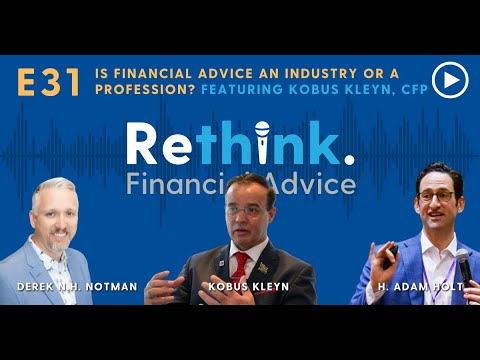
Watch and Listen
Episode Summary
Kobus Kleyn joins Adam Holt and Derek Notman to examine why financial advice is habitually called an industry rather than a profession, and whether the word choice gives something away. The hosts land on a working distinction. An industry manufactures and distributes products, while a profession combines service, credibility, expertise, experience, and a formal educational path, which is how law and accountancy present themselves. Kleyn, speaking from South Africa, argues the labels advisors fight over are beside the point, that restricted or independent everyone is an advisor, and that anyone not leading with advice should not be selling products at all. His warning about language is the sharpest part of the episode. The harder advisors work to sound technically impressive, the more they push people toward solving the problem alone.
What This Episode Covers
- The working difference between an industry and a profession, and where advice sits
- Whether the distinction is really about compensation, education, or mindset
- Kleyn’s argument that the restricted and independent labels are a distraction
- Why technical language pushes people toward do-it-yourself solutions
- How advisors describe their own work in ordinary social settings, and why it matters
Full Transcript
Full timestamped transcript.
[00:00:00] H. Adam Holt: Welcome to Rethink the Financial Advisor podcast. My name is Adam Holt.
[00:00:06] Derek Notman: And this is Derek Notman. We are your hosts, both veteran advisors and fintech CEOs who challenge the status quo, question everything, and have fun doing it.
[00:00:16] H. Adam Holt: Hear honest commentary on the challenges facing advisors
[00:00:19] Derek Notman: today. And be part of a community where we can all rethink the profession.
Now on to our episode.
Adam, why is financial advice referred to as an industry instead of a profession?
[00:00:38] H. Adam Holt: Huh. I love your questions, 'cause they just come out of left field. An industry over a profession. I haven't thought about that one before.
[00:00:47] Derek Notman: It's, it's, uh... I, I think a lot of us use the words interchangeably, actually, but they are very different.
You know the difference between the two, right?
[00:00:56] H. Adam Holt: I think so. I mean, when I think of industry, I think of manufacturing.
[00:01:00] Derek Notman: Yeah, like products, like physical, like widgets, right?
[00:01:04] H. Adam Holt: But maybe that makes sense, 'cause financial services... Wow, that's a good point. Financial advice versus financial services has been an industry of product distribution.
[00:01:16] Derek Notman: Exactly, and that's okay. Like, the, the... We have an industry that manufacturers products, and then it distributes said products through... Well, there's a lot of... And that's a whole other podcast, distribution of said products. But what's the difference between that and a profession?
[00:01:32] H. Adam Holt: A profession, I think, my answer is that a profession is an aspirational role of service that has credibility, expertise, and experience behind it.
I don't know. I think of a lawyer when I think of profession, or a consultant or an accountant.
[00:01:52] Derek Notman: Exactly. I, I think of the same thing. I think they do a really good job of, of marketing themselves as a profession, which is really interesting. Uh, the only other thing I would add to your definition is education.
Education. There's an educational component, uh, you know, baked in there somehow. And-
[00:02:08] H. Adam Holt: But do you think that this is a question about how we get paid again? I mean, is... There's been all this conversation about financial advice and whether we're gonna get paid via the distribution of solutions or the distribution of our time, or is this a mindset question?
How do we approach the business as advisors ourselves, and do we think of it as a entrepreneurial business of an industry or rather of a profession?
[00:02:34] Derek Notman: Well, if I put my entrepreneur hat on, I think it's both.
[00:02:39] H. Adam Holt: Hmm.
[00:02:40] Derek Notman: I think we can get paid for both. Um, so I... Compensation's definitely part of it. Uh, but I think overall, I think one should probably take lead over the other when it comes to what we're trying to do and trying to help our clients and what they're looking for.
Um, I think we should dig into this a little more, and we actually have a really cool guest joining us today. You should definitely connect with this gentleman. His name is Cobus Klein. Comes to us from South Africa. Certified financial planner, and what's cool is that he actually became an advisor as, like, a second career, and you're gonna hear more about why here in a little bit.
Uh, but he's been a c- he's a CFP, he's got over 21 years experience as an advisor. He's an ambassador for the Life Happens, um, movement, if you will. And I'm sure a lot of you are, are out there, you understand what that is. He's a member of the Financial Planning Institute in South Africa, a perennial MDRT member, and also he's published a number of books that are...
Really, it's, it's kind of cool. Like, they teach, they talk to consumers, but also to advisors. Um-
[00:03:49] H. Adam Holt: And he's known for something very unique Do you know what that is? If you ever watch him on social, he's covered in the South African colors.
[00:03:58] Derek Notman: He was for our conversation. I, I love it. The- as he said, well, you'll hear this, you're gonna talk about how he's an addict, actually.
Right? And you, you'll learn more about w- what we're talking about here. It's true. It's not a bad thing. Uh-
[00:04:10] H. Adam Holt: Well, this... It's funny because this debate and this question came up, and he brought it up, and we thought it was unique enough to run an episode around it. So make sure that you listen to what Cobus is talking about here.
He talks about his own journey in the advice profession, which we want you to both listen to his insights about the profession, and also what we need to pay attention to. You ready, Derek? Let's jump in. This'll be a fun conversation.
[00:04:31] Kobus Kleyn: My, my principle was always, and since I started then 21 years ago, that was on the 1st of August, was always that, um, I, you know, I love what I do.
And obviously, you know, after 18 years in the corporate world and climbing that, you know, levels up there, I decided 18 years or 21 years ago, after 18 years in the corporate world, that I need to do something else. I need to find that why, that passion, that purpose, and that was the key thing, yeah. So when I started, I did start as an advisor or financial advisor, if you wanna call it that.
But, you know, as I got to my CFP and as I, uh, joined affiliations like MDRT and FBI and FIAR, I reckon about 2012, that's where I really saw bigger vision. I saw that why is people calling us an industry? Why is this so, so, so orientated for product? Because an industry is something that manufactures something, and that's normally products or goods and stuff and so on.
And I, I just then embarked on what I now call a movement, you know, that we should have a passion for our profession. Because why are we as professionals calling ourselves an industry if we're actually a profession? And that's where the whole story goes. So, so, so my objective with any interview of these, this is not about myself, it's not about my practice and things like that, but it's about how do we transform this industry into a fully fledged profession, where we stand arou- where we can stand around a braai, a Tupperware party or whatever you wanna call it, and people ask you, "What do you do?"
I like that. When people ask you, "What do you do?" And it's not, yeah, you shouldn't be thinking what you do. You shouldn't be thinking of a different term for an insurance advisor, financial advisor, or life advisor, whatever these people call it. You should be proud to stand up to those people and say, "I'm a financial professional."
And they must look in your eyes like they would look at their GP's eyes, their medical professional's eyes, the chartered accountant's eyes. And to me, that's the biggest initiative. I want to take platform, I want to take a, take the movement with organizations like the Financial Planning Institute, and FIA, and MDRT, and all these international and local organization.
And that's why I serve on volunteer committees, and boards, and things to try to, in the next 21 years, because I've still got most probably another 21 years and I'll be 80 one day, 'cause I love what I do, I'm not gonna stop what I'm doing. And that is the bottom line. Can we really call ourselves a financial profession and a professional organization going forward?
[00:07:03] H. Adam Holt: One of the things that I definitely see, Cobus, in your profile and the following that you have on social media is that you, you certainly have been outspoken. You've been a fantastic supporter of South Africa. I think that it's been really e- exciting to see the passion that you have around the nation, what's happening.
What's happening specifically in South Africa that we need to pay attention to in the rest of the world?
[00:07:25] Kobus Kleyn: You know, I, I love my country, and, you know, people sometimes say, "But why?" You know, "What do you love about the country?" I love my flag. I love my flag colors. I'm actually concerned because I've become addicted to it, and if I mean addicted to it, it means if I walk past a store and I see anything with a South African flag on or the colors, I actually buy the stuff.
So, so, so if you look all over my office and my house, it's just South African flag. You know, outside there, there, um, on, on the pole of my, on, on flag pole, if you call it, there's a flag there. Because I believe we still have a fantastic country. We can be proudly South Africa. Why? We have a beautiful country.
We have the best weather, most probably in the world, consistently. We don't have these massive storms and, and, and, uh, you know, droughts and, uh, wetness and what that you see across the world. We, we have some of them, but not on a regular basis. It doesn't happen often. But apart from a fantastic country, we have infrastructure that's actually working.
Yes, there may be a couple of too many potholes and those things, but, you know, in a world it seems everyone has got similar problems. And therefore, if you look at our country, if you understand the politics, the economy, and our financial system, we're actually a third world country, but when it comes to our financial systems, for instance, we are a first world country.
Our financial planning system, our banking, everything. Our politics is a problem, but it's only a problem because people don't, like in many other countries, always use their votes. But I still believe if I had to make a choice between go to Australia or New Zealand or Canada or the UK, I would never have any doubt that I would choose, I would choose South Africa.
Why? Because if you take charge of your own destiny, what I mean by that, so if you look after your children's education, if you can finance your living area, your lifestyle, your security, because it is, there is crime here like in any other country. But if you can s- sustain that and secure that, you live in a country that is the most beautiful country in the world, and most probably one of the most beautiful countries in the world.
And we are friendly people. I mean, there's no doubt this country has got friendly people. This country has got personalities, and this country's got 11 national languages. They're now looking at number 12. That is amazing. And number 12 will be signing. Uh, you know, there's a lot of signing. That's interesting.
They wanna make that the national language. We are called the Rainbow Nation for a reason, 'cause we've got all colors, cultures and diversity in this country. I'm proud to be a South African, and I will never leave this country
[00:10:08] Derek Notman: Uh, I love that, Kobus. Your passion is clear for your country, and your colors are definitely present.
Uh, I love all your posts where you- where you're sharing those different things. I, I just actually wrote a note. I have to buy a new South African flag just so I can have one here as well. Um, so in that context of, of what, what I would... Uh, my interpretation is that you have a l- a country that is amazing.
You love it, and I know this firsthand. Uh, you know, my mom is from there. I've been there. What would you say is a missing opportunity or maybe upcoming challenge that the financial advice profession, not industry, profession, and maybe that is it in itself, is not addressing or can't see coming?
[00:10:51] Kobus Kleyn: You know, if I think about your question, it's very interesting because we always had this threat of robo-advice over the last couple of years versus the human advisor.
Now, the good news is I don't see that as a threat anymore. It will not be a threat in my lifetime, at least. But I do see robo-advice as the future of a hybrid model, hybrid practice model, where you as a practice have robo or, um, algorithms and that in your system to help your clients with it. But you know the opportunities that we are missing?
This COVID-19, this once in a lifetime pandemic, has been a blessing in disguise. There is so many silver linings that this COVID-19 has brought, if you didn't get COVID or died of it, or your family got infected by it. There's so many blessing this is bringing to the financial planning profession as a whole, and those blessings I'm talking about is firstly technology.
And I don't think our current advice structures and our current financial advisors, as the majority, are even 5% to 10% taking advantage of what this technology, what this virtual world, what this digital world has brought to us, where we can talk like this. Borderless. There's no borders. We are borderless.
And if we don't embrace this technology that we've got, if we don't embrace this virtual world, you're gonna miss an opportunity that came to you once in a lifetime. You're most probably not gonna be as sustainable as you were in the past because your clients would wanna stay on this virtual world, I believe, or the majority of them.
And the problem is, too many advisors are currently thinking, I can see it across the board, social media, they're gonna go back to the old world. We are not gonna go back to the old world. I can tell you that categorically. And therefore, we as a financial profession must not miss this opportunity to now embrace the new world, the new hybrid world, the new virtual world, the new working from anywhere world, working from home world.
And who knows, in the future, working from the metaverse world. That is where the most opportunity lies for me for financial professionals, not in South Africa only, but in the world. And because our infrastructure is so... Is not conducive to traveling, you know, and sitting on highways and like your traveling mobility, we want to be virtual because then you don't have to go out there.
And are we therefore taking advantage of that? Because it will lead to efficiency, productivity, cost savings, and sustainability, and a borderless world of business
[00:13:31] H. Adam Holt: That's really amazing. I, I, we tend to agree, and I, I love your forward-thinking nature of this, Kobus. Uh, I'm curious, though, I mean, what, what action steps do you think that financial professionals need to be taking right now to actualize what you're speaking about?
Because I know there's a lot of challenge in change, and of course, the, as you said, the pandemic did force this change. But what are the actual action steps you're telling your community to take today?
[00:13:59] Kobus Kleyn: Well, it, it's, it's really, um, about your mindset, Adam, to start first. Your mindset and then your client's mindset.
Because the first thing you must be willing to do, and that I had to do many times over the last couple of years, back in March 2020 I had to do what I call you need to disrupt yourself before you are disrupted. And if you disrupt yourself and your clients and your profession, and if you are the innovator, the early adopter, if I can call it that, then you've got a gold mine in your hands.
So what must we do? What must my fellow advisors in the world do, and here too, South Africa? They must get their mindset right. You want to change yourself. Change is difficult, and at age 59, believe me, it's even more difficult, especially when it comes to technology. But if you change your mindset and you believe it can work, change it.
Secondly, change your clients' mindsets. Make it for them so easy and make it for... Create an experience for them, a new experience where they want to be in the virtual world with you. And how fortunate could we be that over the last two years, my older clients, my younger clients had to speak to their families, their granddaughters, their daughters, their children across the world, or even in South Africa where they were in lockdown.
So suddenly what we were trying to do for many years, to go virtual, suddenly just was banged upon us overnight. In two years, we did what would normally take 10 to 15 years. And therefore, let's implement... And if you don't have a plan, number one, you must have a plan, and that doesn't mean a detailed strategy plan, outlet, how I'm gonna do that.
I, in March 2020, decided I'm gonna take 100 days and I'm gonna pivot my practice from a 95% office-based practice to 95% virtual practice or hybrid virtual practice, and it took me 100 days. Since then, it took me consolidation after. But without the plan, you ain't gonna get there. Without using that, um, money you're saving on the virtual world to buy new technology, to buy the webcam, the mics, the lights, the laptop, all of those things.
You have to commit. You don't have to do everything at once. It's better to have something, even on your iPhone just using Zoom, than not using anything. But obviously, if you want to go to the next level, and the next level is creating a new experience with a value proposition to your clients where they wanna deal with you on a virtual world.
And that, I must say, I set myself a target to be 95% virtual. Today, I am 99% virtual, if not more. I don't see clients anymore. All my clients love what we're doing here. It takes time, takes commitment, takes effort and energy between both parties to make it work for you
[00:16:44] Derek Notman: You're bringing a tear to my eye, Kobus.
This is something that I c- I started almost 10 years ago. Um, Adam started it before I did, and, uh, but it resonates, and I think your point exactly. All... There's a lot of things that have to happen, as you even found out in your 100-day transition, but if you didn't have that mindset shift first, none of the other stuff would've happened anyways.
So that is extremely important. I hope the advisors listening really, you know, take that to heart. So to kind of wrap this up, Kobus, um, Adam and I do welcome, I guess, what you could call constructive controversy. Uh, so is there anything that you think our profession needs to hear that isn't being talked about?
Any message that you would really like to get out there to be like, "Hey, please think about this. Please make a change. Please say this, do this"? You've kind of got an open floor at this point
[00:17:36] Kobus Kleyn: Yep. I, I have a couple of things to say about that, and, um, I try to not be different, but to, to differentiate. Let's make it a different word for it.
Firstly, we need to focus on advice, advice, and advice. And a consequence of advice, doesn't matter if you're a restricted advisor, a non-restricted advisor, independent broker, forget all those terms. We are all advisors. And if you don't, if you don't give advice first, then you shouldn't be selling products.
You should definitely not be selling products first. You should be giving advice. And a consequence of good advice must be product. I always call advice the car. The financial plan is the car. The engine parts need to be made up of retirement annuities or investments or whatever you wanna call it. That is the engine.
But before you have the engine, you can't put the parts in there. Therefore, if you don't have advice to financial plan, you don't have a financial plan. So let's focus firstly on advice, and let's product be a consequence of good advice. Yes, we all have to earn money. We all have to have income, but there's different ways of doing it still right, ethically with good will and conduct, and then the business will come in any case.
Secondly, we need to get our financial services product providers Two, become simple. What do I mean by that? Take the bells and whistles out of products. Take the tech- the, the, the, the technical difficulty out of the products, out of the products. Make it as easy as possible for the youngest advisor coming into the business to even the master advisor that's got 20 years plus in the business to understand these products, because if they don't understand the product, how must the poor public consumer understand the product?
So my biggest gripe with financial service providers is take the bells and whistles out of it. Take the loyalty programs out of it. Focus on death, disability, redundancies, and whatever's more important when the event happens, and not after or before, how much rewards you can earn. And why must it be so technical?
And I really mean that. It's too technical, it's too complicated, so we must simplify our processes. And thirdly, the profession, the financial services product providers, the investment managers, must get on board with technology, and get on board quickly with technology, and absolutely up their service levels in this new virtual world to make sure we as professionals can operate in a hybrid virtual world with our clients with sustainability, cost-effectiveness, and simplicity.
We are going over our clients' heads. We should go beyond our clients' head and focus on the most important thing. And what is that? That is peace of mind that if I'm going to sleep tonight and I don't wake up tomorrow morning, my family is okay. But if I do go and sleep tonight and I have a stroke or heart attack and I do wake up tomorrow morning, I'm still okay with my family because I'm the breadwinner.
And that is what we should focus on. Simplicity, the dreams of our, of our clients, the needs of our clients, without complicating them with massive financial needs analysis and charts and investment blooming, uh, uh, distribution lists, all of that. That's where I believe we can do a lot more to go forward
[00:20:45] H. Adam Holt: Well, clearly I agree with that 100%.
[00:20:47] Derek Notman: That's-
[00:20:47] H. Adam Holt: 100% ... that's my John. You know? Philadelphia John. J-A-W-N- ... for those that need to know. Simplicity, I, I l- I love that he said this, Derek. What did you think about what Kobus shared?
[00:20:59] Derek Notman: Well, he's, it's... He's inspiring. He actually, like, packed that conversation with a ton of- Yeah ... takeaways that we'll jump into here.
I, I think it's important because I want our listeners to, to walk away and be like, "Oh, man, that's great. I can do this, I can do that." 'Cause he's a smart man, he's been in this industry a long time. He's got a unique perspective given what he's doing and how he's doing it, and selfishly I love him because he's virtual.
So- He's committed. He- He's committed, man. He did it like I did. He went all in, and I love it.
[00:21:30] H. Adam Holt: Do you do notice m- every interaction I've had with Kobus, he is an educator. He's got that paternal let me help you, and that authenticity comes through in such a way that you have to give the guy mad respect because he's really being himself, and he's living it out loud, and I think he's gonna be a real beacon for a lot of people if he's not already, uh, to, to follow and listen to what he has to say from a real mentor standpoint.
And it's one of the things that you and I are both very passionate about, so thank you, Kobus, for those comments. What were the takeaways, Derek, that advisors need to remember and, and hear again?
[00:22:05] Derek Notman: Well, I think the first one that he really, he, you know, he, he leaned into was that we are moving away, not entirely, never entirely, but moving away from industry to what we're calling a profession.
Both exist, both will always exist for obvious reasons, but that we really need to lean in on, on focusing on advice first. I loved his analogy about- I can't remember it now. That's terrible. It was the engine The engine. That's it. I'm a car guy, too. I'm... Boy, that was a, that was a blonde moment, even though I don't have any blonde hair.
[00:22:36] H. Adam Holt: Gray is the new blonde.
[00:22:37] Derek Notman: Gray is the new blonde, everybody. Get on board. But, um, no, it was a great analogy, and it, it just makes sense, and we've talked about this countless times: advice, advice, advice, and then get the right products because of said advice. And that is just where this whole... You know, we should be leading with profession instead of industry.
So embrace that. Know it. It is happening. Uh, my favorite, virtual is here to stay. There are so many benefits. He talks about them, uh, even if you're just in a hybrid model. But what he talked about, like, so he had this 100-day challenge, uh, to do it, and that never would've been possible if he didn't first change his mindset.
So if you're listening to this and you're maybe a little hybrid or you're, you're going back to dinner seminars... By the way, I got an email from an advisor yesterday. He's doing s- dinner seminars again, and he says he hates it. It's expensive. It sucks. So y- you don't have to do this. And what's interesting is that Kobus is almost 60 years old.
He's what some could say a veteran of the profession, and he, he did it. He did it in 100 days.
[00:23:46] H. Adam Holt: Yeah.
[00:23:47] Derek Notman: So mindset's extremely important, and he's doing it. He, uh, if you follow him on LinkedIn and Instagram and so forth, you'll see all the travels that he's doing while he's working. He's just, he's just totally my guy.
Um, so I love it, and he does have a lot of high-net-worth clients that he works with as well. This isn't just, you know, like, um, middle of the road. So virtual, it's here to stay. Change it, your practice. Look into it. Focus on it. Uh, and then, um, eh, I thought it was interesting, so for anyone listening to this that's more on the product manufacturing side, the industry side, he makes an interesting point about simplifying products.
Like, we're always trying to get all these new bells and whistles, but at the end of the day, if, if it's true, if we can't understand them as advisors, how the heck is the consumer gonna, gonna figure them out? You know? We can definitely simplify and do some pretty cool things in the process for our clients.
[00:24:39] H. Adam Holt: Yeah.
[00:24:39] Derek Notman: But anyways, th- those are my big ones. What, um, what kind of stuck out for you, Adam?
[00:24:44] H. Adam Holt: Well, the simplify thing that you just finished with, I think is really important. I kept thinking about, you know, we want to sell these parachutes, right? We, we com- we tell people that they need a parachute, and we sell them these ones with 800 gadgets on it.
And I'm like, "I just, I just want to save myself if I fall," you know? Uh, and so what happens is it gets so complicated that the confused mind doesn't buy. That's the problem. We're trying to get people to take action, and we're giving these massively complicated, "Well, in this iteration, in this situation, and that, or with this fee, we can elect this feature, and we can turn off that feature, and then we..."
People are like, "I, can I just, can I just save money and invest with you?" Yeah. So the point, I think, is the more we do this to try to look like we're smart The more we drive people to go solve the problem on their own simply. That's what I think's gonna happen, right? So I- be careful. And professional doesn't mean to be, uh, so technical that you, you dis- you alienate people.
But I think there were some important things, I wanna kinda jump back to the beginning. He mentioned that how we talk about ourselves in our intimate interactions really matters. And, and I- he mentioned about the braai, which if you don't know, is a South African barbecue or a Tupperware party I think he mentioned.
I guess they're still doing Tupperware parties. I love that. I
[00:25:51] Derek Notman: guess they do that.
[00:25:52] H. Adam Holt: Yeah, that's, th- those are the moments. But why is it important that we talk about what our truth is and how we see ourselves? So if we see ourselves as professionals- He mentioned, "What would I have to say or do or deliver so that you look in my eyes the same way that you do your family physician or your accountant or other respected professionals?"
We- that's really a self-talk, and how we position ourselves to our clients really matters. So maybe it's time for us to rethink our quote, our quote unquote elevator pitch- Yes ... and say, "This is who I am. This is what I do. This is my authentic self," and how would I tell my most intimate friends what I do?
And then that's what I should be telling everybody. And that's the, that's the beauty of what Kobus does. He stays authentic in all moments, and you know you're really talking to the man. The other thing I thought he was really saying, a- and I... It was a good reminder for me, 'cause you brought it up. What are each of us proud of that we are willing to display it publicly and consistently in a way that represents your values?
Okay, some people are, have religious values, right? They'll wear, they'll wear a religious artifact on their neck, or, uh, some, uh, you know, have certain clothing, or some people, um, have a flag and maybe that's their college or university. What, what are you portraying that really represents you that will also draw in the people who feel similarly to you and build an association?
That's a, that's not just marketing. That's, that's building, I think, association- That's human connection ... community, right? Yeah. That's community. Hun- 100%. I wanna be with people like me, right. Um, and I thought it was pretty cool that he said change happens whether you're forced to or it's intentional. The pandemic really forced us to change.
How do we turn that into an opportunity to disrupt ourselves before we are disrupted? That is happening in many ways, in lots more ways than simply just virtual and of course the pandemic. There are a lot of, uh, pressures and shifts that are happening in technology and interaction, socially, politically, that are gonna change our business.
Interest rates, they're gonna change how we deliver our business. Let's think ahead and let's disrupt ourselves before we're disrupted. And I think the last thing I, I took away, 'cause, uh, clearly I took a lot of notes, was create a new experience for your clients, not at the most basic level. Invest in making it the professional level.
Think about what he did with your comments on, on virtual. He spent an intentional 100 days to get himself the mic, the lights, the speaker. Tech. He made it a professional experience. So when you're having a meeting with him... When, by the way, when we joined our meeting with him, he had all the gear, and it was very clear he was intent on making this a world-class experience even though it was virtual, not off the phone, even though that's clearly acceptable these days, in your shorts.
He came in a tie, in a suit, with his colors represented, backdrop, everything. He looked like a professional at the, in the first and then highest level, and that was noticeable. And if you don't think it's noticeable, I think that's something we should be asking ourselves.
[00:28:41] Derek Notman: No question about it. I mean, he's living, he's living it.
He's living the part. So if you would, are not following Kobus on LinkedIn, for example, Instagram, follow the man. You'll, you'll, you'll, you'll learn a lot. Anyways.
[00:28:53] H. Adam Holt: Thank you, Kobus. Thank you for that.
[00:28:54] Derek Notman: Thank you, Kobus. Yeah.
[00:28:55] H. Adam Holt: So this kind of tees us up, Derek. Let me ask you this question. So this came in on LinkedIn from Kelly in California.
As you all know, we do a community question. Every once in a while we forget to do it just because we run out of time, but we have a second here. She writes in that, "Lots of advisors have a new website, send birthday cards, hold webinars and seminars," like the person you just mentioned, "have branded gear.
But what are advisors doing today to stand out from other advisors?" Thank you, Kelly in California.
[00:29:21] Derek Notman: It's a great, it's a great question, and I think a lot of us have done the branded coffee mug, golf balls- Mm-hmm ... you know, whatever. T-shirt. T-shirts, and we send that stuff out to our clients. Um, it's the same, you know, corporate birthday card.
And I'm, I'm not saying it's- Computer wrote it. ... bad. I know, but it's like, uh-
[00:29:48] H. Adam Holt: Yeah ...
[00:29:48] Derek Notman: I, I think that it, we are in this shift almost, I would say, to, like, personalization. When we t- we've talked about niching, right?
[00:29:56] H. Adam Holt: Mm-hmm.
[00:29:57] Derek Notman: If we're niching, if we're specialized working with a certain clientele, then shouldn't our- everything represent that, including our birthday cards and our golf balls, or even if we- Mm-hmm
do we even use that stuff anymore? So it's an interesting question from, from Kelly. I think we'll probably wanna do an episode about this. And I do know, 'cause I have used it, there is a pretty cool alternative, um, that's taken a new spin on how to do these types of gifting things, if you will. Um-
[00:30:29] H. Adam Holt: You mean I shouldn't just send the holiday basket, the same basket, to my top 10 clients and,
[00:30:34] Derek Notman: uh, you know- And it's the same basket every year
[00:30:35] H. Adam Holt: it's right. Written by a computer and I never hear anything- Yeah ... or thank you back. Uh, it's... What happens, I think they just give it to their staff, and their staff eat a bunch of chocolates, and I create no goodwill with my client- Well,
[00:30:46] Derek Notman: yeah ... '
[00:30:46] H. Adam Holt: cause the client's not working during the holidays, so
[00:30:48] Derek Notman: they just give it to staff.
Exactly, right? They're like, it just sits there. It's... I don't think it's- I
[00:30:52] H. Adam Holt: don't think it sits there. Somebody eats it. I think the janitor's eating it. Someone
[00:30:54] Derek Notman: eats it,
[00:30:54] H. Adam Holt: yeah. There's
[00:30:56] Derek Notman: a little note, "Enjoy. Merry Christmas." Yeah. "I re-gifted this to you."
[00:31:00] H. Adam Holt: That's right.
[00:31:01] Derek Notman: Oh, man. Um- That's funny. No, I'm looking forward to it
well, we'll get into it 'cause there's, there's some cool ways to do it. I, I know one of the challenges is scalability when you have a lot of clients, so I think we'll wanna cover that- Mm ... as, as part of it. So great question- Cool ... Kelly and Callie. Thank you for, uh, for, for chiming in. We appreciate it.
[00:31:16] H. Adam Holt: Nice.
Kelly and Callie.
[00:31:18] Derek Notman: There you go. I'm
[00:31:18] H. Adam Holt: sure she's never heard that before.
[00:31:20] Derek Notman: Never.
[00:31:21] H. Adam Holt: Such a dad joke.
[00:31:25] Derek Notman: Dude, I am a dad. I gotta just live it up. Well, that explains it. That's what explains it, remember?
[00:31:31] H. Adam Holt: Oh my gosh. That's great. Well, Derek, thank you so much, uh, for taking the time and, and hanging out like always. To all our friends, uh, out there, and certainly to Cobus, uh, we really appreciate your participation.
Rethink is continue to grow, Derek. Do you believe this thing is continuing to grow?
[00:31:44] Derek Notman: Dude, we're almost at a year and a half in. It's amazing at this point, and it is growing. Like, we're getting some pretty awesome feedback here. I'm, I'm- Mm-hmm. Remember the days when it was just your mom and my wife listening?
[00:31:56] H. Adam Holt: Oh my gosh, we got so much heck for that one.
[00:31:58] Derek Notman: I know. Uh, we, we got past it. We made it. We broke through that barrier, uh- They
[00:32:04] H. Adam Holt: may have unsubscribed, by the way. They finally feel comfortable that we- we're out on our own. Yeah, right. We know where our socks are. We we- you know, we wear our galoshes. Uh, yes.
Thank you. We all grow up. Well, thank you so much, those who are putting up with us, of course. Make sure that you subscribe. Follow us on LinkedIn on our channel. We're putting a lot of content out on there. Let us know what you wanna talk about. Derek and I are open to this. This is a conversation. We want you to be part of it.
And of course, please share the message with those that you think need to participate in this. Derek, until the next time. Until the next time, my friend. Good seeing you. All the best, brother.
[00:32:36] Announcer: Thank you for listening to Rethink, the Financial Advisor podcast with Holt and Notman. Be sure to subscribe now and join the ongoing conversation.
The information covered and posted represents the views and opinions of the guest and does not necessarily represent the views or opinions of Asset-Map or Connectir.
The content has been made available to you by Asset-Map for informational and educational purposes only.