
Ep30 - Rethink: Cut the Tie! Is Advisor Attire dated?
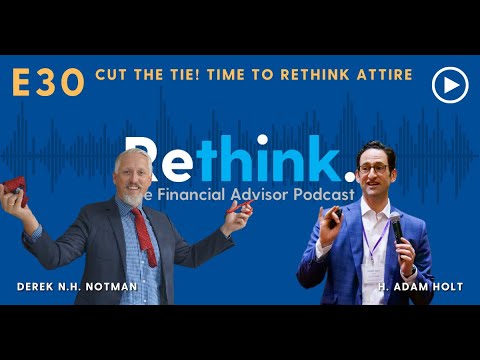
Watch and Listen
Episode Summary
Adam Holt and Derek Notman work through whether the suit-and-tie convention still serves advisors, and use it as a way into a larger question about authenticity. Notman describes entering the business in 2006, when polished formal dress was simply the expectation, believing it signalled competence, and later discovering his clients did not particularly want it. The episode was prompted by a post of his that circulated widely, inspired by Richard Branson’s willingness to be conspicuous. The more useful half of the conversation is about what replaces the uniform. Holt describes the persona many advisors are trained into, the flashy watch and the convertible, as a kind of armor that gets in the way of the thing clients actually want, which is a sense of who you really are. Both argue authenticity is easier to sustain than performance.
What This Episode Covers
- Why formal dress became the industry default, and what it was meant to signal
- What happened when one host tested a deliberately unconventional position in public
- The performed persona advisors are trained into, and what it costs them
- Using an authentic identity as the organizing principle for a website and social presence
- Being bold without being reckless, and where the hosts draw that line
Full Transcript
Full timestamped transcript.
[00:00:27] H. Adam Holt: Derek can advisors finally junk their business attire?
Did you say junk
[00:00:34] Derek N. H. Notman: their business or their
[00:00:35] H. Adam Holt: attire? not junk their tires junk their business attire.
[00:00:41] Derek N. H. Notman: In my opinion, yes, man. I, I think the times have changed and we gotta stay with the times. So I think we need to get rid of our traditional business attire.
[00:00:56] H. Adam Holt: Wow. What do you think, man? There's people literally rolling over in their graves, thinking about their white starched shirts. blue ties that are saying I spent 50 years in this industry and we wore the same shirt every day and we had to, and there was a reason to though there was a reason.
Well, are
[00:01:18] Derek N. H. Notman: you saying the expectation? Well, I mean, there's so many topics I could cover here as, as examples. Probably some of them will get me into trouble, but let's just leave. That's not new. yeah. Let's, let's leave it to this, Adam is that we, we, we can call it progress. We can call it evolution. We can call it change.
Things change and expectations, change, and whatever is considered the quote unquote norm changes.
[00:01:47] H. Adam Holt: Okay.
[00:01:47] Derek N. H. Notman: And I, I think that that has happened more. I mean, heck so when I started in 2006, I mean, you were already an old man when I started, but
[00:01:56] H. Adam Holt: according to you, I've always been an man.
[00:02:00] Derek N. H. Notman: Thanks dad. Uh, when, when I started like it, that was the expectation suit.
You know, polished shoes, nice socks, nice shirt. And you wore that stuff to the office on your way to the office in your client meetings. And that's what all it was. And, you know, I thought it's what I wanted. I thought it was comfortable at first. I thought I liked it. I'm like, oh, this will make me successful, man.
People are gonna buy from me cuz like power suit, power tie, power windows. here we
go. oh, wow. That's a good one. Power windows and power tie. And uh, but
it, it turns out that really wasn't what my clients wanted. And
[00:02:38] H. Adam Holt: well, how did you figure that out though? How did you, what was the moment when all of a sudden you realized that your clients wanted you to take off the.
So well, so I, I ha part of it was okay, first, when you're in the office setting, you're in the bullpen, you're in the training room and you're wearing this stuff, everyone else is wearing it. Like, yeah, pat yourself in the back, great job in the cold calling session. Right. Like rock on you feel great.
But then you get into the real world and you're sitting across the kitchen table from your clients. And remember, so I, I, my clients, which was rural Vermont, um, and so. I would, I would arrive and I'm sitting there, I'm this dude with a full suit and tie on. And I I'm meeting with this lovely family or a business owner or a farmer and they're in their shit kickers.
man, I feel out of place here. And I still remember, I don't know exactly which meeting it was, but it was very early on. I'm sitting in there at the table and we're just chitchatting getting to know each other. And I'm looking at 'em and, you know, there's kind of that feeling of we're all, we're all a little uncomfortable it's first date type of experience.
I'm like, do you mind if I get rid of my tie? He just laughed, please get rid of the tide. It was great. So I took it off and ever since then, that was what started the rabbit hole of changing my attire.
Next thing you know, you're in flip flops. Next
[00:03:57] Derek N. H. Notman: time. I'm in flip flops board shorts.
And, uh, yeah, pretty I'm in flip flops
[00:04:02] H. Adam Holt: right now. I'm sure as am I, by the way, I just wanna let you know yes. And shorts and shorts total. Uh, it's true. That's interesting. You know, I, when you mentioned the whole kitchen table thing, that was, that was very similar to me. The catalyst for me was. People felt uncomfortable with the business attire at their kitchen table.
And they, I, I know somebody actually offered to me said, listen, you can, by the way, you can loosen your tie, take over your tie, get rid of your sport coat, roll up your sleeves. It was permission that the customer or the client said, Hey, I'm okay. I already trust you. Or I already know what this meeting is about.
It's about my financial security and I'm not hiring you for your time. Now, granted, I will tell you this showing up without, it might have set a different tone though, too, right? There's a difference when you show up for battle and you got your full regalia on and you realize, okay, this is really a peace chord.
Okay. Okay. We can afford to put our guns down. I think that there has been a general. And it served our, I think it served the financial services community by creating a level of professionalism and elevating the. Stature, perhaps very similar to a military uniform. Yeah. That people tended to respect honor.
Give credibility to you. Remember in the 1950s, people wore a tie to the supermarket. Okay. They didn't leave the house without a jacket or a hat. Right. There was an, there was an expected social attire that the nicer your suit, the more custom made your suit, the better the fabric people cared about this stuff.
The, the shine on your shoe, right? Sure. Was actually a sign of success. And of potentially credibility. And I think in financial services, no different than the banks having stone columns in front of them, people got used to, I think traditionally and culturally, that, that represented security, safety and professionalism.
I didn't go to any lawyer meeting where the lawyer didn't have a tie today. I go to, to legal meetings. The lawyer's not wearing suits, right. They're not, you know,
[00:06:09] Derek N. H. Notman: I, I love your analogy and, and how you explain that. How it's how it's changed. But look at banks, look at some of the big, I think it's capital one now is doing these, these commercials where they want you to come in.
Like they've got couches and it's this open architecture, it's new, like you get a cup of coffee, it's digital banking. And it's changed from the traditional, very conservative, um, banks. So I think that's just happened. I think it's happened in our industry. I know some of you listen, you're like no ties till I die.
You know, I'm not , that's it. And, but I, I think it's overall. It really is. It, it has shifted. And I think that you said it spot on the client gave you permission. Yep. Right? The expectation was different and you showed up for battle, but maybe we did need to show up for battle. Maybe we just need to show up for the peace.
Right.
[00:07:01] H. Adam Holt: Would be more aware of it. You know, that's really a funny analogy because in many ways, if you remember, in the early days of our career, when we showed up, it was a suit of armor, it was a way for us to stand taller, to have a level of professional protectionism against being authentic, because we didn't know whether people would wanna do business with us.
If they really knew us right by, by doning the suit by doning the brief totally. That or, or whatever you were wearing, the, the, the formal wear. That almost elevated your stature because as we should all be realizing it that our clothing says something about us in a nonverbal communication, that's being interpreted, whether we realize it or not.
Mm-hmm right. I always remember we go to these, um, producer conferences, they would get together. They would say, okay, it's business professional. People would all come in ties cause they know their mentors or their bosses were there and they wanna look like everybody else.
And then one guy inevitably shows up in his loafers, no socks and, and a Hawaii shirt.
[00:07:59] Derek N. H. Notman: That was me.
[00:08:00] H. Adam Holt: That was you. Okay. Everybody, you have to be more looking at this guy saying like, what is this. schmuck Doing and the other guys are like, wow, he must be really successful if he's really not even following the protocol, he's just wearing whatever he wants.
He must be the top producer. So, so the funny thing about it is that people all take this differently. And I think that really kind of, really kind of leads us into what started this podcast topic, because this wasn't our plan to talk about this today, but you had this post that just went mega viral, and I wanted to ask you about it.
So give us the backstory on your cut the tie. Post that you just did.
[00:08:36] Derek N. H. Notman: Yeah, it was, it was really fun.
So for me, my creativity tends to happen sporadically. and I'll have these fits of cool idea. Let's run with it and let's go. I don't spend hours and hours thinking about how I can be creative.
Okay. And for those of you who don't know, one of my, I guess you could say idols. Mentors, I've never met is Richard Branson. And I've read all his books. I follow him religiously. I love his style and everything that he does. And he is known for doing the same thing. I'm like, well, let's have some fun with this, right?
Like within at least my little circle that I have and I, I just I'm like, Hey honey, I needed to get the nice camera out. I want you to take a couple pictures of me cutting this. Right. It was that it was just that quick. I'm like, this is totally sporadic, like spur of the moment and we did it and, um, I posted it and the thing did go viral and I posted it on Twitter and on LinkedIn, on Twitter, Richard Branson actually responded to it.
So that's really cool. Right? that's super cool. That was really stoked about that. But it was really about, I mean, this is what this podcast is about at, uh, Adam. I mean, like we, we talk about this in our intro, challenging the status quo. Mm. And this was a way for me to visually do that while also letting my personal brand come through and talk about something that I am interested in.
And that I think it helps drive conversation and maybe hopefully gets you to think about things something a little bit differently. Yeah. And you were one of the contributors on the post and you had a ton of comments just on your comment.
[00:10:11] H. Adam Holt: Yeah. Well, of course I took the opposite position, right.
Just because I'm so used to our podcasting environment. Yeah. Right? Yeah. I'm like, here's Derek cutting the tie. Now let me, everybody tell everybody why they need to, tape the tie back together. Um, by the way, I'm keep wondering, what did Richard Branson say? Did he say stop stalking me or did he, what did he say?
Something productive? no,
[00:10:28] Derek N. H. Notman: I, I asked him Hey, how many ties have you cut? And he just wrote back quite a.
[00:10:33] H. Adam Holt: Uh, that's awesome. It was really, even those words from your mentor is, uh, is really a cool blessing. you know, look, there's a couple things I take from that just in general, which is number one, you don't have to be brilliant to get kind of engagement, right?
Sometimes the most authentic stuff. Are you saying I'm, I'm really kind of a dead. No, no, you're creative. I said you're.
No. I never said that at all. I, you look, you can engage me. You, you crush all my posts. Like I, I'm looking up to you. you're the man. Um, I'm I guess I'm not creative. I, unfortunately I probably think about creativity all the time. It's why I can't do anything. You're super you're creative, um, but, or impactful, but I think that's really interesting.
Effective you were at engaging people by doing something almost controversial, but not disrespectful. Exactly. And started a conversation where people actually had real position on this and had never really talked about it. And we did hear one of our recent podcasts actually were about to produce it, from South Africa.
Kobus Kleyn is, is really known for wearing a tie all the time he wrote back. Yeah. But yeah. So I, I thought it was really cool cuz it started some great conversation. Make sure you check it out on either of those platforms, LinkedIn or Twitter, cuz you'll start to see everybody's talking about the flip flops and talking about getting rid of the dress shoes or, or holding onto them.
I think there's some really interesting.
[00:11:54] Derek N. H. Notman: Conversations, you know, it's funny, you can't see in the picture and we'll link to the post in, in, in this episode, but I'm not wearing any shoes
[00:12:01] H. Adam Holt: at all at all. You are wearing a suit in this picture. I
[00:12:05] Derek N. H. Notman: know. Right? Well, I wouldn't even call it. It's like sport coat, right?
Like, I mean,
[00:12:10] H. Adam Holt: been so long that's me.
[00:12:12] Derek N. H. Notman: I don't know. Yeah. But it was a lot, it was a lot of fun. It was a lot, lot of good conversation. Um, LinkedIn even did a spotlight on it. They liked
[00:12:20] H. Adam Holt: it so much. That is really cool. And boy, that probably expanded your own preeminence in the space massively. When you think about how many people you touched and now got to know that Derek Notman is actually a figure here.
That's literally the way that advisors should be thinking about marketing going forward. I'm not saying. That, that all of us in the financial advisor space need to do something wacky and crazy just to get attention. I'm saying that just showing a bit of authenticity and having a position that can be debated is really valuable in lifting your overall preeminence and awareness so that you are the most critical aspect of marketing today: being top of mind
Being top of mind is the hardest thing to do, cuz we all have so many things on our mind. But it's really important that we find ways to be relevant in this space of people's limited attention span. And I think these are some great ways to do it by showing your originality and your authenticity, in this social environment.
And it can start with just how you actually dress when you actually interact with people.
Yeah. I
[00:13:17] Derek N. H. Notman: mean,
let's face it, Adam. we, we connect with others on just some pretty basic human fundamentals. And if we can show that pretty cool stuff can happen. Um, you know, because of that post, I had new connections and, um, I'm not taking new clients for my wealth management firm, so I'm not really trying to do it on that side, but I got new business for connector and coupler actually.
Interesting because of it. All through LinkedIn and it didn't cost me anything, but a few minutes of my time and engaging. So you're right. Preeminent dot leadership. Just putting your name out there. And again, you don't have to be as bold as cutting a tie, but the posts, I like the most that I, cause I follow it, you know, thousands of advisors.
The ones I like the most on LinkedIn are not the ones about backdoor Roths and stuff like that. I like the ones that are more human about their family, about things. They've learned stuff. They struggle with. Like one of my favorite posts of yours when, when you were wearing, like, it was a picture of yourself and you had like this, it almost looked like one of those like gold chains and clocks from the nineties, like one of when the old
[00:14:20] H. Adam Holt: rappers , but it was post,
[00:14:24] Derek N. H. Notman: it was a great post and That's the stuff that, that resonates.
And I've had so many people, even this week say Derek, your stuff is always in front of me. I'm always seeing your stuff. Yeah. And so if you're an advisor listing, what we're trying to say is brand awareness, thought leadership, your personal brand really do matter. They really are important, no matter where you wanna put that stake in the ground and what you want to talk.
Yeah, that's
[00:14:46] H. Adam Holt: true. So many of advisors we know still have not gotten into the whole, exposing their personal brand and their authenticity through these types of media channels. And generally we think that's a risk. That's a risk. I wouldn't say it's a mistake. It's just a risk. And the risk has always been, as we've talked about in prior podcast, that people don't know who you are.
They don't know you exist. They can't find out if you're the best financial advisor for them, cuz they just don't know you exist. And the places that they're looking Google and. They may talk to their friends occasionally and ask for a referral. Uh, they're gonna search for you either way. And if you don't exist in digital space, it's almost like you're not relevant.
Right? So the key to being a thought leader or a subject matter expert and having a presence, whether you created it or the media created it for you is I think gonna be critical going into the future just because. That's how people are finding that let's people, people are finding it. Yeah.
When think about the last thing you bought, you probably searched it on Google. You probably checked out reviews in some hundred percent, and then you just did it. You just bought it and it's like, that's good enough for me. I need done is better than perfect. So that's, I think how people are gonna choose their financial advisors, if the costs are aligned but I think relatability is big.
So taking it full circle back to how you. Dress right. Your forward facing first impressions is very often how you dress and how you tire. So I think audience is big. We, we do know the difference between meeting with a millennial. I'm not gonna wear my full suit. Okay. But if I'm meeting with, uh, greatest generation, I might be inclined to have a tie.
And a oppressed shirt because I know my audience and I know what they historically, or culturally are gonna look for when they're making a decision around. Is this person relatable versus is this person credible? Cuz they're asking two separate questions. Those generations, well generation important though.
Exactly. Right. You
[00:16:32] Derek N. H. Notman: know, that's a really interesting point you make. And I would say that the only thing I would add to that, cause you're right on both counts. Is find some balance between what the expectation of that client is depending on their generation, as you said. Yeah. But then also your own comfort level.
one of the things I say in the, in the post is if I'm feeling uncomfortable, like I did all those years ago at the kitchen table, when I'm in my stuffy suit and tight tie, um, then I'm probably gonna project that uncomfortability a little. To those around me. So if I'm a little bit more comfortable because I'm wearing what really feels great.
And if that means you're wearing a tie, like our friend Kobus then rock on, go do that. Yeah. You know, if you wanna wear the heels and the dress, like rock on, like go do, be on be you. But I think that comfort level really is important and it's okay to be a little selfish there to look in the mirror and say, Hey, how do I really feel so I can make sure I'm my best for my clients.
Yeah,
[00:17:30] H. Adam Holt: that's true that this whole virtual movement has clearly changed the game because it gave us permission for the first time to not say, oh, well, I didn't put on a suit today cuz I'm working from home and I need to go pick up the groceries later and the kids and right. So people accepted that and forgave that.
So I don't think a lot of people want to go back by the way. even if they're gonna go back to the office, I'm not saying that I would expect the advisors in our firm to come back, you know, all wearing. flip flops and no, no, wouldn't do that either. I don't think that will happen yet. I, I think it eventually might happen.
Um, for some, we probably will jet us in the office before we require people to wear a full suit. Um, that will go before the, you know, uh, before the sport coat. But I think, uh, also there's an aspect of leadership. If you have staff, if you have team, we all know that the, that the organizations will tend to follow the protocol of the leader.
We always used to say that if the CEO wears a tie, uh, then everybody else is gonna be wearing a tie. If, if the CEO wears a no tie, then you're gonna see, go down to sport coats really fast. and that, that works all the way down through to the rank and file employee. So if you have a full organization recognize your choicefulness is gonna have an impact because people will tend to follow your lead thinking.
That's what I'm expected to do. That's what I'm supposed to do. in virtual world, clearly a much different environment as you know, all too well. Uh,
[00:18:55] Derek N. H. Notman: so to you, you've been doing it a lot longer than I have. Um, you know, and I, I would say like, know your client, we've talked about that before, know what was really gonna resonate, but be comfortable.
And whether you're a one advisor shop or you're running something the size of Richard Branson's enterprises, you don't have to have a tie to be successful though. And I think that was one of the points I was trying to make is people wanted to get to know me, not the tie that I had on my neck.
[00:19:22] H. Adam Holt: You know, there's one other thought I wanna do before we can wrap up our takeaways. There are ways to, to project your brand that I think a lot of financial advisors haven't tried yet. And I would actually tell you that both Derek and I have doing this, looking at our videos, which you can't see, Derek is wearing a T.
That has his coupler company brand on it. I'm wearing a t-shirt that has my advice, tech live brand on it, which is our big event. That's coming up soon. The reason I say this is that I've seen a lot of advisors try to brand their own clothing, but they buy the same old stuff. They buy the golf t-shirt and I think it's an interesting opportunity to.
Regular old t-shirts made, not old re new cool looking, branded t-shirts with your firm on it or hats that people actually wanna wear that look cool. And it's an opportunity to actually, cuz if you ever see me in public, I'm almost always wearing one of my own brands. Oh, totally like a billboard, but I'm comfortable, but I'm wearing the brand and I'm representing and I think what it's done for me is.
Besides making me constantly think about brand. It's also allowed me to say, we're actually cool in hip. We're not wearing my grandpa's polo shirt that I only wear on the golf course. Why actually I don't golf. So I wear it never. So yeah, never, but it was expensive and I go, all right. But. The point is, is that I think we can also have fun with this and even wear our branded company shirts.
Like we're a tech company to a meeting with a sport coat and then give our clients those same branded cool shirts as gifts and let them walk around, be like, oh, what's that cool tech company? Oh no, that's my financial advisor from what, how awesome would that be from a branding? Think about actually taking, I love it.
The persona of your identity and literally expressing it. On the daily in the supermarket. So like, I, I think that that's a possibility for advisors to think beyond the traditional garb. and I think that that's cool. And I think relative to Cobis I want to go buy him a, a tie that's says Cobis on it, you know, because.
I, I mean, like if you're gonna live it, live it out loud. And, and I think that's an opportunity that we have uniquely that unlike any predecessor generation has had, we have the unique opportunity to live out loud. And for those of you that feel comfortable enough to start stretching it, start expressing it.
But I think it resonates with people in a different way these days, uh, and is appreciated, cuz it is novel and it is unique. So why don't we, uh, why don't we wrap it up with the takeaways? What are your takeaways from this conversation, Derek?
[00:22:00] Derek N. H. Notman: Be genuine, just be you, People want that more than the nice clothes, the flash you watch the convertible.
I was that guy. I used to drive up with a nice watch in a convertible, in a suit. People don't want that stuff. They want you it'd be genuine. It's easier said than done. I think a lot of us, I know I was, was, was not really taught to be genuine. I was taught to have that, that almost that battle armor, persona mm-hmm and it was tough to break out of that.
But if you, if you really latch on to just who you are, and you can use that to drive all of your social and digital media engagement, like what's on your website, what t-shirt are you having made that you're giving your clients, things like that. Really will be impactful and meaningful. Mm-hmm uh, and they're you, so it's really easy for you to get behind that and be comfortable at the same time.
I would also say be bold. And I think you summed it up correctly in that, I did something that was a bit edgy or bold, but I didn't do something that was offensive and there's a fine line sometimes between the two. So just be bold. take a stance on something in a way that doesn't offend people necessarily, but where you can have a great conversation and dialogue around, I think that's really important.
And you can do that with all of your marketing. Uh, and I'll tell you what you can't do that if you're not genuine, because then you're not being new, you're being fake. Don't be fake. All of this ties pun intended, mm-hmm into your personal brand. Right. So know that it's all together and then it really will impact your digital presence.
I think that's where I'll leave it. Just, you know, those things together. And if you have any questions about any of it, just look how I interact on LinkedIn. I think that'll speak volumes.
[00:23:40] H. Adam Holt: that was great by the way. I, what kind of came to mind when you said that it sort reminded me of something else, is this word of memorable?
Right? We're all trying to stand out. In some regard, sometimes we don't wanna stand in the front. We wanna, we just don't want to be in the back. but I think we want to be memorable these days and it, it, the first thing I thought of is. How some people have used attire in our space attire, a T T I R E, to set themselves apart and be memorable in little unique ways with or without the suit.
Kitsis is a great example. He always has these dress shirts, right? Yes. So he's taken his suit. Performance now he's stuck with the suit, by the way, he has to wear a suit with a blue shirt, cuz that's oh, he's gas type
[00:24:20] Derek N. H. Notman: for sure. He is gas type for life. but it
[00:24:22] H. Adam Holt: works for him. Right. But it works. He rocks it.
Look at Tony St right? He, oh, it is Mr. Purple. He has. He has always the nicest suit at every conference we ever go to nicest, nicest dress has a purple Carnation or some kind of thing that he brings back to his brand that he's weaved into it way overdressed. Okay. I should cut his, I should cut his, oh yeah, you should walk.
I dare you to walk up to him and cut his talk. Right. He's used to has six children or something. I think he, he can handle you. Okay. Or how about Johnny San QUT? He's figured out, oh, he's, he's got yellow pants. He wears yellow slacks to every event. You know who he is? You don't, you never met him. You know what he is?
He's used this attire now and they're khakis. They're not like they're comfortable. He's found a way to make it fun. And I, and there's several other people. I, I haven't come up with anything. Cool. I wear like, A dumb checkered sport coat so I, I haven't figured out my thing yet. I'll find out in 15 days when I see you.
That's right. You'll find out. But I think the key is, is, you know, if you have an opportunity, you don't have to take it as far as we are. We're trying to have fun with it. but really whatever you choose, make it memorable because it's gonna set an impression, right? Remember that you're clothes, no matter what is saying something about you, it's about your brand.
It's saying something about how you're perceived from a nonverbal communication standpoint. And it says whether you. Or you don't care how you see me. Okay. It says something. The question is, are you being intentional about that? but we are finding more than ever. It's an opportunity to be authentically comfortable and that comfort is relatable to, to whether you are relatable, um, and so forth, or whether you're selling something.
And that's, that's the kind, I think the big key these days, nobody wants to be sold anymore. They want to be engaged and then they will buy from you. Okay. At the end of the day, we're still in the business of facilitating either money management or insurance or annuities or banking or whatever, or actions or fees.
There's still a bit as Mike, as Michael Kitsis
[00:26:19] Derek N. H. Notman: says the money's gotta land somewhere.
[00:26:21] H. Adam Holt: Right. And hopefully it's landing in good hands. Right. And so the key is, is do we trust those hands or do we feel like we're being sold? And it's an opportunity I think, to become more approachable and that's, that's I think really the trend that we're seeing in what you talked about in the very beginning here, which is this generational evolution of what's acceptable culturally in the norm from suits of armor, to suits from Boyds of London
to flip flops or whatever flops, wherever we're going. Right? Yeah. I think the key is just be relatable and just stay authentic to you. So that's my takeaways from this whole fun discussion. Hopefully you heard something in there that's gonna inspire you.
[00:26:57] Derek N. H. Notman: I, I love it. And one of your comments, I'm sorry.
Made me think. But you said a tire and you had to spell it out. Yeah. Can you imagine showing up with an actual
[00:27:06] H. Adam Holt: tire? Sure people have done it before you would be memorable. You'd be genuine. That's right. if you really niched with, automotive workers and you brought your tires. Yeah. I live this stuff.
Talk about
[00:27:18] Derek N. H. Notman: a social media post. Seriously. You could be having put an tire around you. So anyone out there that's working the automotive space here. That's an idea for you.
[00:27:25] H. Adam Holt: And well, after this summer, I feel like I have a tire around me given all the ice cream I ate. So, yeah, seriously. Right. Maybe I am bringing a tire, but none of my regular attire fits me.
So . I don't know, we get, have fun with that one. Anyway, my friend. Good to see you. We have to remind everybody to do what they have to
[00:27:42] Derek N. H. Notman: listen. Well, hopefully they're listening they're at this far in the episode. I sure
[00:27:47] H. Adam Holt: they're doing emails. Yeah. Right.
[00:27:50] Derek N. H. Notman: Subscribe, subscribe. You know, let us know how it's going share this.
We've had so much great feedback just even recently from advisors that just love this, this, uh, our podcast. So. Yeah, just push it out there for us. Help us tell us what you want us to talk about.
[00:28:05] H. Adam Holt: Yeah, please do. Please do that. We have had taken a lot of questions in it's really been inspirational for what we talk about next.
So if there's a topic you wanna talk about industry, you're thinking it really needs to be rethought, uh, or there's a somebody you really want us to interview. We've be, uh, great success getting, uh, interviewee to participate in the rethink tank. So with that being said, have a fantastic day. Remember to like this.
Give the review and we'll see you at the next episode. Rock on brother. We'll talk to you later. You got it.
The content has been made available to you by Asset-Map for informational and educational purposes only.