
Ep26 - Rethink: Work-Life Balance for Financial Advisors? – Featuring Travis Parry
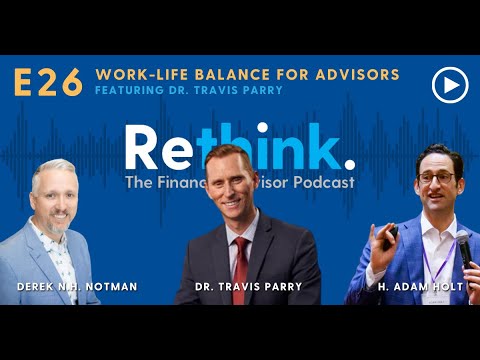
Watch and Listen
Episode Summary
Adam and Derek sit down with Dr. Travis Parry, a recovered financial advisor turned researcher and coach, to unpack why roughly three out of five advisors qualify as workaholics and what that costs them. Drawing on his PhD research and his own father's early death, Travis breaks down the myths of "balance" and introduces his Make Time Method for building boundaries, niching down, and staying relevant as the industry shifts from product-pushing to advice-first relationships. The conversation gives advisors concrete, near-term steps to reclaim their time without sacrificing growth.
What This Episode Covers
- Why 3 out of 5 financial advisors qualify as workaholics
- The "Make Time Method" for reclaiming personal time
- Debunking the myth that balance means doing everything at once
- Niching down and building a digital reputation to stay relevant
- Setting client boundaries without losing the relationship
- Turning personal tragedy into a mission to help other advisors
Full Transcript
Full timestamped transcript.
[00:00:31] H. Adam Holt: Derek are most advisors headed for an early dirt nap?
[00:00:38] Derek N. H. Notman: that's a really interesting question. I , it is a very serious question though.
[00:00:44] H. Adam Holt: Actually doesn't sound like a serious question.
[00:00:46] Derek N. H. Notman: Well, it is, early dirt nap is something I actually referred to as part of my own experience, I think a lot of advisors are, and they just don't know it.
Another way to think about it is like, Hey, are you getting close to pushing up Daisy? Right? Like this job, this profession is not what I think some of us are sold is part of the recruitment process. I, for one was definitely headed for an early dirt nap. And
[00:01:13] H. Adam Holt: early dirt nap.
[00:01:14] Derek N. H. Notman: Yeah. I We're all gonna take one
[00:01:17] H. Adam Holt: as far as depends, I guess, where you're buried, but but we're really saying is you think.
Advisors are on a crash course with calamity based upon what
[00:01:30] Derek N. H. Notman: a lack of work life balance. Right. , we're sold this careers to be an entrepreneur where you're in business for yourself and not by yourself. . And you can go play golf and you can go do all these things you can work when you feel like it.
I found that appealing. I think a lot of people would find that appealing. I don't know. Did you?
[00:01:52] H. Adam Holt: I did see in the early years as I just, by the way I crossed my 25th anniversary, someone just reminded me that. Wow, that's awesome. 25 years. No gold watch though. I don't have a gold watch.
Because I too, like you as an entrepreneur I should say am present tense, but certainly the, you haven't taken on dirt now. Well, it's funny because the way that, that I was told, they said, you'll be overworked and underpaid for the first four years of this business, but if you can survive those four years, you will be overpaid and underworked for the rest of your.
Interesting, right. It was the idea that if you , planted enough seeds, built enough infrastructure, got enough clients in those early years that you would have a different lifestyle and you'd see these guys in the fast cars and the golf courses. Oh yeah. That was the dream base.
Maybe have time back for your family. Attend every event, go on trips five times a year. Right? That's very appealing lifestyle. Even 20, 30 years ago and beyond. But I don't know that after four years I stopped, I forgot to stop and I forgot to smell the roses. Is that what you need?
[00:02:57] Derek N. H. Notman: I think you're, that's spot on.
I think that's a great example. Like being an entrepreneur does not, it's not nine to five and there are risks. Inherent is part of being one. And I would say being a financial advisor is definitely entrepreneurial. I was sold the same bill of goods, but I learned a bunch of really bad habits.
Like what, like working way too much working nights and weekends telling my wife, , you know what, I'm gonna miss dinner again, because I got a meeting an hour away tonight. Know and getting into this cycle where it was just sales, and working too many hours. I didn't have ADI cause I was working so much.
So I, I gained a, I was a Tubby guy, man. yeah. I just, like from the height of where I was, I lost 60 pounds. It's just all these bad habits happened, cuz I was building my business and forgot that I built my business and just kept doing the bad.
[00:03:47] H. Adam Holt: Wait. So I have a question about you.
So since you love controversy, so much, one would argue though, that you created a lot of success and to which you have earned the right to have this work life balance. Now, though, isn't that the irony behind this.
[00:04:04] Derek N. H. Notman: It is the irony, but I think I could have done it faster and with less struggle in the process.
Seriously. Yeah, man, like building a business isn't easy. It's never gonna be easy. Building a practice is not easy. But it can be easier. And I think if we start off with some better practices early on some better habits, like, how the hell am I supposed to advise my clients to. Be there for their family to save for the future to enjoy retirement.
If I am stressed to the gills, I'm leveraged because I'm spending all my money on flashy suits and cars and watches and I did, man. I had bought all that crap early on. It was just, it was so stupid. Cause I thought that's what success was supposed to be and turns out it didn't make me feel any better.
So how am I supposed to advise my clients on how to live a really great life? If I can't even figure it out?
[00:04:56] H. Adam Holt: Just wait till you find out that wealth is not all that it's cracked up to be either that you certainly working for what I thought I was working to be wealthy when I really all wanted to be was healthy and financially well that's, I think that's the interesting thing I've taken from this over the past.
This journey's been interesting because, I have seen a lot of advisors, like you burn out in the world, in the business. I have seen a lot create enormous success and be miserable. I've seen plenty of clients that had more money than all of us combined on this call and still can't find their true purpose.
And of course I have seen plenty of advisors waste a lot of wealth and money on stuff that wasn't real, that didn't really matter throughout time. And it's almost challenging because you almost have to go through that to recognize. it It's hard to tell even my child, oh, this is what you should focus on.
Gratitude, gratitude, dad, I just want the cake. I want another piece of cake and it's not I, to force somebody to see that even on this podcast, right. We could be saying something to you that everybody on this call knows. Right. We all know we would like to have more. Work life balance, not just for ourselves, but for our families who are looking to us to have a relationship with us.
Right. Totally. And here we are. Well, I thought I was doing this for you, right? I'm creating security and financial certainty and it could fall apart any minute. So I gotta go back to work because now that I've created it, now it's gonna fall apart. So you get stuck in the cycle.
You
[00:06:21] Derek N. H. Notman: totally do. And then you wake up and 10 years goes by, your kids are older, your maybe you're not talking to your spouse as much.
Right. Like bad things happen. So it's true. I don't know, man. It's it's an interesting, it's been a really interesting experience. I, so I, for me, , I think there're are really three ways to learn something or to learn how to not do something you can read about. You can learn by doing and failing and figure out what doesn't work, and then you can learn from somebody else.
And I'll tell you, I'd like to learn from a book and somebody else before figuring out the hard stuff myself every day of the week, but you're right. Some things simply can't be learned until you actually go through it yourself. But even if you can make the mistake and make it like a shorter window of mistakes, right.
Cause you're learning from others, like, oh, I sh I'm gonna avoid that pitfall. I'm gonna hit the next one probably. But I'm gonna avoid this one at least.
[00:07:10] H. Adam Holt: Yeah. Right. It's true. That's interesting.
[00:07:14] Derek N. H. Notman: I don't know, man. , hopefully we're able to be that example and I, well, we've got a guest today. That's gonna be able to help, here's some pit balls try to avoid
[00:07:22] H. Adam Holt: these.
Right. It's true. And I can't wait to share this with everybody. It's funny when you bring up how people learn. I think I'm the person who learns from falling all the time. I'm that person. Who needs to actually have the experience so that I can say no, oh, that's the pain I really need to have to go through it.
It's not real until you actually go through it, by the way, it builds character. I've been told that to go through life scars.
[00:07:42] Derek N. H. Notman: And so, oh, it does. It does. It does. There's no question. Think about how much time I would've saved. Oh my gosh. But some of it just really sucks and , if you can avoid at least some of it.
That's cool.
[00:07:54] H. Adam Holt: Yeah. Well, it's true. I'll leave you because we do wanna talk to Dr. Travis, many of you know, Dr. Travis, obviously you were listening to this podcast, we interviewed him. But I will tell you one thing that kind of opened my eyes recently, someone told me that 85% of the time that you will spend with your child happens before the age of 1280 5% of that time, you will have already spent.
That you're ever gonna spend with your child happens before the age of 12 mine. You can figure that one out. I, once I said that my daughter started crying. Do you believe that? I said that to her and some, I was trying to teach her gratitude. Right. And she just started crying.
[00:08:30] Derek N. H. Notman: I wanna start crying. That's sad, I
[00:08:32] H. Adam Holt: know.
Well, sometimes the truth. See, I'm taking you through perfect experiential learning that the truth hurts. Love it. There you go. All right. Well, I'm trying to bring it full circle. Why don't you tell us who joined us today? This is really
[00:08:43] Derek N. H. Notman: special. Yeah. So Dr. Travis Perry, really cool guy, he's actually a recovering or recovered.
I'm not even recovering more. He's out. He's a recovered financial advisor. So he is been in the shoes of a lot of our listeners. He actually has his PhD, hence the doctor, and he's done a lot of research around the association between shared goals, values, beliefs, and financial stability, happiness, and so forth.
So really cool. I, a little bit of more backstory and you'll hear him talk about it, but. He began his career as a financial advisor became quickly overwhelmed. Like we just talked about with all the stuff that's going on in life and found himself in when he calls a workaholic trap. And then what happened for him is that his dad actually passed away unexpectedly at 49 years of age, really young.
And I think that was the thing. That got him to say, all right, I gotta change. There's gotta be a better way to do stuff. And that put him on this path to studying health, stress goals, achievement, and in the process has been able to help. Like 500 a thousand advisors already.
He's really done a lot. So anyways, I enough, we just want to get him here. I think we had a really great chat with him and we're gonna learn a lot from him, so let's see what he has to say.
[00:09:55] H. Adam Holt: You got it. Here's Dr. Travis.
[00:09:59] Dr. Travis Parry: So start as a financial advisor, 2002, 2009, I went back to school to get a master's degree in psychology, cuz I really wanna understand this whole balance thing, goal achievement.
How does this all work together? Strap the body. And quite honestly, when my father passed away, I was really interested in health and the psychological health, the stress part of it fascinated me. The more I dug. The more I realized the majority of our stress in life comes from our family and our relationships or lack of it or problems with it.
And so to really dive deep into where this is coming from, I did a PhD in family and human development. And then I came out of the academic cocoon and said, advisors, I wanna help this field because as an advisor myself, I know that I needed this. And it's likely that the entire industry lacks and it's some research with FBA and found that, yeah, the theory is true.
Three out of five advisors are workaholics or would be classified as workaholics. And so my work began. That's
[00:11:11] H. Adam Holt: fantastic. But you spent so much time, not only as an advisor and as an academic, give us a feel for your take on the financial advisor market today.
[00:11:22] Dr. Travis Parry: This is a moving and shaking field. I'm seeing a lot of change, like more change than ever before with tech, with consumers having access to FinTech, I'm talking to FinTech CEOs right here, who get it.
And so there's a lot of moving and there's a lot less of product pushing and salesmanship. And it's more advice. It's more, if you want that. It's not just a trusting relationship. It's really understanding why clients wanna do what they do. Understanding behavior has never been more important with the CFP board, bringing on more of the psychological aspect for advisors.
This is key. And a big part of that is if we're as advisors, if we're not living it ourselves and we don't understand our own psychology and our own behavior. With balance, our relationship with ourselves, how can we help other clients to have balanced lives and with their financial picture?
[00:12:24] Derek N. H. Notman: Yeah, that's really insightful.
Travis. Thank you. And it's funny, you say you bring up the CFP board and their new psychology category within. And as a quick side note, I just actually got connector approved for CF PCE credit. Partially. I had a direct conversation with them because we covered the psychology as part of our program. So you're spot on with that.
Given your perspective of what would you say that advisors aren't addressing right now or don't even see coming?
[00:12:56] Dr. Travis Parry: I think if they're not. Super focused on who they're helping. They're gonna get drowned out very soon. The internet, social media, everybody now does talks to try to help the younger crowd. If we don't understand the speed, the momentum.
Of information is changing, not just the access, but it's the momentum, it's the speed of which consumers can come and find out. Where can I get advice from these advisors? If they go and Google advisor for pilots and that's your specialty and you don't show up, you are gonna be out of business.
That's just what's happening. If you're not nicheing and you're not scaling, you're literally not staying put you're going backwards in the. Current atmosphere that we're in. You've gotta be a thought leader. You've gotta be seen as a thought leader. Whether you're writing a book, you've got a podcast you've, you're developing content for that niche.
They need to be able to say, oh, that's the guy or gal for me, cuz that's me. Does that make sense? If you're not doing that? I think that if financial advisors are really gonna find themselves. Out of business or in a place where their business is going backwards and they're scrambling to catch up. And it quite honestly, it's a zero sum game after.
[00:14:11] H. Adam Holt: Yeah, that's Derek. And I have talked about that. So many times being relevant in a space that's moving very quickly. Most of the advisors that we talk to don't know, necessarily know where to start. They've maybe got indoctrinated with the old, the networking or the prospecting methods and not necessarily being, we'll call it available or accessible from a digital reputation standpoint.
So I'm glad to hear you saying that you've done so much work on this idea of balance and achieving balance. Tell us how that is really being adopter or what advisor should be paying attention to with that concept. So
[00:14:41] Dr. Travis Parry: three out of five, as I mentioned, likely are working 55 to 60 plus hour weeks. That's not living the dream.
Most advisors get into this industry for three main things. So the three Fs. Freedom flexibility. And the almighty dollar finances, we didn't do it for the, obviously we'd be therapists or something, cuz we're helpers. We wanna help people. We wanna give advice and we get a kick out of our clients, taking that advice, applying it and seeing the outcome.
We love that we wanna help people, but having that freedom and that flexibility and then. Having the rush of knowing that we get paid really well for doing a job well done in this industry can create what I call the workaholic trap, where if we're not careful and we give our, all only to our business and our work, we get stuck.
Cuz what happens, markets are crazy. Oh no, I've gotta. 30 hours more this week than I normally would. Why if you train your clients well and you understand boundaries and they understand boundaries, you can give them the advice that they need in these times without going crazy. What I've found in all of these interviews is that.
When advisors get stressed, they work more, they don't work less, which is opposite. What they should do. If you really wanna be balanced, you take your time off, you take care of your relationships. You take care of the things that really matter the most, the business will always be there. It'll always be there.
Yeah, there's up and downs like the market. But if you create boundaries, you set that aside and when you train or your clients know, and you train them on how to interact, man, it's a breeze, right? Derek, I know you work just a minimal hours a week doing this. Like you're practicing, you're a balanced advisor.
You know how this works?
[00:16:33] Derek N. H. Notman: I do now, but it didn't start that way. I've totally felt victim. Like I remember being hired. I'm talking all this money I can make, I can work whenever I want to. And blah, blah, blah. I'm like, oh, that's awesome. Sign me right up. And then I am like, man, I'm working 60 plus hours a week.
This kind of sucks. What happened to the three Fs? So I get, if you have like maybe a top two or three, things, then an advisor listening right now could do to say, all right, my balance is all messed up. I can do this right now or in the next week to start finding balance the way I really wanted it to be love it.
Most
[00:17:10] Dr. Travis Parry: advisors think I just gotta manage my time better. It's true. But it's a myth that somehow being productive is the magic pill I talk about in my book, achieving balance, there are three main myths. The first one is that balance is doing everyth. All at the same time, we've gotta get past that idea that I can do everything.
I'm on this podcast right now. I'm doing nothing else thinking nothing else. I'm here. I'm focused. I'm present. If I do a horrible job, no, one's gonna care about my book. If I am answering the phone call right now or texting, it absolutely goes against everything that I believe be present, show up. So don't do everything at the same time, have goals and values that you prioritize second.
Yeah, it's great to be productive. In fact, the make time method is be super productive at work, and then the time that's save. Invest it outside of work. I had a client who was like, Travis, thanks for teaching me how to be productive. Now you got me down from 85 hours to 50 hours. That's awesome. However, I'm now really tempted to just keep working.
I call those productive workaholics. You know who you are, you're out there. You're listening. You're like, oh, me guilty. Right? Yeah. And the reality is because we love what we do, but that is not an excuse. Just because you love, it is not an excuse to let go of those things that are more important in your life.
You have things more important in your health, your spirituality, your relationships with your family, your spouse, those things we know are more important. Those are the top three or four. I hear every day. So. Create an ideal calendar that allows you to actually build those in. So those are your boundaries.
Otherwise it'll just keep going. You will continually work until you have things outside of work that are more important that you just get a kick out of. It's not gonna be exciting to go home. If you have struggles in your relationship, if you have bad health habits, you're not gonna wanna go to the gym.
But if you love going to the gym, you love riding your bike. You love standup paddle boarding, whatever it is. If you have great things you do to
[00:19:11] Derek N. H. Notman: surfing, get you out surfing,
[00:19:12] Dr. Travis Parry: let's throw that in there. Or standup paddle boarding in surf.
We'll talk about that later. Or maybe never inside
or love hanging out with your family.
Love going on trips. Like I do. Drives me to work hard, to be productive in the 30 hours I work and then take 12 weeks off and enjoy that time with my family. The third thing I would say is that don't do this alone. Once you have an ideal calendar, once you've built it and it's based in your priorities.
Use your spouse, your family, coworkers, to help you to stay accountable as you're building your business, as you're growing it becoming more productive, it's gonna be a bigger pull to be like, oh, I'm more important. Now that I'm making more money. Or now that I have three companies, instead of one, if you can keep your boundaries in place, don't matter how much you're worth your family, your health spirituality, all those things are way more important.
[00:20:07] Derek N. H. Notman: Follow on question to that, Travis. And we've talked about this before. You've talked to over 500 advisors, probably even a lot more than. What's this thing that you call an ego bomb. I'm really curious cuz I think there's like what people see and then what's actually happening behind the curtain. I'm
[00:20:27] Dr. Travis Parry: curious.
Whenever I do training with advisors about balance, we look at where they spending their time. Cuz time is important. As I mentioned, it's not the magic pill, but it's important to know where you're spending your time. So you can. And I come up with something called the work sweet spot, just like hitting a baseball out of the field, growing up, I playing baseball.
I'm like, man, it doesn't even hurt when I hit it. There's no ring right on my arms. It's just pure gold. When advisors are in their sweet spot, they are doing the things. Not only that they love doing, but are the most productive and the most exhilarating for them to be accomplished. So that's typically the top five or six activities.
But what I find is most advisors are only there. 25, 20% of the. They're wasting time. Oh, they're productive. They're busy. Let's say that they're busy, but they're not necessarily productive as they should be. If they were just focused in the areas where they should be, they could delegate, delete, automate, get rid of these other processes, hire other people, grow their team.
Okay. If they were able to do that, then there's no. They would have much greater balance. But the reality is when I, after I do these exercises, oh yeah. I work 45 hours a week. Okay. Sure. By a time we're done. And we look at where all the activities are, 65, 70 hour weeks without fail. They go, oh my goodness.
I can't believe I've actually worked that much. Yeah. It's because you're what I call fake balance. You think that you're balanced, but until you go through this exercise, which I have in the book and which I do with advisors every day, help them walk through this. They're not putting the mirror up in front of their.
Okay. And they create a reality in their mind that I'm doing everything right, but it typically comes off like this. Oh yeah. I'm not perfect at it, but , I'm working 45, 50 hours a week likely it's 65 70. So they've never tracked it. They don't know where they're at. And until they have an experience like this, a lot of times they won't make a.
[00:22:29] H. Adam Holt: I, this is fantastic. I'm thinking about this for myself and I'm challenging as I listen to you to try to be honest. Am I really working the range of nine to five 30 that I have set forth for the past 10 to 15 years? Yes, I am working during those times, but I know I'm working on the weekends because I do love it.
And so I'm really questioning. So I appreciate that, that comment. I'm curious in closing, , is there anything that advisors really need to hear? They're just not hearing the message, like perhaps I wasn't a second ago that you'd love to share.
[00:23:03] Dr. Travis Parry: Yeah, fear. Let's talk about fear. The last chapter of my book, achieving balance, I threw in a chapter on fear.
Why, if we're not careful, that's our motivator fear drives us. It drives us in a negative direction, unfortunately, and a lot of times it can help us do good behaviors. I'm afraid I'm not gonna hit payrolls. I ever work more or I'm afraid that I'm gonna offend a client or not get the client. So I'm gonna do something different.
If we can come from a place of love. And the highest motivation in our life really is love. It's being a parent, it's being a spouse, a Maslow's hierarchy of needs. I explained it in the last chapters of the book has been totally revised. It's not self-actualization, it's not individualism. It is parenting mate retention and mate acquisition, for lack of a better word.
I love it. but it is about. And I know at the heart and soul of balanced advisors, they love their family, and that is their motivation to be healthy, to be spiritual, to be a better man or. and that is what I think we need to hear. We need to hear get back to these values that society is trashing. Get back to those values that we know is true.
It's not a political statement. This is a spiritual statement. This is a statement to revise your life and move towards motivation of love that drives you. If you're dealing in fear, a lot of times it's SUBC. It's not happening consciously. You're not actually trying to make those thoughts, subconscious ideas and thoughts that we can help you unravel.
And really, if you don't struggle with the ego bomb and you can at least set that aside for a minute and you want more discussion about that, we can help you. Walk through that and really discover my suffering from fear of failure, fear of success or something in the middle or both. And we can help you really start taking action if you're at the point where you're ready to hear the truth.
[00:25:01] H. Adam Holt: Now, that was pretty interesting. I loved what he said at the end. We always get these fantastic mic drops. The end. You notice that? Yeah, totally. We do.
[00:25:11] Derek N. H. Notman: He comes from. A really like a place of genuineness, , and passion clearly, with where he's been at. It's very interesting. And I, somewhat inspiring to listen to the guy.
What was one of the main things that just hit you over the head in listening to what Travis had to say?
[00:25:28] H. Adam Holt: Well, my notes and I'll share them with you because. I thought it was really funny when he said family and relationships create stress, or at least that's how I interpreted it.
that? Did I, and maybe what I've chosen to interpret about that was cuz his thoughtfulness is obviously deeper than mine. He's he spent some time considering this is that perhaps it's the obligations and expectations that we've made for ourself. Or we think that other people have for us create undue levels of stress.
That causes because of fear to work beyond the place where we know we need to stop, or we've dipped into our health bucket and we're now sacrificing presence or time because of fear of being judged expectations, losing it all, whatever it might be. And I thought that was interesting because it's true.
Most of my friends over the years that didn't have family members, they could work 90, a hundred hours a week. They didn't care. Yep. That was their purpose. What about you?
[00:26:24] Derek N. H. Notman: Yeah, I think I'm in the same camp as you are. There's just like, it's not that your family is the source of stress. It's that?
What you're trying to do for them is the source of stress. And when you're outta balance, man, the whole thing just gets outta whack. And it, it adds to that stress, I guess you have a choice, you can just get rid of your family just it's a different stress.
No, don't do that. Keep your family. Yeah it's a really interesting dynamic. I think that, definitely. If advisors don't figure this out from a balance perspective and understanding this psychology. And I know it sounds a little hokey friends. Okay. I get it. But this stuff at the end of the day, man, we're all wired like this, and if we understand them better, I think the stress will go down. But we're also going to be like a really awesome example for our clients to have like this financial wellness and. I don't know about you, Adam, but a lot of my clients, especially the really wealthy ones, they don't care so much about the money, the wealth they care about.
What can I do for my family, for my community, for future generations. It's this quality of life stuff. And if we're gonna help them with some really important decisions, shouldn't our own house be in order to. I don't know. That's where I'm seeing it at. And then like it like an off tangent from that, which out of the balance realm is , He's talking about go niche or go out of business.
And we've talked about this with numerous guests before, but I'm a hundred percent in an agreement with that. That's definitely what's happening right now. So again, you've heard it from someone else it's talking about balance and they're still saying, Hey, go niche or go out of business. Yeah,
[00:28:02] H. Adam Holt: that's true.
It's funny. I the leading by example thing is a big one. I'm glad you picked it up because. It's we forget sometimes that we are very often this shoe cobbler's children's story. Right. We have totally, we're telling everybody what they should do, how they should do, how to create a more wealth.
, well, rounded life right. Do the insurance do the investment, do the structure, do the tax, think about the stuff. And we don't lead by example. So we don't get the opportunity to say, well, here's how I did it specifically. Here's the vulnerable challenges that I dealt. Very similar to you and here's how I've chosen to address it.
And it's a work in progress. It's not a, oh, we're just gonna fix it. And it's gonna be done. Many of these things are in fact behavioral and they come from habits that are learned over time. I have a big kind of awareness recently that we've been focusing so much on the high net worth clients, cuz those have been our clients of financial advice.
What's the rest of the planet doing right? 55. Some percent is living paycheck to paycheck and supposedly over 40% of those making over a hundred thousand dollars are literal. Don't have a rainy day fund cuz they're spending it on iPhones and Netflix, I guess. But the point is that there's a kind of time component of this as well, which is that our time actually has a lot of money too.
And we keep wasting it for the almighty dollar too often. And I love that he picked up that freedom, flexibility and finance is why we got into business. That's what you opened. Totally. But balance is really tough. Even in nature, even in, in, in the whole planet, standing on a ball is not easy, right.
Balance is hard to achieve. And I think I've been looking at balance as everything's gotta be in order. And I got equal waiting in category and it's not about doing everything. It's about being intentional. I think that was really.
[00:29:32] Derek N. H. Notman: Yeah, it was a great point. And further on that point, about balance, like you don't know that you're out of balance or that, you know what balance isn't, til you're out of it.
Right. You have to get outta balance and even like looking at like your client's allocations, if we want to get nerdy for a second, . It's not, , maybe you're a 50 50 portfolio person, I don't know, but like allocations get outta whack. Right. And you've got allocations to this and to that, and they drift and we have to get 'em back in from the drift.
So I think there's something to it, but like it's not a perfect thing. It's something we can achieve for, but it's a living thing that's always gonna evolve.
[00:30:08] H. Adam Holt: Well, you just brought up something really interesting. Why is there no efficient frontier for work life balance? Oh man. You think about that?
Whoa, that's pretty cool. Can, I have an auto rebalancing on my calendar that once it starts to see me work too much, all starts scheduling a bunch of fun stuff. Like that would be pretty cool. I think
that's like you got, we gotta trademark that copyright it, IP, whatever man. That's our next business venture.
After we do our current projects, we'll go and do that one, cuz
yeah. Dr. Travis, you should write that book. The efficient frontier of time
[00:30:39] Derek N. H. Notman: manage. Oh my gosh, Travis. That is, that was pretty cool. He's gotta do that. Yeah, we get royalties on that. Don't
[00:30:44] H. Adam Holt: we? I doubt it. We did it after the fact you keep messing this.
So So Derek, what were your takeaways for everybody can put into action. Well,
[00:30:54] Derek N. H. Notman: I mentioned one already go niche or go out of business. You have to be a thought leader today. And I'd argue, you can tie this back to balance a little bit because when you are speaking to everyone and you don't niche, you are just like this shotgun approach and you're all over the place.
And now no one listens to you. So there's some, maybe an argument here that if you go niche, you actually are able to find a bit more balance. For your business, right? For the predictable lead generation and all these things. So be a thought leader. Balance is not a myth folks. I'm gonna elaborate on this cause we have a follow up here in a second on what I mean by this, but try using the right type of vision board.
This is something I found a lot of value in and I'll elaborate in a minute on that. And again, like we talked about this as far as being an example for your clients, loving what you do, like being an advisor is. There's a reason, Adam and I are still actively practicing advisors. In addition to all the other stuff that we do love it, but it's not an excuse just because you love it to sacrifice your health relationships and so forth to set boundaries.
What did you have Adam, tell
[00:31:54] H. Adam Holt: me no, that's good. I'm still getting reminded to have. Boundaries because I, I think I'm too passionate about so many things I keep taking on more projects. I also wrote down that my takeaways are, or create an ideal calendar to create those boundaries. Just to get you an idea I'm always overworked.
There's plenty of stuff to do. There's plenty of things I would like to do in work. I'm at the office at eight 30. I leave at five every day, no matter. I just accept the fact. I'm not gonna get it all done and it's gonna have to wait. Who's not gonna have to wait my daughter. Yeah. She's not gonna have to wait.
She knows I'm home her entire life at five 30, no matter what, thing's on fire. And I have decided to use that as my leverage point to force me to stop because I do love my business. As I two will share in a second. Number two I heard this really recently from my own coach. I keep a coach, as many of you do.
He said, you talk too much about the time value of money of your clients. You're not talking about the monetary value of your time. And I was like, well, that sounds cool and kitchy, but what does it really mean? And of course, this is one of those things you need to think about it.
The time is more scarce. Then the money. Okay. Just think about it like that. The time is more scarce and it's certainly not guaranteed and there's no insurance policy on time. And so therefore you should value it more than money, dude. That's proprietary value. I know. Right? Mic drop,
[00:33:11] Derek N. H. Notman: mic it, mic to drop. I'm gonna drop it.
Actually right now, drop the mic.
[00:33:15] H. Adam Holt: Just for fun. I thought it was cool. The take away that he said , he said it was a team sport. And I use this phrase all the time, same team, you know, when we were kids on the playground and someone had the ball you're on the same team. You don't notice.
You're so busy looking at the ball, you're fighting over the ball with your own team member. right. So that's when you yell out same team, right? And you realize to put your head up and see where you are in context, and the fact that he mentioned that it requires you to get on the same team with your family members, so that you are supporting the same things with your time spent, not just your money spent like honey, do we value the same things?
Let's value the same things in our time. Be intentional about that. So that's the that's my takeaway is that balance is about intentionality and being choiceful as to where you're spending your. Short lived unfortunate time with gratitude. Hopefully. How about that? That's money all right. So instead of doing a community question, Derek had a great idea.
One, it happens once in a blue moon and he said, let's share our own backhanding
[00:34:09] Derek N. H. Notman: compliment.
[00:34:12] H. Adam Holt: It's a Philly compliment. so, so share me. So what is your personal experience? This is vulnerability moment. Here you go. Yeah, here
[00:34:23] Derek N. H. Notman: you go. And it's all it ties right back in the bound often. ITST well, why Googled this?
And I just copied it. So I don't know. This is somewhere no. When I got into this business as an advisor, and even maybe before that, like I had been wired a certain way, especially when I got into this industry and just all of the folks that are in this industry, , I was like, all right, this is what I gotta do.
If I'm gonna be successful. And. I gotta have a car, like or multiple cars, sports cars, I gotta have expensive watches. I gotta have a suit every day of the week. I have a big house. Like I gotta do all these things. So when I did, I created a vision board with all that stuff on it, and I put it at my cube.
I was still working in a cube and then I got all that stuff. What happened? I was more leveraged than I should have been. I was fat physically and the happiness was sucked outta my life. I was working so many hours and it just it just didn't feel right.
And this is one of those things we talked about at the beginning of the show. I had to learn this one the hard way, unfortunately. And so what I did is after going through. This hail storm, hail fire here. I just literally changed my goals on my, and I have a physical vision board. I did this with my family and instead of just putting material things on, and there's still some material stuff on there, but I put like, Health great marriage, great relationships with family and friends travel spending time with my son one on one to do the things that we want to do.
And all of a sudden what happened. I started making more money. I started working less hours. I was achieving all of these things on my vision board. I lost weight. I got happy and it was amazing. Like I just changed the inputs of what I thought was important and really necessary in life. Not what everyone else thought.
And I was like, holy crap, this actually kind of works. I still had to do the work. But I got to get smarter about it and work less. And man, I'm in a much better spot now than I was in the early years of this business. So there's a little insight to me. Share. Yeah, man. So there you go. Like, I'm sure you've got me.
Heck you just hit 25 years. You've probably got a little bit more to share than I do. I'd love to hear it. No,
[00:36:32] H. Adam Holt: just more. Yeah. More challenges. More. I appreciate the share, we all do. We all have we all go through a path? It sounds eerily familiar sometimes. And. Sometimes we're still learning. I hope that we never stop learning.
If you asked Dr. Perry about me, I, he would tell you that according to his thing, I'm a productive workaholic. My, my goal in this business was before I had kids, was to get to age 35, make a quarter million dollars a year, work 20 hours a week and spend one month in Europe.
And in one month in mountain skiing, that was my idea. That was my vision board. That was in my head. I kept telling myself that's what I was doing. And when I got to 35, I had actually achieved that and I was bored. So I was, it's funny. I, my hobby, what was my hobby at the time I was building technology and building cool processes and doing art and building furniture.
And I. I just filled all my time. And what happened is in order to do more and more hobbies, I need more time. So I just kept compressing my business time until I got it to one day a week. And ironically, I was making twice as much because I was just more efficient and more routine and more regiment. And then I only worked on Tuesday.
I got it to a point where I only work in the business Tuesday and I was making at that 0.4 times what I was thinking, I was. Why amazing because I just kept focusing. Now. I'm not saying that I figured it out balance wise because I still work eight 80, a hundred hours a week cuz I love it. And it's moments like this, listening to Travis that I have to remind myself that.
There is much more to life than all of your hobbies and projects. There's time that you need to spend with other people and to be mindful of that. And that's where I gotta get reminded in my own life is to make sure that I spend time with the people who wanna spend time with me, even though I might wanna do my project.
And I love what I'm doing. I need to make space to meet other people's needs too. And that's the work life balance that I'm currently working on today. So find out what that is for you, but you gotta be willing to ask yourself the question. Yeah. With that in mind, I know we've gone long, but but I hope this was impactful for everybody here.
Thank you, Dr. Perry for this for such great contributions, Derek, why don't you bring us. Yeah,
[00:38:27] Derek N. H. Notman: thanks everyone for listening. We hope you found a ton of value. There's a whole bunch of links in the show notes to some resources that Travis has that we have. Come on folks, please make sure to , subscribe to the rethink podcast, share this with others.
If you have an idea of something we want to talk about and unpack, , let us know, send us a note like we're here. We want to hear from you. Problems stressors issues. We're here to talk about it and it's okay if it's edgy. So anyways, thank you all for listening as always. We love it. Adam man, it's been a pleasure chatting with you as usual.
[00:38:58] H. Adam Holt: Of course it is, man. I look forward to our next opportunity to spend some highly valuable time together. a hundred percent my man by everyone. We'll see later.
The content has been made available to you by Asset-Map for informational and educational purposes only.