
Ep20 - Rethink: The Risk of Advisor Complacency – Featuring Aaron Klein
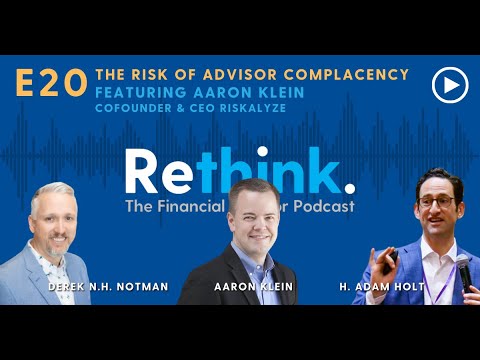
Watch and Listen
Episode Summary
Riskalyze's Aaron Klein joins Adam and Derek to explore how easily advisors can slip into complacency by leaning on outdated technology while fintech keeps advancing around them. Klein makes the case for where human advisors still hold a durable edge over robo-advice, how to talk about risk with both new and existing clients, and what to actually prioritize when choosing and integrating new tech.
What This Episode Covers
- Where human advisors still outperform robo-advisors
- Communicating risk clearly with new and existing clients
- What to prioritize when selecting and integrating advisor tech
- The cost of relying on legacy systems
- Meeting rising digital-first client expectations
Full Transcript
Full timestamped transcript.
[00:00:00] H. Adam Holt: Welcome to Rethink, the Financial Advisor Podcast. My name is Adam Holt.
[00:00:06] Derek Notman: And this is Derek Notman. We are your hosts, both veteran advisors and fintech CEOs who challenge the status quo, question everything, and have fun doing it. Hear honest commentary on the challenges facing advisors today. And be part of a community where we can all rethink the profession.
Now on to our episode.
Adam, are you managing your complacency risk?
[00:00:36] H. Adam Holt: My complacency risk?
[00:00:38] Derek Notman: Yeah.
[00:00:39] H. Adam Holt: I don't know. I'm too-
[00:00:41] Derek Notman: Are you too complacent? ...
[00:00:41] H. Adam Holt: bored and sloth-y to answer that question. Too much brain power. I think I'm gonna go play golf.
[00:00:47] Derek Notman: You should probably take that tub of ice cream off your desk then.
[00:00:51] H. Adam Holt: Oh, gosh, I need to... Well, it was this or do some, like, financial planning for somebody or make some prospecting calls.
I don't know. Or go play golf. I could just go play golf.
[00:01:01] Derek Notman: Or surf.
[00:01:02] H. Adam Holt: Or surf, yeah, that's right. Get some surf and turf. Hey, let's do that. Let's go mate. Done. Let's have my ADD come in here. What's up?
[00:01:10] Derek Notman: Done, done.
[00:01:12] H. Adam Holt: I would love
[00:01:12] Derek Notman: that. Well, I, I think this is a big, bigger risk than a lot of advisors realize. You explained it to me in a really interesting way previously.
I'd like for listeners, just give us, like, the, the two minute, like, what is complacency risk?
[00:01:26] H. Adam Holt: All right, so this w- this is an interesting idea that we came up with, and one of the... It comes out of a lot of things, Derek, that we've seen, which is we talk to a lot of advisors. They're all asking us about whether they should retool, whether they should re-platform.
Maybe they should change up structure completely. Should they add people? Should they not? And these are all good business development questions, and we're glad. You should be asking these questions because it shows that you're not complacent. You're challenging yourself by saying, "I know I need to grow," because if you're not growing, you're doing what?
You're dying, okay? You're dying In fact, worse. But we have seen, 'cause we don't get to talk to everybody, probably 80, 90% of the market of financial professionals just sitting around fat and happy, and they're not changing anything. They're not asking questions. They're not wondering about what's coming. We talked about a tsunami coming in the last episode with Jason Wang.
Check that one out. We talked about this digital revolution. We talked about expectations are changing drastically. I think a lot of financial professionals, Derek, have gotten complacent because between the market growth and their established way of doing business, it ain't broke, don't fix it. Okay? And so they're setting themselves up, in our opinion, with this complacency risk that they're going to get a mad rude awakening, and it's gonna come in the form of either disruption to their business practice or a disruption to their margins.
And I really am trying to impress upon everybody the importance of being intentional and mindful about how do I keep growing and avoid complacency risk?
[00:03:11] Derek Notman: I- that nails it. I think that's spot on. It is a risk we all face, whether we like it or not, and we're not saying n- like, facing that risk means you have to work 100 hours a week.
That's not what we're saying. You can be managing that risk at 10 hours a week if that's all you wanna do and play golf the other four days. Mm-hmm. But it's something that has to be addressed. You know what would be cool, and this is a nice lead-in to who we're talking to today, is could we get a complacency risk score?
[00:03:41] H. Adam Holt: Whoa.
[00:03:42] Derek Notman: How cool would that
[00:03:43] H. Adam Holt: be? How would you measure that?
[00:03:44] Derek Notman: I don't know. How would you calibrate it? I don't know. That, that's above my pay grade, man. I don't, I don't know. But that-
[00:03:48] H. Adam Holt: Oh, I c- I know what it is. Okay, so if you haven't added a new piece of technology in the last two years-
[00:03:55] Derek Notman: Ooh ...
[00:03:56] H. Adam Holt: if you haven't integrated existing infrastructure, if you haven't figured out a way to scale advice, if you haven't figured out a way to make it easier to do business with you, you've got a high complacency risk score.
Ain't going there. Dude,
[00:04:12] Derek Notman: I love it We should create a tool like that for advisors to, to test themselves
[00:04:18] H. Adam Holt: I'm a little too busy. Listen, maybe eventually I'll get around to that. I
[00:04:21] Derek Notman: mean- You're just too complacent.
[00:04:22] H. Adam Holt: Hold on. I've still got to finish this ice cream. Yeah. Well- I would love ice cream right now, by the way.
[00:04:28] Derek Notman: I think it, it's a great topic, and it, it's gonna tie into the value of human advice and just risk in general and all that, and we've got a pretty cool, uh, cool dude we're gonna talk to today. Uh, are there any other things you'd want to add here that people should be thinking about as we go?
[00:04:45] H. Adam Holt: Well, I... You know what's really interesting, because a- as, as Derek is leading in, we actually asked our good friend, someone who's become a good friend because he's such an advocate for the advisor and he's so open and willing, and I think he's done a great job.
Aaron Klein, the CEO and co-founder of Riskalyze. And if you don't know Riskalyze, Riskalyze is, is right now the leading platform in the States at least, uh, one of the fastest-growing for... 'Cause they figured out how to solve a problem that wasn't broken, right? I mean, I think so many of us were used to the typical Ibbotson risk analyzer.
What are you? A moderate plus conservative. Think it was like a political spectrum, right? We... Nobody ever knew where they sat on this, this range. I don't know that kinda coming into 2015, '16, that I thought risk was broken. We just accepted it. We were complacent. It was just the way you always had to do it.
It was a regulatory compliance pa- you know, component of your process. And the interesting thing about it, as he kind of touches on, I don't wanna s- I don't wanna k- give away his thunder here, is I realized after listening to this how much this actually applied to me and my own biases. So I, I hope that when you listen to this, listen for this for yourself, because Aaron always does a great job of really framing a, a perspective.
But listen to this, because there is complacency, bias, fears, and something that we all have, and I think what Riskalyze did is they, they, they proved that it was broken, and they, they proved it actually after they fixed it. Um, so I think that's really, uh, an important aspect of this. Derek, you ready to hear from Aaron?
[00:06:10] Derek Notman: Yeah, I always love chatting with him, so let's get it up and running.
[00:06:13] H. Adam Holt: All right. Let's hear Aaron. So Aaron, what is your perspective of the financial advice market today?
[00:06:20] Aaron Klein: Uh, you know, it, it's so incredible how our, um, market is changing, but still the same all at the same time. And what I find really interesting is that financial advisors often have a really hard time appreciating just how much value they bring to the table for their clients.
We're only like seven years out from that moment when Wealthfront announced that they were going to completely obsolete financial advisors, just send them the way of the dodo bird. And I remember, like, when that was said, I, I, I happened to be, like, walking into a financial advisor conference, and somebody stuck a camera in my face and put a microphone up to me, and they were like, "What do you think about these comments from Wealthfront?"
And I was just like, "Wealthfront is E-Trade with a shiny coat of paint, okay?" And it was... I, I think later that day, their then CEO, Adam Nash, blocked me on Twitter. But nonetheless, I remember like a couple weeks after that, speaking at a conference of financial advisors and just saying, "Look, you can't..." I, like, people, advisors were asking me all the time, like, "I, I'm trying to figure out how I'm gonna compete with 25 basis points."
And I'm like, "In the race to out-robo the robos, you will lose. In the race to depersonalize your services and go to the lowest common denominator, like the venture capital money is gonna win. Like, go the other way, and let's be confident in the value that we deliver to our clients." And I, I look at what just happened with Wealthfront being sold as basically a lead generation engine to the, one of the world's largest and most successful banks that is powered by h- thousands of human financial advisors, and I just go, "UBS just cast a $1.6 billion vote of confidence in the human financial advisor.
We won."
[00:08:09] H. Adam Holt: That's
[00:08:09] Derek Notman: a great perspective Mic, mic drop right there, right? I mean, seriously, we won. We did win. I love it.
[00:08:14] Aaron Klein: Yeah.
[00:08:15] Derek Notman: Oh, man. I, I wonder if you're gonna get blocked by anybody else on Twitter.
[00:08:20] Aaron Klein: One never knows.
[00:08:21] Derek Notman: One never knows. It's possible. Uh, no, that's, that's great. Um, all right, so along that, that theme then is we're not out robo-ing the robo, right?
What is then the missing opportunity or challenge or both for advisors that you s- you see that are, is not being addressed currently?
[00:08:39] Aaron Klein: Yeah. One, one of the things that I think is so interesting is the way that advisors do engagement, both with new clients coming aboard and with existing clients, frankly, for many advisors, they haven't changed it for decades.
Um, or frankly, they're, they're, even if they're a newer advisor, they're using a process that hasn't changed for decades that they learned from somebody else. And the truth is, is that there are new and better ways, and we've seen them. We can see them happening in the real world, and I'm talking a little bit, uh, close to home for me, but when you choose to flip on the lens of risk for how you engage with both new clients and existing clients, it does some really powerful things.
By the way, when we first started Riskalyze, like, people were like, "Are you crazy? You put risk in the name?" There's two things advisors are never supposed to talk about with their clients. It's not religion and politics. It's risk and the short term. And my response to that was like, "Well, the problem is that all of your clients react to risk in the short term, so they're getting emotional when markets start going against them, and they're blowing up perfectly good investment portfolios and perfectly good financial plans because they, their, our psychology works against us with investing, and we've gotta figure out how to build clients a framework to understand and react to risk appropriately because that's what transforms a fearful investor who makes bad decisions into that fearless investor who makes really great decisions.
And ultimately, what every financial advisor needs are clients that are willing to make great decisions. That's what a financial advisor can turn into an amazing financial outcome. And I, I look at that and I just go Um, the missing opportunity that so many advisors have is to have dramatically higher conversion rates for bringing new clients aboard, okay?
Because they are addressing the question of risk upfront. If you ask clients a, a, a question in that first engagement of, "What is your risk number? Let's just see," it's a question that allows you to build trust, and we're starting to do some partnership with some of these, say, lead generation services. I don't know if you heard, there's one called Coupler.
There's one that's kinda interesting, up and coming, right? Like, imagine if these lead generation services might be, like, driving some of this, you know, what is your risk number question at the very beginning of the process of bringing leads into your firm so that you can then answer the question, "Well, based on the fact that you wanna be a risk 42, how does that match up with the risk in your portfolio?"
Boom, we can see the misalignment, and that's a major ACAT form moment. And the flip side of that is with existing clients, when we are continually demonstrating what is normal for our portfolio, we don't have the issue of the client calling up and being upset because, hey, we're down 4%. It's like we've already established that it would be normal behavior for this portfolio to be down 8% all the way to up 12%.
That's normal. So we have good expectations, and we're gonna have dramatically higher retention of clients, and we've seen it. We've seen advisors tell us their conversion rates have gone up from 40% to 80%, and we've seen them talk about retention rates for their clients go up from, like, 83% to 97%.
[00:11:58] H. Adam Holt: That's pretty impressive.
I was thinking about what would happen if you actually could match up yourself with an advisor who has a similar risk preference as you? Well- What do you think would that, what would happen if I say, "I'm a 25 by just-" Yeah ... and I know that. Show me the other advisors who are also 25s, 'cause we're gonna relate on a whole different level.
[00:12:19] Aaron Klein: I think that's a really interesting point, and I do think that there's something to that. But I would tell you that, like, one of the interesting things that we discovered when we got Riskalyze started is that, frankly, it's almost like that was how the advice industry worked. Like, advisors were like, "Well, I'm a 60."
Like, that's the kind of advisor I- they didn't use that language- Sure ... but that's the kind of advisor I am, and those are the clients that gravitate towards me. We had one financial advisor who was one of the first to use Riskalyze, and he called me and he goes, "Okay, this is crazy." He goes, "I, I went in and I plugged in all of my client portfolios.
And first of all, by the way, I did my own risk number and I did my own portfolio, and I'm like, 'I, I got it going on. I know what I'm doing here.' My, my own risk questionnaire came out a 52 and my portfolio was a 55. It was crazy." He goes, "Then I went and I got all my client portfolios, I plugged them all into Riskalyze, and they ranged from the 40s to, like, the 60s, okay?
And then I went and I, I actually did the assessment with all of my clients, and the clients ranged from the 20s to the 80s." He said, "And it didn't take me long to figure out the pattern. I was really good at figuring out which of my clients were more conservative than me, and which of my clients were more aggressive than me.
But see, I was anchoring their portfolios to me. I was actually, like, anchor- I was making this client's portfolio a little bit more conservative or a little bit more aggressive than me, but I had them anchored to me. And so now I understand why my conservative clients still felt nervous and my aggressive clients still felt frustrated.
And now I'm anchoring their portfolios to them. Now I'm actually aligning their portfolio to their risk number, not to my risk number, being a little bit more conservative or more aggressive than me."
[00:14:05] Derek Notman: Wow. I don't even know what else to say. That, that's... I mean, talk about insight, right? It's just- Cool
[00:14:12] Aaron Klein: stuff.
[00:14:12] H. Adam Holt: Oh, that
[00:14:14] Derek Notman: happens all the time. That's amazing. But that's... When we've talked about advisor bias, you know, on previous episodes, right? Talk about an example of advisor bias- Yeah ... or having to remove that, right?
[00:14:24] Aaron Klein: And it's unconscious bias, right? Yeah. Because he wasn't trying to do anything inappropriate. He was actually trying to listen and hear what his clients were saying, and it turns out he was doing a decent job with the tools that he had at the time- Mm-hmm
trying to match what his clients wanted, what he was doing in their portfolios. He was just able to take that to a whole new level by actually quantifying it with real math
[00:14:47] H. Adam Holt: That's really cool. Well, let me ask you this, is what action steps would you recommend advisors taking us now? What should they be rethinking about?
[00:14:55] Aaron Klein: Yeah, the biggest thing advisors need to rethink is their tech stack and how to really get it into action and make it an asset for their practice, and the number one thing that they need to do in that case is to get it really well integrated. Some of the integrations that are out there are really tough, like just being honest, and I think we in the fintech industry owe it to the universe of financial advisors to get this right and to go deeper.
But if you look at integrations and they're just some single sign-on and maybe just a little bit of data sharing, like not cool. We need to think about this in terms of workflows. But there are a lot of integrations out there that are really deep and really great and can really drive incredible productivity gains for advisors.
I think about, again, to bring this close to home, the Riskalyze and the Asset-Map integration and just how seamless that is in terms of workfo- work- workflow for advisors. You can, you know, do the, uh, engagement work with your client and bring their portfolio in to Riskalyze, and you have their risk number and you've got stuff there.
You jump right into Asset-Map and pull up the same client, and bam, you've got their assets mapped out visually to start having that conversation and filling in details about their insurance and filling in details about the rest of their financial lives. It, it, it's incredibly easy, and I set this up myself.
I have an Asset-Map account and I have a Riskalyze account, obviously. And if Aaron Klein can go in and make this integration work really easily, I'm pretty sure any financial advisor can, uh, 'cause I'm not an advisor and I was able to figure it out. Like, it, it, it is so easy and it works so well. So, you know, that's the number one thing advisors have gotta rethink.
Get that tech stack integrated, leverage the support that you have with these different companies. We are willing to jump on and help any advisor get their integrations working with our integration partners. I know Asset-Map is the same. I know Coupler, you know, very much is gonna be the same as it has integrations, too.
Like, these companies will invest in you as a financial advisor to make your tech stack work more effectively when they're a part of it. You've gotta leverage that as a financial advisor.
[00:16:53] H. Adam Holt: So I thought that was interesting. There was a couple things I picked up. How about you?
[00:16:57] Derek Notman: Yeah, I always love chatting with Aaron.
Smart guy, and, and he almost makes fun of himself 'cause he's never been an advisor, but he's pretty darn good at this space.
[00:17:07] H. Adam Holt: Pretends well.
[00:17:08] Derek Notman: Yeah, right? I
[00:17:09] H. Adam Holt: mean, it's just- He understand it. Look, I, I'm sure he has a financial advisor, and his co-founder, Mike, was a financial advisor. But I keep going back to the same idea that a lot of people say, "Don't try to solve a problem that's not broken."
I mean, here he just saw this, and they, they came up with this solution. It's just so effective at communicating something. And by just communicating more effectively, he's helping advisors really reimagine what's possible and make it more accessible and reduce complexity, and then drop the cost of being wrong.
It's the quintessential role that a financial professional has to play. Reduce complexity so I can make a decision, and reduce the cost of being wrong because I'm making it intelligently. Oh, and do it with a number. Like, I... It just is so awesome that it's kind of funny. I, I don't know. I, I, obviously I like it.
I think it's a great... I laugh, just like I laugh at that QR code, flip it across the- Yeah, right ... like, it's just so smart, and it doesn't need to be explained. It just... I- you see it, you're like, "I get it. I get it."
[00:18:06] Derek Notman: You know what, though? Look at all the best solutions out there in fintech or not. They're simple.
[00:18:12] H. Adam Holt: That's right.
[00:18:13] Derek Notman: They take the complex and boil it down to a very simple output that people just love And sometimes as advisors, man, oh, I gotta buy this tech, I gotta buy that tech, and I need all this stuff. And then, one, it doesn't integrate, two, I don't know how to use it, and now I've just got this mess of a machine I don't even know how to use.
[00:18:32] H. Adam Holt: Well, you know what? Maybe you just hit on why the complacency happens. The intimidation factor of adding new technology when it ain't broke is... And margins are still strong, and the markets are going up, and the clients aren't complaining, and they're generating, they're, they're finding more assets. I know, I know so many financial professionals that had their record years in 2021.
They brought on more assets than they could have imagined working from home with lower overhead, um, and they didn't drop their fees per se, and boy, things are good, right? Um, again, I only worry- It's easy to get
[00:19:08] Derek Notman: comfortable.
[00:19:09] H. Adam Holt: Yeah, it's easy to get complacent. It's easy. And look, it's worked. Someone said to me recently, they said, "Change doesn't happen until something changes."
So the question is, is the change gonna happen from within or is it gonna happen from externally? And then you've gotta react. I thought the comment on integrations, uh, and the single sign-on we've seen there, there's been a lot of we'll call it fluff in the air of, oh, these tools integrate so people or advisors will buy them.
They don't really integrate or do anything with strong utility, so it doesn't change anything. You're just using two processes and okay, I could jump into one of them easier, but it doesn't really add real utility to the practice. So I don't know that that gets us out of being complacent, right? 'Cause it's easy.
We gotta actually do some major changes and think about what our customers want.
[00:19:53] Derek Notman: It takes work and thought, and if I have to put all that mental energy in instead of playing nine holes, right? Like, that's tough. It's easy to be complacent, but then eventually you're not gonna be playing nine holes. You're gonna be the caddy because you're out of business- Nah
because you got too complacent.
[00:20:12] H. Adam Holt: Well, that is, I guess unless you banked some of that, I, I guess, uh- Right ... you had a good advisor yourself and, and, uh- ... and invested money. No, it's true. I... And we, we talk about this a lot. We think that maybe there could be a major disintermediator, I mean, uh, disintermediation event, uh, in our space, and we just don't know what it's gonna be.
Is it gonna be the, the Amazon-like, uh, distribution model or is it gonna be the, the, the financial advisor sitting in India replacing you? Is it gonna be, I don't know, the next wave of tech that's really gonna be better, Robo 4.0? Uh, I... What do you think about the whole wealth front comments?
[00:20:44] Derek Notman: I, I like it. I'm right there with them.
I hope I don't get blocked now on LinkedIn or Twitter from the powers that be, but I think it's a great vote of confidence in the human advisor. And I know, like, we're talking some crystal ball stuff, like we don't know what the disruption quite is gonna be yet, but I think two themes that have come through with a lot of the people we've spoken with Human and digital.
[00:21:08] Aaron Klein: Yeah.
[00:21:08] Derek Notman: They're gonna be part of the disruption. How? I'm not quite sure yet, but they're going to- they're gonna be there. So which means we need to focus on being better human advisors, and we need to embrace digital tech.
[00:21:20] H. Adam Holt: Yeah. That's a good
[00:21:21] Derek Notman: one. The rest of it, I don't know. My crystal ball never gets it right.
[00:21:25] H. Adam Holt: I thought the Wealthfront comment was interesting, the, the, the billion-dollar sum vote by UBS, uh, that they basically just created a lead generation tool. I think it actually goes further than that, and I know we didn't get a chance to talk about it. I think what UBS just bought, uh, is a whole new platform without having to rebuild it.
They've already bought a platform that was vetted by the DIYer. Arguably, the highest standard of user experience are the tools that are used and successfully used by the do-it-yourselfers. Because- There's, you know, no one to point the finger at. They've got- it's gotta be effective so that, uh, someone can do it themselves.
And, and basically UBS with an extraordinary distribution model and a lot of capital under management basically just reinvented their entire platform. If they distributed that to their human advisors, they have done exactly that. They have basically elevated their human advisors by giving them a kick-ass platform that they can now go sell to their high net worth clients.
[00:22:22] Derek Notman: Pretty awesome, right?
[00:22:24] H. Adam Holt: I, I think it's a validation that we should be absorbing the robo-advice into the human delivered concept, and I think that's a validation for it. So I think that's really what he's referring to. But you're right, I, I... if we have to find ways to, to, of course, avoid getting comfortable, recognize that we need to probably make some changes for the trends that are happening and coming, we need to get unintimidated by that process, and we have to decide that it's valuable to invest in our own practices now as opposed to just, uh, kind of sit back and say, "Hey, it's not broken.
Let's not fix it." So I think RiskI is a great id- great, you know, example of how you create not only a consumer experience that, that creates a fantastic response, uh, lets people know that you're really paying attention to their needs to understand and remove complexity, but also shows that you're innovating.
And it's a step away from, I think, the, the typical complacency that we tend to have in our space.
[00:23:20] Derek Notman: One way I would say it is easier to overcome the complacency, 'cause it can be a bit of a, a nudge, right? Mm-hmm. Craig Iskowitz moderated a panel for AdviceTech Live, I think it was, uh, last year, the one he did last fall, Adam, and I was on the panel with a couple other people.
One of the things that came up was getting the right tech, the right tech stack. You don't need a whole bunch of tech. You just need the right tech for your firm. You don't need 15 vendors, right? You can do it with a lot less and get the tech that's right for you and for your clients, where you're comfortable.
And I think if you do that, the learning curve is shorter, you're happier, better experience for your clients. You're more inclined to get over the complacency hump, if you will.
[00:24:04] H. Adam Holt: Yeah, that's true. Just start. You gotta just start. But start somewhere- Start somewhere,
[00:24:07] Derek Notman: right?
[00:24:08] H. Adam Holt: Yeah. Agreed, agreed. Nothing changes until something changes.
[00:24:12] Derek Notman: Totally. Yeah.
[00:24:14] H. Adam Holt: So what can advisors take away, Garrett?
[00:24:17] Derek Notman: Double down on being human. That's where it's at, man. Like, the, like, you just said it, enhance your experience with the robo stuff. Embed it into what you're doing. Bring the tech in. Make the best peanut butter and jelly sandwich you've ever had by marrying all this stuff together, and serve that up to your clients.
I think that's what it is. They want that human advice. The delivery of it, as we've talked about, has changed. So I think that, I mean, definitely take away there. Um, and I... A nice way to get over this complacency risk or issue, or to bring that risk profile down for you, go try an integration of some tech, like Riskalyze and Asset-Map.
Just go get it. Try it. Ask for a week of free tech where you can just go demo it. I'm not... So sorry Riskalyze and Adam if, uh, if I'm giving away a week of free tech there.
[00:25:08] H. Adam Holt: Another one. I-
[00:25:10] Derek Notman: Who needs right tech? I just want free tech.
[00:25:12] H. Adam Holt: Free, free tech has no... Right, well, there's no risk in free tech, is there?
[00:25:16] Derek Notman: None.
None. There's also no, no real payoff, actually. There's no value. You gotta pay to get the right stuff, 100%. My point, though, is go get this stuff. You don't need to bring 100 clients on in week one. Use it on yourself and maybe, like, your mom or something- Yeah ... and just see how it feels and works, and be like, "Wow, this thing's really awesome."
[00:25:38] H. Adam Holt: Oh, that's the best test, by the way. Put it in front of your spouse or your partner or your mom. 100%, right? And if they don't get it or they're like, "What? What are you doing? What?" If they don't get it, then don't do it. Okay? Because remember, they're, they're gonna be the most, hopefully, the most honest with you.
[00:25:55] Derek Notman: Oh, yeah. Totally,
[00:25:56] H. Adam Holt: right? They're gonna call you out on what, what, like, like what's real. Okay?
[00:25:59] Derek Notman: Yep.
[00:25:59] H. Adam Holt: Totally. That's a great idea. The mom/spouse test.
[00:26:03] Derek Notman: Totally, right? You know, have them ... They're gonna beat you up, man. Just like, "Dude," like, "This sucks," or, "Wow, this is awesome." Or, "Why would you give this to me-" "Why aren't you doing this for
[00:26:11] H. Adam Holt: all your
[00:26:12] Derek Notman: clients?"
[00:26:13] H. Adam Holt: after all these years?" Yeah. "Why are you giving this to me now after all these years?" Right.
[00:26:14] Derek Notman: Right?
[00:26:16] H. Adam Holt: It's true. That's right. So we're gonna, we need to come up with a little thing on that. The mom test. The mom test and the complacency risk scoring. Okay. So I, I, I wrote a couple things here too, Derek. I, I said nothing changes until something changes.
I mentioned it several time on this podcast because it's, my coach says that to me all the time, "Adam, you wanna make change, change something." And I think the real call to action is for each of us just to change something that you've always done, not just because change for change's sake change. Look at what you can do.
We created actually a survey. We did a checklist. We just threw it up on the website. It's on assetmap.com/journey. You can see it was a huge survey we did of hundreds of advisors and we asked them, "What were the kind of critical pain points in the entire advice journey?" Go check that out. There's an assessment there.
You can just download it and, and give yourself a score, right? We don't care. What- whatever the n- doesn't matter, we don't see that. Give yourself a score and be honest with yourself. And whatever you come up low in a score, just focus on that, right? Whether it's, uh, calendar scheduling or your review process or how you do, uh, data gathering, whatever it might be.
Um, there's probably something that needs to be addressed, right? Maybe there's a better solution And I think the second thing is remember to set expectations early and give people a plan, and expectations when there are gonna be changes in your process. Tell clients what you're doing, how you're investing in them so that you are not complacent, so that you're telling them, "I'm investing in your experience two, three, four years from now," and walk them through the vision of what that journey's gonna be like together.
'Cause remember, it's a long-term relationship if you want it to be, and you have to tell people where you're going, otherwise they assume there's no vision, it's just gonna be the same as it was last year and the year before and the year before. And the next new shiny advice experience that comes along, they're gonna be like, "Yeah, I've gotten the same thing every single year from these guys.
This-- Let's try this new thing," right? And the next thing you know, goodbye relationship. You don't really have a relationship because you've been delivering the same nonsense. It's good enough, right? Paid our fees. I'm telling you, expectations are gonna go up through the roof, so we have to do a better job as professionals of telling people what change is coming, how we're gonna be there, and what we're doing for them.
What's in it for you? You gotta remember to do that and constantly point it out to people. So have a plan, get some confidence, and go with it. But communicate it, um, otherwise I don't know that anybody's gonna value it or know to look out for the investments you're making, especially in their tech experience, until they have it.
So that's my thought on it I don't know if you agree.
[00:28:47] Derek Notman: I agree.
[00:28:48] H. Adam Holt: Try it out.
[00:28:49] Derek Notman: I concur. Your r- your complacency risk just went down.
[00:28:52] H. Adam Holt: Yes. Now I actually have to do something. So, um, so Derek, this, this question came to you actually, so I'm gonna read this question to you as our community question. Remember, you can send these to us in LinkedIn or email.
"Hey, Derek, I'm currently an advisor at an insurance broker-dealer. I'm considering leaving." Okay. "Where should I go for an independent wirehouse, another BD, established RIA? I have met with so many recruiters. They all seem to be more interested in signing me to their firm than to actually figure out what's best for me."
Well, I'm not surprised at that. "I'm frustrated, nervous. I don't know where to s- to turn, what to do. Do you have any thoughts? Thank you and Adam for everything. Love the podcast. Jay." We sure didn't his name. Jay from Wisconsin. Um, well, so thank you, Jay, period, dot, dot, dot. What do you think, Derek?
[00:29:39] Derek Notman: Yeah, this one is close not only to my heart, given what I just went through, but I think for a lot of advisors, this is on the radar.
It's tough. It's really tough. And there's-- I, I think we're gonna have to do a full episode on this one to answer this question. In short, Jay, I think, like, you gotta go with your gut on this one. And it goes back to one of the questions that Adam and I asked earlier is where-- And I think this might've been on the podcast with Jason Wink, actually.
It was one of our questions there was, can you do what you want to do where you currently are, or do you have to go somewhere else to do that? What do you truly want to do? And that's a, a tough question to answer. I think it's also frustrating that recruiters are not aligned with advisors for the most part.
Now, we do know FA Match and Ryan Shanks. Yeah. Like, they're crushing it over there, right? They're doing-- Their model's disrupting the space. They're part of the Jason Wink flywheel that we talked about. But I, I just went through this experience, and I, I considered all the different options. I- I don't know.
I'm passionate about this one. It's close to home for me, and we need to... We- we'll, we'll need to chat this one out.
[00:30:48] H. Adam Holt: Yeah, it's a controversial one. We talked about it, as you said, with Ryan Shanks, and I think that's one of our episodes. Actually, I will look it up. I guess we have to look it up now. We have so many episodes.
But he talked about this problem and, and how there's obviously a... There's a... It's a sales role, right? So they're, they're trying to attract you to go to where they're gonna get comp, and we get it. We understand that. Um, but I think it's important for you to understand where you wanna be, what kind of environment you wanna be in for the next 10 to 15 years.
It's not easy to move. You remember that, you know, wherever you go, you bring your problems with you. So you have to recognize that there's no panacea here. There is, uh... There's... Most of the advisors we talk to that are moving, they're moving for flexibility in either branding, advertising, and message, and/or they're looking for tech platform, or they're looking for product distribution.
For the most part, we've seen a lot of firms really try to retool, but there's no question they're dealing with legacy tech, and I think that's gonna be a big challenge for a lot of advisors, uh, in thinking about where they wanna be. Thankfully, we are seeing good investments from the larger BDs. They're either buying companies up like these, like UBS buying-
[00:31:52] Derek Notman: Right
[00:31:52] H. Adam Holt: um, buying platforms. I think that's gonna continue to happen, or adopting themselves. So but definitely. Let's do an episode on this. I think it's a big enough topic. Let's have fun with it.
[00:32:03] Derek Notman: Awesome. I love it. Yeah. So, you know, Jay in Wisconsin, thank you. Appreciate the question. I think, you know, putting yourself out there, I know this one's a scary one.
We'll dive into this on one of our next episodes here.
[00:32:14] H. Adam Holt: Fantastic. Well, as always, be sure to follow us on LinkedIn. Send us a direct message if you have any questions. We'll be sure to send you some of our swag with Rethink written all over it, so your family can question you and say, "What are you doing?
What are you rethinking?" That'll be fun. Uh, make sure to subscribe, and of course, if you have the opportunity to leave us a review, please do so. Thank you, as always. Derek, my man. Ryan. Adam,
[00:32:37] Derek Notman: m- my man. See
[00:32:40] H. Adam Holt: you, everybody.
[00:32:42] Derek Notman: Take care, guys.
[00:32:51] Announcer: Thank you for listening to Rethink, the Financial Advisor Podcast with Holt and Notman. Be sure to subscribe now and join the ongoing conversation. The information covered and posted represents the views and opinions of the guest and does not necessarily represent the views or opinions of Asset-Map or Connector.
The content has been made available to you by Asset-Map for informational and educational purposes only.