
Ep19 - Rethink: Surviving the (Digital) Tsunami – Featuring Jason Wenk
Watch and Listen
Episode Summary
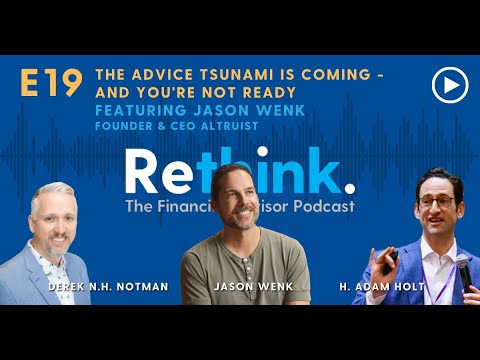
Jason Wenk warns Adam and Derek that a digital tsunami is coming for financial advice, and that it's a matter of when, not if. The three dig into the scale of the coming generational wealth transfer, why advisors who don't reinvent their business models risk getting left behind, and why hiding the price of advice no longer makes sense in a world of increasing transparency.
What This Episode Covers
- Why digital disruption in financial advice is inevitable
- The scale of the coming generational wealth transfer
- Reinventing business models to scale for what's next
- Price transparency and why advisors should stop hiding fees
Full Transcript
Full timestamped transcript.
[00:00:05] H. Adam Holt: Welcome to Rethink the Financial Advisor Podcast. My name is Adam Holt.
[00:00:11] Derek Notman: And this is Derek Notman. We are your hosts, both veteran advisors and fintech CEOs who challenge the status quo, question everything, and have fun doing it. Hear honest commentary on the challenges facing advisors today. And be part of a community where we can all rethink the profession.
Now on to our episode.
[00:00:34] H. Adam Holt: Derek, are you ready for the tsunami that's coming?
[00:00:39] Derek Notman: Hey, Adam. I, I think I am, but I think a ton of people aren't. Let me explain. So how, what is a tsunami? It's this massive event that builds and builds. We have fair warning it's coming. It's precipitated by one event, but then it takes time to build. We know it's coming, we can see it coming, and if we don't get out of the way or preempt it, it crushes and destroys everything in its way.
So I know that I love to surf, so I'll even go out and surf when we have a tsunami warning. But, you know, I'm prepared for it. And I think if we apply this to the financial advice industry, we have got a massive tsunami coming, and we've talked about this before, that's gonna be disruptive in ways we've never seen before.
[00:01:31] H. Adam Holt: Now, that sounds- And I'm
[00:01:32] Derek Notman: trying to be overly dramatic here.
[00:01:34] H. Adam Holt: Yeah. No, that's great. I think there should be drums in the background.
[00:01:37] Derek Notman: Right.
[00:01:38] H. Adam Holt: Maybe like a-
Boom, boom, boom ... Mayan boom, boom, boom, boom, boom. Can
we do that? Like a beatbox on a podcast. I... Now, a tsunami is a wave, right? And we know that there's been several actual tsunamis in the world that have, in our modern day actually, that have been devastating.
And one of those, uh, things that we learned about tsunamis is that the water goes out before it comes in 'cause it gathers and it goes in. And I, I happen to think, and the reason why we're bringing this up on this podcast is we are seeing the signs of the water coming out, going away from the shore. The shore is getting long.
People are getting comfortable. They're like, "Oh, look at this nice big beach." And that's an indication that something's coming. And for those of you that are wondering- I completely agree ... yeah, I, and it really has to do with major change that's coming in the digital advice realm. I think a lot- That's the
[00:02:34] Derek Notman: tsunami.
Yeah, a digital tsunami.
[00:02:37] H. Adam Holt: And the irony behind this as we've been talking about it, is that the tsunami has been argued to be, well, you know, that's just robo-advisor. Maybe robo-advisor 3.0, or maybe that's really just digital processing or straight-through processing. And, and I would argue, I think we both would, that it's all of it.
There's a digital advice wave coming, and you realize how many people have their house and their practices boarded up with, like, paper and staples, and that's not gonna survive this we- this kind of tsunami.
[00:03:11] Derek Notman: No, it's gonna take... This digital wave's gonna, it's gonna push all that stuff away. You're gone.
You're done. It's been a long time coming. I mean, you talked about this years ago. We've discussed it many times. We've got a special guest that has been talking about this for a while, too, that I think it'd be fun to listen to today.
[00:03:30] H. Adam Holt: Absolutely. Well, we did invite Jason Wink in our, from our community.
Jason is the CEO and founder of Altruist, and if you haven't checked out what they're doing, they're really trying to reinvent, uh, the whole custodial process, how you see performance, onboarding, and they're really using modern techniques to do it. And Jason's been, like the two of us, been 20 years as a financial advisor.
He really focuses on systems. He's a EY Entrepreneur of the Year in tw- in 2018. I know that's a big deal because I didn't make it to the nationals, so I was kind of annoyed. So he- hey, hats off, man. That's a real big deal. He previously, uh, founded Formula Fol- Folios. He's got a lot of focus on tech in our space, and he's got a really interesting perspective.
I think Derek will appreciate, uh, this speed rethink tank interview. Should we hear what he has to say?
[00:04:17] Derek Notman: Yeah, let's jump in. Here we go.
[00:04:19] H. Adam Holt: All right, let's hear Jason. Well,
[00:04:21] Jason Wenk: I mean, I, I wish I could say that it's, like, entirely unique and only mine and no one else in the world has the same view, but my, my take is that it's this massively huge market that's largely ignored.
I mean, we live in it, so of course we think it's the greatest thing in the world. But when you really think about, like, people talking about DeFi and Web3 and all sorts of other things happening around the world, I mean, one of the most slept on industries that is absolutely gargantuan and, and massive need of a reinvention, um, it's financial advice.
I mean, it's, it's very, very, very much slept on, and I think going to have a really, really big run in the next 10 to 20 years.
[00:04:57] H. Adam Holt: What are you tending to see in terms of advisors? I mean, when they do talk to you a lot about what their aggravations are, their pains, why they're moving around, what are you seeing as the bigger motivations for people entertaining, we'll call new platforms?
[00:05:10] Jason Wenk: Yeah, well, I've been, like, living in the RIA space for almost 20 years now, and so I don't have total blinders on to the whole rest of the industry, but that's the area that I live in. And I can say that the RIA channel is fascinating because what we're really seeing are incredibly unique small businesses being born really rapidly, meaning like, you know, hundreds, thou- not hundreds of thousands, hundreds to thousands of these really, really unique small businesses being created.
That was not possible in 2004 when I started my first RIA. And, and I'm really, really excited about that. And I think people are doing things on their own terms. It's really cool. They don't have some manager saying, "Go only serve people with a million dollars or $5 million or $10 million," or, "Only work with these people in our local geographic banking office region."
Like, people can create these incredibly unique, specialized businesses, um, in this RIA channel. And still some deficiencies with the tools, but it's so much more possible to build the business of your dreams, serving clients exactly how you want to today, than it's ever been.
[00:06:13] Derek Notman: Yeah, it's really encouraging, right?
It's just, it's a great time to be in this industry. I think as a younger advisor, if we were to rewind 20 years, it'd be a pretty cool, exciting time to enter in. What would you say, Jason, is like a missing opportunity for advisors? Something that is, I don't know, maybe it's a challenge currently or an upcoming challenge that advisors at large are not addressing or don't even see coming.
[00:06:37] Jason Wenk: It's been talked about since I basically got in the business, and it's never come to fruition, right? There's this whole, like, "What's gonna happen when all of the old advisors are gone?" Or, "What's gonna happen when all the old people die and all their money gets transitioned? There's trillions of dollars of wealth transfer, you know?"
Mm-hmm. And for, you know, the better part of 20 years, I've been hearing about these things that are going to happen, and they have not happened yet, and so I think as a result, people are like, "Oh, they're never going to happen." But mortality is real. This is, none of this shit's going away, right? I mean, yes, maybe people are living longer, and yes, maybe a lot of advisors have made the decision that they're just gonna coast and kind of work part-time-ish, you know, versus selling.
But in the next 10 to 20 years, it is going to be just wild how different the average client demographic is, right? Uh, today, all the people who are 60s, 70s, 80s, many of them won't be alive. There will be a massive wealth transfer. The expectations of those clients that today are 40s, 50s, 30s, or even 20, look, they don't want their grandpa's financial advisor, and they don't want their grandpa's financial tools.
They don't want a 400-page financial plan that's impossible to read. These are all things that, like, it's been talked about a long time. People are sleeping on it because it hasn't happened yet, and if people just continue to operate, advisors it is, like, with their blinders on, it's just gonna hit 'em like a ton of bricks, and it's gonna be too late if they're not preparing for it right now.
[00:08:02] Derek Notman: They're, they've really been resting on their laurels- ... is what it sounds like, right? If I got
[00:08:06] Jason Wenk: time- We have a bull market, easy money, nobody has to do anything to, to look smart. Look, the day's coming, right, at some point, and people are gonna have to actually be smart, actually have a meaningful relationship with their clients, actually do real planning.
The last 10 to 12 years has made it look real easy, but it's not going to be this easy r- forever.
[00:08:24] Derek Notman: Yeah, 100% agree. So along that vein then, Jason, what action steps would you say for advisors knowing that this, this tidal wave is coming? And we, we just had the tsunami warning here on the West Coast. Yeah. Um, what can we do with this warning that we're getting?
What, what are the action steps, whether you are listening and you're six months in, and you're like, "What the heck am I doing?" Or you've been around for 30 years, and maybe you're like, "Okay, I finally got to address this thing."
[00:08:52] Jason Wenk: Well, I, I think, again, self-serving, because obviously I've, I've seen this stuff coming, and I think both of you have as well, so w- we'll be collectively self-serving, not just me serving myself, I suppose.
A- advisors have to fully 100% embrace being digital. You... A- and delivering phenomenal digital client experiences. Um, people that are still trying to get by with DocuSign, and that only works on a third of your forms, and then you've gotta get something else, Medallion Stamp Signature Guaranteed, and you're inviting clients to, you know, just in terrible user interfaces and thinking they're gonna be okay with it.
Like, they can get on their phone right now, open accounts, fund accounts, trade accounts, be buying NFTs and buying crypto assets and trading fractional shares of stocks, getting a fully automated sort of financial plan with really elegant design at, I don't know, 70% lower cost. I'm not saying we all need to be deathly afraid of this innovation, you know, tsunami, so to speak, but clients expect something that is modern and relevant, and especially, again, those next generations of clients that we're going to need to have if we want to maintain sort of the wealth of their parents.
Um, so you might as well start today. And it's just, again, it's really easy for people to get complacent and be like, "Well, I don't need to change anything right now. My clients are cool with the way things are right now." Um, and again, then it's too late. Then the client passes away, the 45-year-old kids inherit the money, and they're like, "Yeah, no, I don't want to use my planner.
I already got a planner, right? My planner is a fully digital planner that I don't have to meet with in their mahogany office in the 37th floor of some crowded city," right? It's a, uh, more of a kindred spirit relationship with someone who gets them. Um, and, i- like, so start today. Be prepared. Build a, those, you know, meaningful relationships.
Deliver that phenomenal experience, and you'll never have to worry about it. In fact, you'll benefit from it, which is a great spot to be in.
[00:10:45] H. Adam Holt: Represent. I love that. I'm gonna put you on the spot, because that, that's really great, and you've been future forward if... But in this kind of thing, you know, if you put yourself in this space- 10 years from now, what does it look like?
What is the Jason Wang perspective looking back 10 years from now?
[00:11:03] Jason Wenk: Yeah. If you can- I mean, unpopular opinion, right? But, uh, you know- But we
[00:11:07] H. Adam Holt: want it.
[00:11:07] Jason Wenk: Yeah. We want to
[00:11:08] H. Adam Holt: hear it. I just feel...
[00:11:08] Jason Wenk: I, I feel like, um, and I'm hopeful that, that the company that does it is Altruist. That's why I work a- as hard as I do at the things that I do.
But, but I think that there will be an Amazon-like disruption in our space. And what I mean by that is you look at, like, Amazon's flywheel, and they came out and they, there, it was really simple. They did this in 2001. If all of us have read Good to Great, like, we know this. It's literally been sketched there.
It's been sitting there for 20 years. Incredibly low prices attracts a lot of customers. More customers means more marketplace vendors will come in to sell their products 'cause there's more distribution. With more distribution, they get shared e- co- uh, economics, right, of their core infrastructure. Um, that gives them better margins than anyone else, which allows them to lower the prices, which allows them to attract more customers.
That's the flywheel, right? This thing just starts to spin and, and it, it takes a lot of pushing for them to do it, but eventually it spins. Um, and now it's so obvious. We look back 20 years, like, well, of course Amazon's incredibly successful. But n- people didn't feel that way in 2001, um, when they met, um, and, and kind of created their flywheel, you know, so to speak.
I don't know how that will exactly come out in our space, but expecting that we can continue to use monolith infrastructure and technology that's been around for 40 or 50 years to be the core of, like, most advisors' business, which is the custody business, that's the core piece, right? Every single other piece of technology in our space, and with no disrespect to all of us who are fintech entrepreneurs, every fintech vendor that serves advisors, combine all of us in terms of our, our market values.
Take the 20 largest RIA firms in the country, all huge, huge firms, right? Combine all of them, take all of our collective value, quadruple it, and you get Charles Schwab. Like, there is so much more mass, right, in those two or three really key core vendors than all the rest of us combined times some order of magnitude.
Um, that whole thing needs to be disrupted a la the way that Amazon's done it. Again, I don't know if it'll be Amazon or Google or some tech company coming to our space or just somebody that today is, is out there executing and building the flywheel that 20 years from now we look back and go, "Oh, damn," like, "of course they did that," right?
Much like I think sometimes we look at Amazon today.
[00:13:18] H. Adam Holt: So that was pretty awesome. There's a couple of nuggets in there, Derek, that I think are worth discussing. What did you think about his concept of the unique small businesses born rapidly?
[00:13:30] Derek Notman: I love that. I think the path to entrepreneurship or business ownership, even if you want to just to be a solo shop, is definitely faster and easier than it was when he did his back in 2004, for example.
There's-- It's been somewhat commoditized, so that's great. Wow, like, it's not a, like, a massive mountain for me to have to scale now. It's not as scary. I don't have to attach myself to an insurance BD or wirehouse to, to do this. I can do it on my own. That's huge 'cause I-- at the end of the day, most of us are individuals, and we like to do things our own way.
And it's true. There's more and more RAs starting now than at any time ever in the history of them.
[00:14:12] H. Adam Holt: Well, it's enabling more innovation than we've ever seen too. I can't tell you the number of people over the past 15 years that came to me and said, "Adam, I've got a great idea too, but I really-- I can't leave my practice."
And the, the, the level of ideas never were light, right? Everybody always had an idea about how to disrupt the economy. But now I actually know 10 advisors who have literally built their own tools 'cause they can build in their shit. I mean, granted, I probably did it a little bit earlier, so we did have to, you know, we had to put a significant amount of capital behind it and didn't know what the heck we were doing.
Now there's, like, the internet, like how to build a company in 20 days. Like, so I, I think it's amazing the accessibility that innovation's gonna continue to drive disruption to create these almost mini disruptive waves that I think a lot of people are not even gonna come see coming. Have you ever been on your surfboard where all of a sudden you, you think the waves are pretty systematic, and all of a sudden this huge swell comes out of nowhere.
You're like, "I didn't see that," and it wipes you out. And I think that- Yep ... what's happening is that w-what's h- because there's so much entrepreneurship and it is so easy to put out a shingle and start a business and also build a technology platform now, that there's gonna be, you know, disruptions to the way we do business coming left and right.
The question I think is: How are we going to keep our practices that are established continuing to grow? And I loved his comment on, you know, people don't want their grandpa's advisor. They don't want their grandpa's tools either. Um- What do you think about that?
[00:15:39] Derek Notman: They don't. They want a different experience.
And if, if you haven't learned this about me, to our listeners here, I recently started my own RIA so I could do it my own tech company, and part of that was I wanted to have this better experience for my clients, which is really, really important. And I was actually just speaking to the CEO and owner of a huge RIA in the Midwest.
[00:16:03] Jason Wenk: Mm-hmm.
[00:16:04] Derek Notman: And he custodies with a couple other well-known custodians, and is looking on bringing Altruist on. And I'm not saying terminate your old relationships, but I'm like, listen, your average demographic's what, 55, 60? You've got an older client base.
[00:16:19] H. Adam Holt: Mm-hmm.
[00:16:20] Derek Notman: How are you gonna retain the assets of the kids of those people?
And that's the, that's the disruption there, so that's where bringing on these tech-forward experiences for these folks is what they're... They don't want the 400-page plan, right? I mean, just as an example, like I'm using Altruist and I'm using Asset-Map right now, and the feedback I'm getting from my clients is awesome, and they are actually referring me to younger generations because they love it so much.
It's just such a great experience.
[00:16:45] H. Adam Holt: Yeah.
[00:16:46] Derek Notman: They don't want me to send them a 400-page report. They don't wanna do- deal with a half-hour DocuSign e-app. That stuff's all antiquated. It's done.
[00:16:55] H. Adam Holt: Yeah. You know, I like what he said, too, about the, the whole generational wave coming. I've done a lot of public speaking about this, you know, wealth transfer, the 90, maybe it's $100 trillion now that's gonna move from one generation to the next, uh, or be spent down, obviously, 'cause a lot of it's in qualified plans and it has to be distributed for income purposes.
So it's gonna move, right? And whether it goes to the government or it goes to spending or it goes to the next generation, uh, there's a lot of money that's gonna change hands, and of course it's gonna change hands from a, a very different mindset of this Boomer, uh, Gr- Greatest Generation to X Generation/Y and Millennials.
And the question I'm wondering, is what's driving the tsunami, this singular event, or are expectations gonna change before that generational transfer of wealth happens, right? What's precipitating this massive change that I think is gonna force a lot of advisors to, to change the way they do things?
'Cause we do know that the younger generation is expecting digital-first experiences.
Mm-hmm.
And there's an argument that we should try to serve and grab them now, or do we stick it out for the next 5 or 10 years and try to hold on to the old school expectations of how you can run a practice behind the mahogany and the paper and the gilded books and the-
cards on their birthday, physical cards? Just
[00:18:14] Derek Notman: like your office.
[00:18:16] H. Adam Holt: Yeah, right, my old office. We updated our furniture. We went to maple, just so you know, it's gotten better. Got rid of all that old stuff.
[00:18:23] Derek Notman: I think you make a really interesting point, and I, I don't know if we've got the right answer, but I suspect it's probably a combination of both things you just said.
Uh, but it's this, it's the flywheel, right? Like Amazon got the flywheel started for books and then all the things they do now.
[00:18:41] H. Adam Holt: Mm-hmm.
[00:18:42] Derek Notman: But it doesn't take a whole lot of thought to be like, "Huh, what if I got a flywheel like that for financial advice?"
[00:18:49] H. Adam Holt: Wow.
[00:18:50] Derek Notman: And then, and I... Arguably, and you know, he made a really interesting comparison.
He, like, added all of the t- fintech companies and the large RIAs together, and we're still not as big as Schwab. But when you do take that collective toge- together, maybe that collective over the last 10 years has actually spun up that flywheel.
[00:19:09] H. Adam Holt: Hmm.
[00:19:10] Derek Notman: And now it's either running on its own, we just don't know it yet, or it's about to, and that's gonna be kind of like when that tsunami starts to crest.
Like, wow, that beach was really nice, but what's that big thing coming towards me really quickly now? Uh-oh.
[00:19:23] H. Adam Holt: Yeah. And you feel the wind on your face, right? Yeah. And you can't outrun it. You
[00:19:27] Derek Notman: can't. You're done. It's too late.
[00:19:29] H. Adam Holt: It's gonna be like this in a tsunami. Is there a, is there a survival mechanism? I guess you just get a buoy.
I don't know what you do. What do you do with it?
[00:19:35] Derek Notman: You don't be there in the first place. Ah,
[00:19:38] H. Adam Holt: okay. You
[00:19:38] Derek Notman: listen to the warnings. You listen to the, the people saying, "Hey, it's coming. It's coming. Get the hell out of there."
[00:19:44] H. Adam Holt: Well, I think to stick with this analogy, I think tsunamis in real life also have m- multiple waves, right?
There's usually one, then there's a follow-on, then there's a swell. Yep. I don't know, I don't know exactly how it works. I apologize if we're destroying this analogy. We're
[00:19:55] Derek Notman: not oceanographers.
[00:19:56] H. Adam Holt: Right. Is that... I mean, oceanographers, geologists. Yeah. Uh, right. Uh, climatologists. If
[00:20:02] Derek Notman: even those are the right terms.
I don't know. We're not scientists.
[00:20:04] H. Adam Holt: That's right. We're financial advisors, which means we, we know very little about a lot of stuff.
[00:20:10] Derek Notman: Um. Yep.
[00:20:12] H. Adam Holt: I'm self-deprecating here a little. I, I think the... where I was going with that is I think there's several different m- mega trends that are coming that I don't know that advisors are really paying attention to or caring about because as you said, and I agree and I talk about this too, we've been a little bit complacent.
I, I, we've seen that an argument, "So oh, I'm paperless now." You're not paperless, you're using PDF on DocuSign, right? You're ki- uh, you're still doing a fillable PDF. You're doing 30 minutes to complete an application. It's not a digital process. To move the money over four days, not a r- you know. To do a telemed and that's as advanced as you're gonna get as opposed to, you know, AI underwriting.
I, I don't know. So I think it's true that there's been a lot of patchwork, tape, uh, glue put on those shanties that are still generating huge margins, which is just ripe for the next level of disruption, and I want to ask you about this idea of an Amazon-like disruption, 'cause I know we've talked about it on prior podcasts.
What do you think, what do you think are the first two or three... Let's just imagine for a second. What do you think could be an Amazon-like disruption in our space?
[00:21:24] Derek Notman: Oh my gosh. I... Are you talking from like a product perspective? Like what products or even like- And this is where I, I'm not worried about them replacing us human advisors.
[00:21:36] H. Adam Holt: Hmm. '
[00:21:38] Derek Notman: Cause they can't do that. I think you and I were just chatting about this, but why can't I go, "Hey, Alexa, buy me some life insurance," or, "Hey, Alexa, open up a Roth IRA for me." Right? And then they do like- Let
[00:21:52] H. Adam Holt: me... Your credit card on file. Let me use your, uh, yeah,
[00:21:54] Derek Notman: your Prime account. Seriously, right? The piping's already built to do it.
Right. So I, I think it's just a matter of hooking up the pipes, um, to get that to work, and whether that's Amazon or Google or Facebook or some other behemoth that says, "You know what? It's time to turn this thing on."
[00:22:11] H. Adam Holt: Why can't Apple add- It'll happen, but it- Yeah. Wouldn't Apple just add it to their Wallet?
I mean, can't I just add- Right. Yeah ... a Robinhood-style purchase or, you know, m- take the extra money I was gonna put on this bagel, the extra 50 cents, and with Apple Wallet, move it to a shares in Bitcoin? I, I don't... I, it, it's, it's so clear that this is gonna happen. The question is gonna be, what's the advisor's role in it?
And I don't know that it's gonna be built with the advisor's access in mind. So the advisors are gonna basic- who've usually had access and o- oversight on the investments and the assets and what's going on, so we could be a little bit of the, you know, quarterback or like watching over it. We're watching the store.
I think it's all gonna happen on the consumer side, and advisors are gonna be in the dark unless the consumers actually let them in 'cause it's gonna be in a such a convenient mindset. It's in my Alexa, or I bought it on I-
[00:23:00] Derek Notman: Yeah. It's easy, right?
[00:23:02] H. Adam Holt: Yeah ... make sure I got it done 'cause it's easy. Um-
[00:23:04] Derek Notman: You know, as a consumer, I like that model, and I...
here's where I... you know, for our advisors listening, here's l- where you can position yourself to actually take advantage of this, at least in my opinion. My opinion's not worth much, but-
[00:23:17] H. Adam Holt: Hmm. No, it's
[00:23:18] Derek Notman: worth- I'll give it to... I'm gonna give it to you anyways.
[00:23:20] H. Adam Holt: Yeah.
[00:23:20] Derek Notman: It's the whole advice piece, and I'll give you a, an example.
I talked to a, a brand-new client today, and he's like, "I've got all this money, but I, I, I don't really trust the financial advice space. I can do everything online."
[00:23:36] Jason Wenk: Hmm. "
[00:23:37] Derek Notman: But I have questions. Can I retire at 60?"
How does this purchase or this investment very... affect my future versus this one? How do I put all these things together? And that's where human advice becomes really important, 'cause human advice is, is not something a robot can just punch out and do.
[00:23:58] H. Adam Holt: Yeah.
[00:23:58] Derek Notman: So now if I'm a consumer, I'm like, "All right.
I've got this app. I d- did my Apple Wallet. I've got my Bitcoin. I'm doing all these things digitally, but I... it's not helping me answer the big questions, the things that are keeping me up at night." I need a human- Yeah ... to do that, that is trained with all of these different products and services, and to help me figure out how to do everything.
Right now, all of a sudden that becomes huge, and now the consumer is clamoring for, for human advice. They're desiring it, but now they gotta find it.
[00:24:31] H. Adam Holt: Yeah, that's the thing, though, is that advice... Think about how often you talk to your clients or how often they call upon you. Do they call... They talk to you maybe once, twice, three times a year.
They don't need continuous advice. It's like- They
[00:24:42] Derek Notman: don't ...
[00:24:42] H. Adam Holt: I need an hour here, I need to do... But here we are charging a percentage of asset-based comp because theoretically, we're managing day-to-day their assets, when for the most part we all know we've used technology to scale so that we don't have to spend 80 hours a week making investment decisions.
So as a result, there's inherent, uh, we'll call it arbitrage in there that I think that technology is going to squeeze out, which is my argument for as much as it, you know, concerns me in awareness that wave is gonna disrupt a bunch of people. The monetization for most of the financial services community has been asset-based and, uh, you know, fee only asset-based comp.
If I wanna pay, if I wanna do a lot of this stuff myself from these different disruption tools that's easy for me to do and execute, I'm probably gonna pay a fee as a professional to an advisor, a, a fee-based, a true... like I'm like paying about $100 an hour, whatever it is. My question to you, and I made this to my doctor friends, I said, "You know what?
You're gonna be disintermediated eventually by China and India." And they're like, "What are you talking about? Medicine is always delivered by a human." Yeah. And so we're, we're never gonna get rid of the humans. We're the human advisor. I'm like, "Yeah, I went to the emergency room two years ago, and the doctor was on a screen on Zoom in India."
Okay? Now- Wow ... you tell me that there's not gonna be an impact of that, especially in emergency room technology, or imagine triage environments.
Sure.
That you can outsource a physician or a pharmacist or someone else who can make a legal decree and digitally record that within their, like, boundaries of their profession and their codes and all that other stuff.
How long is it gonna be before we can put a CFP in a low-cost human, uh, you know, capital cost? And so why can't I pay 50 bucks a year instead of 5,000?
[00:26:42] Derek Notman: It's already happening. It is happening. I'm not gonna name the companies, but there are companies doing just that already.
[00:26:49] H. Adam Holt: PowerPlan, I know entire companies that have PowerPlanner teams, hundreds of advisors, CFP certificants-
[00:26:55] Derek Notman: Yep
[00:26:55] H. Adam Holt: in India right now, and they're their back office right now, and they're doing that. You're telling me- Already happening ... they can't do the client who already has the money? I, I think the wave is coming, and such a disruptive wave, that most advisors are literally resting on their laurels and going, "Eh, it's not gonna happen here."
[00:27:12] Derek Notman: And you know what? If you're- It's gonna happen ... five years out from retirement, eh, okay.
[00:27:18] H. Adam Holt: I agree.
[00:27:19] Derek Notman: I agree. I agree. But unless your exit is to literally walk away from your business and just shut the door and turn off the lights and that's it, and you don't need to sell it or whatever, okay. Well, what if you do wanna sell it?
What if you're gonna... Or what if you have a successor advisor that you're trying to bring on or groom?
[00:27:39] H. Adam Holt: Yep.
[00:27:40] Derek Notman: They don't want Grandpa's solutions. Right?
[00:27:45] H. Adam Holt: They don't.
[00:27:45] Derek Notman: So you better pay attention. So I, I would argue that the majority of people or advisors really actually need to pay attention to this, un- unless you really just don't care and you are gonna walk away.
[00:27:56] H. Adam Holt: Mm-hmm. Yeah. Anyways,
[00:27:57] Derek Notman: you know, it-
[00:27:58] H. Adam Holt: I don't say that also to o- you know, at least that perspective I think we have and we share in some regard is not to scare everybody and depress you and say, "Okay, let me go listen to a happier podcast." The point is this is the warning system. It may be years away, but don't be surprised when it happens over a long period of time-
[00:28:17] Derek Notman: Totally
[00:28:17] H. Adam Holt: all of a, all of a sudden. And
[00:28:19] Derek Notman: then- But it's also a massive opportunity, right?
[00:28:21] H. Adam Holt: So big.
[00:28:22] Derek Notman: And that's what's exciting is like, holy smokes, look what is possible. Just heed the warning, start implementing some things to be prepared for when the thing comes, and you're actually gonna ride the wave instead of get crushed by it.
[00:28:36] H. Adam Holt: Amen. I think that's good. That's great. So let's tell our takeaways to everybody. What kind of takeaways do we have, Derek, from you that advisors can put into action?
[00:28:43] Derek Notman: Well, I think, and this is even from my own personal experience, I would say a lot of us cut our teeth at, like, a wire house, a insurance broker, dealer, whatever, and that was okay.
It worked. But the future of our business, as we've just talked a ton about, is headed in a different direction. It, it's what our clients expect, et cetera. So can you do what you need and what your clients want where you currently are? Maybe not today, but can you do it in three years? Are they gonna get there?
Are they gonna have the tech and the capabilities to do that, or are they, are you still doing faxes and DocuSigns in five years? I don't know. So that's something to think about, and if, if you can't, that, then that's kind of like a big question you gotta answer. And then also I think just, like, digital's here.
I don't know if you heard us, but we said digital like 1,000 times during this podcast. Adam's got the little clicker. He's been watching. But we're all gonna have growing pains going through this. Even just doing my own RA recently, I had to bring on some new tech that I had to learn and go through the growing pains.
But better to go through them now and with your clients than to have your clients go through them without you.
[00:29:51] H. Adam Holt: Hmm.
[00:29:51] Derek Notman: And then all of a sudden you wake up and they're like, they're saying, "Goodbye. I already did all this. I'm gonna do something else. Thanks. You know, nice meeting you, but goodbye." That's not a good place to be, so better to experience the growing pains now than to, like, get crushed.
Yeah. You know, that, that's, those are some of my bigger ones.
[00:30:07] H. Adam Holt: Yeah, so you made me think actually about user experience again. I used to be such an advocate for this in all things. I was cr- just zealot about it. Um, being stuck in behind a screen for two years, I don't know that I've gotten out to experience what other people have innovated recently.
But when you think about Disneyland or you think about the, the local Great Adventure, Disneyland's got a, you know, got a UX, um, you know, super lead against, let's say, Great Adventure as an amusement park. Uh, and they might have the same exact rides, but you... It's much more memorable. And so remember that your tech experience is where the rubber hits the road for many of these clients.
They're gonna interact with the tech, and they're gonna start being judgemental. If your tech is pretty lame and they've seen better tech, they're gonna like, "Ah." That is a great point. "I like the relations great, but, but I, I kinda... You know what? It's just easier to work with, you know, Mary. She's, like, more modern, and Joe is kind of...
You know what? Let's move all our stuff to Mary. I just like the interface better." I think people are gonna move because the app is better.
[00:31:03] Derek Notman: You know what? You are spot on with that, and it's true. I mean, think about the stuff that you use on your phone or your computer or anywhere.
[00:31:10] H. Adam Holt: Yeah.
[00:31:10] Derek Notman: That user experience, like I- I'll get on that zealot stage with you.
I agree. It's the truth.
[00:31:16] H. Adam Holt: It's gonna happen. And it will. If it's not happening now, it's gonna happen in the next few years because especially next generation, the younger generations, like you make something a little bit difficult for them, they start crying and, and they just, they leave. They just leave, and it's okay.
They don't have to fight to put up with stuff anymore 'cause-
[00:31:31] Derek Notman: They don't ...
[00:31:31] H. Adam Holt: choices. No. Right? For free. So I don't know. Maybe that's the burden of the X generation is that we were taught to put up with everything. We did. Be grateful, okay? We didn't have it so good when we were your kids- ... but now we have s- access.
I think we still have that.
[00:31:46] Derek Notman: We're not that old, dude.
[00:31:48] H. Adam Holt: Come on, stop. Well, I am. I feel that way. All right, so here's my takeaways. Um, I, I was thinking about this before what Jason said. Decide if you're gonna be in the financial advice business, but decide whether you're doing it like it's 2005, 2015, or 2025.
Just think about where the, the practice that you're building has to be intentional. And you can certainly keep running like it's 2015, and maybe you've got an aggregation portal, and maybe you do planning, and that'll ... You can do that for a while, but I don't know if you're gonna grow the way you could grow.
Yeah.
Um, and I think you're gonna really have to deal with fee compression because clients are gonna look for more value. 2025 means you're coming at it all digital Or you're, or you have a path to get there if you're not there yet, you know how to get there. Um, invest back in the business. I've seen a lot of financial advisors who they make great money, they make more than they need to survive and their family, and they take their money and they go put it in the S&P.
Or they go put it in some deal of one of their clients and do some private equity. Why aren't we investing back in the business? Okay, the highest rate of return I saw ever in my practice was when I built Asset-Map for it. I had the highest rate of return. Now granted, it obviously had scale outside, but the point is that find ways to actually invest real cash into your business.
They weren't always thinking about a cash flow, I gotta suck all the business cash out, um, and then I just, it's a cash cow. Invest back in it. That means people, it means technology, it means next gen. It, it will pay if you do it right and actually manage it like an investment. And it's also number three, it's time to run the family meeting, and the family meeting for us in our practice was every three years, get together with the whole family, talk to the next generation.
So if you're working with a generation, we'll call it A, that means you bring in their parents if they're still living, you bring in the children if they're adults, and hopefully, you know, gonna be the next, the, the recipients of those assets, and you get to know them and you show them that you actually know where everything is going on.
You want to stay that concierge, the owner of the treasure map, uh, and show that you've got relationship value and that it, you're not a mystery, so that when grandpa does pass, you're not grandpa's advisor. You're the family advisor. And that's the point of having a family meetings, run them every three years, bring in lunch, make it a relationship meeting, and then use that opportunity to show what you're doing and how they can make better financial decisions as a family.
Really smart and very effective at building in, in, we'll call it relationship fingers into the next gen.
[00:34:16] Derek Notman: Good, I like that. That's great. That's a human element.
[00:34:19] H. Adam Holt: Yeah. No, look, and it's, it's scrappy. Does... what, how much effort does that take? No, it- it's actually empathetic, and it's, it just makes a lot of sense.
[00:34:25] Derek Notman: Awesome. All right. Well, let's wrap this up. We've got a, an interesting question where we can kind of l- you know, end on this today and, uh, you know, get ready for another awesome podcast another day, 'cause we've got so many awesome listeners now. What do we have? Three?
[00:34:42] H. Adam Holt: Four, I think. I've heard four, four listeners.
[00:34:44] Derek Notman: Is that what we're up to now? We're at, like, the top 99% of podcasts.
[00:34:49] H. Adam Holt: That's right, with four listeners, sort of.
[00:34:51] Derek Notman: Ugh. All right. Well, this one came into you. Do you want me to, to a- Yeah ... you just want me to ask you?
[00:34:57] H. Adam Holt: Read it. Yeah, you read it like you're Jay. Oh, that's Danny.
[00:35:00] Derek Notman: No, this is... Yeah. So this comes from an advisor, Danny in Florida.
"I've heard a couple times that I as an advisor should be more transparent with my prices, uh, fees, all that stuff, especially on my website for the work that I do. First, why should any of us list our prices? And secondly, how should those of us who work on commission handle this? Keep on rocking the pod.
Thanks, Danny."
[00:35:25] H. Adam Holt: Thanks, Danny. All right, awesome. We appreciate it.
[00:35:27] Derek Notman: What do you think?
[00:35:28] H. Adam Holt: Um, it's an interesting thing. I've seen this more and more. There is something that's interesting that we learned from sales many years ago, was that when you don't show your prices You're communicating something intentionally or unintentionally.
Number one, you don't wanna give them sticker price shock, right? 'Cause you know you're gonna deter people. Or you're too high end and you don't need to show your prices, because if you can't afford me, you're not a good client. All right? There was that, that you walk into the Cartier and there's, there's no prices, right?
You gotta ask them what the price is. If you gotta ask, okay, you know, you can- I
[00:36:06] Derek Notman: shop at Walmart, dude. I don't know what you're talking about. Well,
[00:36:09] H. Adam Holt: do they put the prices there?
[00:36:11] Derek Notman: Everywhere, man. With the little happy, like, yellow face.
[00:36:14] H. Adam Holt: The, the, the special, right? Or whatever it is. Yeah. Even point out the price is excellent.
Um, I think it's what you're trying to communicate there. I tend to believe that financial services was the original SaaS business, where advice as a service. We're charging an ongoing asset management fee, uh, and as your success happens, so does my success, and we keep you longterm. And so the lifetime value of the client is really very similar to a tech company.
You're paying monthly, uh, for that, that product. Um, but the reason I say that is because I have seen a couple of firms actually start posting the different price tiers because people are so used to going to a website, checking out the people, looking at the founders, and then seeing the tech at a high level or whatever it is they're buying, and then seeing the price.
They go to the price. It's the second or the third page almost every single time. And in the absence of it, it basically helps... It makes it difficult for me to understand. So that's my take on this. I'm... If you wanna be accessible, put your prices and be proud of those prices.
[00:37:14] Derek Notman: I think so. I think it goes to even a bigger, like, topic that we may or may not even wanna unpack is transparency in this industry.
[00:37:22] H. Adam Holt: Mm-hmm.
[00:37:22] Derek Notman: And maybe it's not your prices. Maybe it's the fees of the things you're doing for your clients, and how that can lead or not lead to trust. So I don't know. We can hash this out, but it's a really interesting question. I mean, me personally, I've been listing my prices for years.
[00:37:38] H. Adam Holt: Mm-hmm.
[00:37:39] Derek Notman: I was always of the opinion, uh, just as you said in the example for the website, that's one of the things I wanna see, and if I don't get that answer, I'm out of there.
Um, I don't care how much it is, I wanna know. It's just like buying a TV at Best Buy. I'm not gonna compare the three most expensive TVs but not know the prices.
[00:37:55] H. Adam Holt: Right.
[00:37:55] Derek Notman: Right? Yeah. I wanna know that stuff.
[00:37:57] H. Adam Holt: Look, price is one thing. We, we do use price to communicate perceived value, so the question is what are you going after?
Yep. Where price is not an object or where price is recognizably a smart decision. If you're a financial planner and you want to have people make good financial decisions on what they spend money on, why are we hiding prices? Right?
[00:38:17] Announcer: Exactly.
[00:38:18] H. Adam Holt: Kind of the antithesis of a budget. Um, so don't worry about what you pay for coffee or, or...
Worry about what you pay for coffee. Don't worry about what you pay for advice. That, that does matter. That kind of doesn't make sense. I think you should show it if you can. A lot of the commission ones, I obviously... That's a problem. I don't know how you do it. Say, yes, I, I make 50% of your first year premium.
I don't think people want to know that .
[00:38:40] Derek Notman: No, they don't want to know that, but you know, uh, uh, I'm not on commission anymore, but I used to be. And what I did for that is I simply said that some of the things that I may help you with pay a commission that is set by the issuing company. If you want to know more about it, ask, right?
And that's pretty transparent because I may or may not sell you one of those products, and if I don't, why am I telling you how much I'm gonna get paid on it, you know? No. That seemed to work pretty well. Anyways, that, that, that's a good one.
[00:39:07] H. Adam Holt: That's great. Well, thank you Danny so much for that. And of course, thanks Jason Wang for being a great sport, uh, and putting up with our antics.
Uh, we appreciate all the stuff that you're doing out there for Altruist and the supporting advisors, and we, we very much think that you're gonna be creating part of that tsunami. So good luck in that. For those of you that are listening to us, make sure that you follow us on LinkedIn. We have a Rethink, uh, the podcast now actual, uh, LinkedIn page.
You can go and check that out, follow us there. Uh, as well as, uh, remember, if you do submit a question, we'll send you some swag that has Rethink on it. And you can walk around, people will be confused why you say Rethink on your T-shirt or your hat. Pretty, pretty cool. Make sure you subscribe and definitely leave a review so other financial professionals like you can find us.
Derek, as always, I appreciate you and all you're doing.
[00:39:50] Derek Notman: Likewise, my friend. Hang 10, everybody.
[00:40:00] Announcer: Thank you for listening to Rethink, the Financial Advisor Podcast with Holt and Notman. Be sure to subscribe now and join the ongoing conversation. The information covered and posted represents the views and opinions of the guest and does not necessarily represent the views or opinions of Asset-Map or Connectr.
The content has been made available to you by Asset-Map for informational and educational purposes only.