
Ep18 - Rethink: Building a Social Media Following – Featuring Devin Banerjee
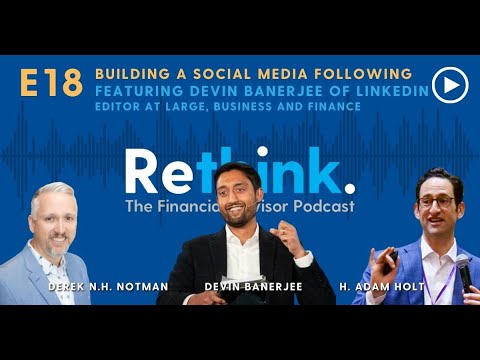
Watch and Listen
Episode Summary
LinkedIn's Devin Banerjee joins Adam and Derek to talk about why every financial advisor is, whether they realize it or not, a subject matter expert with an audience waiting to be built. The conversation covers the major trends reshaping how advisors show up on social media, a practical framework for content creation, and how to keep an authentic voice while staying inside compliance guardrails.
What This Episode Covers
- Why technology should enhance — not replace — the human advisor
- Three major market trends reshaping advisor content
- The ABCDE framework for content development
- Balancing an authentic voice with compliance requirements
Full Transcript
Full timestamped transcript.
[00:00:00] H. Adam Holt: Welcome to Rethink: The financial Advisor Podcast. My name is Adam
[00:00:05] Derek Notman: Holt. And this is Derek Notman. We are your hosts, both veteran advisors and fintech CEOs who challenge the status quo, question everything, and have fun doing it. Hear honest commentary on the challenges facing advisors today. And be part of a community where we can all rethink the profession.
Now on to our episode.
[00:00:31] H. Adam Holt: Derek, why should anybody care about having followers on social media?
[00:00:37] Derek Notman: Hey, Adam, that's an awesome question. I used to not care at all, man. I didn't care. I didn't want the followers. I didn't care. Then all of a sudden I cared. It's really important. But why? Why is it important? It's simple math. And as advisors, I hope, you know, hopefully you have some basic math skills.
[00:00:56] H. Adam Holt: I have an HP calculator. Well, can I tell you the present value of my followers?
[00:01:00] Derek Notman: You actually probably could do that. I'm not gonna get into it on this one. But yeah, like it's important. If you're distributing a product or a service, don't you have to have people to distribute it to to monetize it?
[00:01:14] H. Adam Holt: I mean, I have my clients.
I have my hundred so clients. That's good enough, right? Can't I just distribute to them? Why do I have to go social?
[00:01:20] Derek Notman: Why do I have to go viral? Well, do you want more clients? Do you wanna grow? What about the advisors that don't have 100 clients? What about if your practice is struggling and you're losing more clients than you're gaining through attrition, death?
I don't know, right? Do you want more clients? If you're gonna distribute something, you need people to distribute it to, wouldn't you say?
[00:01:41] H. Adam Holt: I, I do. I mean, look, this is sarcasm and rhetoric. I... We both know how important followers are as a metric for you to run your business, and here's the way that I have come to believe that it's important, Derek.
It's that this represents your captive audience of people who care about your voice. And the problem is is that today almost everybody is mo- is somehow influenced by what I call fake news. Everything is curated propaganda. All of our feeds are curated for what we want to talk about, look about, think about, hear about.
And so the person who you wanna reach, who might be interested in your services, maybe financial advice, if they don't hear about you in their normal day-to-day, they just don't hear about you. You're blocked out. So you gotta get to a place where your voice, your authentic voice, is heard as a credible resource to your prospects, and that's indicated by followers.
[00:02:47] Derek Notman: Exactly. That's the one metric we can track really well.
[00:02:50] H. Adam Holt: It's true. I mean, you have no followers, nobody's hearing your awesome, authentic voice.
[00:02:53] Derek Notman: Yeah, right? Like it's, you got the best cheeseburger in town, but nobody knows about it. How many cheeseburgers are you gonna sell?
[00:03:00] H. Adam Holt: I don't know. How... Well, look, here's a great example.
You have done an awesome job of creating followers even though you come from the roots of being a financial advisor who was never really, quote-unquote, we'll say, permitted to go- Right ... outward and market, market in the way of normal social media, right? But somehow you garnered all of tens of thousands of people listening to your voice.
[00:03:25] Derek Notman: I did I did. And it, it started off, I, well heck, I didn't even wanna be on social. I fought it early on The first three years as an advisor, I didn't even have a cellphone, let alone social media accounts. All right? Like, I- You couldn't afford it. This is true, right? I was that broke, like most new advisors.
Like, I had no money. So I just couldn't afford it. Now I have 14 cellphones and 400 social media accounts.
[00:03:50] H. Adam Holt: And you still don't pick up the phone when I call you.
[00:03:52] Derek Notman: I still don't. Which
[00:03:52] H. Adam Holt: is hilarious. Your voicemail's not even set up. Let's
[00:03:56] Derek Notman: be honest. Not even set up. Oh, we could digress on this one. But I, I had to change my mindset, and then all of a sudden, holy smokes, like here we go.
Like, I have an unlimited potential to grow, and all I have to do is grow my followers? Yeah, so it sounds easy. So I, I, I cared first. I had to care first. I was like, "All right, well, that's super easy. I just gotta grow my followers."
[00:04:23] H. Adam Holt: Mm.
[00:04:23] Derek Notman: But how? Not so easy. Yeah. And I think there's some big trends that we're seeing here.
Well, we've got a special guest that we discussed this with I think is gonna be extremely relevant for all of our listeners.
[00:04:35] H. Adam Holt: Oh, it's
[00:04:35] Derek Notman: super All of our followers. Our two followers. Our two- 'Cause we're trying to grow our followers.
[00:04:39] H. Adam Holt: No, no, it's our two listeners and our- Our two
[00:04:42] Derek Notman: listeners ...
[00:04:42] H. Adam Holt: tens of thousands of followers now between us.
Which you dwarf me by far. I didn't really understand this game actually until more recently when I changed my role from more advisor to leader of a fintech. And-
[00:04:55] Derek Notman: Yeah ...
[00:04:55] H. Adam Holt: I took a lot of cues from you and I learned a lot in this process, and it's, it's been a real interesting learning experience. By no means do I feel an expert.
I just, I feel, like, a little m- more familiar with this rollercoaster. Like, I've ridden, you know, the, the, uh, s- what is it called? Space Mountain now 10 times. I kinda know where the, the, the, the dips are gonna come, so it's- Oh, yeah,
[00:05:14] Derek Notman: yeah.
[00:05:15] H. Adam Holt: But for someone who's new to this and really hasn't really gotten into social media and created a following, and even if it's 1,000 people or 500 people, let alone tens of thousand, there's a real impact to this.
And I wanna also explain why I think this is really important. Both of us have talked about it. The future of distribution of information is gonna be channels that people opt into. They're not gonna necessarily go to NBC per se, unless NBC is, uh, they're following NBC. They're not gonna go to the news outlets.
They're gonna go to the specific news outlets that gives them information the way they want it, and they're gonna select into them. Now, the question is if we think social media's gonna continue to distribute information and awareness and guidance and understanding and education, you wanna be where your customer is actually looking for that information and you should be that subject matter expert, which is you should be the credible source which they will replicate, multiply, share with their friends if in fact you're delivering good information.
So I, I really s- it seems crazy, but every individual is gonna have the opportunity to create a channel, a television or audio channel that represents their brand, and you're either relevant or you're not. And so that's really the challenge of why this is so important. You must arrive in the next two to three years, financial advisors, with either a defined brand that's digital and accessible, or decide you're not doing it and you're gonna go the opposite way.
There's not gonna be an in-between here. It's gonna be a waste of time, I think.
[00:06:47] Derek Notman: That's, that's a bold statement and I suspect you're 100% on there. Y- you ac- you actually made me think, like, I'm... To sum up what you just said, we actually are living In an opt-in, opt-out culture. Hmm. Right? I'm gonna opt into the stuff I actually wanna know about and with people that resonate with me, and I'm opting out of the rest because I don't want to hear it.
Whether it's fake news or any of that other stuff, like I don't have enough time. So it's opt-in, opt-out. So who's gonna opt into your stuff? And if you don't have stuff or have followers to opt in in the first place, what are you doing?
[00:07:17] H. Adam Holt: I agree. I agree. Well, you set up something awesome, and we had a great guest interview in the Rethink Tank.
Devin Banerjee is actually the editor at large for business and finance at LinkedIn. He's actually a CFA charter holder, so he understands the business of finance. He also comes from a, a family, which you'll hear in this, that's comes from the compliance background, so he's got a really interesting mix of background and experience.
And we had this great opportunity to interview him. So why don't we share, Derek, what that interview was, because I think there's gonna be a lot of tidbits here that professionals can pick up. Are you ready? Let's
[00:07:52] Derek Notman: do it. Yeah, some great takeaways here.
[00:07:54] H. Adam Holt: All right. Here we go. Devin Banerjee. So thank you, Devin, for participating in Rethink.
It's really awesome to have you and have a representative from LinkedIn be part of this program today. Thank you. Now, interestingly enough, what, what an in- amazing background you have, obviously, in finance, and as the editor at large for the business and finance. I'm sure you have some really interesting perspective.
So give us an idea. What is your perspective or opinion of the financial advice market today?
[00:08:18] Devin Banerjee: Yeah. Well, first thank you guys both for, for the invite. I'm a huge fan of this pod and the idea behind it. Um, I talk with advisors a lot and, uh, kind of observe the financial advice market, and one thing I love about studying it is it's kind of like applying a, a litmus to society, if you will, 'cause both the providers of this service, the FAs, and the consumers of it, the clientele, are so diverse.
It's a cross-section of society in terms of generation, in terms of geography, in terms of income and interests and all of that. And so as a result, by observing trends in this market, you can observe trends in society, as cliche as that sounds. So what are some of those trends that, you know, I kind of see and observe from my vantage point?
You know, the first, which will come as no surprise, is technological enablement, I'll call it. So yes, of course, what continues to underpin this market is that trusted human relationship between client and advisor, but as you guys know better than anyone, the sourcing and the discovery involved in creating that relationship from both ends and the ongoing communication and interaction in that relationship and the sharing of information, it's now all enabled by technology.
And I use that word enabled versus replaced, which I think you two would certainly agree with. Um, a, a second trend- In this market that kind of mirrors that of society, I think, is, uh, a personalization of services. So this has also been enabled by technology as well as this exponential rise of data that we're all experiencing.
But, you know, consumers now demand personalized services across the board, including, uh, financial advice, and they want those services delivered faster, better, uh, easier. So I see that in this market and, and in society more broadly. And the last one I'll mention, which obviously relates to my role quite a bit, is the explosion of content.
So we at LinkedIn see this across the board, across markets, across industries, which is this recognition that many professionals, I'd say most professionals, or even every professional, is inherently a subject matter expert. Um, and this recognition as well that there are multiple channels, social media channels and others, for exhibiting that subject matter expertise to clients, to prospects, and, uh, to the public.
[00:10:44] Derek Notman: What is a, a, a missing opportunity and/or an upcoming challenge that advisors, uh, the financial advice industry isn't either addressing or just doesn't see coming at all?
[00:10:57] Devin Banerjee: Yeah, I would hone in on that third trend that I just mentioned, which a lot of the financial advice market has already embraced, and I'm preaching to the choir with the two of you.
But I would reinforce that content creation, which it, stepping back, is really, I think, a manifestation of this larger idea that subject matter experts are now more generously, more frequently sharing and discussing their expertise publicly. So I would just reinforce that this trend is irreversible. And yes, perhaps not enough people, including FAs, realize that.
Over the past two years, uh, there's been some fascinating research out of the likes of, uh, Greenwich Associates and Peregrine and others that just revealed a momentum that content creation and social media usage generally have among both FAs and their prospects. So it's meeting this new generation of clients where they are, where they spend time, and for better or worse, that place is online.
So as I said, a lot of the market has embraced this. I still come across, you know, whether it's RIA shops or brokerage houses or individual advisors, where either the culture or, you know, most of the time it's the compliance apparatus is just still behind the curve, uh, on this trend. And yes, I answer their questions about content ownership and, uh, edit abilities and space for regulatory disclosures, handling comments and record retention and all that.
Um, but I'd say overall what I'm finding is that as more advisors and firms get over those, uh, hurdles, more take notice. Others take notice. And there's more evidence all the time that, again, this is what the new and next generations of clients want, and that therefore this drives business out- real business outcomes for the, um, for the FA market.
[00:12:45] Derek Notman: Th- this is almost bringing a tear to my eye. Just hearing what you say. I'm preaching
[00:12:49] Devin Banerjee: to the choir, as I said. It's, it- You guys are a, a, the, a manifestation of all of these best practices, so.
[00:12:55] Derek Notman: I mean, I- Adam's been doing this longer than I've been doing it, and I've been doing it a while, and it's just great to get validation from someone like yourself from such an, uh, you know, awesome worldwide organization that just gets it, right?
Like, content creation is here. There are these compliance and other pain points, but it's possible. I mean, look what Adam and I are able to do, you know? So it's, it's just really cool. It's really neat to hear you say that. Now, what, what do you think, Adam?
[00:13:19] H. Adam Holt: Yeah, no, look, I, I think it's, it's great to hear the, the reiteration of content development.
We know so many financial advisors are stymied by the kind of complexity of, "Oh boy, I can't get this through compliance. I'll do nothing." And we're seeing everything is further from the truth, right? Content doesn't have to be writing a long form article. It can be authentic, posting on what I care about.
And so I think this real need and desire for human potential customers to connect with, uh, our subject matter experts, they can do it in lots of different ways. But I'm, I'm curious, you know, what actions do you think financial advisors should take? Or what should they be rethinking about now?
[00:13:56] Devin Banerjee: Yeah. Well, I- I'll, I'll share this framework.
Uh, it's kind of this forced initialism, A, B, C, D, E, that I share all the time, and, um, it's... You can almost use it as a checklist for thinking through content creation and distribution and all of that. Uh, so A, and actually, Adam, uh, you just mentioned this, is authenticity. That is just paramount. Uh, you have to remember that nobody else has your unique set of experiences and expertise, and so using your own voice to represent that will make your content stand out.
Uh, B, uh, a little bit forced. It's bring something to the table, which, which is to say advance the conversation about that trend or that piece of news or whatever you're sharing, rather than repeat the conversation. So draw on those insights from your unique set of experiences and expertise to, to bring something to the table.
C, I think you just mentioned this as well, Adam, is consistency. Uh, consistency is really key when it comes to building a following around content. And it's important to remember that, uh, consistency does not necessarily mean frequency. Consistency is just some form of, uh, of consistent basis, so that when people click follow or subscribe or what have you, uh, they can expect more insights to follow on a consistent basis.
The D is, uh, distribute on these social channels. You know, if you thought, uh, just clicking publish was the end of the process, online, that can really just be the start. So tag people who you know may be interested in the topic, share links across your other social channels when you publish on one channel, use email or your email signature or your website for links to your social newsletters or your podcast or your profiles.
So just remember that to grow a following, by definition, you have to get in front of people who don't already follow you. By definition. So you got to be distributing your content. And then the E, the last one I'll mention, is engage. So again, when publishing, there's more work to be done. Prompt people to join the conversation with their own take or experience or questions.
Uh, reward them by reacting to their comments and answering their questions. Ask them questions y- as well. So these are social platforms you have to remember to, to be social.
[00:16:17] H. Adam Holt: Um, I'm curious, you know, one of the things that we always allow our interviewees to, to share is sometimes they have a unique perspective that just it needs to be rethought.
Some either controversy or other thing they're experiencing that they're like, they want the world to hear and start thinking about. Is there anything that kind of just touches on your mind?
[00:16:36] Devin Banerjee: Yeah. I mean, this isn't, uh, uh, th- this isn't groundbreaking, and, and it goes to a few things I've said. But I think for this, you know, for the FA market, what, what I find myself always saying is take it to, to compliance.
Take it to your compliance department. I, I think so many advisors, uh, see and hear the value in content creation or just, uh, uh, you know, sparking conversation online. They see and hear the demand from clients or from prospects, but then, uh, compliance is the blocker. And obviously, compliance professionals have their specific duties and job.
Uh, it's funny, my two parents are, um, regulatory financial, uh, consultants in this industry. And, and so our, uh, dinner table debates when they're visiting or I'm visiting them are all about this. But there is a way to get over these hurdles. You see so many, as, as I said, uh, RIA shops or, or brokerage houses or, or advisors doing this so well, so that there is a solution there.
And, uh, just doing it collaboratively with your compliance folks can, can get you over the line. So listen to their questions, find all the answers to all their questions. Ask me if you need help, and, uh, there's a way to get it done.
[00:17:50] H. Adam Holt: What happens when you get two compliance people- ... together in finance- ... have a child who becomes a CFA, and then decides to get into social media?
Like, it- I mean, I- Are they gonna be able to talk about anything at dinner?
[00:18:03] Devin Banerjee: I know. That's awesome. Well, uh, uh, as you can imagine, their, their dream was for me to, uh, to join their business and to- Mm ... take it over and to be a regulatory compliance professional in financial services. But, uh, obviously, I went a different route, but it, it makes for, uh, it makes for interesting debate and conversation.
[00:18:20] H. Adam Holt: See, now wasn't that cool? At the very end, Derek, I don't know if you heard that authenticity Which, if you needed any indication, makes it real for who Devin is, right? That's the kind of piece, and we wanted to include that from our interview. That was our side conversation, by the way, that I wanted to include there so that people would get an idea of, like, that's the level of authenticity we're talking about.
Being vulnerable, in a sense. Talk about your parents and how they, uh, wanted, wanted him to be something else, but he used that and he turned it into something else, and now look at his ascendancy within the organization and, and that's really cool.
[00:18:56] Derek Notman: It is really cool. It, it is super scary too, right? It's, 'cause you're...
It's one thing to open up to, like, one person at a cocktail party. It's another thing to open up to potentially thousands, tens of thousands, whatever, people online. Mm. But if you do it, like, the way he did it, it just works, and all of a sudden you feel this affinity for a person and their content, and you want to hear more from them because you're like, "You know what?
I'm like Devin," right? Yeah. "My parents are compliance officers too," or whatever, right? Yeah. You know?
[00:19:27] H. Adam Holt: That's right. Or, "And I fight with compliance officers.
[00:19:29] Derek Notman: They're my parents." Yeah, I fight. Yeah, right. You know? I've got a compliance officer in my life. Yeah, I get it. Uh- That's true ... so I think that's a great example.
[00:19:38] H. Adam Holt: And when, it's funny, kind of funny. So what, what we wanted to do for everybody is we wanted to also round this out for how. So we talked a little bit about why having followers makes sense and, and what you can do, uh, and Devin did a great job with his framework, the ABCDE framework, which I think is really strong to keep in mind.
So when you're doing posting and content and creation, these are the things that are gonna have mu- multiplicative effect on your content in getting interactions or impressions, other kinda words you're gonna need to be familiar with, because they also dictate how many times your content's interacted with so that that will generate followers.
People will choose to follow you if they like your content after the third or fourth time. Not the first time, usually, unless it's really just aligned with them. Um, talk to me, Derek, about some of the most successful things you've done here.
[00:20:27] Derek Notman: There's a lot of different ways, and also there's a lot of testing.
[00:20:31] H. Adam Holt: Mm.
[00:20:31] Derek Notman: Right? W- And what, that's what's cool. I'm gonna take a quick tangent here. So testing in the old world, whether it was print advertisement like an ad in a magazine or the actual magazine itself, took a lot of time because you'd have to, like, get people to buy that magazine, what, three, four times off a newsstand and maybe, maybe then they subscribe to it.
So the testing's super long term, and the testing on social and digital is super fast. You'll know within 24 hours if your content resonates or not. If it doesn't, just go, "Don't do that anymore."
[00:21:01] Announcer: Mm-hmm.
[00:21:01] Derek Notman: So I, I think there's some great, um, examples. Uh, you know, authenticity really works well. I did an authentic post just today- Mm-hmm
which is already getting some really great traction. I think the one that we all can relate to is the Super Bowl ad, uh, for Coinbase- Mm ... that came out, you know, just a couple weeks ago, and that was huge. I did a post on it. It did really well, but it captured the country's, like, attention really.
[00:21:25] H. Adam Holt: Mm-hmm.
[00:21:25] Derek Notman: But it was authentic.
It was different. They knew who they were talking to. It was just a really fascinating example, but there's so many different ways. Like you and I also started, man, it's been over a year, a, uh, kind of like a multiplication like pod or group to help push each other's content and share with other like-minded people, and even just seeing the growth or lack thereof, some people didn't participate.
[00:21:49] H. Adam Holt: Mm-hmm.
[00:21:49] Derek Notman: They will remain nameless. Well,
[00:21:52] H. Adam Holt: actually- But they'll remain follower-less.
[00:21:54] Derek Notman: Oh. That's even better. Smacked
[00:21:56] H. Adam Holt: down, right?
[00:21:57] Derek Notman: Oh, that is... That's it. Yeah.
[00:22:00] H. Adam Holt: And that's the implication of not participating in an engagement pod is you don't get engagement.
[00:22:07] Derek Notman: Boy, that's actually a really, really good point Case study in my mind I'm glad I, I'm, I'm glad I participated.
[00:22:12] H. Adam Holt: I, you, you rocked it.
[00:22:15] Derek Notman: I'm,
[00:22:15] H. Adam Holt: yeah. But let's, we'll talk about an engagement pod, 'cause I think a lot of professionals don't understand what that is. What is an engagement pod on social media? Well,
[00:22:22] Derek Notman: so and you have to be careful here because you don't want to create a situation where it's spammy. Mm. But an inc- the way that we set up our pod is you and I and others like us, we came together as a group of like-minded individuals who knew who we were talking to, had similar experiences, backgrounds, and messages that we wanted to share.
So it was almost like instead of multiplication, I almost call it more of a collaboration pod, and in that process we're able to help amplify our messages. So we did that. We've done it for over a year. A lot of people fell off, um, and their follow or lack thereof followers, um, show, and the people that stayed in actually did a really good job.
But it was a way for us to get the credibility, the authenticity, the engagement, the conversation going on a social platform. That's what Devin just said, engage. Like, just dropping a post, that's, that's the bare minimum. The content really works after the fact, after you start engaging with people and having dialogue and looking at the conversations and things happening.
[00:23:30] H. Adam Holt: Mm-hmm.
[00:23:31] Derek Notman: And that's, that's... So anyways, that's what we did on LinkedIn. It worked really well for some of us.
[00:23:35] H. Adam Holt: Yeah. And just to kinda give more details of tell me what specifically to do, imagine we got together 15 some subject matter experts with a similar audience, and we all said we would be promotive of each other's posts if we agreed with them, that we would be aware of them, and we would multiply them through what?
We would like them. We would celebrate those posts. We would re-share those posts. We would actually write comments on those posts and tag others and so forth. So what we're doing is we're mul- we're doing what Devin said, was we're multiplying the impact by distributing it intentionally amongst our respective communities.
It's like sharing coupons amongst friends, and I share it with my coupon. He gives his coupon to the next. And next thing you know, we all go to the same restaurant, and we've now increased that restaurant's following. And so in a sense, the, the idea is that if you could do this over time, you start lifting the community's cross engagement with each other.
And I, you know, several of us have increased our followings by thousands. Others have not, and it's because we committed to it on an ongoing basis. So the consistency he was talking about in one of his, in his C bullet of ABC was is you have to do this stuff consistently because I don't know about you, if I see a single post from somebody, and it's the only post I ever notice, I don't know if I get it.
But if I... If it's memorable, and I kinda hear their voice, and I like their attitude, I'm gonna add them into my fake news media cycle, which is called following. Right. And then basically, now I'm listening to their content. Big surprise, I'm being influenced by them because I'm learning sorta news from them.
And I say that lovingly because fa- I joke that fake news is all kind of curated propaganda, as I mentioned earlier. But at the same time, it's the message that somebody wants to project. Are you open to hearing it? And, and I think- Yeah ... that's the key of marketing is putting your brand and your awareness and maybe your preeminence in front of somebody so that you are relevant and top of mind.
When they have a problem, they think, boom, Derek Notman. They think, oh, I gotta call Adam Holt, or I gotta reach out. That's who you should use. That's what we're effectively doing by creating a following with a credible voice.
[00:25:45] Derek Notman: Yeah, staying top of mind. You know, so how can a... If you're an advisor listening to this, how can you take this a little bit more granular, like a tactical step?
[00:25:52] H. Adam Holt: Mm-hmm.
[00:25:52] Derek Notman: Maybe go find other five financial advisors that actually market to the same type of client you do.
[00:25:58] H. Adam Holt: Hmm.
[00:25:59] Derek Notman: Now, that might sound backwards at first. Like, well, that's competition. I don't want them to get my stuff. Well, remember, this is the client's choice, warm inbound. So why not be supportive and all market to the same type of people and let the consumer choose who they want?
Coke and Pepsi are both marketing the same people, right?
[00:26:14] H. Adam Holt: Yeah.
[00:26:15] Derek Notman: Either you're a Coke or a Pepsi, or you don't care. Um, so I think that's just something really important to keep in mind. Like, that's a great quick way to get, you know, tactical with this. Also hashtags. Do you use hashtags, Adam?
[00:26:27] H. Adam Holt: I do, and, and it's becoming more popular on LinkedIn, but obviously for Twitter it's really strong.
[00:26:32] Derek Notman: Yeah.
[00:26:32] H. Adam Holt: It's an interesting thing, the hashtags. I, I, I tend to forget it more, and I tend to, to tag other individuals whom I think would be relevant. So I, I might be inclined to say, uh, "This reminds me of a conversation I just had with," link Derek Nauman, right? So now Derek's gonna get a notification that I mentioned him in a post.
He's probably gonna like it, which means his followers are going to see it if he has enough preeminence with them, and they're gonna see that Derek liked it. Next thing you know, Derek's subscribers are reading my post where I happen to mention Derek because they wanna hear about their friend. And next...
So there's a habit, a cycle that we tend to do every posting, is we tend to, we tend to link certain individuals or communities that we think would be relevant for that audience. And that just, that makes, uh, that makes sense. I recently had this, um, this situation where I was creating very intentional posts that I wanted my audience to hear.
It was really important for them to hear it. It was, it was technical. I really wanted, uh, people to listen to it, and it got 5,000 impressions, and I was really happy with that. Uh, and then I posted some silly photograph of me from 2018 because someone forwarded it to me, and it got 15,000 impressions and, and hundreds and thousands of likes and reviews.
And r- and I'm thinking, "Why is that?" gonna go viral relative to this other really important information. And that's why I tell you, people are not consuming and are emotionally connected to data. They're connected to things that make them feel good or make them laugh or really make them angry. And that's obviously evident in, I think, what people are consuming today.
I say that, too, because that's when we talk about authenticity, that's really what people are looking for engaging with, too. I was surprised at how much that photograph making fun of myself, uh, was really gonna, was gonna have that much more impact. That's not necessarily the preeminence I wanted to create, but it wasn't negative, right?
There was no bad... There's no bad press, right? No,
[00:28:31] Derek Notman: but it was authentic. Yeah. It was genuine. That was me.
[00:28:34] H. Adam Holt: Right? That was me in the photo, I mean.
[00:28:36] Derek Notman: Right. Yeah, I mean, it was pretty authentic- It's true ... right? Unless you've got a doppelganger out there. Um,
[00:28:41] H. Adam Holt: No, I've been told
[00:28:41] Derek Notman: I do ... which is a scary thought. That's a scary thought.
[00:28:44] H. Adam Holt: Yeah, yeah.
[00:28:45] Derek Notman: Um, but it- I look like
[00:28:46] H. Adam Holt: every other person.
[00:28:49] Derek Notman: But think about it, like, followers, right? If you had a lot of followers or enough to, like, engage with that, and which you did, you probably grew your followers. You probably have more profile views. And then some of that- Mm-hmm ... as you're going down this funnel and filtering, probably like, "Huh, I'm gonna send Adam a DM," or, "I'm gonna go check out Asset-Map.com."
With the hyphen. You gotta have the hyphen in there.
[00:29:10] H. Adam Holt: That's right. Don't forget
[00:29:10] Derek Notman: that one. Uh, you know, or whatever, right? So they go down that funnel a little bit, but if you don't have enough followers, then there's not enough people to go through the fu- the funnel, 'cause you're gonna lose some people at each stage of the funnel.
[00:29:21] H. Adam Holt: No, that's true. Your, um, example on Coinbase was so good, 'cause I, I've w- been saying this where I loved, and I told everybody that I laughed that entire ad of the Super Bowl. I did snap on it and, and I... You know, took me to a page, and yeah, now I'm in- caught up in the whole lead gen and- ... and I think it was worth it just to see where it took me.
I did post it. Um, and it was a really great, uh, example of scrappy, scrappy memorabilia- memorability... Am I saying this right? Memorableness. What is that word?
[00:29:51] Derek Notman: Is that a word?
[00:29:52] H. Adam Holt: No, it's not.
[00:29:54] Derek Notman: It's a word
[00:29:55] H. Adam Holt: for right now. Memorable. Oh my gosh. I literally forgot English there for a second. I almost started, I almost started channeling my Ukrainian.
Sorry, Kirsten.
[00:30:03] Derek Notman: I think we just lost some followers, dude.
[00:30:06] H. Adam Holt: We might have. I, you know? But I... Right? Mad respect for what's going on in Ukraine. By the way, we can't- Oh, yeah ... this is going on right now, so we're- Yep ... we're... We've got a lot of, you know, friends and thoughts out there, so I, we can't, we can't be remiss in talking about that, especially when we're talking about memorability.
And I think what was interesting about that advertisement is- It just impacted so many people and got people thinking and talking, good and bad. Some people were quite angry. Recently, I had this situation w- right when we interviewed Devin, and he talked about his A, B, C, D, E, uh, protocol, which I thought was just fantastic, right?
And I'm s- driving in the car with my daughter, and here comes this song, and they're like, oh, A, B, C, D, E, F. Y- what? And all of a sudden I'm thinking, "Where did that come from?" And, and my daughter explained, I don't know if you guys know what I'm talking about, but this is a song by Gayle, a very popular pop artist now, which I have now learned her, her video alone, which we looked it up because Derek and I are old dads, we had to look it all up.
This, this popular thing. We were, like, closing our ears the whole time, like, oh my gosh, laughing because this song, uh, basically uses these characters. It has over 100 million views, right? Now, how does something like this, scrappy, a song about A, B, C, D, gain this much following? And if you watch the video on YouTube, it's all about a home...
It's a home video that this girl and her girlfriends made about her anger with her ex-boyfriend, right? And because it's so relatable to so many people, and authentic, you can just see why it works. Now, I'm not going... I'm not saying that you should all go create, like, your own home video. But look at even the Holderness family.
Have you ever seen what they've done? Oh,
[00:31:46] Derek Notman: yeah. Yeah, yeah, yeah. On Facebook. Sure.
[00:31:47] H. Adam Holt: It's awesome. They do these spoofs on this thing. It's totally clean, and they make it authentic, and then they end with these really kind of spoofy things where they were messing around with their family. Why, why are we telling you this?
What does that have anything to do with gaining followers? People are looking for authentic, real views into who you are as a person, so that they want to, to connect with you. They wanna follow you. They wanna know you're not just some robot with some, you know, cool marketing materials. You know? Like, I...
That just... It's not-
[00:32:17] Derek Notman: Boring ...
[00:32:18] H. Adam Holt: it's not gonna work anymore.
[00:32:18] Derek Notman: Boring. Yeah.
[00:32:20] H. Adam Holt: Stop
[00:32:22] Derek Notman: Don't do that.
[00:32:23] H. Adam Holt: Don't do that. We'll outro this program with the ABCDE song for those of you that don't know.
[00:32:28] Derek Notman: Yeah, you're-
[00:32:28] H. Adam Holt: So let's wrap this up ... and we'll link to
[00:32:29] Derek Notman: it. We'll link to it.
[00:32:30] H. Adam Holt: Oh, we'll even link to it. We're gonna get in real trouble now.
Awesome. Let's talk about our wrap-ups, Derek. So what can advisors take away from this program today?
[00:32:39] Derek Notman: Personality wins, man. Personality, and that's, like, a combination of authenticity and all that stuff. But just as you said, people connect with you and your content. Um, so that's gotta come through. As I mentioned earlier, we're an opt-in, opt-out, like, society, so give people a reason to opt in.
Why should they w- take your news, even if it's fake news, right? Why should they take your news over someone else's news? Why do they wanna do that? And what's cool, though, and keep this in mind, is that you have a direct voice and interaction with your recipients, the people that are getting your content and vice versa.
You can't do that through a magazine ad. So it's pretty cool what you can do if you do it right. Those are my big ones. Like, I think that's, that's... I don't know. What did you... What do you have? What do you wanna add there other than your, your song?
[00:33:24] H. Adam Holt: Well, Devin said that, uh, Devin said that everybody's a subject matter expert here.
That's the expectation, right? If you're publishing something publicly, you gotta stand behind it, right? So that means everybody's got a higher standard. Um, remember that. So here's the question for you listening right now. What are you a subject matter expert about? What are you an expert about? Okay. Now that you know what that is or you're gonna think about it overnight, that's an important.
Go with that. Double down on that and do it authentically. Looks good. And then of course... No, thanks. Compliance procedure for regardless of your broker-dealer affiliation, whatever it might be, just get over your concerns that they're not gonna accept it, so therefore you don't have to start. You have to decide that you're gonna create a digital presence.
Part of this will have to be authentic. Authentic is what people are connecting with. You don't have to talk about guarantees to be authentic. You don't have to talk about returns or performance to be authentic. So the more authentic you are and the less, we'll call it industry you are, the more likely compliance is gonna be supportive, as long as you're not offensive, right?
And so that's the real key to this. I, I, you know, I, I hate to say it, it's, it seems to be obvious. Derek, always a pleasure spending time with you.
[00:34:35] Derek Notman: Yeah. Do we wanna, like, kinda give a little, uh, cue up for the next, uh, episode here? We had an interesting question come in actually.
[00:34:42] H. Adam Holt: Oh, we did. I didn't, I missed it.
What was the question?
[00:34:45] Derek Notman: Um, well, this is from Johnny. I think, was this the question to you? Yeah, this was to you.
[00:34:51] H. Adam Holt: Well, I didn't answer it. What was it? What did Johnny say? Well,
[00:34:54] Derek Notman: well, so, and we've talked about this a number of our episodes, so the thing that's kind of relevant, and may- maybe he listened to all, all of our episodes.
I don't know. That would be... Johnny, if you did, thanks man. That's three listeners now.
[00:35:05] Announcer: Three.
[00:35:06] Derek Notman: That's awesome. Uh, but he- so he says this. He's like, "Listen, there's all this talk of tech integration and the value of human advice and good lead gen and all this stuff, but why?" He just says, "Why? Why should I focus on tech integration?
How am I supposed to find the best clients to work with, and what evidence do we have to support the value of human advice over robo?" What do you think?
[00:35:31] H. Adam Holt: Well, I, I mean, I love this topic. I can't believe- Okay ... I missed it, and I, I wanna talk about it. That's great.
[00:35:40] Derek Notman: Maybe your doppelganger got it instead of you, dude.
I don't know.
[00:35:43] H. Adam Holt: Wait, I actually have to read my emails? I thought they just- ... come in. It's a one-way thing. Right. 125,000 unread emails right now on my phone. It's hilarious.
[00:35:51] Derek Notman: Don't, so in other words, do not email Adam.
[00:35:53] H. Adam Holt: Don't email Adam, and don't call Derek.
[00:35:56] Derek Notman: Don't call me.
[00:35:58] H. Adam Holt: Don't email me. Call me, and email Derek, okay?
There you go. Well, look, there's lots to talk about here. I mean, the, the tech integrations, we've seen it literally go overboard
[00:36:08] Derek Notman: now.
[00:36:09] H. Adam Holt: Um, so I have some opinions as a fintech person on the, the amounts of demands we're getting. A can you just avoid us by moving this one piece of data to here, otherwise we can't consider it, and we're like, "You're missing the whole point."
Um, we're trying to elevate the human experience. I don't know if you realize this. The human value has to be magnified, otherwise we are gonna wind up basically acting like a bunch of cyborg robots. And I'll tell you, robo-advisors are gonna be cheaper than that, by the way. Robo-advisor direct is gonna be cheaper than a cyborg.
Uh, so we keep talking about this hybrid human-tech experience. The tech has to actually just lift the human to its highest, uh, we'll call it, best use, which is with other humans. So we'll just all stand on this technology together, um, not necessarily be taken over by it, and I think that's gonna be a challenging thing, uh, with us going forward.
[00:36:56] Derek Notman: Well, we've got a really cool guest that we're gonna, uh, talk about this on our next episode. And I'm, I'm gonna just leave it as like a, um- A mystery.
[00:37:06] H. Adam Holt: Oh. Mystery.
[00:37:07] Derek Notman: Easter egg. A mystery. Mystery guest. But they are, like, you all know them. They know fintech inside and out. And it's just, yeah, I think it'll be a fun conversation, quick, to the point.
Um, so anyways, we'll get to it. It's all good.
[00:37:22] H. Adam Holt: All right. Derek, my second outro attempt. Let's hear Gail's song. You ready? Get ready to rock, everybody.
[00:37:38] Announcer: Thank you for listening to Rethink, the Financial Advisor podcast with Holt and Notman. Be sure to subscribe now and join the ongoing conversation. The information covered and posted represents the views and opinions of the guest and does not necessarily represent the views or opinions of Asset-Map or Connectr.
The content has been made available to you by Asset-Map for informational and educational purposes only.