
Ep17 - Rethink: Rethinking the Significance of Advice in a Sustainable Sales Practice – Featuring Joe Jordan
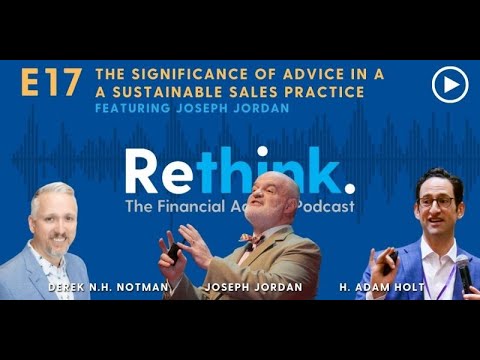
Watch and Listen
Episode Summary
Joe Jordan joins Adam and Derek to make the case that market-centric, product-first advisory practices are unsustainable. Jordan argues the profession needs to lead with stories, not spreadsheets, and shares how helping clients find purpose in retirement — not just optimize a portfolio — is what actually builds a durable, service-oriented practice.
What This Episode Covers
- Why market-centric advisory practices are unsustainable
- Moving from a sales culture to a service culture
- Story-first advising instead of numbers-first advising
- Helping clients discover purpose in retirement
- The role of attitude and behavioral finance in guidance
Full Transcript
Full timestamped transcript.
[00:00:00] H. Adam Holt: Welcome to Rethink: The Financial Advisor Podcast. My name is Adam Holt.
[00:00:06] Derek Notman: And this is Derek Notman. We are your hosts, both veteran advisors and fintech CEOs who challenge the status quo, question everything, and have fun doing it. Hear honest commentary on the challenges facing advisors today. And be part of a community where we can all rethink the profession.
Now on to our episode.
Adam, how do you help clients live a life of significance while building a sustainable practice?
[00:00:36] H. Adam Holt: Are those two things mutually exclusive?
[00:00:40] Derek Notman: Hmm. That's a good question.
[00:00:43] H. Adam Holt: I think we get that feedback a lot, that a lot of advisors are fearful that the movement from a sales culture to an advisory culture is gonna be a big disruptor of personal finances.
In other words, they're gonna ma- they're gonna sacrifice revenue. And the question, is it sustainable even though we know it's the right thing to do by clients' demands these days?
[00:01:06] Derek Notman: Yeah. It's like, so either I make money and I do what's right for my clients, or I do what's right for my clients and I don't make any money.
Right. You know, is, is that, is that the issue we're facing here or, or is it actually even an issue?
[00:01:18] H. Adam Holt: Look, it's not an issue for a lot of established financial advisors. But I, I realize this happened just recently. Someone had said to me that, someone of high acclaim so I won't say who it was, said that the movement of the traditional salesperson, let's call it the insurance agent, the mutual fund salesman, the wire house, uh, broker, moving towards a holistic advisor or at least pretending to be, right?
Some people have called them financial advisors, advisors, what, what are we, uh, is not good for the market. And the reason was because you're not gonna be able to remove the sales mindset from those people- Because they're gonna just pretend to be advisors and still sell. And the selling will promote that they'll just do wrong by the client and s- keep the same perpetuation of best interest concerns, right?
I was like, "Wow, that's pretty interesting." I- my response to it, not that you asked, Eric, but I wanted to tell you. Curious. Tell me. My response was almost everybody who's in the advice game came from the sales culture.
[00:02:21] Derek Notman: Okay? Oh, totally. We both did.
[00:02:23] H. Adam Holt: That's right. And the only reason that we were actually able to afford and not see a huge hit financially is because we did that over a long period of time.
We migrated to an advisory culture where we started assets under management, then we started a fee base, and then we, as we went, went from, remember C shares to fee, to wrap fee- Oh, yeah ... to now fee based? We were able to unwind slowly our legacy sales practices to arrive finally at a place where it was a high performing business, albeit fee based only.
We had that luxury because the or- 'cause the, because the industry changed slowly over 10, 15 years to arrive. But the people who are currently in the sales culture now having to migrate, it's gonna be challenging financially, I think. It
[00:03:08] Derek Notman: will be. It will be difficult. However, I think they probably, at least my h- my hypothesis, challenge me on this one.
I think they could probably do it faster than how you and I did it because there are better tech solutions out there, faster ways to do all of the stuff that we need to do. Whether you're an advisor or another type of business owner, there are inherent risks in starting a business, and you're gonna go in the red initially either way, right?
[00:03:36] H. Adam Holt: Yeah. That's true. Well, I, well, I remember when I first got into the business of financial services. Someone said to me, he said, "Don't worry. The first four or five years you will be underpaid." Yep. "You will be
[00:03:45] Derek Notman: underpaid.
[00:03:46] H. Adam Holt: But if you can survive, you will be overpaid for the rest of your life."
[00:03:50] Derek Notman: Exactly. I
[00:03:51] H. Adam Holt: was like, "Wow, okay."
So then there's a reward. I think this is still true in the advisor practice. We're, we're seeing customers now more aware of paying a fee, getting something that they pay for in tangible services, and expecting more from their advisor. So we think that generally this is actually a good trend. We just need to help the culture that has typically been sales first accept and, and move towards an advice culture.
Um, but I think we run the risk, and one of the reasons we asked our guest, uh, Joe Jordan to participate is because he has seen this firsthand. Now everybody, if you don't know Joe, Joe is a, an international keynote speaker. He's been around the world, literally. He travels around the world speaking. He was one of the first people to start MetLife's transition to financial planning 25-some years ago, and he ran that department, so he's seen it from the time even go back to Nick Murray, who's really well known for, for IRAs.
Like, he was one of those first people that started when they were our age, if you will.
[00:04:47] Derek Notman: Oh, cool.
[00:04:48] H. Adam Holt: So he's got fantastic insight of seeing how you move from a sales-based culture to an advisory culture, and it really starts with this concept of significance. So we wanna, we wanted to bring you, everybody, and our listeners in to this.
So welcome, Joe Jordan. Of course, I think you're gonna really enjoy this, Derek, and of course everyone, because we interviewed him for about 20 minutes. We got it down to about 13, so please enjoy this. We're gonna rethink this as soon as we're done. I, I've been following you for years. You've been such a, a, a voice in the financial services industry for many years.
You've been talking about some of the things that I think were... that a lot of advisors didn't wanna talk about, especially organizations didn't wanna talk about. The, the nature of the humanity behind it, the holistic view, the- Right ... the importance of significance. Uh, and you've obviously written several books as well as been a, a keynote speaker around the world.
Tell us what's your unique, uh, perspective of the advice market today? What do you think about the, the current financial advice market?
[00:05:42] Joseph Jordan: Well, one of the things, having this insight and, and being in those different places and those different cultures, okay? One of the things that I gleaned is that financial services is behind the eight ball when it comes to being client-centric.
And I always thought there would be consequences. There were and there are. Where do you think the DOL came from, for crying out loud? So I think that's something that has to deal. And so look I think it's all about the client. Now that sounds trite, and some people would disagree. We're, well, we've come a long way.
We have, but there's, as the poem says, miles to go, you know? So one of the things I looked at in 2012 was, uh, a Gallup survey, and the survey test, uh, well, looked at, compared different professions by believability and ethics and what have you. The only ones below us were car salesmen and Congress. And so who cares what we think?
It's what the clients think that's there. And so that's the thing that spurred me on. That's where I built ... I, I wrote my book, Living a Life of Significance. So the other professions just underneath, what's the number one? Nurses. This is 2012. This is before all of this stuff that's out, so you can imagine they're on their way to heaven right now.
So the, the fact of the matter is, is that all of the other professions right under that were service professions, and service professions are built on two foundations: humility- And maturity. And humble people don't think less of themselves, they just think of themselves less. And all, uh, mature people aren't necessarily older, they see things from another person's perspective, which means they took the time to find out what that perspective was, and that's the foundational piece for holistic pl- uh, financial planning.
I think there's been tremendous progress, but there's miles to go. And I also think this, here's a foundational piece, financial services must evolve from a sales culture to a service culture. And that's what I think planning, and that's why I like a lot of the stuff you're doing with Asset-Map and what have you, is just trying to get into people's psyche just beyond the numbers.
[00:07:49] H. Adam Holt: No, it's really, I'm, I really appreciate you saying that because it's true. The most successful financial professionals have been thinking like service professionals first for years, right? Right. Those of us that have done, uh, reasonably well in the business, uh, they did it because they led with customer experience and service and, uh, a selflessness, as you mentioned, that basically always puts the client's interest first.
It was ironic when BIR and DOL came out, I think a lot of us were looking at each other saying, "I, I already act in my client's best interest. I don't need someone telling me -" That's right ... "that I, how to actually do that. They can't even tell me how to do it." So I, I appreciate what you're saying. You know, one of the things that you, you have a very unique perspective having traveled around the world, talking to advisors of all sorts on the insurance, investment, annuity, legal, tax, all of these people.
What do you think is the missing opportunity, or even upcoming challenge, that advisors are, are, they just don't see coming? What, what's your unique privilege of that insight?
[00:08:42] Joseph Jordan: I, I, I think the DNA of financial services is very left brain and analytical, okay? And it's all about numbers. And I think the blind spot, again, I'm gonna repeat what I said before, it's not a story of numbers, it's the number of stories.
And that, and we, you really gotta think that thing through to understand it. Look, David Hume, okay, the, the philosopher, said that intellectual awareness and knowledge of something motivates us to do nothing. All right? And all wisdom comes from specific human experiences. So people feel first and they rationalize later, you know?
Statistics play a supporting role, they're not a primary one. And the other thing that's missing is most financial planning programs- Focus exclusively on retirement, and they don't talk about protection problems.
[00:09:27] H. Adam Holt: Mm.
[00:09:27] Joseph Jordan: And I did the research. You know what I found out? Everyone dies. We don't know when, but we do know that that happens.
So the one thing I would tell you is, uh, when you focus exclusively on just wealth management, all right? Look, people feel losses twice as much as they feel gains, and someone's always doing better than you, right? You know, I know my friend down the street does this, that, and the other thing. But there's no case on record, none, where someone on their deathbed said, "Call my broker.
I really appreciate she beat the S&P by two basis points," okay? It, it just doesn't happen, and so that's, that I think is a fundamental mindset that has to happen. The other thing that is important is the dominant determinant in terms of whether for people to have long-term real-life investment outcomes is not performance, it's not fees, it's behavior And when people behave badly, they not only underperform the market, they underperform the very investments they own.
Uh, here- here's an example, okay? The best performing fund in the last decade, 2000 to 2009, was this thing called CGM. The average return over 10 years was 18.2%. You know what the average investor in it got? Negative 11. How the hell, how the hell could that happen? Well, what happened is in 2007 it was up 80%, and then in 2008 it was down 48%.
So right towards the tail end of the decade, everyone rushed in and rushed out. All behavior. When people behave badly, they not only underperform the market, they underperform the very investments they're in. And so there are all of these people and other people who write books and are critical, they're always talking about fees and what have you.
Look, a well-timed intervention can be worth a decade's worth of fees, and that's something that financial advisors have to feel in their guts, you know?
[00:11:14] Derek Notman: And there's so much to talk about there. I love his bluntness. I love his... He did some research, everyone dies. I love that. How profound. Um, you know, what, what came to mind there for me, Adam, with everything he is saying there, he, for me, almost, like, redefines what holistic planning actually means.
[00:11:38] H. Adam Holt: Hmm.
[00:11:38] Derek Notman: It's not just, "Hey, are you beating the S&P, or are you managing my wealth?" It's, like, all of the other stuff he, that said that's so much more important. People don't buy the products, they buy hope, freedom, right? All of those things that are actually important. And talk about a missed opportunity for advisors that are only doing that stuff.
I don't know, it just, it really resonates with me, and I like how he's ripping the Band-Aid off a little bit, 'cause people need to hear this stuff.
[00:12:05] H. Adam Holt: It's true. They totally need to hear this stuff, and I, I think that we've talked a lot about this. It seemingly, you know, a little bit ad nauseam to a degree.
You and I have talked about this on our podcast.
[00:12:17] Derek Notman: Yeah.
[00:12:17] H. Adam Holt: We had Daniel Crosby, we had George Kinder, we've had some people talk about this. But it's really important to hear this, I think, also from this perspective, because Joe's been around for so long and he's got these great little vignette phrases that you can tell he's just used for years.
I feel like he's my dad, just- All right ... dropping the knowledge. Like, you stop by, "Dad, you got anything to say?
[00:12:38] Derek Notman: Let me tell you something." Yes, sir. Here's some wisdom.
[00:12:39] H. Adam Holt: Humble people just think of themselves less, right? I just, this is- That's brilliant ... that's true. You're right. That's right. That's how do we be more, uh, thoughtful and more, more selfless, which I know literally came up with Kinder.
But I think it's important that everybody hears this again, because we have to find ways to emulate this and so forth. So yeah, I agree. Great comments.
[00:12:59] Derek Notman: One real quick thing before we jump back in here with Joe. One thing that I... Yes, we have talked about this ad nauseam a little bit. It's come up multiple times.
But you know what, folks? Maybe that means something. If all these great minds, people that are much smarter than Adam and I, that have been around a long time, right? I, I know, I mean, I, Adam, I... We're getting kinda old, I guess. But-
[00:13:21] H. Adam Holt: I guess ... you
[00:13:22] Derek Notman: know.
[00:13:22] H. Adam Holt: You've got white hair.
[00:13:23] Derek Notman: I got white hair, so it looks like I've been around a long time.
Um, but if they're all saying the same thing, and let's... None of these people talked to each other before they came on our episode, right? Nope. You know, on our podcast. So it's really interesting. And yeah, so maybe it sounds like a little bit like a broken record, but man, if the record keeps saying the same thing- Mm-hmm
listen up. Something's afoot here.
[00:13:44] H. Adam Holt: That's true. Awesome. So that's really interesting. So I heard in their behavior, I heard in their perspective, I heard in their also taking care of the protection, not just the growth. It's funny, what we're seeing, we're seeing a lot of wealth managers always focus on what they think the client really wants to talk about, which is the aspirational growth of this hypothetical retirement, and going and doing this vacation that they think...
And yet it's true. We've seen, actually proved this even in Asset-Map alone. The highest com- The, the highest risk associated with all these households, trillions of dollars on the system already, is that people are not talking about long-term care, life, and disability. They're not talking about it. Why is that?
That's gotta be because the advisors aren't comfortable talking about it, and yet we're seeing mathematical exposures that you can't ignore. They're just clearly under-insured, under-protected, and I guess people are just... It's not real for them. And, and of course, if you've lived through this, it is real, right?
You've seen it, you've experienced it. I have, my own family. Uh, so it is real. So I'm curious. With that mentality of, uh, paying attention to our behaviors and of course supporting our customers' behaviors, what are the kind of action steps you think that advisors need to reexamine for themselves?
[00:14:54] Joseph Jordan: I think we really have to focus on stories and not so much the numbers.
So something you can have, I have a link, it's josephjordan.com/stories. I'll repeat it, josephjordan.com/stories. You hit that, I'll send you two stories a month for six months free. And, and why am I doing that? One is you gotta begin to focus in on the impact you have on others, and the other is it might expand the number of stories that you have.
There's also that program, Life Happens, that Million Dollar Round Table does.
[00:15:22] Derek Notman: Mm-hmm.
[00:15:22] Joseph Jordan: Get into it. Look. And someone says, "I've seen all those stories." They don't change the Lord's Prayer, for Christ's sake, okay? The idea behind it is to put you into another frame of mind. We're talking about an attitude. The other thing that I think is important is my current talk right now, uh, 'cause I do client seminars too, and it's called Purpose Driven Retirement Plan, and here's something that's important.
Those that retire to something- Are happier than people who retire from something. So this starts moving our process around to another thing, and there's a great quote from one of the astronauts, says, "You think going to the moon is hard? Try staying home." Okay? So I just recently did advisor group, and the advisor group CEO got up and said, "I was proud of all you folks with this pandemic 'cause you acted more like a, more like a, a, a, a, a life coach than just an advisor."
And that's a differentiator. No robo-advisor can do that. No idiot on television who's telling you fees and, you know, all this other stuff is there. That's something that I think really has to happen, so that's something that I think is important.
[00:16:24] H. Adam Holt: That's great. So I... Of course, so much of that is there to unpack and w- we're looking forward to discussing that one between ourselves, Derek and I.
And I, I'm, I'm curious, is there anything else you think needs to be heard-
[00:16:36] Joseph Jordan: Mm-hmm ...
[00:16:36] H. Adam Holt: by our community?
[00:16:38] Joseph Jordan: Well, and see, I had to learn financial planning 'cause I had to r- roll it out at Met. I didn't know what the hell it was. At first I was in the numbers and stuff, and the first guy was Nick Murray, so I figured this guy would be there with charts and graphs.
He's talking behavior. It blew my mind. And, uh, I think what's happening now is there's an erosion of the value proposition of the hardcore left brain analytical approach towards fee-based financial planning. It's struggling to justify the recurrence of fees because the client sometimes fails to appreciate beyond money management what you do, and, and it's even worse in the bull market we've had now.
What am I paying you this 100 basis points for? If I'm skiing along, if I had the 100 pay, oh boy, what am I doing? So that's something that's there. So that's the thing that I think is something there just to really explore, evolve more towards the idea of life coach. The money is secondary to the things that people want to do.
It creates the trust and relationships instead of people thinking you're just an accountant, and that's the stuff that I see. I, I think the future's bright, and it especially woke everybody up when we had this pandemic that hit because people are really beginning to think about the stuff that's really important, valuing life and, and it's theirs.
That's some of the stuff I think is important.
[00:17:51] H. Adam Holt: So what a, what a great bunch of information I think from Joe, and thank you so much, Joe, for, for spending time with us and, and sharing that knowledge and dropping the wisdom. What did you think, Derek?
[00:18:01] Derek Notman: Brilliant. I think that was awesome. I, I love his style. I love...
Uh, yeah, he's, he'd be a lot of fun to go get a pint with, I'll tell you that. I believe
[00:18:10] H. Adam Holt: that's true.
[00:18:11] Derek Notman: Yeah, for sure. He's got
[00:18:12] H. Adam Holt: stories.
[00:18:13] Derek Notman: Oh, man, does he ever. I'm sure of it. Um, I, I like how he just said all the things, like if, if this is unsustainable, you know, et cetera, et cetera, et cetera, go back and listen to those things.
It's so true, and he brings it back to what we've always been talking about, this human side of the work we do, to justify our value and what we're charging and all of those types of things. And as you even said earlier, Adam, if we listen to our clients and help them do the things that they actually wanna do with this tool we call money- They're gonna pay us all day long.
[00:18:46] H. Adam Holt: Mm-hmm.
[00:18:47] Derek Notman: That's how you run a sustainable practice. And I think that's what Joe is saying. It's like, "Hey, if you focus on the coaching element and helping these folks, you're gonna get paid." It's interesting 'cause I came into this business from a senior counselor position working with at-risk youth. I worked with murderers, drug dealers, really bad people.
So I was always talking about, like, the goals and the hopes, dreams, and goals, and all that kind of stuff, and then I just plugged the money into it. So I came at it from a different angle, but I think most advisors, like what... I know I'm rambling on here, but, like, most advisors, even including myself, when we come in, you're talking about product, product, product, or sell, sell, sell, and there's no talk about behavior or about coaching or about the softer side of money at all, and I think that's a real challenge if you're trying to be sustainable
[00:19:35] H. Adam Holt: The best salespeople I remember throughout my career were ones that always focused on the big why.
They understood the problem. They used the tools as solutions, not as they didn't lead with the solution. Um, they led with the problem and identifying that, and I think that's really critical. It's interesting because advice-led sales is really trying to solve problems. We've, uh, in some measure, put a, we'll call it a negative connotation on the sales side of it, but at the end of the day, nothing happens until something's sold.
And I do believe that. We just have to make sure that we're there for our customers when they're ready to buy so that they buy the right stuff, and then be mindful of whose team we're on. Are we on the, uh, carrier's team or are we on the client's team? That's big. So I, I think there's a, there's an important nuance that this is not new.
Best interest is not new. Being a fiduciary is not new. We just have a name for it now. Before it was just do the right thing. Do right by my clients.
[00:20:29] Derek Notman: Yeah.
[00:20:29] H. Adam Holt: Be on their team. Uh, the, the reality is the monetization of switching over from a sales culture to a service or an advisory culture, depending upon how you're gonna call it, as Joe did, it's really all about lifetime value.
Can you earn the lifetime trust and confidence of a family so that they stay with you for the next 15 to 20 years? That's how you monetize it. You don't monetize it up front. You monetize it over the long term all of a sudden, and that's how you arrive at creating a practice that's worthy of creating significance for people, as well as something that you'll be proud of long term because it aligns those interests by making sure it's sustainable, as well as making sure the clients wanna be and refer to you all the time, and I think Kinder mentioned that.
He said, "The best evidence of a fiduciary mindset is referral."
[00:21:12] Derek Notman: It's that 100%, it truly is. Well- This has been a real pleasure chatting with him.
[00:21:17] H. Adam Holt: Absolutely. So let's do our takeaway. So you want me to go first? Do you wanna go first? What?
[00:21:22] Derek Notman: Um, do you wanna, like, do paper, rock, scissors for it? Or-
[00:21:28] H. Adam Holt: We could. I, I mean, we could.
Nobody's gonna be able
[00:21:29] Derek Notman: to see. That's, that's, no one's gonna be able to see. Just you go right ahead.
[00:21:32] H. Adam Holt: All right. I will go. Okay. Thank you.
[00:21:33] Derek Notman: Age before wisdom.
[00:21:34] H. Adam Holt: You first, you first, you first. No, you first. Um, sorry everybody. I, the couple things I took away from this, and I just really touched on it, we've had a lot of comments, in fact even Becky at one of our previous who offered, uh, something on LinkedIn said that, uh, how do you transition from a sales to an advisory mindset, which is one of the reasons why we prioritized this specific episode.
But I, I wanna remind everybody that really just sales is helping people execute on their goals, right? The money has to land somewhere, as Michael Kitces said. As we've commented many times So we just have to help... We have the responsibility to help people buy the right stuff, right? And that you're there for that.
So don't just give them the advice and say, "Okay, good luck. Go implement." We still need to be there for them to go execute. I, I tell my kid what to do all the time. If I'm not there, it's gonna be done backwards. She doesn't remember what exactly I said. She doesn't, you know, the nuances that I care about.
So from an execution standpoint, be there to help people make... And this is the behavior part. Get into good behavioral habits. And I recommend you listen to this episode again. There's some really cool Jordanisms we called it, um, because he, he makes some great references, and it gets right to your head and reminds us what matters.
So I recommend that everybody, the action you take is just go back and listen to Joe's section, it's only 12 minutes, uh, and hear what he had to say. Derek?
[00:22:48] Derek Notman: That's great. Thanks. I, I would piggyback that. Michael, s- just sign up for that free offer he gave you for the stories.
[00:22:55] H. Adam Holt: Mm-hmm.
[00:22:55] Derek Notman: Uh, he tells you the website, and we'll put that in the show notes as well.
I think you make an interesting point about the behavior with your daughter. Even that example is really interesting. I think taking that a step further, one of the, the things I would say is that if you're gonna actually help influence your clients' behaviors, they have to trust you.
[00:23:14] H. Adam Holt: Mm-hmm.
[00:23:15] Derek Notman: If you don't have the trust, they're not gonna let you modify their behavior or put the guardrails up when things are going bad.
So I think that you have to focus on that, uh, and that's how you help them live a life of significance. And as we... The recurring theme here is if you do that, if you play the long game, you are going to get paid Right? That's how it works. People will pay you. It's like the whole, what is, what is it? The, uh, the drill bit analogy, right?
They want the h- they don't want the drill bit, they want what it does, but they'll buy that drill bit from you if you can help them, right? That's it. So just, I don't know, it's really corny. My, my wife- That's a good- ... says I have a lot of corny jokes, but that, that's another one for all of you.
[00:23:52] H. Adam Holt: It's a good one.
I'll try to remember that.
[00:23:54] Derek Notman: Go for it. It's, you
[00:23:55] H. Adam Holt: can take it. Tell Joe that one. Joe, maybe Joe can put that into his whole spiel too. That would be good. Yeah, he can use that. The drill bit, they want the hole. I couldn't buy a hole, so I bought a drill.
[00:24:05] Derek Notman: Yeah, right. Right. Got
[00:24:08] H. Adam Holt: it. Well, I got it from this schmuck. I need advice on how to use, how do I put the drill bit- Yeah
in the drill? 'Cause I don't know. I need advisor for that. Too funny. Well,
[00:24:13] Derek Notman: we could, we gotta do a meme on that one.
[00:24:16] H. Adam Holt: We probably should.
[00:24:17] Derek Notman: Oh. And I think it's just one of the things, like help your clients like, like... And I think you and I talked about this on a previous episode, but like focus on the small wins.
"Hey, congrats hitting this benchmark or this milestone or whatever," right? Everyone gets the Merry Christmas, Happy Hanukkah card. How about let's do something a little bit different and celebrate the real little wins to help build the trust, to help modify the behavior. Yeah. It's all interconnected, folks.
All right. There you go. That's, that's, those are mine.
[00:24:43] H. Adam Holt: Good call. Good
[00:24:44] Derek Notman: call. Go buy a drill bit. More b- Buy- You know, be a drill bit ...
[00:24:47] H. Adam Holt: right. Advise people on the right drill bits, and then go to the Lowe's and Home Depot with them to buy the drill bit.
[00:24:52] Derek Notman: Exactly, yeah.
[00:24:53] H. Adam Holt: Right. And then drill the hole with them and then ask them, "Don't have the...
Why, why were you drilling a hole anyway?" "I don't know. I wanted to look through this big wall." Why do you wanna... Oh, anyway. We won't go down the rabbit hole there.
[00:25:02] Derek Notman: No, actually that, that can get dark.
[00:25:04] H. Adam Holt: It's true. But understanding the why is really important, right? 'Cause sometimes it's you didn't even need a drill bit.
[00:25:10] Derek Notman: This is true. This is so true.
[00:25:12] H. Adam Holt: That's why you gotta know why. What are you trying to really do? Okay. Anyway. All our contractor friends, you can tell all your friends that we have home-
[00:25:19] Derek Notman: Do we have contractor friends?
[00:25:20] H. Adam Holt: Home improvement. But we do.
[00:25:22] Derek Notman: I have one. I know one guy.
[00:25:25] H. Adam Holt: Good. Hi. Well, let's, uh, let's kind of wrap up and then talk about our, uh, about our kind of community question.
So Derek did this unbelievable post, for those of you that watched the Super Bowl just recently. One of the comments on Derek's post was about the Coinbase commercial with the QR code that was bouncing like Pong screen to screen, and how effective it was at creating action and controversy. Now, if you saw that, your post is how many views already?
How many interactions?
[00:25:51] Derek Notman: In 24 hours we're over 36,000 at this point.
[00:25:54] H. Adam Holt: Okay, so that's a lot for most... Well, for, for me- It's not bad. It's not bad ... I think that's a lot. That's pretty good. We're
[00:25:59] Derek Notman: pretty good. That's
[00:25:59] H. Adam Holt: a lot. Right? It's all right. Um, so w- How do you do that? Well, that'll be another episode. That's another episode.
What, so what, what can we learn from getting this, uh, this poten- in, in getting potential clients to engage with us for advice delivery? Is there something to learn from this?
[00:26:13] Derek Notman: I think so. I think, like as I even say in my post, this is one of the most brilliant digital marketing examples of our time- Mm-hmm
whether we realize it or not. So I think, like I'd like to talk about that. I'd like to talk about like what you guys are doing with Alexa Voice.
[00:26:28] Joseph Jordan: Mm.
[00:26:28] Derek Notman: Like, this, it's the whole thinking outside the box from a marketing perspective to drive attention and interaction too. Yeah, so I think we gotta do a whole session on that where we can just dive in and use some examples.
And part of this is helping advisors rethink everything, right? So let's rethink this digital marketing thing and use some pretty fun, cool examples on what, what's, what's happening out there.
[00:26:50] H. Adam Holt: Yeah, we'll definitely do that. There's one thing I would just add there. I did a lesser post, not as cool as Derek's, uh, where I said that memorable is better than better.
Memorable is better than better. Uh, it only had 14,000, uh, whatever, interactions. But the point is that in the marketing game, we need to find a way to stand out, not just be better than the last one. We need to be memorable. And that doesn't require money, by the way. That was a- That was a very scrappy, low production, uh, commercial that got a lot of people talking, that will live on in infamy as we all remembered jumping up and trying to capture that thing with our phone and figure out what the heck was going on.
How fun is that? So there are things you can do that we're doing today. So we'll talk about that actually in one of our upcoming episodes. Derek, a pleasure spending time with you as always.
[00:27:37] Derek Notman: Likewise, my man. All the best on the East Coast from the West Coast.
[00:27:41] H. Adam Holt: Yes. And keep warm in this time of winter as it is right now.
Please remember to follow us on LinkedIn, engage with our Rethink LinkedIn page, subscribe to this podcast, tell your friends, put a review, and do a whole bunch of other stuff that's gonna help you achieve your own life of significance and that that helps others. Thank you so much for spending time with us.
We'll see you next time.
[00:28:03] Derek Notman: Adios.
[00:28:09] Announcer: Thank you for listening to Rethink, the Financial Advisor Podcast with Holt and Notman. Be sure to subscribe now and join the ongoing conversation. The information covered and posted represents the views and opinions of the guest and does not necessarily represent the views or opinions of Asset-Map or Connectr.
The content has been made available to you by Asset-Map for informational and educational purposes only.