
Ep16 - Rethink: The 'B' in Beta Stands for Behavior – Featuring Daniel Crosby
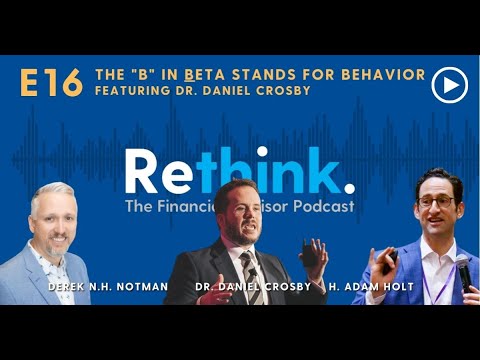
Watch and Listen
Episode Summary
Adam and Derek sit down with Dr. Daniel Crosby to unpack whether investor behavior is the single biggest driver of financial outcomes. The conversation digs into how advisors can actually quantify the value of behavioral coaching, why trust is the currency of the advisor-client relationship, and how human-centered guidance remains a durable competitive advantage as more of the investing experience goes digital.
What This Episode Covers
- Quantifying advisor value through behavioral coaching
- How behavior — not just markets — drives financial outcomes
- Trust as the foundation of the advisor-client relationship
- Competitive advantages of human-centered financial guidance
Full Transcript
Full timestamped transcript.
[00:00:05] H. Adam Holt: Welcome to Rethink the Financial Advisor Podcast. My name is Adam Holt
[00:00:11] Derek Notman: And this is Derek Notman. We are your hosts, both veteran advisors and fintech CEOs who challenge the status quo, question everything, and have fun doing it. Hear honest commentary on the challenges facing advisors today And be part of a community where we can all rethink the profession.
Now on to our episode.
[00:00:34] H. Adam Holt: Derek, have you ever felt like you're a financial therapist?
[00:00:40] Derek Notman: Oh, Adam, man, like I'm laying here on this couch right now and I just, I gotta open up to you, man.
[00:00:45] H. Adam Holt: Wait, are you, are you the therapist or am I the therapist?
[00:00:48] Derek Notman: I think we've both been therapists, and I think pretty much all of our financial advisor, uh, listeners, I think we have a couple now, don't we?
Um- More than
[00:00:58] H. Adam Holt: two.
[00:00:58] Derek Notman: More than two. Uh, I think that we all have been. I mean, like, man, I have got some stories.
[00:01:04] H. Adam Holt: Really?
[00:01:04] Derek Notman: We're not gonna- Are you gonna
[00:01:05] H. Adam Holt: share those
[00:01:05] Derek Notman: stories on this podcast? No, I'm not gonna. That's like off the record stuff. You can email me or call me. But- Wow ... um, dude, like we hear some pretty interesting stuff as advisors, and I always have joked, I hear more from my clients than like a therapist, attorney, and their priest all combined.
[00:01:22] H. Adam Holt: Wow.
[00:01:23] Derek Notman: Um, I'm sure you have as well. Um, I've had, like I had one... Just to totally digress here, I had one m- client meeting. They never actually became clients, thank God. But they like basically got divorced in my office. Hmm. 'Cause we were having some pretty in-depth conversations, and stuff was coming up that the two spouses didn't realize was, was true.
Oh, boy.
[00:01:45] H. Adam Holt: So anyways. I've been through that, similar things. I mean, after so many years of being a financial advisor, you cannot avoid dealing with the tough issues, the, the wounds, the, the fears, all the stuff that comes through. I, I... It's interesting to see how many advisors are moving towards this life coaching.
Uh, obviously having George Kinder on recently talking about life planning. I know there's enormous programs going on in the industry. Columbia's put out a holistic life planning program that I, that I've participated with. Really awesome. There's a great number of financial advisors that are moving towards life coaching, and I think it's very true, Derek.
W- Finance is such an intimate subject for which there's so little education that you get adults sitting with you that you're literally educating and bringing them through an entire emotional journey to get into a place of being more financially fit. And so, yes, I really, I can relate to your stories.
We've s- heard a lot. We've heard a
[00:02:40] Derek Notman: lot. Oh, man, I think, yeah, it would be almost fun to like get a book sometime, put together of horror stories from all of our, our three listeners now.
[00:02:48] H. Adam Holt: For, yes, three or four listeners- Yeah ...
[00:02:50] Derek Notman: that we've heard.
[00:02:50] H. Adam Holt: Yeah. So thanks for being here, you three. Yeah. Look, this is a great lead in because we did have a conversation.
When we were thinking about this, we said, "Well, who is the leader right now? Who's the voice of behavioral finance," right? Why are people making different decisions, and how do we help them as financial professionals? And of course, you can't go very far without running across Daniel Crosby, Dr. Daniel Crosby.
Dr.
[00:03:15] Derek Notman: Daniel Crosby.
[00:03:16] H. Adam Holt: Dr. Daniel. He's written a couple books, therefore he must be smart. Um, we actually really like Dan, so thanks Dan for, uh, participating in this. You probably didn't know what you were getting into when we interviewed you. Um, but he's a really cool person. Um, he has guitars on his wall, and he gets to speak, if you can get to hear him, uh, around the country at different events, and he talks enormously about- Why people take actions and why we need to, how we need to help them.
So, um, Derek, you ready to hear our playback of what we took away from this and get some commentary going?
[00:03:47] Derek Notman: Yeah, let's bring it out and let, let people dive into what he has to say.
[00:03:50] H. Adam Holt: All right, let's hear what h- let's hear what the good doctor had to say.
[00:03:54] Daniel Crosby: Yeah.
[00:03:54] H. Adam Holt: How does an advisor get an understanding of what is BFI for them?
What does it mean to an advisor?
[00:04:00] Daniel Crosby: Yeah, I mean, be- behavioral finance as I, as I describe it, is just sort of, uh, finance that accounts for the messiness of, of human nature. I think a lot of our, our models are based on this idea of spreadsheet optimal or what's optimal holding human behavior constant when we know that human behavior is, is never a constant.
It's always a variable. And so behavioral finance is just messy finance that accounts for the ways that humans think and act and behave in the real world.
[00:04:28] H. Adam Holt: So why does that matter to an advisor today? I mean, given so much tech out there, how is behavioral finance really a, a critical component of what they should be paying attention to?
[00:04:39] Daniel Crosby: Well, it's, uh, there, there's nothing that matters more, I would suggest, and all the research backs that up. So if you look at, uh, the value added by advisors, right? So there was a great study done in Canada that, that compared DIY investors to those who were advised and looked at them at 5 years, 10 years, 15 years.
Uh, at, at 15 years, people who work with an advisor had 2.7 times the wealth as their unadvised peers, holding constant 55 other variables. So this accounts for, you know, levels the playing field across obvious things like income and things like that, which would sort of throw the measurement off. So holding all else equal, folks who work with an advisor have 2.7 times the money of their no advice peers.
And when they dig into the data, the reason that's the case is that advisor has kept that person from two or three catastrophic missteps over that 15-year period, uh, and that's made all the difference. I could go on about this, but I mean, this is the biggest value that we add, and it's, it's really not very close.
[00:05:47] H. Adam Holt: So that's kind of interesting here. So what he's doing is he's framing for us this idea of behavioral finance is really about not just decisions point in time, but decisions over long periods of times and making good habits.
[00:06:00] Derek Notman: Definitely have it for me. I mean, it's all about behavior. But I like how he points out that behavior's probably the only constant that isn't a constant, right?
It's all over the place. People are emotional beings, and all these things continue to change. So it's fascinating, but I, I love that study that he references from Canada. Um, so thank you to our friends in the north there. But, uh, w- we'll, we'll throw that link to that in the, uh, in the, uh, the show notes, but go check it out.
I mean, that's, that is a really brilliant study, and it clearly shows the value of the work that we do. And as Daniel's gonna say here, it's not just, "Hey, how did your return in your S&P 500 fund do," right? There's all these other behavioral aspects to the work that we do.
[00:06:40] H. Adam Holt: Well, it's nice to know also that there's actually a value of an advisor long term, that it's not, you know- It's huge
it's obviously not just about stock picking, and we gotta keep reminding everybody that, that this is, this is about having somebody who's gonna tell you, "Left, right. No, don't go right. What are you doing? Let's go. Let's keep going the course," when you wanna, you know, pull over 'cause you see traffic. So I think that's really clear.
Let's, let's jump back to the doctor. Fantastic. So Dan, what is your perspective or your u- opinion of the financial advisor market today?
[00:07:06] Daniel Crosby: Well, first of all, I, we, we have to start with everything that's going right. We're reaching a higher percentage of Americans than ever before. Uh, planning a- and sort of holistic planning are increasingly taking center stage.
I think fees are more in line with the value provided than ever before, and just the menu of investment alternatives available to the average person is more robust and, and more diverse than ever before. So that's a good news headline. Uh, I think the bad news or the, the opportunity is we still have work to do around deep client discovery, uh, that goes beyond dollars and cents.
You know, at Orion, we do some research. Sort of our goal is to, to understand how well understood our clients feel, uh, when they've been through a typical onboarding process. And, uh, without divulging any company secrets, I can tell you the answer is not very well understood. I think we have a lot, a, a lot more work to do to make sure that our clients feel, uh, how much we care about them a- and that we understand them at a level that is sufficient enough for us to provide appropriate customization and appropriate sort of behavioral coaching.
[00:08:17] H. Adam Holt: See, that's interesting. I mean, the... It's, it's true, understanding the client, which goes back to the therapy content we made, we sent early, which is we get deeper into the real emotional reasons and what are motivators going on in people's lives. What are you, what are you seeing? How does this relate to what you're experiencing?
[00:08:33] Derek Notman: Oh, the same thing. I think that's where the real value comes from, and that study just supports it. And we've talked about this a number of times about leading with advice, and you can't lead it with advice if you don't understand the behavioral aspects of the client that you're working with, why they're doing something, why they haven't done something.
Uh, it's all interconnected. And he's right. We are reaching more Americans, and even just people around the world, than we ever have before. But now that human element of advice is becoming even more important- Mm-hmm ... because we have to understand these behavioral aspects of everything that we're doing.
People know they can go buy a stock wherever the heck they want. They need more and they want more than that, and that, that's where us- Mm ... as advisors come in, and part of that journey is hearing
[00:09:17] H. Adam Holt: a whole ton of stuff that we normally wouldn't hear. Yeah. I... It's funny, you know, I, I'm passionate about this.
At Asset-Map, we focus so much on data gathering, and the reality is, is that the data gathering mindset is so still technical. It's tell me about the people, how much assets do you have, what kind of income do you have, or you have insurance, do you have debts? And the... And what do you care about? I care about retirement and funding my kids' education and making sure there's enough if I'm not here, right?
Those are very quantifiable, we'll call them mathematical approaches. They're not qualitative. And I think one of the things that we've seen is a, a recent, a departure from the numbers-only fact-finding or fact-gathering of can we understand the client on a deeper level, and can we actually maybe even systematize that?
Even though that tends to be a very, we'll call it relationship-driven, long-term empathetic journey that you kind of earn over periods of time, uh, they're out- we're starting to see actual technologies that are starting to come out that try to match up the right psychographic of advisors, uh, that I think are really important
[00:10:16] Derek Notman: That's exactly, yeah.
If you're gonna have this behavioral connection, well, you probably should have people that understand each other and like each other. Probably. I mean, I mean, I don't know. I mean, most marriages that work mean the people like each other, right? You know, I'm just- That's true.
[00:10:28] H. Adam Holt: Well, we don't know, but sometimes-
[00:10:29] Derek Notman: Yeah, no, I mean, you and I like each other still.
We've been doing this a while here.
[00:10:35] H. Adam Holt: We've been going on a good year. We made it a year. We made an anniversary. We made
[00:10:39] Derek Notman: it a year, man. Oh, happy anniversary. It's true.
[00:10:41] H. Adam Holt: Awesome. All right, let's hear Dan.
[00:10:43] Derek Notman: Keep going.
[00:10:44] H. Adam Holt: Awesome. So is that the missing opportunity? Is that people... Or sorry, I should say advisors are not aware of their customer's, we'll call them emotional needs tied to their money?
And you mentioned fact-finding. Can you touch on how advisors can address those things? Are there some takeaways or actions or attitudes they should have?
[00:11:05] Daniel Crosby: Yeah, I th- I think there's a couple of things. One of the things is we, we need to be focused on giving advice that sticks. We are advising about 40% of the American population now, which is up dramatically, as I suggested, uh, from about 25%, uh, not too many years ago.
So that's the good news, right? The bad news is that slightly less than half of those people are taking the advice as it's delivered, and this is consistent with what we see in other fields. One of the leading causes of death in the country, uh, i- is people that have gone to the doctor then don't take their medication as prescribed and end up, uh, having some sort of, uh, fatal problem as a result of that last mile behavioral problem.
We've got the tech, we've got the product, we've solved the investment problem, right? We haven't always solved the investor problem, though. Uh, I did some research lately, it was crazy. I looked at $10,000 i- invested in 1972. Uh, if you put that in sort of your average value factor fund a- and bought and held it over that time, that $10,000 would be $2 million.
If you put it in a growth fund, it's $1.7 million. I'd take either one, right? That's a good return either way. Uh, yet you look at what the average investor got. If we look at seven different academic studies that look at the gap between investment returns and investor returns, the average investor got somewhere in the neighborhood of $400,000.
So capturing between a quarter and a, and a fifth of the return available to them. So sometimes we as an industry are solving the wrong problem. Like we're over here fighting about value versus growth. Meanwhile, investors are over here blowing themselves up, uh, because we haven't solved that investor problem.
We've been too busy fighting about the investment problem.
[00:13:03] Derek Notman: Yeah, that makes so much sense. I like his analogy of, uh, like medicine. Hmm. And I think it, it goes to... I mean, I've, sure I've sat with some doctors in the past where I'm like, "Eh, not sure I trust you. Not sure I like what I'm hearing. I'm gonna go get a second opinion, or I'm gonna do it my own way," and then I end up getting in bigger trouble.
[00:13:24] H. Adam Holt: Hmm.
[00:13:25] Derek Notman: And I, I think it, it goes down to this, like, trust thing. And maybe that doctor, maybe the advisor is 100% spot on with their advice, but because the trust, the behavioral connection isn't there, there is the lack of trust, and therefore they're like, "Eh, not sure if I'm gonna actually follow through on what they're telling me I should do."
[00:13:44] H. Adam Holt: Yeah.
[00:13:45] Derek Notman: So I think you're spot on with the investor problem. And when we say investor, I, I would lump in whether it's insurance, investing, planning, whatever, any of those financial things that we help our clients with. Um, yeah, man, like we gotta solve that problem, and we got... That's that whole human BFI thing here that we're talking about.
[00:14:05] H. Adam Holt: You know what's really funny? Mm-hmm. I just realized it, but I, I think when a consumer comes to a financial professional, they're saying, in a way, "I want your help because I recognize I'm not serving myself as best as maybe I could," 'cause they don't have the expertise or ability or access, or I don't even know if I'm asking the right questions There's an enormous number of people that are obviously DIY.
In fact, many financial advisors DIY themselves. They don't actually get outside advice 'cause they already know it all, right? But I, I don't manage my own money. I don't... But, you know, I, I choose not to 'cause I don't want to be- I have someone else do it ... emotional about it.
[00:14:38] Derek Notman: Exactly.
[00:14:38] H. Adam Holt: Yep. Um, so the point about that, and I think one of the things I've seen personally is where I've seen failures in my own clients to take action, where I have not been able to get them to take behavioral follow-through, is when I can't help facilitate it.
And you know what that area has been the biggest, I'm thinking about it? Curious. It's been on the legal and the tax side. So the investment and the insurance and the money management, we can do that for them. So we can help them follow along and get there and get it done 'cause that's our role. But once I tell them, "Listen, you gotta go get your wills, you gotta go do it this way, you gotta do it this way," I get back to them the end of next year, "Did you do it?"
"No." "Why didn't you do it? Wasn't a problem?" "No, I just didn't get around to it. I got intimidated." In other words, we need to be proactive for our clients and help them get it done. If they're coming to you, they're already saying, they're raising their hand saying, "You know what? My behavior is not aligned with my interests, okay?"
[00:15:31] Derek Notman: Yeah. "
[00:15:31] H. Adam Holt: I actually need you to help me, and I'm willing to pay you to help me get it done." And I think we could do a better job as a community helping people get done stuff, even things that we don't actually manage and get paid for. That's gonna be the interesting thing, and I think that's why you're starting to see movement towards true fee advice, uh, movement is because we need to help people along a whole spectrum of areas, maybe even real estate, maybe even financing.
[00:15:54] Derek Notman: Yeah, it's so interconnected. I think that you're spot on there. And it's tough when you're coming from a sales environment that says, "Hey, sell this product 'cause that's the only thing we can do here." And yeah, sure, tell them they should get a will, but then leave it at that, right? Like- Yeah ... as a consumer, do you really wanna be told to go get 18 different things done and with 18 different advisors?
Like, you're not gonna get it done. You need help.
[00:16:14] H. Adam Holt: That's right. Yeah, maybe it's a, it's an argument for coordination. Let's hear what, uh, let's hear what Dan said.
[00:16:19] Daniel Crosby: So I think one of the things that we need to do is, is use, uh, the learnings of behavioral finance as a mirror onto our own behavior I think, you know, Jason Zweig talks about this.
We've often used it a- as a window onto client irrationality, but seldom have we used it as a mirror to look at our own hangups and our own biases and create that rapport with our clients by being honest about where we get it wrong and where we're scared and where we're fearful or where we're overly excited.
So I think there's an opportunity there for us to do some work on ourselves, uh, rather than using behavioral finance as this thing to look scornfully, uh, on the uneducated masses. We can turn that bright lens of introspection back on ourselves a- and start to be a little more candid about where we could do better and, and how we could help our clients better.
But another thing I think we can do practically, uh, is we can move beyond bias. There's been this huge conversation around where we get it wrong, and it actually mirrors the development of psychology as a discipline more broadly. We started with Freud and your mom and all the ways that you were broken and screwed up and, and needed help, and it's only in the last 50 years that we got to positive psychology, which teaches us how to be better leaders, teaches us how to be more fulfilled.
Behavioral finance started the same way, with sort of these long lists of all the ways in which we're broken with respect to how we think about money. We as an industry need a, a, a positive behavioral finance where we can educate our clients a- about how they can be great with money and about how their values and the things that they love can actually be integrated into their plan i- in a way that spurs them to make better decisions, not always focused on all the ways they're gonna mess it up.
[00:18:09] H. Adam Holt: I think that's really cool. I, I- there's two things I heard. I heard lead by example. Really just w- walk the talk. Show your clients what you've done. I always tell my clients what I do. I show them my asset map. I show them how I dealt with certain things, how I show... 'Cause I want them to know I've actually done it, I'm not just telling them to do it.
And I love that comment of, uh, of just leading by the positive example, not necessarily- Yeah ... here's why you stink, right? Here's what you did wrong. Here's why it's gonna fail.
[00:18:36] Derek Notman: Yeah. Yeah, you, you suck. You just, you don't know how to do anything. You're never gonna, never be successful. Like, uh, you may not actually say that, but they may be feeling that way, right?
Just, uh- The judgment.
[00:18:46] H. Adam Holt: Yeah, that's
[00:18:46] Derek Notman: true ... the judgment is terrible. It's intimidating. I think that might be one... Maybe that's one of the reasons not everyone wants to work with an advisor, 'cause they're afraid of that judgment. Mm.
[00:18:55] H. Adam Holt: That's true.
[00:18:56] Derek Notman: Yeah. I, I heard in, two things. One, be introspective. Let's look at our, at our own bias as an advisor.
How do we mess things up? And let's be honest with ourselves on how we're doing that with our clients. But also, as you said, like, be positive. "Hey, great job setting up that retirement account or getting this done or getting that done," and then just build on that. Yeah. Positive psychology, man. It kind of works.
[00:19:16] H. Adam Holt: It does kind of work. Well, look, you wanna reinforce good behaviors. You can't focus on- Exactly ... the bad behaviors and say- Yeah ... "Hey, why'd you do it this way, you schmuck?" You know, like, I- ... I'm here for you to... Okay, I guess you're right. I did mess up. Yeah. That's not the point, right? So the, the key is we wanna help people get good habits, 'cause their success is our long-term success, uh, so that we can be part of that.
Let's, uh, let's go back to Dan for his, his close up.
[00:19:39] Daniel Crosby: We need to ask the kind of questions that develop a real rapport between advisor and client, because that rapport is the best predictor of whether or not they take your advice down the road. You need some money in the bank with them relationally so six months, two years from now when you're asking them to stay the course and do this hard thing, they know that you care.
They know that you have your b- their best interest at heart. So all of that is important, if only for building rapport. Uh, even if it never taught you a single thing that you needed to fill out a financial plan, your taking a genuine interest in them is, is laying the framework for that later rapport.
[00:20:20] Derek Notman: Love that. It, it's funny 'cause Adam and I, we've had, like, two conversations just recently for this podcast, and you're saying exactly what they were saying. It's great.
[00:20:29] H. Adam Holt: In a different vein, though.
[00:20:30] Derek Notman: In a different vein, though. They, they talked about bias. It's a different vein. It's a different angle, but it's the same thing.
I love it
[00:20:35] H. Adam Holt: It's true. It's fun to hear that, that bi- that's the first... Well, this is the second time we've heard bias come up. That it maybe this is a new kind of a, a, a word to Jack, I guess. Um, listen, Dan, is there any, is there anything that you think that the audience needs to hear, right? Is there a message, a bigger message, or a futuristic perspective on why it matters and what kind of...
We have to create urgency for these advisors to change their behavior and want to change as opposed to being pulled into it. Is there something we can share with them that, that will communicate that to them?
[00:21:07] Daniel Crosby: Yeah. I think the headline here for me is that we're, we're solving the wrong problem. In, in 2016, Merrill Lynch compiled a study.
It was a meta-analysis. It was a study of all the studies on where advisors add value, and they looked at what I'll call the old school stuff, like product selection, asset allocation, tax management. All of it's valuable, right? All of it's valuable on a range of somewhere between 30 and 62 basis points per year to the client.
It's all good stuff. But then you looked at stuff like goal optimization, uh, client assessment, behavioral coaching. This stuff's adding between 65 and 244 basis points a year. So we need to compete where we're most human. I think sometimes we are trying to out robot the robots, and we're having the wrong conversation, solving the wrong problem.
All that stuff's great. We have great tech. We have great automation for asset allocation, tax management, and all the rest. Let's compete where we can win, which is on the human side of money.
[00:22:13] H. Adam Holt: I mean, that... I love it. You know, when we do these interviews, Derek, and they always drop the mic at the end.
[00:22:19] Derek Notman: Right
[00:22:19] H. Adam Holt: there.
They always leave that... Did you guys, did you hear it?
[00:22:22] Derek Notman: The human side of money, man. I heard it. Like, I, I actually kind of... Yeah, I heard it drop, fell
[00:22:28] H. Adam Holt: It's a book. There's a book right there. I-
[00:22:30] Derek Notman: Yeah
[00:22:31] H. Adam Holt: I... What, what, what I think what I'm r- hopefully what I'm focusing on, if you hear- heard what he said, and go back and listen to it.
Like, replay those last two minutes on your podcast and listen to what he said again. He said that the humans have the capacity beyond asset allocation, beyond stock picking, beyond whether you're using alts or REITs or index or any d- of adding significant basis points to the long-term results if we can help manage behavior.
That's it. Yeah. That's the value. We're always asking, "Well, how- why do we justify our fees? How do we justify charging X%?" Right there. That's how. But you have to communicate that to the client, 'cause they don't know. They didn't even know. We were told when we first started in the business that 91% of the results was asset allocation.
[00:23:13] Derek Notman: Oh,
[00:23:13] H. Adam Holt: my gosh. Do you remember that? It was the Ibbotson survey. Oh, my
[00:23:14] Derek Notman: gosh, yes. 91%. Ibbotson, like- That's it. Just do that. N- there was never a single hint about BFI in there at all.
[00:23:22] H. Adam Holt: Not at all. Not at all. Oh, my gosh. So you remember that? 91%. Dude, that was- Nine... You know, something else- Yeah ... was stock. Like, two, two-thirds of 1%.
I can't remember what it was, but it was some small amount was stock selection, and so the rest was maybe timing. And, and of course you couldn't control the timing part, right? Right. So it was the argument of you should just sell a mutual fund and buy and hold to the long term and get the allocation right, and that's what you needed us for.
But that's not what you need us for anymore. It turns out what you really need us for is choicefulness, right? Decision, consistency- That's, that's the point. That's BFI. That's BFI, right? Now you, now we know how to answer that question. What is BFI?
[00:23:56] Derek Notman: That it's, it's that human capital rapport he talks about.
That's what they need- That's what- ... 'cause they're gonna come back to you at some point if they're about to make a mistake. "Well, you know what? I really trust my advisor. I'm gonna, I'm not gonna make that dumb decision today. I'm not gonna be a schmuck."
[00:24:10] H. Adam Holt: Or gonna pick up the phone and call her. Like that's the point.
[00:24:12] Derek Notman: Exactly. Exactly. Now
[00:24:13] H. Adam Holt: that's, that's the- Yeah So what are our takeaways? We always wanna wrap up with what are our top two or three takeaways from each of us that you can put into action right
[00:24:20] Derek Notman: now? Well, I wanna know what yours are.
[00:24:22] H. Adam Holt: You wanna know what mine-
[00:24:23] Derek Notman: Yeah ... okay Because once you do yours I'll just kinda like copy yours so I don't have to think on my own.
[00:24:27] H. Adam Holt: Oh, that's brilliant. That's great behavioral advantage right there.
[00:24:31] Derek Notman: I'm managing my behavior.
[00:24:33] H. Adam Holt: I, I think the first thing that came up was, for me was, you gotta educate the client on the behavioral value, right? What we just talked about, what he just dropped the mic on. And reward good behavior. One of the things that we all know as parents, if you are one or if you've had one I guess, uh, probably one or the other- Yep
that you, if you reward good behavior and you punish poor behavior, or you deter it, or whatever we're using for words these days. And I actually think that there's an opportunity to not only communicate the impact of the good behavior, but when you start to see it, find a way to reward it. Right? We, we tend to send, uh, kind of, hey, Christmas, holiday, uh, you know, birthday gifts.
Why don't we actually flip that on its head and actually reward them when they did something good? Like you saved, you hit your target on savings, we sent you a gift certificate to go get- Yeah ... on a menu. Like on a restaurant. Yeah. Like good job. Go tell your friends like what a good job you did. Take them out to dinner on me.
Like that, I think that's an interesting idea. I don't, you know.
[00:25:30] Derek Notman: I love that idea. How much cooler is that than getting a holiday card? They're getting that from everybody. They're not getting a card saying, "Hey, congratulations. You made it to retirement and you're ready to rock it." You know? Yeah, yeah, yeah, yeah.
Like, they're not getting that. You know? No,
[00:25:41] H. Adam Holt: yeah. No, you, your net worth crossed a million dollars. Congratulations. Yeah. No, how about you actually saved despite the difficulty of saving this year? Congratulations. You actually insured when you said, "I really didn't wanna do it," but you did it and you took...
You made the hard decision, you did. That's the stuff we wanna reward. I, I don't know. I'm, now I'm stuck on this idea as a parent. I'm gonna go and tell my kid that I'm gonna reward her for, for doing good things. Um, obviously leading by example is a big one. I think that's an opportunity to create that rapport he talked about so that you're trustworthy.
We all know that doctors that have a good bedside manner get sued less, okay? There's studies have been done- ... about this. Malpractice is clearly tied to bedside manner. If you don't get along with those clients and they don't like you and something goes wrong, guess who's getting sued? That mean old doctor, okay?
And the opposite is true as well, right? If you're empathetic, you related to the client, things will inevitably go wrong, but things also go well. Uh, you want that value to accrue to you. You lead by example, and you connect with people. And the last thing is I had... I got stuck on this whole thing of beta, this idea that maybe the variability and the volatility of our outcomes, that really the B in beta is behavior.
And so maybe we've been focusing actually on the wrong thing in investments long term, is that that behavior is a real component of the beta and of course the alpha that results in that, which is basically your return performance. If we can actually have good beta, maybe we get good alpha, and that's the, the, the kind of attitude that I think he was just saying.
Maybe there's some fun analogy in there that we can figure out.
[00:27:08] Announcer: Oh, for sure.
[00:27:09] H. Adam Holt: Or if you figure it out, just, you know, send it on our LinkedIn profile and say, "I figured out the coolest saying." I tend to like those things. So th- that's what I'm thinking, is the implication of behavior in outcome.
[00:27:20] Derek Notman: B is the beta in behavior.
I think, uh, that's like a book title. In your free time, Adam, why don't you go write that?
[00:27:28] H. Adam Holt: Oh, I'm gonna call Dan and tell him to write it.
[00:27:31] Derek Notman: You can just... Yeah, you can do like a forward for him. Um, yeah, I'm not gonna just... All right, we'll do this quick. So mine are my friends, my advisors that are listening to this podcast, please know that you are valuable to your clients, and there's data to back it up.
But as Adam said, you gotta be able to communicate that too and show that to them. And as Daniel said, this is where the behavior, the, the social or, um, emotional rapport and capital come in. But you can back it up, so we are valuable. We have to look inwards with the behavioral fi- with BFI, right? Look in the mirror, uh, just as much as you're looking at your clients.
I think that's really important and even about bias. We've talked about that before. And stop competing on tech. We've talked about this before, Adam. Mm-hmm. Like, we all have access to the same tech pretty much at this point. Yeah, there are different flavors of vanilla, but we all pretty much have the same tools.
It's the human stuff, the problems, the solutions, the relationships. That's where we can compete, and nobody can beat us on that one 'cause we're all different.
[00:28:29] H. Adam Holt: Amen. No, that's really great. Um, now I, I really, as you guys all know, we finish with a community request. So Derek, I'd love, uh, for you to share this, uh, this one particularly because this is fun.
[00:28:43] Derek Notman: Yeah, this is fun. So this is coming from our friend Beki Temba in South Africa. Beki Temba.
[00:28:48] H. Adam Holt: What's up, Beki?
[00:28:48] Derek Notman: Um, yeah. He goes by Beki. Really cool dude, all about leading with advice, and he is one of the most forward-thinking people I know in the financial advice space And he sent us a, a note, uh, on LinkedIn here.
By the way, folks, that's where the best way to get ahold of Adam and I, so follow us. We'll have more than two followers. So Becky says, "The biggest issue in my circles is the transition of the industry from product-led to an advice-led profession that is focused on doing the right things first for clients."
Now, we've talked a lot about that. But then he goes on to say, "But how do we do this whilst," I like how he used the word whilst, "whilst also delivering profitability and sustainability for financial advisors?" Mm. And that's huge because I would be willing to bet a lot of advisors agree that we need to lead with advice and do the right things for our clients, but we also aren't charities.
We gotta get paid.
[00:29:46] H. Adam Holt: Mm.
[00:29:47] Derek Notman: So how do we balance it, Adam? What do you think?
[00:29:49] H. Adam Holt: Well, I- it's... I've been talking about it a lot on stage, um, that I think there's gonna be a massive disruption, especially financially, to most financial advisors when they get this rude awakening as not just our own distribution companies start to cut the comp to make the products more competitive, but as technology solutions directly go in there and just start absorbing the cost at a lower margin, right?
So the question is it's gonna happen because economically it makes sense that products will have less overall comp built into them, and I think that's gonna affe- it's really gonna affect the product placers. Now, granted we can probably replace that income in some level with, uh, advisory or fees or professional services and so forth.
I don't know if it's gonna catch up as much, but I think what's gonna happen, Derek, is that those professionals who start to move to the advice world will see a disproportionate growth in their, uh, market share while the rest of those that don't and stay product only are gonna basically leave the market.
So you're gonna have more people that want advice and less advisors that are seasoned enough to help them get the solutions they need anyway. So while I think margins are gonna come down, I think that the market will get much larger. And so the, the question is are we positioned as professionals to pick up more of the wallet share and more of the market share because we're leading with advice and we're hyper-niched into a specific community with expertise.
How about that? It
[00:31:13] Derek Notman: sounds like your solution here is advisors should really focus on this whole leading with advice. Let's get more tactical with that. Get your CFP, charge for a financial plan, charge an ongoing subscription for financial planning services. Mm. That- that's kind of what it sounds like, right?
Like- Yeah, that's right ... charge for that, right?
[00:31:31] H. Adam Holt: I agree. That is a way to capture some of that, Becky. But I, I also think that even if the compensation rates come down on placement, customers who buy advice, as my kid says, he says, "The money has to land somewhere," right? Yeah. Is, is the argument if I walk you to the restaurant door and I leave you at the restaurant door and say, "Okay, I brought you to the restaurant," and then I'm like, "All right, see you later."
And they're like, "No, come, come in, you know, be part of this with us. Sit down with us. Enjoy the dinner. Be part of it. We have more questions for you." Like, I, I think advisors will still wind up placing the business. I just think the margin compression we'll see for the revenue generated from the placement of products will come down.
And so therefore, instead of earning, let's say $10,000 for a life insurance sale, we'll earn 3,800, okay? For the same exact product. Now, obviously the advisor's gonna feel that, but I, I just think there's gonna be that much more volume of business coming in, and tech will basically make it easier to, to triple one's activity.
So I can write now three or four life policies over the same period of time. So I may not actually see a reduction in compensation as a result of that pressure that he's talking about, but I have to be able to compete. That means I gotta have the right tech and I gotta have the right relationship coming into it, and I gotta get my clients in the right behavioral mindset so that they stay with me long-term and I earn the lifetime value as an entrepreneur.
Think about that. It's all about long-term lifetime value capture. So I know I just talked about SAS company metrics, but we have to start- ... thinking like an entrepreneur.
[00:32:57] Derek Notman: Well, we talked with, um, what's the gentleman from Snappy Kraken there about, uh- Robert
[00:33:02] H. Adam Holt: Sofia ...
[00:33:03] Derek Notman: yeah, about enterprise value and building that.
Mm. That's what we're doing here. So awesome question from our friend Becky down in SA. Uh, thank you, sir. Uh, it might take a little longer to get you a Rethink hat or T-shirt since, uh, you're a little bit farther away. We should do it. But, uh, maybe I'll fly it down there for you on my next trip.
[00:33:23] H. Adam Holt: That sounds cool.
Yeah. Well, listen, as Derek already said, thank you so much. Uh, and also be sure to participate in this conversation. Of course, subscribe to the podcast. Uh, tell your friends. Go on, uh, on iTunes and leave us a review. Hopefully it's positive. If it's not positive, you can keep it to yourself. Uh, and then listen to a different podcast.
Yeah. We said we're controversial. No, we love you all anyway. We just wanna know who you are. But the point is- ... is that, uh, look, we love the engagement. The, the podcast has been really exploding, and we've been really blessed to be part of this, uh, this ongoing conversation. Um, to, to Dr. Daniel Crosby, thank you so much for being on here.
We'll put a link to his books and his site so you can engage with him. Obviously, uh, making a huge charge over at Orion to, to make a difference in the industry. We appreciate everything you're doing. Derek, my friend, it's always a pleasure spending time with you. Likewise, brother. Until the next time. Good seeing you.
Till next time.
[00:34:15] Announcer: Thank you for listening to Rethink, the Financial Advisor Podcast with Holt and Knottman. Be sure to subscribe now and join the ongoing conversation The information covered and posted represents the views and opinions of the guest and does not necessarily represent the views or opinions of Asset-Map or Connecture.
The content has been made available to you by Asset-Map for informational and educational purposes only.