
Ep15 - Rethink: Beyond Fiduciary – Featuring George Kinder
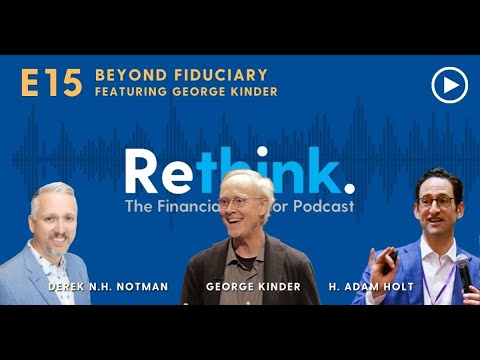
Watch and Listen
Episode Summary
Adam and Derek open by asking what 'fiduciary' really means at a moment when regulation (Reg BI, the DOL rule) has put the term top of mind for advisors and clients alike. To go deeper than the legal definition, they bring in George Kinder — widely known as the father of the life-planning movement and founder of the Kinder Institute — who reframes fiduciary duty as a listening-first practice built around helping clients find meaning and freedom, not just manage assets. The conversation covers what advisors typically miss in client conversations, practical steps toward a genuine fiduciary mindset, and Kinder's broader view of advice as a force for positive impact. The episode closes with a listener question on communicating the value of advice, which the hosts push to their next episode with behavioral finance expert Dan Crosby (Ep. 16).
What This Episode Covers
- Fiduciary duty as a practice discipline, not just a compliance category
- Life planning and client-centered, listening-first discovery
- What advisors typically miss when opening client conversations
- Practical steps toward developing a genuine fiduciary mindset
- Communicating the value of advice amid product commoditization
- Advice as a tool for broader personal and societal impact
Full Transcript
Full timestamped transcript.
[00:00:00] H. Adam Holt: Welcome to Rethink: The Financial Advisor Podcast. My name is Adam Holt.
[00:00:06] Derek Notman: And this is Derek Notman. We are your hosts, both veteran advisors and fintech CEOs who challenge the status quo, question everything, and have fun doing it. Hear honest commentary on the challenges facing advisors today. And be part of a community where we can all rethink the profession.
Now on to our episode.
So I've got a question for
you. What does fiduciary really mean?
[00:00:39] H. Adam Holt: I, I, I don't know. I, I'm ... Well, I think I know, but I know that a lot of advisors are talking about it or wondering about what it means for them. And clearly there's been this movement of late, probably motivated a lot by regulus- regulation, right?
Mm-hmm. Best interest DOL coming back. Fiduciary is, uh, top of mind. What's, what's on your mind about fiduciary?
[00:01:03] Derek Notman: Well,
it almost feels like it's, it's, uh, two things. Like, you've got this legal regulatory, let's not call it a cloud, 'cause I think there's a lot of good that can come from this, but there's this, there's this environment there.
But then we've also got this, like, mindset of what a fiduciary is and how we define that as advisors in our daily practices.
Hmm.
Um, I ... It's super important. It's top of mind. Clients, prospects are searching for it more and more and more, so we know it's not just on the advisors' minds, but it's on the consumers' minds.
But I think, well, why don't we ask somebody else?
[00:01:38] H. Adam Holt: You know who would be great to ask? Who? The father of life planning would understand this best. Do you know George Kinder?
[00:01:47] Derek Notman: Uh, yeah. He is legend, right? You know, he's ... Well, yeah, he's just super awesome, and I think he'd be perfect to talk to about this.
[00:01:57] H. Adam Holt: Well, it, it is true.
You guys already know this. We, we got a chance to talk to George Kinder from his house in Hawaii, where he's built a lifestyle and, uh, and as the, as what's considered effectively the father of life planning, right? Taking financial planning and thinking the next step, right? How do you, how do you actually help clients achieve their life's dreams, their freedom?
So he's, he's very well known literally around the world, uh, for his work at the Kinder Institute, and we got the opportunity to talk to George Kinder, um, who i- if you don't know him, he's a, he's a thought leader. He's an author. He's written a bazillion books. I don't know how many actual books he's written, but enough, more than me and you, right?
[00:02:39] Derek Notman: Yes. Combined.
[00:02:40] H. Adam Holt: Uh, teaches mindfulness before it was cool. Um, you know, I ... One of the things that I picked up in our conversation, which we're gonna share with everybody here, 'cause it's really cool to spend some intimate time with a, with a, a thought leader of this magnitude, um, because it was r- You start to see and hear something really different.
So I want everybody to listen to what George has to say here. We had to actually compress this because we got so many nuggets from him that we were, we, we basically got this to about 15 minutes. So we're gonna share some of the conversation that we had. But one of the thing I, I picked up, I don't know if you heard it, Derek, is that it, it's really, it's really clear to me, if you've ever experienced one of George's books or how he talks, you can tell he's really thinking at a deeper level, right?
He's actively listening, and he's helping his audience get to the place that they need to, almost like he knows where they're going, right? Like, he knows what the plan is, but he, he almost brings you along. I don't wanna say like my grandfather, but he kinda, like, knows the end of the story- but he lets you have your own journey.
And the fact that he's actually been able to do this for clients really helps the clients own their problems and then own their solutions, and he's advocating and facilitating it because he does what? He asks great questions. I think you're gonna s- you're gonna experience this to a degree, uh, and if you've done a- any of his reading, you're gonna, you're gonna find that out.
So I'm looking forward to it. Yeah, this is
[00:04:01] Derek Notman: a real tre- it's a real treat. Let's, let's jump in and hear what this gentleman has to say.
[00:04:05] H. Adam Holt: Well, we started out by asking him, you know, "What are you working on these days?" Here's what, here's what George had to say.
[00:04:11] George Kinder: So I've got like five books coming out that are a mixed intermingling of poetry and photography that are, tell stories, and they're dynamic.
We're putting them online. We're doing subscription basis for them. They're my, they're kind of my life plan. So from that standpoint, I'm doing that, but I'm also writing, I'm finishing up a couple of books on, um, freedom, 'cause really ultimately money and what we stand for of life planning is all about freedom.
So I'm c- completing a couple of books just kind of simplifying that understanding for people. What does freedom mean? How do you get there? Yeah.
[00:04:48] H. Adam Holt: That's amazing. That's really amazing. So, you know, most of us know you and your career as having touched thousands of lives, advisors and of course the clients that they help every day, talking about life planning, financial planning, and of course wellness at a whole new level.
So, you know, give us an idea of what's your unique perspective of the financial advice market now?
[00:05:08] George Kinder: Well, I mean, I, I, I was told coming in here when I talked to you guys to be controversial, so I'm gonna be controversial. And, and just, and just simply say that, uh, that the advice market should be, and is not, fiduciary all the way across, and much broader than how we've thought about it when we're talking about what should happen to the Department of Labor and all this kind of stuff.
It should... Clients come first, and that should be a no-brainer, and absolutely the client should know, "I can trust this guy or this lady. I can trust this person because I know they place me first." So the financial advice industry has to move in that direction if we want to earn the trust of the people.
And then the second thing I would say that I'll come back to at the end here is in a much larger context of fiduciary that the industry itself should be fiduciary for all of our values. And, uh, and we're not... We need to move in that direction. I think we are, but we need to move in that direction.
[00:06:12] H. Adam Holt: That's great.
But so, so that's great. So take it further for us, though. So what does that mean?
[00:06:17] George Kinder: Yeah.
[00:06:18] H. Adam Holt: You know, what is a, a... Paint us a picture of what that means for the existing financial advisor community. How will we know when our, when our advisors are actually looking out for the best interest of our customers?
[00:06:32] George Kinder: The, well, you know, the metrics will be that clients will leave you.
Mm-hmm. Yeah. Uh, and, uh, and that'll be s- significant all the way across, across the board. The second, second, uh, metric that's even more significant is they'll be referring people after the very first meeting. So you will... And third, third, they'll bring in all their money. If they're bringing in just some of their money, they're gonna bring it all in 'cause they trust you.
So when you place the client's interests first, they know it. They'll know that in the first meeting because you're shifting from an orientation of, uh, you know, I'm gonna give you financial advice, and I'm gonna advise about this product and this, this way of doing things and this budget over here and, you know, uh, how's your...
What are you looking for in retirement? No, you place them first. Why are you here? And then you pause. And if they start talking about assets, you go, "No, no, no, no, no. If we work for a long time together, what do you want? What do you want to have happen?" And so the meeting becomes their meeting, and if you do it well, if you're connected emotionally, like with em- empathic listening, with emotional intelligence, and you're connected around the slightest hint of aspiration on their side and go, "Wow, that would be so cool."
When you are connected with the client, they're gonna start just unraveling and sharing everything. I had a principle that in the first hour and a half I... My, my first meetings were two hours typically. First hour and a half, I don't talk. It's 90% the client, and then how do you get them to bring that out?
So and then the other thing is you know it because you're delivering the client into their dream of freedom, and you're doing it in very short order. Like, you're giving them such a rich taste of it that they know it within a year to three years. Often they know it at the end of the first meeting or two.
You, you've nailed something to them, and they are so excited, but it's ex- excitement about them, not about you
[00:08:37] H. Adam Holt: So that was really interesting. I mean, he dropped so many nuggets, Derek. Dream of freedom. Yeah. Oh. Right? Life plan. What did you, what, what did, what grabbed you there?
[00:08:48] Derek Notman: All of it. You know, I recommend that you go back and listen to that again, 'cause it's just brilliant.
And, and what our, our listeners can't see is that is, is we had this conversation with, with George. He was so just ... You could see how happy he was in having the conversation and just saying these things. He is so passionate about this, and he clearly lives it all the time.
[00:09:08] George Kinder: Mm.
[00:09:08] Derek Notman: Um, but he ... It's, it's, it's all about, like, listening and advice and truly tapping into hi- your, your client's actual drivers.
Sure, we wanna make money. Like, what's my rate of return gonna be this quarter? Blah, blah, blah. That's great. But go so much deeper is what he's saying, and then listen. Like, what is your life plan? Like, how are you gonna be free? What is that to you? Um, and some of the stuff can feel touchy feely, but man, like, this is what it's all about.
This is what our jobs are, is to help people figure this stuff out.
[00:09:40] H. Adam Holt: Boy, I s- I agree with you, too, right? I mean, he talks about trust. He talks about, uh, his own life plan, right? His life plan. His vision of his aspiration of what he wants to do with his life is to do art, poetry, painting, photography. And it's really kind of interesting.
He's really living what he's teaching and espousing. 100%. And been an advisor for some 50 years. You know, so, you know, not when it was cool to be empathetic, right? I... What, what's really funny, I think, to me about this is that we, we tend to ... We get asked so many times about, "Well, what kind of tools should you use in the financial planning, and what, what kind of tech?
And what ... Do you use the, the ca- cash flow burn down, or do you use the budgeting tools? Do you like the Monte Carlo?" So tactical.
[00:10:23] Derek Notman: So tactical.
[00:10:24] H. Adam Holt: Like, what? Like- Hello? No. Why? Well, I think there is a, there's a growing voice about this. It's funny because some of ... You know, I was listening to Kitces and Carl recently, their podcast, and how, you know, they were talking about life planning.
And you start, you start to hear a lot of people, advisors are specifically focusing on how they're gonna differentiate going forward in the kind of coaching world of being more of a holistic advocate, if you will. Um, so I really think what he's, what he's talking about, this, this kind of idea, dream of freedom, really focus on can we spend our first meeting not just doing fact-finding and analysis, but can we do aspirational?
Can we talk about put yourself in your shoes when you are in this future state of desire, whether it's retirement or early retirement? Or what does it, what would real meaning be to you, right? Can you, can you uncover that from the client? Because if we understand their why- The tactics- Oh man ... we'll figure
[00:11:19] Derek Notman: out,
[00:11:19] H. Adam Holt: right?
[00:11:19] Derek Notman: Yeah. Everything else is gonna be fine. Honestly, most clients aren't gonna care so much about the tactics. They wanna know that you've, you know their why, and you're helping them get it.
[00:11:28] H. Adam Holt: Yeah. Let's hear more from George.
[00:11:29] Derek Notman: This ties into, like, our whole leading with advice thing that Adam and I have been talking with for a while, and how you're, you're spot on.
Like, there's this touchy-feely side to the relationships we have with our clients, and all too often it's the commission, it's the product that just totally marginalizes the human being, and it's totally backwards. All the other stuff will happen if you just treat them like a human being and listen, right?
So I love hearing you say that. It, it resonates a whole bunch.
[00:11:56] George Kinder: No, I, I mean, you become somebody incredibly special for the client. Yeah. And it, it's not about the product, it's not about the spreadsheets, it's not about your tax strategies. It's because you have really connected with them around who they really wanna be, and you're on their side around it.
[00:12:11] H. Adam Holt: You know, that's true. I mean, look, he's reiterating effectively what we've said, uh, and what, you know, what we've said for years, I guess individually, and now we'll be talking about on the podcast. But we wanted to ask him, you know, what is the missing opportunity that advisors are not capturing from this, this kind of big picture?
[00:12:29] George Kinder: I, I think it's, it's mostly, you know, it's around all of this, and it's really about relationship. The, the... I mean, and, and it's so obvious. It's been there all along and we've known it in some way, but, uh, we don't see it, and we think relationship is playing a golf game, taking them to our favorite restaurant.
You know, you know one of the things clients used to say to me at the end of a, at my first meeting with them, they'd say, "George, this was one of the best conversations I've ever had." End of the first meeting. And I'm going, you know, there's a, you know, a grin on... You know, I'm trying to stifle this grin on my face because I know it wasn't a conversation.
I just listened. And where they said something they were excited about, I went, "Wow." And when they said something that they were really concerned about, said, "Oh, no. Oh. Oh." You know? I just shared with them, I stayed toe-to-toe with their emotional life, letting them know that I care and that I was there for them.
So it's the relationship piece. Trust has been the big issue- Yep ... forever in financial services. You don't build trust by actually delivering a portfolio. That, that's secondary.
[00:13:43] Derek Notman: The- Or completing a fact-finder.
[00:13:46] George Kinder: Yeah. Right. Putting it all in the fact-finder, you know, putting bolts in the fact-finder, you know?
You know, it's a relationship, stupid. You know,
[00:13:56] Derek Notman: it's, it's... Oh, that's great.
[00:13:57] George Kinder: So, so it's, uh, but, and, um, and that relationship is both listening, and then the second meeting we do something where we really inspire the client, where we move them into... We've caught those hints of inspiration, we give them questions to wrestle with.
They come in and we go, we, we filter through to what is the deepest and most exciting thing they could possibly be doing with their life, and then we go, "Let's do it. Let's make it happen."
[00:14:25] H. Adam Holt: That's great. I hear trust, I hear meaning, I hear purpose.
[00:14:28] George Kinder: Yeah.
[00:14:29] H. Adam Holt: I hear listening.
[00:14:31] George Kinder: Listening. Um- Oh,
[00:14:33] H. Adam Holt: that's huge. Yeah ... well, yeah, I mean, and these things we f- we, we, s- we claim to be so basic at, right?
But it's true. I don't, I don't know that, uh... Of course, here we are on a podcast bantering about us doing all this talking, but I think that's really important. And so, so I'm curious, you know, with all the work that you've been doing in helping lift advisors, helping them become more empathetic, what are some clear action steps that advisors can take to further that experience for customers today?
[00:15:02] George Kinder: Well, I, I think you nailed it a, a moment ago when you said listening. Were we ever taught listening skills? No. It's not part of the curriculum. You know, and, and, you know, you guys talk about financial advice. Well, where's the listening? You know? I mean, 'cause, 'cause that kind of implies that we're kinda laying it all on the person in some way.
It... Listening skills would be the, the first thing I'd say, Adam. I'd, I'd say, um, you can get them in a number of different ways. Uh, we love what we offer, and I'll, I'll share that in a moment. But the, you know, you can get listening skills by taking a course in counseling. Uh, you know, we, we... I, I'm not... I don't believe in therapy.
I, I mean, uh, therapy's good for people, but I don't b- I don't believe in it as a financial advisor. I believe in listening and then delivering people into their dream of freedom. But that listening skill echoes what a great therapist will do. They just listen to you, and they're empathic. And, uh, so listening skills, we now do them in the industry.
We, we... Our field, as you know, is called life planning. We have a designation called registered life planner, and we teach listen- listening skills as a way of developing how do you, how do you become a, a life planner? And we teach something that we call the pause, where we give space, and at first it feels a little uncomfortable.
But y- you know, you just learn it. It... You can do it. And, uh, so it's, we teach emotional intelligence and listening skills, and that would be the first thing. And then the second thing I would say, uh... I mean, life planning is a good thing to learn. I... And, and s- Those would be the things I'd probably emphasize more than anything.
[00:16:42] Derek Notman: I, I love that. I, I wish more of the large financial institutions would add that to their training programs. Yeah. It's not just like, "Hey, here's how this product works." Yeah. "Here's how you cold call. Here's a script." Yeah. Uh, what happened to listening, right? What happened to that whole human element that's kind of important?
[00:17:01] George Kinder: Yeah. Your reward becomes more and more from seeing your clients deliver into their life something really extraordinary, something special. Make something out of their life that's amazing, and you realize h- my listening helped make that happen.
[00:17:19] Derek Notman: That feels better than any compensation.
[00:17:22] George Kinder: Absolutely.
[00:17:22] Derek Notman: Yep. As a quick example, I had a client come to happy tears just last week, you know, 'cause, you know, from the work that we did and, like, almost giving her permission.
Like, "Hey, it's okay. You- we planned for this. Now go do it," you know? And it's just... That is worth more than anything else. So that, that's it right there. That's the essence.
[00:17:40] George Kinder: Yeah. Absolutely. Yeah.
[00:17:43] H. Adam Holt: It's true. I'm, by the way, I'm, I'm purposely listening just to make sure- ... that I don't, 'cause I have a habit of talking too much.
So I'm- Okay ... practicing what I'm learning from you right now, just so you know.
[00:17:56] George Kinder: Y- you know, one of the- Um- One of the things about that, Adam, you know, is that we're all, and, and I could see you guys. I mean, you're very engaged. You're very engaging. And, and the best of us, I think, are, but we can hold our fire.
There's gonna be plenty of time for us to be engaging.
[00:18:13] H. Adam Holt: Oh, yeah.
[00:18:14] George Kinder: Yeah. And, and it, it, they come to us for a reason, uh, so we can hold our fire and allow them to feel ownership. Um-
[00:18:22] H. Adam Holt: It does take a sense of confidence, though, to, to, to choose not to always fill the space- Mm-hmm ... with, "Look how much knowledge I have that I am worthy of providing- Yeah
and getting paid for." Right? I think that there's an interesting challenge for most financial advisors, which is we believe that we're selling continuously- Right ... selling not only our products and services, but the fact that we're worthy of being the potential to drive this car with you or to guide you at least on where to go, right?
That's right. Because, uh, because there's plenty of competition these days, right? Direct to consumer, robo, uh, you know, 15 other people that have cold called you, um, that would r- rather m- you know, manage your funds for a, a fraction of the cost, right? So there's all kinds of different competition today. So I think fi- advisors generally tend to have, if they're talking too much and not listening, they're, they're not necessarily-- They're trying to deliver, uh, on value that wasn't asked for, right?
When really what customers wanna know is they are heard. You need confirmation that you actually listened, not just that you listened, but I would even argue that you actually have to prove that you heard them, uh, and then give it back in a concise and, and consumable way.
[00:19:33] George Kinder: Absolutely, a- and that's part of the training and, and good l- great listening skills.
And what you're saying is you, you know, you have a person who's a marquee right here sharing all their skills, and their talents, and their degrees, and all this stuff, and what they've accomplished, and their products and all, and you have someone over here who just listens in that first meeting, and really, and, and connects with you and goes, "Wow, and wouldn't that be wonderful?
Let's make that part of the plan." That's all they say.
[00:19:59] H. Adam Holt: Mm.
[00:19:59] George Kinder: Which one are you gonna choose? You know, you've already looked at their websites. You know they're- Yeah ... relative equivalent. Which one are you gonna choose?
[00:20:05] H. Adam Holt: What do you think about that, Derek?
[00:20:08] Derek Notman: Oh man, I'm just speechless. I love all of it. It, it, it resonates so much with how I run my practice, and I just...
You know, you said something that I, that resonated with me just there too, is that listening obviously is a big piece that we're, we're h- we're hearing over and over and over again, and not having to fill those dead spaces, right? Mm-hmm. And I think part of that also means we have to be humble. Like, it's, it's not all about us.
We're there to help somebody else, and then we can only help if we listen and we're quiet. Uh, yeah man, I, I don't need to beat a dead horse. I just... It- it's good stuff and it... I just... If you do this as an advisor, man, you are gonna not only find the success that you're looking for, but you're gonna, you're gonna be happy and fulfilled.
[00:20:55] H. Adam Holt: You know where I see this tactically getting, uh, totally abused? On these web meetings, right? These Zoom, GoToMeetings where somebody feels like there always has to be some noise coming out of the microphone. Like, a- an advisor typically is in charge of the meeting. It's their meeting. They're running the screen.
The clients may be less sophisticated on the, on the virtual, and so it's almost incumbent to be, to run the meeting like a boss, right? Like, run it, run it- ... run it. And then, and then but where- where's the, where's the opportunity to share, especially in this new venue for a lot of advisors, right? We've been doing it for so long, I think we know how to do it.
I've been really practicing since I heard this from George, the pause, to make opportunities for people to break in. Otherwise, just like a podcast, I'm just go, go, go. Here's all this information, and I got a- Bring from a fire hose ... 45-minute meeting. Yeah. Yeah, like, because you know I'm going back to back and I got another meeting coming up, and I gotta get it all in, which means prepare for, you know, one and a half X time.
Like, we're, we're moving. I've been trying to put these pauses in every three minutes now, where I just stop. Like, what? Did you just lose internet? No, I'm, I'm making space so that you can actually say something or I was gonna run over you, and I think that's a skill that we can all pay attention to.
[00:22:07] Derek Notman: 100%, 'cause if you keep talking, they can't keep up with the processing, right?
You gotta stop. Let them actually hear what you said and vice versa.
[00:22:17] H. Adam Holt: Or maybe redirect us, right? Say maybe I'm on the wrong path completely. I really wanna talk about this and we're running out of time, and if I don't leave space, they're, they're not gonna get their needs met and I won't ever know, right?
And there's no- 'Cause you can't read the body language in the same way.
[00:22:29] Derek Notman: Right.
[00:22:29] H. Adam Holt: Super important. So we asked George, we said, "Is there, is there anything else the community needs to be aware about?" You've got such a fantastic perspective. Really just blow us away. You gotta hear what he said. This was really...
This is amazing.
[00:22:41] George Kinder: Yeah, I have a, uh, one of my books is about, that's gonna be coming out, is about freedom. And, uh, and that freedom, that, that, the notion there, it has three, three elements. It's called the three domains of freedom, and one of them, one of those domains is each moment is yours. The second domain is each, is that your life is yours, and that's where life planning comes in.
And the third domain is that civilization is yours. And we, we are in an incredible place in the financial industry. We have a, a power that we've not owned. And, uh, I think the financial industry, uh, has the potential if we stand up and say, "Fiduciary is what we ought to be," to transform the planet. Would we...
Would there be a huge contingent of mankind right now, humanity right now, worried about global warming i- if the banks didn't lend to people that did, that d- endangered the, endangered the, the planet or whatever? Would- Oh. So, so, so here's my, here's my thing. I think that there's a simple legislative statement, one sentence that I'm proposing that I think would very quickly end war, end planet danger, end threats to democracy, end racism, end bigotry, end false news and propaganda.
One simple sentence legislated, and it has to do with the fiduciary standard applied by institutions all across the board. Should I, should I read it, or you wanna see it?
[00:24:16] Derek Notman: Read it. Let's hear it. Yeah, read it. You're gonna have to maybe send that to us- Yeah ... or we'll have that. Sure. That's brilliant. Okay.
[00:24:21] George Kinder: Yeah. So it, it reads like this. And there'd be controversy around this, but you guys w- you guys thrive on controversy. Oh, yeah. So you'd love it. So a fiduciary standard of obligation is required for all institutions, corporate, non-profit, and governmental, to place the interests of all stakeholders, of humanity, democracy, and the living planet that sustains us first above their own self-interest.
So it's just basically, you know, putting human decency and putting our values of democracy, each other, and the planet into the contract that we get these tax privileges and these special benefits of being corporate or partnership or non-profit or whatever. Well, we- there ought to be some expectation that, that society automatically is gonna benefit from that as well.
Just a basics humane standard, uh, that's what I propose, and it's fiduciary, and we are the... We're the profession that understands what fiduciary is. We've debated it. There's a lot of controversy around it. I think it's time for civilization to have it, and I think without it, um, as the Scientific American came out with their study, th- I don't know if you saw this, this, uh, this last week, Scientific American came out with a, with a big piece saying there's a very good chance humanity will go extinct this century, and they list all the reasons, uh, from a scientific standpoint.
So anyway, that's, that's my- Wow ... bold, wild, uh, you know, humongous thing for you.
[00:26:07] H. Adam Holt: Well, drop the mic on that one. What else do you... Talk about a mind bender. I mean, what else do you say? Like, whoa. Yeah. Boy. Fiduciary is a humane standard. Forget just, you know, doing right by your clients. Are we doing right by each other, by the species?
[00:26:24] Derek Notman: Right?
[00:26:25] H. Adam Holt: Interesting.
[00:26:26] Derek Notman: It's very interesting, and I think in theory it's pr- Personally, I like it. Um, I don't know if, uh, some governmental bodies or corporate are going to embrace, uh-
[00:26:37] H. Adam Holt: No, they're making good money on that.
[00:26:40] Derek Notman: Right. Um, but you know what? It doesn't mean we can't strive for it, right?
[00:26:44] H. Adam Holt: It is true. I, I really applaud George on this one, and I, I appreciated his willingness to be bold and to share and to push also the limits, I think of what some people are
You know, they're, they're not willing to go there. But I love that he did it, right? Yeah. Yeah. Because it's a fantastic ... You know, for somebody who's contributed so much to not only the industry, but to the planet, and also as an artist who's, who's still contributing and communicating in his way according to his life plan, you know, it's a fantastic legacy to keep building upon.
So George, thank you so much for being with us, uh, and spending the time out of your crazy schedule, uh, and of course, your life plan to, to contribute back to our community. We, we really appreciate it. Let's, let's wrap this up, Derek. We, we traditionally know, as you know, we always come up with what are, what are some takeaways, um, that we can help our, our listeners say, "Okay, bundle that down."
What, what did
[00:27:31] Derek Notman: you take away from this? A couple ... You know, there's so much here. I mean, there's a ton here. I- this is one you wanna listen to a couple times, but a couple things come to mind right away. One is, is part of your process with your clients, or maybe as the leading process with your clients, is to ask qualitative questions.
You know, the who, what, why things. What's driving your clients? What is the deeper meaning behind everything they're doing? As George said, it's like a first hour and a half of two hours, he just listens and really probes to find out what is driving them. Don't just ask date of birth, Social Security number, and how much they have in their 401, please.
Okay? Uh, 'cause those things are not driving. Their Social Security number does not drive their life plan. It ju- it really doesn't. Fiduciary is a mindset, for sure, and a- obviously, it's quickly becoming a legal expectation of the consumer. There's just been so much press around it. Um, so like when you look at yourself and how you are operating as advisor, are you being a fiduciary in every sense of the word?
Uh, whether it's the, you, you know, humanity, the humane standard that he's talking about, whatever, but really think about that. And if you aren't, why? Um, and then, you know, I think advisors are really the salt of the earth, and I think it's important that we take pride and pleasure in the work that we do.
And when we listen, man, can we have such an amazing positive impact-
[00:28:52] H. Adam Holt: Hmm ...
[00:28:52] Derek Notman: on the people that we're serving. And as, as George even said, it's like those are the people that are gonna refer more business to you and give you all their business, and talk about a ripple effect of positivity that we can have just by doing great work.
[00:29:03] H. Adam Holt: Ah, very
[00:29:04] Derek Notman: cool. Adam, like, what, what did you take away, man? I know there's a ton here, but what's- Yeah ... what's on your mind?
[00:29:08] H. Adam Holt: Well, I, I love what you said there, fiduciary's a mindset. It really is. That, that's the part that I think we all need to adopt and, and look into for our own selves, 'cause it, it does come down to daily action.
I look, I love the pause. I mentioned it before. I'm really actually trying to implement that in my coaching world, uh, for myself, right? What can I take from this personally? Uh, make pauses, not only in on your podcasts or on your presentations, but also in your other daily meetings that are virtual or otherwise, or even with your family.
Make space for people. Um, I, I agree completely. Uh, listening requires that we actually need to learn again how to ask open-ended questions, right? We need to let people run on and share and communicate and be listened to. I love what he said about... Uh, I, I remember a long time ago I had this, um, I, I thought I had this fantastic conversation with somebody, it was so connecting.
It was... I felt so, you know, involved in the relationship, and I realized I didn't actually... I talked the entire time. I talked about myself. Um, and I felt so connected because I felt like they listened to me, but I learned nothing about them in the same part. So think about that. From my own- Wow ... mindset, I was like, "Oh, what a great conversation."
I'm like, "I did all the talking." That's how great it was, yeah. To me, it was great 'cause I shared all the time. I was all, "Great."
But I realized that I didn't listen. It was a big eye-opener for me, uh, maybe an ear opener, to, to recognize that sometimes we need to give people that gift back, uh, and listen to them. And then the last thing I thought he said was, was just I, I can't get out of my head, a- and I wanna ask all of you that are listening to actually pretend for a minute what, what if you actually behaved like a fiduciary in everything you did for an entire week?
Right? You know what? You know what? I'm gonna, I'm gonna take an action right now. Am I acting like a fiduciary at the planetary level or for my family- Hmm ... or for my kids? Right. Am I acting in the best interests as if I had personal at stake risk? that the decisions I make, the actions I take exa- you know, are going to be completely self, uh, selfless.
Um, and I, I think it's interesting, 'cause he, when he said fiduciary is a humane standard, I think that's kind of altruistic, right? 100%. And that is, that is really where this, I don't know, maybe our species has the opportunity to be really unique on this planet, is to also elevate others and help other people.
It's the real kinda place where we get meaning. And I know it's touchy-feely, and I hope you appreciate it, 'cause it's still true. It's still true. When we're all 80 years old and looking back- Right ... that's what we're gonna think. We're just accelerating now in our 40s, saying, "Okay, let's actually think like an 80-year-old would, and let's actually think about others, not ourselves."
So interesting. Anyway. Are you, you're still in your- Take us to our
[00:31:46] Derek Notman: next, uh- You're still in your 40s?
[00:31:48] H. Adam Holt: I am in my 40s, yeah.
[00:31:50] Derek Notman: Oh, okay.
[00:31:50] H. Adam Holt: In the late 40s, but-
[00:31:51] Derek Notman: I, I don't look like- Don't tell anybody ... I don't look like I'm in my... I had a client laugh at me the other day 'cause they hadn't seen me in, like, a year, and like, "My God, you went gray."
It's like, "Thanks."
[00:32:00] H. Adam Holt: I'm
[00:32:01] Derek Notman: just... Yeah, yeah, I know. "Nice to see you too." Anyways, sorry.
[00:32:04] H. Adam Holt: I,
[00:32:04] Derek Notman: I
[00:32:04] H. Adam Holt: digress. It's okay. Hasn't hap- that's never happened before.
[00:32:08] Derek Notman: Never. Never. I'm always super focused and listening and pausing.
[00:32:11] H. Adam Holt: So the, so our last thing is, you guys know we always take a community question. We got this email from Rachel in California of all places, right?
In your, in your backyard.
[00:32:20] Derek Notman: Backyard.
[00:32:21] H. Adam Holt: Why don't you share what, uh, what she said?
[00:32:24] Derek Notman: Yeah, sh- it's an interesting question. Um, so she says here, "Okay, you two are always talking about leading with advice." Yes, we are. We talk about that a lot. Uh, "But I am struggling with quantifying it as an advisor and community- communicating my actual value to clients.
What is the value of advice to consumers from advisors given the product commoditization that we have now?" What do you think?
[00:32:49] H. Adam Holt: Yeah. Well, I... Look, this is a, this is a common enough question and we know there's a lot of pressures out there, uh, and communicating that is the bigger challenge. So we're gonna actually, um, our next podcast is gonna talk about this, Derek.
Um, we had an opportunity to talk to Dan Crosby, uh, who's r- really just an expert in, uh, behavioral finance, and he had some great things to say here. So, so I think we'll push this to next time 'cause George did such a great job, I'm kind of blown away.
[00:33:12] Derek Notman: I know, right? That's, yeah. Yeah. There's only so much brain bandwidth for all of this.
[00:33:17] H. Adam Holt: That's, yeah, perfect. So w- w- let's, we'll take this on, Rachel, for our next, uh, conversation. W- of course, we'll send you a T-shirt or a, a baseball cap if you want. You can always go to the, the Asset-Map store and check out our, our swag if you want it. Um, pre-order it and walk around with a big shirt that says Rethink.
Rethink everything, perhaps. But, uh, let's, uh, let's push that to the next time. We'll look forward to hearing what Dan had to say at our next podcast. And my friend, it was a pleasure spending this time interviewing, uh, such a hero. So thanks for being
[00:33:45] Derek Notman: here. Oh, man, I... Yeah, thank you. I... Yeah, we're, we're, we're all, like, we're lucky.
I mean- Yeah ... it was a real privilege. So yeah, great seeing you, brother. Awesome conversation and, uh, thanks to everybody for listening. We're hoping you're doing well and getting off to a great start for the new year.
[00:34:00] H. Adam Holt: Absolutely. And make sure you send this podcast to the friends that you know need to hear it, right?
So let's, uh, let's all have a- Yes ... deeper conversation. Send it. There's no reason why we shouldn't do that. Make sure you subscribe, and of course, we'll see you on the next Rethink.
[00:34:11] Derek Notman: Adios.
[00:34:20] Announcer: Thank you for listening to Rethink, the Financial Advisor Podcast with Holt and Notman. Be sure to subscribe now and join the ongoing conversation. The information covered and posted represents the views and opinions of the guest and does not necessarily represent the views or opinions of Asset-Map or Connectir.
The content has been made available to you by Asset-Map for informational and educational purposes only.