
Ep14 - Rethink: Advisor Bias In Distribution Planning – Featuring Ramsey Smith
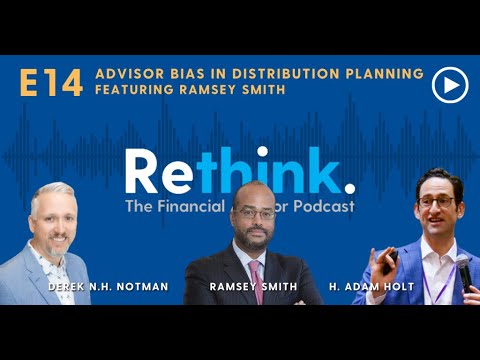
Watch and Listen
Episode Summary
Adam and Derek open by admitting their own biases — in restaurants, movies, and yes, client recommendations — before turning the conversation to how an advisor's background (insurance, wirehouse, tax/legal) quietly shapes what solutions they reach for with clients. Guest Ramsey Smith of Alex.fyi brings a retirement-distribution lens to the discussion, examining income vehicles, pensions, annuities, and qualified-plan options for clients worried about outliving their money. The hosts frame the episode as an invitation to self-audit: are advisors recommending what's genuinely best for the client, or defaulting to what they know best? It closes with a preview of upcoming guests and a running bit about the show's two loyal listeners (Adam's mom and Derek's wife).
What This Episode Covers
- How an advisor's background creates unconscious recommendation bias
- Sustainability of retirement spending and distribution strategy
- Annuities, pensions, and other guaranteed-income vehicles
- Qualified plan options for clients concerned about outliving assets
- Client trust, certainty, and the role of advisor confidence
Full Transcript
Full timestamped transcript.
[00:00:00] H. Adam Holt: Welcome to Rethink: The Financial Advisor Podcast. My name is Adam Holt.
[00:00:06] Derek Notman: And this is Derek Notman. We are your hosts, both veteran advisors and fintech CEOs who challenge the status quo, question everything, and have fun doing it. Hear honest commentary on the challenges facing advisors today. And be part of a community where we can all rethink the profession.
Now on to our episode.
Welcome, Adam, my friend. I have a question for you. Do you have a bias on what you recommend to your clients?
[00:00:45] H. Adam Holt: I, I definitely
[00:00:46] Derek Notman: am biased on restaurants I recommend. Or movies, right? Movies, you know. Movies, abso- books. Books, movies. Yep. Yeah. Clothing sometimes. Well, let's... Well, I'm, I g- I'm a little dense, so I'm gonna, I'm gonna just start over.
When you re- recommendations for your client's financial situation- Oh ... do you have bias?
[00:01:13] H. Adam Holt: I probably don't even realize that I have a bias, but I know this keeps coming up. What do you mean?
[00:01:20] Derek Notman: Yeah, I... We all, I think we all do, and it's probably something we don't even realize as well. But yeah, like, when we're talking about X strategy for our clients to do whatever it is they wanna do, are we being truly objective, or are we throwing our bias in there?
I don't know. I, I... I'm guilty of it. I know I am.
[00:01:41] H. Adam Holt: I know
[00:01:41] Derek Notman: you are too. I think most of us are. Yeah.
[00:01:42] H. Adam Holt: Well, we won't... We all, we all. There is... The, the... My gut reaction to this is depending upon where you come from dictates your bias. No different than your family raising, and your religion, than your environment that you grew in.
We all wind up creating a bias. The biggest one I tend to see is those of us that started in the insurance side have a bias, 'cause we understand those insurance products. Those of us who started on the wirehouse side have a bias, mostly against everybody else who was not in the wirehouse. And those of us
who started in the, in the attacks or the legal professions have a bias for those solutions and strategies, 'cause they understand them.
[00:02:26] Derek Notman: We're all in our own camps, right? Everyone else is wrong. Or are
[00:02:30] H. Adam Holt: they? Is... Well, isn't it interesting how our clients want certainty from their advisor? And if the advisor has certainty around certain things, they're gonna find more confidence, and that leadership will follow through into their recommendations.
And at the end of the day, the client is looking for guidance and certainty, and they don't have a lot of clarity what... what they do, so they follow the bias of the, of the advisor.
[00:02:53] Derek Notman: That's why they pay us, right?
[00:02:55] H. Adam Holt: It is, but that's why they also leave us too. Ooh, that's good. Because the next advisor they meet, guess what?
Has a bias against what any other advisor ever told them to do, and so they destroy the credibility of the prior advisor, don't they?
[00:03:08] Derek Notman: Oh, man, that's, that's, uh, profound. Yeah. So then whose bias is better, right? That's... Talk about a subjective thing.
[00:03:15] H. Adam Holt: Arguably, it's not even profound, it's profitable. We have seen a lot of advisors lose clients.
We've seen a lot of advisors keep their clients, argue that they keep them forever, in fact. So what do you think the difference about this bias is and why it's important?
[00:03:32] Derek Notman: Well, it's gonna come down to the strategy, I think partly, right? Um- Mm. But you, you already said it, like, the bias is important depending on what the type of the client that you're working with, and if it, that your bias actually helps them do what they wanna do or not
[00:03:47] H. Adam Holt: Yeah.
Well, I, you know, it's funny because we had this question that came in from Randy, if you remember in one of our previous podcasts.
[00:03:53] Derek Notman: Yep.
[00:03:54] H. Adam Holt: He wanted to talk about income certainty, and we thought about this a lot, and we said there really is a lot of bias in this space. So one of the most common biases we see by advisor is how to provide sustainable income in retirement.
And, you know, talk to us, Derek, about strategies you're seeing that are being used by advisors you talk to.
[00:04:17] Derek Notman: Yeah. This is definitely something that's top of mind for a lot of advisors and clients, right? And there's so many ways that you can generate an income stream. And again, folks, this is not a product show, all right?
Go somewhere else if you want that. But, but, uh, you know, like, so everything from, like rental real estate. I've owned real estate as a, as a rental, right? You've got annuities which have been around for hundreds of years, uh, like holding a note or reverse mortgages. How many of us have been told to sell cash value life insurance for income in retirement?
Ever, anyone ever heard of the 4% rule?
[00:04:54] Announcer: Mm-hmm.
[00:04:54] Derek Notman: Right? The list goes on. Bond ladders, defined benefit, you know, plans, et cetera, et cetera, et cetera. So I think there's a lot there. So it's a really interesting question that Randy, you know, gave us, but I love how we're gonna rethink it now in a, in a, in a way, a form of bias because obviously with all of those options out there, there are advisors that have bias towards each and every one of them.
[00:05:14] H. Adam Holt: Well, you know, as, as you and I love controversy, at least we, we like addressing controversy-
[00:05:19] Derek Notman: Yes ...
[00:05:20] H. Adam Holt: uh, if not instigating it or inciting it. I told someone the other day- Yeah, that flame ... I, I'm not trying to be disruptive, but I think of myself as a disruptor. That's good. But, um, but I think maybe that kind of goes hand in hand.
Uh, um, I think the, the one of all of those that comes up as the most controversial tends to be around the annuity space, right? See, annuities in general, there tends to be a very big bias toward an, an annuity if you come from the insurance space. You mean, you understand it, you like it, you get the idea of this, like, longevity risk.
Uh, if you come from the investment world, this looks like the most expensive investment ever. Um, and of course, we all know that many of the clients that are really the core of an advisory practice are either heading to retirement or in retirement now. That boomer population that has- Yeah ... 80% of the wealth is really actively asking these questions for how do I make sure I don't outlive my money?
I- interestingly enough, a lot of the, the strategies that worked forever, like my grandfather put it in CDs, right, at 15%. Oh, yeah. Uh, others bought laddered bonds, right? They, like you said, they bought munis, they bought whatever they did, and they lived off the interest. The 4% rule could work. What do you think about what you're seeing these days?
'Cause you actually have active clients, you know, that are asking these questions. What's, what's the impression you have on this?
[00:06:41] Derek Notman: You know, it's interesting, m- most of them don't understand the products or strategies enough to know much about them. They've heard about them, they read about them, or their uncle talked about it.
But this is where it comes back to the bias, you know? And I was just having this conversation with a client yesterday who has commercial real estate and is wondering, does he hold the note or does he sell it and just take the money and do something else?
[00:07:01] H. Adam Holt: Mm-hmm.
[00:07:02] Derek Notman: And it comes down to bias, but also comfortability.
And, of course, I threw my bias in there. I have my own reasons for recommending certain things and, you know, I explain them out and let them pick. It's not like I'm just pushing it It's tough, right? I mean, 'cause it is still top of mind for consumers. But-
[00:07:19] H. Adam Holt: Yeah ...
[00:07:19] Derek Notman: yeah, I mean, I think at the end of the day, we're- this is why we've got our special guest today, right?
To really dive into this specific product i- you know, more so than any of us can to really talk about it. Um. It's
[00:07:32] H. Adam Holt: true. Well, we did, we reached out to one of our friends in the space, Ramsey Smith. And if you don't know Ramsey, Ramsey is, w- we call him our intellectual friend on this topic, right? A- you know, Ramsey is, uh, you know, ex Goldman Sachs, so he spent years understanding the derivative products and all these different, how these things get constructed and why large companies, uh, how they can actually manufacture them.
Uh, Princeton and Harvard, he's the co-host of That Annuity Show you and I both been guests on, so that was really cool. And I think his technical understanding of how these complex financial instruments work, and he can actually explain them in a way a human can understand. We, we thought this would be great.
So, uh, why don't we, why don't we jump to, um, Ramsey? We asked him a couple questions in this speed read rethink tank, uh, interview. Let's, uh, let's hear what Ramsey had to say. We asked him, "Help us understand the income certainty space."
[00:08:25] Ramsey Smith: So this is a, this is an, a, a topic that's, that's near and dear to my heart.
It's what I spend, you know, most days thinking about. The, the big headline is that people need to start thinking more in terms of, of income as opposed to, as opposed to nest egg. And I'm not the first person to say that, and I won't be the last. There are a lot of very, very smart people, Nobel Prize winners, that believe that should be the focus, so I'm in good company there.
But fundamentally, if you, you look historically at, at what some of the most successful retirement plans have been, certainly for broader populations, they've been things like defined benefit pension plans and Social Security. So there's actually a, a long history of guaranteed stable sources of income, uh, as sort of the fundamental basis for a comfortable and, uh, and, and, and rewarding retirement.
So I think we need to, we need to find more balance between this dogged focus on accumulation and really start to think about, well, what are the solutions we have around, uh, making sure that income is, is stable in retirement? And in that, there is a role for sources of guaranteed income. Some of those are, some of those, in some instances, those are various forms of annuity.
And, uh, I think that there is a- There's an interesting sort of hysteria around the d- the, uh, the discussion of annuities, and I think we need to get away from that. And, and I will say, even though I spend a lot of time talking about annuities that are offered by insurance companies, I'm very neutral on, on the sourcing in the sense that, like, I believe that guaranteed income, it should be a part of every- everybody's retirement, uh, retirement solution, whether it comes from the government in the form of Social Security, from a company in the form of a corporate pension, uh, from an insurance company, from, from your Uncle Bob, if your Uncle Bob is somehow triple A-rated and you can, you can count on him to sort of m- pay you every month the rest of your life.
I, uh, first and foremost, I view myself as an advocate for the principle, and then the next question you ask is, well, you know, where can you go for solutions that meet that, meet that specific need? So we need to, we need to get back to the basic discussion of what an annuity is. And I'll just say it, it's a lump sum goes in one direction and periodic payments go in the other direction.
That's what a, that's what a basic annuity is, so I, I wanna start with that as the, as the framework about which we talk about these things.
[00:10:49] H. Adam Holt: So that was kinda interesting, right? I mean, the, the basics of... I love how he just said it's money goes in, payments come back. Pretty straightforward. Where people tend to get hung up with, right, Derek, is, "Yeah, but if I die too early, then all that extra money that you've been holding goes away."
Right? They always think of the negative connotation of that. They do. "Oh, I'm gonna die too early and I'm gonna throw away the money." I'm like, "Yeah, but what if you live too long? Then you're gonna get more money than you're supposed to be-" They
[00:11:13] Derek Notman: don't think about it that way, right? Like, that's- I know ... they don't think...
I still think Uncle Bob is the best option. You know, that's my bias.
[00:11:19] H. Adam Holt: Triple A-rated Bob.
[00:11:21] Derek Notman: Triple A-rated Bob.
[00:11:22] H. Adam Holt: Do you have a cousin like that or an uncle in your, in your family?
[00:11:25] Derek Notman: I, no. N- they're definitely not triple rated.
[00:11:29] H. Adam Holt: He doesn't have the law of large numbers, so he can't really make an annuity work for him.
There's too much risk for him. So one of the funny things is that we can't replicate as individual investors, even with the rule of 4%, is, is that we don't have large volumes of scale that an annuity company does, or an insurance company I should say. Is that they can, they can work with the law of large numbers to make it win for them in the long run, as opposed to taking inordinate risk.
Uh, which is something I think a lot of people don't understand.
[00:11:54] Derek Notman: Yeah. That's really, really important. What I like about what Ramsey just did though too, is like he's a big proponent for annuity type income. But he's not- Mm. He put his bias in there, but he didn't. Because he's not like- Yeah ... saying, "Well, you have, it has to be an annuity."
It just, like, he's a big proponent for guaranteed income, and I think all of us can agree on that.
[00:12:11] H. Adam Holt: Yeah. It's true. Well, we did ask him. We said, "You know, what, what are, what are the arguments these days against, uh, against annuities versus these traditional income vehicles?" So let's hear what he had to say, Derek.
[00:12:23] Ramsey Smith: You know, you're, you're in a, you're in a situation where you can, you can decide that you don't wanna buy anything that locks in a low yield, which means that you're gonna be at all in equities or I guess Bitcoin or something else like that. And, you know, if returns continue the way they are, I guess you can make an argument that, like, that could work.
But the reality is that's not from a, from a risk management perspective, I think few people that are, uh, that are acting in the best interest of their clients would, would say that, like, to be fully, um, fully under diversified like that is the best solution. So really for me, it's really a discussion of annuities versus other sources of, of fixed income.
And the, you know, the, the option that you can, that you can essentially exercise or the, the, the added value you can get from very simple annuities are what are called m- mortality credits. But essentially, you know, on, on the back of pooling your contributions along with everybody else's and everybody getting paid out according to how long they live, you're able to get a much higher periodic payout than you would from an equivalent fixed income portfolio.
Just a basic portfolio, a diversified portfolio of bonds. So that's, that is a, that is the fundamental simple sort of value add that you get from pooling, and it's the same principle that underlies defined benefit pension plans and essentially social security
[00:13:45] H. Adam Holt: You know, that's the funny thing about this, is that, that when we hear this annuities, I always remember thinking, gosh, these annuities, we tended to think of deferred annuities.
Or if you did the immediate annuity and took the income payment, that you were really just y- that the insurance company was always winning, right? So we tended to think- ... wow, gosh, I'm, I'm basically buying generic. I'm not really being custom. Uh, I don't know that I really wanted to do that, right? I tended to have my own bias against this.
I, I tended to use deferred income, uh, sorry, deferred annuities for certain clients that needed guarantees on the back end 'cause they couldn't afford to lose the money, right? So they, they used those GMIB or GWB products. And, and in 2008, if you remember, you know, those were our happiest clients by far.
Tho- those products just outperformed all other investments so much that those clients were the most happy, frankly. Did you experience that at all?
[00:14:36] Derek Notman: Oh yeah, for sure. I, I have and I, I think that even goes to the point of it not just an annuity product, but, uh, Social Security, pensions. Mm-hmm. It's the same thing.
It's this peace of mind that you're getting. Uh, and that's really what, what you're striving at. But then again, like we- and we've talked about leading with advice before. This is all a byproduct of that. And I like how Ramsey's just, like, really explaining it simply and the benefits of it, 'cause there are some benefits of it.
It's funny though, like you say, like, "Oh, you know, I didn't... You know, I've got this negative bias, I'm losing," you know? But the only difference between that and Social Security is that you were forced to do one and not the other. But you're not complaining about Social Security. You'll take that check all day long.
Yeah. And you're, and you're cashing it too.
[00:15:20] H. Adam Holt: Yeah. No, I agree with that. I mean, I, uh, you know, some... I tend to talk about this a lot. My happiest clients in retirement are the ones that have a DB plan.
[00:15:29] Derek Notman: Oh,
[00:15:29] H. Adam Holt: for sure, right? They have a pension. That's... They're, they're right. They're military, they're government, they're teachers.
They know how to live within their lifestyle and their cashflow, and they get it every month. Like, they're not... There are other clients that have what I call the, the Bloomberg effect, which is, "Adam, I was gonna go out to, to dinner with my friends, but Bloomberg said the market's down, so I canceled my plans."
Oh. And I'm thinking like, "Really? Your, your lifestyle is really so dependent because I haven't given you enough income certainty to know that you can't outlive this money," right? That, that's where we start to get into this emotional aspect of this very technical decision that, that is affected by our biases.
And interesting, I, I hope what everybody's doing who's listening is they're getting more educated so that they can help people make, as he even called it, best interest advice decisions, right?
[00:16:13] Derek Notman: You know what's interesting? Tell me. Before you jump in on his next bit. Yeah.
[00:16:16] H. Adam Holt: What's that?
[00:16:16] Derek Notman: The consumer bias is also affecting the advisor bias.
[00:16:20] H. Adam Holt: Yeah.
[00:16:21] Derek Notman: Right? Which, which it just complicates things even more. And that's tough because at the end of the day, they're coming to us for our bias, so we gotta be careful. Well, our bias
[00:16:29] H. Adam Holt: is actually based on credibility and experience. Come on. That- Right. It's not just- ... legit ... the
[00:16:32] Derek Notman: Bloomberg terminal.
[00:16:34] H. Adam Holt: That's right.
Exactly. Um, not too much truth here. I mean, we might get ourselves in trouble. You, we asked Ramsey, you said, you know, given everything you see what's happening on the demographics and also products, what's the opportunity that advisors don't see coming in this space?
[00:16:50] Ramsey Smith: I think one of the issues that we've had is that a lot of the annuities that have been brought into the market have been much more focused on accumulation rather than decumulation.
So that's part of what's caused a lot of the c- a lot of the confusion. So I think frankly, just sort of getting back to basics more is a real opportunity. Focusing on single pr- premium and immediate annuities and deferred income annuities. Again, very simple equivalence to, to a pension plan. But I think the, the, the, the opportunity that I'm most excited about, and, and I think it remains to be seen what it translates into in terms of an opportunity set for advisors.
I think the most exciting thing coming up is what's happening with DC plans on the back of the Secure Act, and I've been spending, you know, a lot of time on that in my own, in my own business. And you've got $7 trillion in, uh, in, in DC assets by some estimates. You've got very, very little penetration by even the availability of annuities in those DC plans.
And where those DC plans have, um, have annuities, the election rates, you know, are frankly are, you know, are disappointingly low. So what I think the future probably looks like is, uh, is an increase, an increase of availability of I'm, I'm gonna say guaranteed income solutions, right? Of guaranteed income options in, uh, in DC plans.
But I, I actually also think that you'll start to see some of those, uh, guaranteed income, uh, options not being optional. Either they'll be the default and there'll be nec- the necessity to opt out or they may simply just be s- simply be, uh, be the required way that you, that you receive your, um, uh, your, your retirement benefit from your, from your employer.
But I think there's... That's a very interesting model. I think it's a very interesting model where, uh, where an employer says, "Look, I want to create a system that truly does replicate what you might have otherwise gotten. Uh, and, uh, and, but if you want this money, you're gonna have to take it as re- as, as your retirement money as opposed to, you know, dollars you can use to buy your next Camaro."
And I, and I... And, and here's the thing. It-- There are some people that will say, "Well, well, that's not right. That's not fair. I should be able to do what I want with my money." But again, I'm gonna go back to what I said at the beginning. The most successful pension plans have not been voluntary. You know, your, your, your, your defined benefit pension plan wasn't voluntary.
Until the end you could take a lump sum, but the accu- But, but contributing to it, whether it was out of your paycheck or from your employer, was essentially not voluntary. And Social Security is certainly not voluntary. So I, I think that there's a... And, and maybe this is, uh... Maybe there's, there's some that might view this as controversial.
Um, but I, I actually think that it's, uh... I, I think if properly applied, I think it's probably the only way we can go about solving this problem in the long run.
[00:19:45] H. Adam Holt: Well, there you go.
[00:19:48] Derek Notman: Fascinating
[00:19:48] H. Adam Holt: Now, that was interesting.
[00:19:50] Derek Notman: Yeah. Fascinating.
[00:19:51] H. Adam Holt: Now here you, here you have an annuity expert who's saying that not only is this stuff important, but it might be the thing that saves us long term by making it not only optional, but mandatory.
In other words, moving back to a DB plan environment. Yeah, I- Funded potentially, I guess, by private insurers.
[00:20:12] Derek Notman: Well, then that's funny because back in the day, you remember this, most 401plans were administered by insurance companies.
[00:20:19] H. Adam Holt: Yeah.
[00:20:20] Derek Notman: And then they were all... You know, he was talking about that, that too many annuities were focused on accumulation and not distribution.
So it almost like we're swinging back a little bit. I struggle with being forced to put all of my money into one thing and not having a choice. Now, I live with it with Social Security, right? I don't have a choice. But maybe there's a sweet spot, this is just my bias now, where part of that DC plan is forced on me.
I don't have a choice. But then I also get to take some so I can buy my Camaro too, maybe just a, a used Camaro instead of a new one.
[00:20:54] H. Adam Holt: The only reason that you and I and everybody else on this planet, in my estimation, actually wants a DC plan that's fully investable with is because we believe we can beat the rate of return over the actuary in this calculation.
[00:21:07] Derek Notman: Right, 'cause we're all
[00:21:08] H. Adam Holt: smarter. We believe-
[00:21:09] Derek Notman: Yeah ...
[00:21:09] H. Adam Holt: right. And by the way, the markets have proven that we're smarter- Right ... I guess. Uh, right? Even I- if I just bought the crypto in my 401, let's add crypto to 401. And if I only bought like a self-managed brokerage account in my 401, I'd have much more money, so let's add that to it.
And what's happening actually now is that the product again is leading the infrastructure that we're building for the entire society. Now think about this this way. We've moved away from, "Hey, we'll take care of you. We're gonna do your financial planning for you. You don't need a financial planner 'cause we're just gonna send you a check for life."
Okay? To now you gotta manage all your own investments, distribution, tax, all that other stuff on your own because supposedly it's supposed to empower you, but yet we have this massive industry called financial planning that people are underutilizing and desperately need. So we've almost created our own monster here, which is, I say we being the financial profession.
A- and what we're seeing here is that, what... I mean, what, when you think about it, we run a retirement analysis for a client. What are we trying to give them? We're trying to give them certainty that they can pay their bills.
[00:22:08] Derek Notman: Yeah. Peace of mind. Hey, you can wake up and that, that deposit's gonna be there every month.
[00:22:13] H. Adam Holt: We're talking about products here that actually can give them a large piece of that stuff without our nonsense math, like trusting a financial planning software to play out for 30 years. Like, that's really almost, I see this listening to him, that- This should be the, this should be a core. I mean, I'm not, I'm, I'm not s- um, clearly you're seeing my bi- my bias Is that, is
[00:22:36] Derek Notman: that
[00:22:36] H. Adam Holt: your
[00:22:36] Derek Notman: bias?
[00:22:37] H. Adam Holt: That's my bias. My bias is that my clients who have certainty live better lifestyles in retirement than the ones that are fully invested.
[00:22:47] Derek Notman: You know, I think here, here's where for all of you listening that are earlier on in your careers, this is where I think you can take some mentorship bits away, is that Adam and I are still active advisors, and our bias, although it may not be right, it does seem to work pretty well in the work we do for our clients, and it should be something that you may wanna consider, right?
Like here's, here's some ta- this is one of those things you can take away and really think about. Um, you know, so if you're at that wire house and you're being told annuities are awful and that we should never even plan on Social Security and b- you know, don't do that pension, eh, maybe you should rethink that.
[00:23:22] H. Adam Holt: Well, we gotta, we gotta understand why that bias exists in the first place. Usually it's around compensation. And that- Mm-hmm ... and that, my friends, is cannot be the way that we lead with advice. And the regulator, r- the regulators are gonna pr- are gonna force it, by the way. Oh, yeah. Besides it being just right for the client, you have to do what's right for the client and meet their needs 'cause they're your boss, okay?
Not your, your, your manager who pays you is not your boss. In this case, we're moving towards a model where the consumer is always the, is always right, um, and has to be protected even from ourselves. So the, the key here is can we create an environment where we're starting to learn? Let's... We asked Ramsey one last question and then we'll wrap this up with our takeaways.
Um, but we asked him, you know, why is this getting so much, why is this such a struggle for this conversation? Um, and, and what's, what's kind of hindering this bias?
[00:24:12] Ramsey Smith: Wow, it's complicated. First of all, on, on a local basis, by that I mean sort of for any given individual, the reality is that, that no matter how smart you are, uh, when you're managing your own personal finances, there are a lot of behavioral things that, that enter into the equation, some of which are, are noneconomic.
And then if you take it sort of more macro and you say, "Okay, well, let's let everybody, let's ev- let everybody do what they wanna do," well, what ends up happening? Like 50% of the people get it right, 50% of the people get it wrong or whatever the, whatever the division is. So those that get it right can certainly feel very good about themselves and they will have, you know, they will have excess returns that they can use to do whatever they want with.
But the other, the other folks w- are gonna have a lot of very, very limited choices. And so what, what does it, what does it mean for them? Like what is, what is the safety net for them? Who ab- who ends up providing it? Like at the end of the day, like, look, I'm a, I'm a capitalist, right? First and foremost. I think that, that having a system that provides like sort of a very basic sort of like very basic foundation allows people to go out and like to slay the dragon, and that's what I want, that's what I wanna see people do.
So that's, that's really why I, I'm very focused on getting people into to a place where they're as free as possible to go out and, and be entre- entrepreneurial, uh, live the life they want, but know that, you know, at a, at, at a very basic level, and certainly in retirement, that they can survive and they don't need to be, they don't need to be a, um, you know, a burden to their, uh, to their children or to anybody else that, uh, that comes behind them.
[00:25:48] Derek Notman: See, that's interesting.
[00:25:50] H. Adam Holt: He just went macro
[00:25:52] Derek Notman: on us. He did, but how can you argue with that? Like he's talking about letting people pursue their passions, about not being a burden on others. Um, I mean, those are hard things to... A- anyone really could argue against, right?
[00:26:04] H. Adam Holt: It's true. It is true. Well, we, you know, just to kind of wrap this up because Ramsey had so much to say and we were able to get so many little snippets out of him.
He's like literally memes inside of our podcat- podcast- ... that hopefully is, uh, is resonating. But we asked him, what's the best skill that an advisor has to, to address to help people address this income certainty problem? Here's what he said. For
[00:26:25] Ramsey Smith: me, the best type of, of financial advisor is one that has high EQ and, you know, and thinks like a therapist, um, because I think that is the...
I think that's the big opportunity, uh, i- in this space.
[00:26:38] H. Adam Holt: I couldn't help but include that one, Derek, because it really goes back to what we started with, which is really looking out for the client's best interest, right? Having high empathy, EQ- Exactly ... as he called it. Um-
[00:26:49] Derek Notman: Humanity, right? Being a human, leading with advice, all of the things.
He... And he summed it up and we didn't even, you know, prompt him on that. He just
[00:26:57] H. Adam Holt: went. No, we didn't, we didn't have to. He, he got it. Well- So thank you, Ramsey, for doing that with us. We really appreciate it. For those of you that wanna reach out to Ramsey, we'll put his contact information in the text. But, uh- He's awesome
you can Google him and LinkedIn him and you'll find him. Fantastic resource. You know, I wanted to kind of close up with some of these other, you know, topics on, on this. Uh, the takeaways for me in many ways is that, uh, you know, this controversial topic called an annuity is we really need to stop calling it an annuity.
I, I would love to submit my, uh... Can I sub- who do we submit that to, to change it from an annuity to a private pension? Because- I don't know ... you know, the reality is... FINRA? Oh, is that who makes that decision? I don't know. I don't think it's a registered product if it's a fixed annuity, but, but I guess the point is, is, is, um- Yeah.
We need to, I think we need to reframe our own thoughts around this to see where it fits, if it does fit with our clients. And I think it would go a long way if we were to just, you know, stop calling it the, the s-
[00:27:52] Derek Notman: I agree ...
[00:27:52] H. Adam Holt: this controversial word, which- I
[00:27:54] Derek Notman: agree. Yeah. There's just too many negative connotations, although it's
Clearly from what we've heard today, it's not a negative thing.
[00:28:00] H. Adam Holt: No. It's just- Yeah ... a financial product, right?
[00:28:03] Derek Notman: Exactly. Exactly. It,
[00:28:04] H. Adam Holt: it makes sense or it doesn't, just like reverse mortgage or any of these other choices that we're gonna make.
[00:28:08] Derek Notman: Yep.
[00:28:09] H. Adam Holt: So what's the, what do you think the takeaways are this? What, what should advisors remember from this session today, Derek?
[00:28:15] Derek Notman: Just be bias aware. Take a step back, be bias aware. Where, and then where are you getting your bias? Is it from somebody that is in charge of your compensation that's pushing you to sell a product, uh, strategy, you know, whatever, or is it more purely educational? And don't forget, like, your client's bias is gonna come into this, but y- they're paying you for your bias.
So just, you know, be careful with that. I, I don't know. I mean, just rethink it all, right? You know, you might be in some environment where there's a culture of do only this. Take a step back, take a deep breath, enjoy the lovely content that Adam and I provide you with our amazing banter- ... and, uh, and rethink it.
[00:28:55] H. Adam Holt: Yeah.
[00:28:55] Derek Notman: How about you, Adam? What do you think?
[00:28:58] H. Adam Holt: I think too much unfortunately. But I'll share it nonetheless-
[00:29:01] Derek Notman: I wanna hear
[00:29:02] H. Adam Holt: it. I wanna hear it ... because there's a microphone in my face. What do you think, Adam? Well, I ... Look, I think there's lots of reasons why we come to the conclusions we do in recommending a str- strategies for our clients, right?
But here, you gotta have defensible research, right? A g- client is actually asking you to help them make a buying decision in many cases. I think that's the case. Um, they're not trying to do the research. They're trying to get some expertise and competence on the process of figuring out what they should do.
Give them options that are suitable for them, okay? That means you gotta do your research. Uh, you gotta understand the cost and the benefits, and it's gotta be defensible, right? So anything that we're recommending today, it's gotta have supporting evidence that it's in their best interest. I, I will remind everybody, um, of research that keeps coming out again and again, is that, that if we wanna reduce our clients' anxiety in retirement, find ways to give them certainty that they're going to be okay.
Oh. I know that's a very soft statement. You can't put math behind that. But I typically look for 50 to 70% of their core living expenses, not their fun time, their core living expenses coming from income sources that we can't mess up. And if I decide to retire or I get hit by a bus, they're still gonna be okay, right?
Yeah. There's a strategy in place that my team is ... That we've thought about the risks, not just to them, but to us in delivering that. It's not based on some complex harebrained scheme of, uh, moving some strategies in this bond ladder, and then nobody knows how to unwind it, and it basically blows up. So I, I like having that certainty for the clients because it makes it really bulletproof.
Um, it doesn't always have to be the most cost-effective if it delivers the solution which is giving them less anxiety, which is why they have you in the first place.
[00:30:44] Derek Notman: Exactly.
[00:30:44] H. Adam Holt: Um, so hopefully that's valuable, too. We got this, uh, we got this fun, uh... We thought kinda coming into the end of the year in 2021, as we are right now, um, we would share this w- this reach-out we got from Malcolm.
He says, "Thank you guys for all the sharing, uh, that you're doing with us. Uh, we love the banter, and you guys are like Howard Sterns of financial radio." That's... I don't know how to take that one. I, I think I take that with a grin and a, "Oh, my gosh."
[00:31:11] Derek Notman: Yeah, right? Like is that a
[00:31:12] H. Adam Holt: backhanded
[00:31:13] Derek Notman: slap- But thank you
maybe
[00:31:15] H. Adam Holt: or... I think we're cleaner, by the way, but, uh- We're definitely cleaner ... we can change that if we had to. Um, "Would you share, uh, your opinion on what the profession is gonna look like 20 years from now?"
[00:31:26] Derek Notman: Oh.
[00:31:26] H. Adam Holt: Malcolm from Seattle, uh, Washington. What do you think?
[00:31:29] Derek Notman: I think that's a long time. You know? The things are changing so quickly.
If you... Uh, yeah. Oh, man. I'm a... Yeah, we're gonna have fun with that. So we'll do that for you, Malcolm. Just so you know, uh, my crystal ball and Adam's has never worked, but we are going to- What do you mean? Well, I mean-
[00:31:47] H. Adam Holt: Yours doesn't work?
[00:31:49] Derek Notman: Dude.
[00:31:49] H. Adam Holt: I based my whole finances on this. I w-
[00:31:51] Derek Notman: w- w- put it all in one stock.
Where, where did you get yours? Where did you buy yours?
[00:31:54] H. Adam Holt: At the local five and dime.
[00:31:55] Derek Notman: I got mine from some guy in a truck on the street, and, you know, he had a really nice sign though.
[00:32:01] H. Adam Holt: Oh, that'll do it. Marketing works, I'm telling you. He had a good social media strategy.
[00:32:05] Derek Notman: He did, yeah. Yeah. Crystal
[00:32:06] H. Adam Holt: balls.
[00:32:07] Derek Notman: It was one of those, uh, DMs on LinkedIn.
That's how I got it.
[00:32:10] H. Adam Holt: Yeah. Um- I just bought an annuity. I didn't, I d- didn't bother. I don't wanna make decisions.
[00:32:16] Derek Notman: Ooh. 20 years, Malcolm. That, that's a tall order, but we're gonna have some fun with it, and we're gonna just throw out some ideas in the next episode then.
[00:32:24] H. Adam Holt: Yeah. This is a great opening, Malcolm.
Thank you. We're, we're gonna, we're gonna open Pandora's box, uh, and we're gonna find some fun things to talk about 'cause we both have opinions of this. Uh, and of course, we don't just sit on our duff. We actually are building, uh, stuff- Yeah ... that's gonna affect the next 20 years. So we'll, uh... We may be able to preview some of that stuff.
Well, thank you, Derek, for taking the time. Thank you, Ramsey. Uh, thank you if you've attended this, uh, to our, our two listeners, uh, that are here. We appreciate it.
[00:32:51] Derek Notman: Your mom and my wife.
[00:32:52] H. Adam Holt: That's right. Hope... They're probably having a party together. Why is it always my mom and your wife? What?
[00:32:57] Derek Notman: I don't know. I- It's
[00:32:58] H. Adam Holt: kinda weird, isn't it?
How do we have so many five-star ratings with just the two of them? Are they, like, literally just logging in?
[00:33:04] Derek Notman: I bet you they're setting up, like, fake email addresses. They just feel bad. They feel bad for us.
[00:33:09] H. Adam Holt: We figured them out. Too funny.
[00:33:11] Derek Notman: That's awesome.
[00:33:12] H. Adam Holt: All right, brother. Have a good one.
[00:33:14] Derek Notman: Thanks, dude. Yeah.
Thanks, everybody. All the best. Cheers.
[00:33:26] Announcer: Thank you for listening to Rethink, the Financial Advisor Podcast with Holt and Notman. Be sure to subscribe now and join the ongoing conversation. The information covered and posted represents the views and opinions of the guest and does not necessarily represent the views or opinions of Asset-Map or Connectr.
The content has been made available to you by Asset-Map for informational and educational purposes only.