
Ep13 - Rethink: Attracting Ideal Clients as a Thought Leader
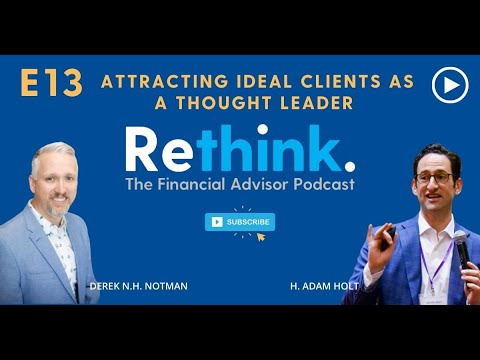
Watch and Listen
Episode Summary
Adam and Derek open the new year by tackling a question nearly every advisor asks: how do I attract the clients I actually want? Their answer centers on thought leadership — becoming a recognized subject-matter expert rather than a generalist — and they walk through concrete tactics for getting there, including LinkedIn engagement strategies, blog writing with backlinked research, video content, podcast guesting, and even voice-search optimization for smart speakers. They reference their earlier conversation with Michael Kitces on advisors being sought out by clients rather than the reverse, tying the episode back into the show's broader marketing arc. No outside guest appears; it's a hosts-only, tactics-focused episode.
What This Episode Covers
- Becoming a subject-matter expert vs. a generalist advisor
- LinkedIn engagement and content strategy
- Blog writing and backlinking to third-party research
- Video content, vlogging, and podcast guesting
- Voice search optimization (Alexa/smart speakers)
- Consistency, authenticity, and niche specialization in content
Full Transcript
Full timestamped transcript.
[00:00:00] H. Adam Holt: Welcome to Rethink: The Financial Advisor Podcast. My name is Adam Holt.
[00:00:06] Derek Notman: And this is Derek Notman. We are your hosts, both veteran advisors and fintech CEOs who challenge the status quo, question everything, and have fun doing it. Hear honest commentary on the challenges facing advisors today. And be part of a community where we can all rethink the profession.
Now on to our episode.
[00:00:35] H. Adam Holt: Derek, how do I attract the ideal clients?
[00:00:39] Derek Notman: Hey, my man. Uh, well, I think that's probably a pretty good question considering most advisors want ideal clients. So do you... Yeah, let's talk about it. I'm not gonna say unpack this, 'cause I always say I- I'm gonna unpack this, but I just said it twice. Well, I'm just-
[00:00:53] H. Adam Holt: Oh.
What's the answer, man? How do you attract? Yeah. It's gotta be an easy answer, right? I- Everybody knows the answer, right?
[00:00:59] Derek Notman: Well, uh, uh, uh, no. No, they don't. That's why we're gonna talk about it.
[00:01:04] H. Adam Holt: Fine.
[00:01:05] Derek Notman: So how... Well, so I- I'll answer it as if you're asking me directly, 'cause I think that's what you did, is I attract clients by being what could be known as, like, what's a thought leader or a subject matter expert.
That's how I attract clients.
[00:01:20] H. Adam Holt: Well, this is... We... You know, we've heard this a lot recently, and it's been intimidating to many advisors, this idea of being a thought leader. I mean, that sounds like a big deal. So what, what is a subject matter expert, and why is it important?
[00:01:35] Derek Notman: They're experts in a particular topic area, type of person that they serve, whatever, right?
It's, it's people that are... If, if you're looking for a problem, let's, let's use, you know, like health, medicine as, as an example. If you're looking for someone to help because you have, uh, an ailment that you need an expert for, like your general practitioner says, "Yeah, I can't help you with that rash.
You're gonna have to go see somebody else." A rash.
[00:02:02] H. Adam Holt: Okay.
[00:02:02] Derek Notman: Um,
[00:02:02] H. Adam Holt: yeah, yeah. Then you won't have the expose on this
[00:02:06] Derek Notman: podcast. That's a different podcast. Okay. Um, but yeah, so you, you wanna find the best person for you to solve those problems. We even talked about this with Michael Kitces and, and his one quote about, you know, clients looking for the best advisor for them to solve their problems, right?
So subject matter experts know how to solve the problems of a particular type of client better than anybody else.
[00:02:31] H. Adam Holt: Right. At least that's the perception that we all have-
[00:02:34] Derek Notman: Yeah ...
[00:02:34] H. Adam Holt: which is that when I have a real, real difficult decision to make, which is either plan of care, as you mentioned, should I do the surgery?
Should I not do the surgery? Should I get the chemo? Should I not? Right, when we're making very big decisions where there's a high cost of being wrong or there's complexity, we all seek the advice of a human who's lived through it before. This is literally in our bones- 100% ... from a decision process, whether it's- Yeah
financial decisions or otherwise. So yeah, so subject matter experts clearly have a perceived awareness I say perceived because some people are such good marketers that they've created the appearance of being a subject matter expert when really they're a fantastic marketer. And the reason why I know that this is really important for all of us in this space is because we continue to see more democratization of financial services, more commoditization of this process that we have owned for a long time, and we know that humans are gonna continue to search on Google for who can solve my problem, right?
They're looking through these technical terms or te- uh, tools to find the experts, not the generalists. Not the generalists.
[00:03:45] Derek Notman: No,
[00:03:46] H. Adam Holt: they- What do you think that's gonna mean?
[00:03:47] Derek Notman: Well, it's gonna mean a massive opportunity for those that become thought leader subject matter experts, right? It's gonna be massive because now they're gonna be able to capture those people looking for help and, like, it's...
Their reputation will precede them. Someone will search it, they'll find them, be like, "Oh, man. This person knows exactly who I am and is gonna easily be able to help me solve my problems."
[00:04:13] Announcer: Mm-hmm.
[00:04:14] Derek Notman: Where if they f- I come across a generalist, you know, that does retirement planning, education planning, corporate benefits, uh, you know, blah, blah, blah, blah-
[00:04:23] H. Adam Holt: Everything
[00:04:23] Derek Notman: like, they're like, "Well, this is a generalist. I don't think they can help me. I'm just not gonna, you know, talk to them." So it's, it's a double-edged sword for those generalists that wanna stay generalists. Um, that's not a path I would wanna be on 'cause it's gonna be harder and harder to grow your business if that's what you wanna do.
Value.
[00:04:40] H. Adam Holt: Yeah, I know. I, I t- we tend to talk about these things and ideas of where the market's going and try to figure out if we can predict the future. But I think one thing is pretty obvious, at least I'll speak for myself. One thing is, is that technology is making it a lot easier to, to get stuff, right?
Whether it's the solutions that typically advisors have sold or charge a fee to manage, it's just getting easier and more convenient to execute right off one's phone today or right off their laptop. They can just buy it now. Um, what that means is that as we've been talking about, uh, leading with advice- Advice has to have context to the person who has the challenge, right?
Whether it's income distribution planning or it's estate planning or I've gotta sell my business and I don't wanna understand the tax implications and I could mess it up, so I don't wanna, let me go to an expert. I'm willing to pay for it. What I, what I think is gonna happen in the next two to three years, and it's interesting because McKenzie did a survey on this which we shared a little while ago.
It said by 2030, there was gonna be a consolidation in the advice delivery market, and what was gonna happen is that the bigger players were gonna start winning more market share from those that were generalists, right? Because i- if, if the technology continues to expand the way it is, and by the way, we're almost perpetrators of this, right?
'Cause we're both technologists- Mm-hmm ... also advisors by design. But we already see what's happening, and that's that the, the general easy problems, right? Managing money for retirement, the accumulation funding, this is kinda getting table stakes. And we think that technology's gonna eat this marketplace up.
You're not gonna differentiate here. All right? Where you're gonna differentiate is in this, this we'll call it complex high cost of being wrong marketplace which is, which is really where subject matter experts are going to be sought out, right? So that's, that's the real key is that within the next three years, you gotta decide if you're gonna be a thought leader subject matter expert that people can seek out and look to verify the credibility of your ability to deliver advice and services.
[00:06:42] Derek Notman: You're, you're certainly gonna have to. But what's interesting is, like, you say in the next three years you're gonna have to decide.
[00:06:48] H. Adam Holt: Mm.
[00:06:48] Derek Notman: Well, the decision can be done, yeah, like, okay, like a light switch, yep, I'm doing it. But you don't become a thought leader or subject matter expert overnight like a light switch, right?
Like, this is gonna take time-
[00:07:02] H. Adam Holt: Mm ...
[00:07:02] Derek Notman: to build up social credibility, to, to build up this awareness of who you are, to, to have others saying, "Hey, Adam's really good at this. You should probably go talk to him."
[00:07:15] Announcer: Mm-hmm.
[00:07:16] Derek Notman: Um, and that takes time, 'cause people are... They're, they're kinda waiting in the wings a little bit.
Even, like, so new advisors, right? Like, you know, they're, they're in six months. Their friends and family are kinda watching from the side like, "Eh, I don't know if Joe's gonna make it, so I'm not gonna invest my money with them just yet," right?
[00:07:34] H. Adam Holt: Very
[00:07:34] Derek Notman: true. Um, and so the same thing is gonna happen as a thought leader.
Like, are you a thought leader flash in the pan, or are you making a whole Thanksgiving dinner? You know, what is it?
[00:07:44] H. Adam Holt: It's true. Being a thought leader happens over a long period of time all of a sudden. That's what happens.
[00:07:51] Derek Notman: That's great. That's a g- yeah, it's great.
[00:07:52] H. Adam Holt: Right? I mean, it, it takes a long-term investment.
Uh, and so I think to round this out, because w- we can't just leave you with this, "Oh, doom and gloom. I'm not a thought l- you know, I'm not known as a thought leader yet."
[00:08:03] Derek Notman: What do I
[00:08:03] H. Adam Holt: do? What do I do? What do we do? Gosh. We're actually gonna share with you, actually, I think it's as many... We've, we've written out all the different ways, and we're gonna share that with you on this podcast, and we're gonna also give you our guidance of h- what we did and what we learned and what you can actually go implement.
So hopefully you've got your pencil or you're gonna remember the notes or you're gonna listen to this four or five times, or you're gonna delegate it even better. Um, right? You're gonna offload it. Yes. Um, hopefully you'll be able to take some things here. I, I wanna kinda leave you, before we go into that is that this is really all about intentionality again.
Here we, we talked about in our prior podcast intentionally creating an identity. Um, niching is gonna be really important in becoming a subject matter expert, 'cause as already you said, Derek, you can't become a thought leader expert in everything, okay? No. That will take you forever. Okay? That's kinda silly.
Um, it's not credible. It's not believable in many cases. And I think given the fact that people are going online and searching Yelp and looking for a five-star rating, you, you can't be a five-star rating generalist. Like, I mean-
[00:09:01] Announcer: Doesn't work ...
[00:09:02] H. Adam Holt: that's... You can't... I don't know. It doesn't really work, no. Um, so that's really important, but I think that we have to broadcast this and recognize the new environment that everybody's using, right?
Everybody's using search to verify and to validate. Um, even for existing customers they're looking for that kind of credentialing. Uh, and so I think those are gonna be also important parts of this, okay? So let's talk about some tools to help build thought leadership and subject matter expert- Whatever you call it
[00:09:35] Derek Notman: Yeah.
Expert,
[00:09:36] H. Adam Holt: expert-ish
[00:09:36] Derek Notman: I'm just like, these are tactics, these are strategies- Yeah ... these are things you can write down and go do. Uh, and we're gonna throw a whole bunch at you here. Um, just get them down and then we'll have some strategy or su- suggestions moving forward here. But, uh, you got some old school ones, like-
[00:09:53] H. Adam Holt: Yeah
[00:09:54] Derek Notman: you know, referrals from clients, from other s- you know, COIs type of stuff. Like- Yeah, I, I mean, I think that you can still do that and that can work. But heck, you can even digitize that to an extent. Um-
[00:10:06] H. Adam Holt: How do
[00:10:07] Derek Notman: you do that?
[00:10:07] H. Adam Holt: What do you mean? How do you take a client referral and make it digitized?
[00:10:11] Derek Notman: Maybe not so much on the client side, but think about this from a COI side.
As simple as even creating a, an engagement pod in LinkedIn, for example.
[00:10:21] Announcer: Hmm.
[00:10:21] Derek Notman: Don't create one with other advisors. Create one with an accountant, an attorney, or multiple of those, people that all serve the s- have the same ideal client niche specialty, right? That you all complement each other, and now you're all helping each other.
So that's a way you can, instead of going to those BNI networking events once a month- Hmm ... right? Just- Got it ... drop in a pod, right? So, um, I as, as, uh, I told an advisor about that this morning. Like, "Hey, why don't you, why don't you go start this as a value add," right? This is a simple thing that can take you three minutes to set up.
It's so easy.
[00:10:56] H. Adam Holt: Um- It's funny how you went right to social media. That's interesting. I mean, you, so you spend so much time there, I could see why. And you know how- It- ... effective that is, but I'm not sure everybody in the audience knows what an engagement pod is. So do you wanna share that?
[00:11:08] Derek Notman: Yeah. It's as simple, folks, as, you know, you have, like, the little chats, the DMs you can have with other people, uh, in LinkedIn with your connections.
You literally start a new chat and invite people that you wanna have in there. It's that simple. You can name it whatever you want, right? And now what you literally do is, with the 5, 10 people, whoever you have in there, you literally drop links to your posts so all of them are aware of it, and then you help engage with each other's posts, which helps drive the algorithm, it helps get stuff out there.
Um, don't abuse it 'cause LinkedIn's not a big fan of it. They don't publicly condone it. Um, but it can work really well if you, if you use it correctly. So that's what it is. Okay.
[00:11:49] H. Adam Holt: But so that's a way to get intentional likes and re-sharing of your social postings that, so that hopefully your, your voice and your messaging, if you're doing social posting by the way, uh, is getting to the, uh, a- an expanded audience, right?
So more people are hearing your voice, and it's getting credible support from people they already follow or believe in, right? So that's, that's kind of the idea.
[00:12:12] Derek Notman: Well, yeah. Is that- Think about it. If, if you, if you do a post and then an expert attorney who also helps the same type of people comments on your post- Yes
that's boosting your social credit and vice versa,
[00:12:22] H. Adam Holt: right? That's right. And yeah, that's, that's right. So that's, that is a, definitely a long game, but it is a multiplier effect for any kind of social posting. The reason that I, I threw client referrals and professional referrals is because that's what's been, we've been taught forever, right?
Is to go back to- Oh my, yeah ... whenever you wanna grow your business, you, you go to the people who already trust you, the people who I obviously are, I, representing an ideal client Uh, and you try to replicate them. The challenge is, of course, that's really tough to scale, and it's hard to get other, uh, your clients to go out there and promote you, right?
Mm-hmm. They're not, they're not, like, writing letters or blogs about you. They're, they're not going to their friends and saying, "Hey, do you need a financial advisor," right? That's awkward. Now, granted, when they hear their friends saying, "Listen, I'm really, I'm dealing with this estate issue or this very niche problem.
Who should I talk to?" You hope that your clients and the professionals you're networked in actually will say, "Oh, go and talk to Derek," right? Yeah. And maybe they'll even introduce you. Yeah, we hope that's the case. But the reason I put it is the following. We all know s- if you've been in the business for any length of time, if you don't intentionally tell your clients that you're seeking new business and you want them to think of this, it goes in the back of their brain and they forget about it, okay?
Clients are not great marketers. They're not asking to be marketers, unless you continue to promote that they help you. And we all know this is really effective, but quite honestly, most advisors just don't do it. So I put it here because it, to remind you that it is a way for you to grow your s- your preeminence within the ideal clients that you want.
But what are some other ways for you to expand that and scale it, right? You know- How do we get 5 or 10 coming in a week instead of once every blue moon?
[00:14:00] Derek Notman: Right. Real quick on the client piece. Yeah. Here's another thought that I've never done this, but you could try this, is literally go connect with all of your ideal clients that you already have on social media, Facebook- Mm-hmm
LinkedIn, whatever, and then create a ton of content on there. They're gonna engage with it. They're probably friends with other people like them, right? Oh. So it's another way to get that out there. So just another thought.
[00:14:22] H. Adam Holt: Um- No, that's really smart. That's, and that's easy to do, right? But
[00:14:24] Derek Notman: that- Oh, so easy to do, right.
Yeah, and it's a nice way for you to stay top of mind and in front of your clients, too, which makes them feel they're more connected to you than maybe they are. Yeah. Um, yeah, but I mean, so many other tools. Like, so there's some great public recognition, you know, awards that maybe you could get or even like, you know, getting like a specialty certification for working with a certain type of person.
Like, there's like some special exit planning certifications- Mm-hmm ... you can get for business owner, you know, type of situation. So stuff like that can be really helpful.
[00:14:54] H. Adam Holt: That's right.
[00:14:54] Derek Notman: I mean, we've all heard the word blog. It almost feels like it's, like, been beat to death. Um, but man, it is so powerful. It is so powerful if you do it right, 'cause people will consume content and, you know, educational stuff all day long.
[00:15:09] H. Adam Holt: Mm-hmm.
[00:15:10] Derek Notman: Um, and the thing is, well, I mean, we'll keep going here. You can add to this list,
[00:15:13] H. Adam Holt: but- Well, I, I'm not, I'm gonna add, I'm gonna add on before you, like, run through the whole list and I haven't said anything yet. I, I can't
[00:15:17] Derek Notman: help it. There's so much. I
[00:15:18] H. Adam Holt: know. There is, there is a lot to go through here. But I, I think, if you don't mind, the, the awards thing is an interesting thing.
Y- if you are getting awards, you need to socialize this. I think, I think let's get this out of the way. There's probably no better tool today than what Derek and I have been using to communicate to an audience that wasn't asking, asked to be communicated with, but open to it, other than LinkedIn and Facebook.
Okay? The, the reality is, is that for the non-business stuff, the real personal stuff, Facebook has been fantastic. The aut- authenticity is great there. It's starting to become very authentic on LinkedIn. We're starting to see that kind of permeate the business side. We know we have a lot of B2B, uh, relationships that are constantly on LinkedIn all day long.
We have whole relationships we've built this way. We promote these things, and then other people celebrate that with us, and it magnifies it. So if you are winning awards, if you've earned credentialing, if you have a certified divorce specialist, if you're a- Mm-hmm ... I work with senior advisors and I'm gonna niche that environment, then you need to tell people and really talk about it and get that out there.
So there, there's almost all of these have a social theme to them- Definitely ... because it's been the biggest megaphone we've found of success. So making sure that you're telling people that you have skill in this area is critical to this whole concept of becoming a s- a thought leader.
[00:16:39] Derek Notman: Yeah, and, and do it in a way where...
'Cause some of you might be like, "Oh, I don't wanna, like, push it on people. I don't want it to feel like I'm, you know, being cheesy or just all about me and I've got an ego." Celebrate something when you get an award. Celebrate that you just got your CFP certificate. Celebrate these things in a way where you're really proud of your achievement and, oh, by the way, people are like, "Oh."
Jane is a certified divorce specialist. Huh, I'm going through a divorce. Huh. Right?
[00:17:06] H. Adam Holt: Was that a, was that anecdotal or is it... Did you just-
[00:17:10] Derek Notman: No. No. Sorry,
[00:17:13] H. Adam Holt: I was trying to trap you there.
[00:17:14] Derek Notman: Yeah. No, my wife's, um, she's, she's around here somewhere.
[00:17:18] H. Adam Holt: I
[00:17:18] Derek Notman: know she
[00:17:18] H. Adam Holt: is. I just saw her open the door. Just kidding.
[00:17:23] Derek Notman: Hello.
[00:17:23] H. Adam Holt: You
[00:17:25] Derek Notman: still have your ring
[00:17:25] H. Adam Holt: on?
Too funny. Yeah, right. That's too funny. Thanks for... See, the g- see, oh, by, by the way, you're doing one of the lessons that we wanted to tell everybody, which is authenticity, right?
[00:17:34] Derek Notman: Yeah.
[00:17:35] H. Adam Holt: Authenticity's been... We've been hearing this again and again. What, what, what's your take on this one?
[00:17:41] Derek Notman: Man, you just gotta be you.
I think one of the biggest stumbling blocks that I personally had to break through, and that I see a lot of others, um, when it comes to creating content in social and all that, is just they think they have to almost be somebody else when they're gonna go market themselves and, and do all the things we're talking about and we'll talk about.
Mm. And the breakthrough for me was like, you know what? I just need to be me, man. I need to be authentic. I need to just... 'Cause people, let's face it folks, you can tell a mile away if someone's just blowing smoke up your, your, your hoo-ha here, you know? It's, uh, we know. Um- You...
[00:18:19] H. Adam Holt: Maybe you can tell. I can't.
[00:18:21] Derek Notman: That's true.
[00:18:23] H. Adam Holt: Yeah, no,
[00:18:23] Derek Notman: I agree. But, but we know, right? Yeah. So just be you. Just be you and get comfortable with that and, and you will attract a tribe of people that, that appreciate and like that
[00:18:32] H. Adam Holt: Yeah, I think it, you know, we, we talk about this way too much, which is that nobody wants to be marketed to, but the reality is is that we have to market to them
Yep. But that we wanna market our authentic self, which is people wanna work with other humans, they're fallible, they know we have foibles, and we might not agree on everything. But th- but I think that humanity is really connecting strangely, believe it or not, it's worked for 1,000 years. Um, we need to, we need to make that more and more transparent.
I think it's really interesting to see how fast our society is really adopting that, um, which is, which is cool. What's the point of it? Yeah. The point is stay authentic. Don't get me wrong, we should stay professional, um- Oh, yeah ... you know, as appropriate as, as it is, we should s- we should stay conscientious of, of other people's needs and so forth.
But, um, but I think the true authentic voice has to come across 'cause you're gonna attract people that are like you. And as we tend to talk about it, your ideal clients are gonna have some commonality to you, either through voice or opinion or, or ideals or values. Uh- Exactly ... and you wanna be able to, you wanna find that commonality fast.
So whether you're doing blogs... And, and I, we put this in order. We, uh, we might wanna actually just kinda throw out a couple of these things. Uh, and then maybe what we'll do is we'll say where we've had some successes or where we think there's some opportunity, right?
[00:19:40] Derek Notman: Yeah. Let's do it.
[00:19:41] H. Adam Holt: All right. So, so one of the things that we l- so clearly blogs has some, has some opportunity.
Video blogs are also really interesting today if you're wr- if you're still writing this list. Um, social posting, we've already mentioned, is really critical. You know, of those three, Derek, what do you, what's the takeaway if someone's gonna commit to creating a blog to become a thought leader?
[00:20:04] Derek Notman: Well, you gotta get people to find the blog.
Mm-hmm. All right? So this is, this is where your social posting is directly related to your blog content. Um, they actually can feed each other. So like, I mean, blogs are, are long form, right? Really long form, right? To help answer specific questions and drive awareness and provide a ton of value, and that builds up that credibility, that authenticity we talked about, but people have to find it.
Now, there is some organic stuff, so if you get super specific like, you know, ask or solving a problem for a very, very specific situation, um, whatever, you can get some good SEO on that, but you may or may not. So social posting's another way to drive that stuff over there. But what's also cool is that if you know what worked, if you had a post on social do really well, go write a blog about it.
Mm. And just expand on it, and we've actually been doing that a little bit. It's, it's another thing you can call is like skyscraper. It's called skyscraper. Uh- What's that? ... where you take one bit of content that did well, and then you can do all of these other sub pieces because of it, video, posts, blogs, on and on and on and on, 'cause you already know it worked really well.
Um,
[00:21:12] H. Adam Holt: I mean- That sounds like a full-time job. I mean, I, I mean, but that's the thing. I mean, most- Hire
[00:21:14] Derek Notman: a team for that. Hire a team for
[00:21:16] H. Adam Holt: that, right? Get a hire a team. Got it. That's... Well, there you go. That's right. So, so generating content, um, I, I think what, look, we should kinda... What's the point of the blog? The blog is effectively like your newsletter of old, right?
But it's also your opportunity to, to talk about a topic, and hopefully you're talking consistently about the same topics that are driving- Yes ... your perceived thought leadership or subject matter, uh, you know, expertise, and that's the whole point, right? Is, is that your blog should support that premise.
Okay? So if theoretically, a good number of your blogs, if they're not just rants, should be helpful to somebody who's got a problem. Because if the blog is written correctly and you've done your back linking, which means that you've put a relevant, credible, um, support or research links, and one of the things I think Kitsis does really well, if you look at his blog, I know so many big words.
Tons. Tons. It's got like 50 links to other content. Yeah. Well, Google knows that that's really valuable because, well, wow, it's linking back to all these other credible sources, so it increases the, the, the, uh... We'll call it the, the, what's the word I'm looking for? The credibility of that piece, therefore it ranks higher in the search engine optimization.
Yeah.
[00:22:30] Derek Notman: That, that's exactly it. Why is that? Like, this is valuable. There's valuable information here. Right. Right? It's all related.
[00:22:35] H. Adam Holt: So if you're gonna write the blogs, one of the things that we thought about from a tips is you really gotta pay attention to keyword consistency and basically, um, and also knowing who you're talking to and making sure that it's really relevant and useful and there's a call to action, which means that there's another way to follow up or to take another, "Oh, I wanna read more.
Oh, I want- Yeah ... I like this content." That what I think is happening actually through blogs is that people have created their own channels of, quote-unquote, fake news. Okay? Why fake news? It's because the news that they're reading, that they're consuming in place of reading, let's say the newspaper, is the information that they want to read about from the perspective that you as the r- author have.
And so they... You become very important as an ongoing voice in their ear, if you will, if you've got certain, uh, subject matter expert roles. But that takes a long time, right? So you, you gotta be consistent about doing a blog. Absolutely. It can't just be once in a blue moon.
[00:23:31] Derek Notman: Yeah. I mean, w- I try on my Connector blog, we try to put out One to two posts a week, right?
Wow. You know, we're just constantly cranking 'em out. Um, and you know, that... Well, I mean, it got us ranked number 37 out of 100 of top advisor websites.
[00:23:47] H. Adam Holt: That's fantastic.
[00:23:47] Derek Notman: Um, right. But it took- Just because you
[00:23:49] H. Adam Holt: did fake news ...
[00:23:50] Derek Notman: but it took two years. Whew. Right?
[00:23:53] H. Adam Holt: Jeez.
[00:23:55] Derek Notman: Two years of fake news, man.
[00:23:57] H. Adam Holt: Geez, Louise.
[00:23:58] Derek Notman: That's pretty
[00:23:59] H. Adam Holt: well.
There you go.
[00:24:00] Derek Notman: Um, so yeah. But it, that, that's where you see consistency, aut- authenticity, knowing your, your, your markets, your audience, all that good stuff.
[00:24:08] H. Adam Holt: That's true.
[00:24:08] Derek Notman: Um-
[00:24:09] H. Adam Holt: Well, some of the interesting things that have come in, you know, we, we- vlogs was something that was, I think, was going to be more important.
But it, but vlogs is a video blog, okay? And these are fantastic for authenticity 'cause people actually get to see you, hear from you. It's almost like having a s- a small, uh, television program that you're producing on an ongoing basis. We've seen some really great ones. Other advisors like Jay Coulter has done a great job of creating video libraries.
Uh, you can watch hours of his, of his content. I- we've tried to do that to some degree at Asset-Map, um, because we think that the- It's a lot of work ... it is a lot of work. Um, and you have the right setup, or else it doesn't look like you're really an expert. It looks like you're in, you know, in your- Yeah.
[00:24:47] Derek Notman: Didn't Jay just start, uh, financialadvisor.tv?
[00:24:50] H. Adam Holt: I think so. I, I am really looking forward to that- Yeah ... because there's, he's gonna be disseminating a whole bunch of content. An effort, no doubt, um, to do that and to do it consistently, but you can really create some a- amazing s- thought leadership if you can focus on a specific niche to your consumers, um, and do that.
So that's some, that's some good. You know, there's some other ones that we wrote down here. Uh, obviously the newsletter's still effectively work. They just don't have the same, uh, kind of scale that, uh, I think some of the social posts and blogs can have. Newsletters don't tend to get cataloged on, uh, on, on Google unless you're actually posting them intentionally and you're kinda getting that out there.
So we, we tend to think that the most effective thing to write is a, is a blog, and get your existing customers to follow it, uh, post on it, create discussions, create interactions, because that multiplies the web of how it gets spread out there. So if you're kinda wondering, how do these things go viral, well, you write something that's got some real good merit, and people forward it to their friends, and they post it, and then they send it out, and next thing you know, you have something that's seen by 10,000 people, right?
That's, that's, that's where you start just, uh, building the, the start of your thought leadership.
[00:25:59] Derek Notman: And the thing is, is you're never gonna know what piece will go viral. You just don't know. And that's why you have to cre- keep creating it, 'cause it, it could happen by complete accident. You just don't know.
Uh, and that's okay. But if it does, like, okay, well, why did that work?
[00:26:12] H. Adam Holt: You
[00:26:13] Derek Notman: know, you got to look at it. Um, so I
[00:26:15] H. Adam Holt: mean- Have you seen much success in the, in kind of the, the PR side of it for advisors?
[00:26:20] Derek Notman: Um, I think it can actually work. I think initially, um, it's really tough to stand out 'cause there are so many of us.
[00:26:28] H. Adam Holt: Mm-hmm.
[00:26:28] Derek Notman: Um, but I know personally I have had some things more recently start to develop because I've just been so consistently creating content where now I'm being asked to be quoted in this or to do that, um, and so forth. So it can work, but that's like super long game because you gotta prove yourself with all the other stuff first, and then people- Mm-hmm
will come back to you. 'Cause if you're gonna get an editor, whether it's LinkedIn or CNBC or Investopedia or whatever, if they're gonna cite you, like, they're kind of putting their own name on the line, so they're gonna wanna look to people who have all got amazing credibility and influence already.
[00:27:05] H. Adam Holt: Yeah.
Well, I'd assume, I... You know, for years we had PR agencies and we worked with several of them. There's some fantastic ones that have been, uh, in the space, uh, for, um, for financial advisors. Marie Swift comes to mind. FiCom. Gregory FCA is also another really well-known organizations that, that people have used for, for, um, for, uh, PR for financial advisors.
The reality is is that you're either paying to get ahead and get into the traditional media through a PR agency who's telling their contacts at the, at the- Exactly ... at Forbes and at Newsweek that you're a relevant expert. But I will tell you, it's a long game again. And a- and, and you've created that thought leadership as well as we have, I think, over the past couple years, that we're getting asked to now do that.
Why... You know, I... For those of you that are wondering, "Well, wait a minute, why is this really so important?" I, we gotta remind you, especially if you're jumping into the middle of this podcast. Why is this important? You have to remember also that not only are new prospects and new individuals that might wanna work with you as ideal customers are really looking into your social and public domain reputation before they even talk to you.
They're vetting you.
[00:28:12] Derek Notman: They're vetting you. Oh,
[00:28:13] H. Adam Holt: yeah. But so are your own clients, though. I mean, even- Mm-hmm ... if a client gave a referral to their friend, who knows? Like, if let's say you said, "Well, I n- I need a, an estate planner," and you asked me, we were talking about it, and I said, "Oh, you know what? I've got a great estate planner.
Uh, Derek, you gotta talk to Mary. She's in, uh, she's in Chicago," right? Before you pick up the phone and call Mary, you're gonna start- You're Googling ... doing your own research. Now, you might Google her, you're gonna check her on LinkedIn, you might check Yelp, you might, like, you'll just see what comes up because- Yep
you wanna vet to get that confidence up front. And you're g- and so the question is, and that we're addressing here is, do you have an intentionality around proving that there is public record support that you are, in fact, legit? You are a subject matter expert, right? That's, like, the whole point, I think.
[00:28:59] Derek Notman: It totally is, and if there's a void there, uh-oh.
[00:29:02] H. Adam Holt: Yeah. Right? Maybe they're not really that good.
[00:29:05] Derek Notman: Yeah, and it, the, if a potential client is having that internal dialogue before they ever talk to you, that's bad. It
[00:29:12] H. Adam Holt: stalls out. It stalls out. Well, they're not, they're gonna still call another friend. Exactly.
And they'll be like, "Who do you use?" Yeah. And maybe they get a response, maybe th- and by the end of the time, if they're really desperate, they might just go on Google and they'll find the vault lighter expert who actually got themselves on the first 10 results of Google, because they're trying to solve a pain point that might be immediate.
And when they need to solve the pain and they have the time to focus on it, they're gonna go solve it whether you're present or not. And that's, and you can imagine what happens when, you know, the big companies get in there and start really owning the first page of Google and saying that they're the expert, and you have no presence on page 85 of Google.
You're not getting that business. You're gonna find it very hard to fight for that. Um, so- Well,
[00:29:55] Derek Notman: and what's interesting in what you're saying here though is, is a lot of the big companies pay to be at the top, right?
[00:30:00] H. Adam Holt: Yeah.
[00:30:02] Derek Notman: Here's how you fight against your competition. Here's how you fight against the big ad spend budgets.
You become a thought leader. That's
[00:30:11] H. Adam Holt: it.
[00:30:11] Derek Notman: That's how you do it, right? 'Cause organically, people are gonna come across your stuff. That's what's so cool.
[00:30:17] H. Adam Holt: Well, true. By, by the way, if you do get a referral or you do do some other form of, you know, somebody finds you, they're just gonna Google your name, which hopefully you own that, right?
Yeah, right. You're gonna own that through organic, right? So if I typed in Derek Notman, I, I mean, I- you will probably come up first, so I don't have to ... I won't get lost looking for you. Right. And that's one of the bigger problems is, right, so there's an Adam Holt. Like, there's a, there's a musician named Adam Holt.
There's a, there's a whole bunch of other Adam Holts, right? I don't know. I thought I never met another in my life. But supposedly when you Google this, but I do ... Because I have so much content out there-
[00:30:50] Derek Notman: You're gonna pop
[00:30:51] H. Adam Holt: up to the top, yeah ... people don't get lost when they're looking for me, right? Exactly.
And by the way, what happens when they get lost? They wind up at a different restaurant. And the next, "I was gonna go to get sushi, but I saw this great hotdog stand, so I
[00:31:00] Derek Notman: just got out." Yeah, "I'm just gonna stop here. I'm tired of looking." Yeah, where is this place? "The kids are complaining."
[00:31:04] H. Adam Holt: Yeah.
[00:31:04] Derek Notman: Yeah. Whatever.
[00:31:05] H. Adam Holt: Exactly. And that's really, I mean, yes, we're literally at that level of convenience. Let's round out a couple more of these things and then let's give them our tips and our takeaways. Um, I, one of the things I, I thought was really kinda interesting, podcast has been an interesting model, especially for us.
Clearly you know that we've been doing this. Um, we actually, this is one of those tougher things for most financial advisors to get involved in, usually because of the compliance aspects. But there have been really great innovations here. Proud Mouth is who we actually went to. They've been supporting our, our growth in the podcast.
There are outlets that understand the financial advisor voice. Yeah. And if this is something you really have to commit to, clearly we know this well now. Uh, even when it's difficult, you got a travel schedule, you're trying to do a podcast, um, it's something you gotta have a passion for and your voice. I think that's important.
But we've also gotten introduced recently to, um, the Alexa space and, and basically the whole, uh, in your house, uh, speaker response system, and we've been recently connected with WealthVoice. Uh, we're gonna be using them actually to create Alexa snippets. Another way for g- to get your voice out there in preeminence, uh, where there's, where it's a real blue ocean.
I, I, I don't know if you have any feeling on this stuff, but I think
[00:32:10] Derek Notman: it's really- I
[00:32:11] H. Adam Holt: think it's
[00:32:11] Derek Notman: fascinating. Like, we have three Alexas in our house, I think. Mm-hmm. Um, and we do use them for all types of random questions. Um, so if I'm doing that or if my son is asking like, uh, you know, "What's some cool old school rap to listen to?"
Then we know other people are asking all sorts of stuff, right?
[00:32:31] H. Adam Holt: Well, c- you ... Well, by the way, with 120 million household, well, you know, people in, in the States using Alexa or some kind of voice enabled device, how many you think of asking, uh, "Alexa, who is an expert in, um, uh, let's say retirement distribution planning in my area?"
What do you think it's gonna do? It's gonna give them a name. Is it your name?
[00:32:54] Derek Notman: Totally, right? Totally, right? And we- Is it your name? You can own that space just like- You can own it ... you can own that, like that blog. You can own a blog, right?
[00:33:01] H. Adam Holt: It's true. But that only happens- It's pretty fascinating ... if you're intentional, isn't that?
But think about how easy. There's only 120 mil- million people that might actually have that question. There's pro- they probably a thousand people ask that question, right? Are they finding you? I don't know. Maybe not. Yeah. Let's talk about some tips here and, um, and then let's jump to our pieces here. Yeah.
I think number one is consistency. What do you think?
[00:33:24] Derek Notman: Totally. A commitment to be consistent, right? That's, that's what it is. You have to, you have to show up every day to keep doing this. Don't try it one or two times, not get a whole lot of results and then give up. Even if you go back to the cold calling days or knocking on doors, if you stopped picking up the phone or knocking on doors, it just didn't work, right?
It's the same thing here.
[00:33:46] H. Adam Holt: It's true. Right? Consistency is really important.
[00:33:50] Derek Notman: So very important.
[00:33:50] H. Adam Holt: And it's, it is, it's a commitment. Um, and what, what, what specifically is a commitment? It's a commitment to go and create a, a persona for yourself that you are a thought leader in a specific area, and that's why it's really critical.
You're gonna have to be authentic about it, but you, to build a credible voice, you gotta know who you're talking to. That means who is the audience you're trying to connect to? Again, not everybody, okay? Not generalists.
[00:34:12] Derek Notman: Yeah.
[00:34:12] H. Adam Holt: Who specifically am I a subject matter expert to? As you mentioned it before, I do retirement distribution planning for, for Philadelphia police officers, right?
I do- Very specific,
[00:34:22] Derek Notman: yeah ...
[00:34:23] H. Adam Holt: I work with business owners, family-owned businesses that have a, um, that have kids in the business and a significant amount of real estate or whatever. Okay? You gotta come up with that, and then your content generation is about that consistently so that there is so much credibility when someone's seeking you, they find not one article, they find 10 articles and they're like, "Wow, this person knows their stuff.
I'm not reading all this. I'm just gonna call them and set up a meeting."
[00:34:48] Derek Notman: Okay?
[00:34:48] H. Adam Holt: So- Yeah, "Here's my
[00:34:48] Derek Notman: problem. Fix it."
[00:34:50] H. Adam Holt: Exactly. Right. By the way, the people who will always solve their own problems will always solve their own problems. They're not gonna call an advisor. Yeah. That's okay to help the masses, all right?
It's for the people who say, "You know what? I'm not doing this on my own." Okay?
[00:35:00] Derek Notman: Exactly,
[00:35:00] H. Adam Holt: yeah. They're the ones that are gonna wanna pay you anyway, so those other ones are not, they're just gonna use your information. It's okay to give to the public domain, uh, content and ideas, but that's how you build this credibility with people.
[00:35:10] Derek Notman: Well, yeah, 'cause one of the people that's a DIY-er that reads it might not want your help, but their brother might need your help. Be like, "Hey, go talk to this guy." Right. "I'm doing it myself 'cause that's what I do, but you don't-" Yeah "... so go use him." Right?
[00:35:21] H. Adam Holt: Well, or eventually they get in a pickle and then they're like, "Okay, I pushed, I tried to do this too much."
Yeah, whoops. It's like, you know, putting together IKEA furniture. Like, eventually I'm like- ... "Can I call somebody? I am-" Oh my
[00:35:31] Derek Notman: God.
[00:35:31] H. Adam Holt: Well, maybe not IKEA. They, they have good directions, but, uh- Oh ... you get the idea. Yeah. Sometimes I try to do too much myself, and then I'm like, "Okay, call the plumber." I- Yeah,
[00:35:39] Derek Notman: yeah.
[00:35:39] H. Adam Holt: Done ... I kinda overdid this one. Um, you know, look, we, we mentioned a couple things here. Newsjacking came up in our, in our brainstorm on this one. Newsjacking like your, what did you call it? The, the sky tower? What'd you call it?
[00:35:51] Derek Notman: Oh, yeah. Skyscraper type of thing. Skyscraper. It's
[00:35:53] H. Adam Holt: like- What's newsjacking?
[00:35:55] Derek Notman: Go where there's something already trending.
[00:35:58] H. Adam Holt: Hmm.
[00:35:58] Derek Notman: Right? So even in LinkedIn, it's got that one thing on the, kind of the right-hand side when you're on your feed, and it, it says what's trending. Try creating content around that. If you have an opinion and good con- like, good content that you can, that still speaks to your audience, but now more and more people will get picked up on that.
So it's, it's... And sometimes, like, they'll be- you'll be featured. I've been getting featured on stuff like that on LinkedIn lately especially, and so it can really work well. Um, you just have to be kind of aware and present of, of what's going on. So I love that. I mean, again, that, that might be a little bit more.
Like, if you're not even doing social media posts, don't worry about newsjacking yet. Just know that it's coming.
[00:36:35] H. Adam Holt: Yeah. Well, let's wrap this up. So what did Derek, do people need to decide to do, research, delegate, uh, to take away from this?
[00:36:43] Derek Notman: Yeah. I mean, we talked about a ton there and we could talk about a lot more, so don't, don't get overwhelmed, folks.
Pick one or two things and places that you can just go start creating content to be that thought leader, that subject matter expert, and then use that skyscraper approach as you go out. Maybe you had a great post on LinkedIn. Well, go write a blog post about it now or do a video, right? Mm-hmm. Create an e-book around it, whatever.
Um, so you can go like that, but just start in one or two places and start. Be consistent. It's gonna take time, but anything worth doing does take time. That's just how it is, so don't show up once and give up. Keep going and going and going. Um, and there's gonna be some pretty cool opportunities that are gonna come up that you're never even gonna realize are there until they happen, so just have an open mind.
And sometimes you might have to pivot with the type of client you're gonna work on or work towards working with or what type of content you're creating. So those are my three tidbits. Adam, what, what would you say is some, uh, advisors should be thinking about here?
[00:37:39] H. Adam Holt: Well, I think, you know, you hear all this stuff and you get, and, and I agree, it's, it is overwhelming.
I think the first thing is to decide, uh, that it's either important to be a subject matter expert or it's not. Sometimes there is some actual attraction to mystery, which means nobody can figure out what you do, and you, like, you reserve it and it's like a secret society. Right. And I- and that can work in a very, very niche, exclusive- It
[00:37:59] Derek Notman: can.
It
[00:38:00] H. Adam Holt: can ... crowd, and we did that in our practice for many years. I call that the non-marketing marketing, right? Which is nobody's gonna know what we do until we meet them and shake their hand, and then we're gonna tell them, and maybe we'll allow them to come in. And that really worked at the high net, ultra high net worth because they didn't want you working- That's what they want.
Yeah ... with the general public. That being said, that, that only works in a certain, you know, very specific market. I, I think, um, the key here is is that you just gotta remember here that preeminence is not neutral. In other words, you're either preeminent or you're not preeminent, okay? There's nothing in between, and my coach told me that, uh, years ago and it stuck with me.
And why it's important is that if you don't create preeminence, then nobody knows that you're not Not preeminent Exactly Okay? Yeah Okay, they just assume that there is no preeminence. You're not a subject matter expert unless you go out there and prove it, or the media's asking for your opinion- Exactly
about every single thing. But how do they find out about you? You had to start somewhere. So how do you create that credibility? You gotta create it. You gotta do your niche, uh, know your niche, um, find out what their real wounds are, and then talk about their pain points all the time. Talk about the pain, okay?
People do more to solve the problem than they will to fix it. They are really kind of focused on, uh, do these, does this advisor really understand my pain? Uh, and again, you can do it, do it consistently, even if it's quarterly, just get in the habit of doing it or delegate it, and that's one other thing. So- Love it.
Good stuff ... hopefully that's valuable to you. Uh, as, as our tradition has been for the past several episodes, we've always taken a question, uh, from the audience. This one came in from Randy in Chicago via email. He said, uh, "Derek and Adam, will you talk about retirement income certainty and how that market is evolving on your next podcast?"
Yes.
[00:39:40] Derek Notman: Yes,
[00:39:42] H. Adam Holt: we will. Randy, thank you. We will send you a shirt- ... just for that.
[00:39:46] Derek Notman: Just for that. Uh,
[00:39:48] H. Adam Holt: yeah.
[00:39:48] Derek Notman: I think that's- Yeah, I think this is interesting. We'll probably wanna ro- rope in, uh, an expert on this one.
[00:39:53] H. Adam Holt: Yeah.
[00:39:54] Derek Notman: Um-
[00:39:54] H. Adam Holt: We can do that ...
[00:39:55] Derek Notman: but, uh, it's definitely top of mind given how many people are retiring. But again, we're gonna rethink this even.
We're gonna come at it from a sideways angle.
[00:40:02] H. Adam Holt: Yeah, that's the way to come
[00:40:03] Derek Notman: at it. Yeah.
[00:40:04] H. Adam Holt: Uh, why not make it more complicated? So, um, With that, I think, uh, let's close this podcast and let's thank everybody for, uh, participating and listening. Hopefully you learned something that you can take away. Maybe you need to go listen to this one again, or you need to reach out to us on LinkedIn, and, uh, through the different ways you can get us, and start a conversation.
Ask questions. Maybe start your own thought leadership if you have an opinion about this stuff. Um, and just-
[00:40:28] Derek Notman: Here's a fun call to action ...
[00:40:30] H. Adam Holt: go.
[00:40:31] Derek Notman: Go write a post on LinkedIn and tag us in it.
[00:40:34] H. Adam Holt: There you go.
[00:40:35] Derek Notman: It's simple, it's easy, it's a great way to get started. We'll help you push your message out.
[00:40:39] H. Adam Holt: There it is.
See? Look at that. You're already winning. Thank you, Derek. I will see and hear you on the next podcast.
[00:40:47] Derek Notman: Sounds good, Adam. All the best to you, my man.
[00:40:49] H. Adam Holt: Cheers, brother.
[00:40:50] Derek Notman: Cheers.
[00:41:00] Announcer: Thank you for listening to Rethink, the Financial Advisor podcast with Holt and Notman. Be sure to subscribe now and join the ongoing conversation. The information covered and posted represents the views and opinions of the guest and does not necessarily represent the views or opinions of Asset-Map or Connectr.
The content has been made available to you by Asset-Map for informational and educational purposes only.