
Ep11 - Rethink: Advisor vs. Entrepreneur – Featuring Robert Sofia
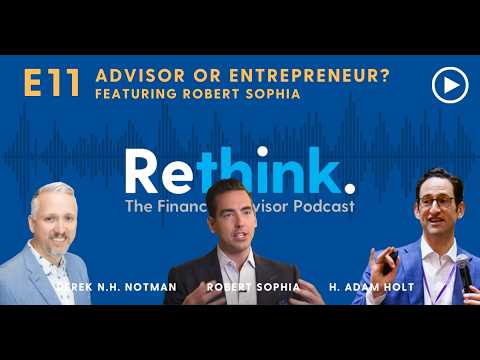
Watch and Listen
Episode Summary
Adam and Derek explore the identity shift from 'advisor' to 'entrepreneur,' opening with their own stories of being trained to sell and service rather than to build a business. Guest Robert Sofia of Snappy Kraken distinguishes a lifestyle practice — profitable but entirely dependent on one person — from a scalable, sellable business with real enterprise value, and explains why large firms' technology and AI investment is raising client expectations across the board. The conversation covers delegation, differentiation, and what actually makes a practice attractive to a future buyer. It's a natural pairing with Episode 10's firm-model discussion, since both address what it takes to build a durable, transferable advisory business.
What This Episode Covers
- The gap between advisor training and business-owner training
- Lifestyle practice vs. scalable, sellable business
- Technology and AI spend as a driver of client expectations
- Differentiation strategy vs. blending in with competitors
- Delegation and operations as a path to enterprise value
- What builds (or destroys) a practice's value to a future buyer
Full Transcript
Full timestamped transcript.
[00:00:00] H. Adam Holt: Welcome to Rethink: The Financial Advisor Podcast. My name is Adam Holt.
[00:00:06] Derek Notman: And this is Derek Notman. We are your hosts, both veteran advisors and fintech CEOs who challenge the status quo, question everything, and have fun doing it. Hear honest commentary on the challenges facing advisors today. And be part of a community where we can all rethink the profession.
Now on to our episode. Adam, my man, when you started off as an advisor, when you, when you were building your practice, did you think of yourself more as an advisor or as an entrepreneur?
[00:00:40] H. Adam Holt: See, that's an interesting question because today, as we both know, we both think of ourselves as entrepreneurs, but it was a, it was a, it was a long haul.
I, I, I wanted to just be- Well- ... the best advisor, right?
[00:00:53] Derek Notman: Yeah. Oh, yeah, for early years. I mean, I, I've got gray hair. You know, I had gray hair in my 30s for a reason.
[00:00:58] H. Adam Holt: You have white hair.
[00:01:00] Derek Notman: I've got white hair now. I thought it was gray. Dude, it's... I've got s- I've got stress highlights, okay?
[00:01:06] H. Adam Holt: Nice. They're somehow strangely consistent, so your entire head is white.
Very consistent
[00:01:12] Derek Notman: stress. But it is an inter- it's an interesting question. Like, what were you? Like, I'm, I'm guessing you... there was, like, a transition. I don't know. Like, I mean, we've got probably a ton of advisors. I'm hoping there's more than three of you because I... your mom's not an advisor listening to this podcast, although she does listen.
[00:01:26] H. Adam Holt: She would argue.
[00:01:26] Derek Notman: Thank you. Um, but, like, earlier stage advisors, or even, like, any stage, like, there is a difference.
[00:01:34] H. Adam Holt: There's a big difference. But what- Yeah. I, I, I... look, I... the answer to your question for me is I went through different phases. One of the, one of the things that someone early on told me was that this is the only business, remember business, not practice always, business, that you could have no inventory, have no cap on the upside, right?
Control all your time, and that sounded really like an entrepreneurial gig.
[00:02:00] Derek Notman: I love
[00:02:00] H. Adam Holt: how- But that doesn't- ... it goes. It is... Right? They, but they never necessarily told me how to run the business. I was taught how to-
[00:02:07] Derek Notman: Sell ...
[00:02:07] H. Adam Holt: sell, and, uh, sometimes how to service as long as it meant that there was a cross sell on it.
Um- Yeah ... yeah, so the, the actual running of the practice, and then ultimately the entrepreneurial aspect of it, um, was really self-taught. I, I really think it was self-taught, and there's a difference in mindset that I've learned becoming an, an entrepreneur, and I, I know you did some research on this. What, what have you found so far?
[00:02:32] Derek Notman: Yeah, it's, it's interesting. Um, when I start... I, I was laughing because it is so true what you're saying. I, I remember, like, going, "Wow, that sounds like a hell of an i- hell of a, of a deal here. Like, I don't have to go get a warehouse and stock it up and hire people? I just go to work, and I can make as much as I want?"
What was it? Like, um, you're in business for yourself but not by yourself. Hmm. There you go. That's what, that's what somewhere it told... anyways, um, I digress. Um, I did- How lonely. I was very lonely ... oh, I, I did a, uh, a poll on LinkedIn. I love LinkedIn. Go follow Adam and I. If you're not already, you should. Um, about ask- I asked advisors is being a financial advisor the same thing as being an entrepreneur?
And it was, it was... I didn't expect the response that I got, but only, let's put it this way, only 44% said no. 25% said yes, 100%, it's the same thing. 29% said somewhere in the middle.
[00:03:36] H. Adam Holt: Hmm.
[00:03:37] Derek Notman: So I think the, the, the, what I, what I walked away with this is that the majority of people, uh, again, remember most of the people answering this survey, this poll, it was almost 1,000 people-
[00:03:46] H. Adam Holt: Wow
[00:03:46] Derek Notman: are advisors. Most of them, the majority think that there is, there are entrepreneurial aspects to being an advisor. But then to your point, Adam, we're not taught those things when we're building the business. Not the practice, the business.
[00:04:01] H. Adam Holt: Well, that's interesting because what I just heard you say is that, you know, pretty much half think that they're some kind of entrepreneur, but, but 44% said, no, it, it's not the same thing.
And I guess the question in all the commentary was, what does it mean to be an entrepreneur? And one of the things that we did decide to do, as you know, Derek, is we've chosen certain subject matter experts based upon what they tend to see in the marketplace. And we recently had an opportunity to interview Robert Sofia, who's a co-founder of Snappy Kraken.
And for those of you that don't know, uh, Snappy Kraken is, is really an, it's an award-winning marketing technology firm. They're getting a lot of attention right now. They focus on marketing automation, online advertising, and they're really bold. I don't know if you've seen their stuff. Very unique, um, for financial advisors, professionals, uh, and they do marketing campaigns.
I know he just released a book, Blend Out, which we'll talk about. Um, and I've really been watching Snappy, uh, Snappy Kraken, as we call them, uh, and they've just made a splash in the advisor space. And, and I wanted to ask Robert this exact question, right? So here's his response. And I asked him, I said, "What, what's your unique perspective on the state of advice?"
Let's listen to what Robert shared on the Rethink Tank.
[00:05:12] Robert Sofia: Well, I, I'm, I love it. I'm passionate about it. I've been in this industry for almost 20 years, and I think it keeps getting better and better. Uh, I think financial services, specifically financial planning, it's something everyone needs, uh, it's something not enough people get, and I think we're in a space that's ripe for consolidation and disruption, and that makes it exciting to me.
[00:05:31] H. Adam Holt: That's true. Well, you know, living in this space, you've obviously done a fantastic job living and breathing this for our financial advisors. Tell us, what do you think is the missing opportunity out there advisors are not paying attention to?
[00:05:43] Robert Sofia: There are a couple of them. It'd be hard for me to just mention one, but I think the, the, if you wrap them all into one general theme, it's customer expectations Um, people's expectations are changing around mobile experiences, uh, around being able to do everything on the go.
If you look at almost every study that's done, I mean, there, there was just a P- PwC study that was done, at least half of consumers prefer to use their devices for all their transactions rather than going to a bricks and mortar location. And, and most firms still operate on a very sort of old school bricks and mortar approach, and their technology is not as advanced or as easy or as accessible.
And so if you, if you start looking at where the, the opportunity is, I think it's around the, the customer-first experiences and even things like AI, and I know a lot of people use that as a, as a buzzword, and that's not how I'm using it here. But if you look at all the major financial institutions, 86% of them, at least, I think that was the last, 86 or 87%, are investing heavily in AI.
But how many advisors really are? So when it comes to customer service, portfolio management, recommendations of financial products, sales and marketing, algorithmic trading, fraud detection, I mean, it's all AI powered. And so I think these, these are the opportunities to build a highly scalable, customer-centric practice that runs with a lot of artificial intelligence is, is where the future is for this industry.
[00:07:07] H. Adam Holt: Gosh, that's amazing. I mean, there's so much to think about. I can't help but think that most advisors would be overwhelmed, right? I mean, for the most part, they're, they're doing their, they're running their practice. They think they're starting to integrate maybe a CRM, maybe portfolio management. You're talking about AI.
So help us understand what are some steps? How can we actually make, turn this into actionable effort? What are some areas that we can start that process?
[00:07:28] Robert Sofia: Yeah, well, I, I think it all begins with having more of an entrepreneurial mindset than a sales mindset. So I, I've personally supported over six thousand advisors just over the course of the last few years in various capacities, and one of the things that I see is, is the majority, they are thinking about their business like, "I need to get leads.
I need to get more clients. I need to have more opportunities. I need to grow my assets under management." And those are very surface level performance indicators. What they really need to be thinking about is what drives enterprise value, and that is a lot more encompassing. That is things like how do you generate more recurring revenue?
How do you incorporate more scalable technology? How do you create m- a stronger brand that you can own that has value? And if you start thinking about your business as an enterprise, and you start looking at the things that enterprises are valued on, then it ... You start building in your business more strategically, and, and that's what I think advisors need to do.
And if, if they do, all these other things... I mean, you know, the AI that I mentioned, I- I'm not saying advisors need to go out and develop their own AI, but they're gonna start thinking about what technology tools are gonna empower them to have a more advanced practice that has more in- enterprise value, and that's gonna lead to better decision-making.
[00:08:48] H. Adam Holt: Yeah. No, I ... We completely agree. Obviously, Derek and I talk about this all the time and thinking like an entrepreneur, so I'm really excited that you're, you're sharing that. You know, I'm curious. You obviously written a book recently that just came out. I'm really excited to read it myself, and it's getting great traction.
What was the, what was the thinking behind it? What was the message that you were trying to share? Is it aligned with this entrepreneurship?
[00:09:09] Robert Sofia: It is. Yeah, definitely. Uh, the concept of Blend Out is... It really comes down to the fact it mo- most advisors, if, if they have a, a small practice in a small town, and, and, and a celebrity were to move in and set up a practice next door to them, that celebrity's practice would blow up, and it has nothing to do with th- their qualifications.
It would have everything to do with the fact that they are known. Well, there are amazingly talented, well-qualified advisors, but people are not beating down their doors to do business with them because they are not blending out. They don't stand out enough. They're not known enough. They don't have enough of a presence, and so the whole book is about how to really scale that- Valuable brand, whether it's your person or your business brand, and do it in a way that really draws ideal clients to you, and a framework for maintaining that and continuing to, uh, accelerate it over time.
So i- i- it's... You think of the word stand out, well, Blendout, it's just a, a little play on that. But it's, it just means you're gonna do the opposite of blending in. You're gonna really get noticed for who you are and what you're great at, and you're gonna draw people to you as a result.
[00:10:20] H. Adam Holt: Now, that was interesting.
You know, it was, Derek, there was a couple of things that really kind of hit home for me. What did you think about his first comments about, uh, how much is being invested in technology and this artificial intelligence? I mean, did, did that, did that resonate with you at all?
[00:10:35] Derek Notman: Well, dude, like, I sure as hell hope that advisors are listening to that if anything else.
Like, you can put Adam and I on mute, but I sure as heck hope you had to hear what, what Safia just had to say there, 'cause that stuff was brilliant. Um, he made some really excellent points about what's going on, and we'll, we'll unpack a couple of them here. But yeah, like this whole investing in, in, in, in technology and AI and all of that type of stuff, yeah, advisors don't need, you don't need to go make it up yourself.
Like, that's not what you do. That's fine. But look at where the big money is being spent.
[00:11:11] Robert Sofia: Mm-hmm.
[00:11:11] Derek Notman: And you know why they're spending it there? Because the consumer wants it and expects it, right? Like mobile over brick-and-mortar and all of this stuff. So it's just fascinating. He's just saying what's happening, what's out there.
And of course, he's got a pretty good finger on the pulse serving over 6,000 advisors. Um, but it's so true. Like, as an advisor, you know, when I have my advisor cap on, Adam, when I think of that, I'm like, "Dude, like, if I don't have these things, if I'm not investing in tech in some way and not doing this stuff, like I am gonna be obsolete so much faster than at like 10, 20, 30 years ago."
I don't know. What, what did, what were your thoughts?
[00:11:48] H. Adam Holt: Well, it's funny because when I first heard this, I, I was thinking to myself from the en- en- environment... Oh, sorry, the entrepreneurial mindset- Advisors, if you approach this problem as an advisor, you hear artificial intelligence and you're thinking- Ugh
this is a human business, right? This is a- Right. Yeah. The technology has always been a bane of my existence. I don't... I can, I can do just fine with a yellow pad and a calculator. Take it all... Take all the tech away from me and I am just fine. And that's, and that's probably true for a lot of advisors 'cause they know their relationship value, the confidence they give their clients is enough to probably carry them.
You know, you give me some, you know, some basic trading account and I can help people and, you know, I'll help them buy and make good decisions, right? But the... But what's happening here, the change that's happening, is that technology is infiltrating in so many levels that we have to address this not just from what's worked for us for the past 20 and 30 and 50 years, but rather how technology's going to force us to, to act like a business, right?
To behave like a boss and, and not just like an advisor. And, and the reason is because we're gonna see such pressures from where we've typically made a lot of margin, where we've had a lot of we'll call it inefficiency. Technology's coming in there, even artificial intelligence is coming in, and from a business perspective is going to literally eat your lunch if you're basically, you know, milking the margins.
And my, and my, my point to you is that, that be- because the consumer is expecting so much more from this relationship, right? They want more value. They want more interaction. We have to use technology to release our time back to them, and that's really the key, is you- when you think about AI, as a business person you say, "Hmm, that means I could do more with less."
Yep. That's what AI is really about. I can... I... And what is it gonna free you up, Derek, to do? It's gonna free my advisor time up to spend more time doing revenue producing activity. That means interacting and adding value to my clients on the human level, and offloading the stuff that's taking my time and attention, and getting rid of that with technology so that I can keep my margins in line with where the cost needs to be for the consumer.
[00:13:54] Derek Notman: And if done right, you blend that into your client experience so it improves the client experience, which- Amen ... which, you know, boom, right? There you go.
[00:14:01] H. Adam Holt: Right. But you, but you have to th- But he's right. You have to think like a business owner, like an entrepreneur, as opposed to a financial advisor, which is usually thinking, "How do I do right by my clients and I get rewarded with AUM?"
Now let's, let's talk about that for a sec 'cause I thought that was really quite funny. He said what you and I have been saying actually many times before.
[00:14:20] Derek Notman: Right.
[00:14:21] H. Adam Holt: That people joke that... You know, I saw his, his eyes were rolling if you, if you were able to see it at the time. Um, when he said, you know, people measure their businesses on AUM.
What do you think about that? Is that the metric?
[00:14:33] Derek Notman: Oh, man. No, I, I think it's a terrible metric. It, it's one that was just like- By default, we kind of arrived there as an industry like, "Well, let's see here. How can we compare all of ourselves to each other? Oh, this AUM thing was cool." Yeah. Ego metric.
Obviously, if you've got more, you're better, right?
[00:14:51] H. Adam Holt: Yeah.
[00:14:51] Derek Notman: Like, uh, no- The bigger the ego,
[00:14:52] H. Adam Holt: the bigger the ego. I, I,
[00:14:55] Derek Notman: that's- Oh my... That, that's, I think you- that's about the only correlation you can make with some certainty. Yeah. So, uh, I, I can't stand it. It, it, it comes from that, as you said, from that sales mindset instead of from an entrepreneurial mindset.
Like, how many entrepreneurs do you hear talking about AUM, you know, or, or a comparable like that? They don't. That, that's, uh... Oh, I can't go on about it. What do they
[00:15:18] H. Adam Holt: talk
[00:15:19] Derek Notman: about?
[00:15:19] H. Adam Holt: Well, what do they talk about? What are the KPIs that an entrepreneur looks at?
[00:15:22] Derek Notman: Well, that's it, like recurring revenue and sales and like- Mm
cost of, you know, uh, acquisition costs and brand value and, and for, and all the stuff that this guy just said, right? Like, this... And this is what I like is because you brought Robert in as a, as an entrepreneur who serves advisors, so he has this interesting perspective Um, that's the stuff that's important, and if you focus on those things and do a good job, two things happen.
One is you get more sales, you get to grow, and two is you can figure out what works good and what doesn't work, so if something's broken, you can go fix it. So sales are a byproduct of all of the entrepreneurial stuff. Where, like, when I started, it was literally like, "Hey, man, you gotta... This is a race to 500 clients, and once you get there, that's success."
[00:16:08] H. Adam Holt: Mm-hmm.
[00:16:09] Derek Notman: Right? Now, like, well, that- that's not building a business. That's just, like a, like, a sales machine to get as many people in the door to sign on the line.
[00:16:17] H. Adam Holt: There's two... You know, it's funny, there's two things that were really told to me when I first started my technology practice. I realized I learned a lot on the job being a technologist, because, you know, venture and, and backers and investors, they, they all are asking different questions of you when they're looking at you from an enterprise value.
And the, the reason why this is relevant for practice is because we're seeing significant number of people that view their practice that, as a long-term asset they plan on selling or creating some succession plan. And so for those of you that, that do think about that, I'm gonna actually sell my practice at some point, th- there's been a couple things I'd, I'd love for you to take away from this.
Um, one is when you have a practice mindset, you're thinking about customer first, customer interaction, and that's great. Lead with expectations and delivering value. Eventually, if you're successful doing this, you actually have to think like an entrepreneur in a business, 'cause you're running a company.
There are people dependent upon you, staff usually. There are vendors, there are obligations you make, and there's of course an expectation long term you're gonna serve these clients. That means you need to bring in the next generation and/or think about a succession plan so that there's continuity for that practice.
And so long term, there, there has to be almost two mindsets here. One is I'm a pr- how do I deliver the, the best practice that aligns with my brand? And number two, how do I run a company? And unfortunately, we just haven't seen a lot of training there. What I, what I learned is d- to really focus on KPIs like lifetime value, which is really a, um, a measure of how long can I keep the business on the books, um, and how much revenue will it generate as a, as a, let's call it as an, an entity, relative to the customer acquisition cost, the cost of ac- the cost of actually getting a client.
And there's a ratio there that you wanna look at. Many acquirers look at that ratio to try to understand how efficient you're being with your capital. Are you actually, are you investable like the stocks that you help to promote for clients? Does it make sense to, to do this? Um, and I think there's a whole bunch of, um, areas we can all grow in to start thinking, are we running this business efficiently?
And frankly, would somebody actually want to walk into this business? Is it attractive or is it really just a cashflow business that works because you show up every day? Does it really have true enterprise value beyond yourself as the professional? And that means you actually have to find ways to actually disconnect all of that value tied to you personally being the main, uh, we'll call it relationship, uh, party.
And that's something I've had to learn
[00:18:41] Derek Notman: What's the... I just read a quote on this, Adam. I, like, the, the greatest, most successful entrepreneurs are the ones that will build a business that they, um, don't need to be a part of anymore. Like, they can be excluded. Like, the business can operate without them- Mm
where, like, a sales practice doesn't go anywhere without that main salesperson.
[00:19:04] H. Adam Holt: That's right.
[00:19:04] Derek Notman: And there is a huge difference. And I, and just as, as a little teaser, I think we're gonna, for our next, one of our next episodes, we're gonna talk about, more about this. But we've g- I think the RIAs listening to this get it because they had to physically go out and set up, you know, a legal entity and get a corporate bank account and all of the things that come with doing a business, right?
But you've got all these BD reps and wire house reps that... And I'm not saying those are bad. Like, and there's a ton of them there, but they're not encouraged or taught about these business things. But, and this is the challenge, like, 'cause they're still running a business. They just weren't told to do these other things 'cause they hooked up to someone who already did some of this infrastructure.
[00:19:43] H. Adam Holt: Well, isn't that... And that was the allure, right? Nobody, uh, uh, nobody- Right ... wanted to run a business and a practice and the compliance engine and the, all the stuff you had to do. You just come in here and do what you do great, which is relationships and, and communication, right? So but it is true, you know, long-term scalable interest where it's not just about the single advisor and not just the cashflow business that, again, supports, right, a lifestyle business.
We all, we all probably got into this business to create a lifestyle business. Now that you have a lifestyle business, that's not, you know, always sellable, right? That's not gonna be something that someone can purchase, so there's no capital value in the, in the instrument, if you will, that's called your practice.
You know, we, we actually asked Robert one more question because it was a great follow on to this, this discussion. So spend the next couple two minutes. Hear, hear what, uh, Robert said. So we asked him, "What do you know that many advisors are missing?" I mean, what's, what's coming around the corner? I
[00:20:35] Robert Sofia: mean, if you look at all of the M&A activity in our space, all the deals, of the 112 transactions in the last eight months, the ones that had over a billion in client assets made up 48 of those transactions So what you're seeing is that the larger, well-branded, scalable regional and national firms, those are the ones that are demanding the valuations.
That's where the M&A activity is happening. So if I think about all these advisors that are making their practice their retirement, and they are expecting to get a s- good multiple on their little 50 million or $100 million book of business, and by the way, I said little, and that might be really offensive to some because that's an ach- that's an accomplishment.
I don't want to undermine it. But from an M&A perspective and a multiple perspective, it is the large, well-branded, scalable regional firms, those are the ones that are getting the, the real multiples. So if you really want to build a practice that has enterprise value, it means scalable, repeatable, predictable systems around marketing, around sales, and around operations.
And if you don't have that in a way that allows you to scale to those levels, you're never gonna reach the, probably the potential you expect. And what you're gonna see is, is, is as these other firms that have the resources, they keep investing in technology, and they keep becoming more scalable, they're just gonna be eating the lunch of these smaller advisors, and they're not even gonna be able to have a good exit.
And I think that's where you're just gonna see the consolidation accelerate pa- partially from acquisitions, but partially from other firms just not being able to, to make it because they don't have that entrepreneurial, that, that growth and, and enterprise-related mindset and focus.
[00:22:37] H. Adam Holt: So there you go. I think you brought it all home.
And I, and I don't know, I, I really don't know that many of us in advice actually thought about that long-term plan, just like we do retirement planning for clients.
[00:22:48] Derek Notman: Right.
[00:22:49] H. Adam Holt: Have we done that for ourselves and built this into our long-term, let's say, financial plan that we're expecting or would... are assuming maybe an exit of some reasonable value from that practice?
[00:23:02] Derek Notman: You know, I wonder 'cause I, I look at, you know, the environment I grew up in as an advisor. You were in the same environment. And I look at what happened there when succession happened, and it was like, "Hey, I got my pension."
[00:23:15] H. Adam Holt: Mm. "
[00:23:15] Derek Notman: I'm good. I'm- I found a successor. They're, I'm, like, they're gonna take it all, and I can just walk away."
Um, and maybe that's fine for you, but, like, I, I think there's this massive shift. And if you are, if you wanna be an entrepreneur and build more than just a lifestyle business that kind of just implodes when you leave, um, and I would hope that you wouldn't wanna do that 'cause you are making long-term promises to your clients, um, then you have to do what he's saying right here about, you know, scalable things that are, you know, predictable, repeatable, um, that if an acquirer comes in, whether that's a junior advisor that just wants to purchase, but chances are the junior advisor's gonna have to finance this somehow, right?
So we're gonna have to know, like, what, what's the lifetime value, right? What, what's the revenue? And we're not asking AUM here. We're wa- we're asking margin and profitability and all, you know, all that stuff. So I don't know, Adam. It almost goes back to do I care?
[00:24:18] H. Adam Holt: Hmm. That's a great point. You know, many people have asked me even in my own ventures, they said, "Adam, what are you trying to build?
Are you trying to build a lifestyle business?" That's one that's gonna pay you cash flow, right? Give you a certain kind of lifestyle. "Or is this, is this an exit opportunity where you're gonna sell it for a bunch of money?" And they're two different approaches, right? Very
[00:24:37] Derek Notman: different.
[00:24:37] H. Adam Holt: We run, we typically run our practices like lifestyle companies, right?
We show up just the way we want. We work the way we want. Um, we know a lot of people that golf more than work.
[00:24:47] Derek Notman: Yeah, yeah.
[00:24:47] H. Adam Holt: That's their work, right? That's their lifestyle. But it is true, there is a mindset shift that has to happen if in fact you plan on having an exit. Now, one of the things that I will tell you that is very real, you just mentioned it, when you're dealing with internal succession- The question get, becomes, okay, long term, do my younger or junior partners have the capacity to actually buy me out with cash?
And if they can't and haven't self, haven't made a fund for it or don't have the cash flow, they're gonna finance it, which means once they're gonna finance it, they're gonna look at the metrics for is this a good investment? One of the things that we addressed actually in our own practice, we looked at the, the value that was expected, and we said to we, said, "How are we gonna cover the financing cost of doing this if we lose the rainmaker here who's generating all the value?
There's no scalability here. Why would I pay top dollar for that?" And as a result, it created a debate that, that wasn't, you know, that I would say one side didn't have really good defense against an analyst who's coming in looking at it from a business perspective and saying- Right ... "This doesn't make sense, guys."
You, you might have all kinds of, you know, relationship value, but it's not transferable, and that's because all those years that part of the business wasn't really treated like an enterprise, like an entrepreneur. Yeah.
[00:26:00] Derek Notman: One thing that also comes to mind, though, is like, okay, let's say I answer that question, I don't care.
I want my lifestyle business and whatever. You know, I'm not interested in really dealing with it, but I wanna be around for the next 20 years and grow and have clients coming in, right? I think then that what Robert Sapia is saying about like scalability and digital and all of these things is just as important.
Whether you wanna exit from your practice or let it fall apart, if you want to grow and capture your share of clients and AUM if that's your thing, um, well, then you better start doing this stuff 'cause otherwise you're, you're gonna be struggling more and more to get them, whether you wanna exit or not.
[00:26:37] H. Adam Holt: Yeah. That's very true. Let's, well, that's great. So let's, let's tell everybody who's listening do what we always do. This is our action point. So what are two to three things that if you're listening to this that you can do? What, where would you go, Derek, if you were making some recommendations to those that are listening?
[00:26:52] Derek Notman: I'm gonna actually start with my last one first and just like- Okay ... if you were looking at, like you mentioned, like an analyst. If I'm looking at my business from the outside in- Mm ... would I buy it? And what would I buy it for, right? You know, is, is it, is it worth something? Do, does it have all the things that I would want as an investor to purchase something, whether I'm gonna buy it just as an investment or buy it as, like, the new advisor taking over?
Um, and be honest with yourself. That's a really, really big question. Um, and then also, like, and to Robert's point, like, do you have documented and scalable processes and tech in place to do the things you wanna do? Exit or not, doesn't really matter. Do you have those things in place? And if you don't, then that, that would be a place I would start looking for right away.
[00:27:33] Robert Sofia: Mm-hmm.
[00:27:33] Derek Notman: And I, you know, just to get more granular, like, how do you document this stuff? Like, break it apart. Like, what's your first client meeting? Like, what's your sales process? What is your digital marketing process? Write these things down- Mm ... and then yes or no, is it scalable? Is it automated? Things of that nature.
That's, that's just some stuff that I would ask advisors to look at.
[00:27:53] H. Adam Holt: Got it. So you're saying ma- build the recipe from the practice so that it is transferable. That's what, that's what I heard, right? Yeah, 100%. Like- Take those processes, break it down, and then make it a process, and see where you can actually put tech or people or delegates, uh, to do this work, right?
[00:28:08] Derek Notman: Totally. Whether that's to, you know, enhance your lifestyle or sell or both, like this is how you do it
[00:28:13] H. Adam Holt: No, that makes sense. I mean, any, any entrepreneur is gonna be looking for efficiency. So there's a couple things that I, I picked up here. I, I think there's a real challenge with financial practitioners/entrepreneurs in knowing what KPIs or key performance indicators, uh, that they can benchmark right now that are not necessarily AUM or sales only driven, right?
We all know that the, the top advisor in the company has the highest AUM, right? Again, another salesman. The, the top advisor- Oh,
[00:28:41] Derek Notman: gosh ...
[00:28:42] H. Adam Holt: has the highest premium placed, right? Yeah. The, it's, it's a, I understand it's a sales game, but it's always, but we could always ask them what are they doing to run their practice.
We might not actually get the answer we're looking for if we're actually thinking about is it the most efficient. That doesn't mean it's the most efficient, and therefore obviously the most highest multiple value there. Um, I think- Or scalable
[00:29:01] Derek Notman: or repeatable ...
[00:29:03] H. Adam Holt: right. KPIs are, are recurring revenue. I'm buying recurring revenue if I'm making a capital investment in you.
Are you giving me strong growth? Do I get a good CAGR? Do I look at revenue growth? What is your net margin? What, what is your gross margin? These are the questions we should start asking. If you're not familiar with these terms, you might have to go back to your CFA handbooks or your CFP and say, "What does a reasonable investment look like?
What's the RO, what's the ROR?" Um, uh, or return on investment rather that, that, that someone would expect from this practice, and are you running in a way that actually matches, let's say, the S&P? Would I invest in you versus invest in the S&P and look at that price to earnings ratio and say, "Gosh, this is something..."
You know this stuff, right? Let's just turn the, let's turn the mirror or the gla- gaze- glazing glass on us to figure that out. Um, I, I would say if you're running a business, you gotta look for inefficiencies, right? So you gotta consider delegating. I know for many of us that are really A type person, personalities that wanna be out there in the field, we wanna talk to people.
We don't wanna do operations management. One of the reasons why many of us started with, we'll call it turnkey programs, is because we didn't wanna do this. Uh, but eventually you get to the, the point where it doesn't make sense i- in some measure to offload everything. Consider adding an operations manager, someone who loves this stuff, and hold them to task for managing to specific KPIs that are ent- entrepreneurial-minded, uh, or capital-minded.
I think these are really important with specific goals. Like I wanna get us to in the next two years, uh, you know, a net retained, uh, revenue of X and an ongoing, uh, an ongoing customer acquisition cost of Y, and you start to work towards these. You figure out then what you have to execute To get there.
And it might be tech, it might be human, it might be delegating, it might be offshoring. I don't know. But the point is that all business owners are really gonna have to make this decision going forward. And I think the last piece about this is that everything that Robert talked about is really brand transferability, right?
How-- can I take the brand and make it not just about me as the, the, the financial advisor and make it about this practice which has long-term value? Uh, and that's the question is, are you-- if you're still critical to the entire process as the financial advisor, it's not scalable yet.
[00:31:11] Derek Notman: There's a lot here, folks.
Don't get overwhelmed, but you're doing this for your clients already. Step back and do it for yourself. You're, you're gonna be happy one way or another. It's gonna, it's gonna make a huge difference. I mean, Robert said it, we've said it before, the world's changed, and it's changed fast. Um, these are things to help you change with it.
[00:31:32] H. Adam Holt: Well, let's take this opportunity to run to our last section, uh, to close out this podcast. As you know, we always ask a question, or a question is asked of us. We, we add one question to the end of our podcast, and this one comes from Sharon, uh, also using LinkedIn. Seems like everybody's using LinkedIn. Um, so I'll ask this of you, Derek.
So, uh, Sharon writes, "I built a respectable BD practice under my own name, and I continue to get solicitations to consider moving my registrations. How do advisors know what they're really getting and what they're leaving behind from their current organizations they're tied to?"
[00:32:06] Derek Notman: This happens a lot. In fact, I was cold called this morning to go to a different firm.
[00:32:11] H. Adam Holt: Mm-hmm.
[00:32:12] Derek Notman: So it, it happens all the time. You go? Yeah, yeah. It, it's on a different planet though, so I, I- Oh ... that might work. I don't know. We'll see. I don't know why I even said that. Just one of those days, Adam. It's Monday.
[00:32:24] H. Adam Holt: It's okay.
[00:32:24] Derek Notman: Um, so anyways, yeah, okay. Sharon, thank you. This is an interesting question. I think a lot of advisors think this or get, you know, pitched from other firms like, "Hey, here's all the great stuff that we have here."
And I, I, I've a- I-- a lot of advisors have asked me, "Now, Derek, like, this firm's saying this," blah, blah, blah. I think in, in short, Sharon, like, it depends. Like, I think first you really gotta figure out, like, what are you paying for and what are you getting where you are today? Like, get super granular. I think a lot of BD advisors don't actually realize how much they're spending each year for all the things they are getting, quote, unquote.
Um, you know, put it into a dollar figure. Would you stroke a check to your current BD for everything that you're getting currently, and would it be worth it? And then look at the new firm. Do you get all that stuff? Do you get more? What's it gonna cost you? Um, like, just, I mean, if you're simple, get a yellow pad and write the stuff down side by side.
But a lot-- It's tough because there's not transparency here, um, unfortunately, on multiple levels.
[00:33:26] H. Adam Holt: Yeah.
[00:33:27] Derek Notman: Um, and then if you're gonna consider moving Like, do you have to go to another BD? Why not just go independent? That's something else that I would add to that, you know, yellow pad, you know, uh, comparison.
What do you think?
[00:33:41] H. Adam Holt: Well, l- it's, there's so many opportunities today, and it's hard to give specific guidance for anybody's spec- you know, situation. So, um, no different than giving investment recommendation, but- Right ... I would, I would offer this, right? We just went through, you know, 25 or so minutes of explaining the mindset.
If you're thinking about this answer from a financial advisor, you're gonna tend to think... Or sorry, from a, a practice manager's perspective, you're gonna think about it from, what's my customer experience? Do they offer me better tech? Is it simpler to execute trades? Do they offer me better benefits? Or, you know what I'm saying?
But if you look at it from an entrepreneurial perspective, you might get stuck more on the financial side and say, "Well, where am I gonna go in the next 10 years, and where am I gonna arrive? And do I wanna be part of this brand as a backbone, or do I wanna be part of my existing?" Right? So, so there's... I, I think it's about what you're focusing on.
If you're focusing on just, "I'm really aggravated where I am, and anything would be better," right? This... Right? So that's, that's, you know, it's almost gonna be an emotional decision. Um, but if you're really looking at it from an entrepreneurial and a practice management, I really think the focus has to be can you still deliver the kind of, uh, expectations of what Robert said early on, which is, "Can I deliver an exceptional customer experience better than I can today, okay, with this new relationship?"
And then from the business end, can it help me get to where I wanna be in 10 years faster or better or more efficiently than the current organization I have? And if that can't be proven for both of those decisions, then I would figure out how to innovate where you are. Uh, and, and that's, and that's really, that's the key.
That's a challenge, I think, for all of us. You gotta have some way to make a decision on this stuff, and I think we're gonna unpack this in our next episode. We've got a lot of requests, uh, to talk about independence and BD affiliation and so forth, so we're gonna actually ask, uh, an expert to come in and talk to us about what are those decision points, and then we'll debate it the way we do.
[00:35:43] Derek Notman: Yeah. I think one thing I would add to this is be careful who you're... Like, especially the firm recruiting, trying to get you to move, be careful who you're talking to for information because remember, it's their job to sell you this new firm. Mm-hmm. Right? So you have to take that stuff with a little bit of a grain of salt.
Like, some, like I've heard horror stories where advisors were told everything they wanted to hear, and then they did it, and they're like, "Oh, sorry, no, I, I was wrong on that one. My bad, but you're here now, so whatever." Um, so just be careful on that. Like, go slowly on this stuff. There's no, there's no rush.
[00:36:19] H. Adam Holt: Yeah. And, and test the waters, right? Talk to people. That's, that's the real key, Shannon- Yeah ... is, is you wanna talk to real humans that made that, that, that shift if they did so. Um, and then by the way, I, I wouldn't be, uh... Today the, the, the employment and job market is so insane, right? In, in a good way for those looking for jobs.
I- if you're ever getting recruited to go s- to another organization, you, you, it, it's worth it for you if you have a relationship to talk to your existing organizations and say, "Hey, I'm contemplating this. Why do I wanna stay?" And, and get resold, right? Tell us- Yeah ... tell me all the stuff you're doing for me that I don't know to value.
Because you wanna make a, a... And sometimes, by the way, you'd be surprised, organizations find ways to keep you in ways that you didn't-
[00:37:00] Derek Notman: This is a
[00:37:00] H. Adam Holt: very good point ... think, think to ask. So that's no different than any kind of employment structure. Sometimes you need to give your current, uh, organization the opportunity to bid for you, um, and show that they really wanna keep you.
So that's, uh, something to think about. Everybody's gonna be throwing hate mail at me after that one. Sorry, employers. Um, but it's the truth. It's happening. I think I'd rather know than see somebody walk out on us that we really wanted to keep, so, um, that's important to put it- Well,
[00:37:24] Derek Notman: it's just like an employee- Yeah
looking to go to a different company, right? Yeah. That's what I mean. Like, you know? I mean, if, if you really wanna keep them, you know?
[00:37:30] H. Adam Holt: Sweet.
[00:37:30] Derek Notman: Yeah. Anyways, I mean-
[00:37:31] H. Adam Holt: All right. Cool ... we'll talk about
[00:37:32] Derek Notman: this later.
[00:37:32] H. Adam Holt: Yeah, we'll wrap this up. All right. Well, thank you everybody for being part of this. We, uh, hope that you, uh, are enjoying the podcast.
Please give us feedback. Please ask questions so that we can have content that just keep coming out our ears. Derek, as always, I appreciate talking to you.
[00:37:47] Derek Notman: Yeah, man. Great seeing you. Be good. Thanks for listening, everybody, and we'll see you on the next one. You
[00:37:54] H. Adam Holt: got it.
[00:37:55] Announcer: Thank you for listening to Rethink, the Financial Advisor podcast with Holt and Notman.
Be sure to subscribe now and join the ongoing conversation. The information covered and posted represents the views and opinions of the guest and does not necessarily represent the views or opinions of Asset-Map or Connecture.
The content has been made available to you by Asset-Map for informational and educational purposes only.