What Financial Software Do Advisors Need?

The Financial Software Stack for Modern Advisors
Financial software for advisors has moved well past a single system that does everything. A modern firm typically runs a CRM, a portfolio and custodial feed, a risk profiling tool, a tax analysis platform, a deep financial planning engine, and, increasingly, an AI notetaker sitting in every client meeting. Each of those tools does one job well. None of them was built to do all of it.
I've watched this play out from both sides, first as a practicing advisor and then building the tool I wished I'd had in the room with clients. I know plenty of firms that have bought the CRM, the planning tool, the portfolio analytics, a specialized planning tool, a Social Security analyzer, an estate planning tool, an aggregation layer, a vault, and none of it works the way it was supposed to. It's rarely the tools themselves. Most firms spend their whole budget on the software and almost nothing on training their team to actually use it. My rule of thumb is that you should spend at least twice what you spend on the technology itself on training your people to run it, or you're just buying a Peloton and hanging your coat on it.
This piece is meant as a map, not a sales pitch. If you're an advisor, here's how the pieces fit together, where they show up in your practice, and where the gaps tend to open up.
Where Financial Software Shows Up Across the Client Relationship
The easiest way to see how it all fits together is to walk it in the order a client actually experiences it. Here's the full arc at a glance before we walk through each stage:

Intake and fact-finding. Every engagement starts with gathering the household's financial picture. Firms that still do this on paper or through long PDF questionnaires lose time and lose clients before the first real meeting happens. Digital intake tools have replaced that step for most modern firms.
Household and family mapping. A client's financial picture rarely lives in one place. Trusts, business interests, aging parents, and adult children all factor into decisions, and software that only tracks the primary account holder misses most of what actually drives a plan.
Goal funding. Retirement, education, and major purchases all need a clear answer to a simple question: is the client on track. Firms rely on goal-funding calculators to answer that in the room, not in a follow-up email.
Protection and risk. Before a firm talks growth, it's worth knowing what could derail the plan entirely. Life, disability, long-term care, and longevity risk all need a place in the conversation, not a separate binder nobody opens.
Estate and beneficiary planning. Beneficiary designations are one of the most common sources of accidental probate and mismatched intent. Software that visualizes how assets actually transfer catches problems before they become expensive ones.
Business exit planning. For advisors who work with business-owner clients, concentrated equity and buy-sell funding gaps are their own category of risk that general planning software often treats as an afterthought.
Tax. Tax-bracket management and Roth conversion opportunities matter most when they're part of the same conversation as the rest of the plan, not a separate report delivered weeks later.
Ongoing reviews. A plan built once and never revisited isn't a plan. The best firms treat reviews as an ongoing checkpoint, not an annual event.
That's the full arc, and most firms have software covering pieces of it. Very few have one layer connecting all of it for the client to see.
The Tools Advisors Are Already Running
None of this is about replacing what firms already have. Most advisors run a CRM like Redtail, Wealthbox, or Salesforce as the system of record for client data and workflows. On the analysis side, Holistiplan handles tax return insight, Nitrogen handles risk profiling, and Morningstar and Black Diamond handle portfolio and custodial data. For deep cash-flow modeling and Monte Carlo analysis, eMoney and MoneyGuidePro remain the standard back-office engines.
AI notetakers are becoming part of that stack too. Jump, which co-sponsored a recent industry webinar alongside Asset-Map, has been explicit that it isn't trying to become a CRM. It integrates bidirectionally with the CRMs firms already run, pulling structured insight out of client meetings and pushing it back into the systems of record advisors already use, rather than replacing them. Contio and Zocks are other popular notetakers that firms are bringing into the same role.
Laid out by category, the stack most advisors are already running looks something like this:
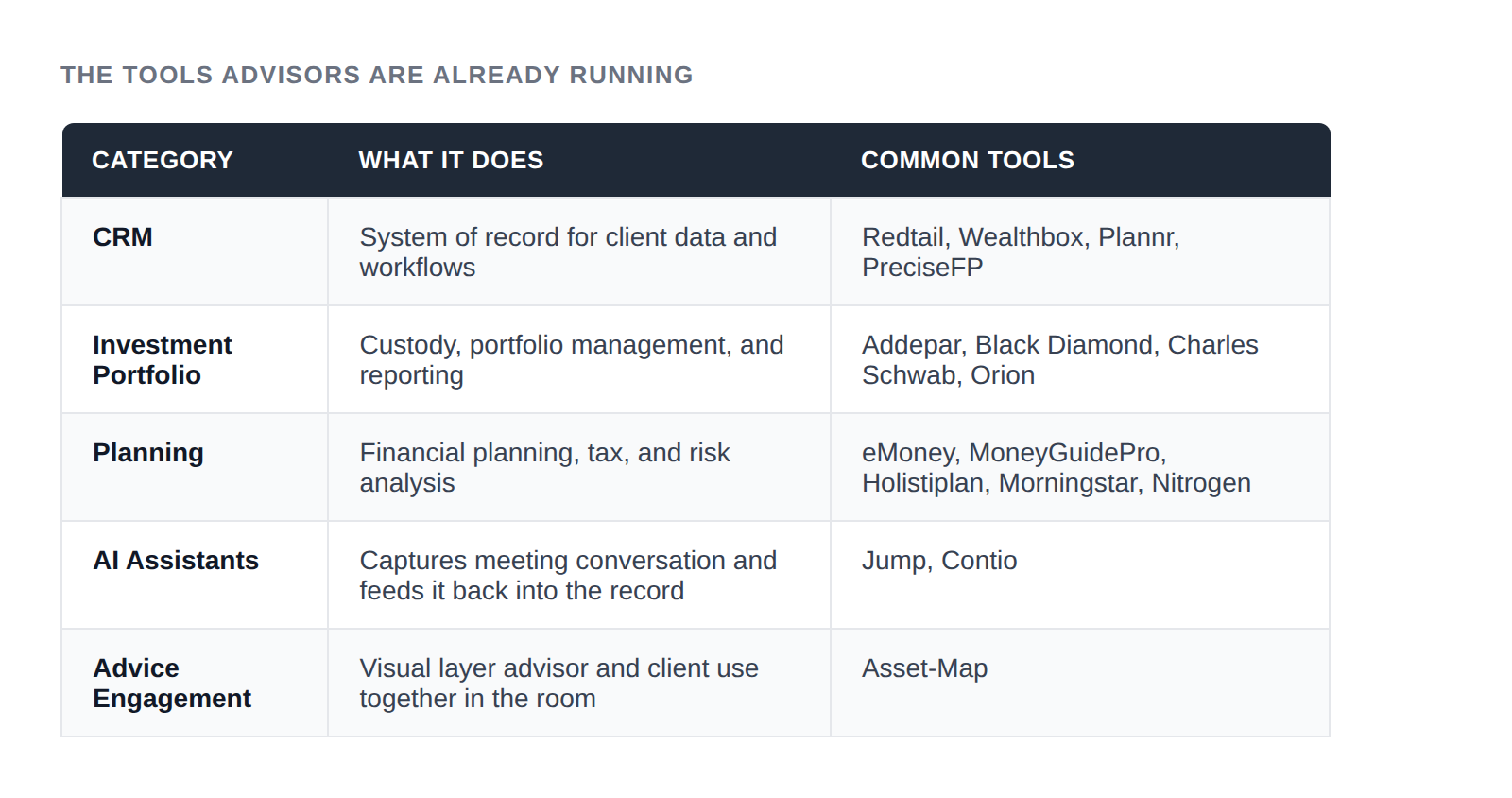
What's often missing is a layer that sits on top of all of it. Not another calculation engine, but a shared visual both advisor and client look at together, one that pulls the outputs of those specialized tools into a single page instead of leaving the client to piece it together from six different reports.
Where Financial Software Is Headed
Two things are true about where financial software is going. First, the number of point solutions in a typical firm's stack keeps growing, not shrinking, as tax, risk, and AI-driven tools each carve out their own category. Second, advisors are getting more selective about what they adopt voluntarily rather than what's mandated from the top down. Advisor-rated platforms on sites like G2 have become a real signal firms use in evaluating new tools, alongside their own trial periods and peer recommendations.
There's a deeper issue underneath the tool sprawl too. Most advisors didn't get into this business to become technologists, and for years the industry has quietly put that burden on them anyway, expecting each advisor to evaluate, install, and maintain an entire stack on top of actually advising clients. One of Asset-Map's earliest team members used to say that advisors who try to compete on technology alone will eventually get replaced by robo-advisors at a fraction of the cost, and I still think about that. Technology is table stakes now, not a differentiator. Clients expect a firm to have it. What they actually remember is whether they understood the conversation.
That selectiveness is worth paying attention to. A crowded stack without a way to bring it together just shifts the burden of translation onto the advisor in the room, which is the opposite of what all this technology was supposed to solve.
There's also a shift happening in how the industry names all of this. If you've looked at Michael Kitces's tech map lately, the one crowded with logos nobody can read without a magnifying glass, you've seen how many categories wealth management technology has split into. One of the newer ones is what I call advice engagement: tools that don't live in the back office but sit in the room with the client, turning a conversation into something the client can actually participate in. Financial planning software and analytics still matter, but they've always run in the back office. Advice engagement is the front office. It's the dining room, not the kitchen, and it's where I think firms need to be investing next.
Where Asset-Map Fits
Asset-Map was built to be that connecting layer. It sits alongside your CRM, your tax and risk tools, and your planning engines, not in place of them, aggregating a household's assets, liabilities, income, and insurance onto a single visual page. Advisors use it across every stage above, from the first Discovery intake through Signals risk triage, Target-Maps goal funding, and ongoing reviews through Client Portal. Asset-Map has been named the highest advisor-rated financial planning technology in the T3 Advisor Software Survey, and firms tell us the reason isn't another feature. It's that their clients finally see the whole picture in one place.
A coach once told me there's a trust formula behind every consultative sale. You have to prove to the client that you know them, you know their situation, and you know their options. That's still the test I hold Asset-Map to. Plenty of tools in your stack can gather the data. Whether the client walks away feeling like you actually know them is a different question, and it's the one advice engagement is built to answer.
The financial software stack isn't getting simpler. The firms that win the next decade won't be the ones with the most tools. They'll be the ones whose clients actually understand what all those tools add up to.

Founder and CEO of Asset-Map, focused on transforming financial planning conversations.